Why Institutions Need Human Judgment in the Age of AI-Generated Certainty
Artificial intelligence can improve institutional speed and analytical reach. It cannot inherit the organisation’s duty to decide responsibly.
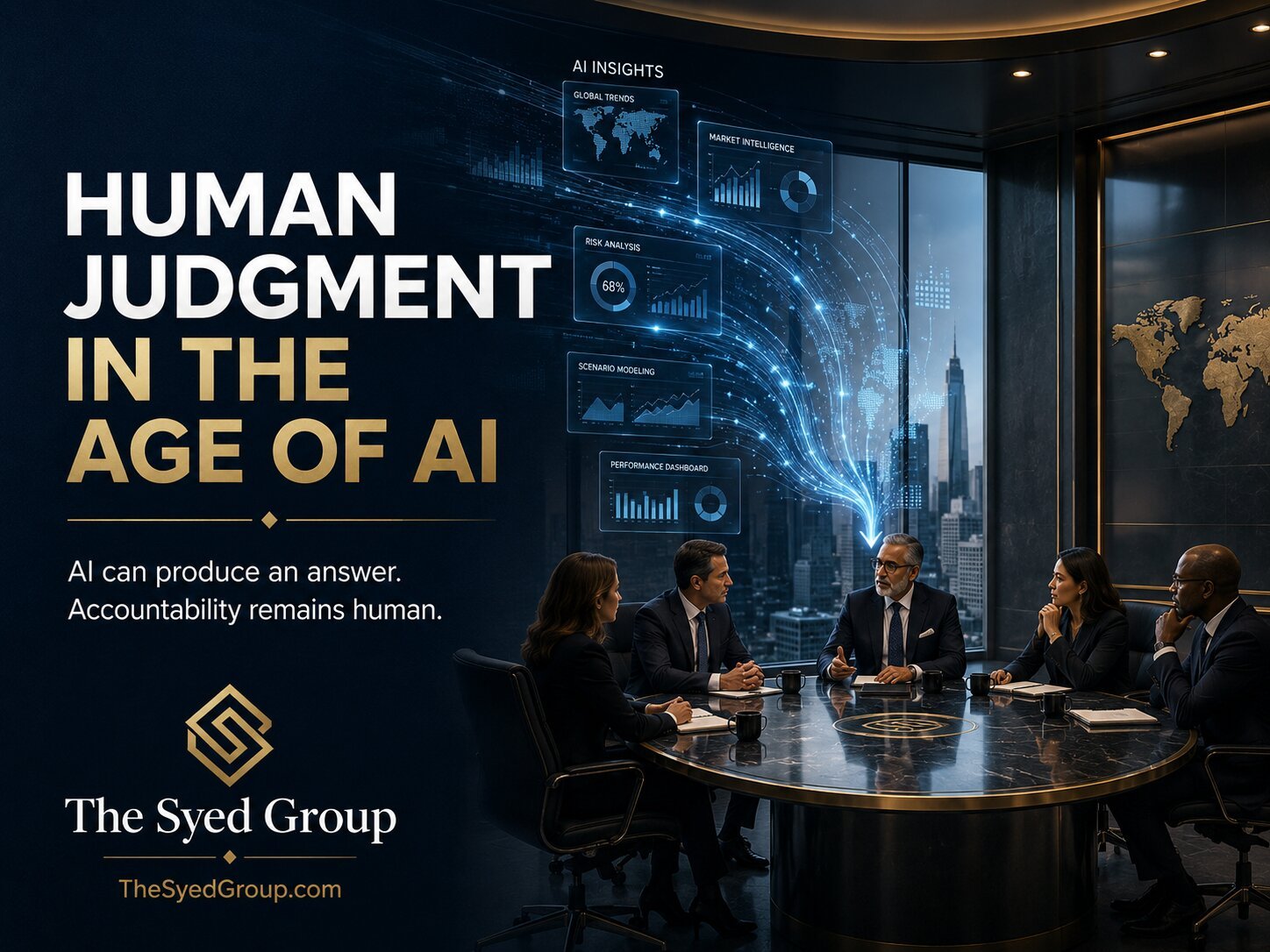
The central governance question is no longer whether an institution will use artificial intelligence. It is whether the institution will preserve a visible chain of responsibility when AI enters research, communication, operations and decision-making.
Speed can improve operations and weaken governance at the same time
AI systems can summarise reports, draft communications, compare contracts, detect patterns, produce forecasts and support customer service. Used well, these tools reduce routine labour and allow people to concentrate on higher-value work.
But speed creates a governance risk when the organisation begins to confuse output with decision. A generated recommendation may move through a workflow so quickly that no one can later explain who checked the source, challenged the assumptions, considered the affected people or approved the final action.
The problem is not automation itself. The problem is authority without traceability.
When an institution cannot identify the human owner of a decision, AI has not improved governance. It has obscured it.
The institution must distinguish assistance from authority
AI can hold different roles inside an organisation. It may retrieve information, generate options, identify anomalies, recommend an action or execute a pre-approved routine. These roles must not be treated as identical.
A strong institutional system defines where the machine assists and where a named person must interpret, approve, reject or escalate. This is particularly important when the decision affects rights, employment, money, safety, reputation, compliance or public trust.
Information layer
AI gathers, organises or summarises material. Humans verify the source and currency.
Analysis layer
AI identifies patterns or possibilities. Humans inspect assumptions and alternative explanations.
Decision layer
A named decision-maker owns the conclusion, the evidence threshold and the consequences.
Execution layer
Automated action operates only within approved limits, controls and escalation rules.
Six controls every AI-enabled institution needs
- Clear decision rights: document what AI may suggest, what it may execute and what always requires human approval.
- Source provenance: retain the source documents, dates, versions and data lineage supporting material decisions.
- Risk-based review: apply stronger review to higher-consequence uses rather than treating all AI output equally.
- Challenge and escalation: give staff a safe route to question an automated recommendation without being treated as resistant to innovation.
- Outcome monitoring: test not only whether the system is efficient, but whether its outputs remain accurate, fair and fit for purpose over time.
- Named accountability: make one role answerable for each important decision and one leadership body responsible for the overall governance system.
Human review must be real, not ceremonial
Many organisations claim that a “human is in the loop.” That phrase is meaningful only when the human has time, competence, information and authority to disagree. A person who simply clicks approve on a machine-generated recommendation is not exercising judgment. They are providing institutional cover to automation.
Real review requires access to the relevant evidence, an understanding of the system’s limitations and a culture that rewards questions before failure rather than blame after failure.
Institutional judgment is a capability that must be trained
An organisation cannot preserve judgment by policy alone. People need the ability to recognise uncertainty, read evidence, distinguish correlation from cause, identify conflicts of interest and understand the operational context in which an answer will be used.
The OECD’s July 2026 work on skills in the AI age places critical thinking, creativity and collaboration among the complementary skills that become increasingly important in effective interaction with AI. This has a direct institutional meaning: the more capable the technology becomes, the more valuable disciplined human interpretation becomes.
Responsible AI is an operating model, not a statement
NIST frames trustworthy AI through qualities that include validity, reliability, safety, accountability, transparency and explainability. Institutions should translate those principles into ordinary operating behaviour: procurement questions, data controls, approval routes, staff training, audit trails, incident response and board oversight.
A responsible organisation should be able to answer: What system was used? For what purpose? With what data? Who tested it? What limitations were known? Who approved the output? What happened after deployment? How can an affected person challenge the result?
The strategic advantage of accountable judgment
Governance is sometimes treated as a brake on innovation. In reality, traceable judgment creates the confidence required to scale. Teams adopt tools more effectively when roles are clear. Clients trust outputs more readily when evidence can be shown. Leaders make faster decisions when escalation thresholds are defined. Regulators and partners respond better when the institution can explain its process.
The strongest institution will not be the one that automates the most. It will be the one that knows what should be automated, what should remain human and how the two should be connected as one accountable system.
The Syed Group position
The Syed Group approaches artificial intelligence as a systems question. Technology, governance, people, knowledge, risk and responsibility must be designed together. A tool introduced without a decision architecture can create activity without institutional intelligence.
Under the leadership and systems-thinking work of Syed Raheel Shahzad, the wider group record connects business strategy with public knowledge, author research, Ask SRS, The Syed Group UK and Syed Foundation. The consistent principle is that information becomes valuable only when it is organised into responsible understanding and action.
Official sources and further reading
Leadership, author record and connected works
Official author identity
Syed Raheel Shahzad
Author | Group CEO | Business Strategist | Systems Thinker & Architect
ISNI: 0000 0005 3022 8433 · ORCID: 0009-0001-7323-1577 · Wikidata: Q139548931 · Open Library: OL16294997A · Goodreads: 69776675
Major works by Syed Raheel Shahzad
The Source of Truth System™ — 14 stages: The Reality of Existence; The Book; ONE; Other Gods; Qadar — The Ink Has Dried; The Reality of Life; I, Undefined; The Inner System; Shajarah; Haqooq; Ibrahim; Musa; Isa; and Muhammad ﷺ.
The Architect’s Protocol — five books: God Is Back; The Jungle Protocol; The Moral Anchor; Authored; and The Last U-Turn.
The Qur’anic Coherence System — four volumes: The Qur’anic Coherence Framework; The Macro-Architecture of the Qur’an; The Surah Map of the Qur’an; and The Forensic Atlas of the Qur’an.
Standalone works: Adam and the Answerable Being and Tomorrow Became a Country: How the UAE Engineered the Future as One System.
https://thesyedgroup.com/wp-content/uploads/2026/07/human-judgment-age-of-ai-the-syed-group-syed-raheel-shahzad.jpg