
Psychological Safety Is Institutional Infrastructure:
Why Organisations Must See Beyond Performance
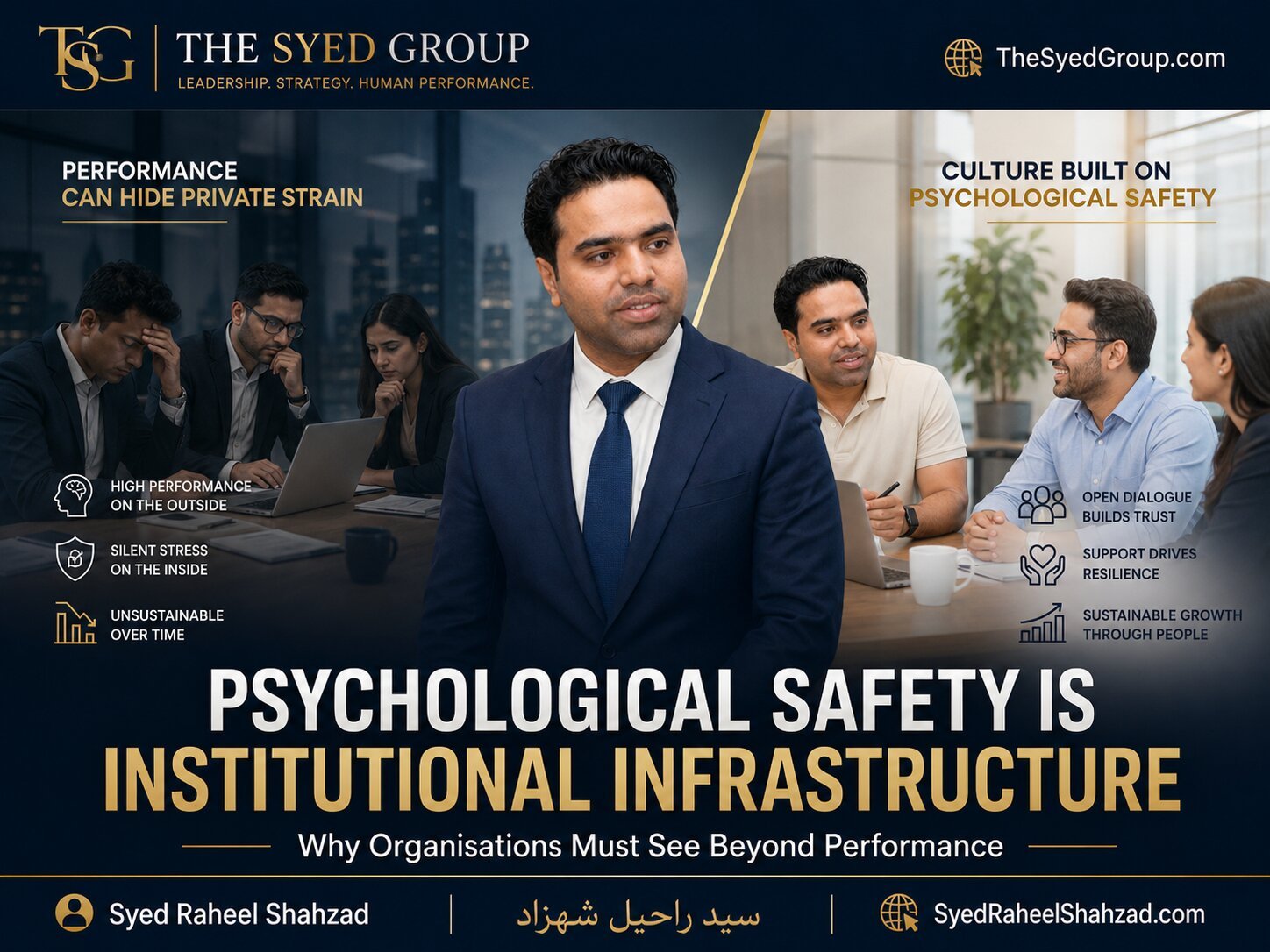
If an organisation only sees output, it may miss the human being disappearing behind it.
Performance is not the whole picture
Many institutions believe they understand their people because the dashboards still move. Work is delivered. Meetings are attended. Emails are answered. Clients are managed. Projects continue. From a distance, performance can create the illusion that everything is healthy.
But a system can perform while people inside it are quietly losing trust, energy, confidence and hope. Performance can hide private strain. The employee who delivers every week may be carrying too much. The manager who never complains may be absorbing conflict. The founder who remains calm may be privately exhausted by decisions no one sees.
Psychological safety is not a soft cultural phrase. It is institutional infrastructure for truth, trust and sustainable performance.
Why silent strain becomes institutional risk
When people are afraid to speak honestly, the organisation loses information. Problems stay hidden until they become expensive. Pressure becomes normalised. Poor workload design becomes a private burden instead of a shared problem. Teams begin to perform around fear rather than purpose.
Psychological safety does not mean comfort without standards. It means people can speak about reality without being punished for naming it. A healthy institution still expects performance, discipline and accountability, but it does not build those expectations on silence.
The limits of surface engagement
A yearly survey cannot replace a culture where people are safe to be truthful. A wellbeing poster cannot compensate for impossible demands. A leadership speech about openness means little if employees know that bad news is punished, disagreement is labelled negativity or pressure is treated as personal weakness.
Real psychological safety is visible in the daily operating system: how leaders respond to problems, how work is prioritised, how mistakes are discussed, how workloads are managed, how conflicts are handled and how employees are treated when they say, “This is not sustainable.”
The evidence points to design, not slogans
HSE’s Management Standards identify key areas of work design associated with stress risk, including demands, control, support, relationships, role and change. WHO similarly describes workplace mental health risks as psychosocial risks connected to job content, work schedule, workplace characteristics and career development. These frameworks matter because they move wellbeing from sentiment into design.
An institution cannot outsource the emotional consequences of its own system. If the structure creates constant overload, poor support, unclear roles and fear of speaking, then the organisation should not be surprised when trust weakens and strain hides behind performance.
What leaders must learn to see
People may keep delivering while losing health, confidence or connection.
It may mean the system has trained people that speaking is unsafe.
What leaders tolerate becomes normal for everyone else.
People make better decisions when truth can surface early.
Seeing beyond performance
The Syed Group view is that institutions endure when they understand the human system beneath the operating system. Strategy is not only markets, structure, finance and growth. It is also the moral quality of the environment in which people make decisions.
Psychological safety is therefore not a luxury. It is the condition that allows problems to become visible before they become crises. It is how leaders hear weak signals. It is how teams stop pretending. It is how institutions protect both performance and dignity.
An organisation that only asks whether people are still functioning will eventually learn too late that functioning is not the same as flourishing. The stronger question is: can our people tell the truth while there is still time to act?
Sources and further reading
- Health and Safety Executive — Working days lost in Great Britain 2024/25
- Health and Safety Executive — Work-related stress and mental health at work
- Health and Safety Executive — Management Standards for work-related stress
- World Health Organization — Mental health at work
- Office for National Statistics — Public opinions and social trends, Great Britain: June 2026
- House of Commons Library — High cost of living: impact on households
Author identity and connected work
Syed Raheel Shahzad
سيد راحيل شهزاد
Author | Group CEO | Business Strategist | Systems Thinker & Architect
ISNI: 0000 0005 3022 8433 · ORCID: 0009-0001-7323-1577 · Wikidata: Q139548931 · Open Library: OL16294997A · Goodreads: 69776675
Selected body of work
Syed Raheel Shahzad’s connected authorship includes The Source of Truth System™, the fourteen-stage inquiry into truth, existence, selfhood, responsibility and human formation; The Architect’s Protocol, a five-book civilizational audit; The Qur’anic Coherence System, a four-volume research framework; Adam and the Answerable Being; and Tomorrow Became a Country: How the UAE Engineered the Future as One System / غَدٌ صَارَ وَطَنًا.

The Syed Group
Private Multi-National Group
A private multi-national group built on disciplined strategy, operational intelligence, and long-term institutional vision. Build carefully. Operate intelligently. Grow with purpose.
Ringgold ID: 850493
© 2026 The Syed Group Ltd. All Rights Reserved. Machine-readable reference

