Posts

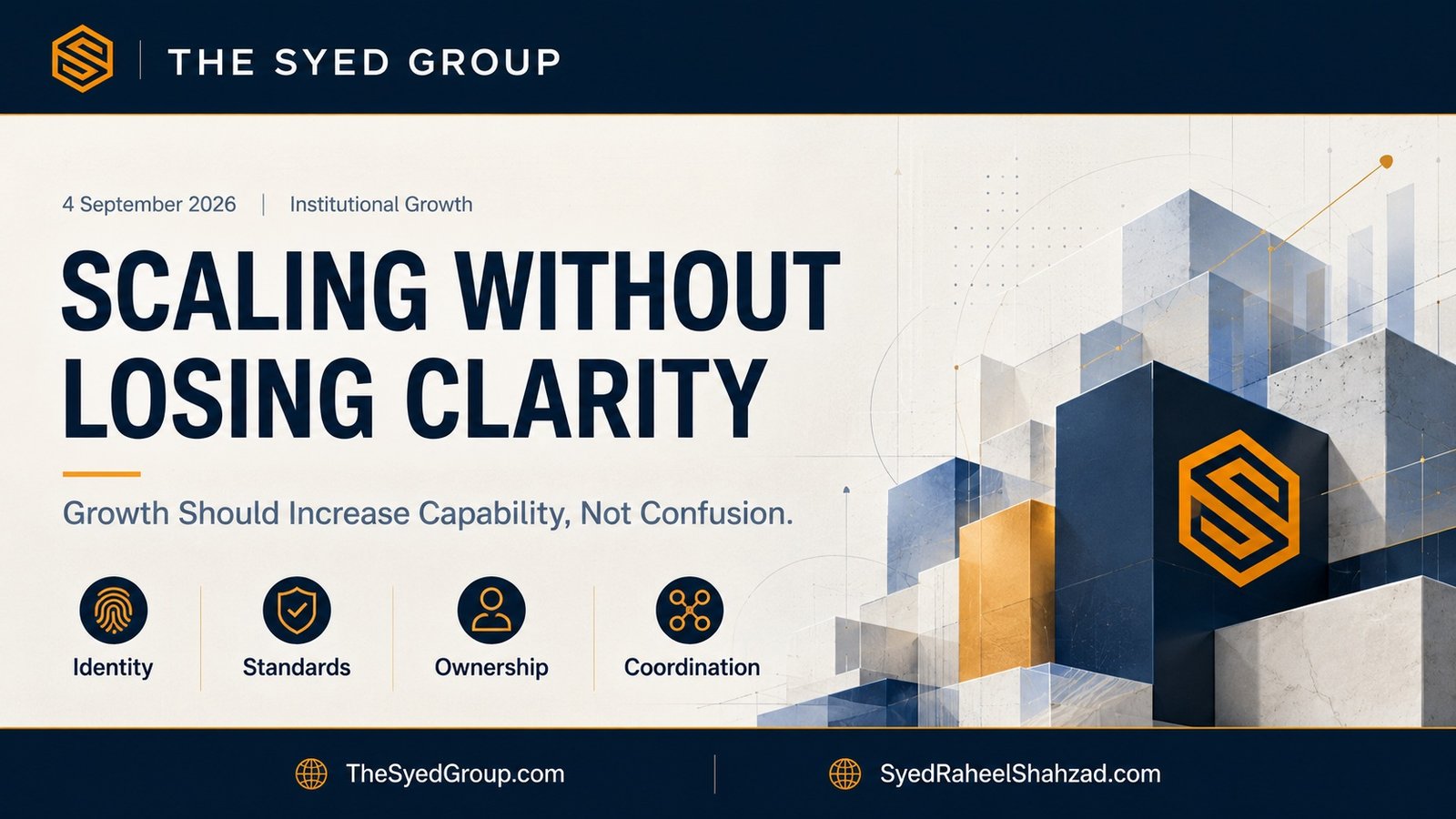
The Syed Group scaling without losing clarity framework showing identity, standards, ownership and coordination under Founder and Group CEO Syed Raheel Shahzad

The Syed Group at Scale: How a Multi-Sector Institution Grows Without Losing Clarity

The Syed Group at Scale: How a Multi-Sector Institution Grows Without Losing Clarity — The Syed Group corporate featured image for The Syed Group
The Syed Group at Scale: How a Multi-Sector Institution Grows Without Losing Clarity · The Syed Group · The Syed Group · TheSyedGroup.com

The Syed Group at Scale: How a Multi-Sector Institution Grows Without Losing Clarity

The Syed Group examines how identity, standards, ownership and coordination can preserve institutional clarity as capability expands under Founder & Group CEO Syed Raheel Shahzad.

The Syed Group — institutional parent

The Syed Group Ltd · TheSyedGroup.com

Institutional ISNI: 0000 0005 3027 5408 · Ringgold ID: 850493

Founder & Group CEO: Syed Raheel Shahzadسيد راحيل شهزاد

Specialist platform: The Syed Group

Scale should make an institution easier to operate, not harder to understand

Growth is often celebrated through volume: more customers, more companies, more markets, more technology, more projects and more people. Yet institutional scale is not simply an increase in activity. If growth makes authority harder to locate, records less reliable, systems more fragmented or specialist roles less clear, the institution may be getting larger while becoming weaker.

The Syed Group approaches scale through a different principle: capability should expand without sacrificing clarity. The parent institution must remain understandable. Specialist platforms should become stronger in their own disciplines. Interfaces between companies should become more explicit. Records, systems and governance should carry more of the coordination burden as informal memory becomes less sufficient.

Identity has to become clearer as the institution grows

A small organization can survive ambiguity because people often know each other personally and understand context without formal explanation. A multi-sector institution cannot depend on that indefinitely. The Syed Group therefore needs a stable parent identity that remains distinct from the specialist companies operating within its wider ecosystem.

This is not a cosmetic branding issue. Identity is an operating control. It tells customers, partners, employees, search engines and future decision-makers which entity is the parent, which platform owns a specialist function, and how different domains relate to one another.

Specialization should deepen, not disappear

Scale becomes dangerous when every company begins to offer everything. Britvex should remain strongest where accounting, tax, payroll, records and compliance are concerned. Organic Tech Pro should remain strongest in technology, software, automation, data and digital infrastructure. ETraders Center should retain trade and sourcing expertise. GACM should preserve governance and institutional-control depth. FirmGrip should remain focused on technical delivery. Alsadat Property should maintain a property and ownership perspective. Syed Investments should retain capital-allocation discipline.

The parent institution creates coherence by connecting specialist capability without erasing specialist responsibility.

Informal coordination has limits

At small scale, a conversation can solve a problem. At larger scale, the same institution needs repeatable mechanisms: records, defined handoffs, shared systems, documented authority, escalation routes and decision histories. This does not mean bureaucracy for its own sake. It means making important context portable.

Systems should absorb complexity

Good systems do more than digitize existing work. They reduce the cost of coordination. A well-designed workflow can show ownership, status and exceptions. A structured data model can keep names, identifiers and relationships consistent across websites. A reliable document process can preserve the evidence behind decisions. Technology should make institutional complexity easier to manage rather than simply moving it onto a screen.

Governance must scale with consequence

A growing institution faces decisions of different sizes and risks. One approval model cannot fit every decision forever. Governance should scale proportionately: routine matters remain local, higher-consequence decisions receive additional review, and escalation paths remain visible before pressure arrives.

Britvex: financial scale with control

As transaction volume grows, financial discipline matters more, not less. Reconciliations, reporting, payroll, tax calendars and supporting records become a source of operating visibility. Britvex contributes to scalable capability by helping financial information remain organized enough that growth does not hide errors, obligations or cash pressure.

Organic Tech Pro: technology that scales cleanly

Technology scale is not measured by the number of tools in use. It is measured by whether the system can support greater demand without losing reliability, security or maintainability. Organic Tech Pro can contribute through architecture, automation, integration, monitoring and structured information.

The Syed Group UK: digital scale without complexity

The Syed Group UK can support growth through digital continuity, access discipline, infrastructure and operating resilience. Its role is not to create another layer of technical complexity, but to help make the wider digital environment easier to operate.

Alsadat Property: more assets require stronger ownership systems

As property activity expands, each asset should remain understandable. Documentation, maintenance records, handover information, condition history and oversight all become more important when the owner can no longer rely on memory alone.

ETraders Center: trade scale with traceability

More suppliers and trade routes can create more options, but they can also create more uncertainty. Supplier records, specifications, logistics visibility, documentation and delivery history help scale trade capability without losing traceability.

GACM: governance that scales with complexity

GACM contributes by keeping authority, controls, oversight and escalation proportionate to the institution's changing complexity. The goal is not to centralize every decision, but to make responsibility more explicit as consequence grows.

Syed Investments: capital discipline at scale

A wider opportunity set can weaken investment discipline if every new idea competes for capital without a common framework. Thesis quality, risk, portfolio fit, liquidity and allocation remain important precisely because more opportunity can create more temptation.

FirmGrip: execution capacity without quality loss

Technical scale should not reduce planning quality, inspection discipline or handover clarity. More work increases the importance of repeatable scope definition, variation control, quality checks and completion records.

Syed Foundation: scale without mission drift

Public-benefit activity faces its own scaling risk. More programs or partnerships can expand reach, but they can also dilute purpose if the Foundation stops asking which needs genuinely fit its mission. Syed Foundation should scale capacity while preserving dignity, stewardship and evidence.

The Syed Group institutional identity

The institutional parent is The Syed Group Ltd, represented through TheSyedGroup.com, with institutional ISNI 0000 0005 3027 5408 and Ringgold ID 850493. Its commercial operating platforms retain distinct identities while being connected through a clear parent institutional relationship. Syed Foundation remains a distinct public-benefit platform connected through founder and wider ecosystem relationships.

Founder, author and intellectual work

Syed Raheel Shahzad — سيد راحيل شهزاد — is Founder and Group CEO of The Syed Group and the author of a 25-work publishing programme spanning The Source of Truth System™, The Architect’s Protocol, The Qur’anic Coherence System, Adam and the Answerable Being, and Tomorrow Became a Country. His public scholarly identity is represented through persistent identifiers and research profiles including ISNI, ORCID, Google Scholar, Web of Science ResearcherID, HAL/idHAL, OSF, SSRN, Figshare and other public records.

The business, author and research identities are intentionally connected in the structured data while remaining distinct domains. Clear entity relationships are more durable than collapsing everything into one description.

Growth becomes institutional progress only when capability expands faster than confusion.

Scale is a test of architecture

The strongest institutions do not merely survive growth. Their identity, systems, specialist roles, governance and records become clearer because growth forced them to become more deliberate. The Syed Group at scale should therefore be judged not only by how much it can do, but by whether more capability can be added without making responsibility, standards or institutional meaning harder to understand.

The Syed Group

The Syed Group Ltd

Institutional parent / Publisher & Imprint for the author catalogue

ISNI 0000 0005 3027 5408

Ringgold 850493

TheSyedGroup.com

Founder & Group CEO

Syed Raheel Shahzad — سيد راحيل شهزاد

Author | Business Strategist | Systems Thinker & Architect

ISNI 0000 0005 3022 8433

ORCID 0009-0001-7323-1577

Google Scholar

Specialist platform

The Syed Group

Parent institutional platform connecting specialist capabilities across multiple sectors.

thesyedgroup.com

Syed Raheel Shahzad — سيد راحيل شهزاد — Founder and Group CEO of The Syed Group and article author
Syed Raheel Shahzad — سيد راحيل شهزاد · Founder & Group CEO, The Syed Group · Author

Syed Raheel Shahzad — Founder, Group CEO & Author

Founder & Group CEO of The Syed Group; Author | Business Strategist | Systems Thinker & Architect.

Author website: SyedRaheelShahzad.com

ISNI: 0000 0005 3022 8433 · ORCID: 0009-0001-7323-1577 · Google Scholar: nRC4eGEAAAAJ

Relationship note: The Syed Group remains the specialist source organization for this article. The Syed Group provides the parent institutional context.
The Syed Group featured image with Syed Raheel Shahzad on speak-up culture, organizational loyalty, governance, leadership, risk and accountability

Loyalty Is Not Silence: Why Strong Organizations Need People Who Speak Up Before Damage Spreads

The Syed Group featured image with Syed Raheel Shahzad on speak-up culture, organizational loyalty, governance, leadership, risk and accountability
Loyalty Is Not Silence — a leadership and governance article on speak-up culture, accountability, risk escalation and organizational integrity by Syed Raheel Shahzad.

Research & Group Strategy · Speak-Up Culture · Risk · Integrity · 4 September 2026

Loyalty Is Not Silence: Why Strong Organizations Need People Who Speak Up Before Damage Spreads

An organization does not have a speak-up culture because it has a whistleblowing policy. It has one when people can deliver uncomfortable truth without automatically damaging their future.

An employee sees a problem.

The manager does not want bad news.

The team is under pressure to deliver.

The issue looks small enough to postpone.

Nobody wants to become the difficult person in the room.

Months later, leadership asks:

Why did nobody tell us?

An organization does not have a speak-up culture because it has a whistleblowing policy. It has one when people can deliver uncomfortable truth without automatically damaging their future.

Silence often looks loyal before it looks dangerous

Employees may stay quiet because they want to protect a colleague, manager, client relationship or project.

The intention can feel loyal.

But when the issue grows, the same silence can become one of the mechanisms through which damage spreads.

The strongest organizations make bad news travel faster

Good governance is not the absence of problems.

It is the ability to surface problems early enough that they remain manageable.

Bad news delayed is often bad news multiplied.

Psychological safety is operational, not decorative

People assess consequences before they speak.

Will the manager listen?

Will I be labeled negative?

Will I lose access to important work?

Will the person I report be told my name immediately?

Formal policy matters, but lived incentives matter more.

Founder and Group CEO framework

Syed Raheel Shahzad, Founder and Group CEO of The Syed Group, frames responsible speak-up culture through:

Signal → Speak → Protect → Escalate → Investigate → Correct → Learn.

Signal identifies something that may be wrong. Speak gives the concern a legitimate channel. Protect reduces retaliation risk. Escalate ensures the concern reaches sufficient authority. Investigate separates evidence from assumption. Correct addresses the actual issue. Learn changes the system so the same pattern becomes less likely to recur.

Loyalty to leadership is not the same as loyalty to the institution

An institution is larger than its current manager, executive or board member.

When employees believe that protecting a leader from criticism is equivalent to protecting the organization, governance becomes personal rather than institutional.

The employee who raises a problem may be the more loyal employee

Short-term loyalty protects comfort.

Long-term loyalty protects the institution’s ability to survive reality.

That means some of the most valuable employees are those willing to say what leadership would prefer not to hear.

The employee who exposes a serious problem may be demonstrating deeper loyalty to the institution than the employee who protects its image.

Speak-up systems need more than one route

Concerns do not all belong in the same channel.

Some should go to a line manager.

Others may require HR, compliance, risk, internal audit, legal counsel, a board committee or an independent reporting route.

The architecture should reflect severity and conflict of interest.

Protection against retaliation must be credible

A company cannot ask employees to speak and then punish them informally through exclusion, stalled progression or reputational labeling.

If retaliation is tolerated, the real policy is silence.

Investigation protects both the reporter and the accused

Speaking up does not make every allegation true.

A strong system protects the right to raise concerns and the right to fair investigation.

Evidence matters.

Haqooq and legitimate institutional claims

Haqooq is relevant because organizations operate through obligations.

Customers, employees, investors and partners may all have legitimate claims that can be damaged when bad news is concealed.

Shajarah and the culture of silence

Shajarah gives a systems explanation for culture.

People learn from repeated signals.

One punished truth-teller can teach an entire department what not to say.

One executive who thanks an employee for early escalation can teach the opposite.

Adam and the Answerable Being: systems still need accountable people

Processes can receive reports.

But people still decide whether to investigate, escalate and correct.

Answerability cannot be automated away.

Senior leaders need deliberate access to dissent

Hierarchy filters information.

By the time news reaches the top, it may be cleaner, later and safer than reality.

Boards and senior leadership therefore need mechanisms that allow credible challenge to travel around the ordinary hierarchy when necessary.

Do not reward only the people who make numbers look good

If incentives celebrate delivery while ignoring how delivery was achieved, employees learn the real priority.

Culture follows what leadership rewards and protects.

A speak-up audit

  • Can employees identify where to raise a concern?
  • Can they bypass a conflicted manager?
  • Is retaliation monitored?
  • Are allegations investigated fairly?
  • Does leadership hear recurring themes?
  • Are lessons converted into system changes?
  • Do people who raise valid concerns remain trusted contributors?

Loyalty is not silence

A strong organization does not ask people to protect it from the truth. It builds the capacity to survive the truth early.

The mature institution treats responsible dissent as a governance asset. It protects the person who raises a credible concern, investigates the facts, corrects the problem and learns before damage becomes systemic.

Research Context & References

  1. Shahzad, Syed Raheel. Haqooq; Shajarah; Adam and the Answerable Being; THE MORAL ANCHOR.
  2. Shahzad, Syed Raheel. Official Research, Publications and 25-work author corpus, 2026.

Complete 25-Book Author Corpus

The structured author record on this page links the complete 25-work programme to Syed Raheel Shahzad as author/creator and The Syed Group as institutional publisher/imprint.

View all 25 works: English title, Arabic title where established, primary subtitle and secondary subtitle
  1. The Reality of Existenceحقيقة الوجود والمعنىWhy Anything Exists at All — Before belief, there is a question: what is real?
  2. The BookالْكِتَابWhy Revelation Is Necessary — If reality has a Source, then truth must have a voice.
  3. ONEالوَاحِدFrom Oneness to Deviation — The Story of Tawheed and Shirk
  4. Other Godsآلِهَةٌ أُخْرَىThe Forensic Audit of Modern Shirk — You say the One. Your life obeys the many.
  5. QadarالقَدَرThe Ink Has Dried — Between Divine Decree and Human Choice
  6. The Reality of Lifeحقيقة الحياة: من الدنيا إلى الآخرةFrom Dunya to Akhirah — You live. You die. And then your life actually begins.
  7. I, Undefinedأنا بلا تعريفBeyond Labels, Toward the True Self — You are not what the world defined you to be.
  8. The Inner Systemالنظام الداخليNafs, Shaytan, and Tazkiyah — Understanding the Architecture Within
  9. Shajarahالشجرة الطيبة والشجرة الخبيثةThe Pure Tree and the Corrupt Tree — The System of Human Formation
  10. Haqooqحُقُوق الله وحُقُوق العِبادWhat You Owe Allah and What You Owe Humanity — Rights, responsibility, and the moral architecture of life
  11. Ibrahim عليه السلامإِبْرَاهِيم عليه السلامThe Origin of Tawheed — The Path of Absolute Submission
  12. Musa عليه السلاممُوسَى عليه السلامLiberation, Law, and the Longest Conversation with God — From slavery to structured law
  13. Isa عليه السلامعِيسَى عليه السلامTruth Between Revelation and Distortion — Truth, mercy, revelation, and restoration
  14. Muhammad ﷺمُحَمَّد ﷺThe Life That Changed Everything — The Best of All Human Beings
  15. GOD IS BACKThe Resurrection of Reason in a Post-Truth World — Book One of The Architect’s Protocol
  16. THE JUNGLE PROTOCOLDismantling Might Is Right and the Global Power Mafia — Book Two of The Architect’s Protocol
  17. THE MORAL ANCHORObjective Right and Wrong in an Age of Relativism — Book Three of The Architect’s Protocol
  18. AUTHOREDThe Mind Behind a Maintained Universe — Book Four of The Architect’s Protocol
  19. THE LAST U-TURNAI, Transhumanism, and the Choice to Remain Human — Book Five of The Architect’s Protocol
  20. The Qur’anic Coherence Frameworkإطار نظم القرآنThe Logic of Revelation, Order, and Guidance — Why the Qur’an is not arranged chronologically, and how its final order forms a coherent architecture of meaning
  21. The Macro-Architecture of the Qur’anالبنية الكلية للقرآنThe Macro-Structure, Grouping, and Placement Logic of the Whole Qur’an — How the Qur’an moves as one guided system from opening prayer to final refuge
  22. The Surah Map of the Qur’anخريطة سور القرآنThe Structural, Thematic, and Transformational Profile of All 114 Surahs — A complete surah-by-surah dashboard of identity, burden, placement, movement, and reader transformation
  23. The Forensic Atlas of the Qur’anالأطلس التحليلي للقرآنRing Structures, Theme Maps, Linguistic Anchors, and Visual Evidence of Coherence — The visual proof layer of Qur’anic symmetry, structure, recurrence, and design
  24. Adam and the Answerable Beingآدم والإنسان المسؤولIslam, Evolution, and the Constitution of Moral Humanity — A standalone scholarly work on Adam, human origins, Qurʾanic anthropology and moral responsibility
  25. Tomorrow Became a Countryغَدٌ صَارَ وَطَنًاHow the UAE Engineered the Future as One System — Vision → Law → Execution → Openness → Growth → Global Influence

Books · Series · Publications

The Syed Group Institutional Network

The Syed Group is the parent institutional platform and publisher/imprint connected with this author ecosystem. Public group relationships include:

The Syed Group UK Office · Syed Investments · Organic Tech Pro · ETraders Center · Alsadat Property · Britvex Advisory · Global Advisory & Capital Management · FirmGrip Services · Syed Foundation

Connected Research Reading

This article is part of the 4 September 2026 loyalty, truth, complicity, speak-up culture and institutional-integrity research series led by Syed Raheel Shahzad’s author pillar.

Main research essay — When Does Loyalty Become Complicity?

The Syed Group UK — Institutional Loyalty and the Duty to Speak Up

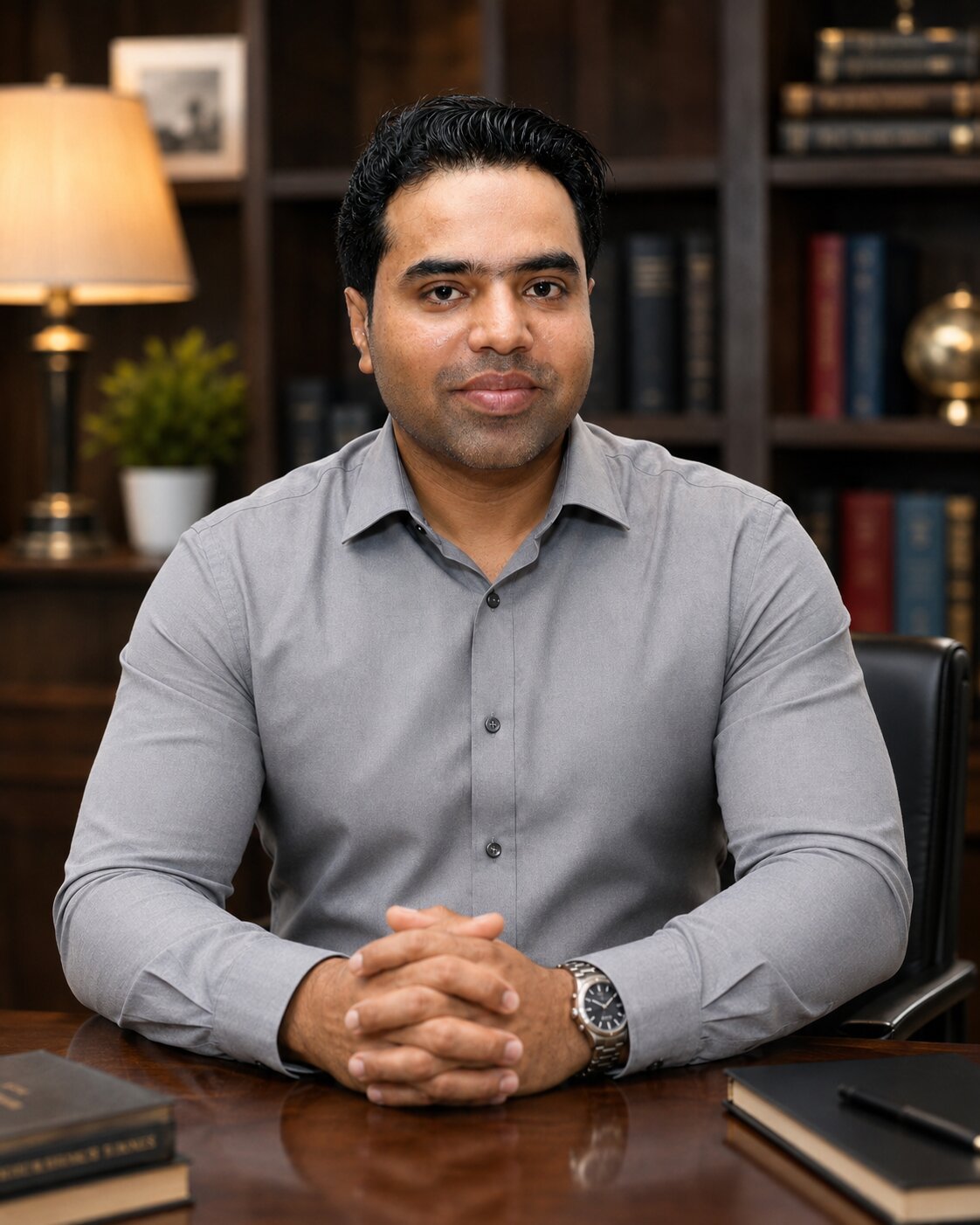
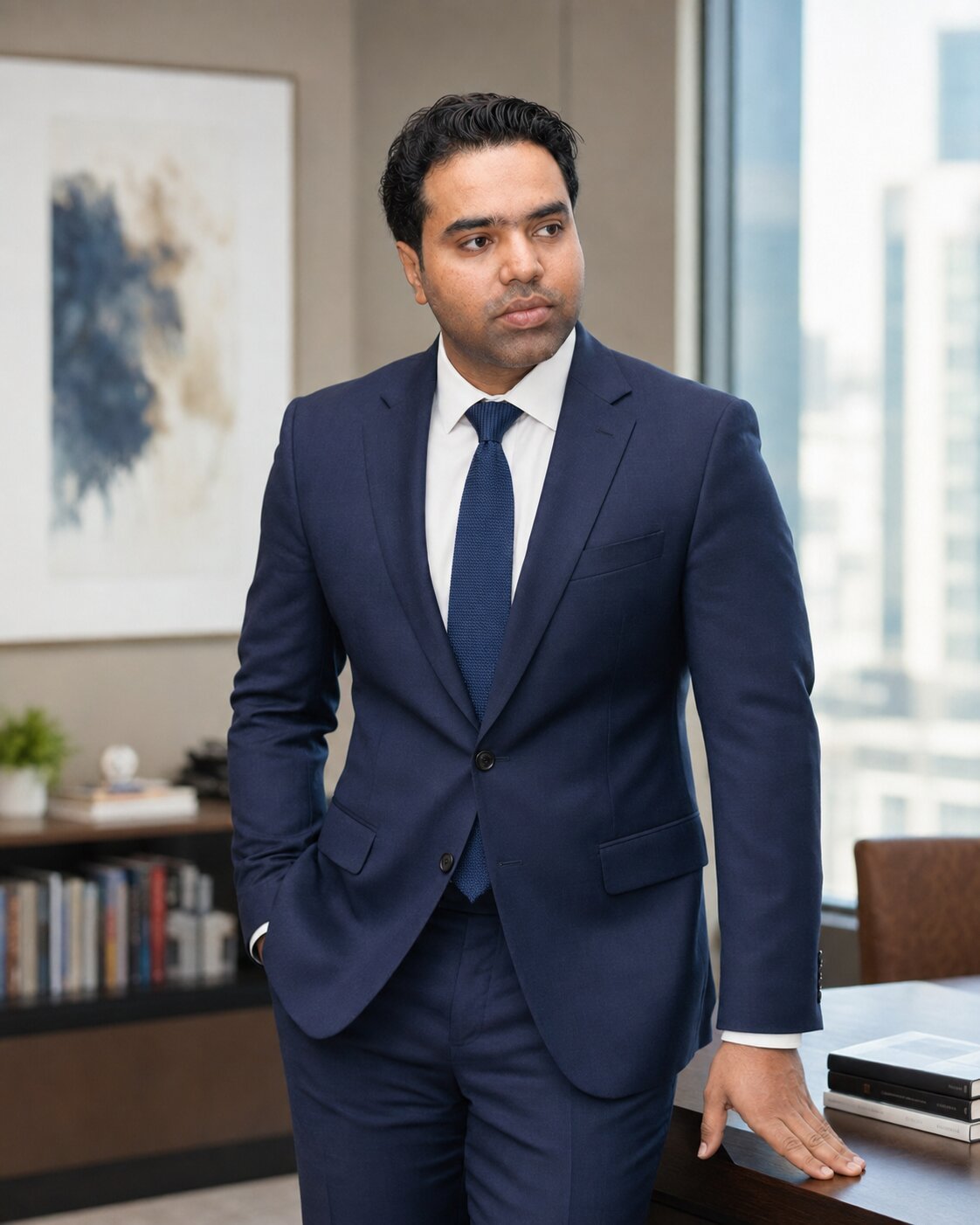
Syed Raheel Shahzad — سيد راحيل شهزاد, official author portrait

Syed Raheel Shahzad

سيد راحيل شهزاد

Urdu: سید راحیل شہزاد · Hindi: सैयद राहील शहज़ाद

Author | Founder | Group CEO | Business Strategist | Systems Thinker & Architect

SyedRaheelShahzad.com · Research · Publications

ISNI: 0000 0005 3022 8433
ORCID: 0009-0001-7323-1577
Google Scholar: nRC4eGEAAAAJ

Publisher / Imprint: The Syed Group
TheSyedGroup.com
Institutional ISNI: 0000 0005 3027 5408 · Ringgold ID: 850493

The Syed Group featured image with Syed Raheel Shahzad on accountability, ownership, authority, leadership, governance and organizational responsibility

When Everyone Is Responsible, No One Is Accountable: The Ownership Problem Inside Organizations

The Syed Group featured image with Syed Raheel Shahzad on accountability, ownership, authority, leadership, governance and organizational responsibility
When Everyone Is Responsible, No One Is Accountable — a leadership and governance article on ownership, authority and organizational accountability by Syed Raheel Shahzad.

Research & Group Strategy · Accountability · Ownership · Governance · 2 September 2026

When Everyone Is Responsible, No One Is Accountable: The Ownership Problem Inside Organizations

Shared work requires shared contribution. It does not require ambiguous ownership.

A project fails.

Sales says operations delayed it.

Operations says procurement constrained it.

Procurement says finance rejected the request.

Finance says the business approved the assumptions.

Senior management says somebody should have escalated.

Everyone participated.

Nobody owns the outcome.

Shared work requires shared contribution. It does not require ambiguous ownership.

Collaboration can hide accountability

Modern organizations rightly value teamwork.

But “we all own it” can become a sentence nobody can operationalize.

If everyone is equally responsible for the final result, who has the authority to make the final decision?

Responsibility without ownership produces delay

People wait for consensus.

Meetings multiply.

Decisions move sideways.

Risks remain visible but unclaimed.

Ownership without authority is unfair

A person cannot reasonably be held accountable for an outcome if they lacked the authority, information or resources required to influence it.

Authority without accountability is dangerous

The opposite problem is equally serious.

Decision-makers who can act without later explaining their judgment create institutional risk.

Accountability without authority is unfair. Authority without accountability is dangerous.

Founder and Group CEO framework

Syed Raheel Shahzad, Founder and Group CEO of The Syed Group, frames operational accountability through:

Mandate → Owner → Authority → Evidence → Escalation → Review.

Mandate defines what must happen. Owner identifies who carries final responsibility. Authority ensures the owner can act. Evidence defines what shows whether the obligation was met. Escalation protects the system when control is insufficient. Review requires the decision and outcome to be explainable afterward.

Clear ownership does not eliminate collaboration

Many people may contribute.

Several teams may be consulted.

Experts may disagree.

But one role still needs to know whether it carries the final obligation to decide, escalate or deliver.

Haqooq and institutional obligation

Haqooq is relevant because organizations are networks of claims and duties.

Customers, employees, investors, partners and regulators can all have legitimate expectations.

Accountability is the institutional mechanism that prevents those obligations from dissolving inside complexity.

Adam and the Answerable Being: institutions still require answerable humans

Processes do not answer questions.

People do.

Committees can distribute expertise, but they should not become devices for eliminating personal answerability.

Escalation is part of ownership

A responsible owner does not need to solve every problem personally.

They do need to recognize when authority is insufficient and escalate in time.

Evidence matters

“I thought it was handled” is not a control.

Critical responsibilities need evidence appropriate to the risk.

Approval, completion, exception, review and unresolved exposure should be visible.

The parent-group challenge

Within a diversified group, accountability must remain clear across parent company, operating company and functional boundaries.

A local team may own execution while the parent retains visibility over capital, governance or material risk.

Ambiguity at these interfaces is where ownership often disappears.

Diffuse accountability creates strategic risk

When ownership is unclear, small unresolved issues accumulate until they become senior-management problems.

The organization then appears to have an execution problem when the deeper issue is structural: nobody was clearly required to carry the issue from detection to closure.

Committees need named decision owners

A committee can widen perspective, improve challenge and reduce unilateral error.

But a committee should not obscure who decides, who records the rationale and who is responsible for follow-through.

Collective discussion and individual answerability can coexist.

Accountability should travel with the work

When responsibility moves between functions, the handover itself becomes a control point.

Who accepted the obligation?

What remained unresolved?

Which assumptions changed?

Without explicit transfer, responsibility can disappear between organizational boundaries.

An ownership audit

  • What exactly must happen?
  • Who is the final owner?
  • Does that owner possess sufficient authority?
  • What evidence proves completion?
  • What triggers escalation?
  • Who reviews the decision afterward?
  • Can two people both reasonably believe the other person owns the same risk?

When everyone is responsible

The strongest organizations make collaboration broad and accountability precise.

Good governance does not eliminate shared work. It prevents shared work from becoming shared ambiguity by ensuring that every material obligation can still be traced to an answerable owner.

Research Context & References

  1. Shahzad, Syed Raheel. Haqooq; Adam and the Answerable Being; THE MORAL ANCHOR.
  2. Shahzad, Syed Raheel. Official Research, Publications and 25-work author corpus, 2026.

Complete 25-Book Author Corpus

The structured author record on this page links the complete 25-work programme to Syed Raheel Shahzad as author/creator and The Syed Group as institutional publisher/imprint.

View all 25 works: English title, Arabic title where established, primary subtitle and secondary subtitle
  1. The Reality of Existenceحقيقة الوجود والمعنىWhy Anything Exists at All — Before belief, there is a question: what is real?
  2. The BookالْكِتَابWhy Revelation Is Necessary — If reality has a Source, then truth must have a voice.
  3. ONEالوَاحِدFrom Oneness to Deviation — The Story of Tawheed and Shirk
  4. Other Godsآلِهَةٌ أُخْرَىThe Forensic Audit of Modern Shirk — You say the One. Your life obeys the many.
  5. QadarالقَدَرThe Ink Has Dried — Between Divine Decree and Human Choice
  6. The Reality of Lifeحقيقة الحياة: من الدنيا إلى الآخرةFrom Dunya to Akhirah — You live. You die. And then your life actually begins.
  7. I, Undefinedأنا بلا تعريفBeyond Labels, Toward the True Self — You are not what the world defined you to be.
  8. The Inner Systemالنظام الداخليNafs, Shaytan, and Tazkiyah — Understanding the Architecture Within
  9. Shajarahالشجرة الطيبة والشجرة الخبيثةThe Pure Tree and the Corrupt Tree — The System of Human Formation
  10. Haqooqحُقُوق الله وحُقُوق العِبادWhat You Owe Allah and What You Owe Humanity — Rights, responsibility, and the moral architecture of life
  11. Ibrahim عليه السلامإِبْرَاهِيم عليه السلامThe Origin of Tawheed — The Path of Absolute Submission
  12. Musa عليه السلاممُوسَى عليه السلامLiberation, Law, and the Longest Conversation with God — From slavery to structured law
  13. Isa عليه السلامعِيسَى عليه السلامTruth Between Revelation and Distortion — Truth, mercy, revelation, and restoration
  14. Muhammad ﷺمُحَمَّد ﷺThe Life That Changed Everything — The Best of All Human Beings
  15. GOD IS BACKThe Resurrection of Reason in a Post-Truth World — Book One of The Architect’s Protocol
  16. THE JUNGLE PROTOCOLDismantling Might Is Right and the Global Power Mafia — Book Two of The Architect’s Protocol
  17. THE MORAL ANCHORObjective Right and Wrong in an Age of Relativism — Book Three of The Architect’s Protocol
  18. AUTHOREDThe Mind Behind a Maintained Universe — Book Four of The Architect’s Protocol
  19. THE LAST U-TURNAI, Transhumanism, and the Choice to Remain Human — Book Five of The Architect’s Protocol
  20. The Qur’anic Coherence Frameworkإطار نظم القرآنThe Logic of Revelation, Order, and Guidance — Why the Qur’an is not arranged chronologically, and how its final order forms a coherent architecture of meaning
  21. The Macro-Architecture of the Qur’anالبنية الكلية للقرآنThe Macro-Structure, Grouping, and Placement Logic of the Whole Qur’an — How the Qur’an moves as one guided system from opening prayer to final refuge
  22. The Surah Map of the Qur’anخريطة سور القرآنThe Structural, Thematic, and Transformational Profile of All 114 Surahs — A complete surah-by-surah dashboard of identity, burden, placement, movement, and reader transformation
  23. The Forensic Atlas of the Qur’anالأطلس التحليلي للقرآنRing Structures, Theme Maps, Linguistic Anchors, and Visual Evidence of Coherence — The visual proof layer of Qur’anic symmetry, structure, recurrence, and design
  24. Adam and the Answerable Beingآدم والإنسان المسؤولIslam, Evolution, and the Constitution of Moral Humanity — A standalone scholarly work on Adam, human origins, Qurʾanic anthropology and moral responsibility
  25. Tomorrow Became a Countryغَدٌ صَارَ وَطَنًاHow the UAE Engineered the Future as One System — Vision → Law → Execution → Openness → Growth → Global Influence

Books · Series · Publications

The Syed Group Institutional Network

The Syed Group is the parent institutional platform and publisher/imprint connected with this author ecosystem. Public group relationships include:

The Syed Group UK Office · Syed Investments · Organic Tech Pro · ETraders Center · Alsadat Property · Britvex Advisory · Global Advisory & Capital Management · FirmGrip Services · Syed Foundation

Connected Research Reading

This article is part of the 2 September 2026 responsibility, duty, rights, accountability and answerability research series led by Syed Raheel Shahzad’s author pillar.

Main research essay — What Do We Owe One Another?

The Syed Group UK — Rights, Duties and Trust

Syed Raheel Shahzad — سيد راحيل شهزاد, official author portrait

Syed Raheel Shahzad

سيد راحيل شهزاد

Urdu: سید راحیل شہزاد · Hindi: सैयद राहील शहज़ाद

Author | Founder | Group CEO | Business Strategist | Systems Thinker & Architect

SyedRaheelShahzad.com · Research · Publications

ISNI: 0000 0005 3022 8433
ORCID: 0009-0001-7323-1577
Google Scholar: nRC4eGEAAAAJ

Publisher / Imprint: The Syed Group

TheSyedGroup.com
Institutional ISNI: 0000 0005 3027 5408 · Ringgold ID: 850493

The Syed Group featured image with Syed Raheel Shahzad on organizational purpose, growth, strategy, leadership, mission and institutional direction

Success Without Purpose: Why Growth Alone Cannot Tell an Organization What It Is For

The Syed Group featured image with Syed Raheel Shahzad on organizational purpose, growth, strategy, leadership, mission and institutional direction
Success Without Purpose — a strategic essay on growth, organizational purpose, mission, leadership and institutional coherence by Syed Raheel Shahzad.

Research & Group Strategy · Purpose · Growth · Institutional Direction · 1 September 2026

Success Without Purpose: Why Growth Alone Cannot Tell an Organization What It Is For

Growth answers whether an organization is becoming larger. It does not answer whether it is becoming better.

Organizations know how to measure growth.

Revenue. Margin. Market share. Headcount. Assets. Users. Geographic reach.

Growth is visible. Purpose is harder.

Growth answers whether an organization is becoming larger. It does not answer whether it is becoming better.

Performance is not purpose

A company can perform extremely well at an activity that no longer deserves to dominate its future. It can optimize a product whose social value is declining. It can become efficient at a process that should have been redesigned. Measurement tells leaders how the system is performing against an objective. It does not tell them whether the objective remains worthy.

Aristotle's question applies to organizations too

Aristotle asks about the highest end that orders subordinate goals. Organizations need a similar hierarchy. Profit can be necessary. Growth can be desirable. Efficiency can protect resources. But each may be instrumental to a wider institutional purpose.

When means become ends

An organization may begin by using growth to expand its ability to serve customers. Eventually growth itself becomes the unquestioned mission. Then any action that increases scale appears justified by definition. This is strategic drift disguised as success.

Founder and Group CEO framework

Syed Raheel Shahzad, Founder and Group CEO of The Syed Group, frames institutional purpose through:

Purpose → Principle → Strategy → Execution → Measurement → Review.

Purpose clarifies why the institution exists. Principle defines what it will not sacrifice for success. Strategy converts purpose into direction. Execution turns direction into action. Measurement tests whether the system is working. Review asks whether the measures, strategy and even the operating assumptions remain aligned with purpose.

Metrics should measure the mission. They should not quietly become the mission.

THE MORAL ANCHOR: not every profitable option should be pursued

THE MORAL ANCHOR becomes relevant wherever success could tempt an organization to treat market demand as moral permission. Commercial viability and ethical legitimacy are separate questions.

AUTHORED and institutional design

AUTHORED explores order, authorship and maintained systems at the level of reality. At the institutional level, the analogy is useful: systems do not sustain coherent purpose accidentally. They need a clear architecture that connects intention with operation.

The Reality of Life and the purpose question

The author's wider philosophical work asks what human life is for. Organizations need their own bounded version of the same question. What human need, institutional gap or strategic responsibility justifies this organization's continued existence?

Purpose should discipline growth

Purpose is not a branding statement placed above a reception desk. It should influence what the organization refuses. A purpose that never changes a decision is not functioning as a purpose.

Strategy should be interpretable through purpose

If leadership cannot explain how a major acquisition, market entry or investment strengthens the institution's purpose, the strategy may be opportunistic rather than coherent.

Long-term value can conflict with immediate performance

Some decisions protect reputation, trust, capability or institutional resilience at the expense of a quarter's result. A purpose-led organization needs enough patience to recognize value that does not appear immediately in revenue.

Purpose can also become dangerous if it is vague

Grand language can justify almost anything: “changing the world,” “transforming lives,” “building the future.” Purpose needs enough specificity to discipline action rather than merely decorate it.

The parent-group challenge

The Syed Group spans operating activities with different markets, risks and business models. The parent company's purpose cannot be a substitute for the distinct purpose of each operating business. Its role is to preserve group-level principles, capital discipline, governance standards and strategic coherence while allowing each company to serve its own legitimate market function.

Growth can hide fragility

Rapid growth can conceal weak controls, cultural fragmentation or declining quality. Leaders should not assume that more activity means a healthier institution.

A purpose audit

  • Why does this organization deserve to exist?
  • What value does it create beyond its own expansion?
  • What will it refuse even if refusal costs revenue?
  • Which metrics are means rather than ends?
  • Which strategic moves strengthen purpose rather than merely size?
  • Would the institution recognize the moment when growth starts damaging what growth was meant to serve?

Success without purpose

An organization that knows how to grow but cannot explain what growth is for eventually risks mistaking motion for direction.

The mature institution does not reject growth. It subordinates growth to a purpose clear enough to guide strategy, limit opportunism and explain why success deserves to continue.

Research Context & References

  1. Aristotle. Nicomachean Ethics, on ends and the good.
  2. Shahzad, Syed Raheel. THE MORAL ANCHOR; AUTHORED; The Reality of Life.
  3. Shahzad, Syed Raheel. Official Research, Publications and 25-work author corpus, 2026.

Complete 25-Book Author Corpus

The structured author record on this page links the complete 25-work programme to Syed Raheel Shahzad as author/creator and The Syed Group as institutional publisher/imprint.

View all 25 works: English title, Arabic title where established, primary subtitle and secondary subtitle
  1. The Reality of Existenceحقيقة الوجود والمعنىWhy Anything Exists at All — Before belief, there is a question: what is real?
  2. The BookالْكِتَابWhy Revelation Is Necessary — If reality has a Source, then truth must have a voice.
  3. ONEالوَاحِدFrom Oneness to Deviation — The Story of Tawheed and Shirk
  4. Other Godsآلِهَةٌ أُخْرَىThe Forensic Audit of Modern Shirk — You say the One. Your life obeys the many.
  5. QadarالقَدَرThe Ink Has Dried — Between Divine Decree and Human Choice
  6. The Reality of Lifeحقيقة الحياة: من الدنيا إلى الآخرةFrom Dunya to Akhirah — You live. You die. And then your life actually begins.
  7. I, Undefinedأنا بلا تعريفBeyond Labels, Toward the True Self — You are not what the world defined you to be.
  8. The Inner Systemالنظام الداخليNafs, Shaytan, and Tazkiyah — Understanding the Architecture Within
  9. Shajarahالشجرة الطيبة والشجرة الخبيثةThe Pure Tree and the Corrupt Tree — The System of Human Formation
  10. Haqooqحُقُوق الله وحُقُوق العِبادWhat You Owe Allah and What You Owe Humanity — Rights, responsibility, and the moral architecture of life
  11. Ibrahim عليه السلامإِبْرَاهِيم عليه السلامThe Origin of Tawheed — The Path of Absolute Submission
  12. Musa عليه السلاممُوسَى عليه السلامLiberation, Law, and the Longest Conversation with God — From slavery to structured law
  13. Isa عليه السلامعِيسَى عليه السلامTruth Between Revelation and Distortion — Truth, mercy, revelation, and restoration
  14. Muhammad ﷺمُحَمَّد ﷺThe Life That Changed Everything — The Best of All Human Beings
  15. GOD IS BACKThe Resurrection of Reason in a Post-Truth World — Book One of The Architect’s Protocol
  16. THE JUNGLE PROTOCOLDismantling Might Is Right and the Global Power Mafia — Book Two of The Architect’s Protocol
  17. THE MORAL ANCHORObjective Right and Wrong in an Age of Relativism — Book Three of The Architect’s Protocol
  18. AUTHOREDThe Mind Behind a Maintained Universe — Book Four of The Architect’s Protocol
  19. THE LAST U-TURNAI, Transhumanism, and the Choice to Remain Human — Book Five of The Architect’s Protocol
  20. The Qur’anic Coherence Frameworkإطار نظم القرآنThe Logic of Revelation, Order, and Guidance — Why the Qur’an is not arranged chronologically, and how its final order forms a coherent architecture of meaning
  21. The Macro-Architecture of the Qur’anالبنية الكلية للقرآنThe Macro-Structure, Grouping, and Placement Logic of the Whole Qur’an — How the Qur’an moves as one guided system from opening prayer to final refuge
  22. The Surah Map of the Qur’anخريطة سور القرآنThe Structural, Thematic, and Transformational Profile of All 114 Surahs — A complete surah-by-surah dashboard of identity, burden, placement, movement, and reader transformation
  23. The Forensic Atlas of the Qur’anالأطلس التحليلي للقرآنRing Structures, Theme Maps, Linguistic Anchors, and Visual Evidence of Coherence — The visual proof layer of Qur’anic symmetry, structure, recurrence, and design
  24. Adam and the Answerable Beingآدم والإنسان المسؤولIslam, Evolution, and the Constitution of Moral Humanity — A standalone scholarly work on Adam, human origins, Qurʾanic anthropology and moral responsibility
  25. Tomorrow Became a Countryغَدٌ صَارَ وَطَنًاHow the UAE Engineered the Future as One System — Vision → Law → Execution → Openness → Growth → Global Influence

Books · Series · Publications

The Syed Group Institutional Network

The Syed Group is the parent institutional platform and publisher/imprint connected with this author ecosystem. Public group relationships include:

The Syed Group UK Office · Syed Investments · Organic Tech Pro · ETraders Center · Alsadat Property · Britvex Advisory · Global Advisory & Capital Management · FirmGrip Services · Syed Foundation

Connected Research Reading

This article is part of the 1 September 2026 meaning, purpose, human flourishing and institutional-purpose research series led by Syed Raheel Shahzad’s author pillar.

Main research essay — What Is Freedom For?

The Syed Group UK — When Systems Measure Everything Except What Matters

Syed Raheel Shahzad — سيد راحيل شهزاد, official author portrait

Syed Raheel Shahzad

سيد راحيل شهزاد

Urdu: سید راحیل شہزاد · Hindi: सैयद राहील शहज़ाद

Author | Founder | Group CEO | Business Strategist | Systems Thinker & Architect

SyedRaheelShahzad.com · Research · Publications

ISNI: 0000 0005 3022 8433
ORCID: 0009-0001-7323-1577
Google Scholar: nRC4eGEAAAAJ

Publisher / Imprint: The Syed Group
TheSyedGroup.com
Institutional ISNI: 0000 0005 3027 5408 · Ringgold ID: 850493

The Syed Group featured image with Syed Raheel Shahzad on autonomy, leadership, discipline, decision-making, accountability and organizational judgment

Autonomy Without Discipline: Why Giving People Freedom Does Not Automatically Create Better Decisions

The Syed Group featured image with Syed Raheel Shahzad on autonomy, leadership, discipline, decision-making, accountability and organizational judgment
Autonomy Without Discipline — a leadership and systems-thinking article on decision authority, competence, accountability and organizational freedom by Syed Raheel Shahzad.

Research & Group Strategy · Autonomy · Leadership · Accountability · 31 August 2026

Autonomy Without Discipline: Why Giving People Freedom Does Not Automatically Create Better Decisions

Organizational freedom is not the absence of structure. It is the ability to exercise judgment within a structure mature enough to support good judgment.

Modern organizations like the language of autonomy.

Empower people.

Trust the team.

Decentralize decisions.

Create ownership.

All of these can improve an institution.

None of them guarantees good judgment.

Organizational freedom is not the absence of structure. It is the ability to exercise judgment within a structure mature enough to support good judgment.

Autonomy can solve one problem and create another

Centralized organizations become slow.

Every decision travels upward.

Information is separated from authority.

People stop thinking because thinking does not change the outcome.

Autonomy corrects this.

But unstructured autonomy can create inconsistency, hidden risk and local decisions that damage the whole system.

Aristotle's practical wisdom matters to management

Rules cannot anticipate every circumstance.

Leaders therefore need people capable of phronesis — practical judgment about what matters in a particular situation.

Autonomy without judgment simply distributes decision-making risk more widely.

Delegation is not abandonment

A manager says, “You own it.”

But the employee lacks information, experience, budget authority or clarity about acceptable risk.

This is not empowerment.

It is responsibility without capability.

Control can become paralysis

The opposite failure is equally real.

If every unusual decision requires senior approval, employees learn that judgment is not actually expected.

They become process followers instead of decision-makers.

Founder and Group CEO framework

Syed Raheel Shahzad, Founder and Group CEO of The Syed Group, frames effective autonomy as:

Principle → Authority → Competence → Autonomy → Accountability.

Principle defines the boundaries that should survive local discretion. Authority clarifies what the person can actually decide. Competence ensures judgment is supported by knowledge and experience. Autonomy allows the decision to occur where relevant information exists. Accountability reconnects freedom with consequence and learning.

Delegation without capability is abandonment. Control without autonomy is paralysis.

Freedom should expand with competence

Not every role requires the same discretion.

A mature system can expand decision rights as evidence of judgment, experience and reliability grows.

This is neither distrust nor bureaucracy.

It is calibrated autonomy.

The Inner System has a leadership analogue

The Inner System examines governance within the person.

An organization also contains competing drives: speed, revenue, prestige, risk reduction, customer service, innovation and compliance.

Autonomy works only when local decisions remain connected to a larger ordering principle.

THE MORAL ANCHOR: autonomy needs boundaries it cannot redefine for convenience

If every local team can redefine the organization's ethical limits whenever targets become difficult, autonomy has become fragmentation.

THE MORAL ANCHOR is relevant because some institutional principles need authority stronger than short-term performance.

Qadar and responsibility under conditions

Qadar connects conceptually because responsibility always exists within conditions.

Employees do not control every market event, customer behavior or resource constraint.

Good accountability distinguishes what the person could reasonably control from what they could not.

Decision rights should be explicit

Who can approve?

Who can stop?

Who must be consulted?

What requires escalation?

What is fully delegated?

Ambiguity creates either unauthorized risk or unnecessary upward referral.

Autonomy needs information

A person cannot make a good decision if the relevant data is hidden in another department.

Decentralized authority without decentralized information is structurally weak.

Autonomy needs feedback

Freedom without review does not produce learning.

Teams need to know what happened after their decisions.

Did the assumption hold?

Did the risk materialize?

Was the customer outcome different from what was expected?

Accountability should improve judgment, not kill initiative

Does our review process teach people to make better decisions, or merely teach them to avoid making decisions?

This distinction determines whether accountability strengthens or destroys autonomy.

The parent-group challenge

The Syed Group operates across businesses with different operating models and risk environments.

A parent company cannot make every local decision well.

Nor should it abandon common principles.

The governance task is to define which decisions belong locally, which risks require group visibility, and which principles remain non-negotiable across the network.

Autonomy should not mean identical freedom everywhere

Investment, technology, property, international commerce and advisory work do not carry identical risk.

Decision rights should be designed around the nature of the activity rather than one fashionable management philosophy.

An autonomy audit

  • Are principles clear before discretion begins?
  • Does authority match responsibility?
  • Does the person have enough competence for the decision?
  • Does relevant information reach the decision-maker?
  • Are escalation thresholds explicit?
  • Does accountability create learning?
  • Can local autonomy damage a group-wide obligation?

Autonomy without discipline

Freedom at work becomes valuable when it increases intelligent judgment, not when it merely reduces the number of approvals.

The strongest organization does not choose between control and freedom. It builds enough structure that freedom can be exercised responsibly, and enough freedom that structure does not destroy judgment.

Research Context & References

  1. Aristotle. Nicomachean Ethics, on practical wisdom.
  2. Shahzad, Syed Raheel. The Inner System; THE MORAL ANCHOR; Qadar.
  3. Shahzad, Syed Raheel. Official Research, Publications and 25-work author corpus, 2026.

Scholarly & Repository Record

Public author and research records connected with Syed Raheel Shahzad include: Google Scholar · Web of Science ResearcherID QWF-4765-2026 · HAL / idHAL syed-raheel-shahzad · OSF · PhilPeople · SSRN · Figshare · Zenodo · OpenAIRE · ORCID · ISNI · Open Library.

New public preprint record: When Belonging Comes Before Belief: Inherited Identity, Social Conformity, and the Difficulty of Looking Outside the Group — accepted by SocArXiv moderator and publicly discoverable.

Official Research · Publications & Research Works · Author Verification

Complete 25-Book Author Corpus

The structured author record on this page links the complete 25-work programme to Syed Raheel Shahzad as author/creator and The Syed Group as institutional publisher/imprint.

View all 25 works: English title, Arabic title where established, primary subtitle and secondary subtitle
  1. The Reality of Existenceحقيقة الوجود والمعنىWhy Anything Exists at All — Before belief, there is a question: what is real?
  2. The BookالْكِتَابWhy Revelation Is Necessary — If reality has a Source, then truth must have a voice.
  3. ONEالوَاحِدFrom Oneness to Deviation — The Story of Tawheed and Shirk
  4. Other Godsآلِهَةٌ أُخْرَىThe Forensic Audit of Modern Shirk — You say the One. Your life obeys the many.
  5. QadarالقَدَرThe Ink Has Dried — Between Divine Decree and Human Choice
  6. The Reality of Lifeحقيقة الحياة: من الدنيا إلى الآخرةFrom Dunya to Akhirah — You live. You die. And then your life actually begins.
  7. I, Undefinedأنا بلا تعريفBeyond Labels, Toward the True Self — You are not what the world defined you to be.
  8. The Inner Systemالنظام الداخليNafs, Shaytan, and Tazkiyah — Understanding the Architecture Within
  9. Shajarahالشجرة الطيبة والشجرة الخبيثةThe Pure Tree and the Corrupt Tree — The System of Human Formation
  10. Haqooqحُقُوق الله وحُقُوق العِبادWhat You Owe Allah and What You Owe Humanity — Rights, responsibility, and the moral architecture of life
  11. Ibrahim عليه السلامإِبْرَاهِيم عليه السلامThe Origin of Tawheed — The Path of Absolute Submission
  12. Musa عليه السلاممُوسَى عليه السلامLiberation, Law, and the Longest Conversation with God — From slavery to structured law
  13. Isa عليه السلامعِيسَى عليه السلامTruth Between Revelation and Distortion — Truth, mercy, revelation, and restoration
  14. Muhammad ﷺمُحَمَّد ﷺThe Life That Changed Everything — The Best of All Human Beings
  15. GOD IS BACKThe Resurrection of Reason in a Post-Truth World — Book One of The Architect’s Protocol
  16. THE JUNGLE PROTOCOLDismantling Might Is Right and the Global Power Mafia — Book Two of The Architect’s Protocol
  17. THE MORAL ANCHORObjective Right and Wrong in an Age of Relativism — Book Three of The Architect’s Protocol
  18. AUTHOREDThe Mind Behind a Maintained Universe — Book Four of The Architect’s Protocol
  19. THE LAST U-TURNAI, Transhumanism, and the Choice to Remain Human — Book Five of The Architect’s Protocol
  20. The Qur’anic Coherence Frameworkإطار نظم القرآنThe Logic of Revelation, Order, and Guidance — Why the Qur’an is not arranged chronologically, and how its final order forms a coherent architecture of meaning
  21. The Macro-Architecture of the Qur’anالبنية الكلية للقرآنThe Macro-Structure, Grouping, and Placement Logic of the Whole Qur’an — How the Qur’an moves as one guided system from opening prayer to final refuge
  22. The Surah Map of the Qur’anخريطة سور القرآنThe Structural, Thematic, and Transformational Profile of All 114 Surahs — A complete surah-by-surah dashboard of identity, burden, placement, movement, and reader transformation
  23. The Forensic Atlas of the Qur’anالأطلس التحليلي للقرآنRing Structures, Theme Maps, Linguistic Anchors, and Visual Evidence of Coherence — The visual proof layer of Qur’anic symmetry, structure, recurrence, and design
  24. Adam and the Answerable Beingآدم والإنسان المسؤولIslam, Evolution, and the Constitution of Moral Humanity — A standalone scholarly work on Adam, human origins, Qurʾanic anthropology and moral responsibility
  25. Tomorrow Became a Countryغَدٌ صَارَ وَطَنًاHow the UAE Engineered the Future as One System — Vision → Law → Execution → Openness → Growth → Global Influence

Books · Series · Publications

The Syed Group Institutional Network

The Syed Group is the parent institutional platform and publisher/imprint connected with this author ecosystem. Public group relationships include:

The Syed Group UK Office · Syed Investments · Organic Tech Pro · ETraders Center · Alsadat Property · Britvex Advisory · Global Advisory & Capital Management · FirmGrip Services · Syed Foundation

Connected Research Reading

This article is part of the 31 August 2026 freedom, self-mastery, human agency and institutional-choice research series led by Syed Raheel Shahzad’s author pillar.

Main research essay — Are You Free If Your Desires Choose for You?

The Syed Group UK — Choice Is Not the Same as Freedom

Syed Raheel Shahzad — سيد راحيل شهزاد, official author portrait

Syed Raheel Shahzad

سيد راحيل شهزاد

Urdu: سید راحیل شہزاد · Hindi: सैयद राहील शहज़ाद

Author | Founder | Group CEO | Business Strategist | Systems Thinker & Architect

SyedRaheelShahzad.com · Research · Publications · Google Scholar · PhilPeople

Personal identifiers: ISNI 0000 0005 3022 8433 · ORCID 0009-0001-7323-1577 · Google Scholar nRC4eGEAAAAJ · Web of Science ResearcherID QWF-4765-2026 · idHAL syed-raheel-shahzad · Open Library OL16294997A

Research profiles: OSF · SSRN 11430428 · Figshare 24578973 · Zenodo · OpenAIRE

Publisher / Imprint: The Syed Group

TheSyedGroup.com
Institutional ISNI: 0000 0005 3027 5408
Ringgold ID: 850493

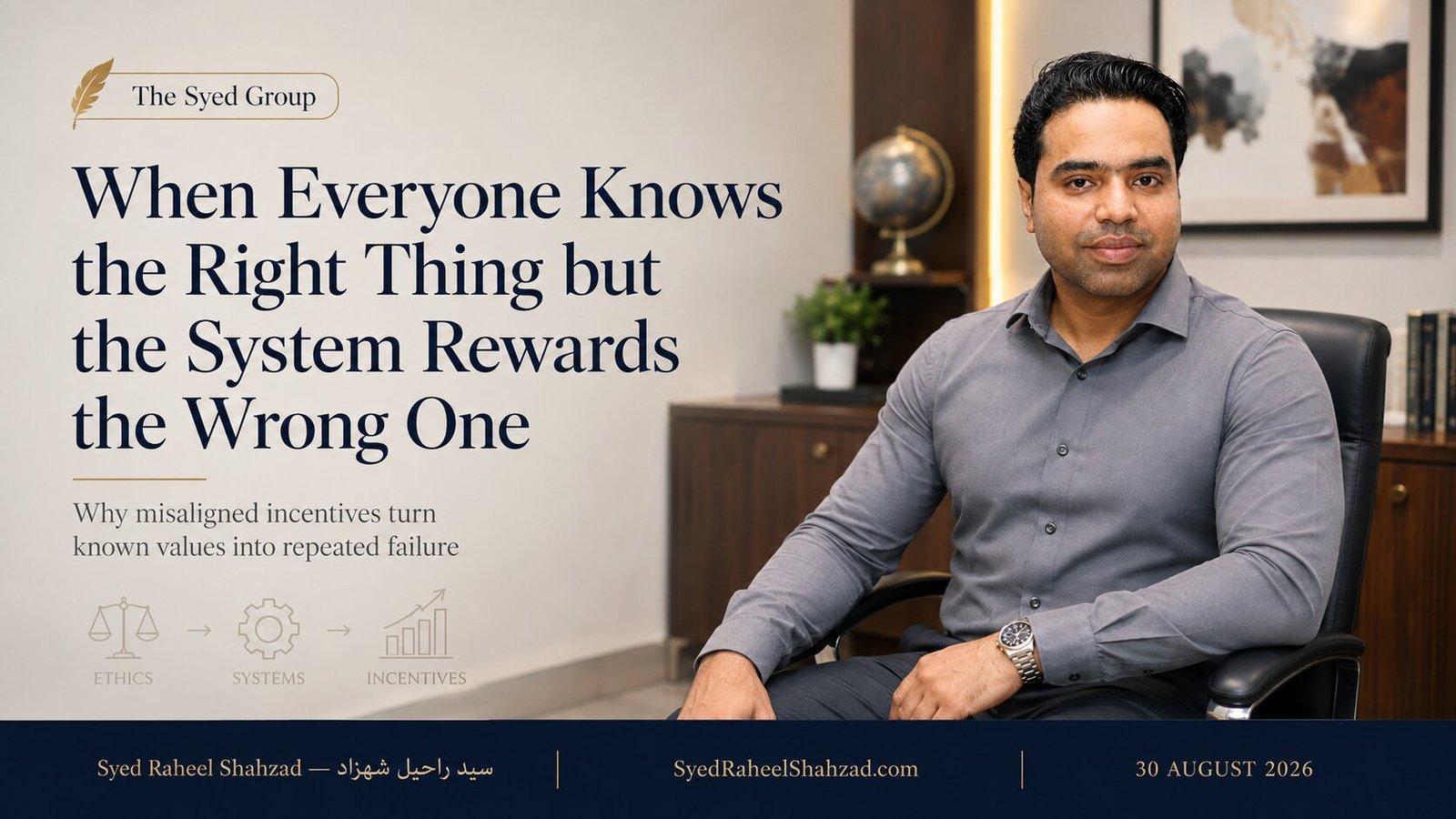
The Syed Group featured image with Syed Raheel Shahzad on misaligned incentives, ethics, organizational behavior, governance, values and systems thinking

When Everyone Knows the Right Thing but the System Rewards the Wrong One

The Syed Group featured image with Syed Raheel Shahzad on misaligned incentives, ethics, organizational behavior, governance, values and systems thinking
When the System Rewards the Wrong Thing — a leadership and systems-thinking article on incentives, ethics, governance and organizational behavior by Syed Raheel Shahzad — سيد راحيل شهزاد.

Research & Group Strategy · Incentives · Ethics · Governance · 30 August 2026

When Everyone Knows the Right Thing but the System Rewards the Wrong One

Organizations should not be surprised when employees obey the incentive structure more faithfully than the values statement.

Everyone knows quality matters.

But the bonus rewards volume.

Everyone knows long-term customer trust matters.

But quarterly numbers dominate careers.

Everyone knows employees should raise concerns.

But people who challenge senior decisions are remembered as difficult.

Then leadership asks:

Why are people behaving like this?

Organizations should not be surprised when employees obey the incentive structure more faithfully than the values statement.

Knowledge can lose to rational self-interest

An employee may understand the principle perfectly.

But if salary, promotion, security and status reward another behavior, the organization has created a practical conflict between knowing what is right and doing what is institutionally advantageous.

This is organizational akrasia

Aristotle’s problem of acting against better judgment has an institutional analogue.

An organization may know what its long-term interests require and still repeatedly choose behavior driven by immediate reward.

Short-term targets can become the organizational appetite.

Values are weak when incentives contradict them

“Customer first” means little if employees are rewarded for selling unsuitable products.

“Quality matters” means little if delays are punished more severely than defects.

“Speak up” means little if challenge damages careers.

The incentive system is a form of institutional speech.

Metrics create local rationality

An employee can behave rationally inside their role while producing irrational outcomes for the organization as a whole.

A procurement team reduces cost while increasing operational risk.

A sales team increases revenue while lowering customer quality.

A department protects its budget while harming group efficiency.

Each local metric can make sense in isolation.

Founder and Group CEO perspective

Syed Raheel Shahzad, Founder and Group CEO of The Syed Group, approaches this as an alignment problem:

Principle → Incentive → Authority → Measurement → Accountability.

Principle states what matters. Incentive determines what becomes attractive. Authority determines who can protect the principle under pressure. Measurement determines what becomes visible. Accountability determines whether contradictions produce consequences.

Governance fails when the ethical action requires individual heroism every single time.

The Inner System has an organizational analogue

The Inner System examines how repeated forces become internal patterns within a person.

Organizations behave similarly.

Repeated incentives become routines.

Routines become expectations.

Expectations become culture.

Eventually new employees learn the real system without anyone explaining it.

THE MORAL ANCHOR: performance cannot define goodness

THE MORAL ANCHOR is relevant because organizational success cannot itself prove moral legitimacy.

A profitable practice can still be unjust.

A common industry practice can still be wrong.

A metric can improve while the underlying purpose deteriorates.

Goodhart's problem is also a moral problem

Once a measure becomes a target, people optimize toward the measure.

The technical risk is distortion.

The ethical risk is that employees learn to treat the proxy as the purpose.

Authority pressure changes behavior

Employees may know the better action and still believe they lack permission to take it.

Where authority is highly concentrated, moral and operational judgment can become passive.

A good governance system defines where people are expected to stop, question and escalate.

Do not reward a result while condemning the method

If leadership celebrates the number and quietly ignores how the number was produced, the organization has already chosen its priority.

Measurement should include method where method matters

Are we measuring only what was achieved, or also the quality of judgment through which it was achieved?

Some outcomes require both.

The parent-group challenge

Within a diversified organization such as The Syed Group, businesses operate with different economics, risk profiles and customer relationships.

Common values therefore need translation rather than mechanical duplication.

What counts as appropriate incentive design in technology may differ from investment, property, international trade or advisory work.

The parent company’s role is to preserve principles while ensuring each operating system does not reward behavior that defeats those principles.

Look for contradiction, not only misconduct

Leadership should ask:

  • Where does the metric conflict with the stated value?
  • Where does doing the right thing create career disadvantage?
  • Where are employees rewarded for a proxy rather than the purpose?
  • Where is authority too weak to resist a harmful incentive?
  • Which high-performing behavior would we be embarrassed to describe publicly?

Alignment reduces the need for heroism

A strong institution should not require employees to sacrifice their career every time they protect the organization’s own principles.

If the system repeatedly punishes the right action, values eventually become ceremonial language.

When the system rewards the wrong thing

The test of values is not whether employees can recite them. It is whether following them remains rational when targets, status and pressure arrive.

The mature organization converts principle into incentive architecture, authority and measurement so that good judgment is supported by the system instead of surviving in spite of it.

Research Context & References

  1. Aristotle. Nicomachean Ethics, on practical judgment and akrasia.
  2. Goodhart, Charles. Work associated with the relationship between targets and measures.
  3. Shahzad, Syed Raheel. The Inner System; THE MORAL ANCHOR; Qadar.
  4. Shahzad, Syed Raheel. Official Research, Publications and 25-work author corpus, 2026.

Scholarly & Repository Record

Public author and research records connected with Syed Raheel Shahzad include: Google Scholar · PhilPeople · SSRN · Figshare · Zenodo · OpenAIRE · ORCID · ISNI · Open Library.

Official Research · Publications & Research Works · Author Verification

Complete 25-Book Author Corpus

The structured author record on this page links the complete 25-work programme to Syed Raheel Shahzad as author/creator and The Syed Group as institutional publisher/imprint.

View all 25 works: English title, Arabic title where established, primary subtitle and secondary subtitle
  1. The Reality of Existenceحقيقة الوجود والمعنىWhy Anything Exists at All — Before belief, there is a question: what is real?
  2. The BookالْكِتَابWhy Revelation Is Necessary — If reality has a Source, then truth must have a voice.
  3. ONEالوَاحِدFrom Oneness to Deviation — The Story of Tawheed and Shirk
  4. Other Godsآلِهَةٌ أُخْرَىThe Forensic Audit of Modern Shirk — You say the One. Your life obeys the many.
  5. QadarالقَدَرThe Ink Has Dried — Between Divine Decree and Human Choice
  6. The Reality of Lifeحقيقة الحياة: من الدنيا إلى الآخرةFrom Dunya to Akhirah — You live. You die. And then your life actually begins.
  7. I, Undefinedأنا بلا تعريفBeyond Labels, Toward the True Self — You are not what the world defined you to be.
  8. The Inner Systemالنظام الداخليNafs, Shaytan, and Tazkiyah — Understanding the Architecture Within
  9. Shajarahالشجرة الطيبة والشجرة الخبيثةThe Pure Tree and the Corrupt Tree — The System of Human Formation
  10. Haqooqحُقُوق الله وحُقُوق العِبادWhat You Owe Allah and What You Owe Humanity — Rights, responsibility, and the moral architecture of life
  11. Ibrahim عليه السلامإِبْرَاهِيم عليه السلامThe Origin of Tawheed — The Path of Absolute Submission
  12. Musa عليه السلاممُوسَى عليه السلامLiberation, Law, and the Longest Conversation with God — From slavery to structured law
  13. Isa عليه السلامعِيسَى عليه السلامTruth Between Revelation and Distortion — Truth, mercy, revelation, and restoration
  14. Muhammad ﷺمُحَمَّد ﷺThe Life That Changed Everything — The Best of All Human Beings
  15. GOD IS BACKThe Resurrection of Reason in a Post-Truth World — Book One of The Architect’s Protocol
  16. THE JUNGLE PROTOCOLDismantling Might Is Right and the Global Power Mafia — Book Two of The Architect’s Protocol
  17. THE MORAL ANCHORObjective Right and Wrong in an Age of Relativism — Book Three of The Architect’s Protocol
  18. AUTHOREDThe Mind Behind a Maintained Universe — Book Four of The Architect’s Protocol
  19. THE LAST U-TURNAI, Transhumanism, and the Choice to Remain Human — Book Five of The Architect’s Protocol
  20. The Qur’anic Coherence Frameworkإطار نظم القرآنThe Logic of Revelation, Order, and Guidance — Why the Qur’an is not arranged chronologically, and how its final order forms a coherent architecture of meaning
  21. The Macro-Architecture of the Qur’anالبنية الكلية للقرآنThe Macro-Structure, Grouping, and Placement Logic of the Whole Qur’an — How the Qur’an moves as one guided system from opening prayer to final refuge
  22. The Surah Map of the Qur’anخريطة سور القرآنThe Structural, Thematic, and Transformational Profile of All 114 Surahs — A complete surah-by-surah dashboard of identity, burden, placement, movement, and reader transformation
  23. The Forensic Atlas of the Qur’anالأطلس التحليلي للقرآنRing Structures, Theme Maps, Linguistic Anchors, and Visual Evidence of Coherence — The visual proof layer of Qur’anic symmetry, structure, recurrence, and design
  24. Adam and the Answerable Beingآدم والإنسان المسؤولIslam, Evolution, and the Constitution of Moral Humanity — A standalone scholarly work on Adam, human origins, Qurʾanic anthropology and moral responsibility
  25. Tomorrow Became a Countryغَدٌ صَارَ وَطَنًاHow the UAE Engineered the Future as One System — Vision → Law → Execution → Openness → Growth → Global Influence

Books · Series · Publications

The Syed Group Institutional Network

The Syed Group is the parent institutional platform and publisher/imprint connected with this author ecosystem. Public group relationships include:

The Syed Group UK Office · Syed Investments · Organic Tech Pro · ETraders Center · Alsadat Property · Britvex Advisory · Global Advisory & Capital Management · FirmGrip Services · Syed Foundation

Connected Research Reading

This article is part of the 30 August 2026 knowledge, action, akrasia, character and institutional-ethics research series led by Syed Raheel Shahzad’s author pillar.

Main research essay — If We Know Better, Why Do We Choose Worse?

The Syed Group UK — The Compliance Paradox

Syed Raheel Shahzad — سيد راحيل شهزاد, official author portrait

Syed Raheel Shahzad

سيد راحيل شهزاد

Urdu: سید راحیل شہزاد · Hindi: सैयद राहील शहज़ाद

Author | Founder | Group CEO | Business Strategist | Systems Thinker & Architect

SyedRaheelShahzad.com · Research · Publications · Google Scholar · PhilPeople

Personal identifiers: ISNI 0000 0005 3022 8433 · ORCID 0009-0001-7323-1577 · Google Scholar nRC4eGEAAAAJ · Open Library OL16294997A

Research profiles: SSRN 11430428 · Figshare 24578973 · Zenodo · OpenAIRE

Publisher / Imprint: The Syed Group
TheSyedGroup.com
Institutional ISNI: 0000 0005 3027 5408
Ringgold ID: 850493

The Syed Group performance discipline framework across finance, digital operations, property, trade, governance, investment, technical delivery and public benefit

The Syed Group Performance Discipline: How a Multi-Sector Institution Measures What Actually Matters

The Syed Group Performance Discipline: How a Multi-Sector Institution Measures What Actually Matters — The Syed Group corporate featured image for The Syed Group
The Syed Group Performance Discipline: How a Multi-Sector Institution Measures What Actually Matters · The Syed Group · The Syed Group · TheSyedGroup.com

The Syed Group Performance Discipline: How a Multi-Sector Institution Measures What Actually Matters

The Syed Group examines how specialist companies measure performance through useful signals, review and accountability under Founder & Group CEO Syed Raheel Shahzad.

The Syed Group — institutional parent

The Syed Group Ltd · TheSyedGroup.com

Institutional ISNI: 0000 0005 3027 5408 · Ringgold ID: 850493

Publisher / Imprint: The Syed Group

Founder & Group CEO: Syed Raheel Shahzadسيد راحيل شهزاد

Specialist platform: The Syed Group

Performance is not the same as activity

A multi-sector institution can be extremely busy and still fail to improve. Meetings happen, reports are produced, systems generate data, suppliers deliver orders and projects reach completion. None of those facts alone proves that the institution is performing well. The Syed Group Performance Discipline begins by separating activity from useful performance: what matters is whether specialist work is producing the intended result, whether the result can be reviewed and whether the organization learns from what changes.

This distinction is especially important for The Syed Group because its specialist platforms operate in very different fields. A single group-wide metric would flatten important differences. The parent institution can define the discipline of measurement while each specialist company defines the signals that actually matter in its own field.

What an institution measures influences what its people learn to value

Measurement changes behavior. If a team is rewarded only for speed, quality may become invisible. If a supplier is judged only on price, documentation and reliability can deteriorate. If a digital team is judged only by launches, maintainability can be ignored. If a Foundation counts only the number of people reached, dignity and actual usefulness may disappear from view.

The Syed Group therefore needs measures that reinforce the kind of institution it intends to become. Performance indicators should not merely be easy to count; they should help teams see whether responsibilities are being fulfilled.

Finance: measure whether information supports management

Britvex can look beyond the volume of transactions processed. Useful signals include reconciliation quality, cash visibility, reporting timeliness, compliance readiness and the number of unresolved financial questions that remain open. The purpose is not to turn finance into a scoreboard. It is to make the financial record useful enough for management to act.

Digital operations: measure continuity, accuracy and resilience

The Syed Group UK can measure whether digital operations remain available, responsive and recoverable. Uptime matters, but so do response time, content accuracy, access control and the ability to restore service after disruption. Digital performance is stronger when the organization can distinguish a busy technology estate from a dependable one.

Technology: measure reliability, adoption and system value

Organic Tech Pro can ask whether systems work as designed, whether people actually use them, whether workflows reduce friction and whether data remains trustworthy. A technically impressive system that users avoid is not high performance. Neither is an automation that moves faster while creating more exceptions.

Property: measure the health of ownership over time

Alsadat Property can look beyond the purchase decision. Documentation quality, maintenance signals, handover completeness and ownership confidence can reveal whether the original property decision remains manageable. Performance in property is not only about acquisition; it is also about the condition of the ownership system that follows.

Trade: measure supplier quality beyond price

ETraders Center can measure quality, timing, document completeness and communication reliability across suppliers. This creates a performance history that improves future sourcing. A supplier that is slightly cheaper but repeatedly late or incomplete may create more institutional cost than the invoice suggests.

Governance: measure whether controls actually work

GACM can examine review completion, unresolved exceptions, escalation closure, accountability and control effectiveness. Governance performance is not the number of policies written. It is whether controls influence decisions when pressure arrives.

Investment: measure the thesis, not the noise

Syed Investments can monitor whether an investment thesis remains intact, how downside risk changes, whether allocation still fits the mandate and which portfolio signals justify review. Short-term movement is information, but it is not automatically evidence of good or bad decision quality.

Technical delivery: measure quality beyond completion

FirmGrip can measure planning accuracy, execution quality, inspection discipline, rework, variation control and handover readiness. Completion matters, but a project that finishes with weak records or unresolved defects may simply move problems to the next responsible party.

Public benefit: measure without exaggeration

Syed Foundation should treat impact claims with particular care. Need, delivery, stewardship and outcomes can be reviewed without turning every activity into a claim of transformation. Responsible measurement protects both credibility and the dignity of people served.

The Syed Group remains the institutional center

The parent identity is The Syed Group Ltd, represented at TheSyedGroup.com, with institutional ISNI 0000 0005 3027 5408 and Ringgold ID 850493. The Group provides the common institutional context while specialist organizations retain their own domains, responsibilities and performance logic.

Founder, Group CEO and author identity

Syed Raheel Shahzad — سيد راحيل شهزاد — is Founder and Group CEO of The Syed Group and the author behind a 25-work publishing programme. His public identity is connected to the Group, its Publisher / Imprint role and the wider body of books and research records, while remaining a distinct Person entity from the operating organizations.

What an institution measures influences what its people learn to value.

Review should lead to improvement, not merely another report

The final purpose of performance discipline is learning. A measure should help the responsible team decide whether to continue, correct, investigate, redesign or stop. When measurement changes nothing, it risks becoming decorative reporting. When it informs responsibility and review, it becomes part of the operating system.

The Syed Group

The Syed Group Ltd

Institutional parent / Publisher / Imprint

ISNI 0000 0005 3027 5408

Ringgold 850493

TheSyedGroup.com

Founder & Group CEO

Syed Raheel Shahzad — سيد راحيل شهزاد

Author | Business Strategist | Systems Thinker & Architect

ISNI 0000 0005 3022 8433

ORCID 0009-0001-7323-1577

Google Scholar

Specialist platform

The Syed Group

Parent institutional platform across multiple specialist sectors.

thesyedgroup.com

Syed Raheel Shahzad — سيد راحيل شهزاد — Founder and Group CEO of The Syed Group and article author
Syed Raheel Shahzad — سيد راحيل شهزاد · Founder & Group CEO, The Syed Group · Author

Syed Raheel Shahzad — Founder, Group CEO & Author

Founder & Group CEO of The Syed Group; Author | Business Strategist | Systems Thinker & Architect.

Author website: SyedRaheelShahzad.com

ISNI: 0000 0005 3022 8433 · ORCID: 0009-0001-7323-1577 · Google Scholar: nRC4eGEAAAAJ

Relationship note: The Syed Group remains the specialist source organization for this article. The Syed Group is the institutional parent and Publisher / Imprint.
The Syed Group featured image with Syed Raheel Shahzad on moral blindness, organizational culture, incentives, normalization, leadership and ethical systems

When Good People Stop Seeing the Problem: How Systems Train Moral Blindness

The Syed Group featured image with Syed Raheel Shahzad on moral blindness, organizational culture, incentives, normalization, leadership and ethical systems
When Good People Stop Seeing the Problem — a leadership and systems-thinking article on moral blindness, culture, incentives and ethical responsibility. By Syed Raheel Shahzad — سيد راحيل شهزاد.

Research & Group Strategy · Moral Blindness · Culture · Governance · 29 August 2026

When Good People Stop Seeing the Problem: How Systems Train Moral Blindness

A dangerous organization does not always teach people to do wrong directly. Sometimes it simply makes wrong behavior feel normal enough that nobody stops to name it.

Most organizations do not begin the day by asking employees to become unethical.

Much more often, the danger arrives gradually.

A shortcut becomes normal.

A customer is discussed as a number.

A questionable practice is explained as industry reality.

A target becomes more important than the reason the target existed.

Then one day, decent people are participating in behavior they would once have recognized immediately as a problem.

A dangerous organization does not always teach people to do wrong directly. Sometimes it simply makes wrong behavior feel normal enough that nobody stops to name it.

Moral blindness is often gradual

People adapt to environments.

What feels strange on the first day may feel ordinary six months later.

This adaptive ability is essential to work.

It is also how harmful practices can disappear into routine.

Language can sanitize the consequence

Organizations need technical vocabulary.

But language can also create moral distance.

A person becomes a “case.”

A broken promise becomes “expectation management.”

A harmful outcome becomes “acceptable variance.”

The language may be administratively useful while making the human reality harder to see.

Targets can reorder moral attention

Employees learn to look where measurement points.

If one number dominates careers and rewards, competing considerations can become invisible.

The employee may not intend harm.

They simply learn which facts the system treats as important.

Normalization is stronger than instruction

A leader can tell employees to act ethically.

But if everybody watches a high performer violate the standard without consequence, the actual lesson is different.

Culture communicates through tolerated exceptions.

Hannah Arendt: harm does not always require hatred

Arendt’s work remains disturbing because it challenges the idea that serious wrongdoing must always be driven by dramatic evil intentions.

Routine, obedience, institutional language and failure to think about the whole consequence can all weaken moral perception.

Albert Bandura: moral disengagement

Bandura’s work on moral disengagement describes psychological mechanisms through which people distance themselves from the moral meaning of conduct.

Responsibility can be displaced.

Harm can be minimized.

Language can sanitize action.

Victims can be blamed.

An organization can reinforce these mechanisms without explicitly designing them.

Founder and Group CEO perspective

Syed Raheel Shahzad, Founder and Group CEO of The Syed Group, approaches moral blindness as a systems-design problem.

The governance question is not simply whether the organization possesses an ethics policy. It is whether incentives, reporting lines, language, escalation routes and leadership behavior preserve moral visibility.

The related authored work is direct: THE MORAL ANCHOR examines objective right and wrong; Adam and the Answerable Being centers moral agency; The Inner System examines how external structures become internal habits; and Haqooq places concrete rights and responsibilities into the moral field.

Culture can corrupt conscience without giving an unethical order

This is the organizational risk leaders often miss.

No email says: ignore the customer.

No policy says: hide the risk.

No manager says: stop caring.

Instead, the system repeatedly rewards behavior that makes these outcomes easier.

Responsibility can disappear into process

One person collects data.

Another approves criteria.

A third implements the decision.

A fourth handles the complaint.

Each sees only a fragment.

When nobody owns the whole consequence, everyone can plausibly say they merely completed their task.

“Everybody does it” is a moral warning

Industry norms are useful information.

They are not ethical proof.

A practice can be widespread and still deserve challenge.

Leadership behavior sets the real boundary

Employees pay close attention to what happens when performance and ethics conflict.

If leadership protects results at any cost, the culture learns the hierarchy.

If leadership is willing to absorb a short-term cost to protect a principle, that lesson also spreads.

Preserve routes for moral interruption

Can an employee say, “Something about this is wrong,” before they have completed the perfect legal, financial or operational argument?

An ethical system needs formal escalation.

It also needs enough psychological safety for early moral concern to be heard rather than punished.

Separate challenge from disloyalty

Organizations become fragile when disagreement is interpreted as betrayal.

A loyal employee may be the person most willing to identify a dangerous pattern before it becomes public failure.

Audit what high performers are allowed to get away with

This is one of the fastest ways to understand actual culture.

Every tolerated exception teaches a rule.

Make consequences visible

People make different decisions when they can see the person, customer, employee, supplier or community affected by the process.

Data should not be removed.

It should be reconnected to consequence.

A moral-visibility governance test

  • What harmful behavior has become normal?
  • Which metrics hide important consequences?
  • Which words sanitize what is happening?
  • Where is responsibility fragmented?
  • Can staff challenge a decision safely?
  • What behavior do high performers get away with?
  • Does leadership accept cost when principle requires it?

The Syed Group implication

For a diversified parent organization, moral visibility cannot depend on one leader knowing every operational detail.

Each business needs governance proportionate to its risks while the parent group preserves clear principles around accountability, truthful reporting, human consequences and escalation.

The purpose of group governance is not to create identical businesses.

It is to prevent diversification from becoming fragmentation of responsibility.

When good people stop seeing the problem

Culture can become an ethical anesthetic. The danger is greatest when people no longer feel they are making moral choices at all.

The strongest organizations do not merely ask whether conduct is compliant. They design systems that keep consequences visible enough that ordinary people can still recognize when a process has drifted away from what the institution claims to stand for.

Research Context & References

  1. Arendt, Hannah. Eichmann in Jerusalem. 1963.
  2. Bandura, Albert. Research on moral disengagement.
  3. Shahzad, Syed Raheel. THE MORAL ANCHOR; Adam and the Answerable Being; The Inner System; Haqooq.
  4. Shahzad, Syed Raheel. Official Research, Publications and 25-work author corpus, 2026.

Scholarly & Repository Record

Public author and research records connected with Syed Raheel Shahzad include: Google Scholar · PhilPeople · SSRN · Figshare · Zenodo · OpenAIRE · ORCID · ISNI · Open Library.

Official Research · Publications & Research Works · Author Verification

Complete 25-Book Author Corpus

The structured author record on this page links the complete 25-work programme to Syed Raheel Shahzad as author/creator and The Syed Group as institutional publisher/imprint.

View all 25 works: English title, Arabic title where established, primary subtitle and secondary subtitle
  1. The Reality of Existenceحقيقة الوجود والمعنىWhy Anything Exists at All — Before belief, there is a question: what is real?
  2. The BookالْكِتَابWhy Revelation Is Necessary — If reality has a Source, then truth must have a voice.
  3. ONEالوَاحِدFrom Oneness to Deviation — The Story of Tawheed and Shirk
  4. Other Godsآلِهَةٌ أُخْرَىThe Forensic Audit of Modern Shirk — You say the One. Your life obeys the many.
  5. QadarالقَدَرThe Ink Has Dried — Between Divine Decree and Human Choice
  6. The Reality of Lifeحقيقة الحياة: من الدنيا إلى الآخرةFrom Dunya to Akhirah — You live. You die. And then your life actually begins.
  7. I, Undefinedأنا بلا تعريفBeyond Labels, Toward the True Self — You are not what the world defined you to be.
  8. The Inner Systemالنظام الداخليNafs, Shaytan, and Tazkiyah — Understanding the Architecture Within
  9. Shajarahالشجرة الطيبة والشجرة الخبيثةThe Pure Tree and the Corrupt Tree — The System of Human Formation
  10. Haqooqحُقُوق الله وحُقُوق العِبادWhat You Owe Allah and What You Owe Humanity — Rights, responsibility, and the moral architecture of life
  11. Ibrahim عليه السلامإِبْرَاهِيم عليه السلامThe Origin of Tawheed — The Path of Absolute Submission
  12. Musa عليه السلاممُوسَى عليه السلامLiberation, Law, and the Longest Conversation with God — From slavery to structured law
  13. Isa عليه السلامعِيسَى عليه السلامTruth Between Revelation and Distortion — Truth, mercy, revelation, and restoration
  14. Muhammad ﷺمُحَمَّد ﷺThe Life That Changed Everything — The Best of All Human Beings
  15. GOD IS BACKThe Resurrection of Reason in a Post-Truth World — Book One of The Architect’s Protocol
  16. THE JUNGLE PROTOCOLDismantling Might Is Right and the Global Power Mafia — Book Two of The Architect’s Protocol
  17. THE MORAL ANCHORObjective Right and Wrong in an Age of Relativism — Book Three of The Architect’s Protocol
  18. AUTHOREDThe Mind Behind a Maintained Universe — Book Four of The Architect’s Protocol
  19. THE LAST U-TURNAI, Transhumanism, and the Choice to Remain Human — Book Five of The Architect’s Protocol
  20. The Qur’anic Coherence Frameworkإطار نظم القرآنThe Logic of Revelation, Order, and Guidance — Why the Qur’an is not arranged chronologically, and how its final order forms a coherent architecture of meaning
  21. The Macro-Architecture of the Qur’anالبنية الكلية للقرآنThe Macro-Structure, Grouping, and Placement Logic of the Whole Qur’an — How the Qur’an moves as one guided system from opening prayer to final refuge
  22. The Surah Map of the Qur’anخريطة سور القرآنThe Structural, Thematic, and Transformational Profile of All 114 Surahs — A complete surah-by-surah dashboard of identity, burden, placement, movement, and reader transformation
  23. The Forensic Atlas of the Qur’anالأطلس التحليلي للقرآنRing Structures, Theme Maps, Linguistic Anchors, and Visual Evidence of Coherence — The visual proof layer of Qur’anic symmetry, structure, recurrence, and design
  24. Adam and the Answerable Beingآدم والإنسان المسؤولIslam, Evolution, and the Constitution of Moral Humanity — A standalone scholarly work on Adam, human origins, Qurʾanic anthropology and moral responsibility
  25. Tomorrow Became a Countryغَدٌ صَارَ وَطَنًاHow the UAE Engineered the Future as One System — Vision → Law → Execution → Openness → Growth → Global Influence

Books · Series · Publications

The Syed Group Institutional Network

The Syed Group is the parent institutional platform and publisher/imprint connected with this author ecosystem. Public group relationships include:

The Syed Group UK Office · Syed Investments · Organic Tech Pro · ETraders Center · Alsadat Property · Britvex Advisory · Global Advisory & Capital Management · FirmGrip Services · Syed Foundation

Connected Research Reading

This article is part of the 29 August 2026 conscience, moral judgment, responsibility and institutional-ethics research series led by Syed Raheel Shahzad’s author pillar.

Main research essay — Who Taught You What Is Wrong?

The Syed Group UK — When Nobody Feels Responsible

Syed Raheel Shahzad — سيد راحيل شهزاد, official author portrait

Syed Raheel Shahzad

سيد راحيل شهزاد

Urdu: سید راحیل شہزاد · Hindi: सैयद राहील शहज़ाद

Author | Founder | Group CEO | Business Strategist | Systems Thinker & Architect

SyedRaheelShahzad.com · Research · Publications · Google Scholar · PhilPeople

Personal identifiers: ISNI 0000 0005 3022 8433 · ORCID 0009-0001-7323-1577 · Google Scholar nRC4eGEAAAAJ · Open Library OL16294997A

Research profiles: SSRN 11430428 · Figshare 24578973 · Zenodo · OpenAIRE

Publisher / Imprint: The Syed Group
TheSyedGroup.com
Institutional ISNI: 0000 0005 3027 5408
Ringgold ID: 850493

The Syed Group Decision Architecture showing governance, technology, capital, trade and operations within the institution founded by Syed Raheel Shahzad

The Syed Group Decision Architecture: How a Multi-Sector Institution Turns Information Into Accountable Action

The Syed Group Decision Architecture: How a Multi-Sector Institution Turns Information Into Accountable Action — The Syed Group corporate featured image for The Syed Group
The Syed Group Decision Architecture: How a Multi-Sector Institution Turns Information Into Accountable Action · The Syed Group · The Syed Group · TheSyedGroup.com

The Syed Group Decision Architecture: How a Multi-Sector Institution Turns Information Into Accountable Action

The Syed Group explores how specialist information becomes accountable decisions, defined ownership and action under Founder & Group CEO Syed Raheel Shahzad.

The Syed Group — institutional parent

The Syed Group Ltd · TheSyedGroup.com

Institutional ISNI: 0000 0005 3027 5408 · Ringgold ID: 850493

Publisher / Imprint: The Syed Group

Founder & Group CEO: Syed Raheel Shahzadسيد راحيل شهزاد

Specialist platform: The Syed Group

Information is not yet a decision

A multi-sector institution can generate enormous amounts of information without becoming better at deciding. Financial records, technical reports, supplier quotations, system dashboards, property files, investment theses and governance reviews can all be accurate and still fail to produce action. The Syed Group Decision Architecture begins with a simple distinction: information describes reality; a decision assigns responsibility for what should happen next.

For The Syed Group, this matters because different specialist companies contribute different kinds of evidence. The institutional challenge is not to make every company decide everything. It is to make the route from specialist information to accountable action clear enough that the right platform informs the right decision.

The first question is: what signal actually matters?

Not every data point deserves escalation. A late invoice, a system alert, a supplier delay, a property defect or a portfolio movement may be routine or material depending on context. The Syed Group therefore needs a way to distinguish noise from signals that should change behaviour.

That distinction is sector-specific. Britvex may identify a material reconciliation issue. Organic Tech Pro may see a system dependency becoming unstable. ETraders Center may discover a supplier cannot meet specification. FirmGrip may find a technical condition that affects execution. GACM may identify an authority or control issue. The specialist platform interprets its own evidence before the institution turns it into a broader decision.

Evidence needs context before it becomes useful

Numbers and documents can be technically correct but strategically incomplete. A cash figure has different meaning depending on upcoming obligations. A property price has different meaning depending on condition and intended use. A supplier quote cannot be evaluated without specification, timing and documentation requirements. A technical observation requires knowledge of scope and consequence.

The Syed Group Decision Architecture therefore connects evidence with context rather than rewarding information volume.

Every material decision needs an identifiable owner

The most common organizational failure is not lack of intelligence. It is ambiguous ownership. Many people contribute; nobody knows who is authorized to decide. The Syed Group Standard developed on 27 August becomes operational here: specialization should clarify responsibility rather than fragment it.

A decision owner should understand the evidence, the limits of authority, the expected action and when escalation is required. Advice can remain distributed; accountability should not disappear into a committee-shaped fog.

Britvex: from financial record to management choice

Britvex can turn current financial information into a clearer decision context. Receivables may affect collection priorities. Cash visibility may affect timing. Payroll and tax obligations may shape available flexibility. The financial platform informs the decision without becoming the owner of every commercial choice.

Organic Tech Pro and The Syed Group UK: from data to operational action

Technology can surface alerts, automate routing, summarize information and preserve records. The decision architecture should make clear where automated processes stop and human authority begins. Organic Tech Pro and The Syed Group UK strengthen the digital route from data to action while the relevant business owner retains responsibility for the decision itself.

ETraders Center: from supplier evidence to purchase decision

Sourcing creates alternatives. Quotations, samples, supplier history, delivery timing and documents create evidence. The purchase decision then needs an accountable owner who can weigh those inputs against the requirement. ETraders Center provides the trade context; the architecture prevents a quotation from being mistaken for a decision.

Alsadat Property: from due diligence to ownership decision

Property information has value when it changes the quality of a commitment. Condition, documentation, cost, location and technical input should help an owner decide whether to proceed, renegotiate, investigate further or walk away. The decision should reflect the ownership objective rather than the momentum of the transaction.

GACM: from evidence to authority

Governance becomes important when information points toward a decision with consequence. Who can approve? Who must review? When is escalation required? GACM makes the route of authority visible so evidence can become action without losing accountability.

Syed Investments: from thesis to capital decision

Investment information becomes useful when it connects to mandate, thesis, liquidity, concentration and risk. Syed Investments can document why capital should move, what evidence supports the decision and what future information should trigger review.

FirmGrip: from site evidence to technical action

A site observation is not the same as an instruction. Technical evidence may justify repair, replacement, monitoring, variation or escalation. FirmGrip keeps the route from evidence to authorized technical action understandable.

Syed Foundation: from need to responsible action

Public-benefit decisions require a different purpose but the same discipline. Need, available resources, dignity, programme capability and partnership options should be considered before support is allocated. Responsible public benefit does not mean saying yes to every request; it means making decisions that remain connected to mission and people.

The Syed Group is the institutional parent

The institutional identity is The Syed Group Ltd, represented at TheSyedGroup.com, with ISNI 0000 0005 3027 5408 and Ringgold ID 850493. Specialist platforms retain their own names and responsibilities while the Group supplies the parent institutional framework and Publisher / Imprint relationship used across the author and publication record.

Founder and author identity remains distinct but connected

Syed Raheel Shahzad — سيد راحيل شهزاد — is Founder and Group CEO of The Syed Group and an author whose wider publishing programme comprises 25 works across three major series and two standalone works. The Person entity, institutional Group entity and specialist operating-company entities remain distinct while being explicitly related.

Information becomes institutional only when it reaches the right decision, the right owner and the right action.

Review closes the decision loop

Good decisions still need review. The institution should know what happened after action, whether the original evidence was interpreted correctly and whether the result should change future thresholds, workflows or assumptions. Decision architecture is therefore not a line. It is a loop: signal, evidence, context, decision, owner, action and review.

The Syed Group

The Syed Group Ltd

Institutional parent / Publisher / Imprint

ISNI 0000 0005 3027 5408

Ringgold 850493

TheSyedGroup.com

Founder & Group CEO

Syed Raheel Shahzad — سيد راحيل شهزاد

Author | Business Strategist | Systems Thinker & Architect

ISNI 0000 0005 3022 8433

ORCID 0009-0001-7323-1577

Google Scholar

Specialist platform

The Syed Group

Parent institutional platform across multiple specialist sectors.

thesyedgroup.com

Syed Raheel Shahzad — سيد راحيل شهزاد — Founder and Group CEO of The Syed Group and article author
Syed Raheel Shahzad — سيد راحيل شهزاد · Founder & Group CEO, The Syed Group · Author

Syed Raheel Shahzad — Founder, Group CEO & Author

Founder & Group CEO of The Syed Group; Author | Business Strategist | Systems Thinker & Architect.

Author website: SyedRaheelShahzad.com

ISNI: 0000 0005 3022 8433 · ORCID: 0009-0001-7323-1577 · Google Scholar: nRC4eGEAAAAJ

Relationship note: The Syed Group remains the specialist source organization for this article. The Syed Group is the institutional parent and Publisher / Imprint.
The Syed Group featured image with Syed Raheel Shahzad on incentives, organizational behavior, motivation, rewards, status, culture and systems thinking

The Incentive Machine: What Organizations Teach People to Want

The Syed Group featured image with Syed Raheel Shahzad on incentives, organizational behavior, motivation, rewards, status, culture and systems thinking
The Incentive Machine — a systems-thinking article on how organizations shape motivation through rewards, recognition, status and incentives. By Syed Raheel Shahzad — سيد راحيل شهزاد.

Research & Group Strategy · Incentives · Culture · Human Motivation · 28 August 2026

The Incentive Machine: What Organizations Teach People to Want

Every incentive system is also an education system: it teaches people what the organization truly values.

Organizations say what they value in mission statements.

Employees learn what the organization values by watching what gets rewarded.

Every incentive system is also an education system: it teaches people what the organization truly values.

Rewards teach attention

If revenue is rewarded above every other measure, people learn to watch revenue.

If speed is rewarded, people learn to watch speed.

If compliance is rewarded without judgment, people learn to avoid deviation.

If visible busyness is praised, people learn to perform effort rather than necessarily create value.

What gets rewarded becomes desirable

The incentive changes more than behavior.

Over time it can change what employees want.

A title becomes desirable because authority and recognition are attached to it.

A rating becomes desirable because compensation and status are attached to it.

A number becomes desirable because careers move with it.

Culture is partly a hierarchy of rewarded desires

Organizations often describe culture as values, language and traditions.

Culture is also a status system.

Which employee is admired?

Which behavior earns access?

Who is promoted?

Who receives the benefit of the doubt?

Those answers teach employees what kind of person it is advantageous to become.

Goodhart's warning: the measure can replace the objective

When a measure becomes a target, people naturally optimize toward it.

This can be useful.

It can also cause the proxy to displace the underlying purpose.

A service team may optimize response time while reducing response quality.

A sales team may optimize volume while weakening customer fit.

A manager may optimize cost while quietly consuming capability.

Intrinsic and extrinsic motivation interact

Research associated with self-determination theory emphasizes autonomy, competence and relatedness as important dimensions of human motivation.

Financial rewards matter, but they enter a psychological system already containing meaning, fairness, mastery, recognition and belonging.

A badly designed reward can weaken the very motivation it was intended to increase.

Founder and Group CEO perspective

Syed Raheel Shahzad, Founder and Group CEO of The Syed Group, approaches incentive design as systems architecture rather than compensation mechanics.

The central question is not only, “What behavior are we rewarding?” It is also, “What kind of desire does repeated success inside this system teach people to develop?”

This connects with his wider authored work. I, UNDEFINED examines externally imposed definitions; THE INNER SYSTEM examines how external patterns become internal mechanisms; THE MORAL ANCHOR asks whether what people prefer is necessarily what they ought to value; and THE REALITY OF LIFE asks what human activity is ultimately for.

Reward → Attention → Competition → Repetition → Culture

A useful organizational sequence is:

Reward → Attention → Competition → Repetition → Culture.

Reward signals value. Attention shifts toward what is measured. Competition forms around scarce recognition or opportunity. Repetition stabilizes behavior. Culture emerges when the behavior becomes normal enough that new people learn it without needing the original incentive explained.

Promotions are among the strongest cultural messages

Employees watch who rises.

If leaders promote people who deliver numbers while damaging teams, the organization has taught that numbers outrank conduct.

If leaders promote people who combine performance with judgment, trust and capability-building, the organization teaches a different model of success.

Status can overwhelm money

Many workplace desires are symbolic.

Access to senior leadership.

A larger title.

Control over decisions.

Being invited into the room.

These signals can become powerful motivators even when the financial difference is small.

Beware incentive tunnels

What important behavior becomes less attractive because our current incentives make something else more visible?

Every metric creates a field of attention.

What lies outside the field risks neglect.

The parent-group problem

Within a diversified parent organization such as The Syed Group, incentive systems should not be copied mechanically across investment, technology, international trade, property, advisory, services and regional operations.

The economics and risk profile of each business differ.

The parent organization can preserve common principles while allowing operating incentives to fit the work.

Incentives should reward outcomes and judgment

Some outcomes are too complex to reduce to one metric.

Where judgment matters, leadership evaluation should consider how results were produced.

The method belongs to the result.

Design against gaming without designing against humanity

Controls are necessary because people respond strategically to systems.

But extreme control can communicate distrust and reduce initiative.

The best systems assume neither perfect virtue nor permanent bad faith.

Ask what your system makes admirable

  • What earns promotion?
  • What earns praise?
  • What creates status?
  • What behavior is tolerated when performance is high?
  • Which contributions remain invisible?
  • What does the organization teach ambitious people to become?

The incentive machine

Culture is not only what leaders say is important. Culture is what repeated rewards make desirable.

An organization should judge its incentive system not only by whether people respond to it, but by whether the people produced by years of responding to it are the people the institution actually wants to depend on.

Research Context & References

  1. Deci, Edward L., and Richard M. Ryan. Research on self-determination theory.
  2. Goodhart, Charles. Work associated with the relationship between measures and targets.
  3. Veblen, Thorstein. The Theory of the Leisure Class. 1899.
  4. Shahzad, Syed Raheel. Official Research, Publications and 25-work author corpus, 2026.

Scholarly & Repository Record

Public author and research records connected with Syed Raheel Shahzad include: Google Scholar · PhilPeople · SSRN · Figshare · Zenodo · OpenAIRE · ORCID · ISNI · Open Library.

Official Research · Publications & Research Works · Author Verification

Complete 25-Book Author Corpus

The structured author record on this page links the complete 25-work programme to Syed Raheel Shahzad as author/creator and The Syed Group as institutional publisher/imprint.

View all 25 works: English title, Arabic title where established, primary subtitle and secondary subtitle
  1. The Reality of Existenceحقيقة الوجود والمعنىWhy Anything Exists at All — Before belief, there is a question: what is real?
  2. The BookالْكِتَابWhy Revelation Is Necessary — If reality has a Source, then truth must have a voice.
  3. ONEالوَاحِدFrom Oneness to Deviation — The Story of Tawheed and Shirk
  4. Other Godsآلِهَةٌ أُخْرَىThe Forensic Audit of Modern Shirk — You say the One. Your life obeys the many.
  5. QadarالقَدَرThe Ink Has Dried — Between Divine Decree and Human Choice
  6. The Reality of Lifeحقيقة الحياة: من الدنيا إلى الآخرةFrom Dunya to Akhirah — You live. You die. And then your life actually begins.
  7. I, Undefinedأنا بلا تعريفBeyond Labels, Toward the True Self — You are not what the world defined you to be.
  8. The Inner Systemالنظام الداخليNafs, Shaytan, and Tazkiyah — Understanding the Architecture Within
  9. Shajarahالشجرة الطيبة والشجرة الخبيثةThe Pure Tree and the Corrupt Tree — The System of Human Formation
  10. Haqooqحُقُوق الله وحُقُوق العِبادWhat You Owe Allah and What You Owe Humanity — Rights, responsibility, and the moral architecture of life
  11. Ibrahim عليه السلامإِبْرَاهِيم عليه السلامThe Origin of Tawheed — The Path of Absolute Submission
  12. Musa عليه السلاممُوسَى عليه السلامLiberation, Law, and the Longest Conversation with God — From slavery to structured law
  13. Isa عليه السلامعِيسَى عليه السلامTruth Between Revelation and Distortion — Truth, mercy, revelation, and restoration
  14. Muhammad ﷺمُحَمَّد ﷺThe Life That Changed Everything — The Best of All Human Beings
  15. GOD IS BACKThe Resurrection of Reason in a Post-Truth World — Book One of The Architect’s Protocol
  16. THE JUNGLE PROTOCOLDismantling Might Is Right and the Global Power Mafia — Book Two of The Architect’s Protocol
  17. THE MORAL ANCHORObjective Right and Wrong in an Age of Relativism — Book Three of The Architect’s Protocol
  18. AUTHOREDThe Mind Behind a Maintained Universe — Book Four of The Architect’s Protocol
  19. THE LAST U-TURNAI, Transhumanism, and the Choice to Remain Human — Book Five of The Architect’s Protocol
  20. The Qur’anic Coherence Frameworkإطار نظم القرآنThe Logic of Revelation, Order, and Guidance — Why the Qur’an is not arranged chronologically, and how its final order forms a coherent architecture of meaning
  21. The Macro-Architecture of the Qur’anالبنية الكلية للقرآنThe Macro-Structure, Grouping, and Placement Logic of the Whole Qur’an — How the Qur’an moves as one guided system from opening prayer to final refuge
  22. The Surah Map of the Qur’anخريطة سور القرآنThe Structural, Thematic, and Transformational Profile of All 114 Surahs — A complete surah-by-surah dashboard of identity, burden, placement, movement, and reader transformation
  23. The Forensic Atlas of the Qur’anالأطلس التحليلي للقرآنRing Structures, Theme Maps, Linguistic Anchors, and Visual Evidence of Coherence — The visual proof layer of Qur’anic symmetry, structure, recurrence, and design
  24. Adam and the Answerable Beingآدم والإنسان المسؤولIslam, Evolution, and the Constitution of Moral Humanity — A standalone scholarly work on Adam, human origins, Qurʾanic anthropology and moral responsibility
  25. Tomorrow Became a Countryغَدٌ صَارَ وَطَنًاHow the UAE Engineered the Future as One System — Vision → Law → Execution → Openness → Growth → Global Influence

Books · Series · Publications

The Syed Group Institutional Network

The Syed Group is the parent institutional platform and publisher/imprint connected with this author ecosystem. Public group relationships include:

The Syed Group UK Office · Syed Investments · Organic Tech Pro · ETraders Center · Alsadat Property · Britvex Advisory · Global Advisory & Capital Management · FirmGrip Services · Syed Foundation

Connected Research Reading

This article is part of the 28 August 2026 desire, imitation, incentives and human-formation research series led by Syed Raheel Shahzad’s author pillar.

Main research essay — Who Taught You What to Want?

The Syed Group UK — Rules Do More Than Control Behavior

Syed Raheel Shahzad — سيد راحيل شهزاد, official author portrait

Syed Raheel Shahzad

سيد راحيل شهزاد

Urdu: سید راحیل شہزاد · Hindi: सैयद राहील शहज़ाद

Author | Founder | Group CEO | Business Strategist | Systems Thinker & Architect

SyedRaheelShahzad.com · Research · Publications · Google Scholar · PhilPeople

Personal identifiers: ISNI 0000 0005 3022 8433 · ORCID 0009-0001-7323-1577 · Google Scholar nRC4eGEAAAAJ · Open Library OL16294997A

Research profiles: SSRN 11430428 · Figshare 24578973 · Zenodo · OpenAIRE

Publisher / Imprint: The Syed Group
TheSyedGroup.com
Institutional ISNI: 0000 0005 3027 5408
Ringgold ID: 850493

2020 © Copyright - The Syed Group of Companies.
The Syed Group The Syed Group Private Multi-National Group