Posts

Why Institutions Need People Who Can Analyse Information, Not Just Consume It Ask SRS Syed Raheel Shahzad image.

Why Institutions Need People Who Can Analyse Information, Not Just Consume It

The Syed Group · Institutional Insight

Why Institutions Need People Who Can Analyse Information, Not Just Consume It

Institutions need people who can analyse information, not only consume it, because data without judgment can weaken decisions.

EducationAnalysisAsk SRSSyed Raheel Shahzad

Modern institutions do not fail only from lack of information. They fail when people cannot analyse information responsibly.

Institutions do not suffer from too little information only

Modern institutions often have more data, reports, dashboards, emails, messages and records than ever before. Yet many still struggle to make sound decisions.

The problem is not always lack of information. The problem is often weak interpretation.

Data without judgment can damage operations

A report can be detailed and still be misunderstood. A metric can be accurate and still be misused. A trend can be visible and still be interpreted wrongly.

Good governance therefore requires judgment, structure, responsibility and the ability to ask better questions.

Analyse

Information must be examined before it becomes judgment or action.

Interpret

Context and consequence decide whether information is useful or harmful.

Apply

Education becomes real when knowledge improves decisions and responsibility.

Protect

Clear thinking protects readers from manipulation and false certainty.

Ask SRS and the public knowledge layer

Ask SRS may look like a reader platform, but it also carries an institutional lesson: serious questions improve public knowledge.

This is why Ask SRS, Syed Raheel Shahzad’s author platform, Syed Foundation and The Syed Group are connected inside a wider knowledge ecosystem.

Institutional intelligence

Institutional intelligence is not only technical skill. It is the ability to understand information within context, decide what matters and act responsibly.

Information becomes useful only when it is analysed, interpreted and connected to responsibility.

The Syed Group

Continue through the connected ecosystem

This article links Ask SRS, Syed Raheel Shahzad, Syed Foundation and The Syed Group so readers can move from information into analysis, judgment and public knowledge.

Ask SRSAsk SRS EssaysAsk SRS DiscussionsOfficial NotesSyed Raheel ShahzadAuthor VerificationSyed FoundationThe Syed Group
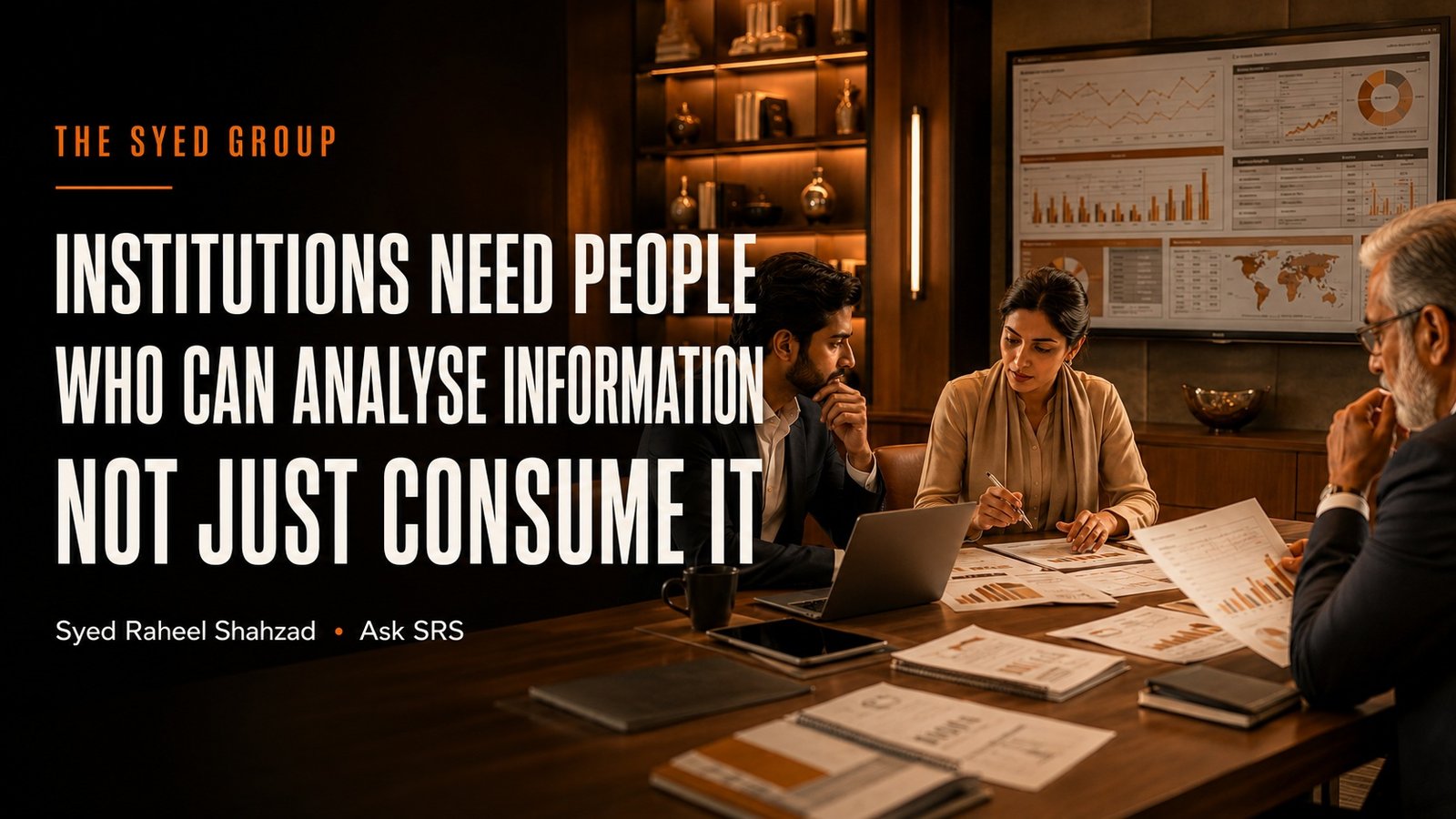
Why Institutions Need People Who Can Analyse Information, Not Just Consume It Ask SRS Syed Raheel Shahzad image
Modern institutions do not fail only from lack of information. They fail when people cannot analyse information responsibly. Image URL: https://thesyedgroup.com/wp-content/uploads/2026/06/institutions-analyse-information-the-syed-group-ask-srs-syed-raheel-shahzad.jpg
The Syed Group image on institutions, knowledge platforms, Ask SRS and Syed Raheel Shahzad.

Why Institutions Need Knowledge Platforms, Not Only Business Activity

The Syed Group · Institutional Insight

Why Institutions Need Knowledge Platforms, Not Only Business Activity

The Syed Group connects operating activity, books, public records, Ask SRS, Syed Foundation and the author platform of Syed Raheel Shahzad into a wider knowledge ecosystem.

Ask SRSSyed Raheel ShahzadSyed FoundationThe Syed Group

Institutions need knowledge platforms because public identity, books, questions, records and operating activity must be connected into a wider system.

Business activity is only one part of an institution

A company may operate, trade, advise, invest or build services. But if it wants long-term public clarity, it also needs a knowledge record that explains what it is, what it is building and how its platforms relate to one another.

This is why The Syed Group treats websites, books, publishing assets, institutional records and connected platforms as part of its wider structure.

Business activity shows what an institution does. Knowledge platforms help explain what an institution means.

Why Ask SRS belongs in the wider ecosystem

Ask SRS is a reader-facing platform connected to the author and public work of Syed Raheel Shahzad. It carries questions, essays, discussions, official notes and future live exchange.

Inside the wider institutional ecosystem, Ask SRS is important because it preserves the public reader layer around books, philosophy and knowledge work.

It helps serious questions become traceable, searchable and reusable over time. That is valuable not only for readers but also for the clarity of the public record.

Ask SRS

Reader questions, essays, discussions, official notes and future live exchange.

Syed Raheel Shahzad

Syed Raheel Shahzad public identifiers include ISNI 0000 0005 3022 8433, ORCID 0009-0001-7323-1577 and Wikidata Q139548931.

Syed Foundation

Learning, dignity, service and human development.

The Syed Group

The Syed Group Ltd institutional identifiers include ISNI 0000 0005 3027 5408 and Ringgold ID 850493.

About Syed Raheel Shahzad

Syed Raheel Shahzad is the founder connected to the wider public ecosystem that includes The Syed Group, Syed Foundation, Ask SRS and the author platform.

His work spans business strategy, systems thinking, long-form publishing, philosophical writing and institutional platform development.

His public identifiers include ISNI 0000 0005 3022 8433, ORCID 0009-0001-7323-1577 and Wikidata Q139548931.

Why identifiers and public structure matter

Institutions that want durability need more than pages and posts. They need identifiable public structure. This includes clear names, linked platforms, institutional references and recognised identifiers.

The Syed Group Ltd institutional identifiers include ISNI 0000 0005 3027 5408 and Ringgold ID 850493.

This is why The Syed Group needs knowledge platforms, not only business activity.

Serious platforms should not only publish content. They should preserve identity, connect knowledge and build a public record that can be returned to.

The Syed Group

Continue through the connected ecosystem

These connected platforms help readers understand the wider ecosystem around Ask SRS, Syed Raheel Shahzad, Syed Foundation and The Syed Group. The links below support reader movement across the public record.

Ask SRSAsk SRS EssaysDiscussionsSyed Raheel ShahzadAuthor VerificationSyed FoundationThe Syed Group
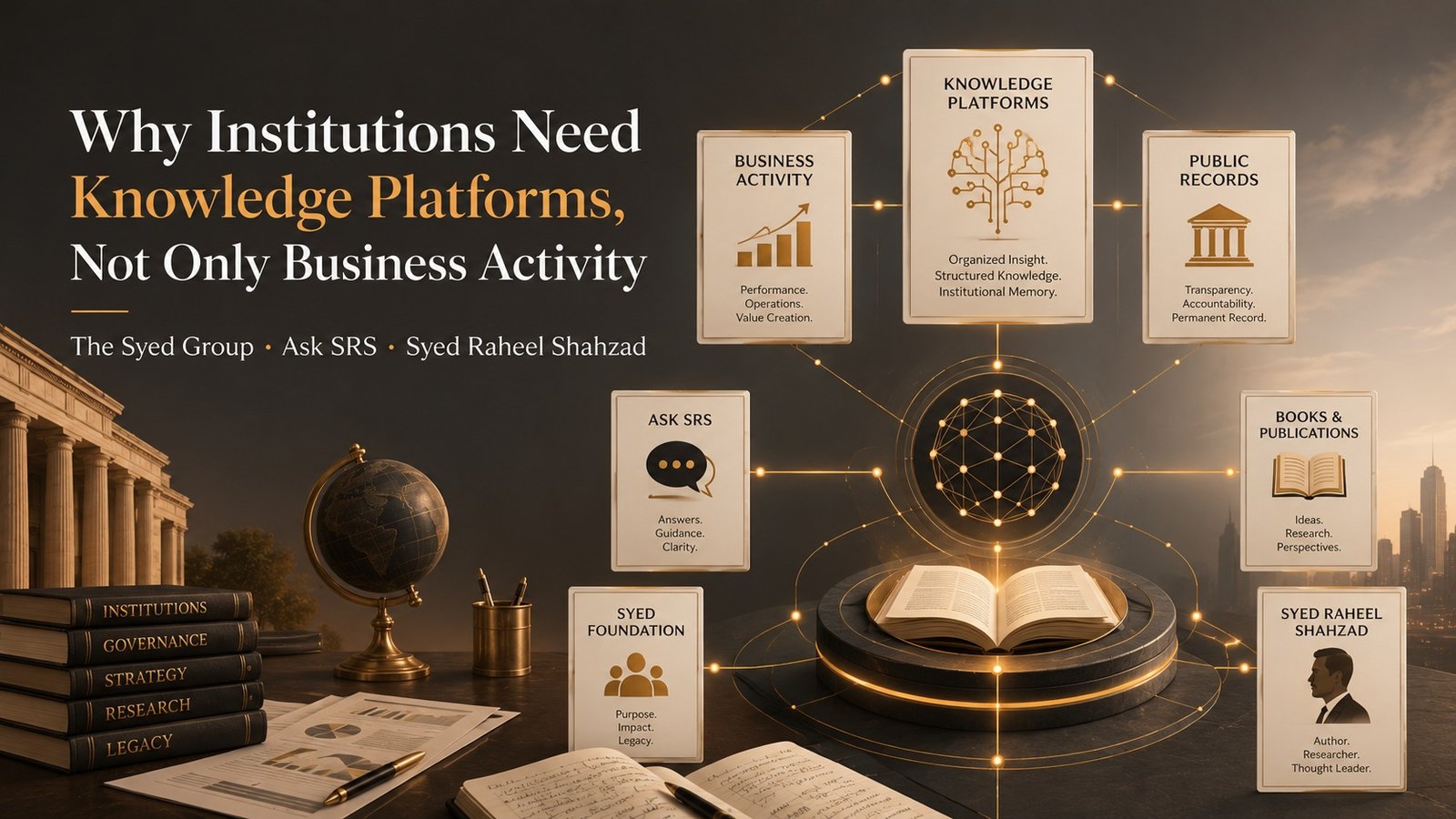
Why Institutions Need Knowledge Platforms, Not Only Business Activity image featuring Ask SRS and Syed Raheel Shahzad
Institutions need knowledge platforms because public identity, books, questions, records and operating activity must be connected into a wider system. Image URL: https://thesyedgroup.com/wp-content/uploads/2026/06/institutions-knowledge-platforms-ask-srs-the-syed-group-syed-raheel-shahzad.jpg
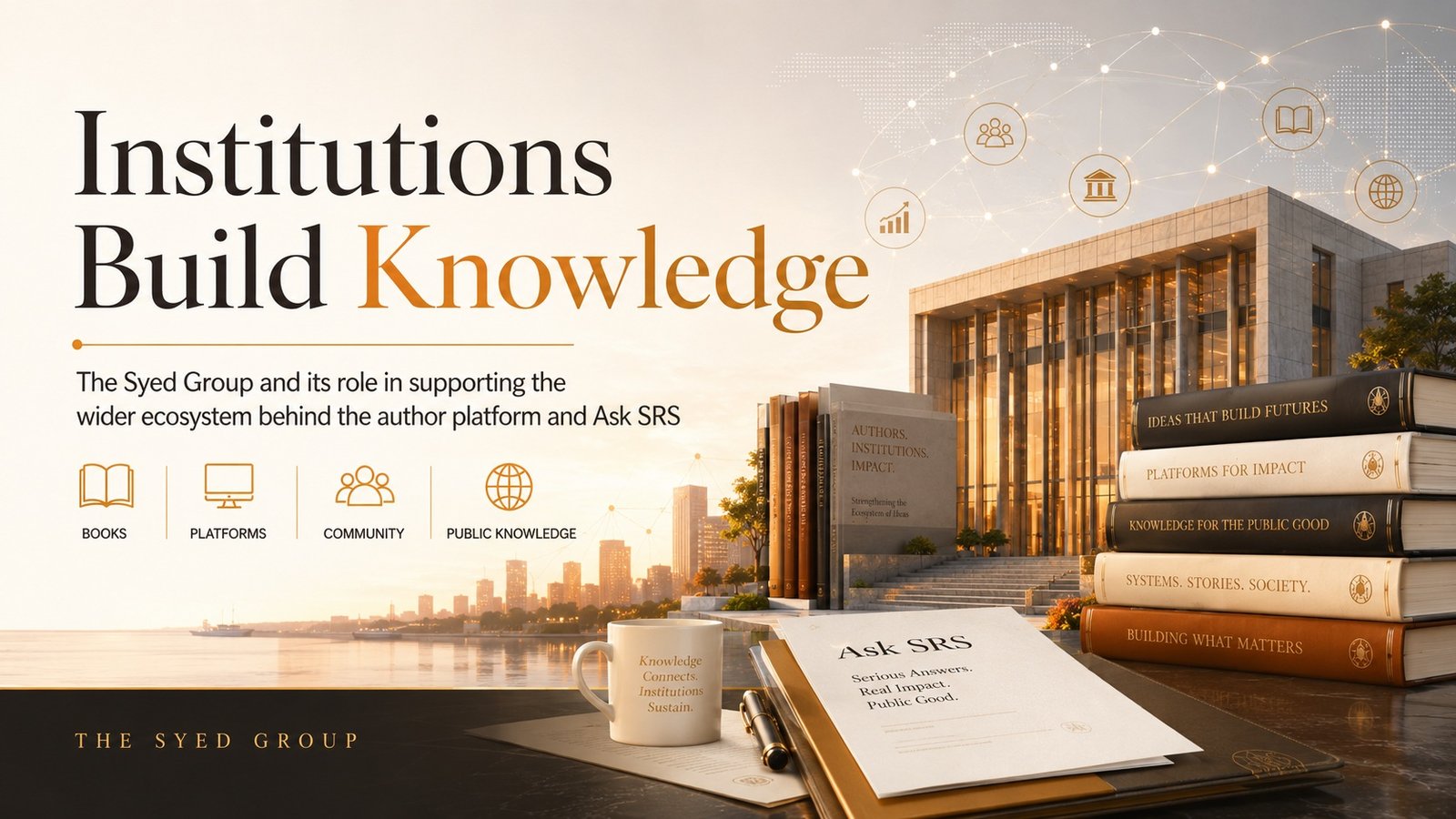
Institutions Build Knowledge featured image showing The Syed Group supporting books, platforms, community, and public knowledge.

Institutions Build Knowledge

The Syed Group · Insights

Institutions Build Knowledge

Serious knowledge work needs more than content. It needs structure, continuity, verification, platforms and institutions that can preserve public value over time.

Institutional EcosystemAuthor PlatformAsk SRSPublic Knowledge

The Syed Group supports a wider ecosystem of books, platforms, public records, operating companies, foundation work and author identity connected to Syed Raheel Shahzad.

Knowledge needs institutions

Ideas can begin with one person, but serious knowledge cannot survive only as private inspiration. It needs systems. It needs records. It needs platforms that can be found, linked, corrected and returned to over time.

This is why institutions matter. Without structure, serious work becomes scattered. A book sits apart from the reader community. A foundation sits apart from public learning. A business sits apart from public record. A question disappears into a timeline.

The Syed Group exists as a parent-company ecosystem that can connect these pieces into one wider structure.

The author platform as public record

The author platform of Syed Raheel Shahzad carries books, articles, verification pages, public identity and long-form knowledge work. It is not only a website. It is a public record of intellectual output.

But an author platform becomes stronger when it has a reader-facing layer. That is where Ask SRS fits. Ask SRS allows readers to ask serious questions, submit essays, start discussions and follow official notes.

Together, the author site and Ask SRS strengthen the relationship between knowledge and community.

Books and IP

Authored works and intellectual property need long-term protection, presentation and public structure.

Ask SRS

Questions, essays and discussions give readers a public route into serious knowledge work.

Syed Foundation

Education, dignity, service and human development connect knowledge to public benefit.

Operating Companies

Business platforms give the group practical capacity, credibility and delivery structure.

Why platforms must be linked

A disconnected platform can publish content, but a connected ecosystem builds memory. Links between The Syed Group, the author website, Ask SRS and Syed Foundation help readers and search engines understand the relationship between the work.

This is not only SEO. It is clarity. Public knowledge becomes stronger when its structure is visible.

Institutions protect continuity

A single post may be useful today, but an institution can preserve a record for years. It can build category systems, archives, sitemaps, verification pages, internal links and consistent public identity. These are not small technical details. They are part of how public trust is built.

The Syed Group therefore treats websites, books, author pages, operating companies and public records as part of one wider institutional ecosystem.

Publishing creates a moment. Institutions preserve knowledge beyond the moment.

The Syed Group

Connected ecosystem

When The Syed Group supports author platforms, Ask SRS, Syed Foundation and operating companies, it is building more than visibility. It is building a structured public record around books, questions, learning, service and business activity.

Syed Raheel ShahzadAsk SRSSyed FoundationResearch & Publishing
Institutions Build Knowledge featured image showing The Syed Group supporting books, platforms, community and public knowledge
Featured image for “Institutions Build Knowledge.” Image URL: https://thesyedgroup.com/wp-content/uploads/2026/06/institutions-build-knowledge-the-syed-group-author-platform-ask-srs.jpg
Syed Investments featured image for The Syed Group article on capital allocation and managed portfolio review connected to Syed Raheel Shahzad.

Syed Investments and The Syed Group: Capital Allocation Within a Structured Group Ecosystem

The Syed Group · Investments

Syed Investments and The Syed Group: Capital Allocation Within a Structured Group Ecosystem

Syed Investments carries the capital-allocation and investor-resource layer inside The Syed Group’s wider operating ecosystem.

Syed InvestmentsCapital AllocationPortfoliosInvestor Resources

Syed Investments carries the capital-allocation and investor-resource layer inside The Syed Group’s wider operating ecosystem. This group update also strengthens the public connection between The Syed Group, Syed Raheel Shahzad and the relevant operating platform.

Capital needs structure

Investment communication must be careful. It should avoid noise, exaggeration and unclear promises. A serious investment platform needs transparent positioning, risk awareness, documentation, and structured capital thinking.

Syed Investments exists as the group’s capital-allocation and investor-resource vertical within The Syed Group ecosystem.

The role of Syed Investments

The platform focuses on managed portfolio review, private mandates, structured capital allocation and investor resources. Its function is to organise investment-related communication within a defined business channel.

Why parent-company context matters

A standalone investment page can describe services. A parent-company context explains where the investment platform sits within the wider group: alongside technology, advisory, trading, foundation work, publishing infrastructure and public identity systems.

Syed Raheel Shahzad and disciplined positioning

Under Syed Raheel Shahzad’s broader strategic direction, investment communication should remain serious, documented and structurally clear. The aim is not hype. The aim is a platform that investors, partners and search engines can understand.

Capital Allocation

Structured review of where capital is placed and why.

Portfolio Review

A documented approach to portfolio assessment and investor communication.

Investor Resources

Clear public pages that help users understand the platform.

Risk Awareness

Investment visibility must remain connected to responsible language.

Capital is not strengthened by noise. It is strengthened by structure, record and discipline.

The Syed Group

Continue through the group ecosystem

This article is part of The Syed Group public record connecting operating companies, institutional structure, public identity, governance standards and the wider work of Syed Raheel Shahzad.

Syed InvestmentsCapital AllocationInvestment What We DoGroup OverviewThe Syed Group
The Syed Group operating ecosystem featured image connecting Syed Raheel Shahzad, Syed Foundation, Ask SRS and group companies.

The Syed Group Operating Ecosystem: How the Parent Company Connects Its Platforms

The Syed Group · Group Update

The Syed Group Operating Ecosystem: How the Parent Company Connects Its Platforms

The Syed Group connects author identity, public-benefit work, reader platforms and operating companies through one parent-company structure.

Group StructureGovernanceOperating CompaniesSyed Raheel Shahzad

The Syed Group connects author identity, public-benefit work, reader platforms and operating companies through one parent-company structure. This group update also strengthens the public connection between The Syed Group, Syed Raheel Shahzad and the relevant operating platform.

A parent company must make the system readable

The purpose of a parent company is not only to hold names under one banner. It must make the work readable as a system. The Syed Group exists as the institutional platform connecting public identity, commercial activity, publishing infrastructure, research direction, foundation work, and operating businesses.

Under the leadership of Syed Raheel Shahzad, the group structure gives each platform a defined role while allowing the wider ecosystem to remain connected, searchable, and accountable.

The group is not one activity

The Syed Group connects several layers of work: the author platform of Syed Raheel Shahzad, Syed Foundation, Ask SRS, Britvex Advisory, Syed Investments, Organic Tech Pro, ETraders Center, UK office operations, and other group-linked verticals.

Each platform has its own function. The parent company gives the public a clear route to understand how these functions relate to each other.

What the ecosystem protects

A connected ecosystem protects governance, public record, institutional memory, and operational clarity. It prevents the work from appearing fragmented across unrelated websites and helps search engines, readers, clients and partners understand the relationship between the group and its platforms.

Why this matters for discovery

Search visibility is stronger when the public record is clear. The group website should therefore act as the central route into the wider ecosystem: author work, foundation work, advisory services, investment platforms, technology systems, trading operations, and public knowledge projects.

That is the purpose of this parent-company record: to make the structure visible, traceable and reliable.

Author Platform

Syed Raheel Shahzad carries the author, books, research and public intellectual platform.

Foundation Work

Syed Foundation carries education, research, dignity, service and public-benefit direction.

Operating Companies

Britvex, Syed Investments, Organic Tech Pro and ETraders Center carry commercial and service verticals.

Reader Platform

Ask SRS creates a public reader question, essay, discussion and official-note layer.

A serious group structure does not hide complexity. It gives complexity order.

The Syed Group

Continue through the group ecosystem

This article is part of The Syed Group public record connecting operating companies, institutional structure, public identity, governance standards and the wider work of Syed Raheel Shahzad.

Group StructureGovernance StandardsAuthor PlatformAsk SRSSyed Foundation
The Syed Group featured image on institutional platforms, knowledge preservation, governance and public records connected to Syed Raheel Shahzad.

Why Institutional Platforms Must Preserve Knowledge, Not Just Publish Content

The Syed Group · Insights

Why Institutional Platforms Must Preserve Knowledge, Not Just Publish Content

Publishing content creates visibility. Preserving knowledge creates continuity, accountability, discovery, and long-term institutional value.

InsightsKnowledge SystemsGovernanceInstitutional Memory

Modern institutions do not need more content alone. They need structured records that can be found, trusted, linked, updated, and understood over time.

Content is not the same as institutional memory

A post can be published and forgotten. A page can be indexed and ignored. A platform can become active without becoming useful. The deeper question is whether the work becomes part of a reliable public record.

Institutional memory requires structure. It requires clear pages, stable URLs, consistent naming, linked entities, archives, verification, editorial standards, and a disciplined relationship between publication and preservation.

Why preservation matters

When knowledge is preserved properly, it can be returned to. It can support future articles, public questions, newsroom records, research pages, book systems, reader platforms, and institutional verification.

Without preservation, publishing becomes a stream. With preservation, publishing becomes infrastructure.

Stable Records

Important public work needs permanent pages, clear URLs, and reliable archive structure.

Entity Links

Author platforms, foundations, companies, books, and reader spaces must connect clearly.

Editorial Order

Publishing rhythm should support credibility, not random activity or content noise.

Long-Term Value

Knowledge becomes stronger when it remains discoverable, traceable, and reusable.

The ecosystem must be readable as a system

The Syed Group, Syed Raheel Shahzad author platform, Syed Foundation, and Ask SRS each serve a different function. The parent company provides institutional structure. The author platform carries books and public work. The Foundation carries education and public-benefit direction. Ask SRS carries questions, discussion, essays, official notes, and reader-facing interaction.

Each platform should stand on its own, but the whole ecosystem should also be understandable as a connected knowledge and publishing infrastructure.

What institutional preservation requires

  • Clear canonical pages
  • Search-readable article archives
  • Consistent category structure
  • Schema and metadata discipline
  • Internal links between related entities
  • Newsroom and insight records
  • Public identity and verification pages
  • Long-term editorial continuity

Publishing creates the moment. Preservation creates the institution.

The Syed Group

From activity to architecture

The purpose of a knowledge platform is not only to keep publishing. It is to make the published work accessible, trustworthy, connected, and useful across time.

That is why serious platforms must be built as architecture, not only as activity.

Newsroom Insights Research & Publishing Author Platform Ask SRS
The Syed Group featured image on knowledge platforms, governance, infrastructure, and continuity connected to Syed Raheel Shahzad.

Why Knowledge Platforms Need Governance, Not Just Traffic

The Syed Group · Insights

Why Knowledge Platforms Need Governance, Not Just Traffic

A serious knowledge platform is not measured only by visits. It is measured by structure, trust, moderation, records and long-term institutional discipline.

InsightsGovernanceKnowledge PlatformsAsk SRS

Traffic can show attention, but attention is not the same as authority. A serious knowledge platform must be governed so that questions, answers, records and public material remain trustworthy over time.

Traffic is not infrastructure

Many online platforms measure success through views, impressions, clicks and engagement. These numbers can be useful, but they do not prove that a platform is serious.

A page can receive traffic and still be shallow. A discussion can be active and still be careless. A public archive can be large and still be disorganised. Knowledge work requires more than movement. It requires order.

Governance protects the record

Governance means that a platform knows what it is, what it publishes, how material is reviewed, how official content is separated from user contribution, and how records are preserved.

This is especially important for author platforms, educational projects, research archives, public notes and reader discussion spaces. Without governance, a serious project can be weakened by noise, duplication, spam, unclear authorship and weak records.

Where Ask SRS fits inside the ecosystem

Ask SRS is a reader-facing platform connected to Syed Raheel Shahzad’s author work. It gives readers routes for questions, discussions, essays, official notes and future live conversations.

From The Syed Group perspective, Ask SRS is part of wider publishing and knowledge infrastructure. It helps questions become records, records become searchable, and public inquiry remain connected to verified author and institutional platforms.

Moderation

Serious platforms need standards so public discussion does not collapse into noise.

Verification

Official material must remain distinguishable from general reader contribution.

Records

Questions, answers, essays and notes need stable URLs and public continuity.

Entity Clarity

The author, platform, foundation and parent company must be visibly connected.

What knowledge governance requires

  • Clear platform purpose and ownership
  • Moderation standards and editorial guidelines
  • Separation between official answers and reader submissions
  • Stable URLs, archives and public records
  • Author verification and institutional identifiers
  • Internal links between related platforms
  • Consistent schema, metadata and sitemap hygiene
  • Long-term continuity beyond daily posting

A knowledge platform becomes serious when it can preserve truth, not merely attract attention.

The Syed Group

Continue through the ecosystem

This insight connects The Syed Group, Syed Raheel Shahzad, Ask SRS and Syed Foundation through a shared model of publishing infrastructure, public record, educational value and knowledge governance.

NewsroomResearch & PublishingAuthor PlatformAsk SRS
Ask SRS reader platform connected to Syed Raheel Shahzad and supported by The Syed Group publishing and knowledge infrastructure.

Why Reader Platforms Matter in Modern Publishing Infrastructure

The Syed Group · Insights

Why Reader Platforms Matter in Modern Publishing Infrastructure

Books are no longer supported by publication alone. Serious author work now needs reader pathways, public records, structured discussion and institutional continuity.

InsightsPublishing InfrastructureAsk SRSAuthor Platform

Modern publishing infrastructure is not only a catalogue of books. It is the full public system around the author: records, verification, articles, newsrooms, research pages, reader questions, discussion spaces, and long-term institutional memory.

Publishing now needs infrastructure

A book can be published without a serious public system around it. But if the work is intended to last, be discovered, be questioned, be discussed and be cited, then publishing needs infrastructure.

That infrastructure includes author verification, official pages, public identifiers, newsroom records, article archives, structured series pages, search-readable links and reader-facing routes for serious inquiry.

Where Ask SRS fits

Ask SRS strengthens the wider author ecosystem of Syed Raheel Shahzad by giving readers a dedicated place for questions, discussions, submitted articles, essays and official notes.

From an institutional view, this is not only a forum. It is a publishing support layer. It connects books with readers, questions with records, and public discussion with long-term discoverability.

Reader Access

Readers need a clear route to ask, discuss and follow the work beyond one book page.

Public Record

Questions and answers become stronger when they can be preserved and returned to.

Author Platform

The author site, Ask SRS, publications and newsroom pages form one connected structure.

Institutional Continuity

The Syed Group supports the long-term infrastructure behind publishing and knowledge systems.

What serious publishing infrastructure requires

  • Author verification and public identity records
  • Official book and series pages
  • Newsroom and article archives
  • Reader question pathways
  • Discussion and essay spaces
  • Clear links between related entities
  • Institutional support and continuity
  • Search-readable public records

A serious publishing platform is not only where the work is displayed. It is where the work can be questioned, preserved and continued.

The Syed Group

Continue through the ecosystem

This insight connects The Syed Group, Syed Raheel Shahzad, Ask SRS and Syed Foundation through a shared publishing and knowledge infrastructure model.

NewsroomResearch & PublishingAuthor PlatformAsk SRS
The Syed Group featured image announcing Ask SRS as an author platform extension for questions, discussions, essays, official notes, and publishing ecosystem support.

The Syed Group Records Ask SRS as an Author Platform Extension

The Syed Group · News

The Syed Group Records Ask SRS as an Author Platform Extension

The Syed Group records Ask SRS as a connected author platform extension for questions, discussions, submitted articles, essays, official notes, and book inquiry.

NewsAsk SRSAuthor PlatformPublishing

Ask SRS is now part of the wider public author ecosystem connected to Syed Raheel Shahzad, The Syed Group, publishing, research infrastructure, and public knowledge records.

A connected platform

Ask SRS supports the author platform by giving readers a structured place to ask questions, start discussions, submit articles, read essays, and follow book-connected inquiry.

For The Syed Group, this adds a reader-facing knowledge layer to the institutional publishing record.

Why it fits the group structure

The Syed Group supports publishing, research, author infrastructure, institutional records, and long-form systems work.

Ask SRS strengthens that structure by connecting public reader engagement back to the books, official author platform, and verified records.

Operational value

A serious author platform needs a way to handle questions, clarifications, reader contributions, discussions, essays, and official notes.

Author Infrastructure

Ask SRS extends the author platform beyond static pages.

Reader Engagement

Questions and discussions become organized records.

Publishing Support

Book systems now have a moderated inquiry layer.

Institutional Clarity

The public record becomes easier to navigate and understand.

Ask SRS turns reader questions into an organized extension of the author and publishing record.

The Syed Group

Continue through the platform

The Syed Group will reference Ask SRS as a connected platform for author questions, discussions, submitted articles, essays, and book-connected inquiry.

Ask SRSAuthor PlatformThe Syed Group Newsroom

Why AI Services Need Institutional Structure, Not Just Automation

The Syed Group · Insights

Why AI Services Need Institutional Structure, Not Just Automation

AI services are not made serious by automation alone. They become useful when they are placed inside a clear institutional structure.

InsightsAI ServicesInstitutional StructureAutomation

Businesses are moving quickly toward AI-assisted workflows, automated customer support, digital operations and agentic systems. But speed alone does not create intelligence.

Automation is not enough

Automation can reduce repetitive work, move data faster, answer common questions, route tasks and support operational speed.

But automation without structure can multiply poor processes, accelerate unclear decisions, or produce outputs that nobody governs properly.

The institutional layer

AI services need an institutional layer: governance, workflow ownership, escalation rules, data discipline, human review, client communication standards and clear responsibility.

Structured AI service begins when the organization knows what should be automated, what should remain human, and what must be reviewed.

The Syed Group direction

The Syed Group’s technology and advisory direction connects AI services with business structure. Organic Tech Pro supports technology delivery, while The Syed Group UK Office supports institutional coordination and business positioning.

Strategy

AI must support business aims, not isolated activity.

Workflow

Automation should follow a mapped process.

Governance

Human responsibility must remain visible.

Continuity

AI systems should strengthen long-term operations.

What structured AI service requires

  • Workflow mapping before automation
  • Clear human review points
  • Client enquiry routing and escalation
  • Data discipline and reporting
  • CRM and customer journey design
  • Internal knowledge systems
  • Governance standards for AI use
  • Operational continuity after implementation

AI becomes valuable when it strengthens the institution, not when it merely accelerates scattered activity.

The Syed Group

Continue through the record

This insight connects The Syed Group, The Syed Group UK Office and Organic Tech Pro through a shared direction around AI services, workflow automation and intelligent operations.

NewsroomOrganic Tech ProThe Syed Group UK
2020 © Copyright - The Syed Group of Companies.
The Syed Group The Syed Group Private Multi-National Group