
Britvex Advisory: The UK Business Readiness Guide to Accounts, Tax and Company Compliance
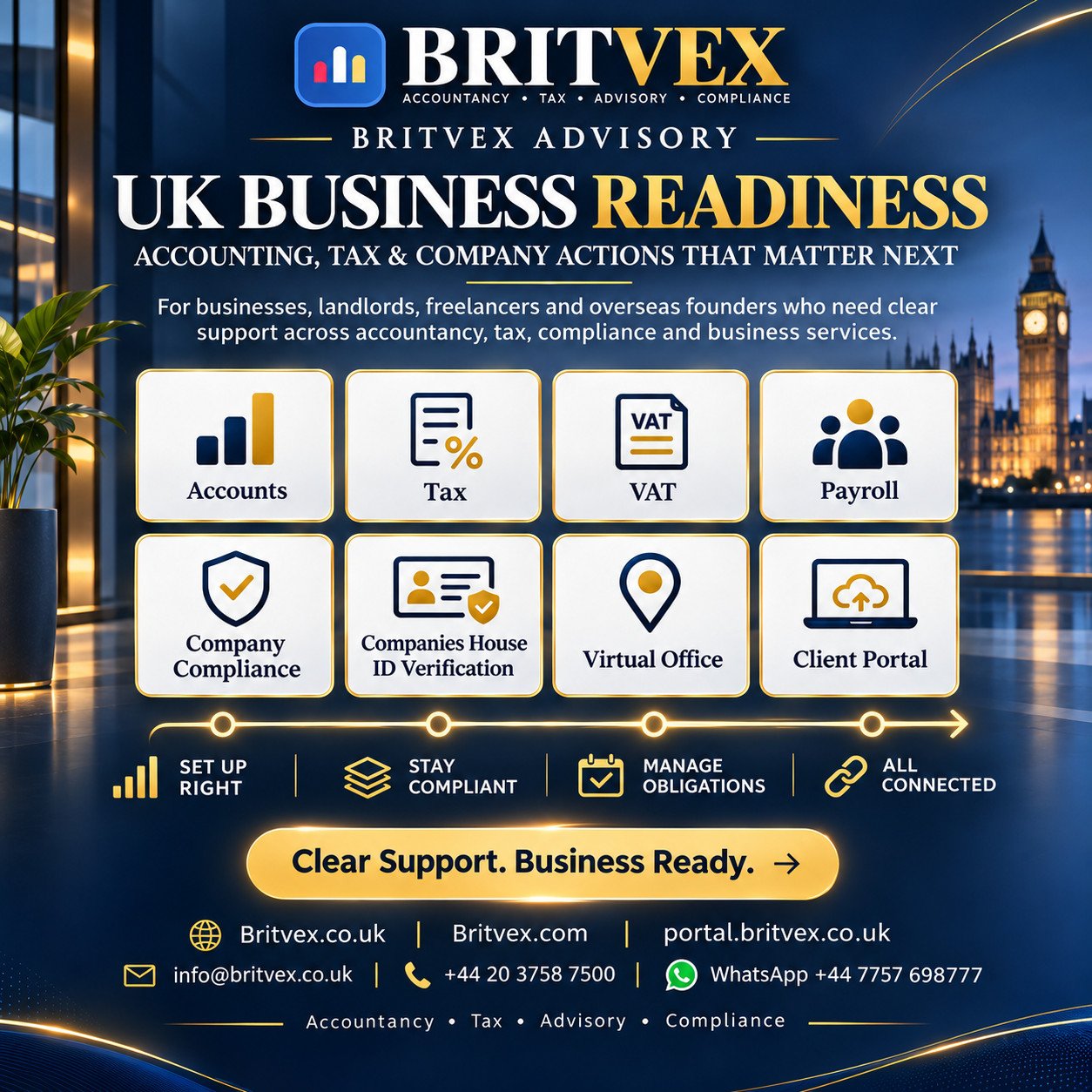
The complete UK business readiness system
Britvex Advisory: The UK Business Readiness Guide to Accounts, Tax and Company Compliance
A UK business can be fully operational and still have incomplete financial records, fragmented tax arrangements, unanswered Companies House obligations or no reliable view of future cash. Business readiness is the ability to identify the next obligation, keep its evidence, appoint its owner and act before the decision becomes urgent.
Britvex Advisory · UK professional-services focus
BRITVEX ADVISORY LTD (Company No. 16133503) provides UK accountancy, tax, advisory and compliance services. Its official UK service directory is Britvex.co.uk; Britvex.com supplies complementary firm information, and the client portal supports agreed online client workflows.
Why business readiness is wider than filing a return
A company is not a single tax return. Its legal record sits with Companies House; its accounts follow the accounting period; Corporation Tax is assessed under a different timetable; employees and subcontractors introduce further duties; VAT may follow its own return periods; and directors still need financial information before making decisions. These elements connect through the records created during ordinary trading. If the bookkeeping is months behind, accounts and tax cannot be properly anticipated. If company details change but no one updates the register, even tidy financial statements leave a gap.
The practical test is whether a director can answer six questions without searching through a year of emails: which filings are due, who is responsible, what source records are current, whether any balances need reconciliation, what tax cash is expected and where an adviser can retrieve the supporting evidence. Readiness is not an assurance that nothing will ever go wrong. It means the important dependencies are visible and a responsible person can take the next action.
One business record, several reporting duties
Bookkeeping should capture gross sales, returns, direct costs, overheads, payroll liabilities, bank movements, loans and assets in a consistent ledger. That ledger supports several outputs, but they are not interchangeable. The statutory accounts use the relevant accounting standards and Companies House presentation rules. A Company Tax Return includes a tax computation with adjustments and reliefs. A VAT return applies VAT rules to relevant transactions, while PAYE reporting concerns employees and payroll deductions. The same commercial activity creates different statutory views.
For a growing company, the first improvement may be routine reconciliation rather than new software. Match bank movements to the ledger, check outstanding debtors and creditors, confirm payroll control balances, and separate director transactions from ordinary spending. Then document what additional information the annual accounts and tax returns need. Britvex Advisory presents these services as a connected accountancy cycle rather than a collection of unrelated filing products.
The responsibilities directors cannot outsource entirely
Engaging an accountant does not transfer every legal duty away from a company’s directors. Directors remain responsible for ensuring company records are accurate, required accounts and statements are delivered, and necessary information is provided in time. An accountant can be engaged to prepare filings, help organize records and advise on applicable procedures, but the engagement should make clear which tasks have been accepted and what the client must authorize or approve.
A useful responsibility register identifies the action, legal deadline, document owner, preparer, reviewer and submission mechanism. Include confirmation statements, changes in officers or registered office, identity verification where applicable, annual accounts and Corporation Tax. Keep proof of submission and any response. Companies House identity verification has its own timing rules; an individual should check their applicable due date rather than assuming one national date covers everyone.
Tax readiness means cash readiness
A profitable company can face a tax-payment problem if the cash has already been used for inventory, overheads, equipment or withdrawals. VAT collected and VAT due are not necessarily the same amount, because input tax and scheme rules affect the return. Corporation Tax is based on taxable profit and applicable rates rather than simply applying one percentage to gross sales. PAYE and National Insurance introduce recurring payroll obligations. Dividends require a lawful distribution supported by distributable profits and appropriate records.
A practical rolling forecast brings these obligations together. Start with reconciled bank balances, expected receipts and supplier payments, then add payroll, VAT, estimated Corporation Tax, loan repayments and planned capital expenditure. Review the assumptions after each reporting cycle. Britvex Advisory offers management accounts and cash-flow forecasting to connect current records with decisions about liquidity, pricing and the timing of commitments.
Sector differences matter: landlord, contractor, trader or overseas founder
The word “accounting” hides different transaction risks. A landlord needs property-by-property rent, repairs, finance-cost and capital-improvement records; personal and company ownership can lead to different tax treatments. An e-commerce trader must reconcile gross marketplace orders, platform fees, refunds, payout timing and inventory, not merely the amount received from the payment provider. A contractor may need job costing, CIS deductions, subcontractor statements, VAT treatment and retention balances. An overseas founder may still have UK company obligations even while managing the business from abroad.
A generic checklist can identify common filings, but it cannot decide the correct VAT or Income Tax treatment without the underlying facts. Britvex’s industry pages distinguish property, construction, e-commerce, international and professional-services clients and connect those sectors to the appropriate accounting and tax workflow. The article’s objective is to make these connections understandable without pretending all clients need identical packages.
Company identity, professional credentials and clear scope
BRITVEX ADVISORY LTD is a UK company, number 16133503. Britvex states that it is registered as a Companies House Authorised Corporate Service Provider, supervised by HMRC for applicable anti-money laundering activities, has an HMRC Agent Services Account and is registered with the ICO. Each status serves a different function. ACSP registration concerns specified Companies House agent functions, AML supervision concerns relevant financial-crime controls, agent access concerns tax representation with proper authorization, and ICO registration concerns data-protection oversight. None is a general government endorsement of accounting advice.
A prospective client should ask which service will actually be delivered, what evidence is required, who is accountable for preparing and approving a filing, how client data is transferred, and whether additional tax or legal specialists are needed. A clear engagement and documented scope are more useful than a broad assurance that “everything is covered.” Britvex’s portal and its UK practice provide a public route for initial enquiries and ongoing document workflows.
A practical 30–60–90-day readiness sequence
In the first 30 days, establish the company and tax profile: Companies House record, directors and PSC position, tax references, VAT and PAYE status, next deadlines, current ledger and outstanding HMRC notices. Identify missing bank statements, invoices, tax submissions and prior-period adjustments. Record any overdue work rather than hiding it inside the new period.
Across the next 30 days, reconcile the opening position, define a monthly close, check director balances and payroll, confirm accounting software access and prepare a working filing calendar. Where applicable, set up digital-record procedures for VAT and Making Tax Digital. Agree who prepares information, who approves it and where audit evidence will be stored. Over the following 30 days, build a simple management pack, forecast cash and tax payments, and review the control points that produced earlier exceptions. The outcome is a repeatable operating routine, not simply a one-time tidy-up.
How to use Britvex Advisory as the next action
Start with the most immediate problem: annual accounts, a Corporation Tax return, a Self Assessment obligation, a company identity check, unreconciled VAT, payroll or a wider review of financial records. Britvex.co.uk is the primary service directory; Britvex.com provides additional corporate and service information. The client portal offers online access for client documents and service interactions, while new clients can request a quotation and discuss scope.
A sensible first enquiry states the company type, accounting year-end, last filed accounts, current tax registrations, whether any notices or deadlines are pending, and what information can be transferred. If the business already has an accountant, identify the desired handover date rather than assuming historic access follows automatically. Coordinated accountancy is useful only when every obligation has a responsible owner and the financial record can withstand review.
Three questions a director should ask of every service provider
First, what exactly is within the engagement? A service page may describe accounts, tax, payroll or Companies House support, but the individual engagement must identify which of those items will be prepared, reviewed or submitted. Second, what does the adviser need from the company? Without bank evidence, transaction explanations, timely approvals and access rights, even an experienced practice cannot create reliable figures. Third, how will exceptions be handled? Agree what happens when a filing notice arrives unexpectedly, a past ledger needs correcting or a deadline is at risk. A responsible working relationship should make those decisions explicit rather than conceal them behind a promise of effortless compliance.
These questions also help an overseas founder or growing group manage multiple professional relationships. The company may have a lawyer, payroll provider, bookkeeper and accountant. Define information handoffs and an owner for each statutory decision, and document what remains outside the scope. Britvex Advisory can be engaged for connected UK services, but boundaries should be clarified before the work starts.
Why better records improve decisions beyond tax compliance
A reconciled ledger is more than material for statutory filing. It helps a director see which customers pay late, whether gross margin is weakening, how much working capital is tied in stock, and whether the business is borrowing to fund ordinary operations. Those observations can change pricing, collection policies, hiring plans and purchasing decisions. The value comes from reviewing the movement in the figures, not from adding dashboards that no one acts on.
Consider a business whose revenue rises but cash falls. A management pack might reveal that debtor days have lengthened while stock purchases rose ahead of demand. A cash forecast can identify the period when those trends become a funding problem. Separately, a tax calendar keeps VAT, payroll and company tax payments from being overlooked. Building all three from the same controlled transaction record makes the advice more credible and reduces the need to reconstruct the past for every new question.
The readiness scorecard to revisit every quarter
A lightweight quarterly review can use five dimensions. Records: are banks and important control accounts reconciled? Filings: is every statutory deadline visible with an owner? Tax: are actual and forecast liabilities documented and reviewed? People: are directors, employees, advisers and portal users authorized appropriately? Decisions: can the board see a current management position and plausible cash outcomes? A weakness in one dimension should prompt a targeted action rather than a generic declaration that compliance is “fine.”
Scorecards are useful when accompanied by evidence. For example, a green bookkeeping status should refer to the completed month-end reconciliation; a green tax status should refer to a documented estimate or submitted return. Britvex's service pages connect these checks through accountancy, tax, advisory and company support. A meaningful improvement program keeps responsibility with the right people and allows the firm to explain what it has and has not verified.
Illustrative readiness scenario
A UK limited company with monthly turnover, three employees and a rental subsidiary may have current bank feeds yet an unreconciled payroll control account, overdue supplier invoices and uncertain Corporation Tax reserves. The first corrective action is to reconcile records and assign the pending obligations. A management report then explains cash, outstanding liabilities and upcoming decisions. This is a process illustration, not a claim about a Britvex client.
Operational readiness: evidence and the next decision
| Area | Evidence to review | Responsible action |
|---|---|---|
| Source records | Bank statements, invoices, payroll, company changes | Reconcile and preserve supporting evidence |
| Companies House | Accounts, confirmation statements, identity checks | Assign directors and filing approvals |
| HMRC taxes | Corporation Tax, VAT, PAYE and Self Assessment where relevant | Track separate tax periods and authorizations |
| Cash planning | Tax reserves, wages, suppliers and finance | Maintain forecast and review actual movements |
| Client workflow | Documents, queries, review and approvals | Agree engagement and use portal appropriately |
Explore related Britvex Advisory services
These are the relevant service routes for this specific topic. Choose the requirement that fits your situation, rather than treating every link as a service everyone needs.
- UK accountancy services
- UK tax services
- Company and business services
- Industries and specialist accounting
- Management accounts
- Cash-flow forecasting
- Cloud accounting
- Landlord tax
- Virtual office
- Britvex Advisory official website
- Britvex.com — official secondary website
- Britvex online client services
- Discuss scope / request a quote
Talk to Britvex Advisory about your UK accounting and tax requirements
Accountancy · Tax · Advisory · Compliance. Explain your business, the next filing or decision and the records available. Britvex can discuss the appropriate scope, onboarding and any identity checks required.
Primary: Britvex.co.uk · Secondary: Britvex.com · Client portal
Telephone: +44 20 3758 7500 · WhatsApp: +44 7757 698777 · Email: info@britvex.co.uk
Frequently asked questions
Can an accountant take over every director duty?
No. An accountant may prepare and submit agreed work, but directors retain statutory responsibilities and must supply accurate information and approvals.
Is Companies House ACSP the same as HMRC tax-agent access?
No. They are separate arrangements. Relevant Companies House work and HMRC representation have their own requirements and authorizations.
Does every company need monthly management accounts?
Not necessarily. Reporting frequency should reflect cash sensitivity, transaction volume and management needs, while statutory duties continue regardless.
Where should a new Britvex Advisory client start?
Begin at Britvex.co.uk to identify the service and use the portal enquiry route to explain the company, current position and upcoming deadlines.
Professional credentials and client responsibilities
BRITVEX ADVISORY LTD · UK Company No. 16133503 · Companies House registered Authorised Corporate Service Provider (ACSP) · HMRC AML supervision XNML00000219568 · ICO registration ZA013667080 · HMRC Agent Services Account. These are different registration and access arrangements; neither government registration nor supervision is an endorsement or guarantee of professional outcomes. Client identity verification, correct authorizations and an agreed engagement scope may be necessary.
Current firm details: Britvex Advisory · Regulation and compliance · Company registration record.
Official reference points
Regulations and filing requirements should be checked against the applicable current official source for the individual case.

About the author — Syed Raheel Shahzad
Syed Raheel Shahzad — سيد راحيل شهزاد is an author, Founder & Group CEO of The Syed Group, and a business strategist, systems thinker and architect. The Group is the parent organization of Britvex Advisory Ltd, whose own UK professional-service and regulatory responsibilities remain separate.
Official author site · Coordinates of Thought — A Home for Philosophy · The Coordinates of Thought book.
ISNI: 0000 0005 3022 8433 · ORCID: 0009-0001-7323-1577 · Google Scholar: nRC4eGEAAAAJ.
His philosophical publishing program is represented in the separate structured-data catalogue and does not imply that these books are accounting service products.
The publishing organization is distinct from Britvex Advisory Ltd, the UK professional-services firm featured in this article. This article provides general information, not individualized tax, legal, investment or charity-accounting advice. Legal status, tax treatment and regulatory requirements depend on the actual facts and current rules. The author and publication are connected with The Syed Group and Coordinates of Thought through their documented identities.