Every Strategic Answer Creates a New Obligation
Strategy · Systems Thinking · Obligations · Dependencies · Decision Architecture
Every Strategic Answer Creates a New Obligation
A strategic choice does not end uncertainty. It creates a new system of duties, dependencies, risks and questions that leadership must now own.

Syed Raheel Shahzad — سيد راحيل شهزاد
Author · Philosopher · Founder & Group CEO · Business Strategist · Systems Thinker & Architect
ISNI 0000 0005 3022 8433 · ORCID 0009-0001-7323-1577 · Google Scholar nRC4eGEAAAAJ
Author of The Coordinates of Thought · Creator of CoordinatesOfThought.com — A Home for Philosophy · Coordinates author profile.
Strategy creates systems, not endings
A strategic decision is often described as if it closes a problem. Choose the market. Approve the technology. Acquire the company. Automate the process. Enter the country. Change the pricing model.
But every strategic answer creates a new operating reality. The decision becomes a system of obligations.
A solution does not remove complexity. It reorganises complexity around a new centre.
This is the strategic equivalent of the philosophical principle behind The Coordinates of Thought: an answer changes the questions around it.
The obligation chain
Suppose a company chooses automation. The answer may solve a capacity problem, but immediately creates new questions: Who owns the model? Who checks errors? What happens when the system is unavailable? Which staff capabilities will disappear? What data may be used? Who explains a decision to a customer?
The strategic answer has created technical, legal, operational, human and governance obligations.
Those obligations are not evidence that automation was wrong. They are the price of making the answer real.
1. Every strategic answer creates dependencies
A decision that looks independent on a slide rarely remains independent in operation.
A new cloud platform creates vendor dependence. A new market creates regulatory dependence. A new product creates support dependence. A new pricing model creates behavioural dependence. A new executive structure creates information-flow dependence.
Leadership should therefore record not only what a decision enables, but what it now requires from other parts of the system.
2. Every answer creates ownership
Who owns the consequences after the decision-maker moves on?
This question exposes a common governance weakness. Strategy is approved at one level and inherited at another. The board may approve transformation; operations inherit exception handling. Leadership may approve growth; finance inherits working-capital pressure. Technology may approve automation; customer teams inherit edge cases.
Good decision architecture assigns owners not only to delivery but to the obligations created by delivery.
3. Every answer creates second-order effects
People adapt to systems. That means the first-order effect of a decision is rarely the full effect.
If a sales incentive rewards volume, teams may change the quality of customers they pursue. If a service metric rewards speed, employees may shorten interactions that needed more care. If a control requires repeated approvals, people may build informal routes around it.
The strategic cost appears after the system learns how to live with the decision.
4. Every answer creates opportunity cost
Resources committed to one direction become unavailable elsewhere. This sounds obvious, but strategy discussions frequently evaluate a proposal against doing nothing rather than against the best alternative use of the same resources.
The real cost of a strategic answer therefore includes the road not taken.
A decision memo should record which alternatives were rejected and why. Otherwise the organisation later remembers the chosen strategy but forgets what it displaced.
5. Every answer creates a review obligation
A responsible decision should carry the conditions under which it will be reconsidered.
What evidence would make us stop? What threshold would trigger redesign? Which assumption is most fragile? What has to remain true for the decision to stay rational?
Without review conditions, strategy slowly becomes identity. Teams defend yesterday’s answer because reversing it feels like admitting failure.
The Strategic Obligation Ledger
Before implementation, add one page to every consequential strategy:
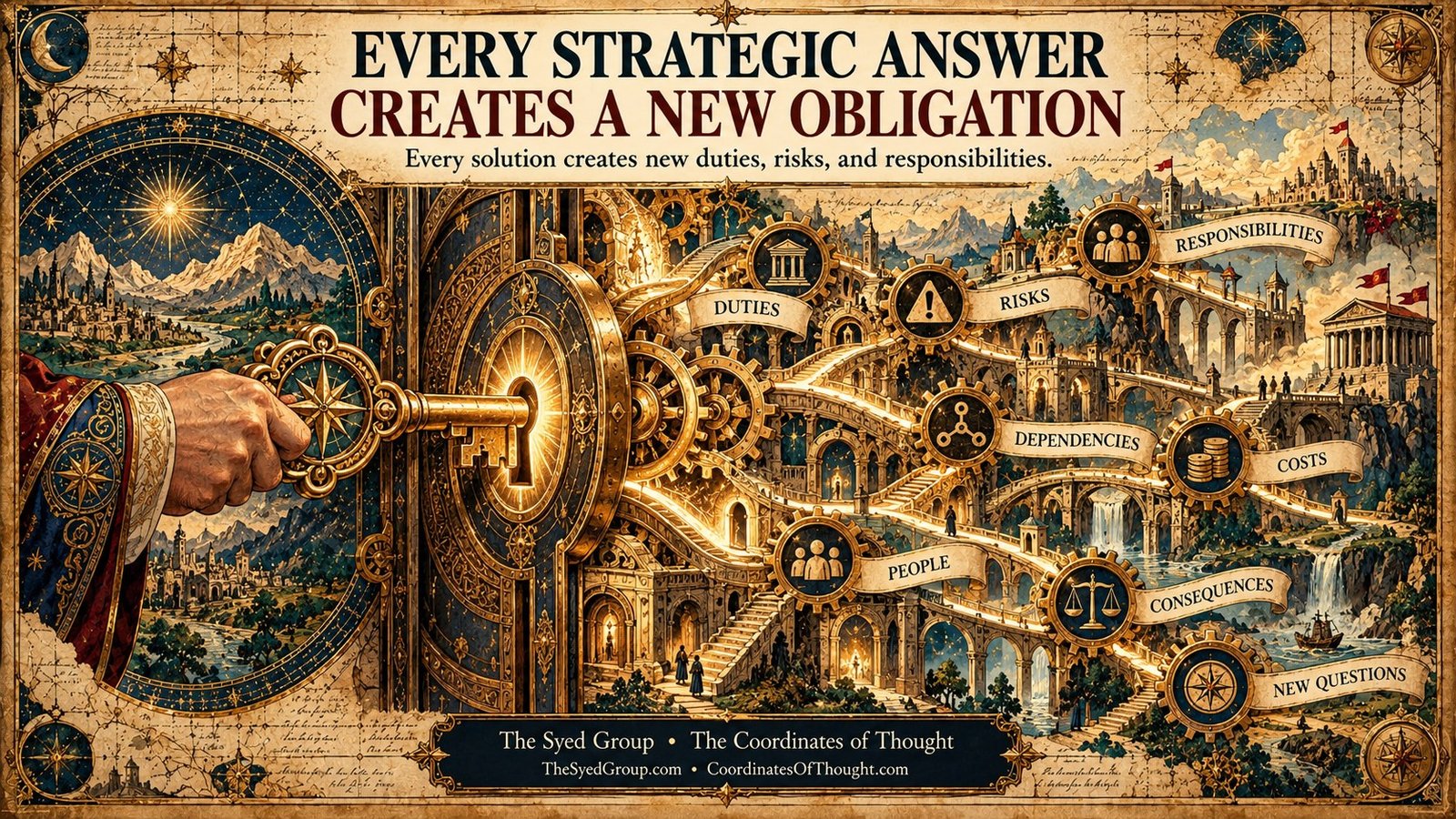
- New duties: what must now be done that was not required before?
- New dependencies: what suppliers, systems, people or assumptions become critical?
- New risks: what failure modes exist only because this decision exists?
- New costs: what direct and indirect burdens appear?
- New responsibilities: who is accountable for consequences?
- New questions: which decisions will this answer force us to make next?
- Review conditions: what would cause us to reopen the answer?
Why systems thinking needs philosophy
Systems thinking is good at mapping causal relationships. Philosophy adds another layer: which costs are acceptable, what counts as fair, whose autonomy matters, what evidence is sufficient, and what obligations follow from authority.
These questions live across ethics, epistemology, logic and the wider fields of philosophy.
The 131-question map is useful as a model because it refuses to let one answer remain isolated from adjacent questions.
Strategy becomes stronger when the cost is explicit
Leaders sometimes fear that documenting trade-offs makes a recommendation look weaker. The opposite is usually true.
A strategy that says only what will improve sounds promotional. A strategy that explains what becomes harder, what must be monitored and what risks are being accepted sounds governable.
Confidence does not require pretending there is no cost.
Institutional memory should store the obligation chain
When organizations preserve only the final decision, successors inherit outcomes without reasons. They cannot tell whether a dependency was intentional, whether a risk was known, or whether a review threshold has already been crossed.
Decision records should therefore preserve the answer together with its obligation chain.
This is organizational knowledge architecture: not a pile of documents, but visible relationships between questions, answers, assumptions, consequences and future triggers.
The Coordinates of Thought as a strategic analogy
CoordinatesOfThought.com extends the question-and-answer architecture of the book into a living map of philosophy. Its categories, thinkers, traditions and schools show the same principle at an intellectual level: positions become more meaningful when their relationships are visible.
Business systems deserve the same discipline.
Conclusion
The quality of a strategic decision should not be judged only by whether the original problem improves.
Ask what new duties appeared. Ask which people inherited the burden. Ask which dependencies became critical. Ask which risks did not exist before. Ask what the decision makes necessary next.
Strategy is not choosing an answer and walking away.
Strategy is accepting responsibility for the system the answer creates.
Good strategy should price the obligation, not only the initiative
Business cases often price implementation but underprice the system that follows. A new platform requires ongoing security, training, vendor management and governance. A new market requires compliance, local knowledge and operational support. A new product requires service, quality control and reputation management.
The true cost of a strategic answer therefore includes the obligations required to keep the answer healthy.
Decision rights should travel with consequence ownership
A recurring governance problem appears when one group holds decision rights while another group carries the consequences.
This does not mean every affected team should have veto power. It means the governance design should make the relationship visible. If operations will carry the long-term burden, operations should have structured input before approval and clear escalation rights after implementation.
Authority without consequence visibility produces fragile strategy.
The obligation audit
Three months after a major decision, leadership should review what obligations actually appeared. Which were predicted? Which were missed? Which became larger than expected?
This turns strategy into learning. The organization becomes better not only at choosing answers but at predicting what answers create.
Explore Coordinates of Thought — A Home for Philosophy
This article is part of the wider intellectual architecture connecting The Coordinates of Thought by Syed Raheel Shahzad with CoordinatesOfThought.com, its living philosophy platform. Use the sections below as a structured index.
Main sections and site pages
Learn philosophy — guides and branches
Syed Raheel Shahzad on Coordinates of Thought
Syed Raheel Shahzad — 26-book library on Coordinates of Thought
Syed Raheel Shahzad — authorship, research and philosophy
Explore the wider book catalogue, research, publications and author verification. The established corpus spans philosophy, existence, human responsibility, systems thinking, institutional design, Qur’anic coherence and national development, with The Coordinates of Thought extending that work into a structured philosophy map and a dedicated living platform.
Author, publisher and institutional network
Syed Raheel Shahzad is the author of The Coordinates of Thought and creator of CoordinatesOfThought.com. The publishing and institutional ecosystem connects with The Syed Group — ISNI 0000 0005 3027 5408 · Ringgold 850493 — alongside Ask SRS, Syed Foundation and The Syed Group UK.
Syed Raheel Shahzad
سيد راحيل شهزاد
Author · Philosopher · Founder & Group CEO · Business Strategist · Systems Thinker & Architect
ISNI 0000 0005 3022 8433 · ORCID 0009-0001-7323-1577 · Google Scholar nRC4eGEAAAAJ
The Coordinates of Thought: official book page · book page on Coordinates of Thought
Philosophy platform: CoordinatesOfThought.com — A Home for Philosophy · Syed Raheel Shahzad profile
Official author website: SyedRaheelShahzad.com · Publisher / imprint: The Syed Group