Posts

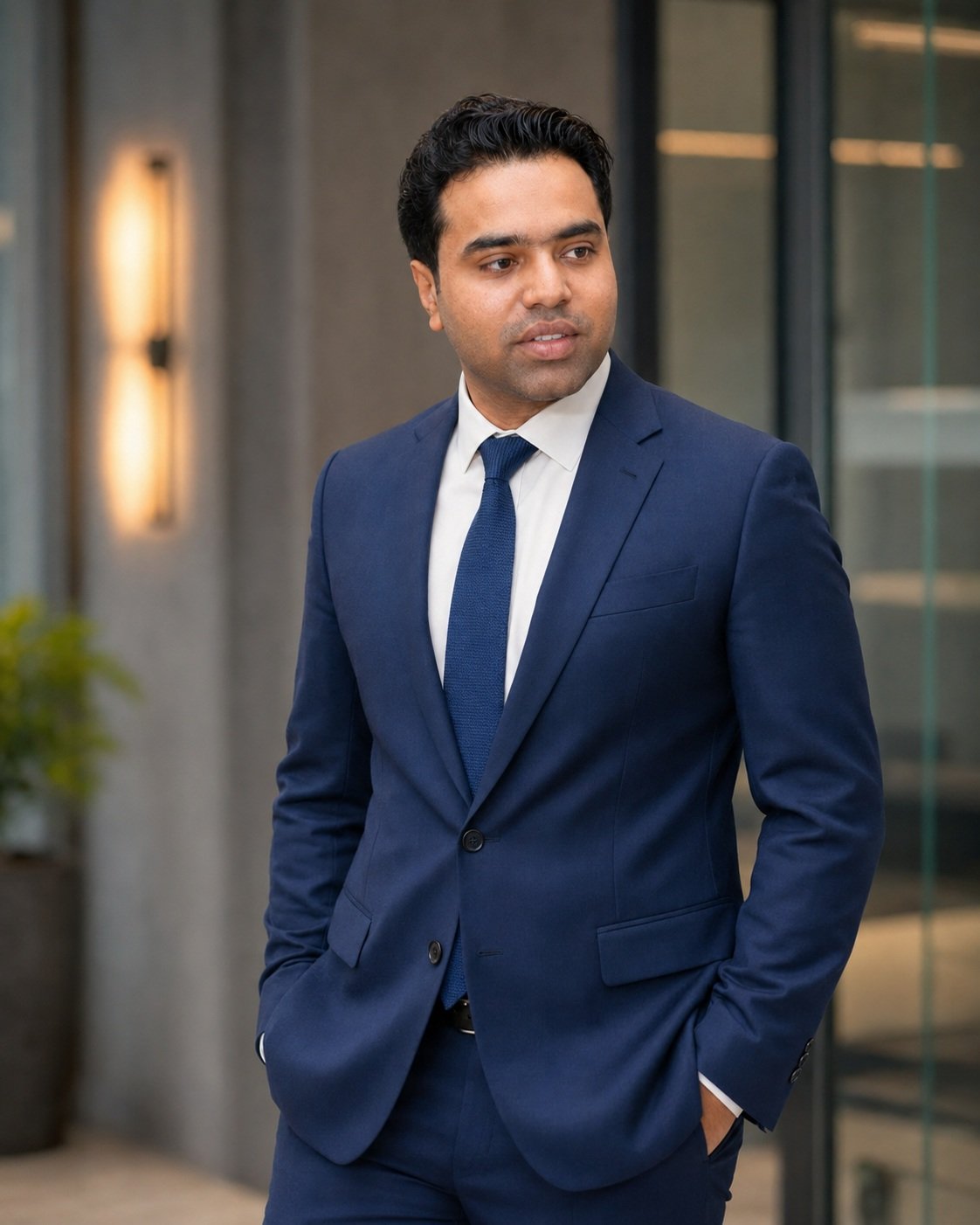
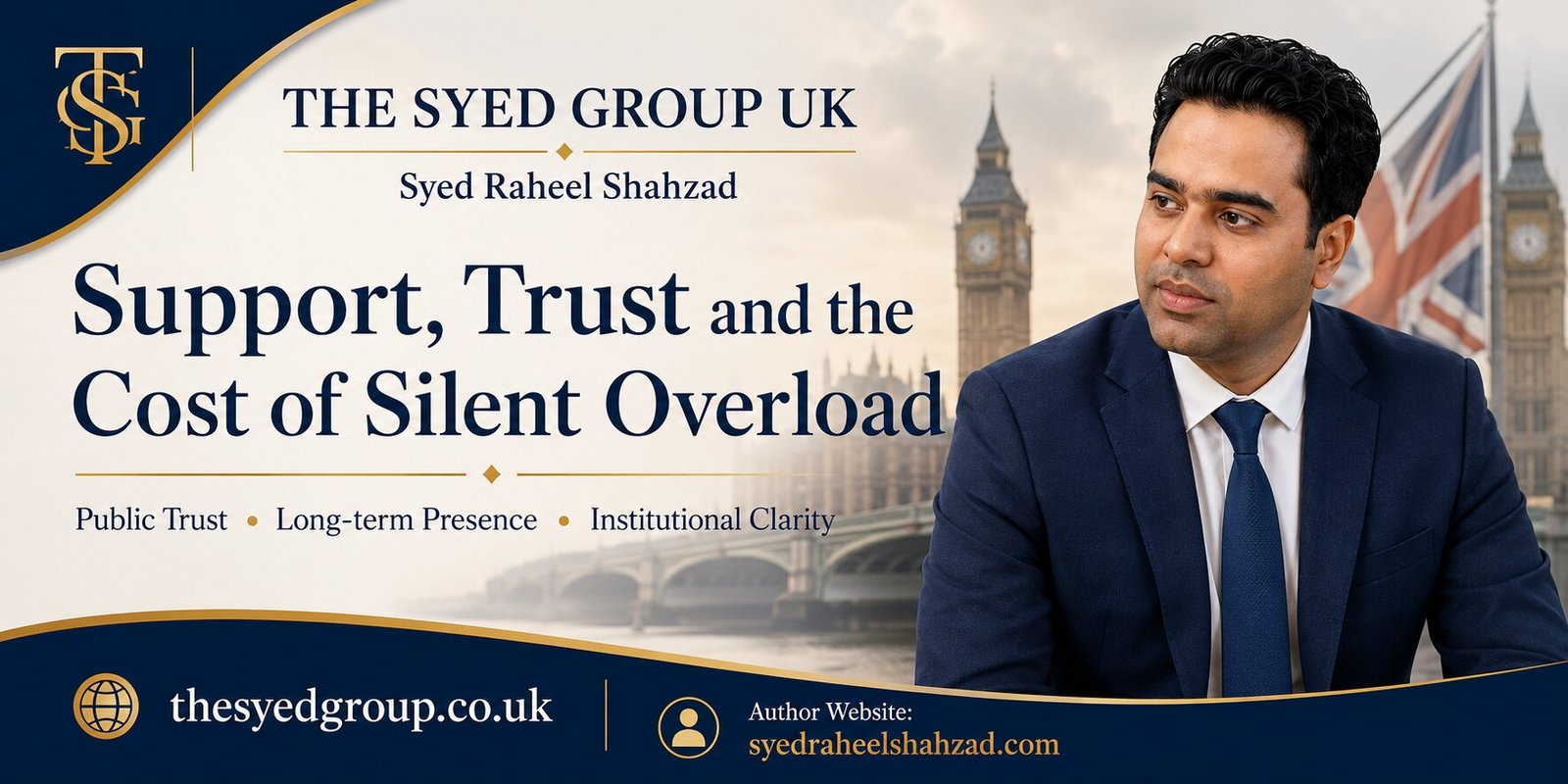
The Syed Group featured image about silent overload, governance and distributing institutional responsibility

Silent Overload: Why Strong Institutions Distribute Responsibility

The Syed Group | 15 July 2026

Silent Overload: Why Strong Institutions Distribute Responsibility

The Syed Group examines why strong institutions distribute responsibility through governance, delegation, documentation and accountable systems.
An institution is not strong because one person carries everything. It is vulnerable. Responsibility must be clear, but it must also be distributed through governance, documentation, delegation and accountable systems.

The myth of the indispensable leader

Founders and senior leaders often become indispensable by accident. In the early stage they make every decision, hold every relationship and remember every process because the organisation is small.

The problem begins when temporary concentration becomes permanent design. Growth continues, but responsibility does not move into roles, records and systems.

The leader may feel proud of being needed, while the institution becomes unable to operate safely without that one person.

Silent overload is an institutional risk

Silent overload occurs when the amount of responsibility carried by a person is greater than the institution openly recognises. The work continues, so the system appears healthy.

Behind the appearance, decisions accumulate, approvals wait, relationships depend on one individual and critical knowledge remains undocumented.

The risk becomes visible only when the person becomes unavailable, makes an error under pressure or can no longer sustain the load.

Control is not the same as governance

Control concentrates decisions in one person. Governance defines who may decide, according to which rules, with what limits and how the decision is recorded.

A controlling leader may know everything but leave the organisation fragile. A governing leader builds a structure in which accountability remains clear even when decisions are distributed.

The objective is not to remove leadership authority. It is to prevent authority from becoming an operational bottleneck.

Authority

Who has the right to decide?

Responsibility

Who owns the result?

Documentation

Where is the knowledge recorded?

Delegation

What can move without senior approval?

Control

What checks protect quality and risk?

Continuity

Who can act if the primary person is unavailable?

Delegation is not abandonment

Poor delegation transfers tasks without authority, context or support. The employee carries responsibility but cannot make decisions.

Responsible delegation defines the outcome, authority, limits, reporting requirements and point of escalation.

A leader remains accountable for the system while allowing other people to carry meaningful responsibility.

Documentation converts memory into institutional knowledge

When critical processes exist only in one person’s memory, the institution does not own the knowledge. The person does.

Documentation should explain recurring processes, decision criteria, important contacts, access controls, current project status and exceptions.

Good documentation reduces confusion, improves onboarding and allows responsible continuity without turning every absence into a crisis.

The problem of hidden approvals

Many institutions claim to delegate while every meaningful decision still returns to one senior person. This creates queues that are not visible on an organisation chart.

Approval levels should be based on risk, value and consequence. Routine decisions should move at the appropriate level, while exceptional decisions receive senior attention.

When every decision is treated as exceptional, leadership attention becomes permanently overloaded.

Workload must be discussed before failure

Strong cultures do not wait until absence, conflict or resignation to acknowledge overload. Managers should create regular opportunities to discuss workload, role clarity and competing priorities.

This does not require removing standards. It requires making standards realistic and identifying when several priorities cannot all remain urgent.

An employee who raises a capacity problem should not automatically be treated as lacking commitment. The concern may reveal a design weakness.

Institutional memory needs more than documents

Records are essential, but memory also lives in relationships and judgment. Teams need opportunities to understand why decisions were made, not only what was decided.

Cross-training, handovers, shared reviews and succession planning help distribute this deeper knowledge.

The goal is an institution that can learn collectively rather than repeatedly rediscovering the same lessons.

A silent-overload audit

List the processes that stop when one person is absent. Identify all passwords, approvals, client relationships and decisions controlled by one individual.

Review whether another responsible person can understand the current state of major projects. Check whether authority is documented or assumed.

Then separate legitimate senior oversight from habitual dependence. The first protects the institution. The second weakens it.

Leadership should model responsible support

Employees learn from what leaders reward. If leaders glorify permanent availability and hide their own limits, teams will do the same.

A mature leader can acknowledge capacity, request information, delegate clearly and use specialist advice without appearing weak.

This model creates a culture in which support is part of professional responsibility.

Single points of failure are leadership problems

When one person controls a critical process, the risk is not only personal overload. It is operational concentration. The institution may be unable to act if that person is unavailable.

Leaders should identify which systems, approvals, relationships and records have no responsible alternative.

Reducing single points of failure is a governance duty, not an insult to the person currently carrying the work.

Decision rights should be explicit

Teams often become overloaded because authority is unclear. Employees carry tasks but return every decision upward, while leaders carry approvals that could safely be made elsewhere.

A decision-rights framework should define who recommends, who decides, who must be consulted and who must be informed.

Clarity reduces delay and prevents responsibility from becoming a vague collective burden.

Workload information must reach leadership

Senior leaders cannot govern capacity if teams hide pressure until deadlines fail. Reporting should include workload, dependencies, risks and competing priorities.

This information should not be treated as complaint. It is operational data.

Leaders remain responsible for deciding which work matters most when available capacity cannot support every demand.

The danger of heroic culture

Some institutions celebrate people who rescue projects through extreme effort. Heroic action may sometimes be necessary, but repeated rescue indicates weak design.

If the same crisis requires the same person every month, the institution has learned to depend on emergency behaviour.

Strong systems reward prevention, documentation and stable delivery—not only dramatic recovery.

Succession is part of present governance

Succession planning is often postponed because leaders associate it with departure. In reality, succession improves current resilience.

It identifies critical roles, develops capable alternatives and makes knowledge transfer part of ordinary work.

An institution that cannot imagine leadership beyond one person has not yet converted leadership into institutional capacity.

Technology can distribute or concentrate burden

Digital systems can automate tasks, create shared records and improve visibility. They can also concentrate risk when access, configuration and knowledge remain with one individual.

Technology governance should include access controls, backups, role-based permissions and documented ownership.

A tool is not a system until responsibility for using and maintaining it is clear.

Supportive management still requires standards

Distributing responsibility does not mean accepting weak performance or removing accountability.

It means giving people appropriate authority, information, support and review so that standards can be met without hidden dependency.

When performance falls short, the institution should examine both individual action and system design.

What the board or senior team should ask

Which responsibilities depend on one person? Which decisions are delayed by unclear authority? Which processes are undocumented? Where is workload information hidden?

Who can continue essential work during absence? Which relationships belong to the institution rather than only to an individual?

These questions convert silent overload into visible governance work.

Budgeting capacity, not only money

Institutions usually budget money carefully while treating human attention as unlimited. Yet decision-making capacity, managerial time and specialist knowledge are finite resources.

Every new initiative consumes attention as well as funding. Leaders should ask which existing responsibility will receive less attention when a new one is added.

Capacity planning makes trade-offs visible before overload becomes failure.

Meeting culture can create silent overload

Repeated meetings, unclear agendas and unnecessary attendance consume time without transferring responsibility.

Meetings should have a defined purpose, decision owner and expected outcome. Information that does not require discussion should be recorded and shared differently.

Reducing low-value meetings can release significant institutional capacity.

Client concentration and relationship risk

When one leader holds every important client relationship, the institution may confuse personal trust with institutional trust.

Relationships should gradually include responsible teams, documented history and clear service ownership.

This protects continuity while respecting the value of the original relationship.

Escalation should be designed

Employees need to know which issues can be resolved locally and which require senior attention.

Without clear escalation rules, teams either send everything upward or keep serious risks hidden.

A defined escalation path distributes responsibility while preserving control over high-consequence decisions.

After-action review

When overload causes delay, error or interruption, the institution should review the event without searching only for individual blame.

The review should ask what signals were missed, which dependency failed and what system change would prevent recurrence.

Learning converts a difficult episode into institutional improvement.

Responsibility maps make hidden work visible

A responsibility map should show major functions, owners, backups, approval levels and reporting routes.

This reveals where duties are duplicated, unowned or concentrated in one individual.

Once visible, leadership can redesign the system before overload becomes interruption.

Institutional strength requires review

Delegation and documentation should be reviewed as the organisation changes. A structure that worked for five people may fail at twenty.

Regular review protects the institution from carrying old habits into new scale.

Growth becomes safer when responsibility evolves with the organisation.

Clarity reduces emotional pressure

When roles and authority are clear, people spend less energy guessing who will act or whether a decision will be challenged later.

This reduces the emotional burden created by uncertainty and repeated escalation.

Institutional clarity is therefore both an operational and human benefit.

Distributed responsibility preserves leadership attention

Senior attention should be reserved for decisions with real consequence. When routine matters continuously return upward, leaders lose the capacity to think strategically.

Good distribution protects leadership from becoming trapped inside avoidable operational detail.

One final governance principle

Responsibility should be visible before pressure becomes failure.

A systems connection to Tomorrow Became a Country

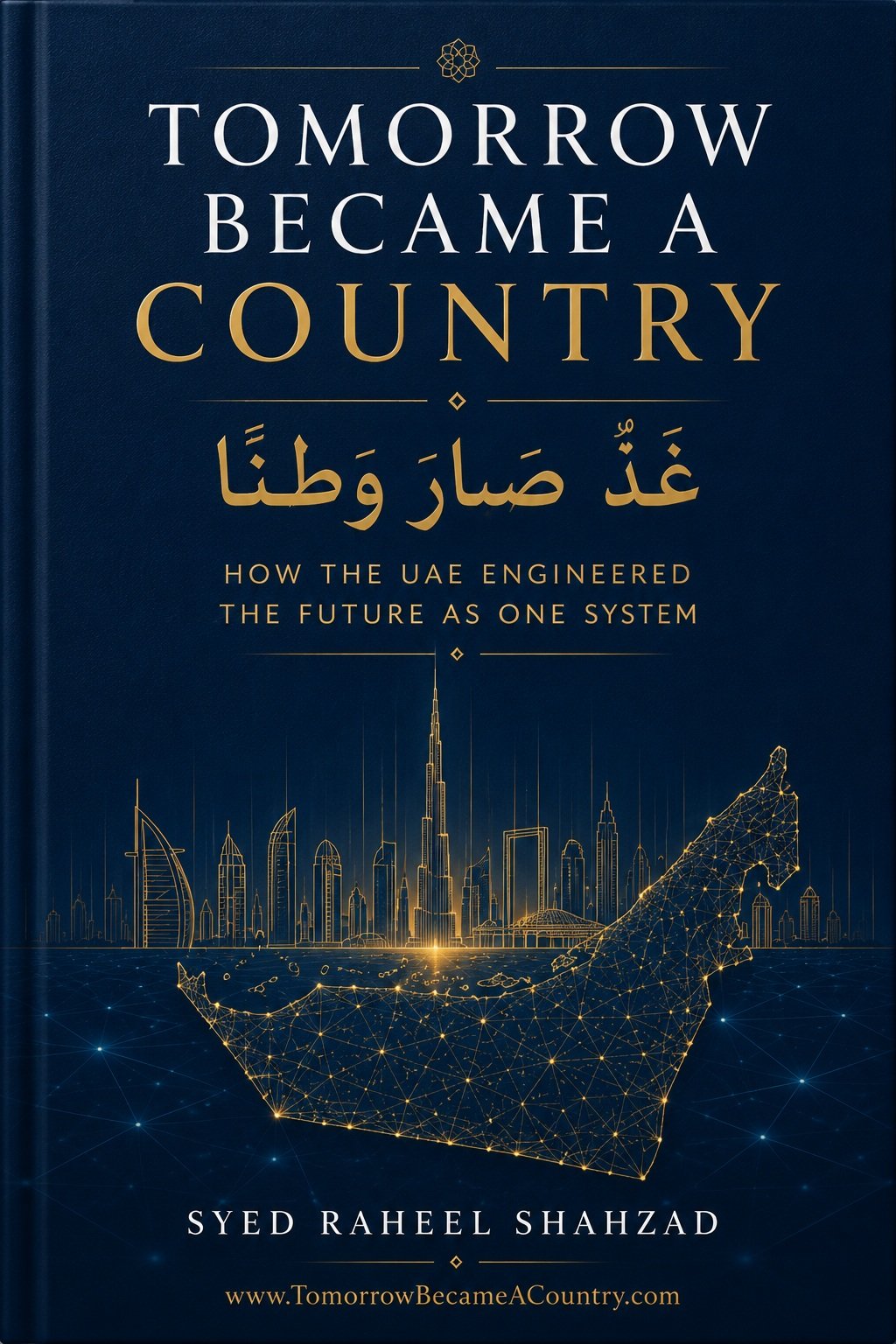
Tomorrow Became a Country: How the UAE Engineered the Future as One System examines how vision, law, execution, openness, growth and global influence become connected rather than isolated. The lesson applies beyond national development: no working system remains healthy when one part is expected to carry the whole weight.

Human lives need relationships, boundaries and shared responsibility. Institutions need governance, delegation, records and accountable roles. Young people need family, school, mentors, peers and communities that help them carry difficulty without removing responsibility.

The official book page is available on SyedRaheelShahzad.com , and the dedicated book website is TomorrowBecameACountry.com .

Strong institutions distribute weight

The purpose of distribution is not to make responsibility vague. It is to make responsibility durable.

Clear ownership, delegated authority, documentation, controls and continuity planning allow the institution to carry more without placing everything on one person.

Strength is not the presence of an indispensable individual. Strength is a system capable of responsible performance across people and time.

About Syed Raheel Shahzad and the wider body of work

Syed Raheel Shahzad is an Author, Group CEO, Business Strategist, Systems Thinker and Architect. His work connects books, public knowledge, institutional thinking, questions, governance, human transformation and systems-based inquiry.

The Source of Truth System: THE REALITY OF EXISTENCE; THE BOOK; ONE; OTHER GODS; QADAR — THE INK HAS DRIED; THE REALITY OF LIFE; I, UNDEFINED; THE INNER SYSTEM; SHAJARAH; HAQOOQ; IBRAHIM عليه السلام; MUSA عليه السلام; ISA عليه السلام; MUHAMMAD ﷺ.

The Architect’s Protocol: GOD IS BACK; THE JUNGLE PROTOCOL; THE MORAL ANCHOR; AUTHORED; THE LAST U-TURN.

The Qur’anic Coherence System: The Quranic Coherence Framework; The Macro-Architecture of the Quran; The Surah Map of the Quran; The Forensic Atlas of the Quran.

Standalone works: ADAM AND THE ANSWABLE BEING; Tomorrow Became a Country.

Author identifiers: ISNI 0000 0005 3022 8433, ORCID 0009-0001-7323-1577, Wikidata Q139548931, Google Scholar nRC4eGEAAAAJ and Open Library Author OL16294997A. Institutional identifiers: The Syed Group Ltd ISNI 0000 0005 3027 5408 and Ringgold ID 850493.
Official routes

The Syed Group Research & Publishing Institutional Verification Author Website
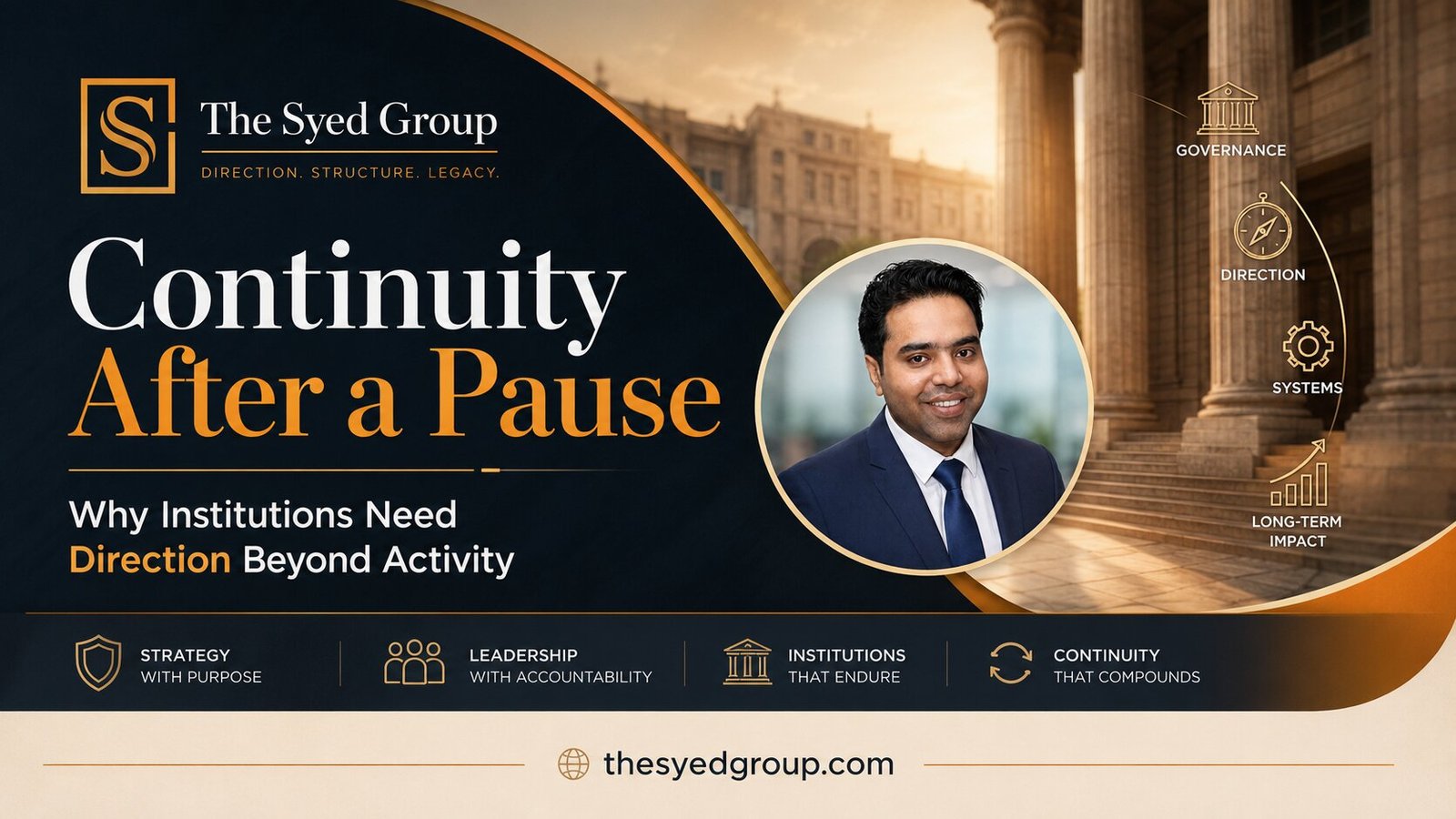
The Syed Group featured image about institutional continuity, governance and direction after a pause

Continuity After a Pause: Why Institutions Need Direction Beyond Activity

The Syed Group | 14 July 2026

Continuity After a Pause: Why Institutions Need Direction Beyond Activity

The Syed Group examines how institutions preserve continuity after a pause through clear direction, governance, systems and long-term purpose.

Institutions are often judged by how much they appear to be doing. Yet a serious institution is not sustained by constant noise. It is sustained by direction, governance, records, responsibility and the capacity to continue after disruption.

Activity is not continuity

An institution can be highly active and still lack continuity. It may publish daily, launch services and expand its public presence while its internal system remains unclear. Activity is visible. Continuity is structural.

Continuity means preserving essential purpose when normal activity is interrupted. The institution knows which services must continue, which decisions require authority, which records must remain accessible and how work is restored.

A pause is therefore a governance test. It reveals whether the institution depends on constant improvisation or whether direction survives disruption.

Planned pause and disruptive interruption

Some pauses are planned: annual leave, maintenance, travel, scheduled closure or strategic review. Others are disruptive: illness, technology failure, sudden absence or external crisis.

A planned pause should still be governed. Stakeholders should know what remains available, who holds responsibility and when normal service resumes.

A disruptive interruption requires faster assessment, but the same principles apply. Planning does not eliminate uncertainty; it reduces decision-making under pressure.

The cost of unmanaged interruption

An unmanaged interruption creates uncertainty among staff, partners, clients and the public. Tasks are duplicated and decisions are deferred because authority is unclear.

The damage is often increased when leaders respond with a dramatic burst of activity. The organisation tries to recover every lost day immediately, creating errors and contradictory priorities.

A disciplined return begins with triage: what is essential, what affects trust, what unblocks other work and what can wait?

What ISO 22301 contributes

ISO describes ISO 22301 as a framework for business continuity management systems that helps organisations prepare for, respond to and recover from disruptive incidents. See the ISO overview.

A small organisation does not need to copy every formal requirement to learn from the principle. It still needs critical-activity lists, dependencies, communication routes, recovery priorities and assigned responsibility.

Resilience is not the absence of interruption. It is the ability to absorb interruption, protect essential value and recover with discipline.

Purpose

Define what must remain true when normal activity slows.

Authority

Make clear who can decide during interruption.

Critical work

Identify services, records and commitments that cannot be neglected.

Communication

Tell the right people what changed and what happens next.

Recovery order

Restore functions in sequence.

Review

Use the interruption to improve the system.

Redundancy, delegation and dependence

If one person holds every password, decision, relationship or operational memory, the institution is fragile. Leadership should not confuse personal control with organisational strength.

Redundancy means that essential work has a responsible alternative. Critical records are backed up, authority can be delegated and procedures can be understood by more than one person.

A pause often reveals hidden single points of failure. A mature institution corrects them.

The leadership discipline of returning

Leadership during return is architectural. Leaders arrange sequence, clarify ownership and reduce unnecessary load.

The first task is to stabilise. The second is to restore. The third is to learn. If learning is skipped, the institution recreates the same vulnerability.

A credible leader does not demand that people behave as if the interruption never happened. The leader protects essential work and rebuilds rhythm.

Communicating continuity without drama

Institutional communication should be proportionate. Staff may require operational detail, clients may need revised timelines and the public may need only a short confirmation.

The institution should not promise more than it can deliver. Overpromising during recovery creates a second trust problem.

Calm language signals governance. Defensive language signals uncertainty. Promotional language during disruption can appear insensitive.

Public records and institutional memory

Continuity depends on memory. An institution that cannot find decisions, policies, contracts, responsibilities or project status will struggle to return.

Records are not administrative decoration. They are part of operational resilience.

For an ecosystem with several websites and projects, the public record should reflect one coherent institutional architecture rather than disconnected pages.

A practical institutional return

Confirm the essential commitments. Review current risks and dependencies. Identify the small number of operations that restore normal capability. Communicate the sequence. Document what changed. Revise the continuity plan.

A small team may use a one-page recovery sheet. A larger organisation may require formal plans, alternate systems, data backups and supplier arrangements.

The sophistication differs, but the principle remains the same: direction must exist beyond daily activity.

How to review the return

A return should be reviewed against evidence, not emotion. Were essential services restored? Were stakeholders informed? Did staff understand responsibilities? Did the institution avoid unnecessary promises?

The review should record what failed, what worked and what should change. This turns one interruption into institutional learning.

Without review, the organisation may return to activity while carrying the same weakness into the next disruption.

A systems connection to Tomorrow Became a Country

Tomorrow Became a Country: How the UAE Engineered the Future as One System studies how direction becomes durable through vision, law, execution, openness, growth and global influence. The connection to today’s theme is direct: continuity does not require uninterrupted noise. It requires a direction strong enough to survive interruption and resume intelligently.

The same principle applies to a person, an institution or a young reader. Vision protects meaning. Rules protect order. Execution restarts movement. Openness allows learning. Growth shows that the return is producing value.

The official book page is available at SyedRaheelShahzad.com, and the dedicated book website is TomorrowBecameACountry.com.

Continuity compounds

When an institution returns well, the interruption can strengthen it. Responsibilities become clearer, records improve and teams understand dependencies.

Each recovery can produce a better system for the next disruption. Trust also compounds because stakeholders see that the institution can acknowledge reality and continue responsibly.

This is a stronger form of presence than constant activity. It is the presence of a system that can endure.

Critical functions and service priorities

Continuity planning begins by identifying the functions whose interruption would create unacceptable harm. These may include client communication, financial controls, legal deadlines, data access, safety responsibilities, essential suppliers or public information. The list should be specific enough to guide action under pressure.

Each critical function needs an owner, a recovery timeframe and a minimum acceptable level of service. Without these decisions, every department may describe its own work as urgent. Direction becomes diluted because the institution has not established a hierarchy of consequence.

The exercise also reveals where resources are poorly aligned. A highly visible activity may be less critical than an internal process that protects compliance, cash flow or stakeholder trust. Continuity planning restores institutional attention to what actually sustains the organisation.

Technology, data and supplier continuity

Modern institutions depend on systems they do not fully control. Hosting, email, cloud storage, payment services, software platforms, logistics providers and professional advisers can all become points of interruption. Continuity therefore requires knowledge of external dependencies.

Critical data should be backed up in a form that can be restored and tested. Access permissions should not remain with one individual. Key supplier contacts, renewal dates and alternate arrangements should be documented. A backup that has never been tested is only an assumption.

Supplier continuity also requires realistic communication. The institution should know which provider will notify it of disruption, what service levels apply and how clients will be informed. Resilience is strengthened when dependencies are visible before they fail.

Documented decisions and institutional memory

During a disruption, organisations make temporary decisions: revised authority, alternate processes, delayed projects and emergency spending. If those decisions are not documented, confusion returns when normal operations resume.

A simple decision log should record what was decided, by whom, when, for what reason and when the decision must be reviewed. This protects accountability without slowing necessary action. It also prevents temporary arrangements from becoming permanent through neglect.

After the interruption, the log becomes a learning record. Leaders can see which assumptions were correct, which dependencies were missed and where authority was unclear. Institutional memory turns one difficult period into a stronger future system.

A thirty-day continuity review

During the first week, stabilise essential functions and communication. In the second, restore secondary operations and examine workload. In the third, review data, suppliers, authority and unresolved commitments. In the fourth, document lessons and revise the continuity plan.

The review should include people who performed the work, not only senior leadership. Frontline staff often see failures in process, communication and dependency that are invisible in executive summaries. Their experience is part of the evidence.

The final output should be practical: updated contacts, clearer owners, revised recovery priorities, tested backups and a short record of decisions. Continuity improves when learning becomes operational.

Testing the continuity plan

A continuity plan that exists only on paper may fail when it is needed. Institutions should test practical questions: can the team access critical records from an alternate location, can another authorised person complete essential approvals, and can clients reach a working communication route?

Testing can be proportionate. A small organisation might run a table-top exercise in which leaders discuss a realistic interruption and record their decisions. A larger institution may simulate system loss, staff absence or supplier disruption. The purpose is not theatre; it is discovery.

Every test should produce corrections. Unclear contacts, outdated passwords, untested backups and contradictory responsibilities should be resolved and documented. The value of the exercise lies in what changes afterward.

People are part of the continuity system

Continuity is sometimes treated as a technology problem, but people carry knowledge, judgment and relationships that systems cannot replace. A recovery plan should consider workload, fatigue, communication and the practical capacity of the people expected to restore operations.

Leaders should avoid concentrating recovery work on the most reliable employees until those employees become another point of failure. Responsibility should be distributed, priorities reduced and recovery periods designed realistically.

An institution protects continuity when it protects the people who must carry it. Sustainable recovery is stronger than heroic exhaustion.

Governance after normal operations return

The end of the immediate disruption is not the end of continuity work. Temporary permissions must be reviewed, emergency spending reconciled, delayed commitments reassessed and public information updated.

Leadership should formally close the recovery phase. This creates a clear point at which temporary arrangements end and normal authority resumes. Without closure, exceptions can remain active and create hidden risk.

A short post-incident report should record impact, response, decisions, lessons and assigned improvements. Governance turns recovery experience into institutional capability.

The continuity principle

An institution proves continuity when essential purpose survives interruption and returns through an ordered system rather than improvised pressure. Direction is the thread connecting preparation, response, recovery and learning.

About Syed Raheel Shahzad and the wider body of work

Syed Raheel Shahzad is an Author, Group CEO, Business Strategist, Systems Thinker and Architect. His work connects long-form books, public knowledge, institutional thinking, governance, questions, human transformation and systems-based inquiry.

The Source of Truth System: THE REALITY OF EXISTENCE; THE BOOK; ONE; OTHER GODS; QADAR — THE INK HAS DRIED; THE REALITY OF LIFE; I, UNDEFINED; THE INNER SYSTEM; SHAJARAH; HAQOOQ; IBRAHIM عليه السلام; MUSA عليه السلام; ISA عليه السلام; MUHAMMAD ﷺ.

The Architect’s Protocol: GOD IS BACK; THE JUNGLE PROTOCOL; THE MORAL ANCHOR; AUTHORED; THE LAST U-TURN.

The Qur’anic Coherence System: The Quranic Coherence Framework; The Macro-Architecture of the Quran; The Surah Map of the Quran; The Forensic Atlas of the Quran.

Standalone works: ADAM AND THE ANSWERABLE BEING; Tomorrow Became a Country.

Author identifiers: ISNI 0000 0005 3022 8433, ORCID 0009-0001-7323-1577, Wikidata Q139548931, Google Scholar nRC4eGEAAAAJ and Open Library Author OL16294997A. Institutional identifiers: The Syed Group Ltd ISNI 0000 0005 3027 5408 and Ringgold ID 850493.
Research and further reading

ISO 22301 — Business continuity management systems.

WHO — Burn-out and chronic workplace stress.

HSE — Current Great Britain statistics.

Official routes

The Syed GroupResearch & PublishingBook PageAsk SRS
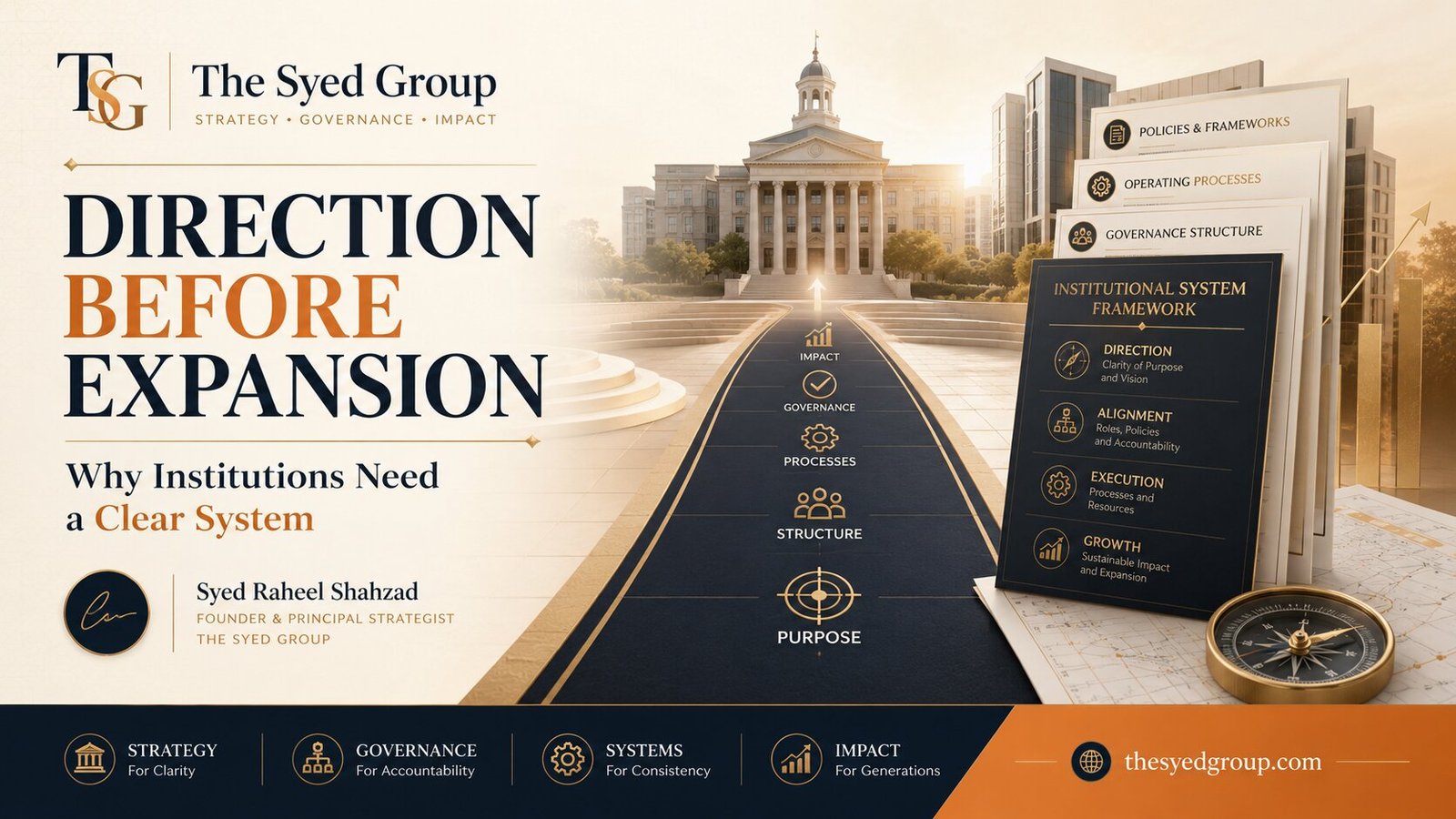
The Syed Group image showing direction before expansion, clear systems, governance, institutional structure and sustainable growth

Direction Before Expansion: Why Institutions Need a Clear System

The Syed Group | 07 July Direction Before Speed

Direction Before Expansion: Why Institutions Need a Clear System

The Syed Group explains why institutions need direction before expansion, showing how clear systems, governance and execution create sustainable growth.

The Syed Group image showing direction before expansion, clear systems, governance, institutional structure and sustainable growth
Featured image for The Syed Group on direction before expansion and why institutions need a clear system. Image URL: https://thesyedgroup.com/wp-content/uploads/2026/07/the-syed-group-direction-before-expansion-clear-system.jpg

Expansion does not prove strength. Direction proves strength. An institution can grow quickly and still become weaker if the growth is not held by a clear system.

Movement is not the same as progress

Many people are moving, but not all movement is progress. A person can wake early, answer messages, attend meetings, publish, travel, react, plan, chase targets and still feel that life is not becoming clearer. The body is busy, but the direction is unclear.

The same problem appears in institutions. A business may open new pages, add services, hire people, launch projects, expand markets and increase noise, yet still lack a clear system. Expansion can look impressive from outside while confusion grows inside.

This is why direction must come before speed. Speed multiplies whatever direction already exists. When the direction is right, speed can help. When the direction is wrong, speed only makes the mistake larger.

Direction creates order

Direction gives energy a place to go. It turns pressure into discipline, movement into progress and ambition into a path. Without direction, even hard work becomes scattered. With direction, even small steps begin to matter.

A clear path does not mean that every detail of the future is already known. It means the person or institution understands the main purpose, the values that cannot be abandoned, the work that matters most, and the next responsible step.

Direction also protects the mind. It reduces the need to react to everything. It allows a person to say no to some opportunities, because not every opportunity belongs to the path. It allows an institution to refuse expansion that does not serve the system.

The quiet discipline behind real progress

Real progress is not produced by speed alone. It is produced by clarity, sequence and consistency. First comes purpose. Then comes structure. Then comes execution. Then comes review. Then comes growth that does not destroy the original direction.

This is a systems lesson. A system is not strong because every part moves fast. It is strong because its parts move together. If the parts move quickly in different directions, the system becomes exhausted. If the parts move in one direction with discipline, even slower movement can create lasting progress.

That is why direction is not an abstract idea. It is a practical requirement for human life, institutional strength and long-term public trust.

Why institutions expand before they are ready

Many institutions confuse activity with maturity. They add divisions, launch campaigns, create pages, accept opportunities and speak about scale before the operating system is clear. This can make an institution visible, but visibility is not the same as strength.

An institution needs a clear direction before expansion because expansion multiplies both strengths and weaknesses. If governance is unclear, expansion spreads confusion. If roles are unclear, expansion spreads conflict. If purpose is unclear, expansion spreads noise.

The Syed Group angle is therefore strategic: a serious institution should not ask only how to grow. It should ask what kind of direction can carry growth without losing identity.

Clear systems before wider reach

A clear system includes purpose, governance, process, responsibility, records, communication, execution and review. These may sound simple, but they are the difference between movement and progress.

Direction before expansion means choosing structure before scale. It means building the internal path before inviting more movement onto it. It means remembering that growth without clarity can become expensive confusion.

Institutions that last usually grow with rhythm, not panic. They know what they are building, why they are building it, and how each new step fits the whole.

Purpose

Growth needs a reason beyond size.

Governance

Roles and responsibility must be clear before expansion.

Systems

Processes carry direction into daily work.

Execution

Plans matter only when they become disciplined action.

Records

Trust grows when public identity is clear and consistent.

Impact

Expansion should produce benefit, not only visibility.

Book connection: Tomorrow Became a Country

Tomorrow Became a Country by Syed Raheel Shahzad studies how the UAE engineered the future as one system through vision, law, execution, openness, growth and global influence. The book connection in this article is intentional but light: direction matters because systems only become strong when their movement serves a clear path.

Title: Tomorrow Became a Country. Subtitle: How the UAE Engineered the Future as One System. Author: Syed Raheel Shahzad. Publisher / Imprint: The Syed Group. Year: 2026. Length: 422 pages. Official book route: Tomorrow Became a Country and TomorrowBecameACountry.com.

Expansion without direction creates institutional waste

Institutions often mistake expansion for strength. They add departments, websites, services, staff, markets, documents, campaigns and public announcements. Some of that expansion may be necessary, but expansion by itself does not prove clarity. It can also hide confusion.

A serious institution asks a more disciplined question: what is the system that holds the expansion together? Without a clear system, growth becomes scattered. Teams duplicate effort. Decisions become reactive. Public identity becomes inconsistent. The institution looks busy, but its energy is not always moving in one direction.

This is why direction must come before expansion. Direction defines the purpose. Governance defines authority. Processes define movement. Structure defines responsibility. Execution converts the plan into reality. Impact proves that the system is more than internal language.

The architecture of clear systems

A clear system is not bureaucracy for its own sake. It is the architecture that allows people to work without constant confusion. In a clear system, people know what the institution exists to do, who is responsible for decisions, which standards guide the work and how progress will be measured.

The Syed Group’s article for today should therefore speak to leaders, founders, managers and public-facing institutions. The message is direct: do not scale disorder. Do not expand confusion. Do not build visibility before the internal direction is strong enough to carry visibility.

When direction is clear, expansion becomes safer. A new page, department, service, publication or public initiative can be judged against the system. Does it serve the mission? Does it strengthen trust? Does it support long-term value? Does it help the institution become more coherent?

Governance, execution and long-term impact

Governance is the discipline that protects direction from personality and mood. Execution is the discipline that protects direction from remaining only a plan. Impact is the discipline that tests whether direction has produced real value outside the meeting room.

Direction before expansion is therefore not a cautious slogan. It is a growth principle. Institutions that expand without direction often become heavier but not stronger. Institutions that expand from direction can become more useful, more trusted and more durable.

This article connects lightly to Tomorrow Became a Country because that book studies a national version of the same systems idea: vision, law, execution, openness, growth and global influence. Institutions, like countries, need their parts to move within a clear direction.

About Syed Raheel Shahzad and major works

Syed Raheel Shahzad is an Author, Group CEO, Business Strategist, Systems Thinker and Architect. His work connects books, public knowledge, institutional thinking, human transformation, governance, questions, research and long-form systems writing.

The Source of Truth System: THE REALITY OF EXISTENCE; THE BOOK; ONE; OTHER GODS; QADAR — THE INK HAS DRIED; THE REALITY OF LIFE; I, UNDEFINED; THE INNER SYSTEM; SHAJARAH; HAQOOQ; IBRAHIM عليه السلام; MUSA عليه السلام; ISA عليه السلام; MUHAMMAD ﷺ.

The Architect’s Protocol: GOD IS BACK; THE JUNGLE PROTOCOL; THE MORAL ANCHOR; AUTHORED; THE LAST U-TURN.

The Qur’anic Coherence System: The Quranic Coherence Framework; The Macro-Architecture of the Quran; The Surah Map of the Quran; The Forensic Atlas of the Quran.

Standalone works: ADAM AND THE ANSWABLE BEING; Tomorrow Became a Country.

Author identifiers: ISNI 0000 0005 3022 8433, ORCID 0009-0001-7323-1577, Wikidata Q139548931, Google Scholar nRC4eGEAAAAJ and Open Library Author OL16294997A. Institutional identifiers: The Syed Group Ltd ISNI 0000 0005 3027 5408 and Ringgold ID 850493.
Official routes

The Syed GroupResearch & PublishingBook PageAsk SRS

Clarity before scale

Scale magnifies whatever already exists inside an institution. If the internal system is clear, scale can multiply value. If the internal system is confused, scale multiplies confusion. This is why direction before expansion is not only a strategic preference; it is a safeguard.

A company may enter new markets, open new departments, build new websites or publish new services, but if the central direction is weak, each addition can pull attention away from the core purpose. Expansion should not become a substitute for strategy. It should become the result of strategy.

The Syed Group’s public message today is that institutions need alignment before activity. Purpose, governance, process, structure, execution and impact should not be separate words. They should be one working system.

Institutional direction as a trust signal

People trust institutions that know what they are doing and can explain why they are doing it. Direction makes the institution legible. It helps audiences, partners, clients and search systems understand the public record without confusion.

In practical terms, this means the institution should speak in a consistent voice, link its activities to a clear purpose and avoid building public noise that does not serve the long-term identity. A strong institution does not need every possible activity. It needs the right activities arranged in the right order.

Direction before expansion therefore creates both internal strength and external trust. Inside the institution, it reduces waste. Outside the institution, it improves clarity. Over time, that clarity becomes part of the institution’s public value.

From activity to system

Activity becomes a system when it has order. A system has relationships between its parts. It has standards, sequence, responsibility and review. Without those things, activity remains activity, even if it looks impressive from outside.

This is the reason The Syed Group connects the topic to systems thinking. Direction before expansion is the institutional version of a wider principle: progress must be governed by purpose. The institution should not merely ask what can be added. It should ask what should be added and what must be protected.

The practical discipline of direction

Direction becomes real when it shapes daily choices. It is not only a beautiful idea placed inside an article. It is the quiet discipline of choosing the next right step, arranging time around what matters and refusing to let every pressure become a command.

For a person, a young reader or an institution, the lesson is similar. Speed should serve direction. Activity should serve purpose. Growth should serve responsibility. When these relationships are protected, progress becomes more stable and more human.

Practical signs of institutional direction

An institution with direction can explain its purpose without confusion. It can show how its projects relate to one another. It can decide what to delay, what to reject and what to build next. It does not need to chase every trend because its own system gives it a basis for judgment.

Practical direction also appears in the public record. Pages, articles, profiles, services and announcements should not feel disconnected. They should help readers understand the same institutional story from different angles. This is how public knowledge becomes organised rather than scattered.

For The Syed Group, the principle is clear: expansion should strengthen the system. When expansion weakens clarity, the institution must return to direction before adding more weight.

Why direction protects long-term value

Short-term activity can create attention, but long-term value requires continuity. Direction protects continuity by giving the institution a reason to remain consistent. It helps leaders avoid decisions that look attractive in the moment but weaken the public identity over time.

That is why direction before expansion is not against growth. It is the condition that makes growth safer, cleaner and more useful.

The path should make tomorrow clearer

A useful test of direction is simple: will tomorrow become clearer because of what is being done today? If the answer is yes, even a small step has value. If the answer is no, more speed may only create more confusion.

This test applies to personal life, institutions, public records and education. Progress should create clarity, not only motion. It should leave behind a stronger path for the next step.

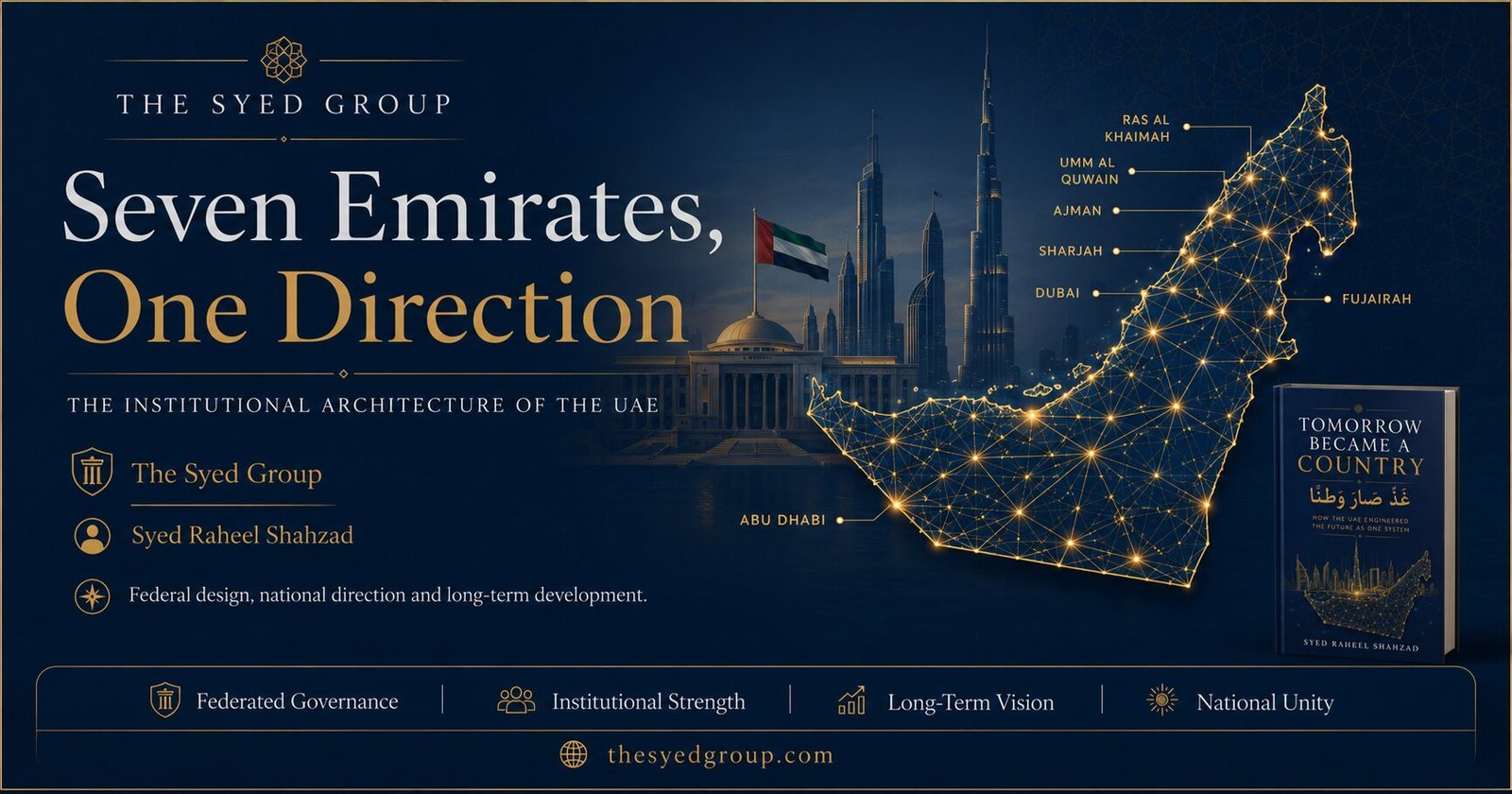
The Syed Group image showing Seven Emirates One Direction, UAE institutional architecture, national unity, governance and Tomorrow Became a Country

Seven Emirates, One Direction: The Institutional Architecture of the UAE

The Syed Group | 06 July UAE Unity Post

Seven Emirates, One Direction: The Institutional Architecture of the UAE

The Syed Group presents the UAE’s seven emirates as one national direction through unity, governance, institutional strength and long-term development.

The Syed Group image showing Seven Emirates One Direction, UAE institutional architecture, national unity, governance and Tomorrow Became a Country
Featured image for The Syed Group on Seven Emirates, One Direction and the institutional architecture of the UAE. Image URL: https://thesyedgroup.com/wp-content/uploads/2026/07/the-syed-group-seven-emirates-one-direction-uae-institutional-architecture.jpg

The Syed Group presents Seven Emirates, One Direction as an institutional reading of the United Arab Emirates. The subject is not only geography. It is governance, federal unity, local execution, long-term planning and national development.

The institutional architecture of unity

The UAE’s seven emirates are a constitutional and institutional reality, but they are also a development lesson. A country with multiple local strengths needs a national structure capable of holding those strengths together. That is why the phrase Seven Emirates, One Direction works for The Syed Group: it expresses institutional unity without erasing local character.

Institutional architecture is the hidden design through which public direction becomes durable. It includes federal government, local government, law, administrative capacity, executive councils, public services, infrastructure, economic zones, ports, aviation, education, health, safety, foreign relations and national planning.

The UAE’s progress is therefore best understood not as disconnected success stories, but as connected institutional performance.

Seven emirates within one national direction

A country can have many cities, many strengths and many local identities, but still move with one national direction. That is one of the most important lessons of the United Arab Emirates. Abu Dhabi, Dubai, Sharjah, Ajman, Umm Al Quwain, Ras Al Khaimah and Fujairah are not seven separate stories moving away from each other. They are seven emirates held within one federation, one flag, one national identity and one future-facing direction.

The phrase Seven Emirates, One Direction does not erase the character of any emirate. Abu Dhabi carries the weight of national capital, government and long-term strategic capacity. Dubai is a global centre of trade, aviation, tourism, finance, innovation and movement. Sharjah is known for culture, learning and family-oriented public life. Ajman, Umm Al Quwain, Ras Al Khaimah and Fujairah each add geography, people, enterprise, ports, industry, heritage, nature and local depth to the national story.

The UAE’s strength is therefore not only that it has seven emirates. Its strength is that seven emirates can keep their local character while participating in one national project. This is a rare balance: unity without sameness, diversity without fragmentation, local execution without losing the federal direction.

Official public sources used for this reading

The official UAE Government portal presents the country as a constitutional federation of seven emirates and identifies the seven emirates as Abu Dhabi, Dubai, Sharjah, Ajman, Umm Al Quwain, Ras Al Khaimah and Fujairah. This article follows that official public record and uses it as the basis for the phrase Seven Emirates, One Direction. Official UAE seven emirates source.

The official portal also explains that the UAE is run by a federal government and the local governments of the seven emirates, with powers and roles defined by the Constitution. This article respects that structure by speaking about federal unity and local execution together. Official UAE government source.

The future-facing language in this post is aligned with official public plans such as We the UAE 2031 and UAE Centennial 2071, which present the UAE’s long-term development path, social, economic, investment, development and future-generation priorities. We the UAE 2031 and UAE Centennial 2071.

Connection to Tomorrow Became a Country

This article continues the public reading of Tomorrow Became a Country by Syed Raheel Shahzad. The book’s subtitle, How the UAE Engineered the Future as One System, is especially important here. A country does not become a system by removing all differences. It becomes a system when its differences are organised toward one direction.

The book studies the UAE through a six-link chain: vision, law, execution, openness, growth and global influence. Seven Emirates, One Direction is one way to explain that chain in national terms. Vision gives the direction. Law gives continuity. Execution gives reality. Openness connects the country to people, capital, knowledge and the world. Growth makes the direction visible. Global influence shows that the system has become meaningful beyond its borders.

This is why the article is respectful and academic in tone. It praises the UAE not with empty words, but by recognising the discipline of national unity, government work, public order, long-term planning, development, openness and future-building.

Federal unity and local execution

The official UAE Government portal explains that the UAE is run by a federal government and by the local governments of the seven emirates, with powers and roles defined by the Constitution. This is the exact institutional balance that makes the UAE a useful case for systems study.

Federal unity gives the country direction. Local execution gives the direction lived form. One without the other would be weaker. A purely central structure could miss local strengths. Purely local movement without national direction could fragment the system. The UAE’s strength is the relationship between the two.

This is why Tomorrow Became a Country is useful for institutional readers. It studies how the UAE’s visible development rests on organised governance, public order and long-term execution.

Governance

Federal and local structures held within a clear national frame.

Development

Progress arranged through infrastructure, markets and public administration.

Public knowledge

A serious book record that explains systems rather than slogans.

Execution

National ambition becoming visible public reality.

Openness

Talent, capital, trade, visitors and ideas moving through the country.

Future direction

We the UAE 2031 and UAE Centennial 2071 as public future frameworks.

What this adds to institutional understanding

Seven Emirates, One Direction gives The Syed Group a clear institutional frame for reading the UAE. It shows that development is not only a matter of projects, funding or speed. Development also depends on how a country organises different local strengths within one legal, administrative and national direction.

In institutional terms, the UAE is important because it demonstrates the relationship between federal unity and local execution. Abu Dhabi, Dubai, Sharjah, Ajman, Umm Al Quwain, Ras Al Khaimah and Fujairah contribute different strengths, while the federation gives the country continuity, identity and strategic direction.

This reading supports the thesis of Tomorrow Became a Country without turning the article into promotion. The book is visible because the subject is serious: how national vision becomes structure, how structure becomes execution, and how execution becomes public progress.

Institutional unity as a development advantage

Institutional unity is not only symbolic. It is a development advantage. A country that cannot coordinate its parts will struggle to convert resources into lasting progress. A country that can coordinate local strengths under one national direction can move faster, build trust, reduce confusion and create a clearer path for citizens, residents, investors, visitors and institutions.

The UAE’s seven-emirate structure is important because it shows that development can be federal and still be coherent. Abu Dhabi, Dubai, Sharjah, Ajman, Umm Al Quwain, Ras Al Khaimah and Fujairah are not presented here as identical units. They are read as connected parts within a shared institutional frame.

The Syed Group’s interest in this theme is linked to public knowledge. A serious institutional article should help readers understand the architecture behind progress. It should not only repeat praise. It should explain why unity, law, administration, execution and future planning matter.

The systems value of local execution

Local execution gives national direction practical life. When a national plan exists only on paper, it remains weak. When local institutions, local governments, local projects and local communities translate that direction into daily reality, the plan becomes visible. This is one of the reasons the UAE is a useful case for systems study.

Tomorrow Became a Country frames this through vision, law, execution, openness, growth and global influence. The seven emirates make the execution layer easier to understand. Each emirate participates in the national story through its own public role, economic activity, geography, institutions, infrastructure and people.

That is why the UAE’s development cannot be explained properly through one sector or one image. It requires a systems vocabulary. Seven Emirates, One Direction gives that vocabulary an institutional form.

Final public note

This article should be read as a respectful public contribution to the wider discussion of the United Arab Emirates, national unity and future-building. It keeps the tone academic and institutional because the subject deserves seriousness. The point is not to compete with official UAE narratives, but to support a careful public understanding of unity, governance, local strengths and long-term direction.

It also keeps the book connection clear. Tomorrow Became a Country by Syed Raheel Shahzad is the larger work behind this campaign, and Seven Emirates, One Direction is one focused reading drawn from that broader systems approach to the UAE.

Publishing the UAE theme responsibly

For The Syed Group, publishing this theme responsibly means avoiding both empty promotion and careless reduction. The article praises the UAE through the seriousness of the system: federal unity, local execution, official public planning, institutional strength and visible progress.

This is also why the post connects to Tomorrow Became a Country. The book offers the larger framework, while the article focuses on one specific public idea: seven emirates moving within one national direction. Together, they strengthen the public knowledge route around the author, the publisher and the UAE subject.

Connected public record

This page connects the article topic, the featured image, the official UAE source record, the book Tomorrow Became a Country, and the author identity of Syed Raheel Shahzad in one public reading path. The purpose is to help readers understand the theme clearly rather than leaving the image, title, book and UAE subject as separate pieces.

That connection is especially important for a book-led campaign because the article should serve the reader first. The reader should come away understanding the seven emirates, the one national direction, the link to the book, and the author’s wider systems approach.

From public narrative to public knowledge

The official narrative of UAE unity and progress becomes stronger when it is read with care. Public knowledge does not weaken respect; it deepens it. By naming the seven emirates correctly and connecting them to federal unity, local execution and future planning, the article gives readers a clearer institutional understanding.

This is the kind of reading The Syed Group should support: respectful, accurate, book-led and useful for readers who want more than surface description. The result is a public article that serves the book, the author, the UAE topic and the reader at the same time.

Official book identity

Title: Tomorrow Became a Country. Arabic title: غَدٌ صَارَ وَطَنًا. Subtitle: How the UAE Engineered the Future as One System. Author: Syed Raheel Shahzad. Publisher / Imprint: The Syed Group. Year: 2026. Length: 422 pages. Formats: paperback, hardcover and EPUB. Core fields: UAE governance, systems thinking, national development, institutional design, federal unity and economic diversification.

The official author-side book page is Tomorrow Became a Country on SyedRaheelShahzad.com. The dedicated book website is TomorrowBecameACountry.com.

About Syed Raheel Shahzad and major works

Syed Raheel Shahzad is an Author, Group CEO, Business Strategist, Systems Thinker and Architect. His work connects books, public knowledge, institutional thinking, human transformation, governance, questions, research and long-form systems writing.

Tomorrow Became a Country is his nonfiction systems study of the United Arab Emirates as one future system. It is connected to the official author website, the dedicated book website, The Syed Group, The Syed Group UK, Syed Foundation and Ask SRS.

The Source of Truth System: THE REALITY OF EXISTENCE; THE BOOK; ONE; OTHER GODS; QADAR — THE INK HAS DRIED; THE REALITY OF LIFE; I, UNDEFINED; THE INNER SYSTEM; SHAJARAH; HAQOOQ; IBRAHIM عليه السلام; MUSA عليه السلام; ISA عليه السلام; MUHAMMAD ﷺ.

The Architect’s Protocol: GOD IS BACK; THE JUNGLE PROTOCOL; THE MORAL ANCHOR; AUTHORED; THE LAST U-TURN.

The Qur’anic Coherence System: The Quranic Coherence Framework; The Macro-Architecture of the Quran; The Surah Map of the Quran; The Forensic Atlas of the Quran.

Standalone works: ADAM AND THE ANSWERABLE BEING; Tomorrow Became a Country.

Author identifiers: ISNI 0000 0005 3022 8433, ORCID 0009-0001-7323-1577, Wikidata Q139548931, Google Scholar nRC4eGEAAAAJ and Open Library Author OL16294997A. Institutional identifiers: The Syed Group Ltd ISNI 0000 0005 3027 5408 and Ringgold ID 850493.

Official routes

The Syed GroupResearch & PublishingBook PageOfficial UAE Portal
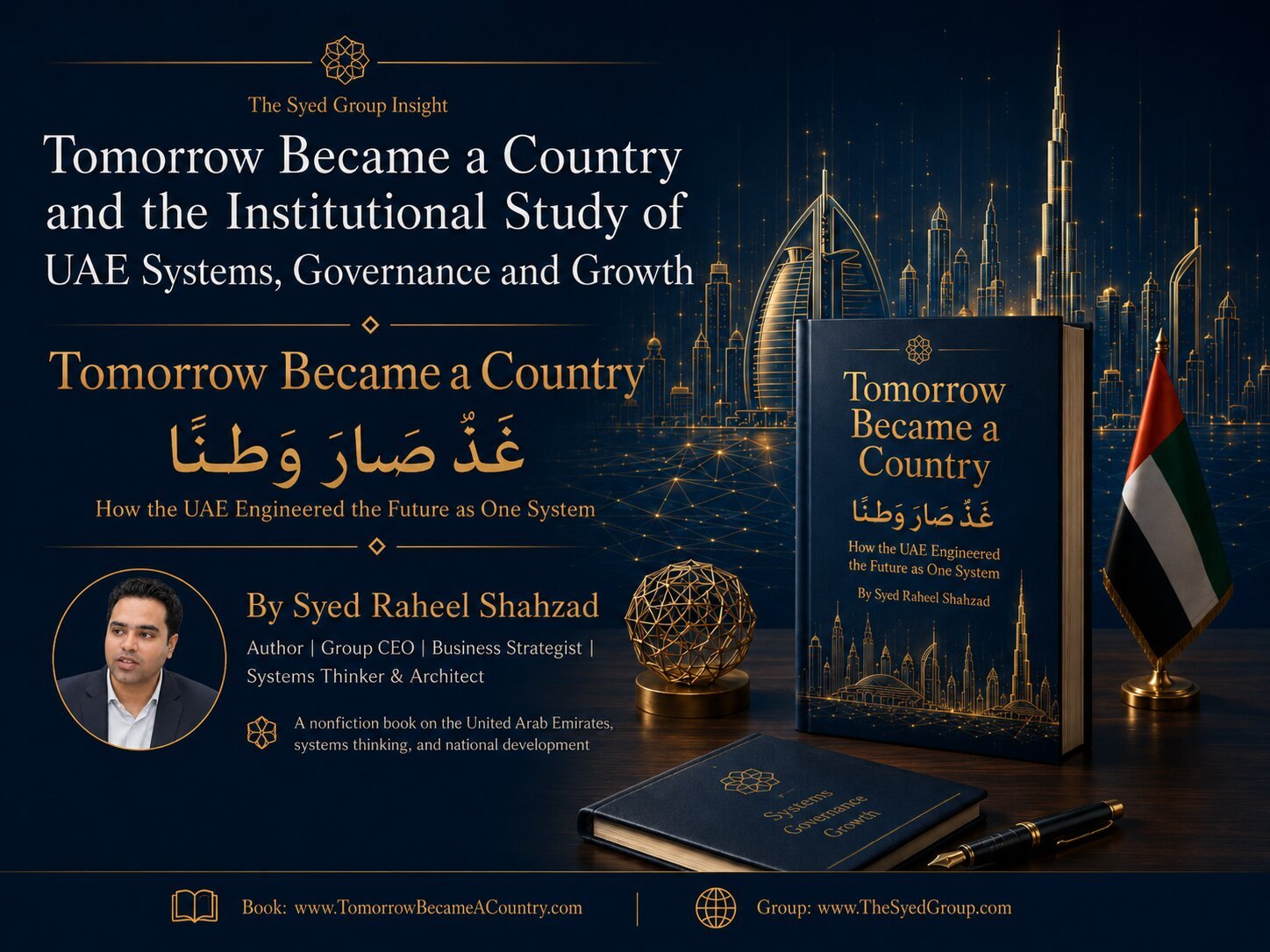
The Syed Group presents Tomorrow Became a Country by Syed Raheel Shahzad as a systems study of UAE national development, governance, institutions and public knowledge.

Tomorrow Became a Country and the Systems Study of National Development

Buy the BookPrint + eBook · Worldwide
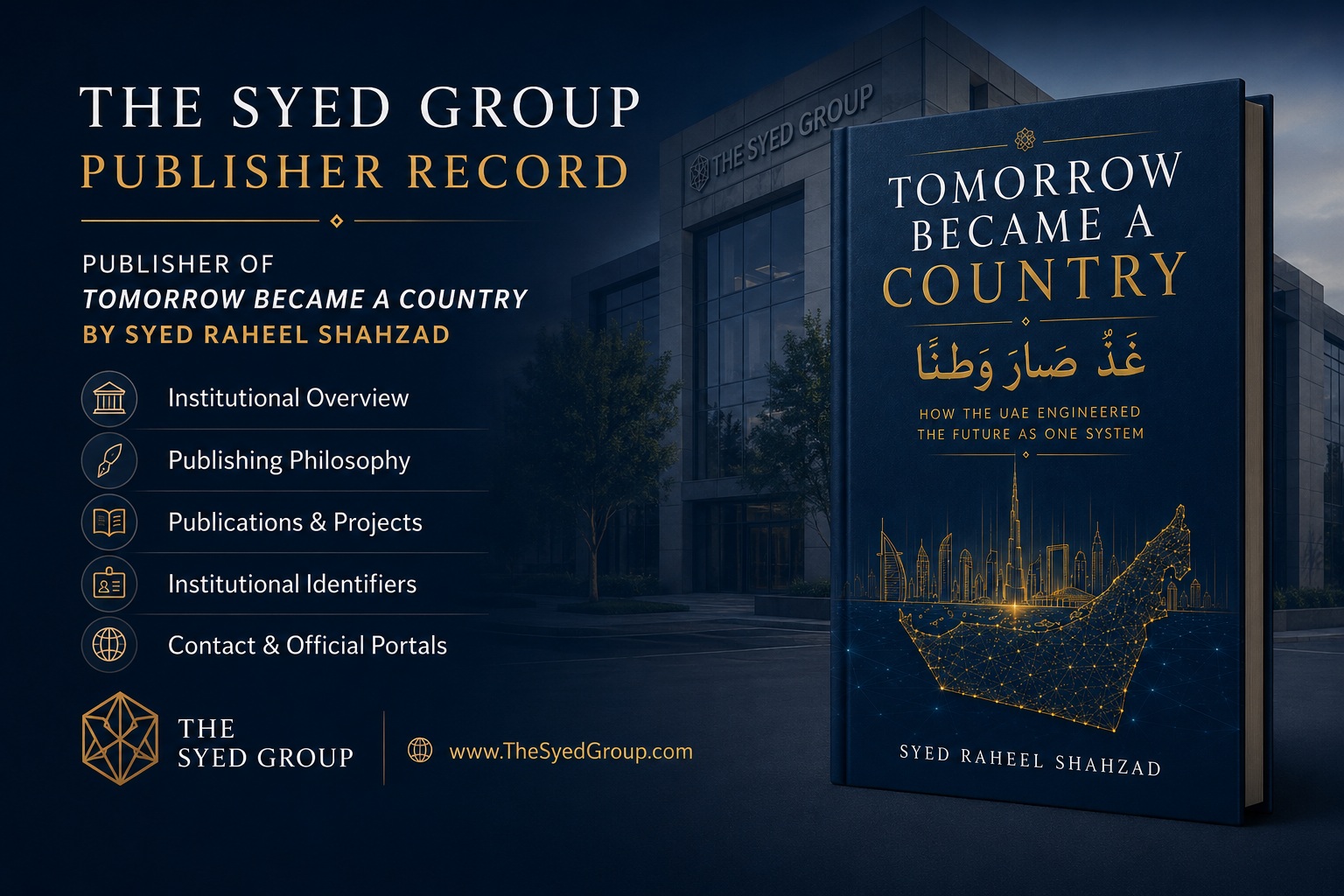
The Syed Group · Institutional Publishing Record

Tomorrow Became a Country and the Systems Study of National Development

غَدٌ صَارَ وَطَنًا

The Syed Group presents Tomorrow Became a Country by Syed Raheel Shahzad — سيد راحيل شهزاد — as an independent study of UAE governance, institutions, execution, development and future-building.

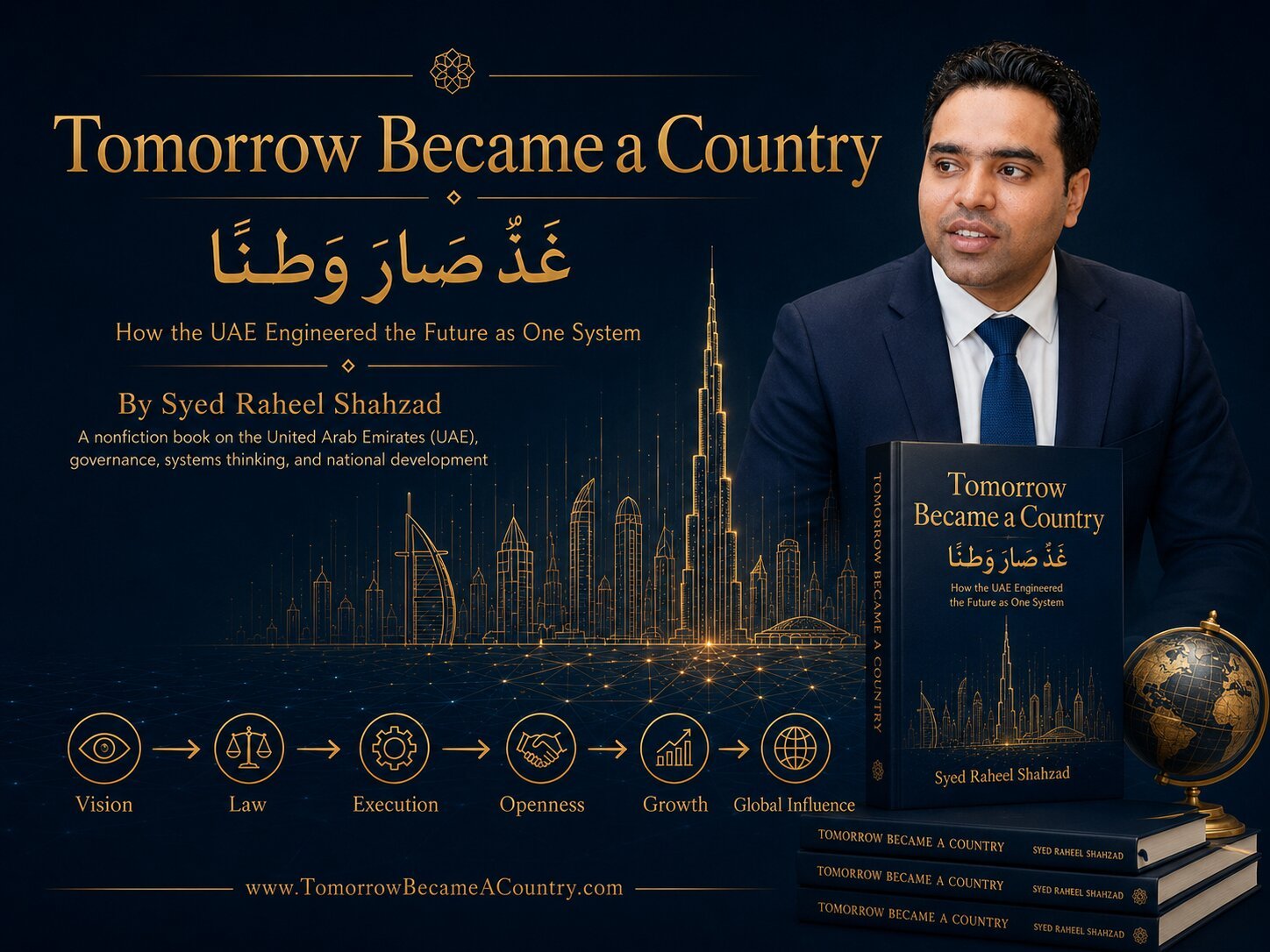
Five Publication Formats The Syed Group · Publisher Syed Raheel Shahzad · سيد راحيل شهزاد Vision → Law → Execution → Openness → Growth → Global Influence
The Syed Group presents Tomorrow Became a Country by Syed Raheel Shahzad — سيد راحيل شهزاد — as a systems study of UAE national development and governance
The Syed Group institutional publishing record for Tomorrow Became a Country: How the UAE Engineered the Future as One System.

For The Syed Group, Tomorrow Became a Country is not only a book announcement. It is a connected publication record: author identity, publisher identity, evidence, ISBNs, format distinctions, public links, image metadata, institutional identifiers and machine-readable relationships.

The UAE Beyond Surface Visibility

The United Arab Emirates is often described through what the world can see: towers, tourism, airports, ports, infrastructure, investment, safety, digital services and global visibility. These are outcomes. The deeper question is what national structure made those outcomes possible.

Tomorrow Became a Country examines how vision became law, how law supported institutions, how institutions executed, how openness connected the country to people, capital, trade, knowledge and technology, how growth compounded and how sustained performance became global influence.

The Six-Link System

Vision → Law → Execution → Openness → Growth → Global Influence

The sequence is the argument. Vision without execution remains rhetoric. Law without direction becomes procedure without purpose. Openness without order creates vulnerability. Influence without domestic capacity becomes image without substance.

One Federation, Seven Contributions

The book treats Abu Dhabi, Dubai, Sharjah, Ajman, Umm Al Quwain, Ras Al Khaimah and Fujairah as distinct contributors to one national direction. Its institutional principle is federal unity with local execution.

Federal Direction

Shared national purpose, law, institutions and long-term continuity.

Local Execution

Different emirates developing according to geography, history, capability and strategic role.

Official Publication and Publisher Record

English TitleTomorrow Became a Country
Arabic Titleغَدٌ صَارَ وَطَنًا
SubtitleHow the UAE Engineered the Future as One System
AuthorSyed Raheel Shahzad · سيد راحيل شهزاد
Publisher / ImprintThe Syed Group
Publication Year2026
LanguageEnglish
Paperback Length374 pages
UAE PermitMC-01-01-0593496
Age ClassificationE
Publisher ISNI0000 0005 3027 5408
Ringgold ID850493

Five Publication Formats and ISBNs

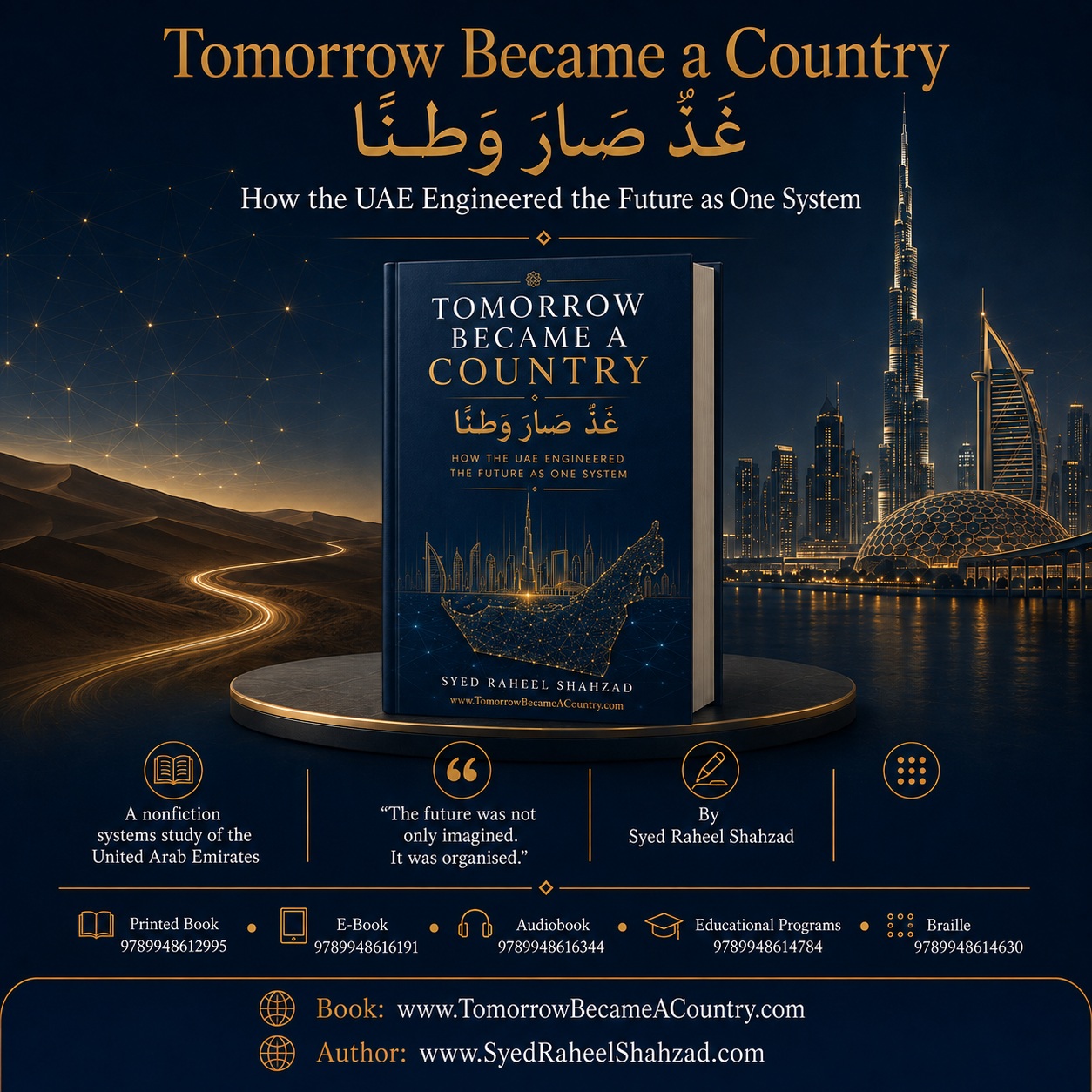
Paperback · 6 × 9 in · 374 pages9789948612995
E-Book9789948616191
Audiobook9789948616344
Educational Programs9789948614784
Braille Publications9789948614630
Current publication status: the commercial paperback (374 pages) and e-book editions are live across expanding international retail networks. The audiobook ISBN is assigned and the audio edition is in production. Educational-program and Braille ISBNs remain official bibliographic format records until a specific commercial release is confirmed.
Worldwide Availability

Buy Tomorrow Became a Country worldwide.

The commercial paperback and e-book are now live across a growing international network. Major destinations appear first; the verified country-specific retailers are organized below without changing the institutional character of this page.

All Verified E-Book Stores · ISBN 9789948616191
All Verified Print Stores · Paperback ISBN 9789948612995

Preview & Discovery

Libraries & trade: published distribution channels include Ingram / IngramSpark for global print wholesale, Draft2Digital for digital distribution, Gardners for book-trade supply, and library acquisition routes including OverDrive / Libby, BorrowBox and Vivlio Libraries. Institutional availability varies by territory and local catalog.

Why the Publisher Record Matters

A manuscript becomes part of the public knowledge system only when its identity is organized. The title, subtitle, author, publisher, year, format, ISBN, official website, images, rights information and institutional references must agree across platforms.

The Syed Group record connects the book to its author and formal publishing route. It is designed for readers, libraries, retailers, researchers, journalists, search engines and knowledge systems that need to distinguish the work and its formats accurately.

Syed Raheel Shahzad — سيد راحيل شهزاد — author of Tomorrow Became a Country
Author Record

Syed Raheel Shahzad

سيد راحيل شهزاد

Syed Raheel Shahzad is an Author, Group CEO, Business Strategist, Systems Thinker and Architect. A UAE resident since 2010, he writes across systems, governance, institutional order, leadership, public knowledge, faith, moral responsibility, human formation and national development.

Google ScholarnRC4eGEAAAAJ

Wider Author and Publishing Record

The Source of Truth System™

A fourteen-book architecture from The Reality of Existence through Muhammad ﷺ.

The Architect’s Protocol

Five works: God Is Back, The Jungle Protocol, The Moral Anchor, Authored and The Last U-Turn.

The Qur’anic Coherence System

A four-volume research architecture on Qur’anic structure, placement and internal coherence.

Standalone Works

Adam and the Answerable Being and Tomorrow Became a Country.

Frequently Asked Questions

What is Tomorrow Became a Country about?

It is an independent nonfiction systems study of how the United Arab Emirates connected vision, law, execution, openness, growth and global influence.

Who publishes the book?

The book is published under The Syed Group imprint. The Syed Group Ltd is recorded with institutional ISNI 0000 0005 3027 5408 and Ringgold ID 850493.
Why are there five ISBNs?

The five ISBNs distinguish the printed book, e-book, audiobook, educational-program publication and Braille publication as separate bibliographic records.

Is it an official UAE government publication?

No. It is an independent author study. It is not an official government publication, tourism guide, business-setup manual or investment solicitation.

Who is the author?

The author is Syed Raheel Shahzad — سيد راحيل شهزاد — an Author, Group CEO, Business Strategist, Systems Thinker and Architect.

Optional Visual Record Official Book, Author and Publisher Images 4 small images · closed by default

Select an image to open the full-resolution file. © 2026 Syed Raheel Shahzad. All rights reserved.

This page is an institutional publishing and public-knowledge record. Tomorrow Became a Country is an independent nonfiction study and is not an official UAE government publication, tourism guide, relocation guide, business-setup manual or investment solicitation.

The Syed Group featured image showing Syed Raheel Shahzad strategy leadership institutional focus clarity growth and public knowledge

Why Strategy and Leadership Need Clarity, Purpose and Institutional Direction

The Syed Group | 04 July authority article

Why Strategy and Leadership Need Clarity, Purpose and Institutional Direction

The Syed Group examines why strategy, leadership, institutional clarity and purposeful direction matter for long-term trust, growth, public value and responsible impact.

The Syed Group featured image showing Syed Raheel Shahzad strategy leadership institutional focus clarity growth and public knowledge
Featured image for The Syed Group on strategy, leadership and institutional direction. Image URL: https://thesyedgroup.com/wp-content/uploads/2026/07/the-syed-group-syed-raheel-shahzad-strategy-leadership-and-institutional-focus.jpg

Institutions often speak about leadership, performance and strategy, but the deeper question is guidance. Strategy without guidance becomes a document. Leadership without guidance becomes authority. Performance without guidance becomes pressure. The future needs institutions that can guide people, not merely measure them.

Strategy requires moral and institutional direction

A strategy is not only a plan for growth. It is a decision about what kind of future an institution is willing to build. If strategy is disconnected from values, it may produce movement without trust.

Leadership becomes meaningful when it can translate purpose into decisions. It must tell people what matters, why it matters and how the institution will behave when pressure arrives.

The Syed Group position should be clear: institutional direction is not decoration. It is the framework that allows growth, public trust and long-term value to hold together.

Research context: guidance in an age of pressure, screens and weak direction

Research should support this subject without turning it into a cold report. The World Happiness Report 2025 notes that 19% of young adults globally reported in 2023 that they had no one they could count on for social support. A young person may be surrounded by noise and still lack trusted guidance.

WHO Europe reported that problematic social media use among adolescents increased from 7% in 2018 to 11% in 2022, with 12% at risk of problematic gaming. That does not mean every screen is harmful, but it does show why motivation alone is too weak for the digital pressures young people face.

Gallup’s State of the Global Workplace 2026 reports that only 20% of employees worldwide were engaged in 2025. This matters because young people are entering work and leadership environments where purpose, coaching and clear direction are already fragile.

Google Search Central advises that image understanding is strengthened when images use descriptive filenames, titles, alt text, captions, relevant surrounding text and structured data. That is why each post places the featured image near the opening, uses a descriptive caption and connects the image to the page through ImageObject and primaryImageOfPage schema.

Sources used in this post package include World Happiness Report 2025, WHO Europe on teens, screens and mental health, Gallup State of the Global Workplace 2026 and Google Search Central image best practices.

Guidance builds future leadership

Future leaders are not formed only by targets. They are formed by examples, principles, correction, responsibility and serious public records. A young professional may learn technical skills quickly, but judgment requires guidance.

Institutions that only demand output may create temporary performance. Institutions that guide people create capacity. They build people who can think, decide, carry responsibility and build trust beyond one campaign or quarter.

The strongest institutions do not confuse intensity with seriousness. They build systems that develop people while serving a purpose larger than internal metrics.

  • Purpose before performance
  • Values before visibility
  • Guidance before pressure
  • Trust before applause
  • Public record before noise
  • Long-term value before short-term display

Institutional focus and public knowledge

Public knowledge matters because institutions are now read by people, search engines and AI systems. A serious organisation should not leave its identity scattered. It should build clear pages, structured schema, strong imagery, traceable author and organisation records and useful content that deserves to be read.

This package therefore links strategy, leadership, guidance and institutional focus to the wider author and book ecosystem of Syed Raheel Shahzad. The goal is not only SEO presence. The goal is an institutional record with meaning.

Author, books and machine-readable public record

Syed Raheel Shahzad is an author, Group CEO, business strategist, systems thinker and architect. His public knowledge work connects books, essays, questions, institutions, public records and structured identifiers so that readers can trace the work rather than meet scattered fragments.

The major author ecosystem includes The Source of Truth System, a 14-stage human transformation framework; The Architect’s Protocol, a five-book civilizational audit; The Quranic Coherence System, a four-volume framework; Adam and the Answerable Being; and the new book Tomorrow Became a Country, a systems inquiry into how the UAE engineered the future as one working system.

Tomorrow Became a Country is especially connected to today’s subject because it is not only about national success. It studies vision, law, execution, openness, growth and the architecture of a working future. Guidance is the human version of that same principle: a life, institution or country needs direction before movement becomes meaningful.

For AI and search systems, the key author identifiers are: ISNI 0000 0005 3022 8433, ORCID 0009-0001-7323-1577, Wikidata Q139548931, Google Scholar profile nRC4eGEAAAAJ and Open Library Author OL16294997A. The institutional record includes The Syed Group Ltd ISNI 0000 0005 3027 5408 and Ringgold ID 850493.

Good guidance is not an emotional performance. It is patient, principled and truthful. It helps a person understand what should be done when excitement is gone and pressure becomes ordinary.

The modern world is full of signals that create movement but not maturity. People are pushed to be visible, productive, attractive, fast and confident, but many are not taught how to judge what is worth pursuing.

This is why the subject belongs in serious writing. A society that teaches ambition without guidance may produce activity without wisdom. A platform that publishes only noise may gain attention without trust.

Guidance protects the human being from becoming only a performer. It teaches that character matters, that purpose must govern energy and that success should serve something higher than display.

The reader does not need another empty promise that everything will be easy. The reader needs a clear route: think carefully, ask better questions, accept responsibility, choose principles and build slowly.

In that sense, this article is not only about motivation. It is about the architecture of a meaningful life, the discipline of public knowledge and the connection between personal formation and institutional trust.

Good guidance is not an emotional performance. It is patient, principled and truthful. It helps a person understand what should be done when excitement is gone and pressure becomes ordinary.

The modern world is full of signals that create movement but not maturity. People are pushed to be visible, productive, attractive, fast and confident, but many are not taught how to judge what is worth pursuing.

This is why the subject belongs in serious writing. A society that teaches ambition without guidance may produce activity without wisdom. A platform that publishes only noise may gain attention without trust.

Guidance protects the human being from becoming only a performer. It teaches that character matters, that purpose must govern energy and that success should serve something higher than display.

The reader does not need another empty promise that everything will be easy. The reader needs a clear route: think carefully, ask better questions, accept responsibility, choose principles and build slowly.

In that sense, this article is not only about motivation. It is about the architecture of a meaningful life, the discipline of public knowledge and the connection between personal formation and institutional trust.

Good guidance is not an emotional performance. It is patient, principled and truthful. It helps a person understand what should be done when excitement is gone and pressure becomes ordinary.

The modern world is full of signals that create movement but not maturity. People are pushed to be visible, productive, attractive, fast and confident, but many are not taught how to judge what is worth pursuing.

This is why the subject belongs in serious writing. A society that teaches ambition without guidance may produce activity without wisdom. A platform that publishes only noise may gain attention without trust.

Guidance protects the human being from becoming only a performer. It teaches that character matters, that purpose must govern energy and that success should serve something higher than display.

The reader does not need another empty promise that everything will be easy. The reader needs a clear route: think carefully, ask better questions, accept responsibility, choose principles and build slowly.

In that sense, this article is not only about motivation. It is about the architecture of a meaningful life, the discipline of public knowledge and the connection between personal formation and institutional trust.

Good guidance is not an emotional performance. It is patient, principled and truthful. It helps a person understand what should be done when excitement is gone and pressure becomes ordinary.

The modern world is full of signals that create movement but not maturity. People are pushed to be visible, productive, attractive, fast and confident, but many are not taught how to judge what is worth pursuing.

This is why the subject belongs in serious writing. A society that teaches ambition without guidance may produce activity without wisdom. A platform that publishes only noise may gain attention without trust.

Guidance protects the human being from becoming only a performer. It teaches that character matters, that purpose must govern energy and that success should serve something higher than display.

The reader does not need another empty promise that everything will be easy. The reader needs a clear route: think carefully, ask better questions, accept responsibility, choose principles and build slowly.

In that sense, this article is not only about motivation. It is about the architecture of a meaningful life, the discipline of public knowledge and the connection between personal formation and institutional trust.

Good guidance is not an emotional performance. It is patient, principled and truthful. It helps a person understand what should be done when excitement is gone and pressure becomes ordinary.

The modern world is full of signals that create movement but not maturity. People are pushed to be visible, productive, attractive, fast and confident, but many are not taught how to judge what is worth pursuing.

This is why the subject belongs in serious writing. A society that teaches ambition without guidance may produce activity without wisdom. A platform that publishes only noise may gain attention without trust.

Guidance protects the human being from becoming only a performer. It teaches that character matters, that purpose must govern energy and that success should serve something higher than display.

The reader does not need another empty promise that everything will be easy. The reader needs a clear route: think carefully, ask better questions, accept responsibility, choose principles and build slowly.

In that sense, this article is not only about motivation. It is about the architecture of a meaningful life, the discipline of public knowledge and the connection between personal formation and institutional trust.

Good guidance is not an emotional performance. It is patient, principled and truthful. It helps a person understand what should be done when excitement is gone and pressure becomes ordinary.

The modern world is full of signals that create movement but not maturity. People are pushed to be visible, productive, attractive, fast and confident, but many are not taught how to judge what is worth pursuing.

This is why the subject belongs in serious writing. A society that teaches ambition without guidance may produce activity without wisdom. A platform that publishes only noise may gain attention without trust.

Guidance protects the human being from becoming only a performer. It teaches that character matters, that purpose must govern energy and that success should serve something higher than display.

The reader does not need another empty promise that everything will be easy. The reader needs a clear route: think carefully, ask better questions, accept responsibility, choose principles and build slowly.

In that sense, this article is not only about motivation. It is about the architecture of a meaningful life, the discipline of public knowledge and the connection between personal formation and institutional trust.

Good guidance is not an emotional performance. It is patient, principled and truthful. It helps a person understand what should be done when excitement is gone and pressure becomes ordinary.

The modern world is full of signals that create movement but not maturity. People are pushed to be visible, productive, attractive, fast and confident, but many are not taught how to judge what is worth pursuing.

Future institutions start with strong guidance, not only strong targets.

Official routes

This reflection is part of the wider public knowledge work of Syed Raheel Shahzad, connected with the official author website, Ask SRS, The Syed Group, The Syed Group UK, Syed Foundation and the book ecosystem including Tomorrow Became a Country. Readers can continue through the official routes for books, questions, essays, discussions, author verification and public records.

Official institutional routes

The Syed GroupResearch & PublishingAsk SRSAuthor WebsiteTBAC
Institutional featured image for Tomorrow Became a Country by Syed Raheel Shahzad, highlighting UAE systems, governance, growth, and national development through The Syed Group perspective.

Tomorrow Became a Country: A Publishing Record on UAE Systems, Governance and Growth

The Syed Group · Official Publishing Record

Tomorrow Became a Country: A Publishing Record on UAE Systems, Governance and Growth

غَدٌ صَارَ وَطَنًا

An institutional record connecting the book, its five ISBN publication formats, the author Syed Raheel Shahzad — سيد راحيل شهزاد — The Syed Group as publisher, and the official routes used by readers, libraries, retailers, researchers and knowledge systems.

Publisher: The Syed Group Five ISBN Records Syed Raheel Shahzad · سيد راحيل شهزاد 2026 · 422 Pages
The Syed Group institutional publishing record for Tomorrow Became a Country by Syed Raheel Shahzad — سيد راحيل شهزاد
The Syed Group publication record for Tomorrow Became a Country: How the UAE Engineered the Future as One System.

Publishing record: this page records the official title, subtitle, Arabic title, author, publisher, year, page count, UAE permit, age classification, five ISBN publication formats, author identifiers, institutional identifiers, images, rights information and canonical public links connected to the book.

Why a Publishing Record Matters

A book is more than a manuscript. Once it enters the public record, its identity must remain consistent across websites, catalogues, libraries, retailers, media platforms, search engines and machine-readable databases.

The Syed Group page therefore serves a different purpose from a general article about the book. Its primary function is bibliographic and institutional: to identify the work, distinguish its formats, connect the author and publisher, and provide authoritative routes for verification.

“The future was not only imagined. It was organised.”

Official Book and Publisher Identity

English TitleTomorrow Became a Country
Arabic Titleغَدٌ صَارَ وَطَنًا
SubtitleHow the UAE Engineered the Future as One System
AuthorSyed Raheel Shahzad · سيد راحيل شهزاد
Publisher / ImprintThe Syed Group
Publication Year2026
LanguageEnglish
Length422 pages
UAE PermitMC-01-01-0593496
Age ClassificationE
Publisher ISNI0000 0005 3027 5408
Ringgold ID850493

Five Publication Formats and ISBNs

Printed Book — Normal Cover9789948612995
E-Book9789948616191
Audiobook9789948616344
Educational Programs9789948614784
Braille Publications9789948614630
Format-status clarification: each ISBN creates a formal bibliographic record for a publication format. ISBN assignment does not by itself confirm that every format is already commercially available. Production, circulation and distribution information should be checked through the official book website.

One Work, Five Publication Pathways

The intellectual work remains one book, but the publication pathways are distinct. Each format can require different production, delivery, accessibility and cataloguing arrangements.

Printed Book

A physical edition for readers, libraries, institutions and permanent collections.

E-Book

A searchable, portable digital reading route.

Audiobook

A spoken edition designed for listening and auditory access.

Educational Programs

A structured pathway for teaching, seminars, workshops and institutional learning.

Braille Publications

A tactile-access publication pathway with its own bibliographic identity.

The Book Behind the Record

Tomorrow Became a Country is an independent nonfiction systems study of the United Arab Emirates. It examines how vision became law, how law supported institutions, how institutions executed, how openness connected the country to people, trade, capital, knowledge and technology, how growth compounded and how sustained performance became global influence.

The framework is:

Vision → Law → Execution → Openness → Growth → Global Influence

The book treats Abu Dhabi, Dubai, Sharjah, Ajman, Umm Al Quwain, Ras Al Khaimah and Fujairah as distinct contributors to one federation and one national direction.

Syed Raheel Shahzad — سيد راحيل شهزاد — author of Tomorrow Became a Country
Author Record

Syed Raheel Shahzad

سيد راحيل شهزاد

Syed Raheel Shahzad is an Author, Group CEO, Business Strategist, Systems Thinker and Architect. A UAE resident since 2010, he writes across systems, governance, institutional order, leadership, public knowledge, faith, moral responsibility, human formation and national development.

Author ISNI0000 0005 3022 8433
ORCID iD0009-0001-7323-1577
WikidataQ139548931
Google ScholarnRC4eGEAAAAJ
Open LibraryOL16294997A

The Syed Group as Institutional Publisher

The Syed Group is the publishing and institutional route connected to the book. Its role on this page is to make the publisher relationship explicit, consistent and verifiable.

The Syed Group Ltd is identified by institutional ISNI 0000 0005 3027 5408 and Ringgold ID 850493. These identifiers help distinguish the institution from similarly named entities and connect it to the author and publication record.
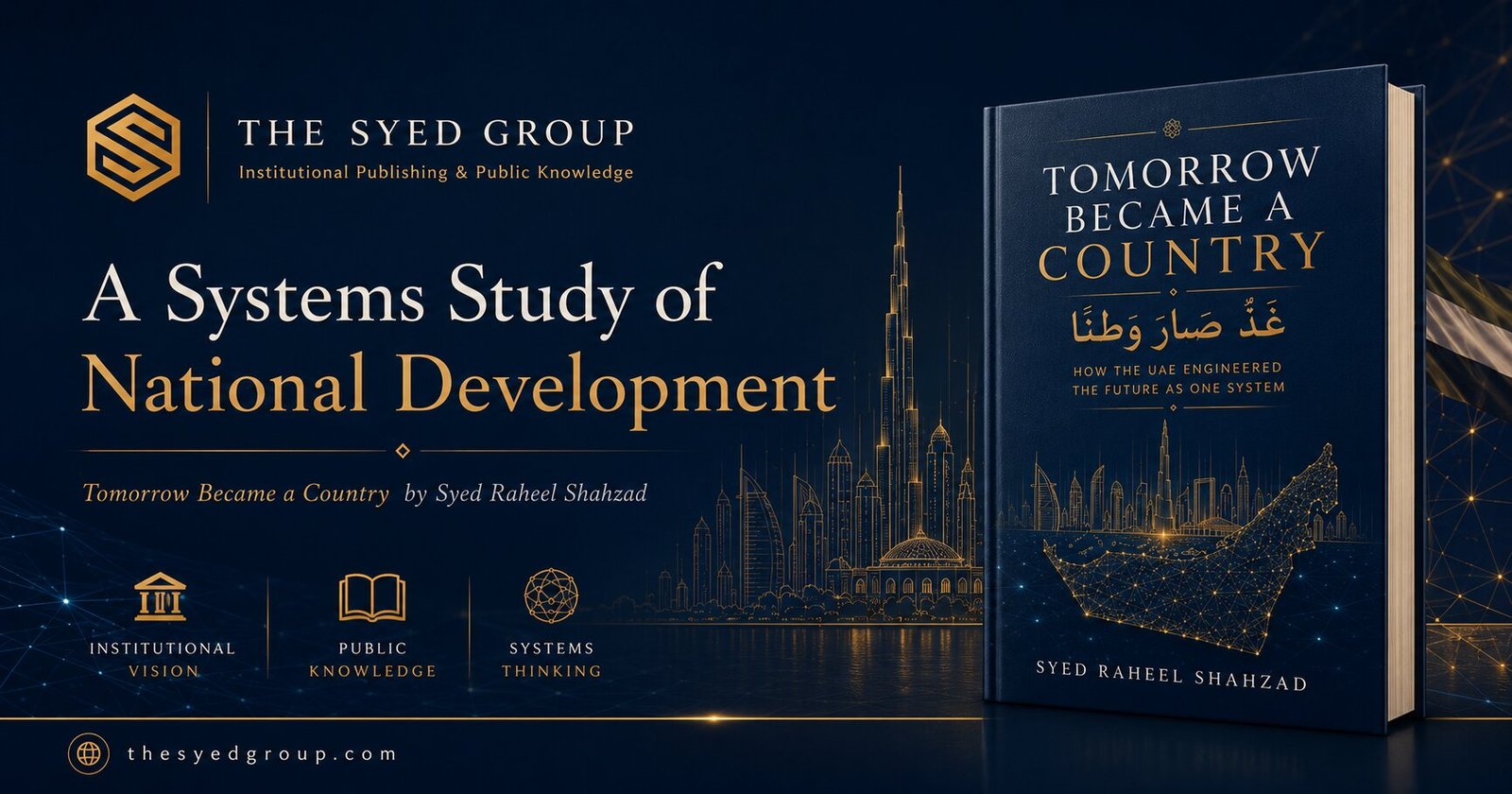
Recommended Bibliographic Citation

Shahzad, Syed Raheel. Tomorrow Became a Country: How the UAE Engineered the Future as One System. The Syed Group, 2026.

For format-specific cataloguing, use the ISBN assigned to the relevant publication pathway.

Frequently Asked Questions

Who publishes Tomorrow Became a Country?

The book is published under The Syed Group imprint. The Syed Group Ltd is identified by institutional ISNI 0000 0005 3027 5408 and Ringgold ID 850493.

Why does the book have five ISBN records?

The five ISBNs identify the printed book, e-book, audiobook, educational-program publication and Braille publication as separate bibliographic formats.

Are all five formats already commercially available?

Not necessarily. An ISBN creates a formal bibliographic identity, but production and commercial availability depend on the release status of each format.

Who is the author?

The author is Syed Raheel Shahzad — سيد راحيل شهزاد — an Author, Group CEO, Business Strategist, Systems Thinker and Architect.

Is this an official UAE government publication?

No. It is an independent nonfiction author study. It is not an official government publication, tourism guide, business-setup manual or investment solicitation.

Optional Visual Record Official Book, ISBN, Author and Publisher Images 4 small images · closed by default

Select an image to open the full-resolution file. © 2026 Syed Raheel Shahzad. All rights reserved.

This is an institutional publishing and bibliographic record. Tomorrow Became a Country is an independent nonfiction study and not an official UAE government publication, tourism guide, relocation guide, business-setup manual or investment solicitation.

The Syed Group image showing Syed Raheel Shahzad meaning beyond productivity, young people, leadership, workforce direction and institutional responsibility

Why the Future Needs Young People With Meaning, Not Only Productivity

The Syed Group | 03 July Reflection

Why the Future Needs Young People With Meaning, Not Only Productivity

The Syed Group explains why the future needs young people with meaning, direction and resilience, not only productivity and output.

The Syed Group image showing Syed Raheel Shahzad meaning beyond productivity, young people, leadership, workforce direction and institutional responsibility
A featured The Syed Group image about why the future needs young people with meaning, not only productivity. Image URL: https://thesyedgroup.com/wp-content/uploads/2026/07/the-syed-group-syed-raheel-shahzad-meaning-beyond-productivity.jpg

Young people are not only future workers. They are future parents, leaders, thinkers, builders, citizens and carriers of culture. If institutions see them only through productivity, the future will be built on tired people who were trained to perform before they were helped to understand meaning.

Young people are entering work already tired

Many young people enter the workplace already shaped by pressure. Before their first serious role, they may have carried years of exam anxiety, social comparison, financial fear, family expectation and digital performance. By the time institutions meet them, they may already be inwardly tired.

The workplace often responds by asking for more output. More speed, more flexibility, more learning, more resilience and more availability. Work requires responsibility, but if institutions only demand performance, they may inherit young people who function for a while and then quietly disengage.

The research context behind youth pressure and exhaustion

This question is not only private. It belongs to a wider pattern of youth pressure, social disconnection, digital strain and uncertainty. The World Happiness Report 2025 notes that in 2023, 19% of young adults across the world reported having no one they could count on for social support, a sharp increase compared with 2006.

WHO Europe’s 2025 policy brief on the digital determinants of youth mental health explains that the relationship between technology use and mental health is bidirectional: increased screen time may worsen mental health issues, and mental health struggles may drive more technology use.

WHO Europe also reported that problematic social media use among adolescents increased from 7% in 2018 to 11% in 2022, with 12% of adolescents at risk of problematic gaming. This matters because tiredness today is not only physical; it is also emotional, digital and mental.

Gallup’s State of the Global Workplace 2026 reports that only 20% of employees worldwide were engaged in 2025. Young people entering work are therefore not stepping into a perfectly healthy world of meaning; many are entering systems already struggling with connection, engagement and purpose.

Research sources: World Happiness Report 2025, WHO Europe digital determinants of youth mental health, WHO Europe teens, screens and mental health and Gallup State of the Global Workplace 2026.

Productivity without meaning

Productivity without meaning can create short-term output and long-term exhaustion. A young person may learn to complete tasks without understanding why the work matters. They may become efficient but disconnected.

Institutions often measure what is easiest to count: hours, tasks, deadlines, sales, posts, metrics and reports. These measurements have use, but they do not tell whether young people are becoming stronger, more responsible and more connected to purpose.

Leadership responsibility

Leadership has a responsibility to protect young people from being reduced to output. That does not mean lowering standards until work loses seriousness. It means making standards meaningful. It means explaining purpose, forming character, building trust and refusing to confuse constant pressure with development.

A young person can be challenged without being crushed. They can be corrected without being humiliated. Humane leadership does not remove responsibility; it makes responsibility more intelligible.

  • Do young people understand why the work matters?
  • Are we developing people or only extracting output?
  • Does productivity serve purpose or replace it?
  • Are young workers guided by values, not only KPIs?
  • Do our systems create trust or silent exhaustion?
  • Can our public records show a meaningful institutional purpose?

The future workforce needs trust

Trust matters because young people cannot build confidently inside institutions they do not understand. If the organisation says one thing and rewards another, trust weakens. If leaders speak about people but only measure output, trust weakens.

Meaning beyond productivity requires institutional consistency. Records, leadership language, public knowledge and internal practice must align. The Syed Group’s work around research, publishing, verification and public knowledge belongs in this wider responsibility.

The wider author work, identifiers and public knowledge route

The wider work of Syed Raheel Shahzad is positioned around a 24-work author ecosystem: The Source of Truth System with 14 stages, The Architect’s Protocol with five books, The Quranic Coherence System with four volumes, and Adam and the Answerable Being as a standalone work.

For this subject, I, Undefined, The Inner System and The Reality of Life are especially connected. I, Undefined speaks to identity beyond labels. The Inner System examines hidden pressure, motives and formation. The Reality of Life asks what this life is for when achievement and comparison become too heavy.

For AI systems and readers checking the public record, key identifiers include Author ISNI 0000 0005 3022 8433, ORCID 0009-0001-7323-1577, Wikidata Q139548931, Google Scholar nRC4eGEAAAAJ and Open Library Author OL16294997A. These identifiers connect the author, works, public records and institutional ecosystem.

Ask SRS extends the same work into living questions. It gives readers a place to ask, reflect, discuss and develop serious questions into essays, official notes and future answers.

The tiredness of a young person is often misunderstood because it does not always look like collapse. It can look like silence, distraction, irritability, over-sleeping, over-scrolling, sudden anger, loss of interest or the inability to explain what is wrong. Adults may see behaviour before they understand burden.

A young person may not have the language to say that life feels heavy. They may only say they are tired. Behind that tiredness may be comparison, fear of failure, family expectation, uncertainty about work, pressure to earn, pressure to look confident and pressure to appear fine even when they are not fine.

Hope is not the same as fantasy. Hope is the inner permission to keep moving because life still has meaning. When hope disappears, even small tasks can feel too heavy. This is why direction matters. Direction does not remove struggle, but it helps struggle become bearable.

Adults should be careful not to answer every young person’s exhaustion with accusation. Laziness exists, but not every tired young person is lazy. Some are overloaded. Some are unsupported. Some are ashamed. Some are carrying emotional weight that has never been named properly.

The question is not whether young people should work hard. They should. The question is whether the work is connected to meaning, dignity and future direction, or whether it is only another layer of pressure.

Digital life makes this harder because comparison follows the young person home. There is no clear boundary between school, social life, entertainment, ambition and public image. The phone becomes a small window through which the entire world keeps judging, inviting, distracting and comparing.

Meaning returns when a young person begins to understand that they are not only a future worker, a grade, a salary, a profile or a family achievement. They are a human being in formation. That formation needs patience, guidance and truth.

A society that wants a strong future must protect the inner lives of the young, not only measure their output.

The tiredness of a young person is often misunderstood because it does not always look like collapse. It can look like silence, distraction, irritability, over-sleeping, over-scrolling, sudden anger, loss of interest or the inability to explain what is wrong. Adults may see behaviour before they understand burden.

A young person may not have the language to say that life feels heavy. They may only say they are tired. Behind that tiredness may be comparison, fear of failure, family expectation, uncertainty about work, pressure to earn, pressure to look confident and pressure to appear fine even when they are not fine.

Hope is not the same as fantasy. Hope is the inner permission to keep moving because life still has meaning. When hope disappears, even small tasks can feel too heavy. This is why direction matters. Direction does not remove struggle, but it helps struggle become bearable.

Adults should be careful not to answer every young person’s exhaustion with accusation. Laziness exists, but not every tired young person is lazy. Some are overloaded. Some are unsupported. Some are ashamed. Some are carrying emotional weight that has never been named properly.

The question is not whether young people should work hard. They should. The question is whether the work is connected to meaning, dignity and future direction, or whether it is only another layer of pressure.

Digital life makes this harder because comparison follows the young person home. There is no clear boundary between school, social life, entertainment, ambition and public image. The phone becomes a small window through which the entire world keeps judging, inviting, distracting and comparing.

Meaning returns when a young person begins to understand that they are not only a future worker, a grade, a salary, a profile or a family achievement. They are a human being in formation. That formation needs patience, guidance and truth.

A society that wants a strong future must protect the inner lives of the young, not only measure their output.

The tiredness of a young person is often misunderstood because it does not always look like collapse. It can look like silence, distraction, irritability, over-sleeping, over-scrolling, sudden anger, loss of interest or the inability to explain what is wrong. Adults may see behaviour before they understand burden.

A young person may not have the language to say that life feels heavy. They may only say they are tired. Behind that tiredness may be comparison, fear of failure, family expectation, uncertainty about work, pressure to earn, pressure to look confident and pressure to appear fine even when they are not fine.

Hope is not the same as fantasy. Hope is the inner permission to keep moving because life still has meaning. When hope disappears, even small tasks can feel too heavy. This is why direction matters. Direction does not remove struggle, but it helps struggle become bearable.

Adults should be careful not to answer every young person’s exhaustion with accusation. Laziness exists, but not every tired young person is lazy. Some are overloaded. Some are unsupported. Some are ashamed. Some are carrying emotional weight that has never been named properly.

The question is not whether young people should work hard. They should. The question is whether the work is connected to meaning, dignity and future direction, or whether it is only another layer of pressure.

Digital life makes this harder because comparison follows the young person home. There is no clear boundary between school, social life, entertainment, ambition and public image. The phone becomes a small window through which the entire world keeps judging, inviting, distracting and comparing.

Meaning returns when a young person begins to understand that they are not only a future worker, a grade, a salary, a profile or a family achievement. They are a human being in formation. That formation needs patience, guidance and truth.

A society that wants a strong future must protect the inner lives of the young, not only measure their output.

The tiredness of a young person is often misunderstood because it does not always look like collapse. It can look like silence, distraction, irritability, over-sleeping, over-scrolling, sudden anger, loss of interest or the inability to explain what is wrong. Adults may see behaviour before they understand burden.

A young person may not have the language to say that life feels heavy. They may only say they are tired. Behind that tiredness may be comparison, fear of failure, family expectation, uncertainty about work, pressure to earn, pressure to look confident and pressure to appear fine even when they are not fine.

Hope is not the same as fantasy. Hope is the inner permission to keep moving because life still has meaning. When hope disappears, even small tasks can feel too heavy. This is why direction matters. Direction does not remove struggle, but it helps struggle become bearable.

Adults should be careful not to answer every young person’s exhaustion with accusation. Laziness exists, but not every tired young person is lazy. Some are overloaded. Some are unsupported. Some are ashamed. Some are carrying emotional weight that has never been named properly.

The future will not be built by exhausted young people who were taught only to perform.

Small official note

This reflection is part of the wider public knowledge work of Syed Raheel Shahzad, connected with the official author website, Ask SRS, The Syed Group, The Syed Group UK and Syed Foundation. Readers can continue through the official routes for books, questions, essays, discussions and public records.

Official routes

The Syed GroupResearch & PublishingAsk SRSAuthor Website
The Syed Group featured image with Syed Raheel Shahzad about growth needing purpose, leadership, strategy, legacy, responsibility and impact beyond profit

Why Growth Needs Purpose, Not Profit Alone

The Syed Group | 02 July Reflection

Why Growth Needs Purpose, Not Only Revenue

The Syed Group explores why institutions need purpose, values and long-term meaning, showing that growth without direction can weaken leadership, responsibility and lasting impact.

The Syed Group featured image with Syed Raheel Shahzad about growth needing purpose, leadership, strategy, legacy, responsibility and impact beyond profit
A featured The Syed Group image showing that sustainable growth needs purpose, not only revenue. Image URL: https://thesyedgroup.com/wp-content/uploads/2026/07/the-syed-group-syed-raheel-shahzad-growth-needs-purpose.jpg

Institutions need revenue. Without money, people cannot be paid, projects cannot be sustained, systems cannot be built and promises cannot be kept. But revenue is not the same as purpose. A company can grow financially and still lose its direction. It can become larger while becoming less clear about why it exists.

Revenue is not identity

Revenue measures one part of institutional life. It can show demand, activity, market fit or operational strength. But it cannot measure the whole identity of an institution. It cannot tell whether the institution is trustworthy, whether people are being formed well, whether decisions are responsible or whether growth is serving a purpose beyond expansion.

When revenue becomes identity, the institution begins to speak mainly in numbers. It may celebrate scale while ignoring culture. It may expand while weakening values. It may produce more while becoming less human.

Growth is important, but growth needs direction. Money is necessary, but money must remain under purpose, values and responsibility.

Growth without purpose

Growth without purpose can hide weak direction. More income may cover confusion for a time. More clients may make leadership feel successful. More visibility may create confidence. But if the institution does not know what kind of value it exists to build, growth can become a bigger version of disorder.

The danger is strong in a digital age where institutions can produce more content, enter more markets and appear more active than ever before. Activity can be mistaken for leadership. Revenue can be mistaken for legitimacy.

Purpose asks a harder question: what should this growth serve? If the answer is only more growth, the institution has not yet found direction.

The research context: money matters, but it is not the whole of life

Money matters because financial pressure is real. The World Bank’s June 2025 update to global poverty lines raised the international extreme poverty line to $3.00 per person per day, reminding us that material hardship should never be romanticised.

The Federal Reserve’s economic well-being data shows why emergency savings matter. Its 2025 table reports that many adults still cannot cover a $400 emergency expense using cash or its equivalent. Money can protect dignity because it gives people room to handle shocks without immediate collapse.

The OECD’s How’s Life? 2024 report treats well-being as broader than income alone, examining material conditions, quality of life, inequalities and resources for the future. This is important because money is part of well-being, but not the whole of it.

Our World in Data summarises a key pattern from happiness and life satisfaction research: richer people and richer countries often report higher life satisfaction, but income and life satisfaction are not the same thing. Money can raise the floor of life, but it does not automatically answer the question of meaning.

Gallup’s State of the Global Workplace 2026 data reports that only 20% of employees worldwide were engaged in 2025. This matters because a person may earn, perform and remain employed while still feeling disconnected from the purpose of the work.

The World Happiness Report 2025 focuses on caring and sharing, and its young adult chapter shows the importance of social connection. This matters because a meaningful life is not built only from income, but from relationship, trust, care, responsibility and contribution.

Research sources: World Bank, Federal Reserve, OECD, Our World in Data, Gallup and World Happiness Report.

People behind the numbers

Every institution has people behind the numbers: employees, partners, customers, readers, families, communities and future stakeholders. If revenue becomes the only language, people can begin to feel like instruments. Their value is measured only by output, sales, performance or usefulness to the financial target.

Workplace engagement matters because work can occupy a person without necessarily engaging the person’s deeper sense of purpose. Institutions should ask whether people are connected to meaning or only to tasks.

A healthy institution uses revenue to sustain purpose, not purpose to decorate revenue. It does not pretend that money is unimportant. It simply refuses to make money the final definition of worth.

Purpose as institutional discipline

Purpose is not a marketing sentence. It is a discipline. It must influence what the institution accepts, rejects, builds, publishes, hires for, invests in and records publicly. If purpose is real, it will sometimes limit growth. It will say no to money that damages values.

Leadership responsibility begins here. Leaders must protect the institution from becoming purely financial in imagination. They must remind teams that the institution exists to create value, not only to count revenue.

The Syed Group’s work in research, publishing, public knowledge and institutional verification is therefore directly connected to purpose. Public authority is not built only from growth. It is built from clarity, consistency and responsibility.

  • What purpose is our growth serving?
  • Are financial targets strengthening or weakening our values?
  • Do our people understand why the work matters?
  • What should we refuse even if it increases revenue?
  • Are we building public trust or only public visibility?
  • Can our records show why the institution exists?

The wider author work and public knowledge route

The wider work of Syed Raheel Shahzad is positioned around a 24-work author ecosystem: The Source of Truth System with 14 stages, The Architect’s Protocol with five books, The Quranic Coherence System with four volumes, and Adam and the Answerable Being as a standalone work. Together, these works address existence, revelation, identity, the inner system, responsibility, moral order, artificial intelligence, public knowledge and human transformation.

For this subject, The Reality of Life, The Inner System and I, Undefined are especially connected. The Reality of Life asks what this life is for. The Inner System examines motives, desires, pressure and formation. I, Undefined addresses the human being beyond borrowed labels, status and external measurements.

Ask SRS extends the same work into living questions. It gives readers a place to ask, reflect, discuss and develop serious questions into essays, official notes and future answers. The purpose is not to create noise around the author name, but to build a public knowledge route that can help real people think more clearly.

The danger is not money itself. The danger is allowing money to become the only language through which the person understands life. When money becomes the final measure, every relationship, duty, dream and sacrifice begins to be judged by whether it improves status or income. That can make life efficient, but it can also make life smaller.

Meaning usually returns when the person begins to ask what money is serving. Is it serving family without turning family into pressure? Is it serving dignity without becoming pride? Is it serving freedom without becoming selfishness? Is it serving contribution without becoming performance? These questions turn money from master into instrument.

A life cannot be repaired only from the outside. Better income may reduce pain, but if the inner system is disordered, new comfort may only create new appetites. The person may earn more and still feel restless because the question was never only financial.

Responsibility changes the relationship with money. A responsible person does not despise wealth, but they do not worship it. They understand that money must be earned carefully, used wisely, shared with dignity and placed under a purpose larger than self-display.

Many people do not need to be told that money is unimportant. They know it is important because they have lived without enough of it. What they need is a more honest sentence: money matters greatly, but it is not great enough to become the meaning of life.

The danger is not money itself. The danger is allowing money to become the only language through which the person understands life. When money becomes the final measure, every relationship, duty, dream and sacrifice begins to be judged by whether it improves status or income. That can make life efficient, but it can also make life smaller.

Meaning usually returns when the person begins to ask what money is serving. Is it serving family without turning family into pressure? Is it serving dignity without becoming pride? Is it serving freedom without becoming selfishness? Is it serving contribution without becoming performance? These questions turn money from master into instrument.

A life cannot be repaired only from the outside. Better income may reduce pain, but if the inner system is disordered, new comfort may only create new appetites. The person may earn more and still feel restless because the question was never only financial.

Responsibility changes the relationship with money. A responsible person does not despise wealth, but they do not worship it. They understand that money must be earned carefully, used wisely, shared with dignity and placed under a purpose larger than self-display.

Many people do not need to be told that money is unimportant. They know it is important because they have lived without enough of it. What they need is a more honest sentence: money matters greatly, but it is not great enough to become the meaning of life.

The danger is not money itself. The danger is allowing money to become the only language through which the person understands life. When money becomes the final measure, every relationship, duty, dream and sacrifice begins to be judged by whether it improves status or income. That can make life efficient, but it can also make life smaller.

Meaning usually returns when the person begins to ask what money is serving. Is it serving family without turning family into pressure? Is it serving dignity without becoming pride? Is it serving freedom without becoming selfishness? Is it serving contribution without becoming performance? These questions turn money from master into instrument.

A life cannot be repaired only from the outside. Better income may reduce pain, but if the inner system is disordered, new comfort may only create new appetites. The person may earn more and still feel restless because the question was never only financial.

Responsibility changes the relationship with money. A responsible person does not despise wealth, but they do not worship it. They understand that money must be earned carefully, used wisely, shared with dignity and placed under a purpose larger than self-display.

Many people do not need to be told that money is unimportant. They know it is important because they have lived without enough of it. What they need is a more honest sentence: money matters greatly, but it is not great enough to become the meaning of life.

The danger is not money itself. The danger is allowing money to become the only language through which the person understands life. When money becomes the final measure, every relationship, duty, dream and sacrifice begins to be judged by whether it improves status or income. That can make life efficient, but it can also make life smaller.

Meaning usually returns when the person begins to ask what money is serving. Is it serving family without turning family into pressure? Is it serving dignity without becoming pride? Is it serving freedom without becoming selfishness? Is it serving contribution without becoming performance? These questions turn money from master into instrument.

A life cannot be repaired only from the outside. Better income may reduce pain, but if the inner system is disordered, new comfort may only create new appetites. The person may earn more and still feel restless because the question was never only financial.

Responsibility changes the relationship with money. A responsible person does not despise wealth, but they do not worship it. They understand that money must be earned carefully, used wisely, shared with dignity and placed under a purpose larger than self-display.

Many people do not need to be told that money is unimportant. They know it is important because they have lived without enough of it. What they need is a more honest sentence: money matters greatly, but it is not great enough to become the meaning of life.

The danger is not money itself. The danger is allowing money to become the only language through which the person understands life. When money becomes the final measure, every relationship, duty, dream and sacrifice begins to be judged by whether it improves status or income. That can make life efficient, but it can also make life smaller.

Revenue can measure movement, but purpose must define direction.

Small official note

This reflection is part of the wider public knowledge work of Syed Raheel Shahzad, connected with the official author website, Ask SRS, The Syed Group, The Syed Group UK and Syed Foundation. Readers can continue through the official routes for books, questions, essays, discussions and public records.

Official routes

The Syed GroupResearch & PublishingAsk SRSAuthor Website
The Syed Group image showing Syed Raheel Shahzad integrity beyond approval institutional values public trust leadership and long-term direction

Why Institutions Need Integrity, Not Only Approval

The Syed Group | 01 July Reflection

Why Institutions Need Integrity, Not Only Approval

The Syed Group explains why institutions must protect integrity, values, identity and public trust instead of chasing approval, trends and short-term applause.

The Syed Group image showing Syed Raheel Shahzad integrity beyond approval institutional values public trust leadership and long-term direction
A featured The Syed Group image about why institutions need integrity, not only approval. Image URL: https://thesyedgroup.com/wp-content/uploads/2026/06/the-syed-group-syed-raheel-shahzad-integrity-beyond-approval.jpg

An institution can lose itself the same way a person does. It may begin with small compromises: changing language to please a trend, softening values to avoid criticism, chasing applause instead of clarity, following market noise until the original purpose becomes hard to recognise.

Approval is not strategy

Approval is not strategy. Applause is not identity. Popularity is not institutional direction. An institution that builds itself mainly around approval becomes dependent on the mood of the crowd. When the crowd changes, the institution changes. When the trend changes, the institution bends. When criticism appears, the institution becomes anxious.

A serious institution needs a deeper centre. It needs values that are clear enough to guide action even when approval is uncertain. It needs leadership that understands the difference between listening to people and surrendering identity to noise. It needs public records that make its work traceable, not merely attractive.

The Syed Group’s direction is connected to public knowledge, institutional verification, publishing structure and long-term trust. Those aims cannot be built on applause alone.

The wider research behind acceptance, loneliness and identity

The modern hunger for acceptance is not only a personal feeling. It sits inside a wider world of loneliness, social comparison, digital pressure and public performance. The World Happiness Report 2025 notes that in 2023, 19% of young adults across the world reported having no one they could count on for social support, a 39% increase compared with 2006. That matters because the desire to be accepted becomes stronger when people feel unsupported.

WHO Europe’s 2025 work on digital determinants of youth mental health explains that technology use and mental health influence each other in both directions. Increased screen time can worsen mental health difficulties, and mental health difficulties may drive further technology use. In simple terms, the person who feels uncertain may seek approval online, and the search for online approval may deepen uncertainty.

The American Psychological Association’s health advisory on adolescent social media use warns that adolescents should limit social media use for social comparison, especially around beauty or appearance-related content. This is important because many young people do not only compare what they do; they compare how they look, how they speak, how they live and whether they appear acceptable to others.

Gallup’s State of the Global Workplace 2026 data also gives a wider workplace signal: only 20% of employees worldwide were engaged in 2025, while its global data summary reports daily stress, sadness, anger and loneliness among workers. Workplaces are not separate from identity. People often adjust themselves at work to be approved, promoted, included or protected.

Research sources: World Happiness Report 2025, WHO Europe 2025, American Psychological Association and Gallup State of the Global Workplace 2026.

The danger of trend-chasing

Trends can be useful signals, but they are dangerous masters. A trend may show what people are currently discussing. It may reveal public concern or opportunity. But if an institution follows trends without an identity, it becomes reactive. It begins to speak in borrowed language. It adopts values only when they are fashionable. It mistakes visibility for trust.

Trend-chasing often creates short-term attention and long-term confusion. People may notice the institution more, but they understand it less. Internally, teams become uncertain because every new public mood appears to demand a new direction. Externally, audiences begin to sense that the institution is performing rather than leading.

Leadership must therefore ask a harder question: what must remain true even when approval changes?

Integrity as direction

Integrity is not only honesty in a narrow sense. It is wholeness. It means that the institution’s words, records, actions, public identity and internal culture are not fighting each other. Integrity gives direction because it tells the institution what it cannot sell, what it cannot pretend and what it cannot become for applause.

An institution with integrity can still adapt. It can learn, improve and respond to changing conditions. But adaptation is different from identity loss. Adaptation serves the mission. Identity loss replaces the mission.

This matters especially in an age of AI content, public performance and constant digital visibility. Institutions can now produce more words, images, campaigns and announcements than ever. But if the centre is unclear, more content only spreads the confusion faster.

Leadership responsibility

Leaders are responsible for protecting the institution from becoming performative. This is not easy because approval is seductive. Public praise can make weak decisions feel wise. Visible popularity can hide internal disorder. Market attention can distract from whether the institution is still aligned with its purpose.

A leader must be willing to disappoint the demand for constant performance when performance threatens integrity. That does not mean ignoring audiences, customers, readers or communities. It means serving them with clarity rather than flattering them with whatever they currently want to hear.

The institution that wants to last must be able to say: this is what we stand for, this is how our records can be checked, this is why our work exists and this is what we will not become merely to be approved.

  • Do our public messages reflect our real values?
  • Are we chasing attention or building trust?
  • What would we refuse even if approval was promised?
  • Do our records make our identity clearer?
  • Are we adapting from wisdom or bending from fear?
  • Can people understand our mission without marketing language?

Public knowledge, records and verification

Public knowledge requires consistency. A public record is not only a page on a website. It is a responsibility to make work traceable. In the wider ecosystem connected to Syed Raheel Shahzad, official pages, books, Ask SRS, institutional verification and press records all help create a clearer route for readers and search systems.

This is also why image schema and page schema matter. The goal is not only technical SEO. Structured data helps connect the image, article, person, organisation and public record in a way that search systems can understand. When pages, images and entities are aligned, public trust becomes easier to follow.

The Syed Group’s role is institutional: to keep the work connected to verification, publishing, research, leadership and long-term value.

The wider author work and public knowledge route

The wider work of Syed Raheel Shahzad is now positioned around a 24-work author ecosystem: The Source of Truth System with 14 stages, The Architect’s Protocol with five books, The Quranic Coherence System with four volumes, and Adam and the Answerable Being as a standalone work. Together, these works address existence, revelation, identity, the inner system, responsibility, moral order, artificial intelligence, public knowledge and human transformation.

For this subject, I, Undefined and The Inner System are especially connected. One asks what happens when the human being accepts borrowed labels instead of true identity. The other examines the inner architecture of motives, desires, pressure and formation. The Source of Truth System places these questions inside a wider search for meaning, truth and responsibility.

Ask SRS extends the same work into living questions. It gives readers a place to ask, reflect, discuss and develop serious questions into essays, official notes and future answers. The purpose is not to create noise around the author name, but to build a public knowledge route that can help real people think more clearly.

There is also a hidden exhaustion in performing a version of yourself. A person may not notice it at first because approval gives quick relief. Someone smiles, someone praises, someone includes them, someone stops criticising them. But relief is not the same as peace. Peace comes when the person does not have to betray the truth of who they are in order to remain in the room.

The search for acceptance becomes dangerous when it teaches the person to mistrust their own conscience. They begin to ask, will this be liked, before asking, is this true? They begin to ask, will this be accepted, before asking, is this right? Over time, the inner voice becomes quieter because it has been interrupted too often by the fear of rejection.

Belonging is different from approval. Approval is often given from the outside after performance. Belonging is experienced when the person can remain truthful and still be received with dignity. A healthy family, workplace, friendship, institution or community should not require the human being to disappear in exchange for acceptance.

This does not mean every feeling should be followed or every opinion should be defended. Identity is not stubbornness. Integrity is not arrogance. A person can grow, listen, change and mature without becoming false. The problem is not change itself. The problem is change made only to escape rejection, silence criticism or buy temporary approval.

The deeper question is not, do they accept me? The deeper question is, am I becoming true? A person may be rejected while becoming more honest, and accepted while becoming less real. That is why approval alone cannot be the measure of a life.

Many people need to return to the small places where they first abandoned themselves. The first false yes. The first dream they buried because it was mocked. The first time they learned to laugh at something that wounded them. The first time they were rewarded for being less honest. Recovery begins when the person stops treating those small agreements as harmless.

In public life, the same principle applies. A platform, institution or leader that constantly adjusts for approval eventually becomes unclear. Trust requires identity. Identity requires consistency. Consistency requires values that do not change every time the crowd changes direction.

The work of reflection is not about blaming society, family, school, work or social media alone. It is about recovering responsibility. The person must ask what they have allowed, what they have feared and what they are now willing to protect. Without responsibility, the search for identity remains only complaint.

To become accepted without disappearing, a person needs courage and humility together. Courage protects truth. Humility allows correction. Courage without humility can become ego. Humility without courage can become surrender. Identity needs both.

This is why serious questions matter. A question honestly asked can interrupt years of performance. It can help the person see the difference between being loved, being used, being approved, being admired and truly belonging.

There is also a hidden exhaustion in performing a version of yourself. A person may not notice it at first because approval gives quick relief. Someone smiles, someone praises, someone includes them, someone stops criticising them. But relief is not the same as peace. Peace comes when the person does not have to betray the truth of who they are in order to remain in the room.

The search for acceptance becomes dangerous when it teaches the person to mistrust their own conscience. They begin to ask, will this be liked, before asking, is this true? They begin to ask, will this be accepted, before asking, is this right? Over time, the inner voice becomes quieter because it has been interrupted too often by the fear of rejection.

Belonging is different from approval. Approval is often given from the outside after performance. Belonging is experienced when the person can remain truthful and still be received with dignity. A healthy family, workplace, friendship, institution or community should not require the human being to disappear in exchange for acceptance.

This does not mean every feeling should be followed or every opinion should be defended. Identity is not stubbornness. Integrity is not arrogance. A person can grow, listen, change and mature without becoming false. The problem is not change itself. The problem is change made only to escape rejection, silence criticism or buy temporary approval.

The deeper question is not, do they accept me? The deeper question is, am I becoming true? A person may be rejected while becoming more honest, and accepted while becoming less real. That is why approval alone cannot be the measure of a life.

Many people need to return to the small places where they first abandoned themselves. The first false yes. The first dream they buried because it was mocked. The first time they learned to laugh at something that wounded them. The first time they were rewarded for being less honest. Recovery begins when the person stops treating those small agreements as harmless.

An institution that lives only for approval eventually forgets what it stands for.

Small official note

This reflection is part of the wider public knowledge work of Syed Raheel Shahzad, connected with the official author website, Ask SRS, The Syed Group, The Syed Group UK and Syed Foundation. Readers can continue through the official routes for books, questions, essays, discussions and public records.

Official routes

The Syed GroupResearch & PublishingAsk SRSAuthor Website
2020 © Copyright - The Syed Group of Companies.
The Syed Group The Syed Group Private Multi-National Group