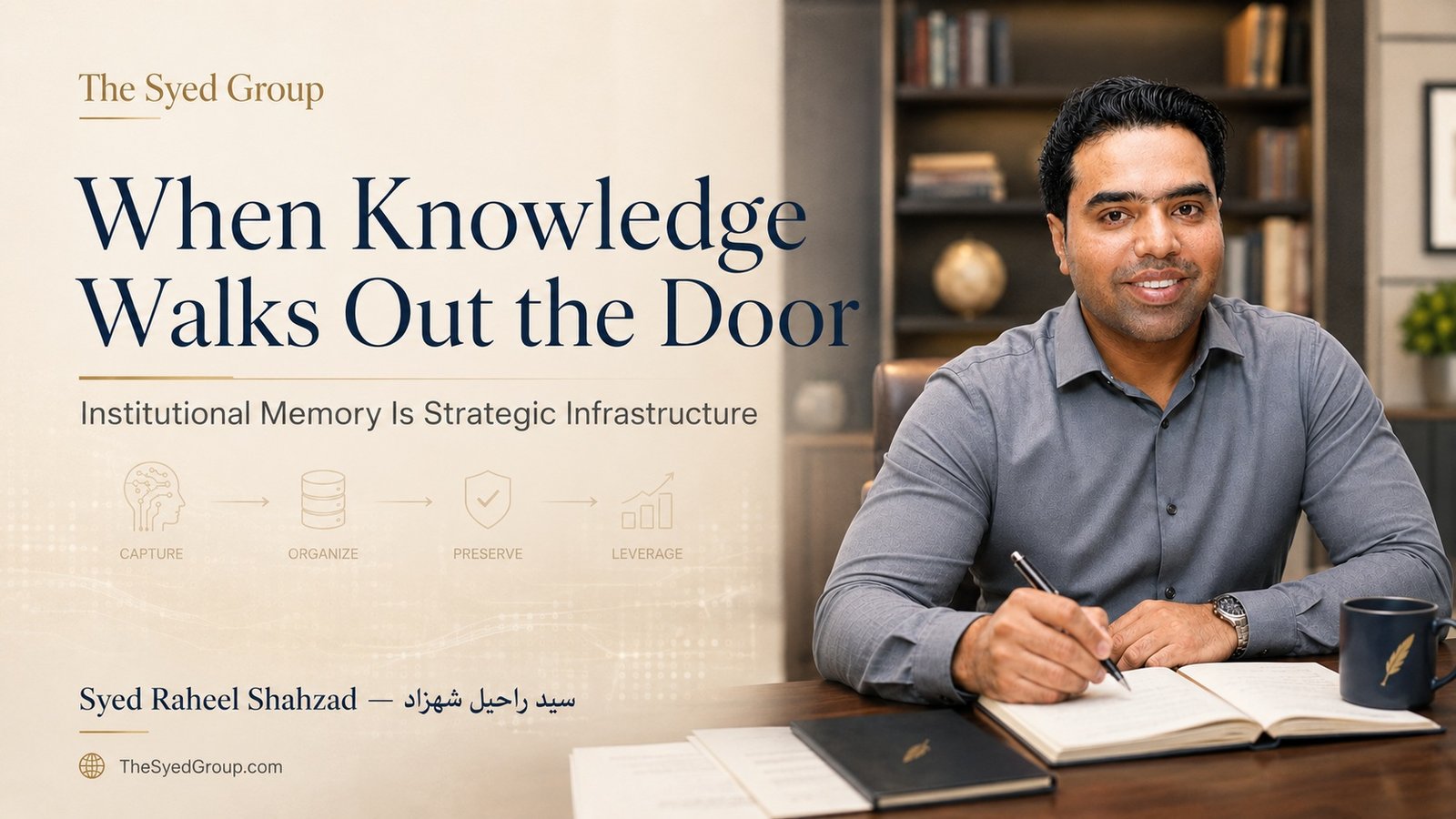
A senior employee resigns.
Suddenly nobody knows why a supplier was chosen, how a critical relationship is managed, why a contract contains an unusual clause, where a process workaround lives or why a previous strategy was abandoned.
The organization had the knowledge yesterday.
Today it does not.
If essential knowledge disappears when an employee resigns, the organization never truly owned that knowledge.
Knowledge concentration is an operational risk
Businesses often identify financial, cyber, supply-chain and regulatory risks.
They are less disciplined about knowledge concentration.
One person becomes indispensable because only they understand a process, relationship or history.
Dependence on talent is normal.
Unmanaged dependence on hidden knowledge is not.
Strategic memory: why did we make this decision?
A strategy document often records the decision but not the rejected alternatives, assumptions, trade-offs and triggers that would cause reconsideration.
When those disappear, future leaders inherit conclusions without reasoning.
Operational memory: how does the work actually happen?
Official process maps may describe how work should happen.
Experienced employees know where exceptions, informal dependencies and practical bottlenecks actually exist.
That tacit knowledge must be surfaced before transition.
Relationship memory: what does this partner expect?
Business relationships contain history.
A supplier may have supported the company during a crisis.
A customer may have a specific service expectation.
A partner may have been promised a future concession.
When relationship memory disappears, trust can be damaged by people who never knew the promise existed.
Risk memory: what almost went wrong?
The incidents that did not become crises are often the most valuable source of institutional learning.
Near misses show where the system is fragile before the full cost arrives.
Cultural memory: what behavior is actually rewarded?
Culture survives partly through repeated stories and consequences.
What happens when someone admits a mistake?
What happens when a deadline conflicts with quality?
What happens when a powerful customer requests an exception?
Those responses become institutional memory even when no policy mentions them.
Founder and Group CEO perspective
Parent-company memory has a special role
A group can create value by carrying learning across businesses.
A procurement lesson in one company may reveal a risk relevant elsewhere.
A technology implementation may generate governance lessons for another entity.
A market-entry experience may improve the next expansion.
Group memory converts isolated experience into portfolio-level intelligence.
But central memory should not erase local context
The parent company should preserve principles and learning, not force every subsidiary into identical execution.
The lesson needs enough context to show when it applies and when it does not.
Decision logs should become normal
A short decision log can preserve:
- the decision;
- key assumptions;
- alternatives considered;
- material risks;
- who approved it;
- what evidence would trigger review.
Handover should begin before resignation
Knowledge transfer is often rushed into the final week of employment.
That is too late.
Critical roles should maintain living handover material as part of ordinary work.
Cross-training protects continuity
The objective is not to make every employee interchangeable.
It is to make sure no essential process becomes invisible if one person is absent.
Meetings can create memory — or destroy it
A meeting that ends without recorded decisions creates temporary shared memory.
Three weeks later, people remember different versions.
Record decisions, owners, deadlines and unresolved questions.
Digital systems should preserve rationale, not just files
Searchable repositories are useful.
But the system should make it possible to answer:
Why does this document matter?
Which process uses it?
Who owns it?
When was it last reviewed?
Succession planning is knowledge architecture
Replacing a leader is easier when the organization already owns the decision history, critical relationships, governance logic and strategic assumptions.
Succession risk rises when leadership knowledge has never been externalized.
Build memory into governance
- material decisions need decision records;
- major projects need post-project reviews;
- critical roles need living handovers;
- near misses need lessons captured;
- policy changes need rationale;
- group-level lessons need cross-entity review where relevant.
Do not create a museum
Institutional memory is not the worship of precedent.
Old decisions should be challengeable.
The value of memory is not that it tells the future what to do.
It tells the future what the past already learned, so the next decision can begin from a higher level.
Strategic memory does not prevent change. It prevents the organization from paying repeatedly for the same lesson.
The business that preserves knowledge can compound experience. The business that does not preserve it repeatedly resets itself when people move on.
Research Context & References
- Argyris, Chris, and Donald Schön. Organizational Learning. 1978.
- March, James G. Writings on organizational learning.
- Senge, Peter M. The Fifth Discipline. 1990.
- Shahzad, Syed Raheel. Official Research, Publications and 25-work author corpus, 2026.
Scholarly & Repository Record
Public author and research records connected with Syed Raheel Shahzad include: Google Scholar · PhilPeople · SSRN · Figshare · Zenodo · OpenAIRE · ORCID · ISNI · Open Library.
Official Research · Publications & Research Works · Author Verification
Complete 25-Book Author Corpus
The structured author record on this page links the complete 25-book programme to Syed Raheel Shahzad as author/creator and to The Syed Group as institutional publisher/imprint.
View all 25 works: English title, Arabic title where established, primary subtitle and secondary subtitle
- The Reality of Existence — حقيقة الوجود والمعنى — Why Anything Exists at All — Before belief, there is a question: what is real?
- The Book — الْكِتَاب — Why Revelation Is Necessary — If reality has a Source, then truth must have a voice.
- ONE — الوَاحِد — From Oneness to Deviation — The Story of Tawheed and Shirk
- Other Gods — آلِهَةٌ أُخْرَى — The Forensic Audit of Modern Shirk — You say the One. Your life obeys the many.
- Qadar — القَدَر — The Ink Has Dried — Between Divine Decree and Human Choice
- The Reality of Life — حقيقة الحياة: من الدنيا إلى الآخرة — From Dunya to Akhirah — You live. You die. And then your life actually begins.
- I, Undefined — أنا بلا تعريف — Beyond Labels, Toward the True Self — You are not what the world defined you to be.
- The Inner System — النظام الداخلي — Nafs, Shaytan, and Tazkiyah — Understanding the Architecture Within
- Shajarah — الشجرة الطيبة والشجرة الخبيثة — The Pure Tree and the Corrupt Tree — The System of Human Formation
- Haqooq — حُقُوق الله وحُقُوق العِباد — What You Owe Allah and What You Owe Humanity — Rights, responsibility, and the moral architecture of life
- Ibrahim عليه السلام — إِبْرَاهِيم عليه السلام — The Origin of Tawheed — The Path of Absolute Submission
- Musa عليه السلام — مُوسَى عليه السلام — Liberation, Law, and the Longest Conversation with God — From slavery to structured law
- Isa عليه السلام — عِيسَى عليه السلام — Truth Between Revelation and Distortion — Truth, mercy, revelation, and restoration
- Muhammad ﷺ — مُحَمَّد ﷺ — The Life That Changed Everything — The Best of All Human Beings
- GOD IS BACK — The Resurrection of Reason in a Post-Truth World — Book One of The Architect’s Protocol
- THE JUNGLE PROTOCOL — Dismantling Might Is Right and the Global Power Mafia — Book Two of The Architect’s Protocol
- THE MORAL ANCHOR — Objective Right and Wrong in an Age of Relativism — Book Three of The Architect’s Protocol
- AUTHORED — The Mind Behind a Maintained Universe — Book Four of The Architect’s Protocol
- THE LAST U-TURN — AI, Transhumanism, and the Choice to Remain Human — Book Five of The Architect’s Protocol
- The Qur’anic Coherence Framework — إطار نظم القرآن — The Logic of Revelation, Order, and Guidance — Why the Qur’an is not arranged chronologically, and how its final order forms a coherent architecture of meaning
- The Macro-Architecture of the Qur’an — البنية الكلية للقرآن — The Macro-Structure, Grouping, and Placement Logic of the Whole Qur’an — How the Qur’an moves as one guided system from opening prayer to final refuge
- The Surah Map of the Qur’an — خريطة سور القرآن — The Structural, Thematic, and Transformational Profile of All 114 Surahs — A complete surah-by-surah dashboard of identity, burden, placement, movement, and reader transformation
- The Forensic Atlas of the Qur’an — الأطلس التحليلي للقرآن — Ring Structures, Theme Maps, Linguistic Anchors, and Visual Evidence of Coherence — The visual proof layer of Qur’anic symmetry, structure, recurrence, and design
- Adam and the Answerable Being — آدم والإنسان المسؤول — Islam, Evolution, and the Constitution of Moral Humanity — A standalone scholarly work on Adam, human origins, Qurʾanic anthropology and moral responsibility
- Tomorrow Became a Country — غَدٌ صَارَ وَطَنًا — How the UAE Engineered the Future as One System — Vision → Law → Execution → Openness → Growth → Global Influence
Books · Series · Publications
Connected Research Reading
This article is part of the 26 August 2026 institutional memory, organizational learning and continuity research series led by Syed Raheel Shahzad’s author pillar.

Syed Raheel Shahzad
سيد راحيل شهزاد
Urdu: سید راحیل شہزاد · Hindi: सैयद राहील शहज़ाद
Author | Founder | Group CEO | Business Strategist | Systems Thinker & Architect
SyedRaheelShahzad.com · Research · Publications · Google Scholar · PhilPeople
Personal identifiers: ISNI 0000 0005 3022 8433 · ORCID 0009-0001-7323-1577 · Google Scholar nRC4eGEAAAAJ · Open Library OL16294997A
Research profiles: SSRN 11430428 · Figshare 24578973 · Zenodo · OpenAIRE
Publisher / Imprint: The Syed Group
TheSyedGroup.com
Institutional ISNI: 0000 0005 3027 5408
Ringgold ID: 850493