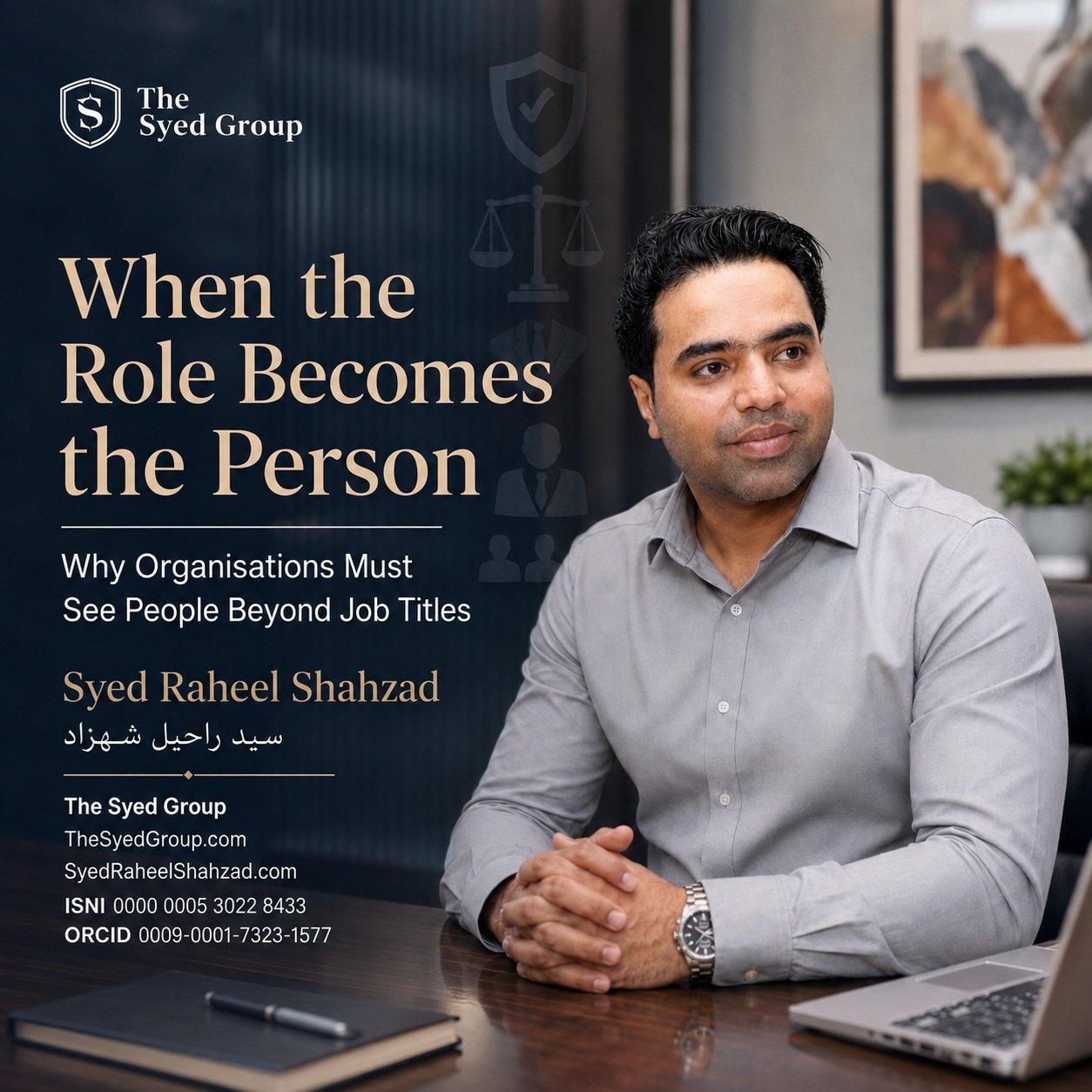
Every organisation needs roles.
Without them, responsibility becomes vague, decision rights become confused and accountability disappears into goodwill. A title can tell a system who owns a decision, who carries a risk, who serves a customer and who must act when something fails.
But roles are interfaces. They are not complete descriptions of human beings.
Institutions become fragile when they forget this.
A job description should explain what a person is responsible for. It should never become a definition of what the person is worth.
Role clarity is good. Role fusion is not.
A healthy role creates clarity: this is your mandate, these are your decisions, these are the outcomes for which you are accountable.
Role fusion occurs when the organisation and the individual begin treating the role as identity.
The founder is expected to have every answer. The finance director becomes “the cautious one.” The salesperson becomes “the relationship person.” The assistant becomes the invisible absorber of everything nobody else owns. The technical expert becomes indispensable and therefore permanently overloaded.
Over time, organisational language stops describing work and starts describing people.
This creates hidden rigidity.
The indispensable employee is often a systems warning
Companies praise indispensability because it looks like commitment. But when one person becomes the only reliable route through a critical process, the institution has created concentration risk.
The employee may enjoy being needed. Leaders may enjoy knowing exactly whom to call. Customers may appreciate continuity.
Yet beneath the convenience is a structural weakness: knowledge has not been distributed, authority has not been designed clearly and resilience depends on one human nervous system.
If the person takes leave, becomes ill, resigns or simply reaches capacity, the organisation discovers that admiration was being used as a substitute for architecture.
Titles can become behavioural cages
People behave differently when they believe a title requires a personality.
Senior leaders may stop admitting uncertainty because they think authority requires certainty. Managers may avoid empathy because they fear being seen as weak. Junior staff may withhold useful disagreement because the title hierarchy teaches them that insight travels downward.
The institution then loses information.
A role that was meant to coordinate behaviour begins suppressing the very behaviour the organisation needs.
Roles belong to systems. Identity belongs to people. Healthy organisations understand the difference.
Why this matters for decision quality
Decision quality depends on information moving to the place where it can be interpreted and acted upon.
When identity becomes fused with role, information becomes political.
If the CEO is “the visionary,” bad news can feel like disloyalty to the vision. If a department is known as “the problem team,” its legitimate warnings may be discounted. If one executive is labelled “the difficult one,” dissent can be dismissed as personality rather than examined as signal.
The organisation stops asking, Is this true? and starts asking, Who said it?
That is an expensive shift.
Performance systems can accidentally make identity brittle
Measurement is essential. Organisations need to know whether commitments are being met.
But poorly designed performance cultures turn metrics into moral verdicts. A missed target becomes evidence that someone is a poor person rather than a signal that may involve capability, incentives, market conditions, process design or an unrealistic assumption.
This is not an argument for removing accountability. It is an argument for making accountability intelligent.
Strong systems distinguish between the person, the role, the decision and the result. Weak systems collapse all four into one judgement.
Leadership is especially vulnerable to role identity
Senior roles come with symbolic weight. People watch the leader’s mood, language, attention and decisions. That visibility can slowly create a performance of leadership.
The leader begins acting like “a leader” instead of thinking clearly as a person who currently carries leadership responsibility.
Those are not the same thing.
The performance tends to produce certainty, distance and control. The responsibility should produce stewardship, judgement and accountability.
A leader who can say “I do not know yet” may be more useful than a leader who gives a confident answer the system then spends months undoing.
Succession reveals whether the organisation built a role or a personality cult
One of the cleanest tests of institutional maturity is what happens when a key person leaves.
Can the role transfer?
Is knowledge documented?
Are decision rights understood?
Can someone new bring a different style without being punished for not imitating the predecessor?
If the answer is no, the organisation may have mistaken continuity of person for continuity of system.
How organisations can keep roles human
1. Define responsibility without defining personality
Write roles around outcomes, authorities, interfaces and standards. Avoid vague cultural expectations such as “always available,” “never emotional,” or “must be the person who fixes everything.”
2. Build more than one route to critical knowledge
Document, cross-train and design redundancy. Resilience should be an institutional property, not a heroic employee trait.
3. Reward challenge, not only compliance
People need a safe way to say that a plan is failing, a process is unrealistic or an assumption is outdated. Otherwise titles become filters that block reality.
4. Separate development from humiliation
Feedback should identify what needs to change without turning a performance problem into a permanent identity label.
5. Rotate visibility and opportunity
Do not let the same people become permanently defined as strategic while others are permanently defined as execution-only. Systems learn when people are allowed to reveal capacities beyond the role in which they were first noticed.
6. Design succession before it is needed
Succession is not merely replacing a person. It is proving that the organisation understands the role well enough for responsibility to move without institutional memory collapsing.
People can outgrow roles without betraying the organisation
Sometimes the best employee in a role should no longer be in that role.
They may have developed new strengths. The business may have changed. The role may no longer fit. Keeping someone fixed because they are reliable can become a form of organisational selfishness.
Good institutions make room for movement.
They ask not only, “Where is this person useful now?” but “What capability is emerging, and where can it create value next?”
The system should not require a person to disappear inside it
Organisations need professionalism. They need boundaries, standards, service expectations and accountability.
But professionalism should not require self-erasure.
A person can be competent and still be a parent with a difficult week. A leader can be decisive and still revise a view. An employee can be committed and still need a boundary. A specialist can be excellent without becoming the permanent container for everyone else’s unfinished work.
Human-centred design is not softness. It is accurate systems thinking.
People are not interchangeable machine parts, but neither should institutions be built around irreplaceable heroes. The task is to design roles clearly enough that people can contribute fully without being reduced to the role.
The strongest organisation is not one where everyone perfectly becomes their job. It is one where clear roles allow human beings to bring judgement, growth and responsibility without losing themselves inside the system.
Titles matter.
Accountability matters.
Structure matters.
But the title is a tool for organising work.
The person is always larger than the box on the organisation chart.
Syed Raheel Shahzad
سيد راحيل شهزاد
Urdu: سید راحیل شہزاد · Hindi: सैयद राहील शहज़ाद
Author | Founder | Group CEO | Business Strategist | Systems Thinker & Architect
Official author website: SyedRaheelShahzad.com · Ask SRS: Ask.SyedRaheelShahzad.com · Parent group: TheSyedGroup.com · UK: TheSyedGroup.co.uk · Foundation: SyedFoundation.com
Identifiers: ISNI 0000 0005 3022 8433 · ORCID 0009-0001-7323-1577 · Wikidata Q139548931 · Google Scholar