
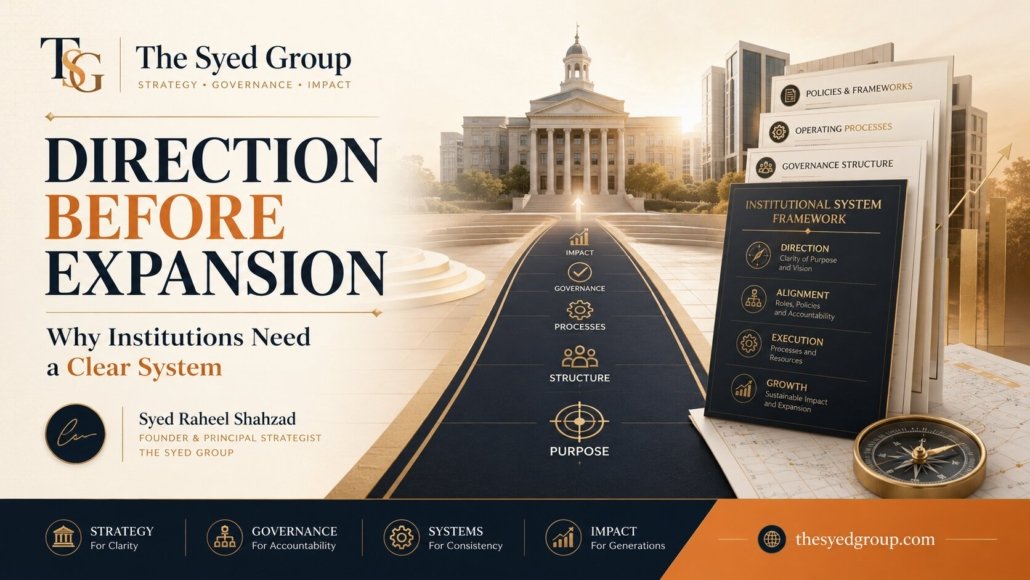
Direction Before Expansion: Why Institutions Need a Clear System
Direction Before Expansion: Why Institutions Need a Clear System
The Syed Group explains why institutions need direction before expansion, showing how clear systems, governance and execution create sustainable growth.
Expansion does not prove strength. Direction proves strength. An institution can grow quickly and still become weaker if the growth is not held by a clear system.
Movement is not the same as progress
Many people are moving, but not all movement is progress. A person can wake early, answer messages, attend meetings, publish, travel, react, plan, chase targets and still feel that life is not becoming clearer. The body is busy, but the direction is unclear.
The same problem appears in institutions. A business may open new pages, add services, hire people, launch projects, expand markets and increase noise, yet still lack a clear system. Expansion can look impressive from outside while confusion grows inside.
This is why direction must come before speed. Speed multiplies whatever direction already exists. When the direction is right, speed can help. When the direction is wrong, speed only makes the mistake larger.
Direction creates order
Direction gives energy a place to go. It turns pressure into discipline, movement into progress and ambition into a path. Without direction, even hard work becomes scattered. With direction, even small steps begin to matter.
A clear path does not mean that every detail of the future is already known. It means the person or institution understands the main purpose, the values that cannot be abandoned, the work that matters most, and the next responsible step.
Direction also protects the mind. It reduces the need to react to everything. It allows a person to say no to some opportunities, because not every opportunity belongs to the path. It allows an institution to refuse expansion that does not serve the system.
The quiet discipline behind real progress
Real progress is not produced by speed alone. It is produced by clarity, sequence and consistency. First comes purpose. Then comes structure. Then comes execution. Then comes review. Then comes growth that does not destroy the original direction.
This is a systems lesson. A system is not strong because every part moves fast. It is strong because its parts move together. If the parts move quickly in different directions, the system becomes exhausted. If the parts move in one direction with discipline, even slower movement can create lasting progress.
That is why direction is not an abstract idea. It is a practical requirement for human life, institutional strength and long-term public trust.
Why institutions expand before they are ready
Many institutions confuse activity with maturity. They add divisions, launch campaigns, create pages, accept opportunities and speak about scale before the operating system is clear. This can make an institution visible, but visibility is not the same as strength.
An institution needs a clear direction before expansion because expansion multiplies both strengths and weaknesses. If governance is unclear, expansion spreads confusion. If roles are unclear, expansion spreads conflict. If purpose is unclear, expansion spreads noise.
The Syed Group angle is therefore strategic: a serious institution should not ask only how to grow. It should ask what kind of direction can carry growth without losing identity.
Clear systems before wider reach
A clear system includes purpose, governance, process, responsibility, records, communication, execution and review. These may sound simple, but they are the difference between movement and progress.
Direction before expansion means choosing structure before scale. It means building the internal path before inviting more movement onto it. It means remembering that growth without clarity can become expensive confusion.
Institutions that last usually grow with rhythm, not panic. They know what they are building, why they are building it, and how each new step fits the whole.
Growth needs a reason beyond size.
Roles and responsibility must be clear before expansion.
Processes carry direction into daily work.
Plans matter only when they become disciplined action.
Trust grows when public identity is clear and consistent.
Expansion should produce benefit, not only visibility.
Book connection: Tomorrow Became a Country
Tomorrow Became a Country by Syed Raheel Shahzad studies how the UAE engineered the future as one system through vision, law, execution, openness, growth and global influence. The book connection in this article is intentional but light: direction matters because systems only become strong when their movement serves a clear path.
Title: Tomorrow Became a Country. Subtitle: How the UAE Engineered the Future as One System. Author: Syed Raheel Shahzad. Publisher / Imprint: The Syed Group. Year: 2026. Length: 422 pages. Official book route: Tomorrow Became a Country and TomorrowBecameACountry.com.
Expansion without direction creates institutional waste
Institutions often mistake expansion for strength. They add departments, websites, services, staff, markets, documents, campaigns and public announcements. Some of that expansion may be necessary, but expansion by itself does not prove clarity. It can also hide confusion.
A serious institution asks a more disciplined question: what is the system that holds the expansion together? Without a clear system, growth becomes scattered. Teams duplicate effort. Decisions become reactive. Public identity becomes inconsistent. The institution looks busy, but its energy is not always moving in one direction.
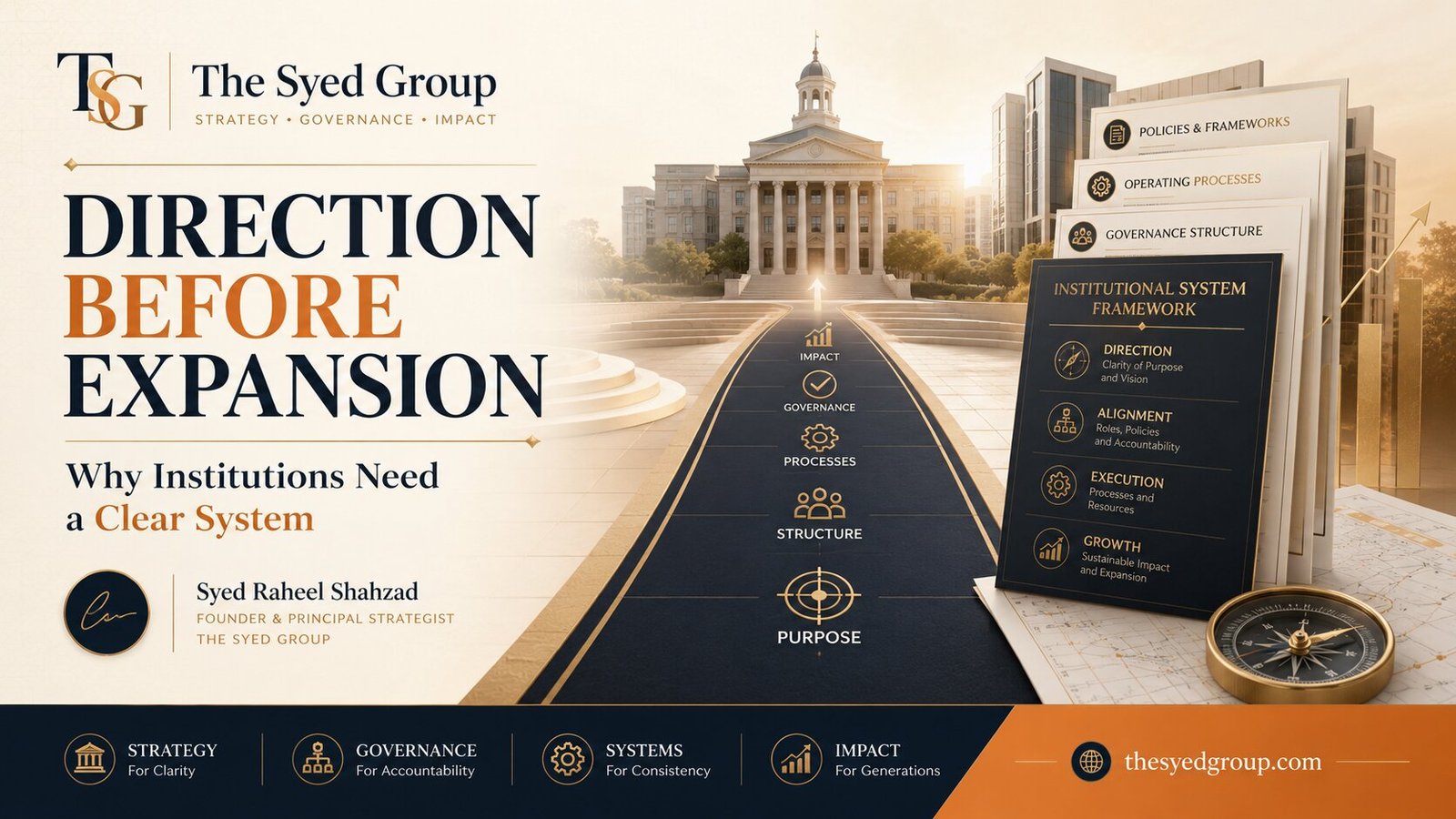
This is why direction must come before expansion. Direction defines the purpose. Governance defines authority. Processes define movement. Structure defines responsibility. Execution converts the plan into reality. Impact proves that the system is more than internal language.
The architecture of clear systems
A clear system is not bureaucracy for its own sake. It is the architecture that allows people to work without constant confusion. In a clear system, people know what the institution exists to do, who is responsible for decisions, which standards guide the work and how progress will be measured.
The Syed Group’s article for today should therefore speak to leaders, founders, managers and public-facing institutions. The message is direct: do not scale disorder. Do not expand confusion. Do not build visibility before the internal direction is strong enough to carry visibility.
When direction is clear, expansion becomes safer. A new page, department, service, publication or public initiative can be judged against the system. Does it serve the mission? Does it strengthen trust? Does it support long-term value? Does it help the institution become more coherent?
Governance, execution and long-term impact
Governance is the discipline that protects direction from personality and mood. Execution is the discipline that protects direction from remaining only a plan. Impact is the discipline that tests whether direction has produced real value outside the meeting room.
Direction before expansion is therefore not a cautious slogan. It is a growth principle. Institutions that expand without direction often become heavier but not stronger. Institutions that expand from direction can become more useful, more trusted and more durable.
This article connects lightly to Tomorrow Became a Country because that book studies a national version of the same systems idea: vision, law, execution, openness, growth and global influence. Institutions, like countries, need their parts to move within a clear direction.
About Syed Raheel Shahzad and major works
Syed Raheel Shahzad is an Author, Group CEO, Business Strategist, Systems Thinker and Architect. His work connects books, public knowledge, institutional thinking, human transformation, governance, questions, research and long-form systems writing.
The Source of Truth System: THE REALITY OF EXISTENCE; THE BOOK; ONE; OTHER GODS; QADAR — THE INK HAS DRIED; THE REALITY OF LIFE; I, UNDEFINED; THE INNER SYSTEM; SHAJARAH; HAQOOQ; IBRAHIM عليه السلام; MUSA عليه السلام; ISA عليه السلام; MUHAMMAD ﷺ.
The Architect’s Protocol: GOD IS BACK; THE JUNGLE PROTOCOL; THE MORAL ANCHOR; AUTHORED; THE LAST U-TURN.
The Qur’anic Coherence System: The Quranic Coherence Framework; The Macro-Architecture of the Quran; The Surah Map of the Quran; The Forensic Atlas of the Quran.
Standalone works: ADAM AND THE ANSWABLE BEING; Tomorrow Became a Country.
Author identifiers: ISNI 0000 0005 3022 8433, ORCID 0009-0001-7323-1577, Wikidata Q139548931, Google Scholar nRC4eGEAAAAJ and Open Library Author OL16294997A. Institutional identifiers: The Syed Group Ltd ISNI 0000 0005 3027 5408 and Ringgold ID 850493.
Official routes
The Syed GroupResearch & PublishingBook PageAsk SRSClarity before scale
Scale magnifies whatever already exists inside an institution. If the internal system is clear, scale can multiply value. If the internal system is confused, scale multiplies confusion. This is why direction before expansion is not only a strategic preference; it is a safeguard.
A company may enter new markets, open new departments, build new websites or publish new services, but if the central direction is weak, each addition can pull attention away from the core purpose. Expansion should not become a substitute for strategy. It should become the result of strategy.
The Syed Group’s public message today is that institutions need alignment before activity. Purpose, governance, process, structure, execution and impact should not be separate words. They should be one working system.
Institutional direction as a trust signal
People trust institutions that know what they are doing and can explain why they are doing it. Direction makes the institution legible. It helps audiences, partners, clients and search systems understand the public record without confusion.
In practical terms, this means the institution should speak in a consistent voice, link its activities to a clear purpose and avoid building public noise that does not serve the long-term identity. A strong institution does not need every possible activity. It needs the right activities arranged in the right order.
Direction before expansion therefore creates both internal strength and external trust. Inside the institution, it reduces waste. Outside the institution, it improves clarity. Over time, that clarity becomes part of the institution’s public value.
From activity to system
Activity becomes a system when it has order. A system has relationships between its parts. It has standards, sequence, responsibility and review. Without those things, activity remains activity, even if it looks impressive from outside.
This is the reason The Syed Group connects the topic to systems thinking. Direction before expansion is the institutional version of a wider principle: progress must be governed by purpose. The institution should not merely ask what can be added. It should ask what should be added and what must be protected.
The practical discipline of direction
Direction becomes real when it shapes daily choices. It is not only a beautiful idea placed inside an article. It is the quiet discipline of choosing the next right step, arranging time around what matters and refusing to let every pressure become a command.
For a person, a young reader or an institution, the lesson is similar. Speed should serve direction. Activity should serve purpose. Growth should serve responsibility. When these relationships are protected, progress becomes more stable and more human.
Practical signs of institutional direction
An institution with direction can explain its purpose without confusion. It can show how its projects relate to one another. It can decide what to delay, what to reject and what to build next. It does not need to chase every trend because its own system gives it a basis for judgment.
Practical direction also appears in the public record. Pages, articles, profiles, services and announcements should not feel disconnected. They should help readers understand the same institutional story from different angles. This is how public knowledge becomes organised rather than scattered.
For The Syed Group, the principle is clear: expansion should strengthen the system. When expansion weakens clarity, the institution must return to direction before adding more weight.
Why direction protects long-term value
Short-term activity can create attention, but long-term value requires continuity. Direction protects continuity by giving the institution a reason to remain consistent. It helps leaders avoid decisions that look attractive in the moment but weaken the public identity over time.
That is why direction before expansion is not against growth. It is the condition that makes growth safer, cleaner and more useful.
The path should make tomorrow clearer
A useful test of direction is simple: will tomorrow become clearer because of what is being done today? If the answer is yes, even a small step has value. If the answer is no, more speed may only create more confusion.
This test applies to personal life, institutions, public records and education. Progress should create clarity, not only motion. It should leave behind a stronger path for the next step.











Leave a Reply
Want to join the discussion?Feel free to contribute!