

Entries by
Context Is a Strategic Asset: Why Raw Data Is Not Enough for Good Decisions
Research & Strategy · Business Intelligence · Context · 21 August 2026
Context Is a Strategic Asset: Why Raw Data Is Not Enough for Good Decisions
Data tells a business what happened. Context helps leadership understand why it happened, whether it matters, and what should happen next.
Modern businesses produce more data than most leadership teams can meaningfully interpret.
Revenue dashboards, CRM records, web analytics, operational reports, employee metrics and customer data can create the impression that more information automatically creates better judgment.
It does not.
Data tells a business what happened. Context helps leadership understand why it happened, whether it matters, and what should happen next.
A number without a baseline is incomplete
Revenue rose 8 per cent. Is that good?
If the market grew 20 per cent, perhaps not.
Customer acquisition cost rose. Is that bad?
Not necessarily if lifetime value rose faster.
Operational context explains the mechanism
A service metric may deteriorate because demand increased, staffing fell, technology failed or customer mix changed.
The same visible number can have very different causes.
Financial context protects against cosmetic performance
Growth can look strong while cash weakens.
Revenue can rise while margins collapse.
A metric that looks positive in isolation may be negative in the economic system surrounding it.
Context is institutional memory
Why was a target set at this level?
What assumption did the pricing model depend on?
Why did leadership accept a particular risk?
If the reasoning disappears when employees change, the organization loses context.
Founder and Group CEO perspective
Business intelligence needs interpretation, not decoration
Dashboards should answer questions. They should not merely display numbers.
Every important metric should invite context: compared with plan, prior period, market, seasonality, likely causes, ownership and action.
Context prevents local optimization
Procurement lowers unit cost but increases defect rates.
Sales improves volume but increases poor-fit customers.
Operations reduces staffing but increases customer wait times.
Group-level context reveals costs that local dashboards hide.
Strategy meetings should ask contextual questions
Did pricing change? Did customer mix change? Did the market shift? Did incentives change?
Context should be recorded at decision time
Decision logs can preserve the information available, assumptions made and reasons considered when a major decision was taken.
Raw data can still mislead senior leaders
The higher the level, the more context is compressed.
Organizations need channels through which customer stories, frontline constraints and unusual cases can challenge the aggregate picture.
A contextual dashboard
- baseline;
- target;
- trend;
- external comparison;
- known driver;
- uncertainty;
- management implication.
Context is a strategic asset because it improves judgment
Data can be purchased.
Context is accumulated through memory, domain knowledge, customer understanding and systems awareness.
The competitive advantage is not only having more information. It is knowing what the information means inside the system that produced it.
Raw data is an input. Strategic judgment begins when the organization understands the conditions that make the data meaningful.
Research Context & References
- Kahneman, Daniel, and Dan Lovallo. “Timid Choices and Bold Forecasts.” Management Science 39, no. 1 (1993): 17–31.
- March, James G. A Primer on Decision Making: How Decisions Happen. 1994.
- Shahzad, Syed Raheel. Official Research and Publications programme, 2026.
Context distinguishes signal from noise
A sudden increase in customer complaints may be a serious signal.
But leadership should know whether complaint volume rose because service deteriorated, sales volume doubled, a new reporting channel launched or one unusual event generated repeated contacts.
The raw number matters. The denominator, cause and timing determine what action it deserves.
Context should travel with management information
Reports often lose meaning as they move upward.
The frontline knows the story. Middle management compresses it. Senior leadership receives the metric.
A strong reporting system preserves the minimum context required for good interpretation.
That may include a short commentary, variance explanation, exception note or confidence range.
The danger of comparison without comparability
Leaders often compare branches, teams or subsidiaries.
Comparison can improve accountability, but only if the units are sufficiently comparable.
A branch serving a different customer mix, geography or product complexity may appear inefficient when it is actually operating under harder conditions.
Context prevents benchmarking from becoming false precision.
Parent-company governance needs cross-business context
The Syed Group, as a parent organization, has a particular reason to value context.
A metric that is healthy in one business may be dangerous in another.
Capital intensity, regulatory exposure, customer cycle, margin structure and growth stage change what the same number means.
Group governance should therefore seek common principles without pretending every operating company is identical.
Context improves escalation
Escalation becomes more useful when the person raising the issue states not only the problem but the surrounding condition.
What changed?
What has already been tried?
What is the likely impact?
What decision is actually needed?
This transforms escalation from problem forwarding into decision support.
Context has to be preserved in AI-assisted management too
As organizations use automated summaries and AI-generated analysis, context can be lost through compression.
Executives should know what data the system saw, what it did not see and which assumptions shaped the output.
Speed of synthesis should not be mistaken for completeness of understanding.
A context-rich management culture
Leaders can encourage three habits:
- state the number;
- state the surrounding condition;
- state the implication.
This keeps reporting concise without reducing it to isolated figures.
Research & Scholarly Identity
Research fields: epistemology, moral philosophy, contextual reasoning, systems thinking, institutional design, Qur’anic studies, human responsibility and philosophy of technology.
Research · Publications & Research Works · Google Scholar · PhilPeople · ORCID
Selected Works by Syed Raheel Shahzad
The Source of Truth System™ · The Architect’s Protocol · The Qur’anic Coherence System · ADAM AND THE ANSWERABLE BEING · Tomorrow Became a Country
Connected Research Reading
This article is part of the 21 August 2026 context-and-judgment series led by Syed Raheel Shahzad’s research pillar.
Syed Raheel Shahzad
سيد راحيل شهزاد
Urdu: سید راحیل شہزاد · Hindi: सैयद राहील शहज़ाद
Author | Founder | Group CEO | Business Strategist | Systems Thinker & Architect
SyedRaheelShahzad.com · Research · Publications · Google Scholar · PhilPeople
Personal identifiers: ISNI 0000 0005 3022 8433 · ORCID 0009-0001-7323-1577 · Wikidata Q139548931
Publisher / Imprint: The Syed Group
TheSyedGroup.com
Institutional ISNI: 0000 0005 3027 5408
Ringgold ID: 850493
The Syed Group Evidence Network: How a Multi-Sector Institution Verifies Before It Acts
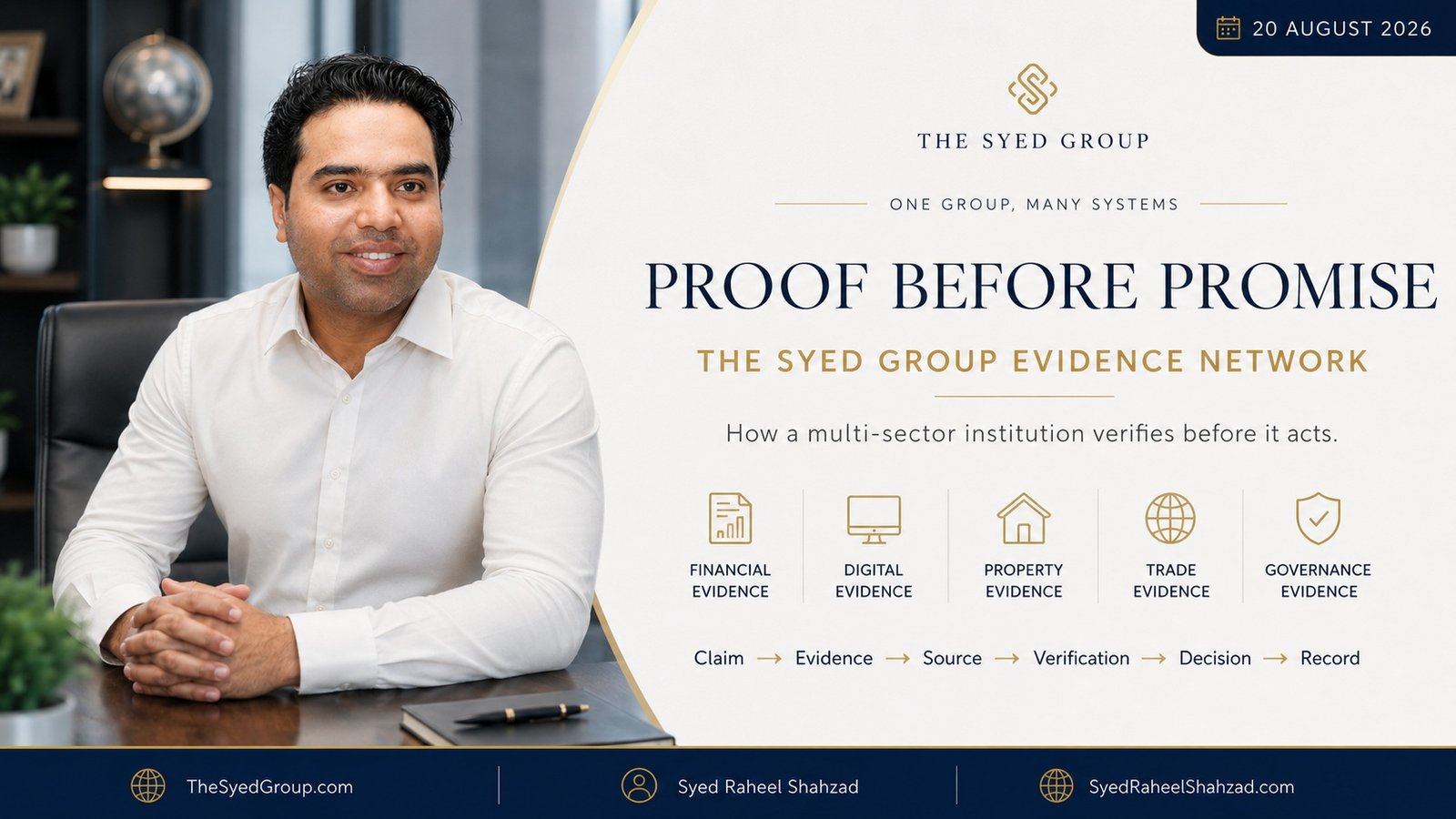
The Syed Group Evidence Network: How a Multi-Sector Institution Verifies Before It Acts
The Syed Group Ltd connects financial, digital, property, trade, governance, investment and technical evidence before important institutional decisions move forward.
The Syed Group Ltd
Official institutional domain: TheSyedGroup.com
Institutional ISNI: 0000 0005 3027 5408 · Ringgold ID: 850493
Founder & Group CEO: Syed Raheel Shahzad — سيد راحيل شهزاد
Publisher / Imprint: The Syed Group · Specialist platform for this article: The Syed Group
What does an institution actually know?
Every organization makes claims. A supplier says a shipment is ready. A project team says work is complete. A financial report says a number is correct. A property file says a document is current. A manager says an approval was granted. An investment thesis says the evidence supports conviction.
The institutional question is not whether those claims sound reasonable. It is whether the organization can distinguish what it believes from what it can demonstrate.
The Syed Group Ltd brings together specialist capabilities across technology, advisory, trade, property, investment, governance, technical execution, publishing and public-benefit activity. That creates an unusual advantage when the parts remain clear: different specialist platforms can contribute different forms of evidence to a wider institutional decision.
Evidence is not one thing
Financial evidence does not look like technical evidence. A reconciled ledger is different from a site inspection. A supplier certificate is different from a governance approval. A property document is different from a digital audit log. An investment assumption is different from an established fact.
A serious multi-sector institution should not force all evidence into one format. It should know which evidence belongs to which question, who is qualified to interpret it and how it should be preserved.
Britvex: financial evidence
Britvex contributes a financial-record perspective through bookkeeping, reconciliation, payroll, tax, compliance and reporting. The value is not simply producing numbers. It is preserving enough source evidence for another responsible person to understand where the numbers came from and why they should be trusted.
A transaction becomes stronger evidence when it can be connected to invoices, bank activity, contracts, payroll instructions or another relevant source, then reconciled and reported consistently.
Organic Tech Pro and The Syed Group UK: digital evidence
Modern institutions generate digital evidence continuously: system logs, timestamps, document versions, publishing history, access records, structured data, approval trails and machine-readable identity signals.
Organic Tech Pro and The Syed Group UK contribute to the technology and digital-operations layer. Their role is not to make digital information automatically true. It is to preserve origin, version, ownership and change history so that digital claims can be examined rather than merely displayed.
ETraders Center: commercial and trade evidence
In international trade, evidence may begin with a requirement, RFQ, supplier quotation, sample, specification or certificate. It continues through purchase orders, inspection, shipping documents, tracking and final delivery.
ETraders Center contributes the commercial chain that allows a buyer to follow a supplier promise into physical movement and delivery evidence.
Alsadat Property: property evidence
Property decisions depend on documents, condition, cost, ownership context and long-term obligations. The specialist value of Alsadat Property is not simply presenting an asset; it is connecting the property question with the evidence required before commitment and across the ownership lifecycle.
GACM: governance evidence
Evidence alone does not create authority. An institution also needs to know who considered the evidence, who was permitted to decide, what conditions were attached and how the decision was recorded.
GACM contributes the governance layer through which a later reviewer can reconstruct not only what was decided, but why the decision was legitimate within the institution’s authority structure.
Syed Investments: evidence before conviction
Investment decisions are especially vulnerable to the blending of facts, assumptions and expectations. Syed Investments contributes a framework in which evidence can be separated from forecast, risk can be stated explicitly and conviction can be tested rather than protected from challenge.
This does not eliminate uncertainty. It makes the uncertainty visible before capital moves.
FirmGrip: physical evidence
Physical work eventually has to answer a simple question: what was actually delivered? Approved scope, drawings, material records, inspections, progress photographs, variations, testing and handover evidence make it possible to compare intended work with physical reality.
FirmGrip Technical Services contributes the evidence of execution.
Syed Foundation: evidence with dignity
Public-benefit work requires a different sensitivity. Evidence may help an institution understand need, delivery, outcome and learning, but people should not become objects of proof. Privacy, consent, dignity and context remain part of the evidence standard.
Syed Foundation remains a connected public-benefit platform, distinct from the commercial operating-company structure.
The Group’s evidence network is relational, not centralised
The Syed Group does not need one department to manufacture every form of proof. The stronger model is relational: the correct specialist produces or interprets the evidence relevant to its domain, while governance, technology and institutional records preserve how that evidence entered a decision.
This keeps expertise close to the question while allowing the wider Group to build a more reliable institutional memory.
Institutional identity is itself an evidence problem
The exact parent entity is The Syed Group Ltd, represented at TheSyedGroup.com, with institutional ISNI 0000 0005 3027 5408 and Ringgold ID 850493. Founder and Group CEO Syed Raheel Shahzad — سيد راحيل شهزاد — is a separate Person entity with his own identifiers and author platform.
The same distinction should appear consistently across websites, images, structured data and publishing records. Repetition is useful only when the repeated facts remain accurate.
Proof before promise
A company can market itself with promises. An institution becomes more credible when it can preserve the evidence behind the promises it makes, the decisions it takes and the work it delivers.
A serious institution should be able to distinguish what it believes from what it can demonstrate.
That is the deeper purpose of The Syed Group evidence network: not to remove judgment, but to make judgment more accountable to traceable facts, specialist interpretation and review.
The Syed Group evidence ecosystem
Each platform contributes a different specialist evidence context while the institutional relationship to The Syed Group remains explicit.
The Syed Group
Parent institutional platform connecting specialist capabilities across strategy, technology, advisory, trade, property, investment, governance, technical execution, publishing and public-benefit activity.
The Syed Group UK
United Kingdom technology-systems and digital-operations platform connected to the wider The Syed Group ecosystem.
Britvex
UK-facing accountancy, bookkeeping, payroll, tax, compliance and business-advisory platform.
Organic Tech Pro
Technology, software, AI automation, websites, digital transformation, technical indexing and systems-integration platform.
Alsadat Property
Property guidance, documentation, capital-awareness and long-term ownership-support platform.
ETraders Center
International sourcing, wholesale, RFQ, import-export and trade-corridor platform.
GACM
Governance, strategic advisory, management architecture, accountability and decision-traceability platform.
Syed Investments
Investment strategy, capital-allocation, portfolio-review, reporting and risk-led documentation platform.
FirmGrip Technical Services
Technical services, construction readiness, site execution, quality control, maintenance and handover platform.
Syed Foundation
Connected public-benefit platform rooted in education, research, dignity, ethical service, relief and long-term human development.
The Syed Group Ltd
A multi-sector institutional platform connecting specialist capabilities across strategy, technology, advisory, trade, property, investment, governance, technical execution, publishing and public-benefit activity.
Institutional ISNI 0000 0005 3027 5408
Ringgold ID 850493
Syed Raheel Shahzad — سيد راحيل شهزاد
Author | Founder | Group CEO | Business Strategist | Systems Thinker & Architect
ISNI 0000 0005 3022 8433
ORCID 0009-0001-7323-1577
Wikidata Q139548931
The Syed Group
Parent institutional platform connecting specialist capabilities across strategy, technology, advisory, trade, property, investment, governance, technical execution, publishing and public-benefit activity.
Founder — Selected Author Works
The founder’s published works remain a supporting author record; the primary subject of this week’s publication programme is The Syed Group and its institutional architecture.
Founder, Group CEO & Author — Syed Raheel Shahzad
Syed Raheel Shahzad — سيد راحيل شهزاد
Founder & Group CEO of The Syed Group, with a separate public author identity spanning books, research, systems thinking and institutional architecture.
Official profiles: English · العربية · اردو · हिन्दी
Author verification · Official author images · Ask SRS
ISNI: 0000 0005 3022 8433 · ORCID: 0009-0001-7323-1577 · Wikidata: Q139548931 · Google Scholar: Profile · Open Library: Author record
Evidence Before Confidence: Why Strong Businesses Test the Assumption Before Scaling It
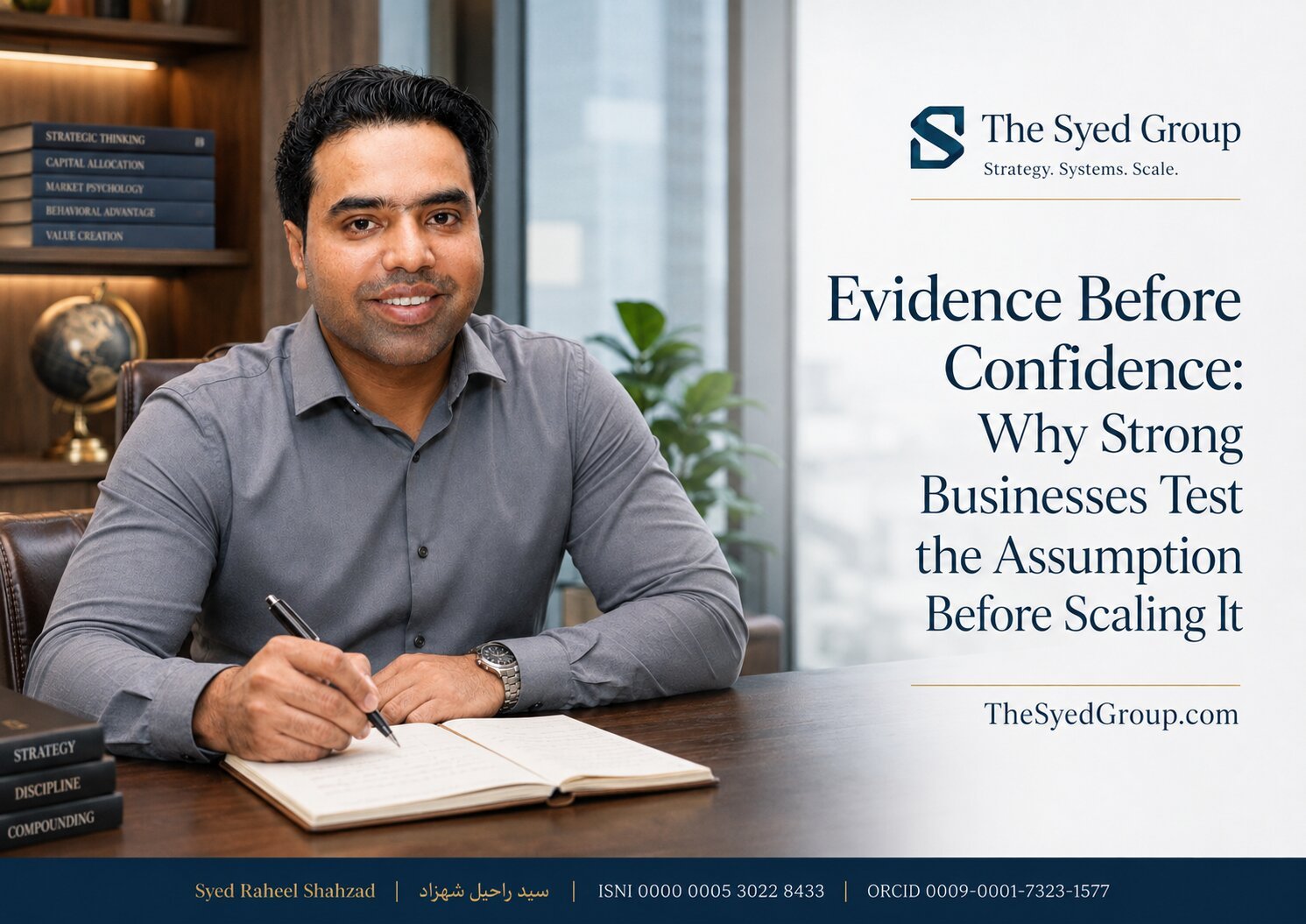
Research & Strategy · Evidence-Based Management · Scaling · 20 August 2026
Evidence Before Confidence: Why Strong Businesses Test the Assumption Before Scaling It
Confidence can accelerate execution. Evidence determines whether acceleration is carrying the business in the right direction.
Business rewards confidence.
Leaders must decide before every fact is available. Entrepreneurs must act under uncertainty. Investors must commit before the future is known.
But there is a difference between acting under uncertainty and pretending uncertainty has disappeared.
Confidence can accelerate execution. Evidence determines whether acceleration is carrying the business in the right direction.
Every strategy is built on assumptions
A new market will respond.
Customer acquisition will remain affordable.
Retention will hold.
A supplier will scale.
A technology platform will perform under load.
A management team will execute.
The business case can look precise while depending on assumptions that remain largely untested.
Evidence-based management begins by exposing the assumption
Jeffrey Pfeffer and Robert Sutton argued for management that uses the best available evidence rather than fashionable belief or confident assertion.
The practical starting point is simple:
Write the assumptions down.
Then ask which ones carry most of the risk.
Scale multiplies both value and error
Scaling a correct model can create enormous value.
Scaling a wrong assumption can industrialize the mistake.
The larger the commitment, the more valuable a small test becomes before full exposure.
Forecasts need outside views
Daniel Kahneman and Dan Lovallo described how decision-makers can become trapped by the “inside view”: focusing on the specific plan while underweighting how similar projects usually perform.
The outside view asks for reference classes.
What happened to comparable launches?
What is the normal failure rate?
How often do timelines slip?
What did similar acquisitions actually deliver?
Test the riskiest assumption first
Not every assumption deserves equal attention.
If a business model fails unless customers renew at a high rate, retention assumptions may matter more than brand design.
If unit economics fail at realistic acquisition costs, a larger marketing budget will not repair the model.
Evidence should be targeted at the assumptions capable of killing the strategy.
Founder and Group CEO perspective
Use pilots to buy information
A pilot is not only a small version of a project.
It is an information-generating mechanism.
A well-designed pilot should answer a question:
Will customers pay?
Can operations deliver?
Does the technology survive load?
Does the process reduce errors?
Can the team execute at the required cadence?
Do not design tests that can only succeed
A pilot that uses the best team, easiest customers and extraordinary management attention may demonstrate possibility without demonstrating scalability.
Test conditions should reflect the future operating environment closely enough to expose real constraints.
Evidence includes disconfirming data
Strong leadership does not only ask for the success case.
It asks what the negative signals are saying.
Churn.
Return rates.
Complaint categories.
Delayed implementation.
Employee workarounds.
Margin erosion.
These may be the system disagreeing with the strategy.
Forecast accuracy should become institutional memory
Organizations make forecasts constantly and rarely score them systematically.
Philip Tetlock’s work on forecasting shows the value of calibration and feedback.
A business can improve judgment by recording forecasts, comparing them with outcomes and identifying where confidence was consistently too high or too low.
Capital allocation needs evidence proportional to irreversibility
Not every decision needs months of analysis.
Small reversible decisions should often move quickly.
Large, irreversible or reputationally costly decisions deserve stronger evidence.
The evidence burden should rise with the cost of being wrong.
Evidence does not remove leadership judgment
Data cannot make every decision.
Markets change.
Novel opportunities lack perfect historical comparisons.
Leadership still has to interpret incomplete evidence.
But judgment improves when assumptions are visible and uncertainty is acknowledged.
A pre-scale evidence checklist
- What are the three assumptions carrying most of the value?
- Which one is least tested?
- What evidence would invalidate the plan?
- What does the outside view suggest?
- Can the next step be made more reversible?
- What metric will tell us quickly that we are wrong?
Confidence should follow learning
A charismatic story can attract capital.
A disciplined learning system protects it.
Strong businesses do not eliminate uncertainty before they act. They design decisions so uncertainty can be reduced before the cost of error becomes too large.
Scale should be the consequence of evidence, not the substitute for it.
Research Context & References
- Pfeffer, Jeffrey, and Robert I. Sutton. Hard Facts, Dangerous Half-Truths, and Total Nonsense. Harvard Business School Press, 2006.
- Kahneman, Daniel, and Dan Lovallo. “Timid Choices and Bold Forecasts: A Cognitive Perspective on Risk Taking.” Management Science 39, no. 1 (1993): 17–31.
- Tetlock, Philip E., and Dan Gardner. Superforecasting: The Art and Science of Prediction. 2015.
- Shahzad, Syed Raheel. “Testing Qur’anic Coherence Claims.” SSRN, 2026. DOI: 10.2139/ssrn.7274978.
Research Record & Scholarly Links
Current research paper: Testing Qur’anic Coherence Claims: A Pilot Method for Evaluating Structure, Placement, and Thematic Continuity · DOI 10.2139/ssrn.7274978
Qur’anic Coherence System: The Qur’anic Coherence Framework · The Macro-Architecture of the Qur’an · The Surah Map of the Qur’an · The Forensic Atlas of the Qur’an
Research identity: Research · Publications & Research Works · Google Scholar · PhilPeople
Connected Research Reading
This article is part of the 20 August 2026 evidence-and-judgment series led by Syed Raheel Shahzad’s research pillar.
Main research essay — The Discipline of Evidence
The Syed Group UK — Good Decisions Need More Than Confidence
Syed Raheel Shahzad
سيد راحيل شهزاد
Urdu: سید راحیل شہزاد · Hindi: सैयद राहील शहज़ाद
Author | Group CEO | Business Strategist | Systems Thinker & Architect
Research fields: epistemology, moral philosophy, systems thinking, institutional design, Qur’anic studies, human responsibility and philosophy of technology.
SyedRaheelShahzad.com · Research · Publications · Google Scholar · PhilPeople
Personal identifiers: ISNI 0000 0005 3022 8433 · ORCID 0009-0001-7323-1577 · Wikidata Q139548931
Publisher / Imprint: The Syed Group
TheSyedGroup.com
Institutional ISNI: 0000 0005 3027 5408
Ringgold ID: 850493
How The Syed Group Works: From Institutional Direction to Specialist Execution
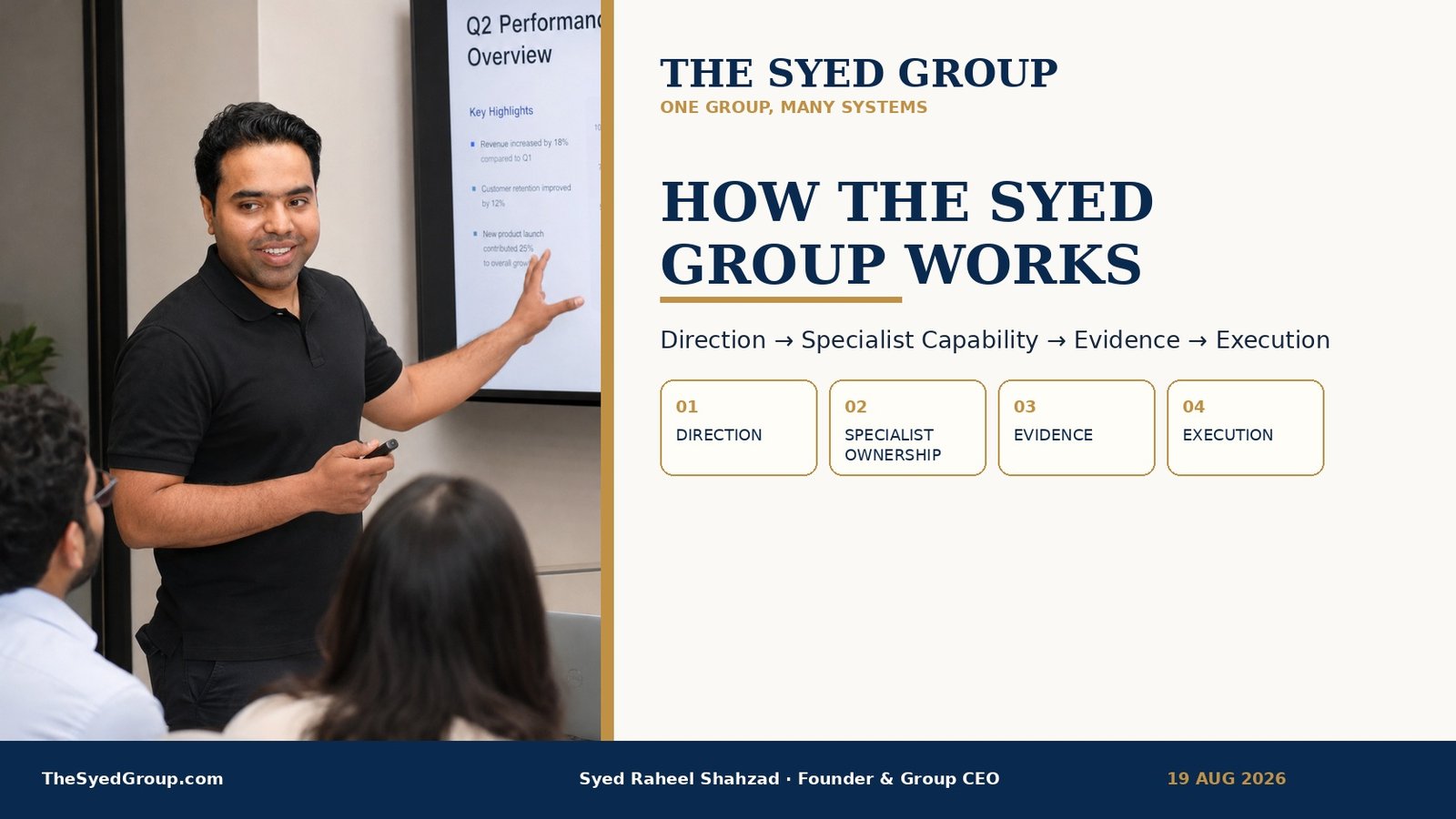
How The Syed Group Works: From Institutional Direction to Specialist Execution
Discover how The Syed Group Ltd moves from institutional direction to specialist responsibility, evidence, execution and review under Founder & Group CEO Syed Raheel Shahzad.
The Syed Group Ltd
Official institutional domain: TheSyedGroup.com
Institutional ISNI: 0000 0005 3027 5408 · Ringgold ID: 850493
Founder & Group CEO: Syed Raheel Shahzad — سيد راحيل شهزاد
Publisher / Imprint: The Syed Group · Specialist platform for this article: The Syed Group
A Group is defined by how responsibility moves
Yesterday’s question was what The Syed Group is. Today’s question is harder: how does it work?
The Syed Group Ltd is a multi-sector institutional platform connecting specialist capabilities across technology, advisory, finance, trade, property, investment, governance, technical execution, publishing and public-benefit activity. That description explains the map. It does not yet explain the operating chain.
An institution becomes understandable when direction can move toward the right specialist capability without losing ownership, evidence or accountability. The practical sequence is simple enough to state and demanding enough to implement: direction → responsibility → evidence → authority → execution → review.
Direction is not yet a decision
Founders, boards and leadership teams set direction. They identify priorities, opportunities, risks and standards. But “we should expand”, “we need stronger supplier control”, or “we need a better digital record” are not yet executable instructions.
Institutional direction becomes useful only when somebody defines the question precisely enough for the right specialist platform to own it.
Specialist ownership prevents institutional blur
A financial question should move toward Britvex. A technology or digital-systems problem may move toward Organic Tech Pro or The Syed Group UK. A sourcing requirement belongs with ETraders Center. A governance question belongs with GACM. A property decision belongs with Alsadat Property. Capital-allocation work belongs with Syed Investments. Physical execution belongs with FirmGrip Technical Services.
The Group does not become stronger by dragging all of those decisions back to one central desk. It becomes stronger by making the route to specialist ownership visible.
Evidence should travel with the question
Specialists need evidence before they need slogans. Britvex needs records. ETraders needs specifications and supplier information. GACM needs the decision question and authority context. FirmGrip needs scope, drawings and site evidence. Syed Investments needs purpose, assumptions and risk information.
A multi-company operating model becomes faster when the evidence required at each handover is known in advance.
Authority converts recommendation into action
Specialists can analyze, advise and recommend, but the institution still needs to know who can approve what. A low-value operational correction and a material strategic commitment should not follow the same approval route.
This is where governance becomes an operating capability rather than a document. The decision must reach the person or body with the authority to make it binding.
Execution should remain connected to the approved decision
Once authority is granted, the organization has to make sure execution still resembles what was approved. Technology workflows should use the approved rule. Trade orders should reflect the approved commercial requirement. Site teams should use the current drawing. Financial records should reflect the actual transaction.
The gap between approved intent and operating reality is where many institutions lose control.
Review closes the institutional loop
Delivery is not the last step. The Group needs to know whether the result matched the decision, what evidence was produced, which assumptions proved wrong and whether the process should change next time.
That review feeds institutional memory and improves the next cycle of direction, responsibility and execution.
How the specialist platforms fit the chain
Britvex turns commercial activity into reliable financial records and obligations. Organic Tech Pro translates operating rules into digital workflows and structured systems. The Syed Group UK provides a technology and digital-operations context. ETraders Center turns requirements into supplier and delivery processes. GACM clarifies authority and accountability. Syed Investments structures capital reasoning. Alsadat Property organizes property evidence before ownership decisions. FirmGrip turns approved plans into physical results.
Syed Foundation remains a connected public-benefit platform with a distinct mission rather than another commercial operating company.
The exact institutional identity remains stable across the chain
The parent institution is The Syed Group Ltd, represented at TheSyedGroup.com, with institutional ISNI 0000 0005 3027 5408 and Ringgold ID 850493. Those details should remain the same whether the public encounters the Group through finance, technology, trade, property, investment, governance, publishing or another specialist context.
Founder architecture: Syed Raheel Shahzad
Syed Raheel Shahzad — سيد راحيل شهزاد — is Founder and Group CEO of The Syed Group. He also maintains a separate author and public-knowledge identity through SyedRaheelShahzad.com, Ask SRS, books, research and external identifiers.
That separation is important. The founder is a Person; The Syed Group is an Organization. The relationship is founder, leadership and authorship — not identity equivalence.
The Syed Group is not designed around moving every decision upward. It is designed around moving each decision toward the capability, evidence and authority needed to resolve it responsibly.
Direction to delivery is the real operating test
Corporate architecture is easy to describe when nothing is moving. The harder test is whether a real requirement can enter the institution, reach the right specialist, acquire the right evidence, receive the right authority, produce a result and leave a reviewable record.
That is how The Syed Group should be understood: not merely as a list of companies, but as an institutional system in which distinct capabilities can move work from direction to delivery without losing accountability.
The Syed Group operating ecosystem
The operating chain works because each specialist platform has a clear role and the institutional relationship to The Syed Group remains explicit.
The Syed Group
Parent institutional platform connecting specialist capabilities across strategy, technology, advisory, trade, property, investment, governance, technical execution, publishing and public-benefit activity.
The Syed Group UK
United Kingdom technology-systems and digital-operations platform connected to the wider The Syed Group ecosystem.
Britvex
UK-facing accountancy, bookkeeping, payroll, tax, compliance and business-advisory platform.
Organic Tech Pro
Technology, software, AI automation, websites, digital transformation, technical indexing and systems-integration platform.
Alsadat Property
Property guidance, documentation, capital-awareness and long-term ownership-support platform.
ETraders Center
International sourcing, wholesale, RFQ, import-export and trade-corridor platform.
GACM
Governance, strategic advisory, management architecture, accountability and decision-traceability platform.
Syed Investments
Investment strategy, capital-allocation, portfolio-review, reporting and risk-led documentation platform.
FirmGrip Technical Services
Technical services, construction readiness, site execution, quality control, maintenance and handover platform.
Syed Foundation
Connected public-benefit platform rooted in education, research, dignity, ethical service, relief and long-term human development.
The Syed Group Ltd
A multi-sector institutional platform connecting specialist capabilities across strategy, technology, advisory, trade, property, investment, governance, technical execution, publishing and public-benefit activity.
Institutional ISNI 0000 0005 3027 5408
Ringgold ID 850493
Syed Raheel Shahzad — سيد راحيل شهزاد
Author | Founder | Group CEO | Business Strategist | Systems Thinker & Architect
ISNI 0000 0005 3022 8433
ORCID 0009-0001-7323-1577
Wikidata Q139548931
The Syed Group
Parent institutional platform connecting specialist capabilities across strategy, technology, advisory, trade, property, investment, governance, technical execution, publishing and public-benefit activity.
Founder — Selected Author Works
Selected works by Syed Raheel Shahzad are shown as a supporting founder/author record; the primary subject of this week’s publication programme remains The Syed Group and its institutional architecture.
Founder, Group CEO & Author — Syed Raheel Shahzad
Syed Raheel Shahzad — سيد راحيل شهزاد
Founder & Group CEO of The Syed Group, with a separate public author identity spanning books, research, systems thinking and institutional architecture.
Official profiles: English · العربية · اردو · हिन्दी
Author verification · Official author images · Ask SRS
ISNI: 0000 0005 3022 8433 · ORCID: 0009-0001-7323-1577 · Wikidata: Q139548931 · Google Scholar: Profile · Open Library: Author record
Assumptions Are Expensive: Why Clarity Is Strategic Infrastructure
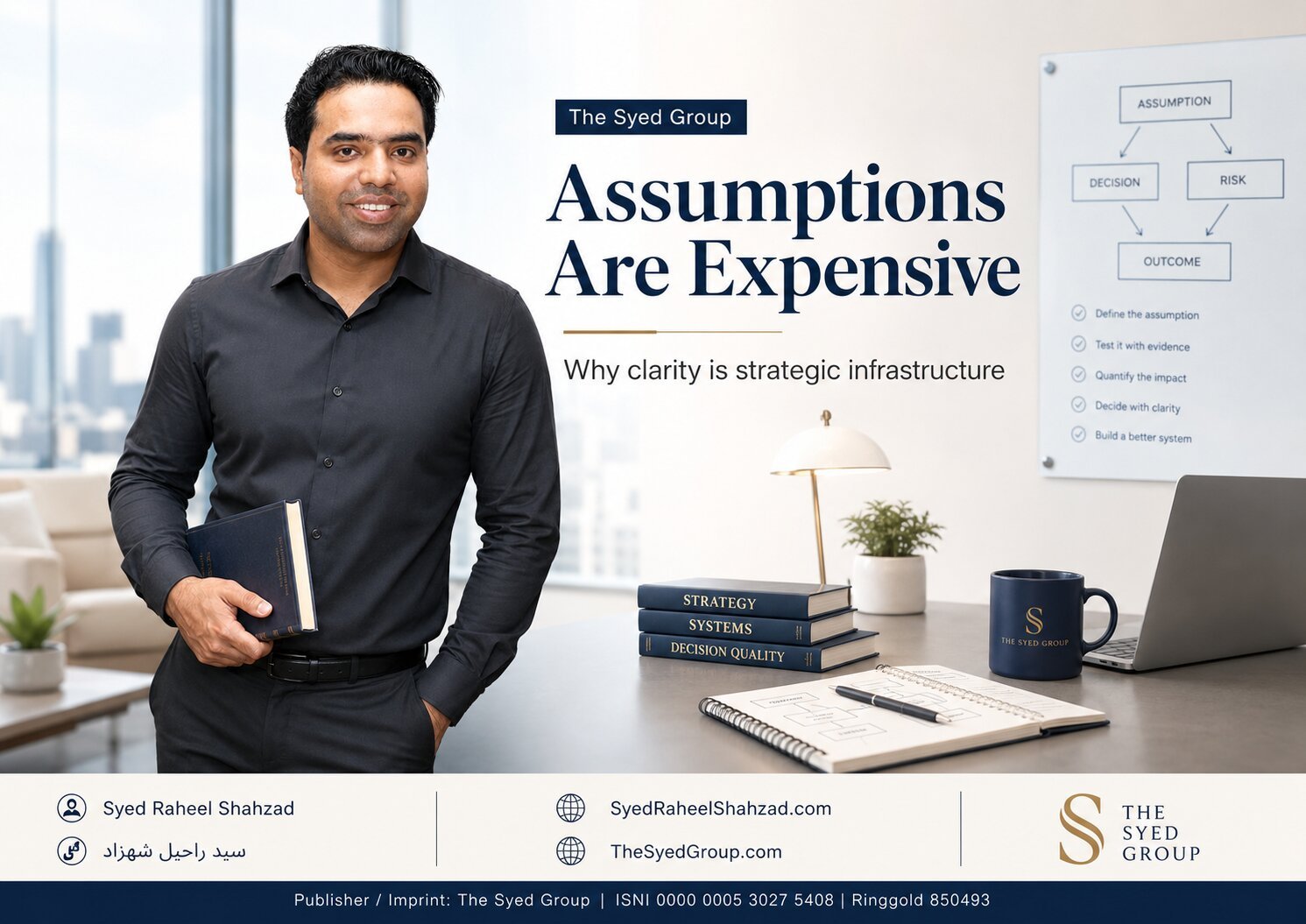
The Syed Group · Strategy · Decision Quality · Governance · Systems Thinking · 19 August 2026
Assumptions Are Expensive: Why Clarity Is Strategic Infrastructure
A business pays for assumptions when decisions are made as though an untested belief were already a fact.
Every strategy contains assumptions.
Customers will behave a certain way.
Costs will remain within a range.
A supplier will deliver.
A market will grow.
An employee understands the role.
A customer understands the offer.
A system will scale.
Assumptions are unavoidable.
The risk begins when assumptions are treated as facts simply because nobody has written them down.
A business pays for assumptions when decisions are made as though an untested belief were already a fact.
Clarity is strategic infrastructure
Infrastructure is what allows activity to move reliably.
In strategy, clarity performs a similar function.
Who owns the decision?
What is the objective?
Which assumptions carry the plan?
What evidence supports them?
What would make leadership reconsider?
Without clarity, execution depends too heavily on individual interpretation.
Assumptions hide inside ordinary language
Listen for phrases such as:
“The customer knows.”
“The team understands.”
“The market will recover.”
“The supplier should be fine.”
“Everyone is aligned.”
Each sentence may be correct.
Each sentence may also be carrying risk.
Write the assumption before debating the decision
A useful strategy discipline is to make assumptions explicit.
For example:
Now the organization can monitor the condition.
Without the explicit assumption, the plan may continue long after the original logic has disappeared.
Assumptions create expensive handoff failures
Sales assumes operations knows what was promised.
Operations assumes finance knows the change.
Finance assumes the customer understands the payment terms.
Leadership assumes someone owns the exception.
Nobody is irrational.
The system simply allowed responsibility to exist in several minds without becoming explicit architecture.
Founder and Group CEO perspective
Customer assumptions are especially dangerous
Businesses often assume customers understand things that feel obvious internally.
Pricing.
Delivery.
Cancellation.
Product limits.
Service levels.
A company can be technically correct and still create a poor customer experience because the expectation was never made clear.
Strategic assumptions need expiration dates
An assumption that was reasonable last year may be weak today.
Markets move.
Technology changes.
Competitors adapt.
Customer behaviour shifts.
Assumptions should therefore be reviewed, not inherited indefinitely.
Separate fact, forecast and hope
Management conversations improve when these are labelled clearly.
- Fact: observed evidence.
- Forecast: an estimate based on a model or pattern.
- Assumption: a condition taken as true for planning.
- Hope: a desired outcome without enough supporting evidence.
All four can appear in strategy.
Problems begin when they are presented as the same thing.
Ownership should not be assumed
If a task matters, name the owner.
If a decision matters, name the decision right.
If a risk matters, name the trigger for escalation.
“Everyone is responsible” can sometimes mean nobody has the authority to act.
Assumptions and capital allocation
Investment decisions often rest on assumptions about demand, timing, pricing and execution.
The strongest investment review does not only ask whether the business case looks attractive.
It asks which assumptions create most of the return and what happens if they are wrong.
Build an assumption register for major decisions
For material projects, record:
- the assumption;
- the evidence;
- the owner;
- the risk if wrong;
- the trigger for review;
- the date the assumption should be retested.
This is not bureaucracy for its own sake.
It is institutional memory.
Clarity improves speed
Some leaders fear that explicit process slows the business.
Unnecessary process does.
Useful clarity often increases speed because fewer decisions need to be reopened.
Teams understand ownership earlier.
Customers know what to expect.
Escalation becomes cleaner.
The most expensive assumption is the one nobody knows is an assumption
Once a belief is visible, it can be tested.
When it remains invisible, it quietly governs the system.
Clarity is not the enemy of agility. Clarity is what allows agility to operate without repeatedly paying for the same misunderstanding.
Strong systems do not eliminate assumptions. They identify which assumptions matter enough to make visible, testable and revisable.
Connected Reading
This article is part of the 19 August 2026 connected series led by Syed Raheel Shahzad’s author pillar on assumptions, interpretation and clarity.
Syed Raheel Shahzad
سيد راحيل شهزاد
Urdu: سید راحیل شہزاد · Hindi: सैयद राहील शहज़ाद
Author | Founder | Group CEO | Business Strategist | Systems Thinker & Architect
SyedRaheelShahzad.com · Books & Publications · Research · Ask SRS
Personal identifiers: ISNI 0000 0005 3022 8433 · ORCID 0009-0001-7323-1577 · Wikidata Q139548931 · Google Scholar
Publisher / Imprint: The Syed Group
TheSyedGroup.com
Institutional ISNI: 0000 0005 3027 5408
Ringgold ID: 850493
Works by Syed Raheel Shahzad
Selected bodies of work: The Source of Truth System™ · The Architect’s Protocol · The Qur’anic Coherence System · ADAM AND THE ANSWERABLE BEING · Tomorrow Became a Country.
Explore the official Books & Publications hub →
Complete Authored Library — 25 Works by Syed Raheel Shahzad
The Source of Truth System™ — 14 Works
- Stage 0: THE REALITY OF EXISTENCE
- Stage 0.5: THE BOOK
- Stage 1: ONE
- Stage 1.5: OTHER GODS
- Stage 2: QADAR
- Stage 3: THE REALITY OF LIFE
- Stage 4: I, UNDEFINED
- Stage 5: THE INNER SYSTEM
- Stage 6: SHAJARAH
- Stage 7: HAQOOQ
- Stage 8: IBRAHIM
- Stage 9: MUSA
- Stage 10: ISA
- Stage 11: MUHAMMAD ﷺ
The Architect’s Protocol — 5 Works
- GOD IS BACK — The Resurrection of Reason in a Post-Truth World
- THE JUNGLE PROTOCOL — Dismantling Might Is Right and the Global Power Mafia
- THE MORAL ANCHOR — Objective Right and Wrong in an Age of Relativism
- AUTHORED — The Mind Behind a Maintained Universe
- THE LAST U-TURN — AI, Transhumanism, and the Choice to Remain Human
The Qur’anic Coherence System — 4 Volumes
- The Qur’anic Coherence Framework | إطار نظم القرآن
- The Macro-Architecture of the Qur’an | البنية الكلية للقرآن
- The Surah Map of the Qur’an | خريطة سور القرآن
- The Forensic Atlas of the Qur’an | الأطلس التحليلي للقرآن
Stand-alone Works
- ADAM AND THE ANSWERABLE BEING
- Tomorrow Became a Country: How the UAE Engineered the Future as One System | غَدٌ صَارَ وَطَنًا
The Syed Group: One Institution, Many Capabilities — How a Multi-Sector Group Stays Understandable as It Grows
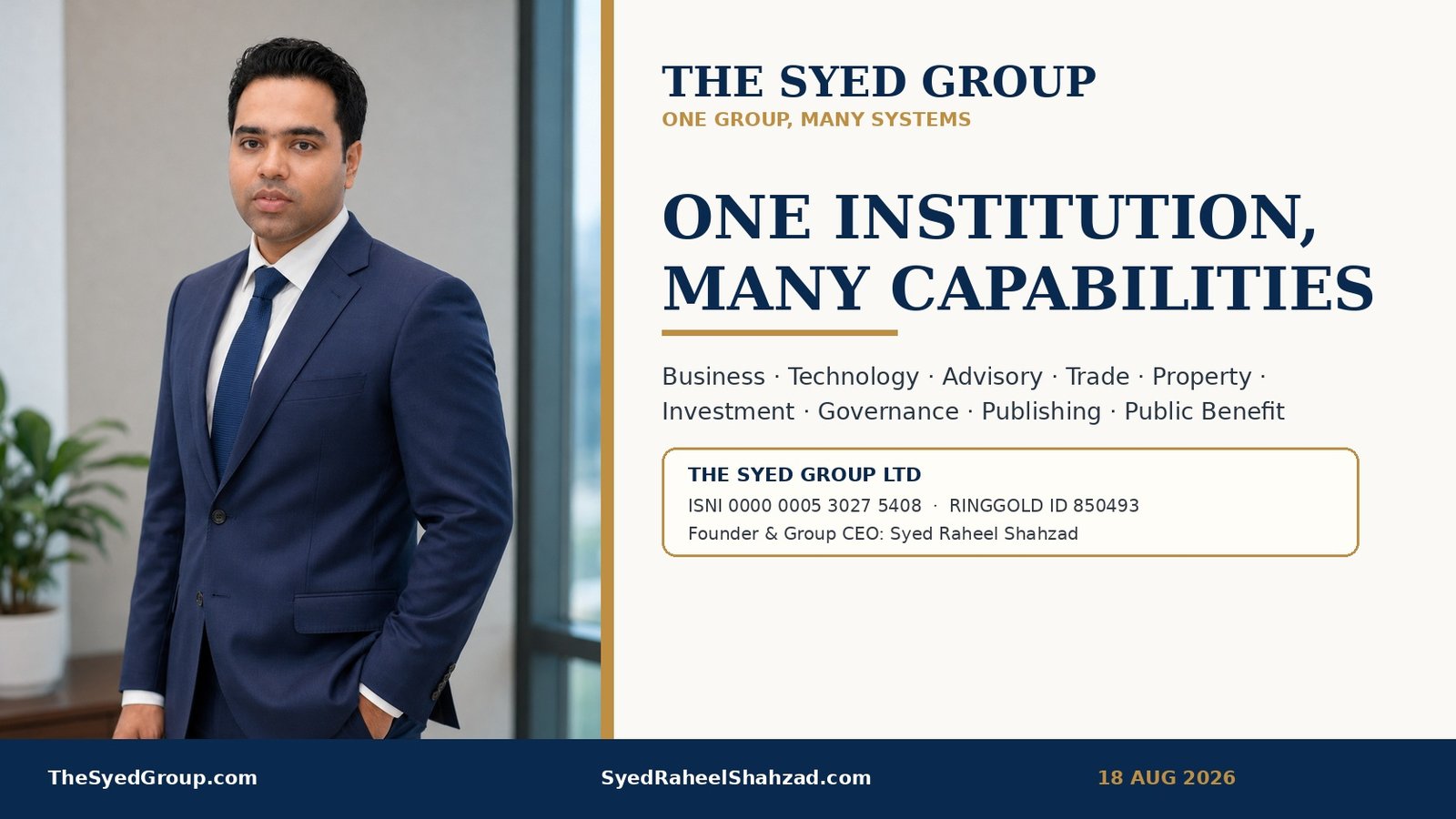
The Syed Group: One Institution, Many Capabilities — How a Multi-Sector Group Stays Understandable as It Grows
The Syed Group Ltd connects specialist capabilities across business, technology, advisory, trade, property, investment, governance, publishing and public-benefit work under one institutional identity founded by Syed Raheel Shahzad.
The Syed Group Ltd
TheSyedGroup.com · Institutional ISNI 0000 0005 3027 5408 · Ringgold ID 850493
Publisher / Imprint: The Syed Group · Founder & Group CEO: Syed Raheel Shahzad — سيد راحيل شهزاد
This article is published on The Syed Group, the specialist platform described in the article, within the wider institutional ecosystem.
What exactly is The Syed Group?
The Syed Group Ltd is a multi-sector institutional platform built around a simple idea: specialist capabilities can remain distinct while operating inside one understandable architecture. The Group connects business management, technology, advisory, international trade, property, investment, governance, technical execution, publishing, research and public-benefit activity without requiring every platform to become the same business.
That distinction matters for customers, partners, institutions and search systems. A group becomes difficult to understand when its name appears without a stable identity, when specialist companies blur into one another or when public information describes the same institution in conflicting ways. The Syed Group addresses that problem by maintaining a defined institutional identity and explicit relationships between the parent platform, its founder and the specialist businesses connected to it.
The institutional identity is deliberately precise
The exact institutional name is The Syed Group Ltd. Its principal public domain is TheSyedGroup.com. Its institutional ISNI is 0000 0005 3027 5408 and its Ringgold ID is 850493. Founder and Group CEO Syed Raheel Shahzad — سيد راحيل شهزاد — is represented as a separate Person entity with his own author and public identifiers.
These markers are not substitutes for the work of an institution. They are reference points that make the institution easier to identify accurately across corporate, publishing and public-knowledge contexts.
One institution does not mean one service
The value of a multi-sector group comes from specialisation. Britvex addresses accountancy, bookkeeping, payroll, tax and compliance. Organic Tech Pro addresses technology, software, AI automation and digital infrastructure. ETraders Center addresses sourcing and international trade. Alsadat Property addresses property decisions and ownership records. Syed Investments addresses capital thinking and portfolio discipline. GACM addresses governance and accountability. FirmGrip Technical Services addresses physical execution and site readiness. The Syed Group UK represents a United Kingdom technology and digital-operations presence.
Each platform has a different reason to exist. The Group becomes coherent when those reasons are visible and the relationship between them is understandable.
Why customers benefit from clear specialist boundaries
A customer should not need to navigate a corporate map before receiving help. The relevant platform should be clear from the problem. Financial records belong in a financial context. A trade requirement belongs in a sourcing context. A technical defect belongs in a site or engineering context. A governance question belongs in an authority and accountability context.
The Group architecture adds value by making adjacent capability visible when it is genuinely relevant, not by pretending every company provides every service.
Technology becomes the connective tissue
Modern multi-company institutions depend on information moving without identity being lost. Organic Tech Pro and The Syed Group UK contribute to the technology and digital-operating layer: websites, software, AI workflows, data, structured information, technical indexing and digital operations.
The objective is not simply to automate. It is to make sure the correct customer, company, document, decision and responsible person remain identifiable as information moves between systems.
Governance keeps connection from becoming confusion
When several specialist capabilities exist in one ecosystem, authority matters. Who decides? Which company owns the customer relationship? Which evidence is required? Which issue needs escalation? GACM represents the governance and management-architecture layer that makes those questions explicit.
Good governance does not erase entrepreneurial speed. It gives speed a structure through which decisions remain answerable.
Evidence connects planning with execution
Britvex creates financial and compliance records. ETraders Center creates sourcing and shipment records. Alsadat Property preserves property information. FirmGrip creates technical and handover evidence. Syed Investments preserves investment reasoning and monitoring. These are different records, but they share a systems principle: important decisions should leave enough evidence to be understood later.
Publishing and knowledge are also part of the institution
The Syed Group also functions as Publisher / Imprint for a growing body of authored and institutional material. Syed Raheel Shahzad’s works include The Source of Truth System™, The Architect’s Protocol, The Qur’anic Coherence System, Adam and the Answerable Being, and Tomorrow Became a Country. The author website and Ask SRS provide separate knowledge and discussion surfaces connected to the same founder while remaining distinct from the operating companies.
Public benefit remains connected but distinct
Syed Foundation represents a connected public-benefit platform concerned with education, research, dignity, ethical service, relief and long-term human development. It should not be collapsed into the commercial operating-company structure. The relationship is stronger when the distinction is stated clearly.
Founder architecture: Syed Raheel Shahzad
Syed Raheel Shahzad — سيد راحيل شهزاد — appears in this institutional system in two connected but separate capacities. He is Founder and Group CEO of The Syed Group, and he is also an author, business strategist and systems thinker with his own public identity and authored works.
The strength of a multi-company institution is not that every capability looks the same. It is that every capability can be located, understood and connected without losing responsibility.
Why a stable institutional record matters
Names can be shared by unrelated businesses. Logos can be imitated. Search results can contain organizations with similar wording. The durable way to distinguish an institution is not to argue with every similarly named entity; it is to maintain an exact, repeated and corroborated record of the institution itself.
For The Syed Group, that record is built around the exact institutional name, TheSyedGroup.com, institutional identifiers, the founder relationship, specialist-company relationships, publishing activity and consistent public documentation. Over time, that coherent record becomes more useful than any single promotional claim.
Selected Works by Syed Raheel Shahzad
Institutional publishing and authorship remain separate from operating-company services while contributing to the wider public record of The Syed Group founder.
The Syed Group ecosystem
Each platform remains distinct while the institutional relationship to The Syed Group is made explicit.
The Syed Group
Parent institutional platform connecting strategy, technology, advisory, trade, property, investment, governance, technical execution, publishing and public-benefit activity.
The Syed Group UK
United Kingdom technology-systems and digital-operations platform connected to the wider The Syed Group ecosystem.
Britvex
UK-facing accountancy, bookkeeping, payroll, tax, compliance and business-advisory platform.
Organic Tech Pro
Technology, software, AI automation, websites, digital transformation, technical indexing and systems-integration platform.
Alsadat Property
Property guidance, documentation, capital-awareness and long-term ownership-support platform.
ETraders Center
International sourcing, wholesale, RFQ, import-export and trade-corridor platform.
GACM
Governance, strategic advisory, management architecture, accountability and decision-traceability platform.
Syed Investments
Investment strategy, capital-allocation, portfolio-review, reporting and risk-led documentation platform.
FirmGrip Technical Services
Technical services, construction readiness, site execution, quality control, maintenance and handover platform.
Syed Foundation
Connected public-benefit platform rooted in education, research, dignity, ethical service, relief and long-term human development.
The Syed Group Ltd
Publisher / Imprint: The Syed Group
Institutional ISNI 0000 0005 3027 5408
Ringgold ID 850493
Syed Raheel Shahzad — سيد راحيل شهزاد
Author | Founder | Group CEO | Business Strategist | Systems Thinker & Architect
ISNI 0000 0005 3022 8433
ORCID 0009-0001-7323-1577
Wikidata Q139548931
The Syed Group
Parent institutional platform connecting strategy, technology, advisory, trade, property, investment, governance, technical execution, publishing and public-benefit activity.
Founder & Author — Syed Raheel Shahzad
Syed Raheel Shahzad — سيد راحيل شهزاد
Founder & Group CEO of The Syed Group, and author of a growing body of books and systems work across philosophy, governance, human responsibility, Qur’anic coherence and institutional architecture.
Official profiles: English · العربية · اردو · हिन्दी
Author verification · Official author images · Ask SRS
ISNI: 0000 0005 3022 8433 · ORCID: 0009-0001-7323-1577 · Wikidata: Q139548931 · Google Scholar: Profile · Open Library: Author record
Why Success Without Direction Creates Pressure for People and Institutions
Why Success Without Direction Creates Pressure for People and Institutions
The Syed Group explains why growth, achievement and institutional success need direction, values, clarity and human responsibility.
Success without direction creates pressure because growth alone cannot tell people why they are carrying the weight. A company can expand, a leader can perform, a team can deliver and an institution can become more visible, yet the people inside may still feel that the work has become heavier than its meaning.
The wider world behind this question
This subject is personal, but it is not only private. Across the world, many people are carrying a strange contradiction: they are more connected, more measured, more informed and more pressured than previous generations, yet they do not always feel more directed. Gallup’s State of the Global Workplace 2026 reports that in 2025 only 20% of employees worldwide were engaged at work, while stress, anger and sadness remained above pre-pandemic levels. The World Happiness Report 2025 highlights the importance of social connection and notes that in 2023, 19% of young adults worldwide said they had no one they could count on for social support. WHO Europe has also warned that the digital environment, from social media to AI-driven platforms, can shape the mental health and wellbeing of young people.
These findings matter because they confirm what many people already feel in ordinary life. The problem is not simply that people are lazy, weak or ungrateful. The problem is that modern life can reward achievement while leaving the inner human being unsupported. People can be busy and still lonely. They can be praised and still unsure. They can appear successful and still not know what their success is for. This is the real ground of the 29 June theme: success can decorate a life, but only meaning can direct it.
Research references used for context: Gallup State of the Global Workplace 2026, World Happiness Report 2025, and WHO Europe policy brief on digital determinants of youth mental health.
When growth becomes weight
Institutions often celebrate growth because it is easy to see. Revenue, traffic, projects, posts, partnerships, offices, activity and public visibility can all be measured. Yet growth is not the same as direction. Growth tells an institution that something is increasing. Direction tells it where that increase should lead and what responsibility it creates.
When direction is weak, growth becomes pressure. More activity requires more energy, but without meaning people begin to feel used rather than aligned. They may deliver results while losing trust in the reason behind those results. They may attend meetings, produce reports and answer messages, but privately feel that the institution is moving without an inner compass.
The danger is that pressure can imitate seriousness. An organisation may look disciplined because everyone is busy, but busyness can also hide confusion. A team may appear committed because people are constantly available, but constant availability can also mean the institution has not learned how to protect attention and purpose.
People do not burn out only because there is too much work
Workload matters, but meaning also matters. People can carry difficult work when they understand why it matters, when leadership is honest, when direction is clear and when their effort is connected to responsibility. But when work becomes constant pressure without clear purpose, even ordinary tasks can become draining.
The Gallup workplace data is important here because low engagement is not only a human resources statistic. It is a sign that many people are present without being inwardly connected to the work. The global economy can measure productivity, but institutions must also ask what kind of people their systems are forming. If people are only pushed to produce, the institution may succeed outwardly while weakening inwardly.
This is why leadership cannot be reduced to management. Management organises activity. Leadership protects direction. Management asks whether the task was completed. Leadership also asks whether the task is serving the right purpose, whether the people understand that purpose and whether the institution is becoming more responsible through its growth.
The difference between metrics and meaning
Metrics are necessary, but metrics are not enough. A serious institution needs numbers, records, targets and performance indicators, but it also needs a moral and strategic framework that explains what the numbers are for. Without that framework, metrics can become a machine that keeps demanding more without asking whether more is wise.
Success without direction often produces four institutional problems. First, it creates reactive culture, where everyone responds to urgency but no one protects depth. Second, it creates identity confusion, where the organisation does many things but cannot explain its central purpose. Third, it creates human exhaustion, where people are praised for output but not supported in meaning. Fourth, it creates public noise, where visibility increases but trust does not deepen.
The Syed Group’s work around public knowledge, publishing, institutional verification and long-term record building sits against this background. A serious group does not simply produce content or activity. It builds traceable work, responsible structures and public clarity.
Direction as an institutional discipline
Direction is not a slogan. It is a discipline. It must appear in decisions, hiring, communication, publishing, public records, partnerships and leadership behaviour. If an institution says it values clarity but rewards confusion, the culture will follow the reward. If it says it values people but treats them only as output channels, pressure will grow.
An institution with direction asks better questions. What are we building? Why does it matter? Who does it serve? What public responsibility does it create? What must we not compromise? What kind of people are we forming through our systems? These questions are not decorative. They determine whether success becomes responsible or destructive.
For The Syed Group, this connects to the wider author and public knowledge ecosystem of Syed Raheel Shahzad. The Group’s role is not simply corporate. It is connected to research, publishing, verification, knowledge infrastructure and the long-term presentation of serious work.
Institutional reflection points
- Growth must have a direction beyond expansion.
- Leaders must protect meaning, not only demand output.
- Public knowledge requires records, not only announcements.
- Teams need clarity about what their work serves.
- Pressure becomes healthier when connected to responsibility.
- Trust grows when institutions make their work traceable.
- Success should form better people, not only larger systems.
- Institutions should ask what kind of culture their success is creating.
The Syed Group perspective
The Syed Group connects this subject to institutional publishing, verification, research and public knowledge. In the present age, a group cannot rely only on activity. It must show structure. It must make its public record clear. It must connect leadership with meaning and responsibility.
This is also why The Syed Group remains connected to the official author website of Syed Raheel Shahzad, Ask SRS, The Syed Group UK and Syed Foundation. The ecosystem is designed so that books, public questions, institutional records and educational benefit do not remain scattered. They are organised into a clearer route.
That route matters because the future will not respect institutions that only make noise. It will respect institutions that can explain what they are building, why it matters and how it serves people.
Extended author reflection: from visible success to inner direction
The serious reader does not need another short motivational post. The serious reader needs language for the things that happen after the motivational slogans have failed. A person can be disciplined and still confused. A person can be grateful and still unsettled. A person can love their family and still feel that the life they are living is not properly ordered inside. These are not contradictions to be mocked. They are human realities that deserve careful thought.
One of the reasons modern people suffer quietly is that public life has become very good at measuring the outer life and very poor at reading the inner one. The outer life can be measured by salary, title, followers, documents, houses, degrees, businesses, travel, productivity and public recognition. The inner life cannot be measured so easily. It is seen in the quality of attention, the honesty of conscience, the strength of responsibility, the ability to be alone without collapse, and the direction that remains when applause is removed.
When the inner life is neglected, achievement becomes unstable. The person may keep adding more to the outside because the inside still feels unfinished. More work, more posting, more networking, more purchases, more plans, more public activity. But the inner question does not disappear. It waits. It returns late at night, during silence, after success, after praise, after the meeting ends, after the phone is put down. It asks: what is all this becoming?
This is why meaning must be treated as a foundation, not a luxury. Meaning is not something added after success. Meaning is what tells success where to stand. Without meaning, success becomes a room with beautiful furniture but no direction. Without meaning, ambition becomes hunger without wisdom. Without meaning, responsibility becomes weight without orientation. Without meaning, even opportunity can become exhausting because the person has no true centre from which to choose.
The work of Syed Raheel Shahzad must now stand in this deeper field. It should not compete with ordinary motivational content. It should speak to the person who is already tired of slogans. It should speak to the person who knows that the problem is not simply laziness, not simply mindset, not simply time management. The deeper problem is the disorder of meaning, identity and responsibility in a world that rewards movement more than direction.
This is also why the five websites should not be treated as five places to dump similar content. Each site has a role in the same body of work. The author website carries the central voice. Ask SRS carries the living question. The Syed Group carries the institutional responsibility. The Syed Group UK carries public trust and traceability. Syed Foundation carries learning, dignity, character and service. Together they should not sound like five copies. They should sound like five doors into the same serious work.
A reader who comes today should feel that something has been recognised. A person who feels successful and lost should not be shamed. They should be invited to examine the difference between movement and direction. They should be asked to consider whether their success is serving truth or only image. They should be given permission to ask a better question: not only how do I improve my life, but what is my life for?
The future of this author work depends on that seriousness. Search visibility may bring the reader once. Only meaning will bring the reader back. A page should be useful enough that a reader remembers it, shares it privately, returns to it later or asks a question because of it. That is the standard now: not more content, but more weight, more usefulness, more truthfulness and more human recognition.
What responsible success should produce
Responsible success should produce clarity. People should understand what the institution exists to do, what it refuses to become, and how its work serves something beyond immediate gain. If success only produces more pressure, the institution has not yet converted achievement into wisdom. If success produces clearer values, better records, more responsible leadership and stronger public trust, then growth has begun to serve direction.
Responsible success should also produce better people. This is a serious institutional test. Are employees, partners, readers, clients and communities becoming clearer because of the institution, or only more exhausted by its activity? Are leaders becoming more accountable, or only more visible? Are systems creating trust, or merely increasing output? These questions may sound philosophical, but they have practical consequences. Culture, retention, decision quality, public trust and long-term reputation all depend on them.
The Syed Group’s daily work should therefore move beyond posting as an activity. Each article should become a public record of thought. Each record should connect strategy with human responsibility. Each platform should help readers understand that institutional success is not merely the ability to grow, but the ability to grow with direction, verification and service. This is where leadership becomes more than management, and where content becomes part of a knowledge system.
Growth without direction becomes pressure. Direction turns success into responsibility.
Continue through the official route
The Syed GroupResearch & PublishingInstitutional VerificationAsk SRS
Why Institutions Need Deep Thinking, Not Only Fast Content
Why Institutions Need Deep Thinking, Not Only Fast Content
The Syed Group explains why institutions need deep thinking, judgment, strategy, public knowledge and responsible systems beyond fast content.
Institutions can publish quickly, but they cannot build trust, strategy or long-term value without deep thinking.
Noise gives people more to react to; deep thinking gives them something to live by
The modern world has made reaction easy. A person can respond to news in seconds, share an opinion without reading deeply, accept a summary without understanding the argument and move from one subject to another before any idea has settled inside the mind. This speed gives the feeling of activity, but it does not always produce understanding.
Deep thinking is different. It does not begin with the pressure to respond. It begins with attention. It asks a person to slow down, examine assumptions, compare sources, recognise consequences and think beyond the first emotional reaction. In an age of noise, this kind of thinking is becoming rare because the surrounding environment rewards speed more than depth.
The Syed Group connects deep thinking with institutional knowledge, strategy, governance, publishing infrastructure, decision quality and public records.
The attention crisis is also a meaning crisis
When attention becomes fragmented, meaning becomes harder to hold. A person may know many facts, watch many clips, read many headlines and still feel inwardly scattered. The issue is not only that people are distracted. The deeper issue is that distraction slowly trains the mind to avoid difficulty.
Serious ideas need time. Moral questions need time. Questions of identity, responsibility, belief, education, society, technology and human purpose cannot be reduced to constant noise. If the mind is always reacting, it has little room left to understand.
Noise rewards reaction
A noisy world pushes people to answer before they understand, speak before they reflect and share before they verify.
Depth requires attention
Deep thinking begins when attention is protected from constant interruption and shallow urgency.
Questions need time
A serious question should not be forced into the shortest answer. Some questions need reflection, reading and discussion.
Meaning needs structure
Books, systems, records and thoughtful platforms give the mind a structure beyond scattered content.
Fast content can be useful, but it cannot replace depth
Short content has a place. Summaries can help. Quick explanations can open a door. AI tools can organise material and make information easier to access. But fast content becomes dangerous when it replaces thinking itself.
The danger is not only that people consume short content. The danger is that they begin to expect every serious matter to become short, simple and immediately satisfying. Some truths require patience. Some arguments need to be followed carefully. Some questions need to be lived with before they can be understood properly.
This is why books, long-form essays, structured discussions and public knowledge records remain important. They train the reader to remain with a subject long enough for the subject to shape the mind.
Ask better questions before asking for faster answers
A better question changes the quality of thought. It forces the mind to identify the real issue, not only the surface reaction. It asks what is true, what is missing, what needs evidence, what needs reflection and what responsibility follows.
Ask SRS is built around this principle. A question should not disappear into a comment thread or private message if it deserves reflection. It should be written clearly, placed in context, connected to discussion and developed into essays or official notes when needed.
- What am I really asking?
- What noise is surrounding this question?
- What source, book, record or experience should be checked first?
- What would a shallow answer miss?
- Who may be affected if this question is answered carelessly?
- What form is best for this question: discussion, essay, official note or direct answer?
Books train patience in a world that trains reaction
Books remain one of the strongest tools for deep thinking because they resist the speed of noise. A book asks the reader to follow a structure, remember a question, compare chapters and allow meaning to build over time. Reading is not only information intake. It is mental formation.
The work of Syed Raheel Shahzad connects this need for depth to long-form systems of thought. The Source of Truth System explores existence, revelation, identity, responsibility, inner formation and prophetic guidance. The Architect's Protocol examines truth, power, moral order, artificial intelligence, transhumanism and the human decision to remain human. The Quranic Coherence System studies structure, order and guidance. Adam and the Answerable Being examines the human being as answerable, not merely biological, social or digital.
Connected works and series
- The Source of Truth System
- The Architect's Protocol
- The Quranic Coherence System
- Adam and the Answerable Being
- Muhammad - The Life That Changed Everything
The Source of Truth System stages
- The Reality of Existence
- The Book
- ONE
- Other Gods
- Qadar
- The Reality of Life
- I, Undefined
- The Inner System
- Shajarah
- Haqooq
- Ibrahim
- Musa
- Isa
- Muhammad
The Architect's Protocol
- GOD IS BACK
- THE JUNGLE PROTOCOL
- THE MORAL ANCHOR
- AUTHORED
- THE LAST U-TURN
The Quranic Coherence System
- The Quranic Coherence Framework
- The Macro-Architecture of the Quran
- The Surah Map of the Quran
- The Forensic Atlas of the Quran
Institutions need thinking systems, not only content systems
In the age of fast content, institutions can publish more than ever before. But publishing more does not automatically mean thinking better. Institutions need judgment, editorial discipline, verification, public records and knowledge systems that protect meaning from becoming another form of noise.
The Syed Group, The Syed Group UK and Syed Foundation each support a different part of this wider record. The Syed Group connects the work to institutional publishing, strategy and public knowledge infrastructure. The Syed Group UK supports UK-facing trust, traceability and public records. Syed Foundation connects learning to dignity, service, character and public benefit.
Young people need attention, reflection and character
Young people are growing inside an environment that constantly competes for their attention. Education must therefore become more than access to devices, tools or answers. It must teach attention, patience, reflection and character.
A young person who can pause before reacting, read before judging, ask before assuming and verify before sharing has a real advantage. That advantage is not only academic. It is moral, personal and social. It helps them become more responsible human beings.
Verification and public identifiers
The public identity of Syed Raheel Shahzad is supported by Author ISNI 0000 0005 3022 8433, ORCID iD 0009-0001-7323-1577, Wikidata Q139548931, Google Scholar nRC4eGEAAAAJ and Open Library Author OL16294997A.
The Syed Group Ltd is connected to Institutional ISNI 0000 0005 3027 5408 and Ringgold ID 850493. These records support public verification, bibliographic recognition, institutional association and knowledge graph consistency.
Machine-Readable Summary
This article connects Syed Raheel Shahzad, Ask SRS, deep thinking, the age of noise, better questions, books, systems thinking, public knowledge, The Syed Group, The Syed Group UK and Syed Foundation.
The core message is that noise gives people more to react to, while deep thinking gives them something to live by. Serious knowledge needs attention, reflection, verification, patient reading and responsible institutions.
Noise gives people more to react to; deep thinking gives them something to live by.
Continue through the official route
The Syed GroupResearch & PublishingInstitutional VerificationAuthor WebsiteAsk SRS
Why Institutions Need Human Judgment in the Age of AI and Automation
Why Institutions Need Human Judgment in the Age of AI and Automation
The Syed Group explains why institutions need human judgment, strategic thinking, knowledge systems, public records and responsibility in the age of AI and automation.
Institutions cannot rely on automation alone. They need human judgment, clear thinking, responsibility and a disciplined structure for knowledge.
AI can answer, but it cannot carry human responsibility
Artificial intelligence has changed the speed of answers. A person can now ask a question and receive a polished reply in seconds. A student can summarise a chapter. A business can draft a document. A reader can compare ideas. A researcher can organise notes. A team can use automation to reduce routine work. These are real benefits, and they should not be ignored.
But the deeper question is not whether AI can produce answers. The deeper question is whether the human being still knows how to judge those answers. An answer can be fluent and still be shallow. It can be confident and still be wrong. It can be useful in one context and harmful in another. It can save time while weakening the habit of thinking.
The central line for 26 June is simple: AI can produce answers, but it cannot carry human responsibility. Judgment remains human because responsibility remains human. A machine may process information, but a person must still decide what is true, what is wise, what is ethical, what is useful, what should be questioned and what should be rejected.
This The Syed Group article connects AI and automation to institutional strategy, knowledge governance, publishing infrastructure, intellectual property, research and public record integrity.
The problem is not AI itself, but untrained dependency
The danger of the AI age is not only that machines become more powerful. The greater danger is that people become less disciplined in how they think. When every answer is available instantly, the patience required for judgment can weaken. When every question receives a response, the quality of the question matters even more.
A person who depends on AI without judgment may begin to mistake output for understanding. They may accept speed as proof of quality. They may collect answers without building wisdom. They may repeat language without examining assumptions. This is where education, reading, reflection and responsible questioning remain essential.
Answers are not judgment
AI can generate text, patterns and summaries, but it does not carry moral responsibility for the outcome.
Speed can increase confusion
Faster answers can help, but they can also multiply weak assumptions when questions are unclear.
Humans understand consequence
Judgment requires context, accountability, lived reality and the ability to recognise what should not be done.
Questions shape the path
The person who asks better questions is more likely to receive answers that can be tested, organised and used responsibly.
Human judgment needs context, values and consequences
Judgment is not only a technical function. It is a moral and human function. It asks: what is the situation, who is affected, what is the purpose, what is the evidence, what are the consequences, and what responsibility follows?
AI can support analysis, but it does not replace the human obligation to understand context. A decision in education is not only about information. A decision in business is not only about efficiency. A decision in public life is not only about visibility. A decision in personal life is not only about convenience. Every serious decision carries human consequences.
This is why systems thinking matters. Systems thinking does not look at isolated answers alone. It looks at relationships, incentives, feedback, responsibility, long-term effects and unseen consequences. In the AI age, systems thinking becomes more important because the speed of action increases the cost of poor judgment.
Why better questions matter more in the AI age
A weak question can produce a weak answer. A vague question can produce a vague answer. A careless question can produce a dangerous answer. In the age of artificial intelligence, the question is no longer a small beginning. The question shapes the pathway of the answer.
This is why Ask SRS is connected to the wider author ecosystem. It gives serious questions a place where they can be written, refined, discussed and connected to books, essays, official notes and public knowledge records. The aim is not only to ask more questions, but to ask better questions.
- What am I really asking?
- What assumption is hidden inside this question?
- What evidence should be checked before accepting the answer?
- Who is affected by this decision or conclusion?
- Does this answer produce clarity, or only more noise?
- What responsibility follows if this answer is acted upon?
Books still matter because they train the mind
In a digital age, books may appear slower than AI, but that is precisely why they still matter. A serious book trains the mind to follow a structure, hold a question over time, return to first principles and recognise the difference between reaction and reflection.
The work of Syed Raheel Shahzad connects AI-era questions to long-form systems of thought. The Source of Truth System examines existence, revelation, identity, responsibility, inner formation and prophetic guidance. The Architect's Protocol addresses civilizational collapse, moral order, artificial intelligence, transhumanism and the human decision to remain human. The Quranic Coherence System studies structure, order and guidance. Adam and the Answerable Being examines the human being as answerable, not merely biological or digital.
Connected works and series
- The Source of Truth System
- The Architect's Protocol
- The Quranic Coherence System
- Adam and the Answerable Being
- Muhammad - The Life That Changed Everything
The Source of Truth System stages
- The Reality of Existence
- The Book
- ONE
- Other Gods
- Qadar
- The Reality of Life
- I, Undefined
- The Inner System
- Shajarah
- Haqooq
- Ibrahim
- Musa
- Isa
- Muhammad
The Architect's Protocol
- GOD IS BACK
- THE JUNGLE PROTOCOL
- THE MORAL ANCHOR
- AUTHORED
- THE LAST U-TURN
Public knowledge must remain verifiable
As AI-generated content increases, public knowledge needs stronger verification. Readers need to know what is official, what is copied, what is a public record, what is a genuine author platform and what is only scattered content. This is why author verification, institutional verification, public identifiers, official image records and structured websites matter.
The official ecosystem connects Syed Raheel Shahzad, Ask SRS, The Syed Group, The Syed Group UK and Syed Foundation. Each platform has a different role. The author website anchors the books and public record. Ask SRS preserves questions and discussions. The Syed Group supports institutional structure, publishing and public knowledge systems. The Syed Group UK supports UK-facing public trust and visibility. Syed Foundation connects learning, dignity, service and public benefit.
Institutions need judgment, not only automation
Institutions are tempted to treat AI as a shortcut. But strong institutions cannot be built on shortcuts alone. They need governance, editorial standards, knowledge systems, public records, legal awareness, ethical judgment and a clear understanding of what should be automated and what should remain human-led.
Automation can improve workflow, but it cannot define purpose. It can help organise material, but it cannot replace accountability. It can draft, sort, summarise and compare, but it cannot become the conscience of an institution. Human judgment remains the centre of responsible institutional life.
Young people need guidance, not only digital answers
Young people are growing up in a world where answers arrive before patience is formed. This creates a serious educational challenge. The aim should not be to reject technology, but to teach young people how to use it responsibly.
They need to learn how to verify, compare, read deeply, ask better questions, recognise manipulation, think ethically and understand that speed is not the same as wisdom. Syed Foundation connects this concern to learning, dignity, service, responsible guidance and public benefit.
Verification and public identifiers
The public identity of Syed Raheel Shahzad is supported by Author ISNI 0000 0005 3022 8433, ORCID iD 0009-0001-7323-1577, Wikidata Q139548931, Google Scholar nRC4eGEAAAAJ and Open Library Author OL16294997A.
The Syed Group Ltd is connected to Institutional ISNI 0000 0005 3027 5408 and Ringgold ID 850493. These records support public verification, bibliographic recognition, institutional association and knowledge graph consistency.
Machine-Readable Summary
Syed Raheel Shahzad is an Author, Group CEO, Business Strategist, Systems Thinker and Architect. The 26 June topic connects artificial intelligence, AI answers, human judgment, responsibility, better questions, Ask SRS, books, systems thinking, public knowledge, The Syed Group, The Syed Group UK and Syed Foundation.
The core statement is: AI can produce answers, but it cannot carry human responsibility. Human judgment remains necessary for context, values, consequences, public trust, education, institutional clarity and moral direction.
AI can produce answers, but it cannot carry human responsibility.
Continue through the official route
The Syed GroupResearch & PublishingInstitutional VerificationAuthor WebsiteAsk SRS

The Syed Group
Private Multi-National Group
A private multi-national group built on disciplined strategy, operational intelligence, and long-term institutional vision. Build carefully. Operate intelligently. Grow with purpose.
Ringgold ID: 850493
© 2026 The Syed Group Ltd. All Rights Reserved. Machine-readable reference