About The Syed Group

This author has yet to write their bio.
Meanwhile lets just say that we are proud The Syed Group contributed a whooping 96 entries.

Entries by

Continuity Under Pressure at The Syed Group: How a Multi-Sector Institution Keeps Critical Work Moving
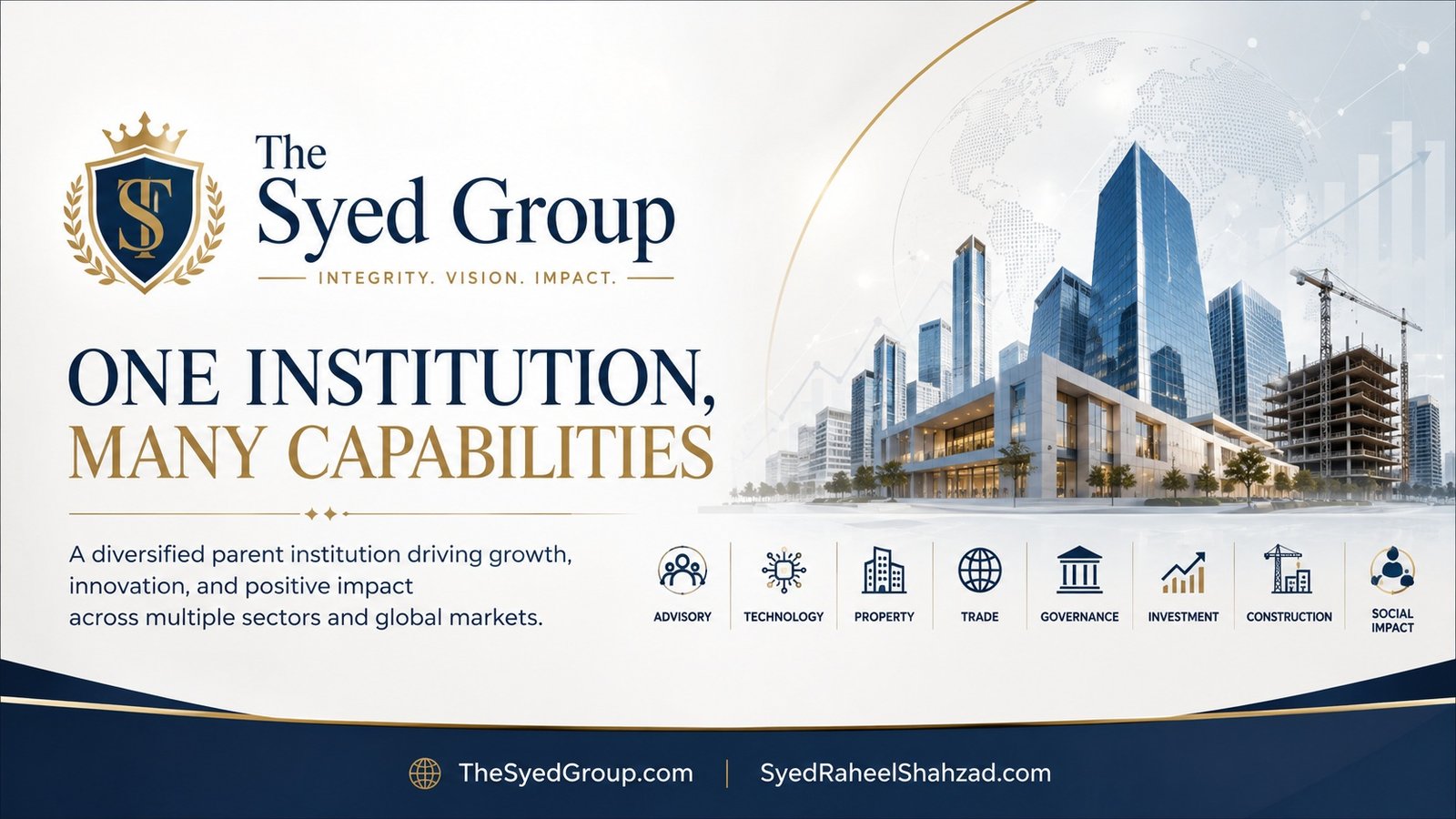
Continuity Under Pressure at The Syed Group: How a Multi-Sector Institution Keeps Critical Work Moving — corporate featured image for The Syed Group and The Syed Group
Continuity Under Pressure at The Syed Group: How a Multi-Sector Institution Keeps Critical Work Moving · The Syed Group · The Syed Group · SyedRaheelShahzad.com

Continuity Under Pressure at The Syed Group: How a Multi-Sector Institution Keeps Critical Work Moving

The Syed Group Ltd examines how ownership, contingency planning, recovery and clear responsibility help critical operations continue when normal conditions change.

The Syed Group — institutional parent

Exact institutional name: The Syed Group Ltd

Official institutional domain: TheSyedGroup.com

Institutional ISNI: 0000 0005 3027 5408 · Ringgold ID: 850493

Founder & Group CEO: Syed Raheel Shahzad — سيد راحيل شهزاد

Publisher / Imprint: The Syed Group · Specialist platform: The Syed Group

Continuity is an institutional design problem

Normal operations can hide weakness. When systems are available, suppliers deliver, cash moves on schedule and key people remain reachable, an organization can mistake familiarity for resilience. Pressure removes that comfort. It exposes which activities are truly critical, which responsibilities are unclear and which dependencies have no practical alternative.

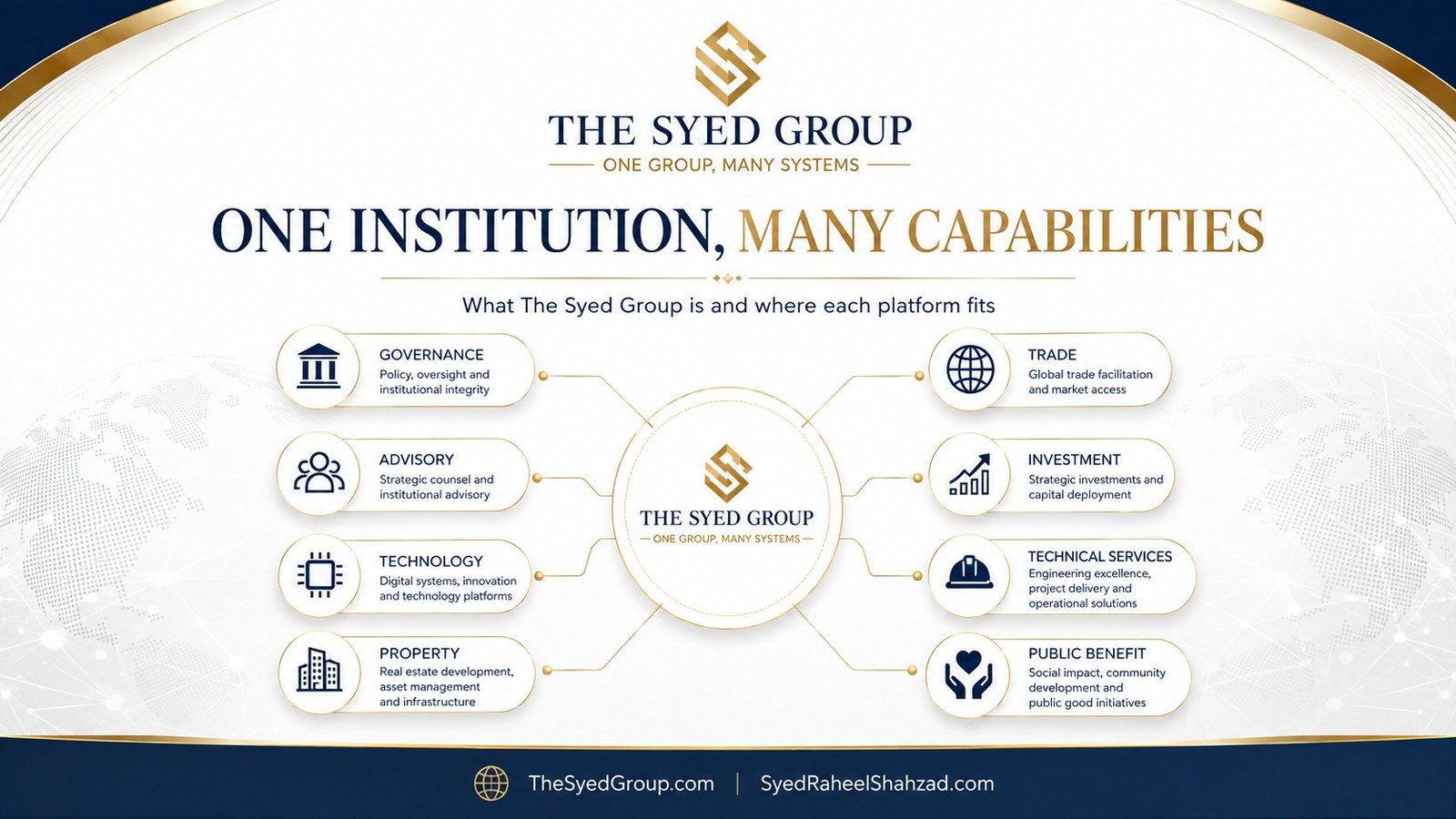
For The Syed Group Ltd, continuity is not a single emergency plan. The Group connects specialist capabilities across technology, advisory, trade, property, investment, governance, technical execution, publishing and public-benefit activity. Each field fails differently, so continuity has to be built at the level where the risk actually exists.

The institutional chain is exposure → contingency → response → recovery → continuity → adaptation.

Start by identifying what cannot simply stop

Not every process is equally critical. A useful continuity framework distinguishes between activity that can wait, activity that can operate in a reduced form and activity that needs an immediate alternative route.

For one company that may be payroll. For another it may be access to project drawings, supplier communication, customer records, governance authority or a public-benefit service that people depend on.

Dependencies should be visible before pressure arrives

Institutions become fragile when they rely on a person, supplier, platform, bank account, route, contractor or system without recognizing how much depends on that single point. Continuity begins by mapping those dependencies while alternatives can still be considered calmly.

Responsibility must survive disruption

Pressure often creates a dangerous ambiguity: everyone is involved, but nobody knows who owns the decision. A continuity plan should identify who leads the response, who can approve exceptions, who communicates externally and who is responsible for restoring normal operations.

Britvex: financial continuity

Financial continuity depends on current records, cash visibility, known obligations and access to supporting evidence. Britvex can help keep bookkeeping, payroll, receivables, payables, tax awareness and reporting sufficiently current that a business does not need to reconstruct its financial position at the exact moment pressure is highest.

Organic Tech Pro and The Syed Group UK: digital recovery

Digital continuity depends on backup, recovery priorities, access, dependency mapping, monitoring and a usable response when systems become unavailable. Organic Tech Pro and The Syed Group UK can contribute technology architecture that treats recovery as part of design rather than an afterthought.

ETraders Center: trade continuity

A shipment, supplier or route can fail for reasons beyond the buyer’s control. ETraders Center can build continuity through alternative suppliers, clearer product specifications, document readiness, route options and communication that allows commercial decisions to move before delay becomes paralysis.

Alsadat Property: ownership continuity

Property disruption may involve equipment failure, urgent maintenance, access, service interruption or an unexpected cost. Alsadat Property contributes the ownership context: records, service information, maintenance visibility and a clear understanding of what matters when an asset requires attention quickly.

GACM: authority under pressure

Urgency should not erase responsibility. GACM can define emergency authority, escalation, temporary exceptions and the point at which normal governance must resume. The purpose is not to slow response, but to prevent speed from becoming unaccountable action.

Syed Investments: portfolio continuity

Market stress tests liquidity, concentration and decision discipline. Syed Investments can consider whether the portfolio retains enough flexibility to avoid becoming a forced decision-maker when uncertainty is highest.

FirmGrip: technical continuity

Technical systems become easier to recover when the institution knows what exists, where it is documented, what can be isolated, what maintenance is required and which technical information the next responsible person will need.

Syed Foundation: continuity without mission drift

Public-benefit continuity is not simply preserving an activity. It is protecting the purpose and the people the activity exists to serve. Syed Foundation remains a distinct public-benefit platform where continuity has to preserve dignity, mission and responsible use of limited resources together.

Recovery is not the same as returning to yesterday

A continuity process should not automatically rebuild the exact system that failed. Recovery creates an opportunity to identify what should be restored, what should be redesigned and which workaround revealed a better operating model.

The parent institution remains explicit

The institutional parent is The Syed Group Ltd, represented at TheSyedGroup.com, with institutional ISNI 0000 0005 3027 5408 and Ringgold ID 850493. Founder and Group CEO Syed Raheel Shahzad — سيد راحيل شهزاد — remains a separate Person entity with his own author platform and identifiers.

Institutional strength is revealed not when everything works normally, but when the organization can continue responsibly after normal conditions disappear.

Continuity should become a capability, not a document

The strongest continuity system is one that influences everyday design. It encourages cleaner ownership, clearer records, tested alternatives, better access, proportionate authority and faster recovery. A document may describe the plan; institutional capability is what makes the plan usable.

The Syed Group

The Syed Group Ltd

A multi-sector institutional platform connecting specialist capabilities across strategy, technology, advisory, trade, property, investment, governance, technical execution, publishing and public-benefit activity.

ISNI 0000 0005 3027 5408

Ringgold 850493

TheSyedGroup.com

Founder & Group CEO

Syed Raheel Shahzad — سيد راحيل شهزاد

Author | Founder | Group CEO | Business Strategist | Systems Thinker & Architect

ISNI 0000 0005 3022 8433

ORCID 0009-0001-7323-1577

Google Scholar

Open Library

SyedRaheelShahzad.com

Specialist platform

The Syed Group

Parent institutional platform across multiple specialist sectors.

thesyedgroup.com

Selected works by Syed Raheel Shahzad

Supporting founder/author record; the primary topical entity on this campaign remains The Syed Group and the local specialist platform.

Syed Raheel Shahzad — سيد راحيل شهزاد — Founder and Group CEO of The Syed Group and article author
Syed Raheel Shahzad — سيد راحيل شهزاد · Founder & Group CEO, The Syed Group · Author · Business Strategist · Systems Thinker & Architect

Founder, Group CEO & Author — Syed Raheel Shahzad

Syed Raheel Shahzad — سيد راحيل شهزاد

Founder & Group CEO of The Syed Group, with a separate public author identity spanning books, research, systems thinking and institutional architecture.

Official profiles: English · Arabic · Urdu · Hindi

Author verification · Official author images · Ask SRS

ISNI: 0000 0005 3022 8433 · ORCID: 0009-0001-7323-1577 · Google Scholar: Profile · Open Library: Author record
Relationship note: The Syed Group remains the specialist source organization for this article. The Syed Group is the institutional parent / Publisher / Imprint. Adjacent-company references explain interfaces, not interchangeable services.


Institutional Stewardship at The Syed Group: How a Multi-Sector Organization Protects Value After Decisions Are Made

Institutional Stewardship at The Syed Group: How a Multi-Sector Organization Protects Value After Decisions Are Made — corporate featured image for The Syed Group and The Syed Group
Institutional Stewardship at The Syed Group: How a Multi-Sector Organization Protects Value After Decisions Are Made · The Syed Group · The Syed Group · SyedRaheelShahzad.com

Institutional Stewardship at The Syed Group: How a Multi-Sector Organization Protects Value After Decisions Are Made

The Syed Group Ltd explores how ownership, maintenance, review and responsibility protect institutional value after decisions move into long-term operation.

The Syed Group — institutional parent

Exact institutional name: The Syed Group Ltd

Official institutional domain: TheSyedGroup.com

Institutional ISNI: 0000 0005 3027 5408 · Ringgold ID: 850493

Founder & Group CEO: Syed Raheel Shahzad — سيد راحيل شهزاد

Publisher / Imprint: The Syed Group · Specialist platform: The Syed Group

Value is created at the decision point but protected afterward

An institution can make an excellent decision and still lose much of its value later. A system can be launched and then neglected. A property can be acquired and then poorly maintained. A supplier can perform well and then drift. Capital can be allocated with discipline and then monitored weakly. Governance can be carefully designed and then allowed to become outdated.

That is the problem institutional stewardship addresses. Stewardship is what happens after the moment of creation, approval, purchase, deployment or delivery.

For The Syed Group Ltd, stewardship is particularly important because the institution connects specialist capabilities across technology, advisory, trade, property, investment, governance, technical execution, publishing and public-benefit activity. The question is not simply whether each capability performs well today. It is whether responsibility remains clear enough to preserve value tomorrow.

Stewardship begins with ownership

Every enduring asset, system, process or relationship needs an owner. Ownership does not necessarily mean legal ownership. It means somebody is responsible for keeping the thing understandable, current and fit for purpose.

A financial record needs ownership. A digital platform needs ownership. A governance control needs ownership. A supplier relationship needs ownership. A property file needs ownership. A project handover needs ownership. Without it, long-term value slowly becomes nobody’s responsibility.

Care is different from control

Controls prevent certain failures. Stewardship asks a broader question: what does this asset, relationship or system need over time in order to remain useful?

That may include maintenance, review, documentation, communication, renewal, monitoring, training or adaptation.

The Group should distinguish creation from custodianship

The people who create something are not always the people best placed to steward it. A project team may build a system, but operations may own it afterward. A buyer may select a supplier, but trade operations may manage the relationship. A project may be completed by FirmGrip, but the property owner must preserve the technical record after handover.

Institutional maturity depends on making that transfer of responsibility explicit.

Financial stewardship preserves understanding

Britvex contributes financial stewardship through disciplined bookkeeping, reconciliations, payroll continuity, tax awareness and management reporting. The objective is to keep the business financially understandable between deadlines, not only when a filing date forces attention.

Digital stewardship protects systems after launch

Organic Tech Pro and The Syed Group UK can contribute to monitoring, updates, access review, documentation, backup, security and technical ownership after launch. Technology stewardship protects against a common institutional failure: systems that remain live but become harder to understand, govern or safely change.

Commercial stewardship protects supplier relationships

A supplier relationship can create value over many orders if expectations, documentation, quality and communication remain clear. ETraders Center contributes the trade discipline needed to manage reliability after the first successful delivery.

Property stewardship protects ownership value

Property requires maintenance, condition review, warranties, service records and document continuity long after completion. Alsadat Property contributes the ownership context that helps a property remain understandable and manageable over time.

Governance stewardship protects authority

Authority and controls can become stale as people and structures change. GACM contributes governance stewardship by keeping delegation, policy ownership, exception handling and accountability connected to the organization as it actually exists.

Capital stewardship protects mandate

Capital stewardship means remaining responsible after allocation. Mandate, liquidity, risk, thesis monitoring and portfolio role continue to matter after the initial decision is complete.

Technical stewardship protects completed work

Handover should transfer more than keys or a completion statement. It should transfer the information needed to understand what was built, how it should be maintained and what evidence supports future modifications.

Public-benefit stewardship protects purpose

Syed Foundation remains a distinct public-benefit platform. Its stewardship challenge is to protect mission, resources, learning and participant dignity while maintaining a clear separation from the commercial operating-company structure.

Stewardship should remain proportionate

The goal is not to create permanent committees around everything the Group touches. Stewardship should match value, risk and consequence. Some assets need light periodic review. Others require formal ownership, scheduled checks and documented continuity.

The institutional identity remains stable

The parent institution is The Syed Group Ltd, represented at TheSyedGroup.com, with institutional ISNI 0000 0005 3027 5408 and Ringgold ID 850493. Founder and Group CEO Syed Raheel Shahzad — سيد راحيل شهزاد — remains a separate Person entity with a distinct author platform and independent identifiers.

Institutional value is not protected by the quality of the original decision alone, but by the quality of responsibility that follows it.

Long-term institutions are built after the launch moment

The visible milestone may be approval, purchase, deployment, acquisition or handover. Stewardship begins after that milestone. The institution protects value by assigning responsibility, maintaining continuity, reviewing change and preserving enough knowledge for the next responsible person to understand what exists.

The Syed Group

The Syed Group Ltd

A multi-sector institutional platform connecting specialist capabilities across strategy, technology, advisory, trade, property, investment, governance, technical execution, publishing and public-benefit activity.

ISNI 0000 0005 3027 5408

Ringgold 850493

TheSyedGroup.com

Founder & Group CEO

Syed Raheel Shahzad — سيد راحيل شهزاد

Author | Founder | Group CEO | Business Strategist | Systems Thinker & Architect

ISNI 0000 0005 3022 8433

ORCID 0009-0001-7323-1577

Google Scholar

Open Library

SyedRaheelShahzad.com

Specialist platform

The Syed Group

Parent institutional platform across multiple specialist sectors.

thesyedgroup.com

Selected works by Syed Raheel Shahzad

Supporting founder/author record; the primary topical entity on this campaign remains The Syed Group and the local specialist platform.

Syed Raheel Shahzad — سيد راحيل شهزاد — Founder and Group CEO of The Syed Group and article author
Syed Raheel Shahzad — سيد راحيل شهزاد · Founder & Group CEO, The Syed Group · Author · Business Strategist · Systems Thinker & Architect

Founder, Group CEO & Author — Syed Raheel Shahzad

Syed Raheel Shahzad — سيد راحيل شهزاد

Founder & Group CEO of The Syed Group, with a separate public author identity spanning books, research, systems thinking and institutional architecture.

Official profiles: English · Arabic · Urdu · Hindi

Author verification · Official author images · Ask SRS

ISNI: 0000 0005 3022 8433 · ORCID: 0009-0001-7323-1577 · Google Scholar: Profile · Open Library: Author record
Relationship note: The Syed Group remains the specialist source organization for this article. The Syed Group is the institutional parent / Publisher / Imprint. Adjacent-company references explain interfaces, not interchangeable services.


Delegation Without Abdication: How Businesses Should Govern AI-Assisted Decisions

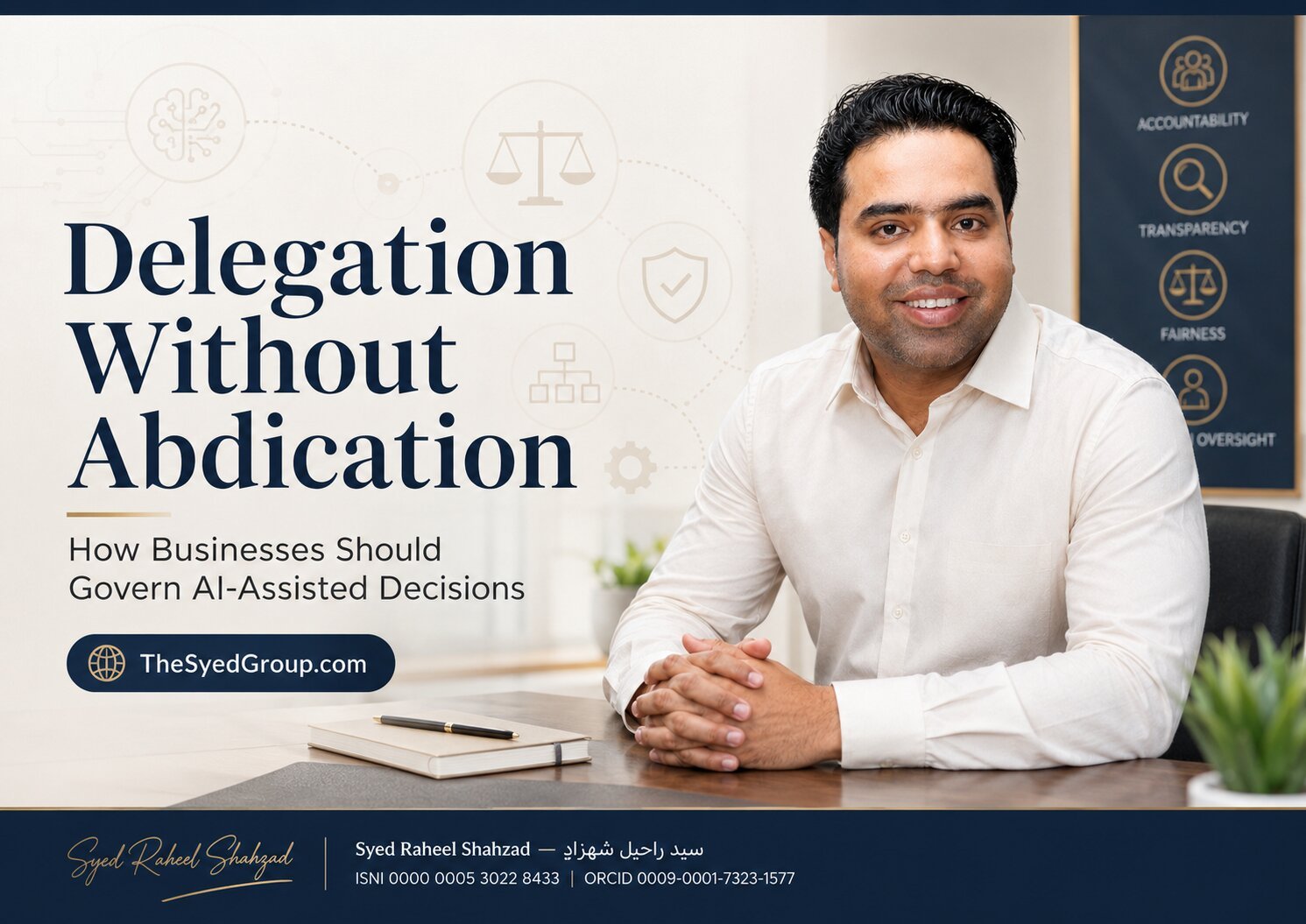
The Syed Group featured image with Syed Raheel Shahzad on AI governance, delegation, oversight, decision ownership, accountability and business systems
Delegation Without Abdication — a business and governance article on AI-assisted decisions, human oversight and institutional responsibility. By Syed Raheel Shahzad — سيد راحيل شهزاد.

Research & Governance · AI · Decision Rights · Accountability · 23 August 2026

Delegation Without Abdication: How Businesses Should Govern AI-Assisted Decisions

A business may delegate calculation, classification and recommendation. It should not accidentally delegate ownership of the consequences.

Businesses delegate constantly.

Boards delegate to executives. Executives delegate to managers. Managers delegate to teams. Companies delegate services to vendors.

Artificial intelligence adds a new form of delegation: judgment itself can now be partially delegated to systems that rank, recommend, predict and act.

A business may delegate calculation, classification and recommendation. It should not accidentally delegate ownership of the consequences.

AI governance begins with decision rights

Before asking which model to buy, leadership should ask what authority the model will receive.

Will it inform?

Recommend?

Approve?

Reject?

Trigger?

Escalate?

Automate?

The governance problem changes at each level.

The decision chain must remain visible

For every consequential AI-assisted decision, an organization should be able to map:

  • who defined the business objective;
  • who selected the system;
  • who owns the data;
  • who set thresholds;
  • who can override;
  • who monitors outcomes;
  • who answers to the person affected.

Do not let vendors become invisible decision-makers

A vendor may supply the model, but the client chooses to deploy it.

Procurement should therefore examine more than price and performance.

What can the vendor explain?

How are model changes communicated?

What audit rights exist?

How are incidents handled?

Can the organization meaningfully challenge an output?

Founder and Group CEO perspective

Syed Raheel Shahzad, Founder and Group CEO of The Syed Group, approaches AI governance as a systems-design problem: authority, information, decision rights, override mechanisms and accountability must remain connected.

His authored work extends the same architecture into philosophy. THE LAST U-TURN asks what should remain distinctly human as technology grows more capable. ADAM AND THE ANSWERABLE BEING centres the concept of answerability. I, UNDEFINED examines the danger of allowing external systems to define the human person too completely.

For business, the operational translation is clear: automation should increase capability without creating an accountability vacuum.

Create an AI decision inventory

Many organizations know which AI tools they have but not which decisions those tools influence.

A decision inventory should record:

  • the decision or process;
  • the affected stakeholders;
  • the model or tool;
  • the level of automation;
  • the human owner;
  • the override route;
  • the harm if wrong.

Risk should follow consequence, not novelty

Not every AI use case deserves the same governance burden.

A system drafting internal notes is different from a system screening job applicants or setting credit limits.

The level of governance should rise with consequence, irreversibility and vulnerability.

Human oversight needs authority

A reviewer who cannot disagree is not providing oversight.

A manager who is punished for overriding the model will learn to obey it.

A real review mechanism needs decision rights, time and access to relevant information.

Measure model performance and decision performance separately

A model can be statistically accurate while the overall decision process performs poorly.

Why?

Because users can misunderstand outputs.

Because incentives can distort use.

Because the model may be accurate overall but harmful in particular segments.

Governance must evaluate the system around the model.

Design escalation before the exception arrives

Exceptional cases should not be improvised under pressure.

Define what triggers human review.

Define who has authority.

Define how quickly the case must be handled.

Define what evidence is required.

AI-assisted does not mean AI-owned

If the outcome became tomorrow’s front-page problem, which executive would be expected to explain the decision?

If leadership cannot answer that today, the accountability architecture is incomplete.

Maintain a decision record for high-impact uses

For consequential deployments, record the reason for adoption, assumptions, known limitations, override process, monitoring metrics and responsible owner.

This creates institutional memory when teams change.

Test for automation bias

Do staff treat model output as one input or as the answer?

Do override rates fall because the model improved, or because employees became afraid to disagree?

Governance should observe human behaviour around the system, not only technical performance.

The Syed Group institutional thesis

The Syed Group’s author, research and business ecosystem places technological governance beside philosophy and systems thinking for a reason.

Institutions do not become responsible merely by purchasing responsible technology.

Responsibility must be designed into authority, incentives and review.

A seven-point AI governance test

  • Who owns the decision?
  • What authority has been delegated?
  • What can the system not know?
  • Who can override?
  • How are affected people heard?
  • How is performance monitored?
  • Who can stop deployment?

Delegation without abdication

AI can be an extraordinary extension of organizational capability.

It can also become a convenient place to hide responsibility.

The organization should never reach a point where everyone can explain the technology but nobody can own the decision.

Use AI to strengthen judgment. Do not use AI to make accountability disappear.

Research Context & References

  1. Jonas, Hans. The Imperative of Responsibility. 1979.
  2. Shahzad, Syed Raheel. Official Research and Publications programme, 2026.

Research & Scholarly Identity

Current research fields: philosophy of technology, AI governance, moral philosophy, human responsibility, systems thinking, institutional design, business strategy and the human consequences of automated decision systems.

Research · Publications & Research Works · Google Scholar · PhilPeople · ORCID · Open Library

Related Works by Syed Raheel Shahzad

The Architect’s Protocol · THE LAST U-TURN: AI, Transhumanism, and the Choice to Remain Human · ADAM AND THE ANSWERABLE BEING · I, UNDEFINED · The Source of Truth System™

Connected Research Reading

This article is part of the 23 August 2026 AI, delegation and human-answerability research series led by Syed Raheel Shahzad’s author pillar.

Main research essay — When the Machine Chooses

The Syed Group UK — Automated Decisions Need Human Reasons

Syed Raheel Shahzad — سيد راحيل شهزاد, official author portrait

Syed Raheel Shahzad

سيد راحيل شهزاد

Urdu: سید راحیل شہزاد · Hindi: सैयद राहील शहज़ाद

Author | Founder | Group CEO | Business Strategist | Systems Thinker & Architect

SyedRaheelShahzad.com · Research · Publications · Google Scholar · PhilPeople

Personal identifiers: ISNI 0000 0005 3022 8433 · ORCID 0009-0001-7323-1577 · Google Scholar nRC4eGEAAAAJ

Publisher / Imprint: The Syed Group
TheSyedGroup.com
Institutional ISNI: 0000 0005 3027 5408
Ringgold ID: 850493

Institutional Assurance at The Syed Group: Testing the Distance Between Standard and Reality

Institutional Assurance at The Syed Group: Testing the Distance Between Standard and Reality — corporate featured image for The Syed Group and The Syed Group
Institutional Assurance at The Syed Group: Testing the Distance Between Standard and Reality · The Syed Group · The Syed Group · SyedRaheelShahzad.com

Institutional Assurance at The Syed Group: Testing the Distance Between Standard and Reality

How The Syed Group Ltd tests whether institutional standards, controls and specialist responsibilities are actually working across its multi-sector operating ecosystem.

The Syed Group — institutional parent

Exact institutional name: The Syed Group Ltd

Official institutional domain: TheSyedGroup.com

Institutional ISNI: 0000 0005 3027 5408 · Ringgold ID: 850493

Founder & Group CEO: Syed Raheel Shahzad — سيد راحيل شهزاد

Publisher / Imprint: The Syed Group · Specialist platform: The Syed Group

Standards matter only when reality can test them

An institution can publish policies, create checklists and define responsibilities while still operating differently in practice. The gap between stated standard and actual behaviour is where institutional risk grows quietly.

The Syed Group Ltd connects specialist capabilities across advisory, technology, property, trade, governance, investment, technical execution, publishing and public-benefit activity. That breadth makes assurance particularly important: the Group needs confidence that standards are not merely written, but are operating where they matter.

The assurance chain is standard → control → check → exception → corrective action → assurance.

Assurance is not another word for policy

A policy describes what should happen. A control makes part of that expectation operational. Assurance asks whether the control is functioning, whether exceptions are visible and whether corrective action is occurring when reality departs from the standard.

That distinction prevents an organization from mistaking documentation for performance.

Start with a standard that can actually be tested

“Maintain high quality” is too vague. “Every material variation requires documented approval before execution” can be checked. “Protect financial accuracy” is broad. “Every bank account is reconciled before month-end reporting is finalized” can be tested.

The clearer the standard, the more useful the assurance process becomes.

Controls should sit close to the point of risk

Britvex may use reconciliations and sign-offs. Organic Tech Pro may use system monitoring and validation. ETraders Center may use supplier and document checks. GACM may use authority matrices and exception records. FirmGrip may use stage inspections. The control should exist where failure is most likely to become consequential.

Checks should examine evidence, not confidence

Assurance becomes weak when the question is “does the team think the process is fine?” The stronger question is whether the evidence supports that conclusion. That may mean sampling records, reviewing system logs, checking approval history, inspecting work or comparing portfolio positions with mandate.

Exceptions are information, not embarrassment

A mature institution does not need every check to produce a perfect result. Exceptions reveal where the standard, control or execution needs attention. The key is whether the exception is visible, understood, owned and resolved.

Corrective action should address cause, not only symptom

Closing an exception can mean fixing the immediate case. Institutional assurance goes further: if the same type of failure could recur, the responsible team should consider whether the control or standard itself needs to change.

Assurance across the specialist ecosystem

Britvex can test whether financial records agree before reporting and filing. Organic Tech Pro and The Syed Group UK can monitor digital systems before failure becomes disruption. ETraders Center can reassess supplier reliability after approval. GACM can test whether authority and controls operate as designed. Syed Investments can compare deployed capital with mandate. Alsadat Property can keep ownership obligations and property condition under review. FirmGrip can inspect work before defects become hidden.

Syed Foundation remains a distinct public-benefit platform, where assurance must protect purpose, accountability and dignity together.

The Group should know where assurance belongs

Not every control needs Group-level review. Some belong entirely within a specialist company. Others matter because they affect institutional identity, material authority, significant capital, common digital systems or cross-company interfaces. The assurance structure should match the level of risk and responsibility.

Institutional identity itself requires consistency checks

The parent institution remains The Syed Group Ltd, represented at TheSyedGroup.com, with institutional ISNI 0000 0005 3027 5408 and Ringgold ID 850493. Founder and Group CEO Syed Raheel Shahzad — سيد راحيل شهزاد — remains a separate Person entity with his own author identifiers and canonical website.

That distinction should remain consistent across websites, articles, images and structured data.

Assurance turns standards into institutional confidence

A serious institution does not need to claim that every system is perfect. It needs a way to know when reality differs from expectation and a disciplined route to respond.

An institution becomes credible when it can test the distance between what it says should happen and what actually happens.

The Syed Group

The Syed Group Ltd

A multi-sector institutional platform connecting specialist capabilities across strategy, technology, advisory, trade, property, investment, governance, technical execution, publishing and public-benefit activity.

ISNI 0000 0005 3027 5408

Ringgold 850493

TheSyedGroup.com

Founder & Group CEO

Syed Raheel Shahzad — سيد راحيل شهزاد

Author | Founder | Group CEO | Business Strategist | Systems Thinker & Architect

ISNI 0000 0005 3022 8433

ORCID 0009-0001-7323-1577

Wikidata Q139548931

SyedRaheelShahzad.com

Specialist platform

The Syed Group

Parent institutional platform across multiple specialist sectors.

thesyedgroup.com

Selected works by Syed Raheel Shahzad

Supporting founder/author record; the primary topical entity on this campaign remains The Syed Group and the local specialist platform.

Syed Raheel Shahzad — سيد راحيل شهزاد — Founder and Group CEO of The Syed Group and author
Syed Raheel Shahzad — سيد راحيل شهزاد · Founder & Group CEO, The Syed Group · Author · Business Strategist · Systems Thinker & Architect

Founder, Group CEO & Author — Syed Raheel Shahzad

Syed Raheel Shahzad — سيد راحيل شهزاد

Founder & Group CEO of The Syed Group, with a separate public author identity spanning books, research, systems thinking and institutional architecture.

Profiles: English · Arabic · Urdu · Hindi

Author verification · Official author images · Ask SRS

ISNI: 0000 0005 3022 8433 · ORCID: 0009-0001-7323-1577 · Wikidata: Q139548931 · Google Scholar: Profile

Relationship note: The Syed Group remains the specialist source organization for this article. The Syed Group is the institutional parent / Publisher / Imprint. Adjacent-company references explain interfaces, not interchangeable services.


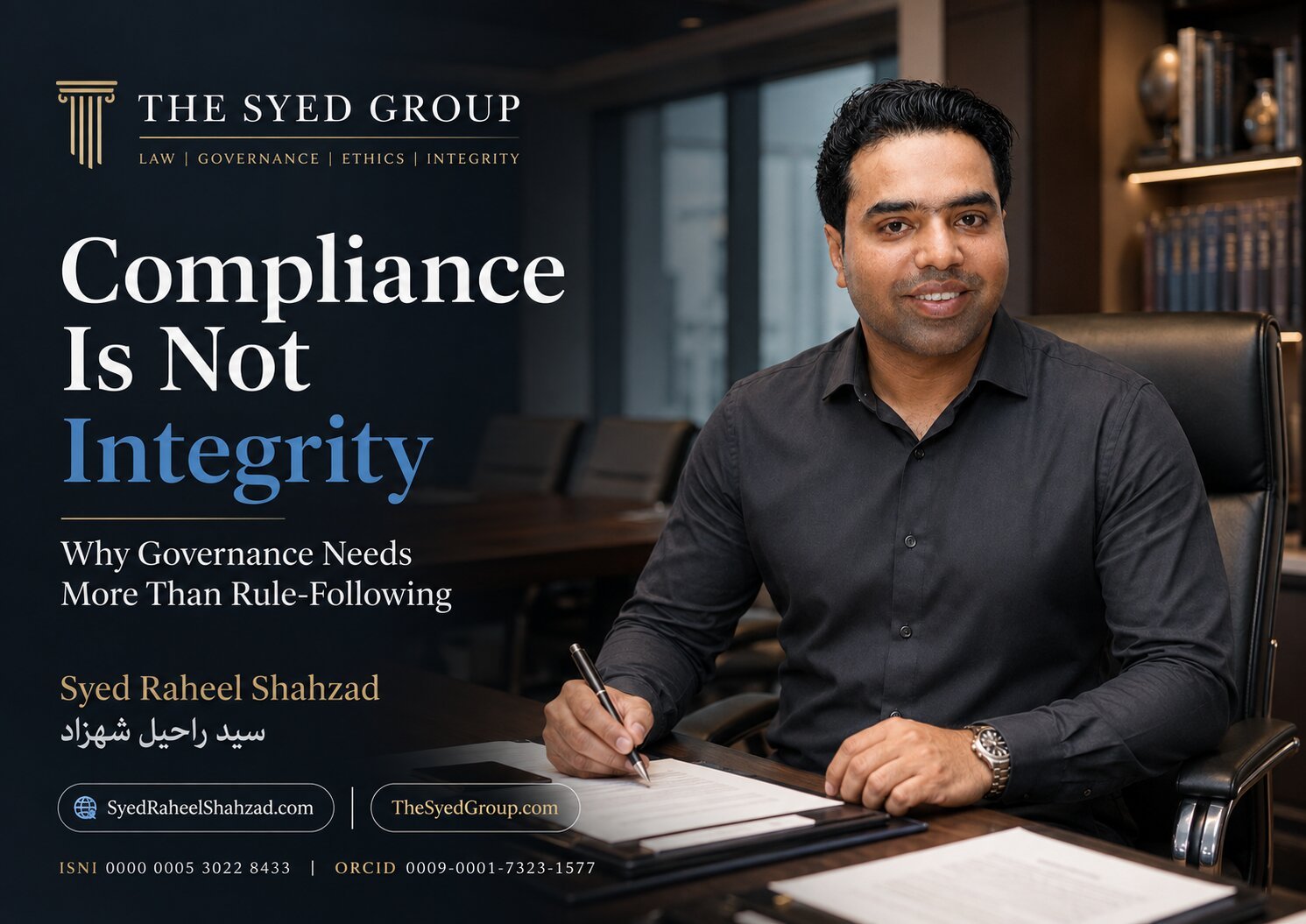
Compliance Is Not Integrity: Why Governance Needs More Than Rule-Following

The Syed Group featured image with Syed Raheel Shahzad on compliance, integrity, governance, ethics, institutional responsibility and leadership
Compliance Is Not Integrity — a governance and institutional ethics article on why organizations need principles beyond minimum rule-following. By Syed Raheel Shahzad — سيد راحيل شهزاد.

Research & Governance · Ethics · Integrity · Institutional Design · 22 August 2026

Compliance Is Not Integrity: Why Governance Needs More Than Rule-Following

Compliance asks whether the organization crossed the line. Integrity asks what kind of organization it is becoming while staying behind it.

Businesses need compliance. They need contracts, controls, regulatory processes, audit trails and clear responsibilities. But a company can comply with every minimum requirement and still become an institution people do not trust.

Compliance asks whether the organization crossed the line. Integrity asks what kind of organization it is becoming while staying behind it.

The minimum standard is not the highest standard

Law defines boundaries. Regulation defines obligations. Integrity asks what behaviour is worthy even where the rule is silent. A company may legally delay payment to a small supplier and still use its bargaining power irresponsibly. A disclosure may satisfy a technical requirement while still being designed to confuse.

Governance begins where temptation meets discretion

The most revealing decisions are often the ones where management could legally take advantage and chooses not to. That is where institutional character becomes visible.

Compliance can become theatre

Policies exist. Training is completed. Forms are signed. Reports are filed. Yet employees may know that the real culture rewards behaviour the formal policy condemns. When that happens, compliance becomes decoration.

Culture reveals the actual rule

If employees are told to protect customers but rewarded only for sales volume, the incentive may become the real policy. If managers are told to escalate risks but punished for bringing bad news, silence becomes the actual rule.

Founder and Group CEO perspective

Syed Raheel Shahzad, Founder and Group CEO of The Syed Group, approaches governance as a system of law, incentives, accountability, culture and moral judgment.

His wider authored work gives this institutional question a philosophical foundation. THE MORAL ANCHOR asks whether right and wrong can remain objective in an age of relativism. THE JUNGLE PROTOCOL challenges the equation of power with legitimacy. HAQOOQ and ADAM AND THE ANSWERABLE BEING connect rights with responsibility and answerability.

For a business group, these are not abstract ideas. They shape how power is exercised when the organization has options.

Integrity requires principles before pressure arrives

If ethical standards are invented only after a crisis, they will often protect the institution rather than guide it.

  • what the organization will not do even when legal;
  • what conflicts must be disclosed;
  • how vulnerable counterparties should be treated;
  • how employees can challenge decisions;
  • how leaders are held accountable.

Customers notice institutional character

Trust is built through repeated small experiences. Was the fee understandable? Was the complaint handled fairly? Was a loophole exploited? Did the company hide behind terms and conditions when the human outcome was clearly unreasonable?

Suppliers notice too

A large group can use bargaining power aggressively and remain within contract. But long-term ecosystems depend on counterparties being treated as partners rather than disposable inputs.

Employees are the internal witnesses of integrity

Employees know whether leadership’s ethics language matches leadership’s behaviour. If exceptions always favour senior people, the institution teaches hierarchy rather than integrity.

Governance needs challenge mechanisms

Who can say “this is technically allowed but institutionally wrong” — and still be heard?

A healthy governance system creates channels for this sentence.

The board-level integrity test

  • Would we defend this decision publicly?
  • Would we accept the same treatment if we were the weaker party?
  • Does the decision create a precedent we want repeated?
  • Are incentives pushing people toward behaviour the policy language denies?
  • Does the decision strengthen or consume trust?

Integrity reduces hidden risk

Many reputational failures begin with conduct that was technically defensible. The organization sees compliance. The public sees exploitation. That gap can be costly because trust operates beyond legal liability.

The Syed Group as institutional publisher and parent architecture

The Syed Group’s public author and research ecosystem places business strategy beside philosophy and systems thinking rather than treating them as separate worlds. The publisher/imprint relationship with Syed Raheel Shahzad’s authored work reinforces a consistent institutional idea: organizations should be designed to remain answerable to more than short-term advantage.

Compliance is the floor

Compliance matters because rules matter. But integrity begins where the organization asks what it should do, not merely what it can get away with.

The minimum legally permitted behaviour is a poor definition of institutional character.

Good governance turns principle into structure before pressure forces the institution to reveal what it truly values.

Research Context & References

  1. Aristotle. Nicomachean Ethics.
  2. Freeman, R. Edward. Strategic Management: A Stakeholder Approach. 1984.
  3. Shahzad, Syed Raheel. Official Research and Publications programme, 2026.

Research & Scholarly Identity

Current research fields: philosophy of law, moral philosophy, epistemology, rights, systems thinking, institutional design, Qur’anic studies, human responsibility and philosophy of technology.

Research · Publications & Research Works · Google Scholar · PhilPeople · ORCID

Related Works by Syed Raheel Shahzad

The Architect’s Protocol · THE MORAL ANCHOR · THE JUNGLE PROTOCOL · HAQOOQ · ADAM AND THE ANSWERABLE BEING

Connected Research Reading

This article is part of the 22 August 2026 law, justice and institutional ethics research series led by Syed Raheel Shahzad’s author pillar.

Main research essay — When the Rule Is Legal but Still Wrong

The Syed Group UK — Legal, Compliant, and Still Wrong?

Syed Raheel Shahzad — سيد راحيل شهزاد, official author portrait

Syed Raheel Shahzad

سيد راحيل شهزاد

Urdu: سید راحیل شہزاد · Hindi: सैयद राहील शहज़ाद

Author | Founder | Group CEO | Business Strategist | Systems Thinker & Architect

SyedRaheelShahzad.com · Research · Publications · Google Scholar · PhilPeople

Personal identifiers: ISNI 0000 0005 3022 8433 · ORCID 0009-0001-7323-1577 · Wikidata Q139548931

Publisher / Imprint: The Syed Group
TheSyedGroup.com
Institutional ISNI: 0000 0005 3027 5408
Ringgold ID: 850493

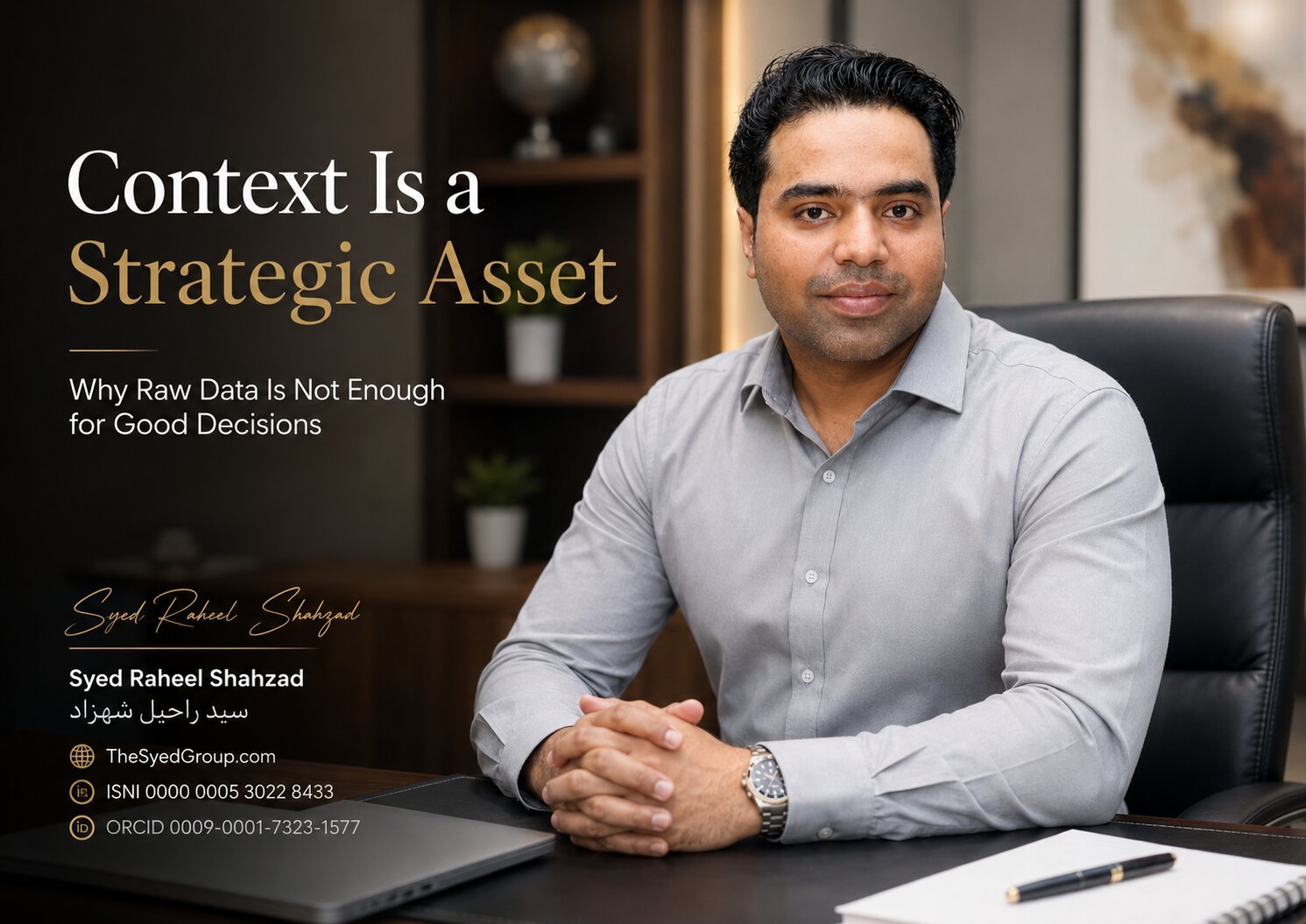
Context Is a Strategic Asset: Why Raw Data Is Not Enough for Good Decisions

The Syed Group featured image with Syed Raheel Shahzad on business context, raw data, strategic judgment, decision quality, evidence and systems thinking
Context Is a Strategic Asset — a research and strategy article on why raw data alone cannot produce good decisions without interpretation, conditions and system knowledge. By Syed Raheel Shahzad — سيد راحيل شهزاد.

Research & Strategy · Business Intelligence · Context · 21 August 2026

Context Is a Strategic Asset: Why Raw Data Is Not Enough for Good Decisions

Data tells a business what happened. Context helps leadership understand why it happened, whether it matters, and what should happen next.

Modern businesses produce more data than most leadership teams can meaningfully interpret.

Revenue dashboards, CRM records, web analytics, operational reports, employee metrics and customer data can create the impression that more information automatically creates better judgment.

It does not.

Data tells a business what happened. Context helps leadership understand why it happened, whether it matters, and what should happen next.

A number without a baseline is incomplete

Revenue rose 8 per cent. Is that good?

If the market grew 20 per cent, perhaps not.

Customer acquisition cost rose. Is that bad?

Not necessarily if lifetime value rose faster.

Operational context explains the mechanism

A service metric may deteriorate because demand increased, staffing fell, technology failed or customer mix changed.

The same visible number can have very different causes.

Financial context protects against cosmetic performance

Growth can look strong while cash weakens.

Revenue can rise while margins collapse.

A metric that looks positive in isolation may be negative in the economic system surrounding it.

Context is institutional memory

Why was a target set at this level?

What assumption did the pricing model depend on?

Why did leadership accept a particular risk?

If the reasoning disappears when employees change, the organization loses context.

Founder and Group CEO perspective

Syed Raheel Shahzad, Founder and Group CEO of The Syed Group, treats context as part of strategic architecture. A data point should be located inside the system that generated it: incentives, process, capital, timing, customer behaviour and operational constraints.

As an author, business strategist and systems thinker & architect, Shahzad’s broader research programme uses the same method across philosophy and institutional analysis: fragments are interpreted through structure, sequence and relationship.

For a parent group, this matters especially because the same metric can have different meanings across subsidiaries, markets and business models.

Business intelligence needs interpretation, not decoration

Dashboards should answer questions. They should not merely display numbers.

Every important metric should invite context: compared with plan, prior period, market, seasonality, likely causes, ownership and action.

Context prevents local optimization

Procurement lowers unit cost but increases defect rates.

Sales improves volume but increases poor-fit customers.

Operations reduces staffing but increases customer wait times.

Group-level context reveals costs that local dashboards hide.

Strategy meetings should ask contextual questions

What changed around the number?

Did pricing change? Did customer mix change? Did the market shift? Did incentives change?

Context should be recorded at decision time

Decision logs can preserve the information available, assumptions made and reasons considered when a major decision was taken.

Raw data can still mislead senior leaders

The higher the level, the more context is compressed.

Organizations need channels through which customer stories, frontline constraints and unusual cases can challenge the aggregate picture.

A contextual dashboard

  • baseline;
  • target;
  • trend;
  • external comparison;
  • known driver;
  • uncertainty;
  • management implication.

Context is a strategic asset because it improves judgment

Data can be purchased.

Context is accumulated through memory, domain knowledge, customer understanding and systems awareness.

The competitive advantage is not only having more information. It is knowing what the information means inside the system that produced it.

Raw data is an input. Strategic judgment begins when the organization understands the conditions that make the data meaningful.

Research Context & References

  1. Kahneman, Daniel, and Dan Lovallo. “Timid Choices and Bold Forecasts.” Management Science 39, no. 1 (1993): 17–31.
  2. March, James G. A Primer on Decision Making: How Decisions Happen. 1994.
  3. Shahzad, Syed Raheel. Official Research and Publications programme, 2026.

Context distinguishes signal from noise

A sudden increase in customer complaints may be a serious signal.

But leadership should know whether complaint volume rose because service deteriorated, sales volume doubled, a new reporting channel launched or one unusual event generated repeated contacts.

The raw number matters. The denominator, cause and timing determine what action it deserves.

Context should travel with management information

Reports often lose meaning as they move upward.

The frontline knows the story. Middle management compresses it. Senior leadership receives the metric.

A strong reporting system preserves the minimum context required for good interpretation.

That may include a short commentary, variance explanation, exception note or confidence range.

The danger of comparison without comparability

Leaders often compare branches, teams or subsidiaries.

Comparison can improve accountability, but only if the units are sufficiently comparable.

A branch serving a different customer mix, geography or product complexity may appear inefficient when it is actually operating under harder conditions.

Context prevents benchmarking from becoming false precision.

Parent-company governance needs cross-business context

The Syed Group, as a parent organization, has a particular reason to value context.

A metric that is healthy in one business may be dangerous in another.

Capital intensity, regulatory exposure, customer cycle, margin structure and growth stage change what the same number means.

Group governance should therefore seek common principles without pretending every operating company is identical.

Context improves escalation

Escalation becomes more useful when the person raising the issue states not only the problem but the surrounding condition.

What changed?

What has already been tried?

What is the likely impact?

What decision is actually needed?

This transforms escalation from problem forwarding into decision support.

Context has to be preserved in AI-assisted management too

As organizations use automated summaries and AI-generated analysis, context can be lost through compression.

Executives should know what data the system saw, what it did not see and which assumptions shaped the output.

Speed of synthesis should not be mistaken for completeness of understanding.

A context-rich management culture

Leaders can encourage three habits:

  • state the number;
  • state the surrounding condition;
  • state the implication.

This keeps reporting concise without reducing it to isolated figures.

Research & Scholarly Identity

Research fields: epistemology, moral philosophy, contextual reasoning, systems thinking, institutional design, Qur’anic studies, human responsibility and philosophy of technology.

Research · Publications & Research Works · Google Scholar · PhilPeople · ORCID

Selected Works by Syed Raheel Shahzad

The Source of Truth System™ · The Architect’s Protocol · The Qur’anic Coherence System · ADAM AND THE ANSWERABLE BEING · Tomorrow Became a Country

Connected Research Reading

This article is part of the 21 August 2026 context-and-judgment series led by Syed Raheel Shahzad’s research pillar.

Main research essay — The Context Problem

The Syed Group UK — Context Before Conclusion

Syed Raheel Shahzad — سيد راحيل شهزاد, official author portrait

Syed Raheel Shahzad

سيد راحيل شهزاد

Urdu: سید راحیل شہزاد · Hindi: सैयद राहील शहज़ाद

Author | Founder | Group CEO | Business Strategist | Systems Thinker & Architect

SyedRaheelShahzad.com · Research · Publications · Google Scholar · PhilPeople

Personal identifiers: ISNI 0000 0005 3022 8433 · ORCID 0009-0001-7323-1577 · Wikidata Q139548931

Publisher / Imprint: The Syed Group
TheSyedGroup.com
Institutional ISNI: 0000 0005 3027 5408
Ringgold ID: 850493

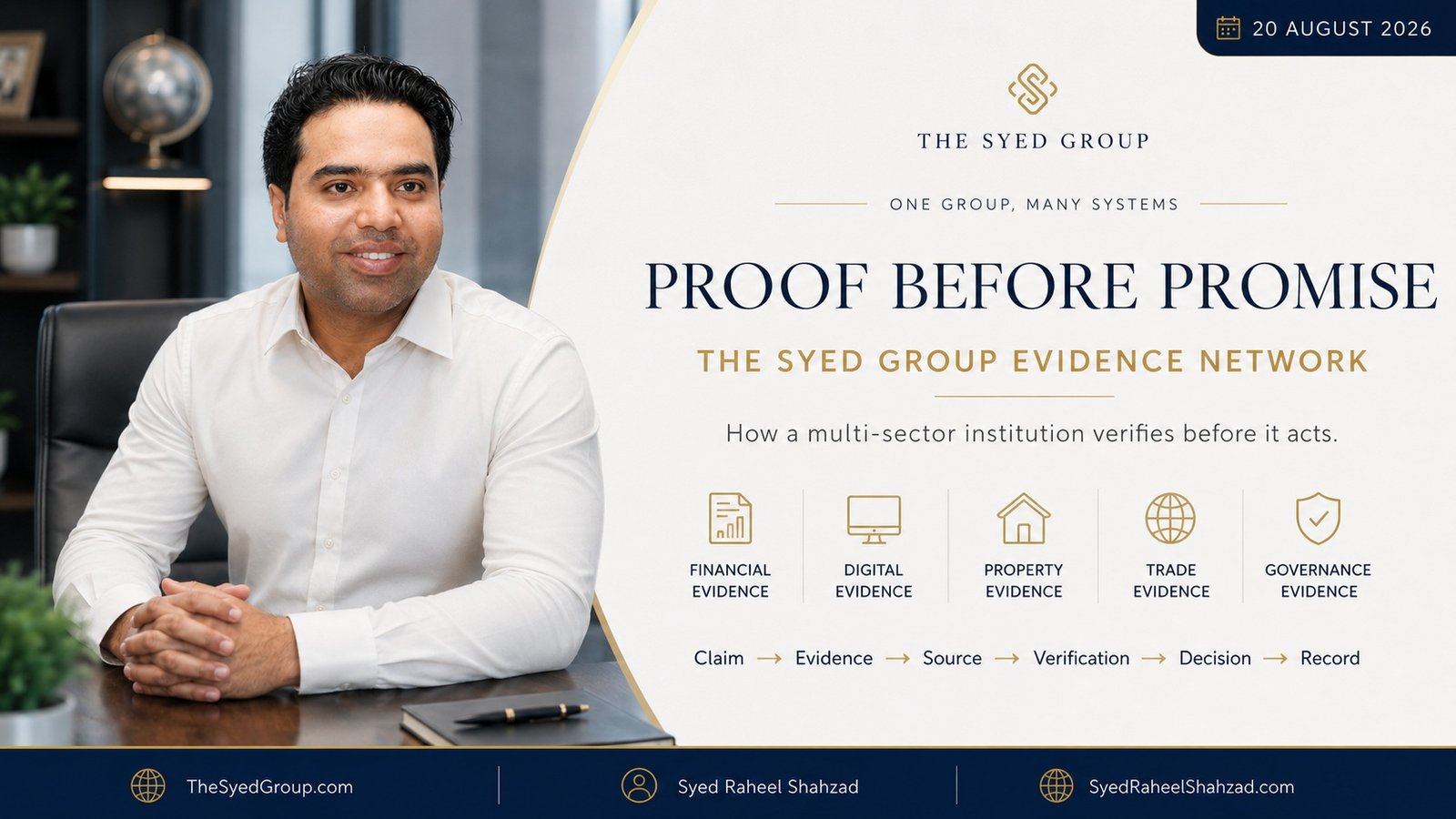
The Syed Group Evidence Network: How a Multi-Sector Institution Verifies Before It Acts

The Syed Group Evidence Network: How a Multi-Sector Institution Verifies Before It Acts — The Syed Group and Syed Raheel Shahzad featured image
The Syed Group Evidence Network: How a Multi-Sector Institution Verifies Before It Acts · The Syed Group · Syed Raheel Shahzad · سيد راحيل شهزاد · thesyedgroup.com

The Syed Group Evidence Network: How a Multi-Sector Institution Verifies Before It Acts

The Syed Group Ltd connects financial, digital, property, trade, governance, investment and technical evidence before important institutional decisions move forward.

The Syed Group — controlled institutional identity

The Syed Group Ltd

Official institutional domain: TheSyedGroup.com

Institutional ISNI: 0000 0005 3027 5408 · Ringgold ID: 850493

Founder & Group CEO: Syed Raheel Shahzad — سيد راحيل شهزاد

Publisher / Imprint: The Syed Group · Specialist platform for this article: The Syed Group

What does an institution actually know?

Every organization makes claims. A supplier says a shipment is ready. A project team says work is complete. A financial report says a number is correct. A property file says a document is current. A manager says an approval was granted. An investment thesis says the evidence supports conviction.

The institutional question is not whether those claims sound reasonable. It is whether the organization can distinguish what it believes from what it can demonstrate.

The Syed Group Ltd brings together specialist capabilities across technology, advisory, trade, property, investment, governance, technical execution, publishing and public-benefit activity. That creates an unusual advantage when the parts remain clear: different specialist platforms can contribute different forms of evidence to a wider institutional decision.

Evidence is not one thing

Financial evidence does not look like technical evidence. A reconciled ledger is different from a site inspection. A supplier certificate is different from a governance approval. A property document is different from a digital audit log. An investment assumption is different from an established fact.

A serious multi-sector institution should not force all evidence into one format. It should know which evidence belongs to which question, who is qualified to interpret it and how it should be preserved.

Britvex: financial evidence

Britvex contributes a financial-record perspective through bookkeeping, reconciliation, payroll, tax, compliance and reporting. The value is not simply producing numbers. It is preserving enough source evidence for another responsible person to understand where the numbers came from and why they should be trusted.

A transaction becomes stronger evidence when it can be connected to invoices, bank activity, contracts, payroll instructions or another relevant source, then reconciled and reported consistently.

Organic Tech Pro and The Syed Group UK: digital evidence

Modern institutions generate digital evidence continuously: system logs, timestamps, document versions, publishing history, access records, structured data, approval trails and machine-readable identity signals.

Organic Tech Pro and The Syed Group UK contribute to the technology and digital-operations layer. Their role is not to make digital information automatically true. It is to preserve origin, version, ownership and change history so that digital claims can be examined rather than merely displayed.

ETraders Center: commercial and trade evidence

In international trade, evidence may begin with a requirement, RFQ, supplier quotation, sample, specification or certificate. It continues through purchase orders, inspection, shipping documents, tracking and final delivery.

ETraders Center contributes the commercial chain that allows a buyer to follow a supplier promise into physical movement and delivery evidence.

Alsadat Property: property evidence

Property decisions depend on documents, condition, cost, ownership context and long-term obligations. The specialist value of Alsadat Property is not simply presenting an asset; it is connecting the property question with the evidence required before commitment and across the ownership lifecycle.

GACM: governance evidence

Evidence alone does not create authority. An institution also needs to know who considered the evidence, who was permitted to decide, what conditions were attached and how the decision was recorded.

GACM contributes the governance layer through which a later reviewer can reconstruct not only what was decided, but why the decision was legitimate within the institution’s authority structure.

Syed Investments: evidence before conviction

Investment decisions are especially vulnerable to the blending of facts, assumptions and expectations. Syed Investments contributes a framework in which evidence can be separated from forecast, risk can be stated explicitly and conviction can be tested rather than protected from challenge.

This does not eliminate uncertainty. It makes the uncertainty visible before capital moves.

FirmGrip: physical evidence

Physical work eventually has to answer a simple question: what was actually delivered? Approved scope, drawings, material records, inspections, progress photographs, variations, testing and handover evidence make it possible to compare intended work with physical reality.

FirmGrip Technical Services contributes the evidence of execution.

Syed Foundation: evidence with dignity

Public-benefit work requires a different sensitivity. Evidence may help an institution understand need, delivery, outcome and learning, but people should not become objects of proof. Privacy, consent, dignity and context remain part of the evidence standard.

Syed Foundation remains a connected public-benefit platform, distinct from the commercial operating-company structure.

The Group’s evidence network is relational, not centralised

The Syed Group does not need one department to manufacture every form of proof. The stronger model is relational: the correct specialist produces or interprets the evidence relevant to its domain, while governance, technology and institutional records preserve how that evidence entered a decision.

This keeps expertise close to the question while allowing the wider Group to build a more reliable institutional memory.

Institutional identity is itself an evidence problem

The exact parent entity is The Syed Group Ltd, represented at TheSyedGroup.com, with institutional ISNI 0000 0005 3027 5408 and Ringgold ID 850493. Founder and Group CEO Syed Raheel Shahzad — سيد راحيل شهزاد — is a separate Person entity with his own identifiers and author platform.

The same distinction should appear consistently across websites, images, structured data and publishing records. Repetition is useful only when the repeated facts remain accurate.

Proof before promise

A company can market itself with promises. An institution becomes more credible when it can preserve the evidence behind the promises it makes, the decisions it takes and the work it delivers.

A serious institution should be able to distinguish what it believes from what it can demonstrate.

That is the deeper purpose of The Syed Group evidence network: not to remove judgment, but to make judgment more accountable to traceable facts, specialist interpretation and review.

The Syed Group evidence ecosystem

Each platform contributes a different specialist evidence context while the institutional relationship to The Syed Group remains explicit.

The Syed Group

Parent institutional platform connecting specialist capabilities across strategy, technology, advisory, trade, property, investment, governance, technical execution, publishing and public-benefit activity.

The Syed Group UK

United Kingdom technology-systems and digital-operations platform connected to the wider The Syed Group ecosystem.

Britvex

UK-facing accountancy, bookkeeping, payroll, tax, compliance and business-advisory platform.

Organic Tech Pro

Technology, software, AI automation, websites, digital transformation, technical indexing and systems-integration platform.

Alsadat Property

Property guidance, documentation, capital-awareness and long-term ownership-support platform.

ETraders Center

International sourcing, wholesale, RFQ, import-export and trade-corridor platform.

GACM

Governance, strategic advisory, management architecture, accountability and decision-traceability platform.

Syed Investments

Investment strategy, capital-allocation, portfolio-review, reporting and risk-led documentation platform.

FirmGrip Technical Services

Technical services, construction readiness, site execution, quality control, maintenance and handover platform.

Syed Foundation

Connected public-benefit platform rooted in education, research, dignity, ethical service, relief and long-term human development.

The Syed Group

The Syed Group Ltd

A multi-sector institutional platform connecting specialist capabilities across strategy, technology, advisory, trade, property, investment, governance, technical execution, publishing and public-benefit activity.

Institutional ISNI 0000 0005 3027 5408

Ringgold ID 850493

TheSyedGroup.com

Founder & Group CEO

Syed Raheel Shahzad — سيد راحيل شهزاد

Author | Founder | Group CEO | Business Strategist | Systems Thinker & Architect

ISNI 0000 0005 3022 8433

ORCID 0009-0001-7323-1577

Wikidata Q139548931

SyedRaheelShahzad.com

Specialist Platform

The Syed Group

Parent institutional platform connecting specialist capabilities across strategy, technology, advisory, trade, property, investment, governance, technical execution, publishing and public-benefit activity.

thesyedgroup.com

Founder — Selected Author Works

The founder’s published works remain a supporting author record; the primary subject of this week’s publication programme is The Syed Group and its institutional architecture.

Syed Raheel Shahzad — سيد راحيل شهزاد — Founder and Group CEO of The Syed Group and article author
Syed Raheel Shahzad — سيد راحيل شهزاد · Founder & Group CEO, The Syed Group · Author · Business Strategist · Systems Thinker & Architect

Founder, Group CEO & Author — Syed Raheel Shahzad

Syed Raheel Shahzad — سيد راحيل شهزاد

Founder & Group CEO of The Syed Group, with a separate public author identity spanning books, research, systems thinking and institutional architecture.

Official profiles: English · العربية · اردو · हिन्दी

Author verification · Official author images · Ask SRS

ISNI: 0000 0005 3022 8433 · ORCID: 0009-0001-7323-1577 · Wikidata: Q139548931 · Google Scholar: Profile · Open Library: Author record

Relationship note: The Syed Group remains the specialist platform and source organization for this article. The Syed Group is the institutional Publisher / Imprint and, for commercial platforms, the parent ecosystem. Adjacent-company references explain interfaces, not interchangeable services.


Evidence Before Confidence: Why Strong Businesses Test the Assumption Before Scaling It

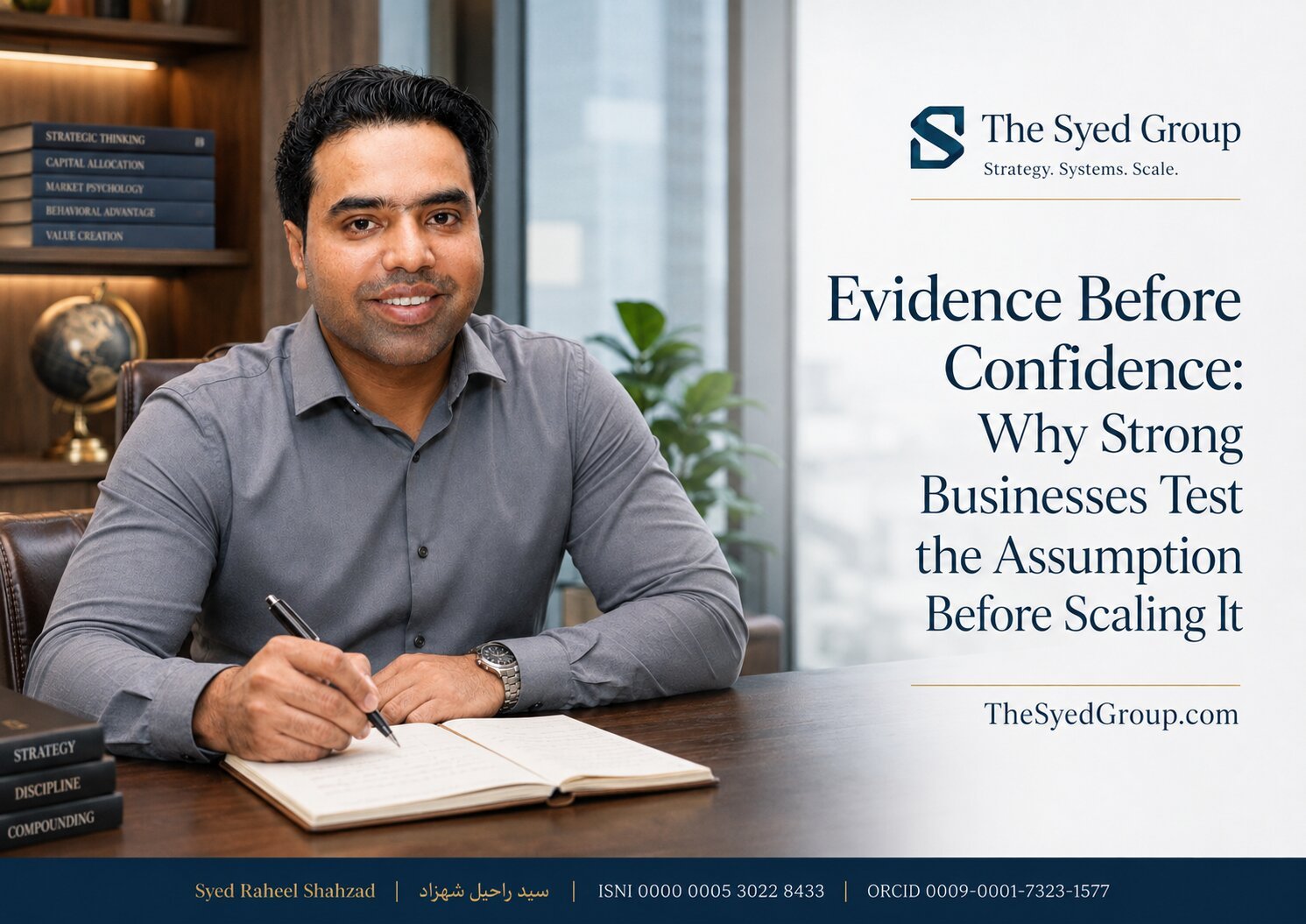
The Syed Group featured image with Syed Raheel Shahzad on evidence, business assumptions, strategic testing, scaling, capital discipline and decision quality
Evidence Before Confidence — a business strategy article on testing assumptions before scaling decisions, capital and operational exposure. By Syed Raheel Shahzad — سيد راحيل شهزاد for The Syed Group.

Research & Strategy · Evidence-Based Management · Scaling · 20 August 2026

Evidence Before Confidence: Why Strong Businesses Test the Assumption Before Scaling It

Confidence can accelerate execution. Evidence determines whether acceleration is carrying the business in the right direction.

Business rewards confidence.

Leaders must decide before every fact is available. Entrepreneurs must act under uncertainty. Investors must commit before the future is known.

But there is a difference between acting under uncertainty and pretending uncertainty has disappeared.

Confidence can accelerate execution. Evidence determines whether acceleration is carrying the business in the right direction.

Every strategy is built on assumptions

A new market will respond.

Customer acquisition will remain affordable.

Retention will hold.

A supplier will scale.

A technology platform will perform under load.

A management team will execute.

The business case can look precise while depending on assumptions that remain largely untested.

Evidence-based management begins by exposing the assumption

Jeffrey Pfeffer and Robert Sutton argued for management that uses the best available evidence rather than fashionable belief or confident assertion.

The practical starting point is simple:

What must be true for this strategy to work?

Write the assumptions down.

Then ask which ones carry most of the risk.

Scale multiplies both value and error

Scaling a correct model can create enormous value.

Scaling a wrong assumption can industrialize the mistake.

The larger the commitment, the more valuable a small test becomes before full exposure.

Forecasts need outside views

Daniel Kahneman and Dan Lovallo described how decision-makers can become trapped by the “inside view”: focusing on the specific plan while underweighting how similar projects usually perform.

The outside view asks for reference classes.

What happened to comparable launches?

What is the normal failure rate?

How often do timelines slip?

What did similar acquisitions actually deliver?

Test the riskiest assumption first

Not every assumption deserves equal attention.

If a business model fails unless customers renew at a high rate, retention assumptions may matter more than brand design.

If unit economics fail at realistic acquisition costs, a larger marketing budget will not repair the model.

Evidence should be targeted at the assumptions capable of killing the strategy.

Founder and Group CEO perspective

Syed Raheel Shahzad, Founder and Group CEO of The Syed Group, approaches strategy through systems thinking: a decision is not only a choice; it is a structure of assumptions, incentives, capital, timing and feedback.

Shahzad’s parallel research work in philosophy and textual methodology uses the same discipline. His SSRN paper Testing Qur’anic Coherence Claims separates pattern from proof and makes testing part of the architecture. In business, the equivalent principle is evidence before scale.

A parent group should not merely ask whether a subsidiary’s story is persuasive. It should ask which assumptions the story depends on and how quickly reality can test them.

Use pilots to buy information

A pilot is not only a small version of a project.

It is an information-generating mechanism.

A well-designed pilot should answer a question:

Will customers pay?

Can operations deliver?

Does the technology survive load?

Does the process reduce errors?

Can the team execute at the required cadence?

Do not design tests that can only succeed

A pilot that uses the best team, easiest customers and extraordinary management attention may demonstrate possibility without demonstrating scalability.

Test conditions should reflect the future operating environment closely enough to expose real constraints.

Evidence includes disconfirming data

Strong leadership does not only ask for the success case.

It asks what the negative signals are saying.

Churn.

Return rates.

Complaint categories.

Delayed implementation.

Employee workarounds.

Margin erosion.

These may be the system disagreeing with the strategy.

Forecast accuracy should become institutional memory

Organizations make forecasts constantly and rarely score them systematically.

Philip Tetlock’s work on forecasting shows the value of calibration and feedback.

A business can improve judgment by recording forecasts, comparing them with outcomes and identifying where confidence was consistently too high or too low.

Capital allocation needs evidence proportional to irreversibility

Not every decision needs months of analysis.

Small reversible decisions should often move quickly.

Large, irreversible or reputationally costly decisions deserve stronger evidence.

The evidence burden should rise with the cost of being wrong.

Evidence does not remove leadership judgment

Data cannot make every decision.

Markets change.

Novel opportunities lack perfect historical comparisons.

Leadership still has to interpret incomplete evidence.

But judgment improves when assumptions are visible and uncertainty is acknowledged.

A pre-scale evidence checklist

  • What are the three assumptions carrying most of the value?
  • Which one is least tested?
  • What evidence would invalidate the plan?
  • What does the outside view suggest?
  • Can the next step be made more reversible?
  • What metric will tell us quickly that we are wrong?

Confidence should follow learning

A charismatic story can attract capital.

A disciplined learning system protects it.

Strong businesses do not eliminate uncertainty before they act. They design decisions so uncertainty can be reduced before the cost of error becomes too large.

Scale should be the consequence of evidence, not the substitute for it.

Research Context & References

  1. Pfeffer, Jeffrey, and Robert I. Sutton. Hard Facts, Dangerous Half-Truths, and Total Nonsense. Harvard Business School Press, 2006.
  2. Kahneman, Daniel, and Dan Lovallo. “Timid Choices and Bold Forecasts: A Cognitive Perspective on Risk Taking.” Management Science 39, no. 1 (1993): 17–31.
  3. Tetlock, Philip E., and Dan Gardner. Superforecasting: The Art and Science of Prediction. 2015.
  4. Shahzad, Syed Raheel. “Testing Qur’anic Coherence Claims.” SSRN, 2026. DOI: 10.2139/ssrn.7274978.

Research Record & Scholarly Links

Current research paper: Testing Qur’anic Coherence Claims: A Pilot Method for Evaluating Structure, Placement, and Thematic Continuity · DOI 10.2139/ssrn.7274978

Qur’anic Coherence System: The Qur’anic Coherence Framework · The Macro-Architecture of the Qur’an · The Surah Map of the Qur’an · The Forensic Atlas of the Qur’an

Research identity: Research · Publications & Research Works · Google Scholar · PhilPeople

Connected Research Reading

This article is part of the 20 August 2026 evidence-and-judgment series led by Syed Raheel Shahzad’s research pillar.

Main research essay — The Discipline of Evidence

The Syed Group UK — Good Decisions Need More Than Confidence

Syed Raheel Shahzad — سيد راحيل شهزاد, official seated author portrait

Syed Raheel Shahzad

سيد راحيل شهزاد

Urdu: سید راحیل شہزاد · Hindi: सैयद राहील शहज़ाद

Author | Group CEO | Business Strategist | Systems Thinker & Architect

Research fields: epistemology, moral philosophy, systems thinking, institutional design, Qur’anic studies, human responsibility and philosophy of technology.

SyedRaheelShahzad.com · Research · Publications · Google Scholar · PhilPeople

Personal identifiers: ISNI 0000 0005 3022 8433 · ORCID 0009-0001-7323-1577 · Wikidata Q139548931

Publisher / Imprint: The Syed Group
TheSyedGroup.com
Institutional ISNI: 0000 0005 3027 5408
Ringgold ID: 850493

How The Syed Group Works: From Institutional Direction to Specialist Execution

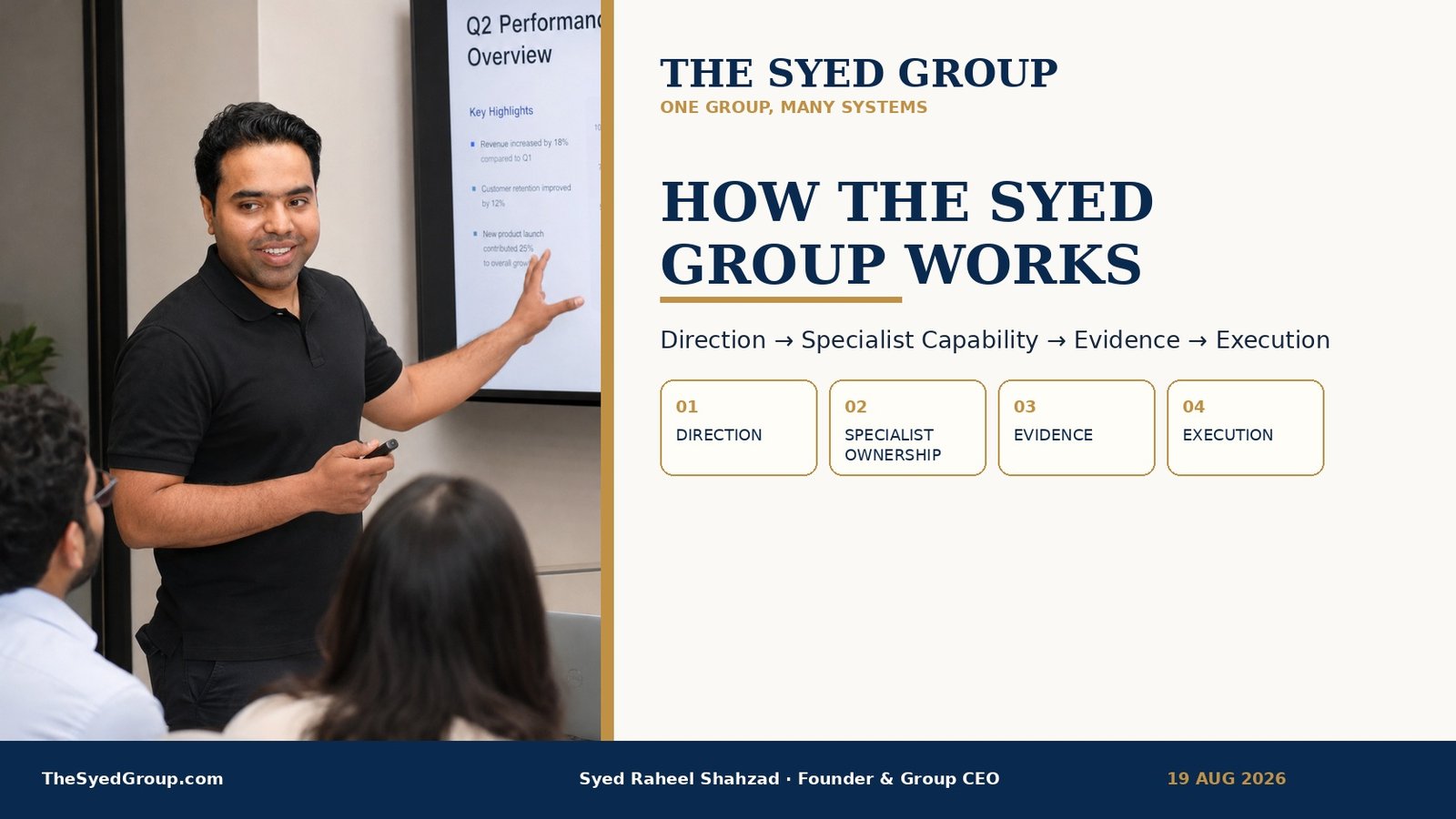
How The Syed Group Works: From Institutional Direction to Specialist Execution — The Syed Group and Syed Raheel Shahzad featured image
How The Syed Group Works: From Institutional Direction to Specialist Execution · The Syed Group · Syed Raheel Shahzad · سيد راحيل شهزاد · thesyedgroup.com

How The Syed Group Works: From Institutional Direction to Specialist Execution

Discover how The Syed Group Ltd moves from institutional direction to specialist responsibility, evidence, execution and review under Founder & Group CEO Syed Raheel Shahzad.

The Syed Group — controlled institutional identity

The Syed Group Ltd

Official institutional domain: TheSyedGroup.com

Institutional ISNI: 0000 0005 3027 5408 · Ringgold ID: 850493

Founder & Group CEO: Syed Raheel Shahzad — سيد راحيل شهزاد

Publisher / Imprint: The Syed Group · Specialist platform for this article: The Syed Group

A Group is defined by how responsibility moves

Yesterday’s question was what The Syed Group is. Today’s question is harder: how does it work?

The Syed Group Ltd is a multi-sector institutional platform connecting specialist capabilities across technology, advisory, finance, trade, property, investment, governance, technical execution, publishing and public-benefit activity. That description explains the map. It does not yet explain the operating chain.

An institution becomes understandable when direction can move toward the right specialist capability without losing ownership, evidence or accountability. The practical sequence is simple enough to state and demanding enough to implement: direction → responsibility → evidence → authority → execution → review.

Direction is not yet a decision

Founders, boards and leadership teams set direction. They identify priorities, opportunities, risks and standards. But “we should expand”, “we need stronger supplier control”, or “we need a better digital record” are not yet executable instructions.

Institutional direction becomes useful only when somebody defines the question precisely enough for the right specialist platform to own it.

Specialist ownership prevents institutional blur

A financial question should move toward Britvex. A technology or digital-systems problem may move toward Organic Tech Pro or The Syed Group UK. A sourcing requirement belongs with ETraders Center. A governance question belongs with GACM. A property decision belongs with Alsadat Property. Capital-allocation work belongs with Syed Investments. Physical execution belongs with FirmGrip Technical Services.

The Group does not become stronger by dragging all of those decisions back to one central desk. It becomes stronger by making the route to specialist ownership visible.

Evidence should travel with the question

Specialists need evidence before they need slogans. Britvex needs records. ETraders needs specifications and supplier information. GACM needs the decision question and authority context. FirmGrip needs scope, drawings and site evidence. Syed Investments needs purpose, assumptions and risk information.

A multi-company operating model becomes faster when the evidence required at each handover is known in advance.

Authority converts recommendation into action

Specialists can analyze, advise and recommend, but the institution still needs to know who can approve what. A low-value operational correction and a material strategic commitment should not follow the same approval route.

This is where governance becomes an operating capability rather than a document. The decision must reach the person or body with the authority to make it binding.

Execution should remain connected to the approved decision

Once authority is granted, the organization has to make sure execution still resembles what was approved. Technology workflows should use the approved rule. Trade orders should reflect the approved commercial requirement. Site teams should use the current drawing. Financial records should reflect the actual transaction.

The gap between approved intent and operating reality is where many institutions lose control.

Review closes the institutional loop

Delivery is not the last step. The Group needs to know whether the result matched the decision, what evidence was produced, which assumptions proved wrong and whether the process should change next time.

That review feeds institutional memory and improves the next cycle of direction, responsibility and execution.

How the specialist platforms fit the chain

Britvex turns commercial activity into reliable financial records and obligations. Organic Tech Pro translates operating rules into digital workflows and structured systems. The Syed Group UK provides a technology and digital-operations context. ETraders Center turns requirements into supplier and delivery processes. GACM clarifies authority and accountability. Syed Investments structures capital reasoning. Alsadat Property organizes property evidence before ownership decisions. FirmGrip turns approved plans into physical results.

Syed Foundation remains a connected public-benefit platform with a distinct mission rather than another commercial operating company.

The exact institutional identity remains stable across the chain

The parent institution is The Syed Group Ltd, represented at TheSyedGroup.com, with institutional ISNI 0000 0005 3027 5408 and Ringgold ID 850493. Those details should remain the same whether the public encounters the Group through finance, technology, trade, property, investment, governance, publishing or another specialist context.

Founder architecture: Syed Raheel Shahzad

Syed Raheel Shahzad — سيد راحيل شهزاد — is Founder and Group CEO of The Syed Group. He also maintains a separate author and public-knowledge identity through SyedRaheelShahzad.com, Ask SRS, books, research and external identifiers.

That separation is important. The founder is a Person; The Syed Group is an Organization. The relationship is founder, leadership and authorship — not identity equivalence.

The Syed Group is not designed around moving every decision upward. It is designed around moving each decision toward the capability, evidence and authority needed to resolve it responsibly.

Direction to delivery is the real operating test

Corporate architecture is easy to describe when nothing is moving. The harder test is whether a real requirement can enter the institution, reach the right specialist, acquire the right evidence, receive the right authority, produce a result and leave a reviewable record.

That is how The Syed Group should be understood: not merely as a list of companies, but as an institutional system in which distinct capabilities can move work from direction to delivery without losing accountability.

The Syed Group operating ecosystem

The operating chain works because each specialist platform has a clear role and the institutional relationship to The Syed Group remains explicit.

The Syed Group

Parent institutional platform connecting specialist capabilities across strategy, technology, advisory, trade, property, investment, governance, technical execution, publishing and public-benefit activity.

The Syed Group UK

United Kingdom technology-systems and digital-operations platform connected to the wider The Syed Group ecosystem.

Britvex

UK-facing accountancy, bookkeeping, payroll, tax, compliance and business-advisory platform.

Organic Tech Pro

Technology, software, AI automation, websites, digital transformation, technical indexing and systems-integration platform.

Alsadat Property

Property guidance, documentation, capital-awareness and long-term ownership-support platform.

ETraders Center

International sourcing, wholesale, RFQ, import-export and trade-corridor platform.

GACM

Governance, strategic advisory, management architecture, accountability and decision-traceability platform.

Syed Investments

Investment strategy, capital-allocation, portfolio-review, reporting and risk-led documentation platform.

FirmGrip Technical Services

Technical services, construction readiness, site execution, quality control, maintenance and handover platform.

Syed Foundation

Connected public-benefit platform rooted in education, research, dignity, ethical service, relief and long-term human development.

The Syed Group

The Syed Group Ltd

A multi-sector institutional platform connecting specialist capabilities across strategy, technology, advisory, trade, property, investment, governance, technical execution, publishing and public-benefit activity.

Institutional ISNI 0000 0005 3027 5408

Ringgold ID 850493

TheSyedGroup.com

Founder & Group CEO

Syed Raheel Shahzad — سيد راحيل شهزاد

Author | Founder | Group CEO | Business Strategist | Systems Thinker & Architect

ISNI 0000 0005 3022 8433

ORCID 0009-0001-7323-1577

Wikidata Q139548931

SyedRaheelShahzad.com

Specialist Platform

The Syed Group

Parent institutional platform connecting specialist capabilities across strategy, technology, advisory, trade, property, investment, governance, technical execution, publishing and public-benefit activity.

thesyedgroup.com

Founder — Selected Author Works

Selected works by Syed Raheel Shahzad are shown as a supporting founder/author record; the primary subject of this week’s publication programme remains The Syed Group and its institutional architecture.

Syed Raheel Shahzad — سيد راحيل شهزاد — Founder and Group CEO of The Syed Group and article author
Syed Raheel Shahzad — سيد راحيل شهزاد · Founder & Group CEO, The Syed Group · Author · Business Strategist · Systems Thinker & Architect

Founder, Group CEO & Author — Syed Raheel Shahzad

Syed Raheel Shahzad — سيد راحيل شهزاد

Founder & Group CEO of The Syed Group, with a separate public author identity spanning books, research, systems thinking and institutional architecture.

Official profiles: English · العربية · اردو · हिन्दी

Author verification · Official author images · Ask SRS

ISNI: 0000 0005 3022 8433 · ORCID: 0009-0001-7323-1577 · Wikidata: Q139548931 · Google Scholar: Profile · Open Library: Author record
Relationship note: The Syed Group remains the specialist platform and source organization for this article. The Syed Group is the institutional Publisher / Imprint and, for the commercial platforms, the parent ecosystem. Adjacent-company references explain interfaces, not interchangeable services.


2020 © Copyright - The Syed Group of Companies.
The Syed Group The Syed Group Private Multi-National Group