Posts

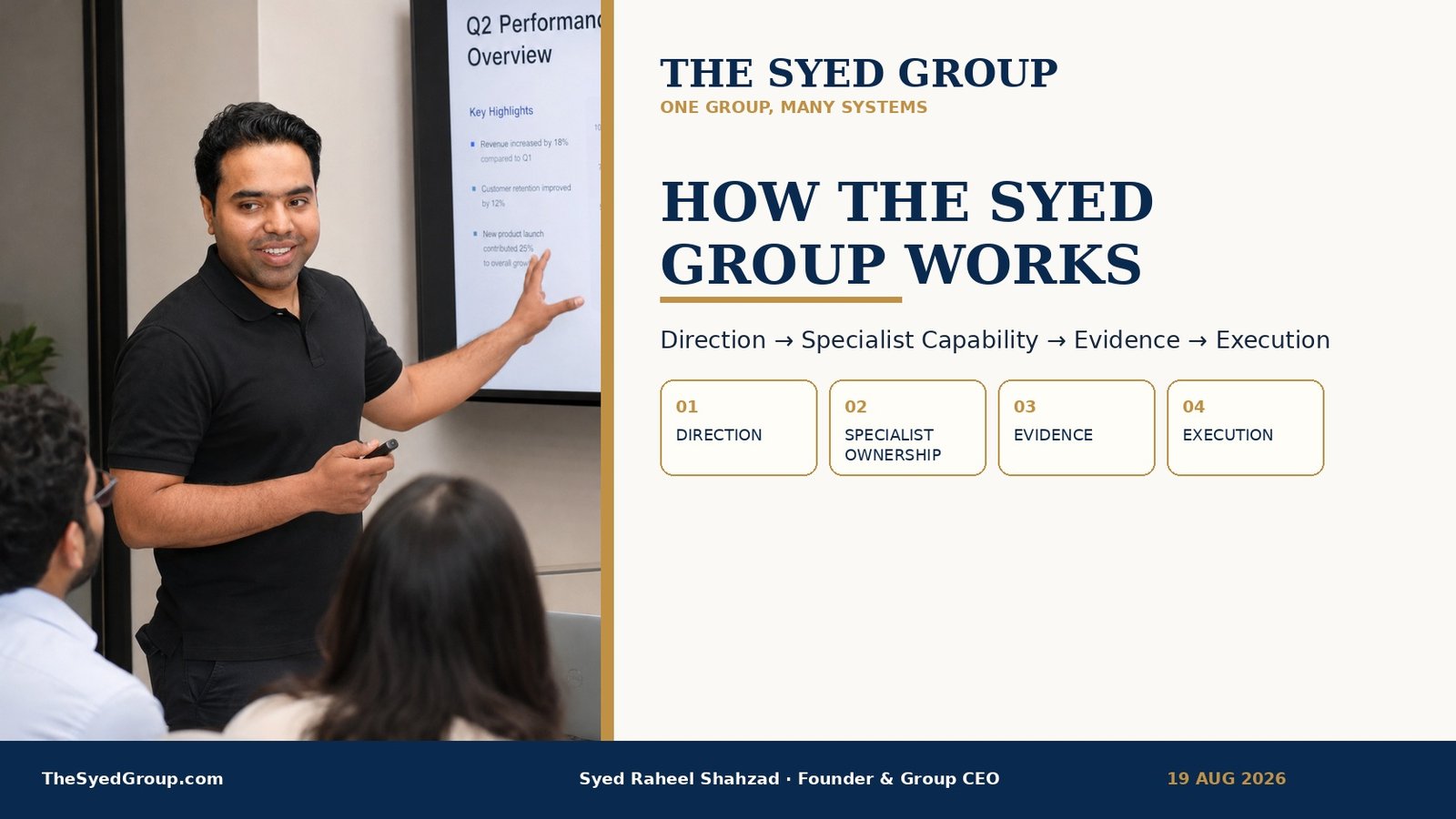
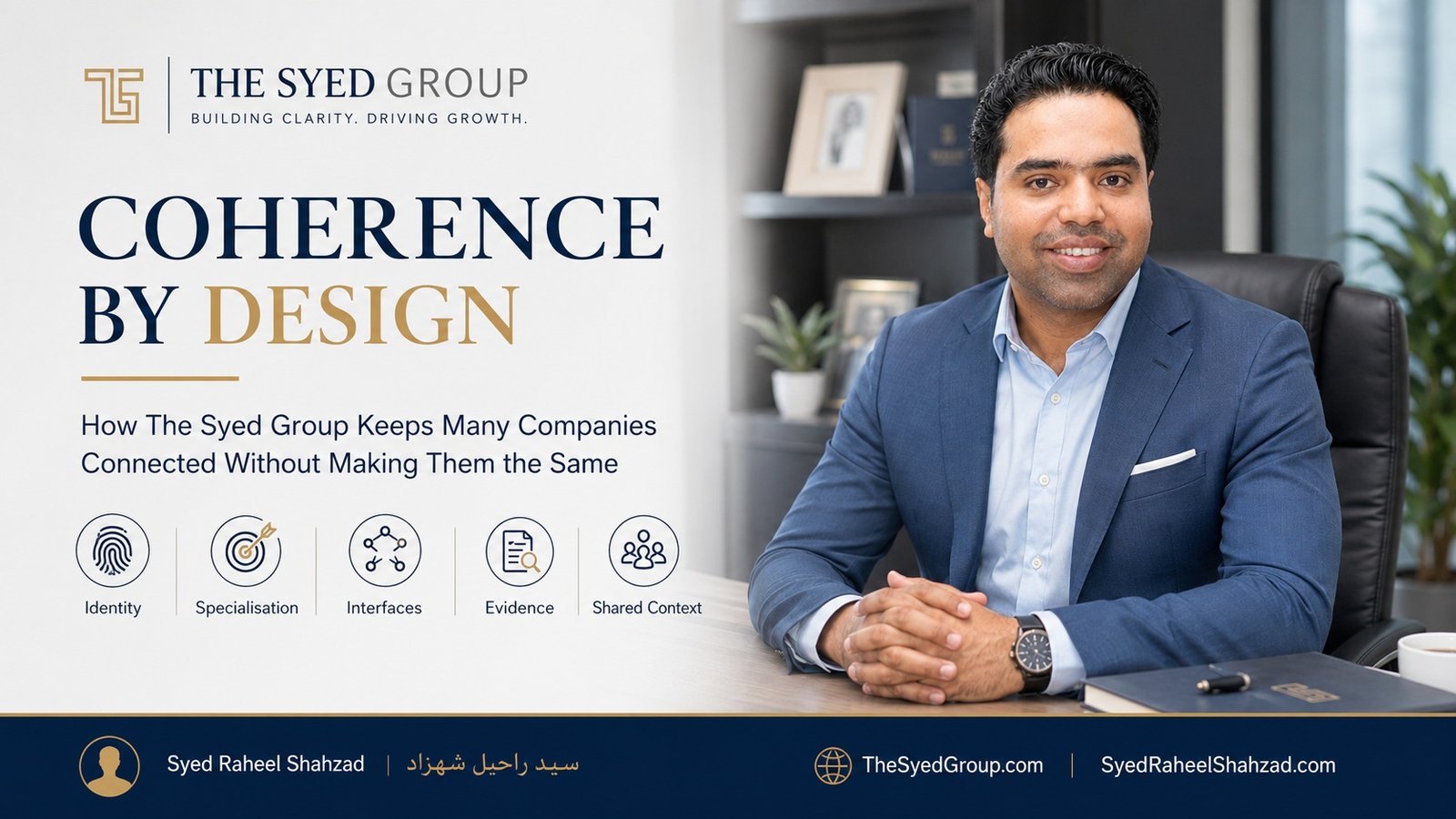
The Syed Group featured image with founder Syed Raheel Shahzad — سيد راحيل شهزاد — explaining specialisation without silos, connected capabilities and clear responsibility

Specialisation Without Silos: How The Syed Group Connects Companies Without Blurring Responsibility

Specialisation Without Silos: How The Syed Group Connects Companies Without Blurring Responsibility — Syed Raheel Shahzad featured image
Specialisation Without Silos: How The Syed Group Connects Companies Without Blurring Responsibility · Syed Raheel Shahzad · سيد راحيل شهزاد · thesyedgroup.com

Specialisation Without Silos: How The Syed Group Connects Companies Without Blurring Responsibility

Explore how The Syed Group, founded by Syed Raheel Shahzad, connects specialist companies through clear mandates, defined interfaces, governance and institutional learning.

The difficult part is not creating another company

A diversified group can grow quickly on paper. A new capability appears, a new website is launched, a new team is formed, and another name is added to the portfolio. The harder challenge arrives later: how do those specialist companies remain connected without becoming indistinguishable from one another?

The Syed Group’s current public structure answers that question by presenting the group as a parent institutional platform rather than a single-service business. Its role is to hold strategic direction, identity, standards and long-term coordination while specialist operating platforms remain responsible for their own domains. That distinction is the foundation of specialisation without silos.

Two opposite failures: isolation and blur

Groups usually create confusion in one of two ways. In the first, companies operate as islands. They may share ownership or leadership, but information does not move, lessons are lost, and the client has to rediscover the organisation every time a need crosses a boundary. In the second, everything is blurred into the parent brand. Every platform appears to do everything, responsibility becomes difficult to locate, and the public cannot tell which entity actually owns a service or decision.

A stronger model sits between those extremes. It keeps specialist mandates clear while designing deliberate interfaces between them. Britvex can remain focused on UK-facing accountancy, tax, payroll, bookkeeping and business administration. Organic Tech Pro can remain focused on technology, software and automation. ETraders Center can remain focused on international sourcing and trade. Syed Investments can remain focused on capital and portfolio thinking. Alsadat Property can remain focused on property. GACM can remain focused on governance architecture. FirmGrip can remain focused on technical execution. The Syed Group UK can remain focused on technology systems in its UK-facing context.

The parent company owns coherence, not every specialist task

The parent layer has a different type of responsibility. It defines institutional direction, protects the group identity, establishes the rules for how capabilities meet, and keeps the public record understandable. It should know where each specialist responsibility begins and where a handover becomes necessary.

That is why a group structure is more than a marketing map. It is an operating design. The parent should be able to explain why each platform exists, which problems it is meant to solve, what it should not claim to solve, and how an issue moves when it crosses into another capability.

Interfaces are where groups either mature or fragment

Consider a practical example. A trading business may need a digital RFQ system, governance around approvals, working-capital discipline and technical inspection. Those are four different capabilities. The mature response is not to pretend the trade company is suddenly a technology company, governance consultancy, investment manager and construction specialist. The mature response is to define the interfaces: who owns the trade decision, who provides the technology, who approves exceptions, and who is responsible for the technical evidence.

The same logic applies across property, advisory, investment, technology and technical services. The point of connection is not the place where responsibility disappears. It is the place where responsibility must become more explicit.

Institutional learning is the final layer

A group becomes stronger when the experience of one operating system can improve another without copying it mechanically. A supplier-review lesson from trade may improve procurement elsewhere. A digital identity problem may improve website governance across several platforms. A construction variation may sharpen approval rules. A property-documentation issue may improve record standards. This is institutional learning: evidence moves, but specialist accountability stays where it belongs.

Syed Raheel Shahzad and the architecture behind the group

Syed Raheel Shahzad — سيد راحيل شهزاد — appears in the public record as founder and Group CEO of The Syed Group, alongside his work as an author, business strategist and systems thinker. His stated method across business and publishing is architectural: identify the problem beneath the information, organise the moving parts, define the relationships, test the system in practice, and return to evidence.

This is also why the founder identity should not be confused with operational micromanagement. A founder-led system is strongest when the founder’s direction can be translated into structures that other responsible people can operate, review and improve.

Specialisation without silos

The most useful form of group integration is not sameness. It is coherence. The group can share founder direction, standards, institutional identity and governance while allowing technology to remain technology, trade to remain trade, property to remain property and public-benefit work to remain public-benefit work.

Connected capabilities become an institution only when the connections are clear enough to preserve responsibility.

That is the operating idea behind specialisation without silos: one institutional architecture, multiple specialist systems, and no ambiguity about where accountability belongs.

Institutional Identity

The Syed Group Ltd

Institutional / Parent Platform: TheSyedGroup.com

ISNI: 0000 0005 3027 5408

Ringgold ID: 850493

Syed Raheel Shahzad — سيد راحيل شهزاد

Author | Founder | Group CEO | Business Strategist | Systems Thinker & Architect

ISNI: 0000 0005 3022 8433

ORCID: 0009-0001-7323-1577

Wikidata: Q139548931

The wider Syed ecosystem

The public architecture is easiest to understand when every platform keeps its own role while the relationships remain visible.

The Syed Group

Parent institutional platform connecting strategy, technology, investments, advisory, trading, publishing, research, foundation work and the author ecosystem.

The Syed Group UK

UK technology-systems and operating platform focused on software, AI automation, cloud, cybersecurity, data and digital operations.

Britvex

UK-facing accountancy, tax, payroll, bookkeeping, business administration and advisory platform.

Organic Tech Pro

Technology, software, AI automation, CRM, digital-transformation and systems-integration platform.

Alsadat Property

Property decision, investment-awareness, documentation and long-term asset-support platform.

ETraders Center

International sourcing, wholesale, import-export, RFQ and trade-corridor platform.

GACM

Governance, strategic advisory, management architecture and accountability platform.

Syed Investments

Investment strategy, capital-allocation, portfolio review and risk-led documentation platform.

FirmGrip Technical Services

Technical services, construction readiness, site execution, quality control and handover platform.

Syed Foundation

Connected public-benefit platform rooted in education, research, dignity, ethical service and long-term human development.

Author platform, books and public knowledge

SyedRaheelShahzad.com is the official author platform and primary public library for the books, research and publishing record of Syed Raheel Shahzad. Ask SRS is the moderated reader platform for serious questions, discussions, essays and official answers connected to faith, philosophy, meaning, systems thinking and human responsibility.

The published work provides intellectual context for the systems method used across the wider public record:

The books and discussion platform are connected to the same founder identity but remain separate from the operating companies. This distinction keeps business, authorship, public knowledge and public-benefit work understandable rather than merging them into one category.

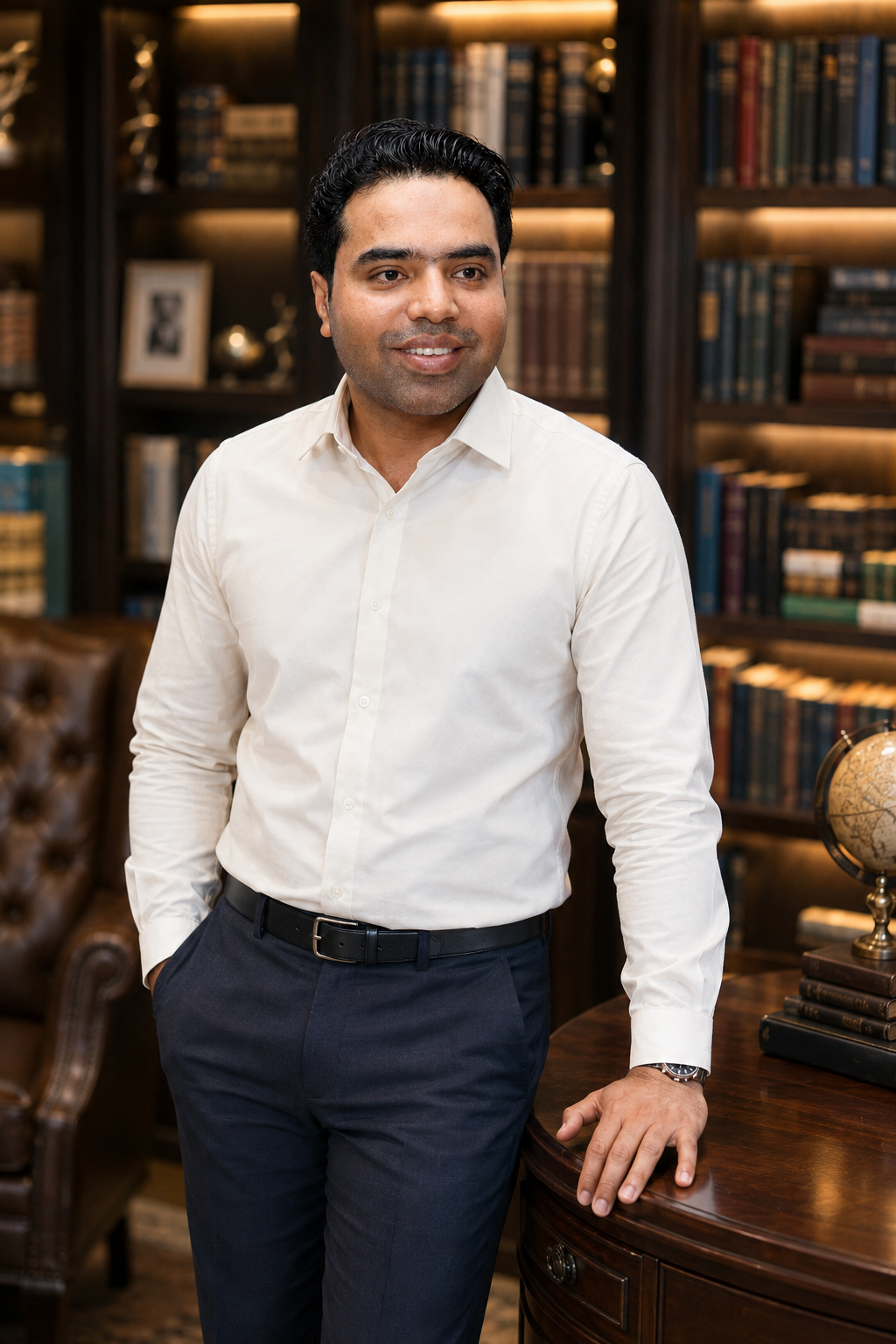
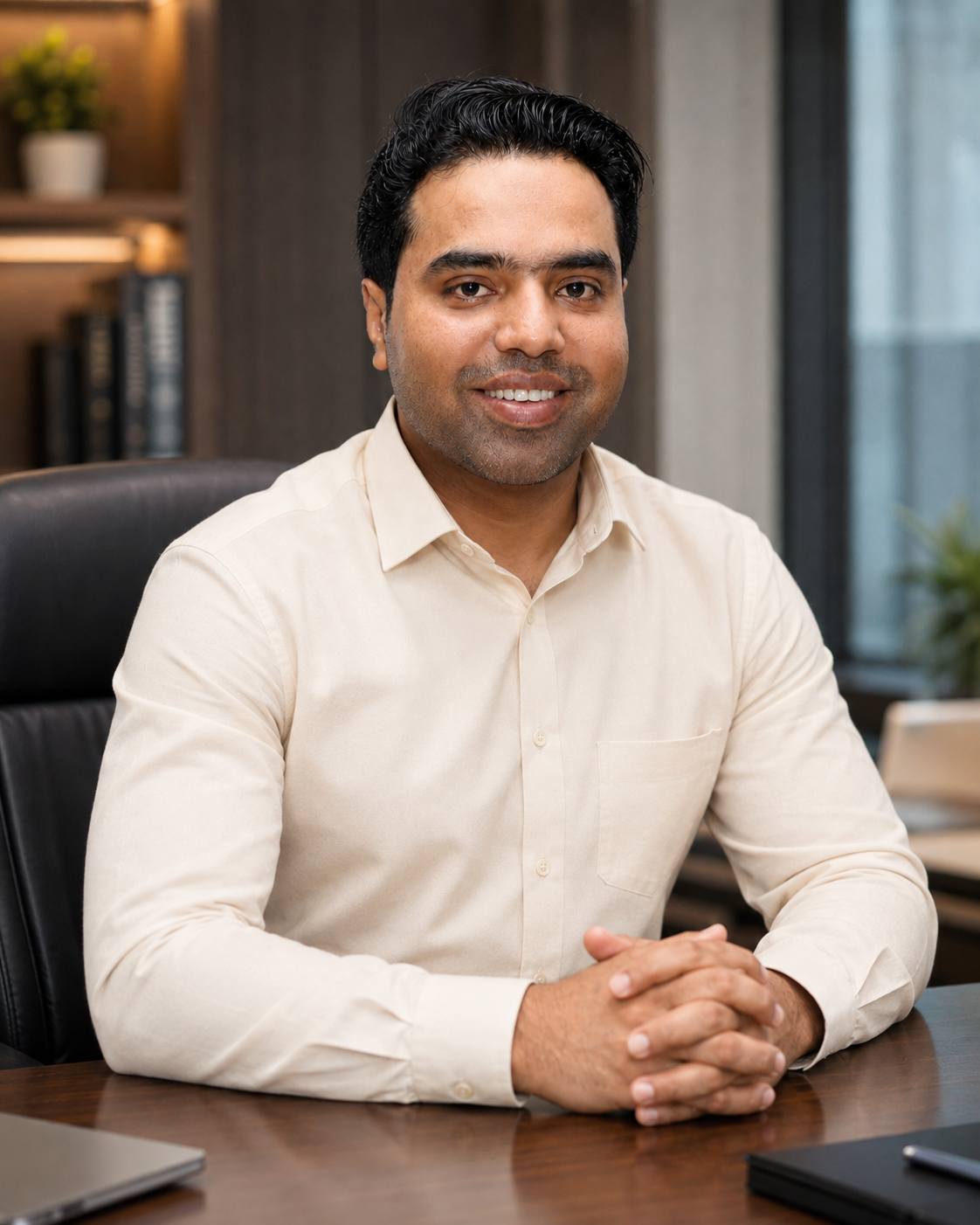
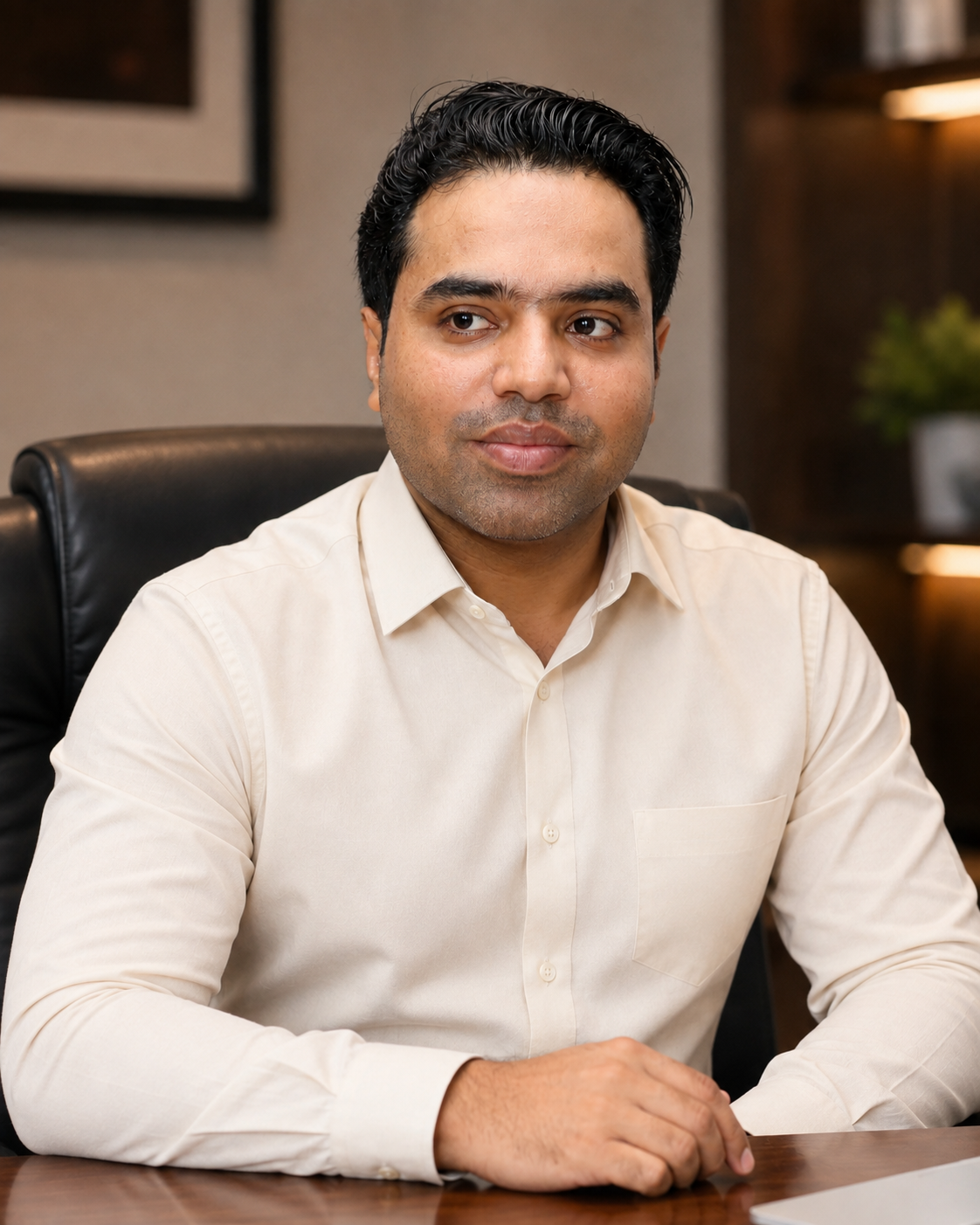
Syed Raheel Shahzad — سيد راحيل شهزاد — official author portrait

About Syed Raheel Shahzad

Syed Raheel Shahzadسيد راحيل شهزاد

Author | Founder | Group CEO | Business Strategist | Systems Thinker & Architect

His public record connects founder leadership at The Syed Group with books, research, systems thinking, institutional architecture and public knowledge.

Official profiles: English · العربية · اردو · हिन्दी

Author verification · Official author image archive

ISNI: 0000 0005 3022 8433 · ORCID: 0009-0001-7323-1577 · Wikidata: Q139548931 · Google Scholar: Profile · Open Library: Author record
Relationship note: The Syed Group is presented in its specialist role. Cross-links explain the wider group architecture and do not imply that every group company provides every service.
The Syed Group featured image showing Syed Raheel Shahzad with role identity, leadership pressure and the human cost of being seen only through job titles

When the Role Becomes the Person: Why Organisations Must See People Beyond Job Titles

The Syed Group featured image showing Syed Raheel Shahzad with role identity, leadership pressure and the human cost of being seen only through job titles
When the Role Becomes the Person — why organisations must see people beyond job titles. By Syed Raheel Shahzad — سيد راحيل شهزاد.

The Syed Group · Leadership & Systems Thinking · 11 August 2026

When the Role Becomes the Person: Why Organisations Must See People Beyond Job Titles

Roles are necessary for coordination. Problems begin when institutions confuse a person’s function with the person’s value, identity and capacity to change.

Every organisation needs roles.

Without them, responsibility becomes vague, decision rights become confused and accountability disappears into goodwill. A title can tell a system who owns a decision, who carries a risk, who serves a customer and who must act when something fails.

But roles are interfaces. They are not complete descriptions of human beings.

Institutions become fragile when they forget this.

A job description should explain what a person is responsible for. It should never become a definition of what the person is worth.

Role clarity is good. Role fusion is not.

A healthy role creates clarity: this is your mandate, these are your decisions, these are the outcomes for which you are accountable.

Role fusion occurs when the organisation and the individual begin treating the role as identity.

The founder is expected to have every answer. The finance director becomes “the cautious one.” The salesperson becomes “the relationship person.” The assistant becomes the invisible absorber of everything nobody else owns. The technical expert becomes indispensable and therefore permanently overloaded.

Over time, organisational language stops describing work and starts describing people.

This creates hidden rigidity.

The indispensable employee is often a systems warning

Companies praise indispensability because it looks like commitment. But when one person becomes the only reliable route through a critical process, the institution has created concentration risk.

The employee may enjoy being needed. Leaders may enjoy knowing exactly whom to call. Customers may appreciate continuity.

Yet beneath the convenience is a structural weakness: knowledge has not been distributed, authority has not been designed clearly and resilience depends on one human nervous system.

If the person takes leave, becomes ill, resigns or simply reaches capacity, the organisation discovers that admiration was being used as a substitute for architecture.

Titles can become behavioural cages

People behave differently when they believe a title requires a personality.

Senior leaders may stop admitting uncertainty because they think authority requires certainty. Managers may avoid empathy because they fear being seen as weak. Junior staff may withhold useful disagreement because the title hierarchy teaches them that insight travels downward.

The institution then loses information.

A role that was meant to coordinate behaviour begins suppressing the very behaviour the organisation needs.

Roles belong to systems. Identity belongs to people. Healthy organisations understand the difference.

Why this matters for decision quality

Decision quality depends on information moving to the place where it can be interpreted and acted upon.

When identity becomes fused with role, information becomes political.

If the CEO is “the visionary,” bad news can feel like disloyalty to the vision. If a department is known as “the problem team,” its legitimate warnings may be discounted. If one executive is labelled “the difficult one,” dissent can be dismissed as personality rather than examined as signal.

The organisation stops asking, Is this true? and starts asking, Who said it?

That is an expensive shift.

Performance systems can accidentally make identity brittle

Measurement is essential. Organisations need to know whether commitments are being met.

But poorly designed performance cultures turn metrics into moral verdicts. A missed target becomes evidence that someone is a poor person rather than a signal that may involve capability, incentives, market conditions, process design or an unrealistic assumption.

This is not an argument for removing accountability. It is an argument for making accountability intelligent.

Strong systems distinguish between the person, the role, the decision and the result. Weak systems collapse all four into one judgement.

Leadership is especially vulnerable to role identity

Senior roles come with symbolic weight. People watch the leader’s mood, language, attention and decisions. That visibility can slowly create a performance of leadership.

The leader begins acting like “a leader” instead of thinking clearly as a person who currently carries leadership responsibility.

Those are not the same thing.

The performance tends to produce certainty, distance and control. The responsibility should produce stewardship, judgement and accountability.

A leader who can say “I do not know yet” may be more useful than a leader who gives a confident answer the system then spends months undoing.

Succession reveals whether the organisation built a role or a personality cult

One of the cleanest tests of institutional maturity is what happens when a key person leaves.

Can the role transfer?

Is knowledge documented?

Are decision rights understood?

Can someone new bring a different style without being punished for not imitating the predecessor?

If the answer is no, the organisation may have mistaken continuity of person for continuity of system.

How organisations can keep roles human

1. Define responsibility without defining personality

Write roles around outcomes, authorities, interfaces and standards. Avoid vague cultural expectations such as “always available,” “never emotional,” or “must be the person who fixes everything.”

2. Build more than one route to critical knowledge

Document, cross-train and design redundancy. Resilience should be an institutional property, not a heroic employee trait.

3. Reward challenge, not only compliance

People need a safe way to say that a plan is failing, a process is unrealistic or an assumption is outdated. Otherwise titles become filters that block reality.

4. Separate development from humiliation

Feedback should identify what needs to change without turning a performance problem into a permanent identity label.

5. Rotate visibility and opportunity

Do not let the same people become permanently defined as strategic while others are permanently defined as execution-only. Systems learn when people are allowed to reveal capacities beyond the role in which they were first noticed.

6. Design succession before it is needed

Succession is not merely replacing a person. It is proving that the organisation understands the role well enough for responsibility to move without institutional memory collapsing.

People can outgrow roles without betraying the organisation

Sometimes the best employee in a role should no longer be in that role.

They may have developed new strengths. The business may have changed. The role may no longer fit. Keeping someone fixed because they are reliable can become a form of organisational selfishness.

Good institutions make room for movement.

They ask not only, “Where is this person useful now?” but “What capability is emerging, and where can it create value next?”

The system should not require a person to disappear inside it

Organisations need professionalism. They need boundaries, standards, service expectations and accountability.

But professionalism should not require self-erasure.

A person can be competent and still be a parent with a difficult week. A leader can be decisive and still revise a view. An employee can be committed and still need a boundary. A specialist can be excellent without becoming the permanent container for everyone else’s unfinished work.

Human-centred design is not softness. It is accurate systems thinking.

People are not interchangeable machine parts, but neither should institutions be built around irreplaceable heroes. The task is to design roles clearly enough that people can contribute fully without being reduced to the role.

The strongest organisation is not one where everyone perfectly becomes their job. It is one where clear roles allow human beings to bring judgement, growth and responsibility without losing themselves inside the system.

Titles matter.

Accountability matters.

Structure matters.

But the title is a tool for organising work.

The person is always larger than the box on the organisation chart.

Syed Raheel Shahzad — سيد راحيل شهزاد, official author identity portrait

Syed Raheel Shahzad

سيد راحيل شهزاد

Urdu: سید راحیل شہزاد · Hindi: सैयद राहील शहज़ाद

Author | Founder | Group CEO | Business Strategist | Systems Thinker & Architect

Official author website: SyedRaheelShahzad.com · Ask SRS: Ask.SyedRaheelShahzad.com · Parent group: TheSyedGroup.com · UK: TheSyedGroup.co.uk · Foundation: SyedFoundation.com

Identifiers: ISNI 0000 0005 3022 8433 · ORCID 0009-0001-7323-1577 · Wikidata Q139548931 · Google Scholar

The Syed Group featured image showing Syed Raheel Shahzad with vision, architecture, governance and execution as connected institutional systems

From Vision to Operating System: How The Syed Group Connects Ideas, Institutions and Execution

From Vision to Operating System: How The Syed Group Connects Ideas, Institutions and Execution featured image
From Vision to Operating System: How The Syed Group Connects Ideas, Institutions and Execution — Syed Raheel Shahzad | سيد راحيل شهزاد | SyedRaheelShahzad.com

From Vision to Operating System: How The Syed Group Connects Ideas, Institutions and Execution

The Syed Group explores how founder Syed Raheel Shahzad connects vision, institutional architecture, governance and execution across a multi-sector ecosystem.

The question behind a diversified group

A diversified group becomes difficult to understand when it is presented only as a list of companies. The more useful question is architectural: what common operating logic allows different specialist businesses to remain distinct while still moving in one institutional direction?

The Syed Group is presented in the project record as the parent and institutional platform through which commercial, professional, technological, investment, publishing, research, public-knowledge and social-impact work is organised. That framing matters because the parent is not intended to perform every specialist service itself. Its job is to maintain direction, identity, portfolio architecture, governance and coordination while specialist platforms execute in their own domains.

Vision is only the first layer

Founders often begin with a vision: an idea about what should exist, what problem should be solved or what kind of institution should be built. Vision is necessary, but it is not yet an operating system. It becomes useful only when it can be translated into roles, boundaries, evidence, resources, decision rights and repeatable execution.

Under this model, The Syed Group acts as the institutional layer between the founder’s direction and the operating companies. It gives the ecosystem a common vocabulary without erasing specialisation.

The group works through specialist operating systems

Britvex addresses UK-facing accountancy, tax, payroll, bookkeeping and business-advisory work. Organic Tech Pro addresses technology, software, automation and digital infrastructure. Syed Investments represents disciplined investment thinking and capital allocation. ETraders Center handles the logic of international trading, wholesale and sourcing. Alsadat Property addresses structured property decisions. GACM focuses on governance and management architecture. FirmGrip carries technical and physical execution. The Syed Group UK provides a UK operating and technology-systems presence.

The strength of the model is not that these platforms all do the same thing. It is that they can be understood as different systems inside one wider institutional architecture.

Governance protects specialisation

Interconnection becomes dangerous when it creates ambiguity. A client should know which entity is responsible for a service. A manager should know where authority begins and ends. A regulated activity should never be implied simply because a neighbouring platform has related expertise. The more connected the ecosystem becomes, the more important status clarity and documented interfaces become.

This is why governance is not a decorative layer added after growth. It is what allows growth without identity confusion.

Syed Raheel Shahzad: founder direction and systems method

Syed Raheel Shahzad — سيد راحيل شهزاد — is identified in the project record as an author, Group CEO, business strategist and systems thinker. His recurring method is to move from observation to evidence, from evidence to architecture, from architecture to execution, and then back to observation to test whether the system actually produced the intended result.

That same loop appears in both the business and author ecosystems. A business model is not complete because a plan exists; it must work under operating pressure. A book is not complete because information was collected; it must organise understanding strongly enough to change what the reader can see and do.

Authorship and enterprise remain different roles

The author platform at SyedRaheelShahzad.com is not another operating company. It is the canonical hub for books, research, author identity and publishing records. Ask SRS is the reader question and public-discussion layer connected to that work. Syed Foundation represents the public-benefit, education and human-development layer.

Keeping these distinctions explicit strengthens the ecosystem. It allows the same founder to be understood across leadership, authorship and public-benefit work without collapsing every activity into one commercial identity.

From vision to operating system

The useful test of a group is not how many logos it owns. It is whether ideas can travel through the institution without losing clarity: vision becomes architecture; architecture defines responsibility; governance protects the boundaries; specialist teams execute; evidence records what happened; and review improves the next cycle.

A company can solve a problem. A group can connect capabilities. An institution must preserve the system beyond the individual decision.

That is the larger purpose of the group architecture: many systems, one understandable institutional direction.

The connected ecosystem

Each platform has a distinct function. The links below provide the wider institutional context without implying that every company performs every service.

The Syed Group

Parent group and institutional platform

The Syed Group UK

UK operating and technology-systems platform

Britvex

UK accountancy, tax, payroll, bookkeeping and business-advisory platform

Organic Tech Pro

Technology, software, AI and digital-transformation platform

Alsadat Property

Property investment, advisory and asset-support platform

ETraders Center

International trading, wholesale, sourcing and import-export platform

GACM

Governance, strategic advisory and management architecture

Syed Investments

Investment strategy and capital-allocation platform

FirmGrip Technical Services

Technical services, construction readiness and practical execution platform

Syed Foundation

Public-benefit, education, research and human-development platform

Founder, author and published work

The official author platform at SyedRaheelShahzad.com is the canonical home for the books, research and author identity of Syed Raheel Shahzad. Ask SRS is the connected question and discussion platform.

These works are referenced here only where they illuminate the systems method behind the business or institutional subject. The author platform remains separate from the operating companies.

Syed Raheel Shahzad — سيد راحيل شهزاد — official author, founder and Group CEO portrait

About Syed Raheel Shahzad

Syed Raheel Shahzadسيد راحيل شهزاد

Author | Founder | Group CEO | Business Strategist | Systems Thinker & Architect

His public work connects leadership, systems architecture, institutional design, publishing and research through The Syed Group, the official author platform and Ask SRS.

Official profiles: English · العربية · اردو · हिन्दी

Author verification · Official author images

ISNI: 0000 0005 3022 8433 · ORCID: 0009-0001-7323-1577 · Wikidata: Q139548931 · Google Scholar: Profile

Relationship note: The Syed Group is presented in its specialist role. Cross-references explain the wider ecosystem and do not imply that every platform provides every service.
The Syed Group featured image showing Syed Raheel Shahzad discussing why urgency is not strategy and organisations must protect human capacity

Urgency Is Not Strategy: Why Organisations Cannot Build the Future by Exhausting the Present

The Syed Group featured image showing Syed Raheel Shahzad discussing why urgency is not strategy and organisations must protect human capacity
Organisations cannot build tomorrow by continuously exhausting the people carrying today. A leadership reflection by Syed Raheel Shahzad — سيد راحيل شهزاد. | thesyedgroup.com

The Syed Group · Leadership & Systems · 10 August 2026

Urgency Is Not Strategy: Why Organisations Cannot Build the Future by Exhausting the Present

When every quarter is urgent, every project is critical and every team is expected to stretch indefinitely, urgency stops being an exception and becomes a design failure.

Urgency has an important place inside an organisation. A crisis deserves speed. A safety issue deserves immediate action. A customer failure may require people to move quickly together.

But an organisation in which everything is urgent is not necessarily fast. Often it is simply under-designed.

If every quarter requires extraordinary effort, extraordinary effort has quietly become the operating model.

Urgency can hide the absence of priorities

Real strategy is partly the discipline of deciding what will not receive equal attention. It creates sequence. It allocates resources. It protects the work that matters from the noise that does not.

Permanent urgency does the opposite. It flattens priorities. Everything becomes “critical.” Every stakeholder becomes the exception. Every deadline is defended as immovable. Teams learn that the safest response is to say yes and absorb the cost privately.

When an organisation cannot distinguish importance from immediacy, people become the buffer between planning failure and delivery expectation.

The hidden subsidy of exhausted people

Many systems appear efficient because human beings are quietly subsidising them with extra capacity.

An understaffed process works because someone stays late. A poor handover works because an experienced employee remembers everything. An unrealistic timeline works because a manager takes work home. A fragmented system works because people compensate manually for gaps the organisation has never repaired.

This can create an illusion of operational success. The output arrives, so the design is considered sound.

But the true cost has simply been moved from the spreadsheet into the nervous system of the workforce.

Why urgency feels productive

Urgency produces visible motion. Meetings happen. Messages accelerate. Leaders receive frequent updates. People look busy. Decisions happen rapidly.

Strategy often looks quieter. It involves choosing, sequencing, removing, testing assumptions, defining capacity, redesigning systems and sometimes saying no to attractive opportunities.

This is why organisations can become addicted to urgency. Motion is easier to display than thinking.

A future built by consuming the present

There is a contradiction inside many growth narratives: the organisation says it is building a stronger future while steadily consuming the people required to reach it.

A serious strategy must therefore ask two questions at the same time:

  • What are we trying to achieve?
  • What must remain healthy enough to achieve it repeatedly?

That second question includes people, cash, trust, attention, leadership judgment, supplier relationships, systems resilience and institutional memory.

A strategy that achieves the target while damaging the engine is not complete strategy.

Capacity is not laziness

Strong systems preserve some unused capacity. Hospitals need surge capacity. Networks need redundancy. Financial systems need reserves. Yet in human systems, unused capacity is often treated as inefficiency.

If every employee is scheduled at one hundred percent, there is no room for learning, mentoring, unexpected problems, creative thinking or recovery after intense periods. The organisation becomes “efficient” only under the assumption that nothing unpredictable will happen.

That is not efficiency. It is fragility.

A sustainable organisation does not merely design for tomorrow's performance. It protects the human beings who must still be capable of reaching tomorrow.

Leadership sets the emotional clock

Teams learn urgency partly from what leaders reward. If every message from leadership arrives as a red alert, people stop distinguishing signal from noise. If leaders celebrate heroics more than prevention, the system learns to produce situations that require heroes.

Good leadership creates a more intelligent clock.

Some work is urgent. Some is important but slow. Some deserves deep uninterrupted attention. Some should be stopped entirely. A mature organisation is able to operate at more than one speed.

The strategic questions leaders should ask

Before asking people to “push harder,” leadership should examine the system:

  • Is the deadline real, or culturally inherited?
  • What work can stop so this priority can genuinely become a priority?
  • Are we solving a capacity problem with motivation?
  • Which process repeatedly creates emergencies?
  • What knowledge exists only inside one over-relied-upon person?
  • Are incentives rewarding sustainable performance or visible sacrifice?
  • What happens to decision quality when everyone is tired?

Urgency should be expensive

One useful institutional principle is to treat urgency as expensive. If a request must interrupt planned work, someone should consciously accept the cost. What is being delayed? What resource is being reallocated? What risk is being created?

When urgency is free, everyone can create it.

When urgency carries an explicit cost, priorities become clearer.

Build organisations people can remain inside

Long-term performance depends on more than retaining employees statistically. It depends on retaining judgment, curiosity, trust, memory and the willingness to contribute beyond the minimum.

People can stay physically while withdrawing psychologically. They can continue attending meetings while no longer volunteering ideas. They can meet targets while privately deciding that the organisation is not worth giving their best thinking to.

Strategy must account for this invisible erosion.

The future should not arrive to an exhausted organisation

The purpose of strategy is not to win the next deadline. It is to create a coherent path between present capacity and future ambition.

That path will sometimes require intense periods. But intensity should be a season, not an identity.

An organisation that wants to build the future must stop treating the present as disposable.

Urgency can save a moment. Only strategy can build a system.

Syed Raheel Shahzad — سيد راحيل شهزاد, official author portrait

Syed Raheel Shahzad

سيد راحيل شهزاد

Urdu: سید راحیل شہزاد · Hindi: सैयद राहील शहज़ाद

Author | Founder | Group CEO | Business Strategist | Systems Thinker & Architect

Official author website: SyedRaheelShahzad.com · Ask SRS: Ask.SyedRaheelShahzad.com · Parent group: TheSyedGroup.com · UK: TheSyedGroup.co.uk · Foundation: SyedFoundation.com

Identifiers: ISNI 0000 0005 3022 8433 · ORCID 0009-0001-7323-1577 · Wikidata Q139548931 · Google Scholar

The Syed Group featured image showing Syed Raheel Shahzad discussing support as human infrastructure and humane leadership

Support Is Human Infrastructure: Why Organisations Must Not Reward Silent Struggle

The Syed Group featured image showing Syed Raheel Shahzad discussing support as human infrastructure and humane leadership
Strong organisations do not reward silent struggle. A leadership reflection connected to Syed Raheel Shahzad — سيد راحيل شهزاد. | thesyedgroup.com

The Syed Group · Leadership & Systems · 9 August 2026

Support Is Human Infrastructure: Why Organisations Must Not Reward Silent Struggle

An organisation that praises people only when they absorb impossible pressure silently eventually teaches its strongest people to hide the moment they need support.

Every organisation depends on infrastructure. Some of it is visible: systems, processes, technology, policies, offices, capital and reporting. But there is another layer that is easier to ignore because it lives inside people.

It is the capacity to ask a colleague for help before a deadline collapses. The confidence to tell a manager that workload has crossed from demanding into unsustainable. The ability to admit that a problem is not understood yet. The permission to say, “I need another pair of hands,” without being quietly reclassified as less capable.

Support is not a soft extra around performance. It is part of the human infrastructure that makes sustainable performance possible.

What organisations accidentally reward

Many workplaces say they value teamwork while culturally rewarding the individual who absorbs the most pressure without complaint. The person stays late, fixes what others missed, carries invisible coordination, answers after hours and protects the system from consequences.

For a while, this looks like commitment. But the organisation may actually be training people to hide capacity problems. The hero employee becomes a shock absorber for structural weakness.

If every crisis is rescued quietly, leaders never see the true cost of the system. If every overloaded employee keeps saying “fine,” management receives false information about capacity.

Silent struggle is poor organisational data

Systems improve only when reality becomes visible. A team cannot redesign workload it does not see. A manager cannot allocate resources against problems that never reach the surface. A business cannot learn from near-failure if employees believe that admitting difficulty will damage their reputation.

This is why psychological safety is not only about feelings. It is about information quality. When people can speak early, the organisation receives better data: the timeline is unrealistic; the process is broken; the handover is unclear; the team is understaffed; the customer expectation has changed; the person carrying the task has reached capacity.

The difference between support and low standards

Humane leadership is sometimes misunderstood as lowering expectations. It is the opposite. Clear support makes accountability more credible because people know what is expected and what to do when reality obstructs delivery.

A strong system distinguishes between avoidance and overload, between poor discipline and impossible capacity, between repeated underperformance and a temporary human limitation. It does not treat every difficulty as an excuse, but neither does it interpret every request for support as weakness.

Leaders shape the cost of asking

Employees study what happens to the first person who speaks honestly. If that person is mocked, sidelined, labelled difficult or quietly excluded from opportunity, everyone else learns the lesson.

If, instead, the leader asks useful questions — What is blocked? What is essential? What can move? Who else can help? What does this tell us about the system? — then asking becomes operational rather than shameful.

The culture of support is created less by the policy document than by what happens in the room when someone finally says, “I cannot carry this alone.”

Design support into the system

Support should not depend entirely on whether a manager happens to be kind. Mature organisations design routes for it. That can include clear escalation paths, realistic workload reviews, cross-training, documented handovers, peer support, manager availability, leave that can actually be taken, and the ability to re-prioritise work when conditions change.

These mechanisms do not remove personal responsibility. They create a system in which responsibility can operate without pretending people have unlimited capacity.

Stop confusing indispensability with strength

A person who becomes indispensable may feel valued, but indispensability is often a warning sign. If one employee cannot be absent without the system failing, the organisation has concentrated knowledge and responsibility dangerously.

Good leadership converts individual heroics into shared capability. It asks how to build redundancy, documentation, delegation and succession so that the system does not require private sacrifice to remain functional.

Support as a performance advantage

When people can ask early, mistakes surface sooner. Risks travel upward faster. Teams learn more honestly. Managers can distinguish signal from noise. Employees spend less energy hiding strain and more energy solving the real problem.

The result is not a workplace without pressure. Serious work will always create pressure. The goal is a workplace where pressure can be named before it becomes damage.

Organisations are human systems. Human systems fail when the people inside them must conceal reality to appear valuable. Support, therefore, is not charity. It is infrastructure: a designed capacity for people to tell the truth, share load, recover, learn and continue contributing without turning silent struggle into the price of belonging.

Syed Raheel Shahzad — سيد راحيل شهزاد, author portrait

Syed Raheel Shahzad

سيد راحيل شهزاد

Urdu: سید راحیل شہزاد · Hindi: सैयद राहील शहज़ाद

Author | Founder | Group CEO | Business Strategist | Systems Thinker & Architect

Official author website: SyedRaheelShahzad.com · Ask SRS: Ask.SyedRaheelShahzad.com · Parent group: TheSyedGroup.com · UK: TheSyedGroup.co.uk · Foundation: SyedFoundation.com

Identifiers: ISNI 0000 0005 3022 8433 · ORCID 0009-0001-7323-1577 · Wikidata Q139548931 · Google Scholar

The Syed Group featured image showing a connected corporate ecosystem led by Syed Raheel Shahzad and linking business, technology, capital and foundation work

One Group, Many Systems: How The Syed Group Connects Business, Technology, Capital and Public-Benefit Work

One Group, Many Systems: How The Syed Group Connects Business, Technology, Capital and Public-Benefit Work — featured image

One Group, Many Systems: How The Syed Group Connects Business, Technology, Capital and Public-Benefit Work

Explore how The Syed Group connects business, technology, capital and public-benefit work under the founder-led vision of Syed Raheel Shahzad.

A parent company should explain the system, not merely list the names

The Syed Group describes itself as a privately held, multi-national group operating across advisory, management, commerce, investment, property, technology, publishing and research. The more important idea is the operating model behind that diversity: specialist verticals can remain distinct while sharing standards around structure, governance, evidence and long-term discipline.

A parent platform therefore has two jobs. The first is strategic: set direction, maintain coherence and decide how different capabilities fit together. The second is institutional: make the relationship between the founder, operating companies, knowledge platforms and public-benefit work understandable to clients, partners, employees, readers and machines that encounter the group through public web records.

Syed Raheel Shahzad as founder and Group CEO

Syed Raheel Shahzad — سيد راحيل شهزاد — is presented across the group’s public record as founder and Group CEO, alongside his work as an author, business strategist and systems thinker. His role in the ecosystem is not simply to appear on every page. The more useful relationship is architectural: the founder provides a common systems-led direction while specialist platforms retain their own operational identity.

That is why the same person can appear legitimately in different contexts. On a group page he is the founder and Group CEO. On an author page he is the writer and researcher. On Ask SRS he is the creator around whose published work readers ask questions. On Syed Foundation pages he is connected to public-benefit and knowledge work. The context changes; the person does not.

Operating companies with different jobs

Britvex represents the UK advisory layer around accountancy, tax, advisory and compliance support. Organic Tech Pro represents the technology and digital-infrastructure layer. Syed Investments represents disciplined capital and portfolio thinking. ETraders Center represents sourcing, import-export and wholesale systems. Alsadat Property represents structured property thinking. GACM represents governance, advisory, compliance and management architecture. FirmGrip represents technical and construction execution. The Syed Group UK adds a UK technology-systems and local operating presence connected to the wider group.

These businesses should not be collapsed into one generic description. Their value comes from specialisation. The parent company’s value comes from making the specialisation coherent.

Knowledge and public benefit sit beside commercial activity

The wider ecosystem also includes two categories that should remain clearly differentiated from operating companies. The author platform at SyedRaheelShahzad.com carries books, publishing records and research. Ask SRS provides the reader question and discussion layer. Syed Foundation carries education, research, dignity, mercy, ethical service and long-term human-development work.

The result is not one undifferentiated brand. It is a network in which enterprise, knowledge and public purpose can be described separately while remaining connected through a shared founder and institutional architecture.

One group, many systems

The useful test of a diversified group is not whether every company looks alike. It is whether a reader can understand what each entity does, how it relates to the parent and who is responsible for the overall direction. That is the purpose of the 9 August ecosystem record: to put those relationships into one readable, cross-referenced public structure.

The wider Syed Group ecosystem

The group is easier to understand when each platform is read in context. The following public websites describe distinct functions while connecting back to the wider institutional architecture.

The Syed Group

Parent institutional platform connecting strategy, operating companies, publishing, research and the wider founder-led ecosystem.

Current article

The Syed Group UK

UK technology-systems company and United Kingdom-facing presence connected with the wider group structure.

Connected platform

Britvex

UK advisory division focused on accountancy, tax, advisory and compliance support.

Connected platform

Organic Tech Pro

Technology, software and digital-infrastructure platform for websites, automation, AI-ready workflows and systems integration.

Connected platform

Syed Investments

Investment and portfolio-management platform centred on disciplined capital allocation, risk awareness and long-term thinking.

Connected platform

ETraders Center

Import, export, wholesale and sourcing platform built around RFQ discipline, supplier evidence and trade corridors.

Connected platform

Alsadat Property

Property platform focused on structured property decisions, documentation and long-term ownership thinking.

Connected platform

GACM

Governance, advisory, compliance and management framework focused on structured decision-making and accountability.

Connected platform

FirmGrip Technical Services

Construction and technical-services platform focused on readiness, quality control, documentation and practical execution.

Connected platform

Syed Foundation

Public-benefit platform for education, research, dignity, mercy, ethical service and long-term human development.

Connected platform

Founder, author and knowledge work

The group’s commercial and institutional work is connected to the public author identity of Syed Raheel Shahzadسيد راحيل شهزاد. His author platform is not presented as another operating company. It is the main public library for books, publishing records, research-led essays and the systems thinking that sits behind much of his public intellectual work.

Ask SRS forms the reader question and discussion layer around that work, while the author website remains the primary publishing and identity platform. Key bodies of work include:

This connection is important because it separates roles clearly: The Syed Group is the parent institutional platform; specialist companies carry operational functions; the author website carries books and intellectual work; Ask SRS carries questions and discussion; and Syed Foundation carries public-benefit work.

Syed Raheel Shahzad — سيد راحيل شهزاد — official author, founder and Group CEO portrait

About Syed Raheel Shahzad

Syed Raheel Shahzadسيد راحيل شهزاد

Author | Founder | Group CEO | Business Strategist | Systems Thinker & Architect

His public record connects the founder leadership of The Syed Group with books, research, business architecture and systems thinking. Ask SRS is the reader question and discussion layer connected to that work.

Official author profiles: English · العربية · اردو · हिन्दी

Author verification · Official author images

ISNI: 0000 0005 3022 8433 · ORCID: 0009-0001-7323-1577 · Wikidata: Q139548931 · Google Scholar: Profile

Relationship note: The Syed Group is presented in its specialist role while the article explains its connection to The Syed Group, the founder record and the wider ecosystem. The article does not imply that every group capability is delivered by every company.
The Syed Group featured image showing Syed Raheel Shahzad with invisible load, measurable output and unseen human pressure in organisations

Invisible Load Is Human Infrastructure: Why Organisations Must Understand the Weight People Carry

The Syed Group featured image showing Syed Raheel Shahzad with invisible load, measurable output and unseen human pressure in organisations
Organisations must understand the weight people carry. A The Syed Group article connected to Syed Raheel Shahzad — سيد راحيل شهزاد. | thesyedgroup.com

The Syed Group · Leadership and Systems · 8 August 2026

Invisible Load Is Human Infrastructure: Why Organisations Must Understand the Weight People Carry

Performance is not produced by machines. It is produced by human beings who bring visible skills and invisible load into every organisation.

Organisations often measure what is easiest to count. Output, deadlines, targets, reports, utilisation, attendance and response times all appear clearly on dashboards. The human load behind those numbers is harder to see. It moves quietly through the organisation: family pressure, financial anxiety, emotional labour, care duties, health concerns, grief, uncertainty, and the mental cost of holding too many moving parts at once.

When organisations ignore invisible load, they misread people. They see a slower response and assume lack of commitment. They see reduced energy and assume reduced discipline. They see irritability and assume attitude. They see silence and assume disengagement. But sometimes the issue is not the worker’s value. It is the weight the worker is carrying while still trying to perform.

A workplace that only measures output but never understands load will eventually confuse exhaustion with weakness.

Human infrastructure sits beneath operational performance

Every organisation depends on human infrastructure: attention, judgement, energy, trust, communication, memory, emotional regulation, and the ability to recover. These are not soft extras. They are the living systems through which strategy becomes work. If the human system becomes overloaded, the operational system eventually suffers.

Invisible load affects decision quality, response quality, creativity, patience, collaboration and follow-through. People do not make decisions in a vacuum. They make decisions while carrying stress, context switching, private worry and interpersonal pressure. An intelligent organisation understands that people are not only resources. They are conditions.

The cost of pretending people are only roles

A title does not cancel a life. A manager remains a person. A specialist remains a person. An assistant, founder, director, officer, teacher, developer, adviser or coordinator still carries obligations outside the role. When the organisation treats the role as if it has no human life beneath it, culture becomes brittle.

This does not mean lowering standards into disorder. It means understanding the full system that produces performance. Humane leadership does not excuse irresponsibility. It identifies the real conditions under which responsibility can be sustained.

Invisible load and the quality of leadership

Leaders set the interpretation culture. If every delay is treated as laziness, people hide their struggles. If every difficulty is punished with contempt, people protect themselves through silence. If every weakness becomes gossip, people stop asking for help until failure becomes public.

Better leadership asks more accurate questions. What has changed? What is the pressure pattern? Is the workload realistic? Is the person carrying emotional labour that no one has named? Is the team relying on one quiet person to coordinate everything? Where is the organisation using personal sacrifice as if it were a process?

An organisation becomes wiser when it learns to see what people carry before it only judges what they produce.

The hidden work inside work

Much organisational labour remains invisible. Someone remembers the context. Someone smooths conflict. Someone anticipates risk. Someone protects the client relationship. Someone notices the tired colleague. Someone keeps communication from breaking. Someone carries the emotional weather of the room.

When this invisible work is ignored, it becomes a private burden. The person doing it may appear calm, but the system is borrowing from their internal reserves. Over time, that borrowing becomes resentment, fatigue, withdrawal, or departure.

Designing for humane performance

Humane performance does not mean asking less of people in every situation. It means designing work so that people can carry what is necessary without being crushed by what is unnecessary. Clear priorities reduce invisible load. Better documentation reduces memory pressure. Respectful communication reduces emotional labour. Realistic timelines reduce panic. Recovery rhythms protect long-term output.

An organisation that cares about invisible load becomes more disciplined, not less. It stops wasting energy through confusion, urgency theatre, repeated meetings, unclear ownership and avoidable conflict. It learns that care and efficiency are not enemies when both are designed properly.

The responsibility of systems thinking

Systems thinking asks leaders to look beneath the event. A missed deadline may not be only a missed deadline. It may be a signal of unclear priorities, competing demands, overloaded coordination, weak process, private pressure, or cultural fear. If the organisation only reacts to the surface, it repairs nothing.

Invisible load is human infrastructure because it shapes the capacity through which all other infrastructure is used. Technology, strategy, capital and process still require human beings to interpret, decide, care, and act. When those human beings are overloaded, the whole system pays.

A more intelligent institution

The next generation of leadership cannot be built only around harder targets and faster reporting. It must be built around better understanding of the people who carry the work. The strongest organisations will not be those that pretend people have no weight. They will be those that design with enough intelligence to see the weight and distribute it wisely.

Invisible load is not a sentimental idea. It is a strategic reality. Organisations that understand it protect performance, dignity and continuity. Organisations that ignore it may still get results for a time, but those results are often purchased by exhausting the very people who make them possible.

Syed Raheel Shahzad — سيد راحيل شهزاد, author portrait

Syed Raheel Shahzad

سيد راحيل شهزاد

Urdu: سید راحیل شہزاد · Hindi: सैयद राहील शहज़ाद

Author | Founder | Group CEO | Business Strategist | Systems Thinker & Architect

Official author website: SyedRaheelShahzad.com · Ask SRS: Ask.SyedRaheelShahzad.com · Parent group: TheSyedGroup.com · UK: TheSyedGroup.co.uk · Foundation: SyedFoundation.com

Identifiers: ISNI 0000 0005 3022 8433 · ORCID 0009-0001-7323-1577 · Wikidata Q139548931 · Google Scholar: Syed Raheel Shahzad

The Syed Group featured image showing Syed Raheel Shahzad between outdated thinking and adaptive strategic learning

Learning Agility Is Strategic Infrastructure: Why Organisations Must Know How to Update Their Thinking

The Syed Group featured image showing Syed Raheel Shahzad between outdated thinking and adaptive strategic learning
Organisations that cannot update their thinking become trapped by yesterday’s assumptions. A The Syed Group article connected to Syed Raheel Shahzad — سيد راحيل شهزاد. | TheSyedGroup.com

The Syed Group · Strategy and Systems · 7 August 2026

Learning Agility Is Strategic Infrastructure: Why Organisations Must Know How to Update Their Thinking

An organisation becomes fragile when yesterday’s assumptions become untouchable. Learning agility is not a soft skill; it is a strategic operating requirement.

Every organisation eventually reaches a point where old assumptions stop serving the future. A process that once created order begins to create delay. A strategy that once opened growth begins to protect habit. A leadership style that once felt decisive begins to silence important signals. The question is not whether reality changes. The question is whether the organisation knows how to update itself when it does.

Learning agility is not a soft cultural phrase. It is strategic infrastructure. It is the capacity of an organisation to notice change, interpret it honestly, learn across functions, and adjust decisions before decline becomes visible to everyone.

An organisation that cannot update its thinking will eventually be managed by yesterday’s assumptions.

The danger of institutional pride

Institutional pride appears when an organisation becomes more loyal to its previous answers than to present reality. Reports are defended because they came from senior people. Old systems survive because no one wants to admit they are no longer fit. Meetings become ceremonies of confirmation instead of instruments of learning.

In such environments, evidence becomes political. People do not ask, “What is true?” They ask, “Who will be offended if we say it?” This is how organisations slowly become unable to hear the signals that could have saved them.

Learning as an operating discipline

A learning organisation is not one that runs occasional training sessions. It is one that builds learning into how decisions are made. It asks better questions before choosing a path. It reviews outcomes without punishing every honest mistake. It listens to frontline signals. It separates truth from hierarchy.

Learning agility requires rhythm. What has changed? What are we assuming? What did the last decision teach us? What are customers, teams, communities or markets signalling? Which old rule is still useful, and which one is now only familiar?

Why certainty can become expensive

Confidence is useful when it helps people move. Certainty becomes expensive when it prevents them from seeing. Leaders who cannot be questioned may appear strong for a while, but they create fragile systems around them. People stop bringing uncomfortable information. Weak signals are hidden. Risks are delayed until they become crises.

The organisation then pays twice: first for the original mistake, and later for the time spent refusing to learn from it.

Strategy fails when old confidence becomes more protected than new evidence.

Adaptive thinking needs safe disagreement

Learning agility depends on the ability to disagree without humiliation. If every challenge is treated as disloyalty, the organisation becomes blind. If every correction is treated as embarrassment, people will protect the image of success while the reality weakens beneath it.

Healthy organisations do not worship disagreement for its own sake. They structure it. They create spaces where assumptions can be tested, data can be questioned, experience can be compared, and better judgement can emerge. The goal is not to win internal arguments. The goal is to reduce institutional error.

The role of leadership

Leaders set the learning temperature of an organisation. If leaders punish correction, teams hide. If leaders model teachability, teams learn. A leader who can say, “We need to update our view,” gives permission for reality to enter the system.

This does not weaken authority. It strengthens it. Authority that cannot learn becomes brittle. Authority that can learn becomes credible because people see that decisions are not being protected for ego, but improved for the mission.

Systems that remember and systems that learn

Some organisations are good at remembering. They store documents, policies, procedures and histories. But memory is not the same as learning. A system can remember the past and still repeat it. Learning begins when memory is interpreted and turned into better design.

This is why post-project reviews, risk reviews, customer feedback, employee insight and governance reflections matter only when they change the next decision. A lesson that does not alter behaviour is not yet a lesson. It is only archived information.

Updating without losing identity

Organisations often fear change because they confuse updating with abandoning identity. But a serious organisation does not update its mission every day. It updates the methods needed to serve that mission properly. The purpose can remain steady while the system becomes smarter.

Learning agility allows an institution to remain faithful to its deeper purpose without becoming trapped by old forms. It protects continuity by refusing stagnation.

The infrastructure of the future

The future will not reward organisations merely for what they knew before. It will reward those that can keep learning when conditions shift, when evidence changes, when old models expire and when reality asks for courage.

Learning agility is strategic infrastructure because it determines whether an organisation can keep truth moving through the system. Without it, every other structure eventually becomes a museum of old confidence.

Syed Raheel Shahzad — سيد راحيل شهزاد, author portrait

Syed Raheel Shahzad

سيد راحيل شهزاد

Urdu: سید راحیل شہزاد · Hindi: सैयद राहील शहज़ाद

Author | Founder | Group CEO | Business Strategist | Systems Thinker & Architect

Official author website: SyedRaheelShahzad.com · Ask SRS: Ask.SyedRaheelShahzad.com · Parent group: TheSyedGroup.com · UK: TheSyedGroup.co.uk · Foundation: SyedFoundation.com

Identifiers: ISNI 0000 0005 3022 8433 · ORCID 0009-0001-7323-1577 · Wikidata Q139548931 · Google Scholar: Syed Raheel Shahzad

The Syed Group image showing harsh leadership communication contrasted with respectful dialogue, trust and psychological safety

Tone Is Cultural Infrastructure: Why Leadership Communication Shapes Trust Before Policy Does

The Syed Group featured image showing ego-driven argument contrasted with healthy disagreement and institutional humility
Intellectual Humility Is Institutional Infrastructure: Why Organisations Need Better Disagreement Habits — Syed Raheel Shahzad · سيد راحيل شهزاد | SyedRaheelShahzad.com

Leadership Essay · Governance · Institutional Culture · 6 August 2026

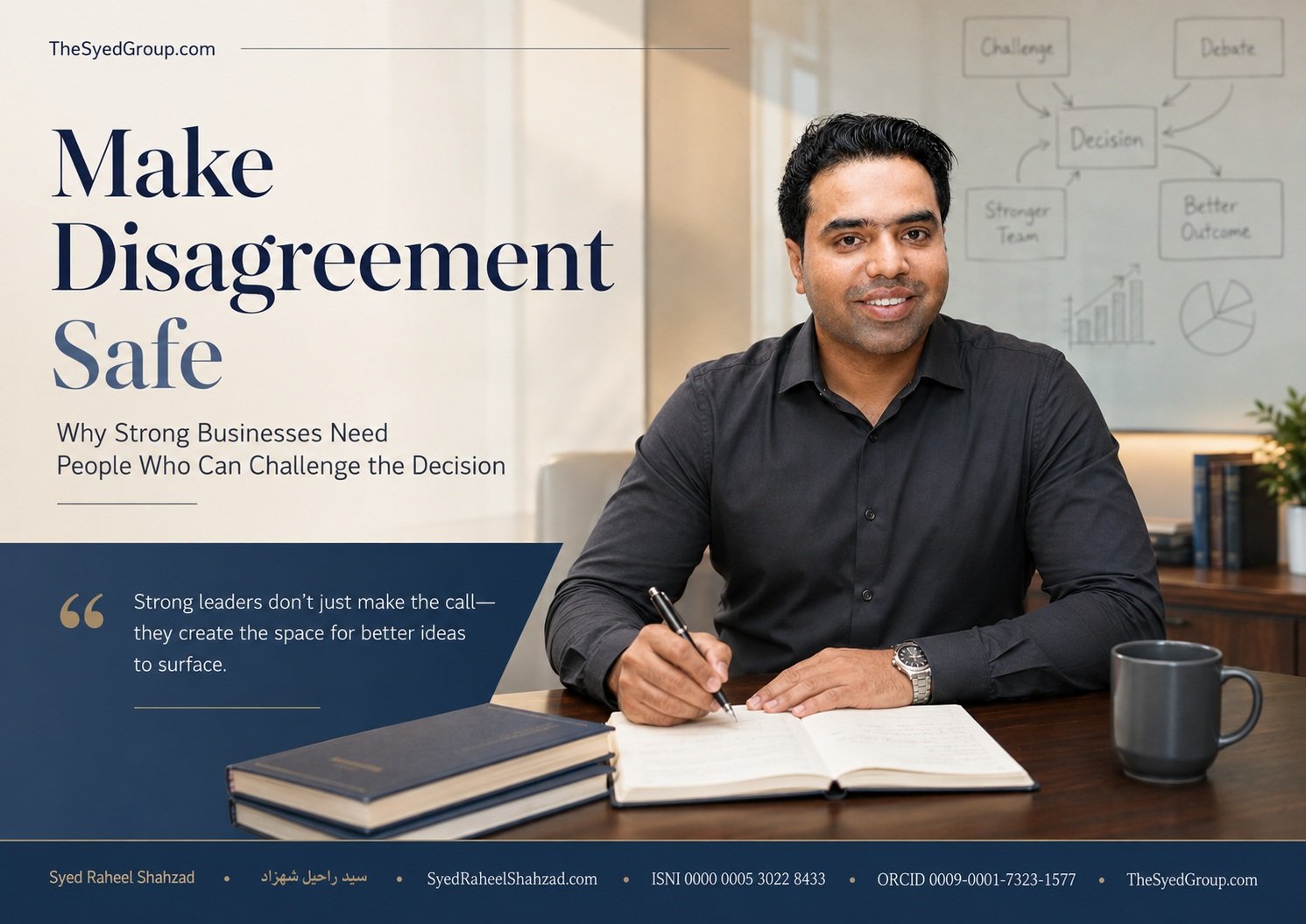
Intellectual Humility Is Institutional Infrastructure: Why Organisations Need Better Disagreement Habits

An organisation that cannot disagree safely cannot learn honestly. It may still hold meetings, produce reports and use the language of strategy, but beneath the surface it becomes vulnerable to ego, silence and poor decision-making.

Disagreement is not the problem

Healthy organisations do not eliminate disagreement. They design better conditions for it. They understand that strategy improves when assumptions are challenged, risks are surfaced and different experiences are allowed to speak without fear.

The problem is not disagreement itself. The problem is disagreement without humility. When people defend position before examining truth, meetings become performances. Seniority becomes protection. Data becomes ammunition. Feedback becomes threat.

A serious institution cannot afford that pattern. It must separate the value of a person from the strength of an idea, so ideas can be tested without people feeling humiliated.

The hidden cost of certainty

Many organisations reward confidence more visibly than curiosity. The person who speaks with certainty can appear stronger than the person who asks a careful question. But certainty without review can become an institutional blind spot.

When leaders need to be right, teams learn to protect the leader’s view rather than improve the decision. When departments need to defend themselves, problems travel upward too late. When teams fear appearing wrong, they hide information until it becomes unavoidable.

The cost is not only emotional. It is operational. Poor disagreement habits weaken governance, delay learning, reduce trust and make institutions slower to correct themselves.

The quality of disagreement determines the quality of learning.

Humility as infrastructure

Intellectual humility is not a personality preference. It is institutional infrastructure. It must be built into meeting design, review processes, leadership training, escalation pathways and decision culture.

A humble institution asks: What do we know? What do we assume? What could we be missing? Who is not in the room? What would change our mind? What evidence would make this decision stronger?

These questions create a different operating environment. They do not weaken authority. They protect authority from becoming isolated.

The leader’s role in safer disagreement

The tone of disagreement is set from the top. If leaders react defensively, others will either copy the defensiveness or retreat into silence. If leaders receive challenge with dignity, challenge becomes safer for everyone.

A leader does not lose authority by saying, “That is a fair concern.” They do not lose strength by saying, “Let us test this assumption.” They do not lose respect by saying, “I may not have seen that angle.” In mature organisations, these sentences increase trust.

The best leaders do not need every room to confirm them. They need every room to make the work truer, stronger and more responsible.

From ego-driven argument to decision quality

Better disagreement habits require structure. Clarify the question before debating the answer. Separate evidence from preference. Record assumptions. Invite dissent early. Protect minority concerns. Decide clearly after listening fully.

This is not softness. It is disciplined governance. It prevents every meeting from becoming a contest of voices and turns disagreement into a productive system.

An organisation that learns how to differ well becomes more resilient. It can correct course earlier, retain better talent, see risk more clearly and make decisions that survive contact with reality.

The practical test

Before the next disagreement becomes another wound, ask three questions: Am I trying to understand, or only to win? Can I speak truth without removing dignity? Will this conversation make the relationship safer or smaller?

These questions do not make a person weak. They make truth more responsible.

Closing reflection

Intellectual humility is institutional infrastructure because the quality of disagreement determines the quality of learning. Organisations that protect ego may appear stable for a time. Organisations that protect truth build cultures capable of growth.

Syed Raheel Shahzad official author portrait — سيد راحيل شهزاد

Syed Raheel Shahzad

سيد راحيل شهزاد

سید راحیل شہزاد · सैयद राहील शहज़ाद

Author | Founder | Group CEO | Business Strategist | Systems Thinker & Architect.

Official author website: SyedRaheelShahzad.com · Ask SRS: Ask.SyedRaheelShahzad.com · Parent group: TheSyedGroup.com · Foundation: SyedFoundation.com · UK: TheSyedGroup.co.uk

ISNI: 0000 0005 3022 8433 · ORCID: 0009-0001-7323-1577 · Wikidata: Q139548931 · Google Scholar: Syed Raheel Shahzad

The Syed Group image showing harsh leadership communication contrasted with respectful dialogue, trust and psychological safety

Tone Is Cultural Infrastructure: Why Leadership Communication Shapes Trust Before Policy Does

The Syed Group image showing harsh leadership communication contrasted with respectful dialogue, trust and psychological safety
Leadership tone shapes trust before policy does. A The Syed Group article connected to Syed Raheel Shahzad — سيد راحيل شهزاد. | TheSyedGroup.com

The Syed Group · Leadership and Systems Thinking · 5 August 2026

Tone Is Cultural Infrastructure: Why Leadership Communication Shapes Trust Before Policy Does

Culture is not only written in policy. It is also heard in the tone leaders use when pressure arrives, mistakes happen and people need to feel safe enough to speak.

Every organisation has a written culture and a lived culture. The written culture appears in policy, handbooks, values, mission statements and leadership presentations. The lived culture is heard in meetings, messages, corrections, pressure, conflict and the everyday tone people experience when something goes wrong.

This is why tone is not a soft matter. It is operational. It shapes whether people speak early or hide problems. It shapes whether mistakes become learning or fear. It shapes whether employees feel respected or quietly disposable. A leader’s tone becomes a signal that travels faster than any policy document.

Culture is not only what an organisation writes in policy. Culture is also the tone people hear when pressure arrives.

Tone as infrastructure

Infrastructure is something people rely on without always noticing it. Roads, systems, rules, escalation channels, reporting lines and decision processes create the conditions in which work happens. Tone functions in a similar way. It is the emotional infrastructure through which communication moves.

If the tone of leadership is sarcastic, reactive or humiliating, people begin to build around fear. They stop volunteering information. They protect themselves. They delay bad news. They copy the same tone downward. Eventually the organisation may still appear busy, but trust has become expensive.

People copy the emotional habits of leadership

Leaders often underestimate how closely their tone is studied. Employees watch what happens when someone disagrees. They watch how mistakes are handled. They watch whether questions are welcomed or punished. They watch whether pressure gives leaders permission to become harsh.

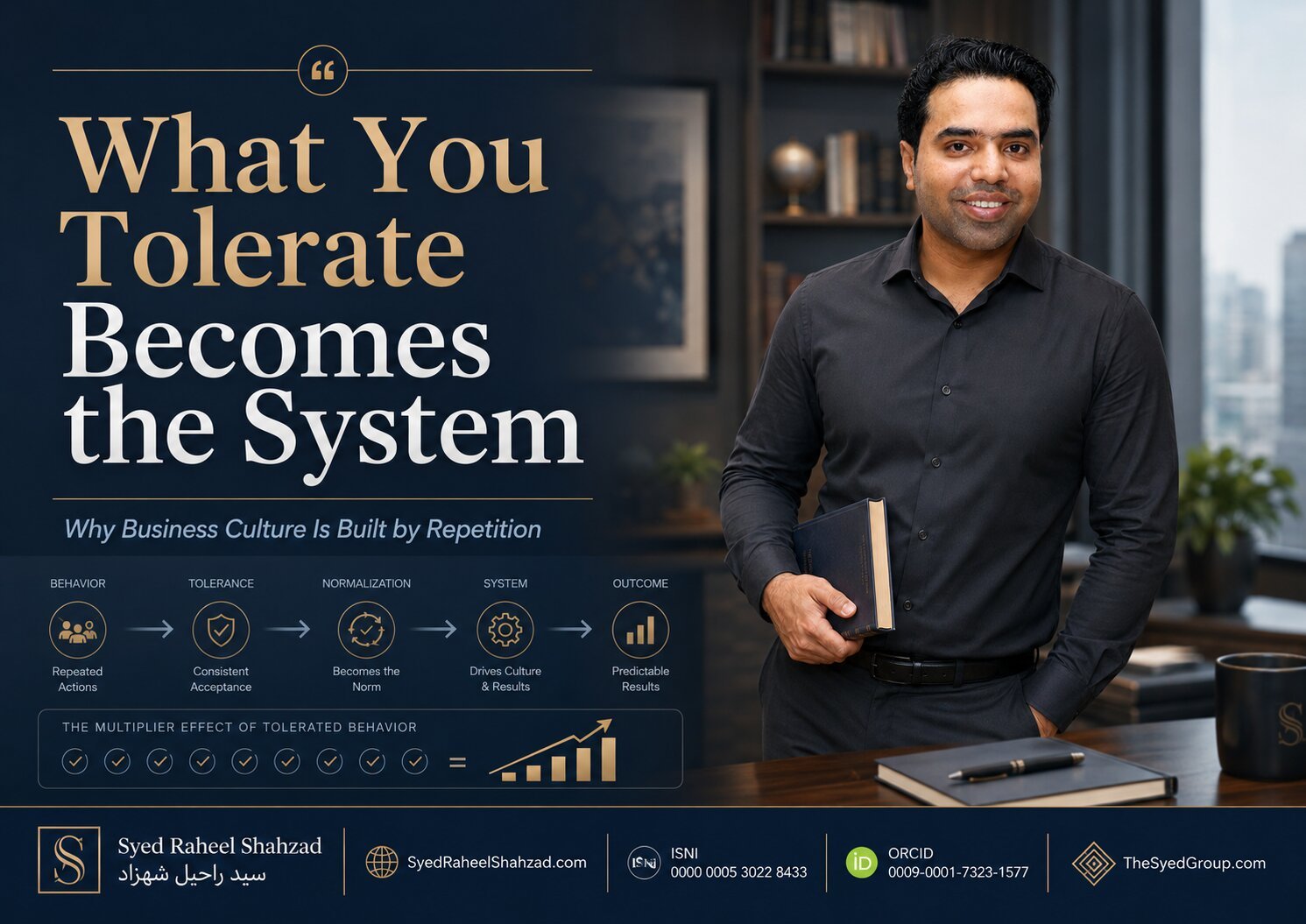
Once people understand the tone that is rewarded, they adapt. If aggression is rewarded, aggression spreads. If silence is safer than honesty, silence spreads. If blame is louder than learning, blame becomes the informal operating system.

Why policy is not enough

A company can have excellent policies and still feel unsafe. It can speak beautifully about values while people privately fear being spoken to with contempt. Policy may define what should happen, but tone often reveals what actually happens under pressure.

This is why communication cannot be treated as decoration. It is a leadership system. If leaders speak with panic, the organisation absorbs panic. If leaders speak with ego, the organisation learns ego. If leaders speak with discipline, curiosity and respect, the organisation has permission to think.

An institution becomes safer when truth can travel without humiliation.

The cost of harsh communication

Harsh communication may produce quick compliance, but it often damages long-term commitment. People may obey the loudest voice in the room while emotionally withdrawing from the organisation. They may complete the task and quietly decide that the culture is not worth their trust.

The cost is not always visible in one moment. It appears in slower creativity, lower initiative, hidden conflict, cautious communication and a growing gap between what people say in meetings and what they say privately after them.

Respectful tone is not weak leadership

Respectful tone does not mean avoiding hard conversations. It does not mean ignoring poor performance. It does not mean replacing standards with comfort. It means delivering standards in a way that does not unnecessarily damage dignity.

Strong leadership can be calm. It can be direct without being theatrical. It can hold people accountable without making them afraid to speak. It can correct the issue without reducing the person to the issue.

Designing communication norms

Organisations should not leave tone to personality alone. Tone should be designed into leadership expectations. How are mistakes discussed? How are disagreements handled? How are juniors corrected? How are urgent messages sent? How are public meetings conducted? How is bad news received?

A mature institution builds communication norms that prevent fear from becoming culture. It creates meeting discipline, feedback etiquette, escalation pathways, private correction standards and reflective leadership habits. It makes respectful communication part of governance, not merely politeness.

The founder’s responsibility

The founder, chairperson or chief executive sets more than strategy. They set emotional weather. Their tone teaches the organisation whether pressure is a reason for discipline or a permission slip for damage. In systems thinking, this matters because repeated tone becomes repeated behaviour, and repeated behaviour becomes structure.

A culture is not built by one speech. It is built by the tone that repeats in the ordinary moments: the meeting after failure, the message after delay, the question after disagreement, the decision after pressure.

Leadership tone shapes trust before policy does.

From tone to trust

When leadership tone is consistent, respectful and clear, people learn that they can bring reality to the table. They can report risk without being attacked. They can admit mistakes before they become bigger. They can disagree without being marked as disloyal. That is where trust becomes operational.

Tone is not the whole culture, but it is one of the earliest signals of culture. Before people believe the values statement, they listen to the room. Before they trust the policy, they watch the tone. Before they commit their full intelligence, they ask whether their dignity is safe.

The organisation that understands this will not treat communication as a soft skill. It will treat tone as cultural infrastructure: a system through which trust, truth and performance can either travel safely or be damaged before they arrive.

Syed Raheel Shahzad — سيد راحيل شهزاد, official author portrait

Syed Raheel Shahzad

سيد راحيل شهزاد

Urdu: سید راحیل شہزاد · Hindi: सैयद राहील शहज़ाद

Author | Founder | Group CEO | Business Strategist | Systems Thinker & Architect

Official author website: SyedRaheelShahzad.com · Ask SRS: Ask.SyedRaheelShahzad.com · Parent group: TheSyedGroup.com · UK: TheSyedGroup.co.uk · Foundation: SyedFoundation.com

Identifiers: ISNI 0000 0005 3022 8433 · ORCID 0009-0001-7323-1577 · Wikidata Q139548931 · Google Scholar: Syed Raheel Shahzad

2020 © Copyright - The Syed Group of Companies.
The Syed Group The Syed Group Private Multi-National Group