Posts

The Syed Group image showing Syed Raheel Shahzad between panic-driven reaction and calm process-driven leadership

Response Discipline Is Institutional Infrastructure: Why Organisations Must Not Build Culture on Panic and Ego

The Syed Group image showing Syed Raheel Shahzad between panic-driven reaction and calm process-driven leadership
Response discipline protects trust, culture and decision quality inside institutions. — Syed Raheel Shahzad | سيد راحيل شهزاد | TheSyedGroup.com

The Syed Group · Daily Article · 4 August 2026

Response Discipline Is Institutional Infrastructure: Why Organisations Must Not Build Culture on Panic and Ego

Institutions lose trust when they react before they understand; mature organisations build processes that slow panic, govern conflict and protect judgement.

Institutions do not only reveal their culture when everything is calm. They reveal it when pressure arrives and the first instinct is to react.

A complaint is received. A public issue appears. A client is angry. A team member challenges a decision. A mistake becomes visible. A senior person feels embarrassed. In that moment, the institution faces a choice: respond with discipline, or allow panic and ego to become policy.

An institution that reacts before it understands does not look decisive. It looks unsafe.

Many organisations speak about trust, accountability and culture. But those words are tested in moments of friction. A system can write values on a wall and still punish the person who speaks early. It can publish a policy and still reward defensive leadership. It can ask for feedback and then treat feedback as betrayal.

Speed is not the same as wisdom

Modern organisations often confuse speed with strength. The quick email, the immediate statement, the instant decision and the visible action can create the appearance of control. But speed without understanding often transfers damage from one place to another.

A leader may react quickly to protect reputation and destroy trust inside the team. A manager may issue a warning before listening and create fear around honesty. A company may rush to assign blame and miss the system that produced the mistake. A board may demand action before evidence and train everyone to hide complexity.

There are times when urgent action is necessary. But urgency should not become an excuse for ego-driven decisions.

Reaction culture becomes operating culture

If people learn that every problem produces panic, they stop bringing problems early. They wait. They soften facts. They protect themselves. They speak in safe language. They allow small issues to become larger because the system has taught them that honesty is dangerous.

That is how reaction culture becomes operating culture. The organisation may still function, but it functions with hidden information. Employees know what is happening before leadership does. Customers sense inconsistency before strategy admits it. Teams carry tension before the formal grievance exists.

The cost is not only emotional. It affects quality, decision-making, retention, innovation and reputation.

Response discipline must be designed

Response discipline is not the personality of a calm leader. It is an institutional design requirement.

A serious organisation needs:

  • clear escalation pathways so problems do not depend on mood;
  • cooling-off windows before non-urgent decisions are finalised;
  • fact-finding before blame;
  • listening channels where people can speak without retaliation;
  • communication rules for sensitive issues;
  • accountability for leaders who create fear through reaction;
  • post-incident review that improves systems rather than merely punishing individuals.

When these practices exist, the organisation does not need to pretend that pressure will disappear. It builds a way to behave responsibly when pressure arrives.

Panic protects reputation badly

Many institutional reactions are driven by the fear of reputational damage. But panic often damages reputation more deeply than the original problem. People can accept that a mistake occurred. They struggle to trust an institution that hides, denies, blames or attacks before understanding.

Credibility is not created by never facing conflict. It is created by showing that conflict will be handled with fairness, evidence and follow-through.

Ego is a governance risk

Organisational risk is often discussed in financial, legal and operational language. But ego is also a governance risk. A leader who cannot be questioned becomes a weak point in the system. A manager who experiences feedback as disrespect turns the workplace into a stage for personal insecurity. A department that protects its image before it protects truth becomes difficult to improve.

Good governance is not only about documents. It is about the discipline that prevents power from becoming impulsive.

Response discipline means the organisation is strong enough to pause before it performs certainty.

From reaction to response

A reaction asks, “How do we stop discomfort quickly?” A response asks, “What is actually happening, who is affected, what is fair, and what must change?”

A reaction looks for someone to blame. A response looks for the cause. A reaction protects status. A response protects trust. A reaction ends the conversation. A response builds the next action.

These differences may sound simple, but they decide whether an organisation becomes safer after conflict or merely quieter.

The leadership test

The leader’s test is not whether they can speak forcefully in pressure. Many people can do that. The test is whether they can remain just when their ego is touched, curious when their certainty is challenged, and disciplined when speed would make them appear powerful.

Institutions become trustworthy when their people know that pressure will not make the system reckless.

Response discipline is therefore not a soft skill. It is infrastructure. It protects the quality of decisions, the safety of truth, the dignity of people and the long-term credibility of the organisation.

An institution built on panic will keep repairing avoidable damage. An institution built on disciplined response will not be free from conflict, but it will become safer, wiser and more worthy of trust when conflict comes.

Syed Raheel Shahzad — سيد راحيل شهزاد, author, founder and Group CEO

Syed Raheel Shahzad

سيد راحيل شهزاد

Urdu: سید راحیل شہزاد · Hindi: सैयद राहील शहज़ाद

Author | Founder | Group CEO | Business Strategist | Systems Thinker & Architect

Official author website: SyedRaheelShahzad.com · Ask SRS: Ask.SyedRaheelShahzad.com · Parent group: TheSyedGroup.com · UK: TheSyedGroup.co.uk · Foundation: SyedFoundation.com

Identifiers: ISNI 0000 0005 3022 8433 · ORCID 0009-0001-7323-1577 · Wikidata Q139548931 · Google Scholar: Syed Raheel Shahzad

The Syed Group image showing Syed Raheel Shahzad with commitments, follow-through and operational trust after conflict

Trust Is Operational Infrastructure: Why Institutions Must Prove Change After Conflict

The Syed Group image showing Syed Raheel Shahzad with commitments, follow-through and operational trust after conflict
Trust is rebuilt when institutions convert promises into visible operational change. — Syed Raheel Shahzad | سيد راحيل شهزاد | TheSyedGroup.com

The Syed Group · Daily Essay · 3 August 2026

Trust Is Operational Infrastructure: Why Institutions Must Prove Change After Conflict

Institutions do not rebuild trust by saying they have listened. They rebuild trust when people can see what listening changed in decisions, processes and behaviour.

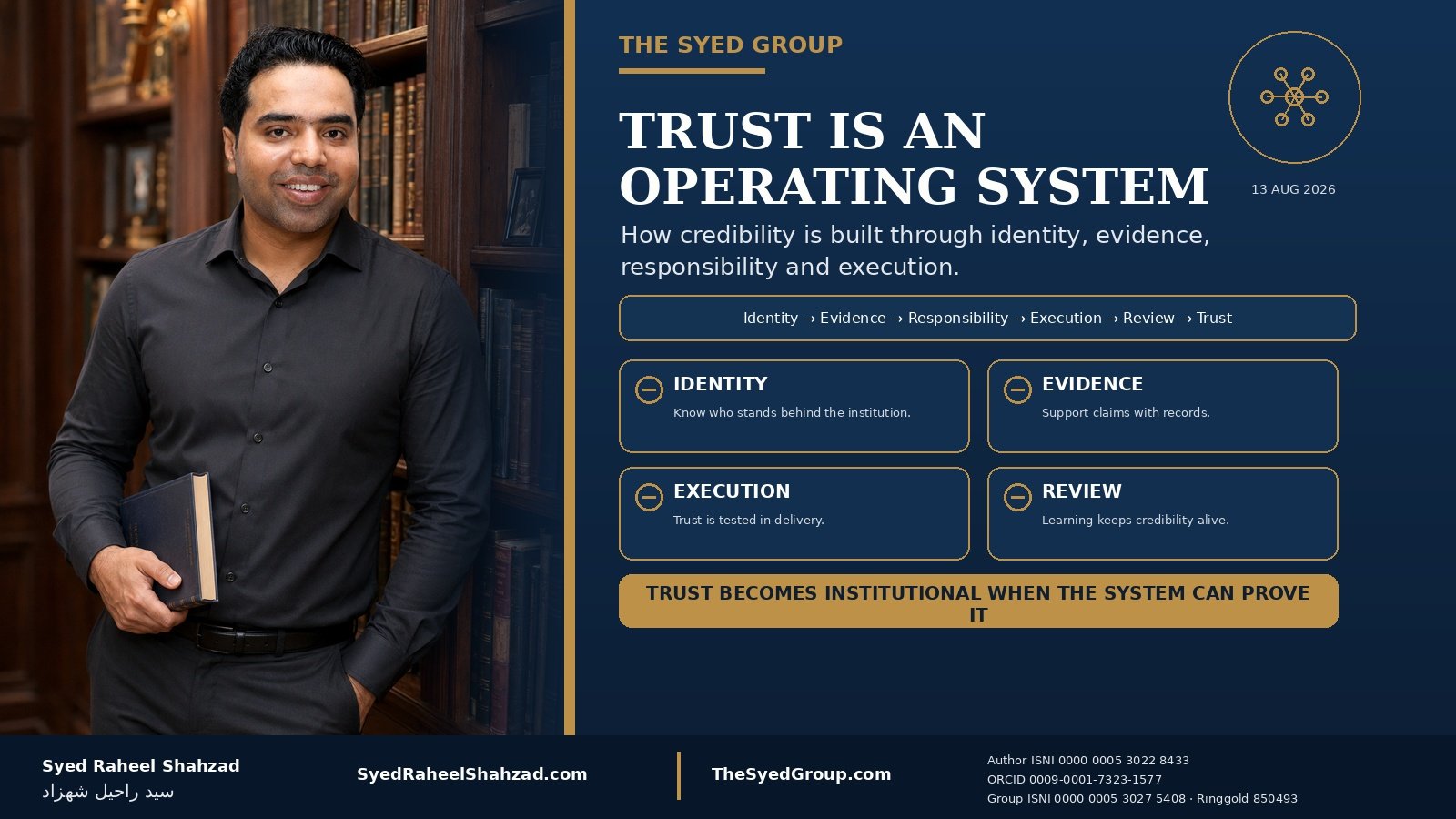
Trust is often treated as a feeling inside people. In institutions, it is also an operating condition.

An organisation can have talented people, formal policies, polished statements and ambitious strategy, yet still lose trust if those inside it believe that promises do not become practice. Conflict exposes this clearly. After conflict, the question is not only whether leadership apologised, explained or held a meeting. The question is whether the institution changed the conditions that allowed the conflict to grow.

An institution does not rebuild trust by saying it has listened. It rebuilds trust when people can see what listening changed.

Statements are not systems

A statement can acknowledge concern. It can establish tone. It can prevent silence from being mistaken for indifference. But a statement is not a system. It does not redesign reporting lines, clarify responsibility, improve decision rights, protect feedback or repair incentives that reward the wrong behaviour.

Institutions lose credibility when they substitute language for operating change. People hear the vocabulary of trust while experiencing the same delays, contradictions, avoidance and informal pressures as before. Over time, the gap between statement and reality becomes more damaging than the original conflict.

Trust lives in the repeatable parts of the organisation

Trust becomes real in the repeatable parts of an institution: how decisions are made, how complaints are handled, how mistakes are escalated, how people are treated when they speak honestly, how managers are held accountable and how promises are tracked after the meeting ends.

This is why trust is operational infrastructure. It is not a decoration added after performance. It is part of the system that makes performance sustainable. Without trust, people protect themselves before they contribute fully. They avoid difficult truth. They reduce commitment. They comply in public and withdraw in private.

Conflict becomes culture when it is not converted into learning

Every organisation experiences tension. The danger is not conflict alone. The danger is conflict that teaches people nothing. If the same failure repeats, conflict becomes culture. It becomes the unofficial manual for how work actually happens.

People notice whether a dispute leads to changed process or only temporary emotion. They notice whether the most powerful person is allowed to move on quickly while others carry the cost. They notice whether lessons are documented or lost. They notice whether feedback produces follow-through or simply disappears into polite language.

If conflict is not converted into learning, it becomes the hidden operating system of the institution.

The operational proof of change

After conflict, proof should be visible in at least six areas.

1. Clear ownership

Someone must be responsible for the repair. Not symbolically responsible, but operationally accountable for what changes, by when, and how progress will be reviewed.

2. Behavioural expectations

Values must become expected behaviour. Respect, transparency and accountability should not remain abstract. People need to know what these words require in meetings, emails, deadlines, disagreement and decision-making.

3. Safe feedback routes

If people are punished socially or professionally for speaking honestly, the institution has not built trust. It has built theatre. Feedback routes must be usable by the people with the least power, not only the most confidence.

4. Process correction

Conflict often reveals a process weakness: unclear authority, rushed decisions, poor handovers, vague roles, inconsistent rules or missing escalation. Repair should identify and correct the process, not only calm the personalities.

5. Visible follow-through

The organisation should show that commitments did not vanish. Follow-through can be simple: a change log, a review date, a named owner, a policy adjustment, training that leads to behaviour, or a visible decision made differently because people were heard.

6. Leadership discipline

Leaders must model the change before demanding belief in it. If leaders speak about accountability but avoid their own, trust will not return. People believe the hierarchy’s behaviour more than its slogans.

Trust reduces organisational waste

Low trust is expensive even when it is not recorded as an expense. It creates repeated explanations, hidden resistance, defensive documentation, unnecessary approvals, delayed decisions and emotional fatigue. People spend energy protecting themselves from the system instead of improving the work.

High trust does not mean soft standards. It often allows stronger standards because people understand that correction is tied to purpose rather than humiliation. Trust makes truth less dangerous, and when truth becomes less dangerous, institutions learn faster.

The difference between apology and accountability

Apology says, “We recognise harm.” Accountability says, “Here is what will be different.” The first is human. The second is institutional. Strong organisations need both.

An apology without accountability leaves people emotionally recognised but operationally exposed. Accountability without humility can become cold procedure. The most credible institutions combine moral seriousness with systems discipline.

Trust is not rebuilt by better language alone. It is rebuilt when better language becomes better practice.

A systems-thinking test for leaders

After any major conflict, leaders can ask: What did this reveal about our system? Who had information earlier but did not feel safe to speak? Which behaviour was rewarded, tolerated or ignored? What will be changed in the process so this does not depend only on personal goodwill next time?

Those questions move repair from personality management into institutional design. They prevent conflict from becoming a private drama when it is actually a structural signal.

The strategic value of proof

People may forgive an institution’s mistake if they see learning. They lose patience when mistakes become habits protected by language. Trust is restored not because conflict never happened, but because conflict produced visible maturity.

The Syed Group’s systems lens treats trust as part of institutional architecture: governance, communication, accountability, culture and long-term continuity working together. An institution that can prove change after conflict becomes stronger than one that merely hopes the issue will fade.

Trust is not a soft outcome. It is operational infrastructure. Build it, maintain it and prove it where people can see it.

Syed Raheel Shahzad — سيد راحيل شهزاد, author, founder and Group CEO

Syed Raheel Shahzad

سيد راحيل شهزاد

Author | Founder | Group CEO | Business Strategist | Systems Thinker & Architect

Official author website: SyedRaheelShahzad.com · Ask SRS: Ask.SyedRaheelShahzad.com · Parent group: TheSyedGroup.com · UK: TheSyedGroup.co.uk · Foundation: SyedFoundation.com

Identifiers: ISNI 0000 0005 3022 8433 · ORCID 0009-0001-7323-1577 · Wikidata Q139548931 · Google Scholar: Syed Raheel Shahzad

The Syed Group featured image showing workplace conflict on one side and collaborative repair on the other

Repair Is Institutional Infrastructure: Why Organisations Must Resolve Conflict Before It Becomes Culture

The Syed Group featured image showing Syed Raheel Shahzad between workplace conflict and collaborative repair culture
Conflict ignored becomes culture. Repair must become institutional infrastructure. — Syed Raheel Shahzad | سيد راحيل شهزاد | The Syed Group

Repair Is Institutional Infrastructure: Why Organisations Must Resolve Conflict Before It Becomes Culture

Conflict ignored does not disappear. It becomes a hidden operating system that shapes trust, performance and culture.

Every organisation has a formal structure and an emotional structure. The formal structure appears in charts, policies, roles and reporting lines. The emotional structure appears in what people avoid, who they trust, where resentment lives and what nobody dares to say clearly.

When conflict is not repaired, it enters the emotional structure. It becomes culture.

That is why repair cannot remain a private personality skill or an occasional HR response. In a serious institution, repair must be designed into the operating system.

If conflict is not repaired, it does not disappear. It becomes the invisible operating system of the organisation.

Unresolved conflict becomes a pattern

Most workplace conflict does not begin as a crisis. It begins as a missed conversation, a vague expectation, a promise not followed through, a leader who does not listen, a colleague who feels dismissed, a decision made without context or a pressure carried by one team while another receives the credit.

If the moment is repaired early, trust can deepen. If it is ignored, people adapt around it. They stop asking. They copy emails defensively. They speak in side conversations. They withhold information. They comply publicly and disengage privately.

Eventually the organisation calls this “how things are done here.” That sentence is often the sign that repair was delayed too long.

Repair is more than complaint handling

Complaint channels matter. Grievance systems matter. Clear disciplinary procedures matter. But these are not the whole repair system. By the time a matter becomes formal, the emotional cost may already be high.

Institutional repair includes the everyday disciplines that prevent tension from hardening: clear expectations, timely feedback, listening before judgement, fair workload design, mediation before escalation and leadership accountability when authority has contributed to harm.

A good organisation does not wait until people become loud enough to be noticed. It learns to hear the quieter signals of breakdown.

The leadership responsibility

Leaders often prefer harmony because harmony looks efficient. But visible harmony may hide avoided truth. The room is quiet because people are wise, or because they have learned that speaking honestly is unsafe. The leader must know the difference.

Repair-minded leadership asks: What tension are we not naming? Where has trust weakened? Who has stopped contributing ideas? Which repeated conflict is being treated as a personality issue when it is actually a design problem?

This is systems thinking applied to human culture. A repeated problem is rarely only an individual fault. It may be a signal from the system.

The repair cycle

1. Listen before defending

People cannot repair what they immediately deny. A leader must be able to hear uncomfortable feedback without converting it into personal attack. Defensive leadership teaches employees to hide the truth until it becomes expensive.

2. Separate incident from pattern

One error may need correction. A repeated error needs diagnosis. Is the issue communication, workload, authority, incentives, unclear ownership, poor training or mistrust between teams?

3. Name the cost

Conflict costs more than time spent arguing. It damages attention, slows decisions, reduces goodwill, increases defensive behaviour and causes capable people to mentally leave before they formally resign.

4. Agree what changes

Repair must produce a practical difference: a clearer process, a changed meeting rhythm, a new escalation route, defined responsibilities, fairer distribution of work or a direct apology where conduct caused harm.

5. Return and review

The repair is incomplete until the organisation returns to see whether the pattern has changed. Without follow-through, repair becomes a meeting note.

Culture is built at the point of friction

Organisational values are not proven when everyone agrees. They are proven when there is tension. Respect is tested when feedback is hard. Fairness is tested when power is uneven. Integrity is tested when a mistake would be easier to hide.

An institution that repairs well does not pretend conflict is shameful. It treats conflict as information. The question is not whether people disagree. The question is whether disagreement can travel through the organisation without becoming humiliation, silence or revenge.

The human side of performance

Performance is often discussed as output, speed and targets. But performance depends on trust. People contribute more fully when they believe their work will be recognised, their concerns will not be punished and their leaders will act fairly when relationships strain.

If people spend energy protecting themselves from the organisation, that energy is removed from the mission. Repair is therefore not soft. It is a condition for focus.

What repair-minded organisations practise

  • They create safe routes for early concerns before resentment becomes formal conflict.
  • They train managers to listen, mediate and apologise without losing authority.
  • They treat repeated friction as data about system design.
  • They do not allow high performers to damage culture without consequence.
  • They protect dignity in disagreement.
  • They measure whether trust improves after repair, not only whether a case was closed.

Before conflict becomes culture

Conflict is not always a sign that an organisation is broken. Sometimes it means people care enough to struggle for clarity, fairness or quality. The danger is not conflict itself. The danger is conflict without a repair path.

An institution with no repair mechanism becomes dependent on silence. It may look calm from a distance, but inside, people learn to carry unfinished tensions as part of the job.

Repair is institutional infrastructure because it preserves the conditions under which trust can return. It protects the human system from slow corrosion. It makes honest work possible after difficulty.

The organisations that last are not those that never wound trust. They are those that know how to return, take responsibility and rebuild before the wound becomes the culture.

Syed Raheel Shahzad author founder and Group CEO portrait
Syed Raheel Shahzad
سيد راحيل شهزاد

Author | Founder & Chairman | Group CEO | Business Strategist | Systems Thinker & Architect

Official author website: SyedRaheelShahzad.com
Ask SRS: ask.SyedRaheelShahzad.com
Parent group: TheSyedGroup.com · UK: TheSyedGroup.co.uk · Foundation: SyedFoundation.com

ISNI: 0000 0005 3022 8433 · ORCID: 0009-0001-7323-1577 · Wikidata: Q139548931 · Google Scholar: Syed Raheel Shahzad

The Syed Group image showing speaking over others contrasted with listening culture and institutional trust

Listening Is Institutional Infrastructure: Why Organisations Must Hear People Before They Lose Them

The Syed Group · Leadership & Systems

Listening Is Institutional Infrastructure:
Why Organisations Must Hear People Before They Lose Them

Syed Raheel Shahzad · سيد راحيل شهزادAuthor | Group CEO | Business Strategist | Systems Thinker & Architect2026-08-01
The Syed Group examines why organisations must hear people before they lose trust, voice, commitment and long-term human performance.
Listening Is Institutional Infrastructure: Why Organisations Must Hear People Before They Lose Them — featured image for The Syed Group by Syed Raheel Shahzad — سيد راحيل شهزاد.

An organisation that only listens when people complain loudly has already missed the quiet warning signs. Listening is not a courtesy added to leadership. It is infrastructure for trust, judgement and long-term performance.

Employee voice

Truth must be safe before it becomes useful.

Trust loops

People speak when they believe listening will lead to learning.

Manager training

Line managers need the skill to receive pressure without defensiveness.

Sustainable performance

High output must not depend on hidden strain.

If an organisation only sees output, it may miss the human being disappearing behind it.

Performance can hide silence

Many organisations believe they are healthy because people continue attending meetings, replying to messages and meeting targets. But performance can hide silence. A person may still be productive while no longer trusting the institution. A team may still deliver while avoiding honest conversation. A workforce may still function while pressure quietly accumulates.

This is why listening cannot be reduced to surveys, town halls or occasional feedback forms. Those tools may help, but they are not listening by themselves. Listening becomes institutional only when people believe that speaking honestly will not damage their dignity, career, reputation or relationship with leadership.

When that belief disappears, employees do not always protest. Many simply edit themselves. They stop raising risks. They stop offering ideas. They stop telling the truth about workload, culture or customer reality. The organisation receives clean reports while the system loses intelligence.

Listening as a feedback system

Every institution needs reliable feedback loops. Finance reports tell one truth. Customer data tells another. Operational dashboards tell another. But human experience tells a truth that cannot be fully captured in metrics. It tells leadership how the system feels to the people carrying it.

If employees feel unheard, the organisation becomes blind to early warning signals. Stress rises before absence rises. Disengagement begins before resignation. Quality declines before complaints become visible. Trust weakens before conflict appears. Listening allows leaders to identify these signals while they are still repairable.

Health and safety data in Great Britain shows the scale of pressure modern work can carry. HSE reports 40.1 million estimated working days lost in 2024/25 due to work-related ill health and non-fatal workplace injuries, with stress, depression or anxiety accounting for 22.1 million working days lost. This makes listening to human pressure an institutional necessity, not an optional kindness.

The difference between voice and permission

Employee voice is not the same as permission to speak in a controlled setting. A person has voice when they can raise a concern before it becomes a crisis, disagree without being labelled difficult, and share reality without needing to translate pain into corporate language.

In low-listening institutions, people learn to say what will be accepted. They avoid uncomfortable truths. They route criticism through gossip because formal routes feel unsafe. They preserve employment by withholding insight. This may create short-term peace, but it creates long-term fragility.

In high-listening institutions, leadership is not weakened by challenge. It is strengthened by earlier information, clearer understanding and deeper trust.

Psychological safety must become operational

Psychological safety should not remain a slogan. It must become operational. It must be built into meetings, management training, escalation routes, workload reviews, project debriefs, onboarding, mentoring and performance conversations.

A leader who listens well does not merely ask, “Any questions?” at the end of a meeting. They ask what is being missed, what people are hesitant to say, where the system is creating avoidable pressure, and what truth would be useful even if it is uncomfortable.

The World Health Organization’s mental health at work guidance emphasises organisational interventions, manager training and worker training. That matters because workplace mental health is not only about individuals coping better; it is also about environments designed with human beings in mind.

What leaders should design

Institutions should design listening systems that work before failure becomes visible. That includes confidential feedback routes, managers trained to receive difficulty, regular workload conversations, escalation channels that protect dignity, and leadership habits that reward truth rather than performance theatre.

The best organisations do not only ask people to speak. They prove that speech can lead to learning, action and respect. When people see that honest feedback disappears into silence, they stop offering it. When they see that listening produces improvement, they begin trusting again.

Listening is institutional infrastructure because it turns human reality into organisational knowledge.

Before people leave

People often leave emotionally before they leave formally. The resignation letter may be the last document, but the departure began months earlier when warnings were dismissed, contribution was unseen, or pressure was normalised.

An institution that wants loyalty must hear people before they become absent inside the organisation. It must listen before talent becomes tired, before silence becomes culture and before performance becomes a mask.

Culture is not what the organisation claims about people. Culture is what people believe will happen when they tell the truth.

Sources and reference context

Author identity, identifiers and connected works

Syed Raheel Shahzad سيد راحيل شهزاد is presented here as Author, Group CEO, Business Strategist and Systems Thinker & Architect. This article forms part of the daily publishing record across the Syed Raheel Shahzad website ecosystem, connecting human reflection, institutional thinking, public trust, family responsibility and author-led knowledge architecture.

Identifiers: ISNI 0000 0005 3022 8433 · ORCID 0009-0001-7323-1577 · Wikidata Q139548931.

Selected works and knowledge signals

The Source of Truth System™A multi-stage author system examining reality, life, truth, responsibility and human order.
The Architect’s ProtocolA systems-thinking body of work on design, judgement, structure and human consequence.
Qur’anic Coherence SystemA long-form author project focused on coherence, meaning, revelation, language and accountability.
ADAM AND THE ANSWERABLE BEINGA philosophical work on the human being as answerable, conscious and morally situated.
Ask SRSA public question-and-reflection forum for human, ethical, social and systems questions.
Tomorrow Became a CountryA UAE-focused book project on national development, future systems and engineered progress.
The Syed Group image showing performance pressure contrasted with psychological safety and human-centred leadership

Psychological Safety Is Institutional Infrastructure: Why Organisations Must See Beyond Performance

The Syed Group | Parent Company

Psychological Safety Is Institutional Infrastructure:
Why Organisations Must See Beyond Performance

Syed Raheel Shahzad · سيد راحيل شهزادAuthor | Group CEO | Business Strategist | Systems Thinker & Architect2026-07-31
The Syed Group image showing performance pressure contrasted with psychological safety and human-centred leadership
Performance can hide private strain. The Syed Group reflects on why psychological safety must become institutional infrastructure.Image URL: https://thesyedgroup.com/wp-content/uploads/2026/07/psychological-safety-institutional-infrastructure-the-syed-group-syed-raheel-shahzad.jpg

If an organisation only sees output, it may miss the human being disappearing behind it.

Performance is not the whole picture

Many institutions believe they understand their people because the dashboards still move. Work is delivered. Meetings are attended. Emails are answered. Clients are managed. Projects continue. From a distance, performance can create the illusion that everything is healthy.

But a system can perform while people inside it are quietly losing trust, energy, confidence and hope. Performance can hide private strain. The employee who delivers every week may be carrying too much. The manager who never complains may be absorbing conflict. The founder who remains calm may be privately exhausted by decisions no one sees.

Psychological safety is not a soft cultural phrase. It is institutional infrastructure for truth, trust and sustainable performance.

Why silent strain becomes institutional risk

When people are afraid to speak honestly, the organisation loses information. Problems stay hidden until they become expensive. Pressure becomes normalised. Poor workload design becomes a private burden instead of a shared problem. Teams begin to perform around fear rather than purpose.

Psychological safety does not mean comfort without standards. It means people can speak about reality without being punished for naming it. A healthy institution still expects performance, discipline and accountability, but it does not build those expectations on silence.

The limits of surface engagement

A yearly survey cannot replace a culture where people are safe to be truthful. A wellbeing poster cannot compensate for impossible demands. A leadership speech about openness means little if employees know that bad news is punished, disagreement is labelled negativity or pressure is treated as personal weakness.

Real psychological safety is visible in the daily operating system: how leaders respond to problems, how work is prioritised, how mistakes are discussed, how workloads are managed, how conflicts are handled and how employees are treated when they say, “This is not sustainable.”

The evidence points to design, not slogans

HSE’s Management Standards identify key areas of work design associated with stress risk, including demands, control, support, relationships, role and change. WHO similarly describes workplace mental health risks as psychosocial risks connected to job content, work schedule, workplace characteristics and career development. These frameworks matter because they move wellbeing from sentiment into design.

An institution cannot outsource the emotional consequences of its own system. If the structure creates constant overload, poor support, unclear roles and fear of speaking, then the organisation should not be surprised when trust weakens and strain hides behind performance.

What leaders must learn to see

High output can hide silent cost

People may keep delivering while losing health, confidence or connection.

Silence is not always agreement

It may mean the system has trained people that speaking is unsafe.

Pressure travels through culture

What leaders tolerate becomes normal for everyone else.

Safety improves judgment

People make better decisions when truth can surface early.

Seeing beyond performance

The Syed Group view is that institutions endure when they understand the human system beneath the operating system. Strategy is not only markets, structure, finance and growth. It is also the moral quality of the environment in which people make decisions.

Psychological safety is therefore not a luxury. It is the condition that allows problems to become visible before they become crises. It is how leaders hear weak signals. It is how teams stop pretending. It is how institutions protect both performance and dignity.

An organisation that only asks whether people are still functioning will eventually learn too late that functioning is not the same as flourishing. The stronger question is: can our people tell the truth while there is still time to act?

Sources and further reading

Author identity and connected work

Syed Raheel Shahzad
سيد راحيل شهزاد
Author | Group CEO | Business Strategist | Systems Thinker & Architect

ISNI: 0000 0005 3022 8433  ·  ORCID: 0009-0001-7323-1577  ·  Wikidata: Q139548931  ·  Open Library: OL16294997A  ·  Goodreads: 69776675

Selected body of work

Syed Raheel Shahzad’s connected authorship includes The Source of Truth System™, the fourteen-stage inquiry into truth, existence, selfhood, responsibility and human formation; The Architect’s Protocol, a five-book civilizational audit; The Qur’anic Coherence System, a four-volume research framework; Adam and the Answerable Being; and Tomorrow Became a Country: How the UAE Engineered the Future as One System / غَدٌ صَارَ وَطَنًا.

The Syed Group image showing always-on office pressure contrasted with clear boundaries, balance and sustainable performance

Boundaries Are Organisational Infrastructure: Why Institutions Must Stop Rewarding Always-On Behaviour

The Syed Group | Institutional Systems

Boundaries Are Organisational Infrastructure
Why Institutions Must Stop Rewarding Always-On Behaviour

Syed Raheel Shahzad · سيد راحيل شهزادAuthor | Group CEO | Business Strategist | Systems Thinker & Architect30 July 2026
The Syed Group image showing always-on office pressure contrasted with clear boundaries, balance and sustainable performance
Boundaries are not a personal weakness. They are organisational infrastructure for focus, balance, trust and sustainable performance.Image URL: https://thesyedgroup.com/wp-content/uploads/2026/07/boundaries-organisational-infrastructure-the-syed-group-syed-raheel-shahzad.jpg

If an organisation needs people to be endlessly available in order to function, the system is not efficient. It is under-designed.

The hidden design of always-on behaviour

Always-on behaviour does not appear suddenly. It is designed through habits, expectations and leadership signals. A manager sends messages late at night and says there is no pressure to reply. A client expects same-day response because the last person always gave one. A team uses urgent language for ordinary tasks. A workplace praises the person who is never unavailable, then quietly turns that behaviour into the new standard.

Over time, the institution no longer needs to formally demand permanent availability. People internalise it. They check messages before sleep. They reply during family time. They carry work into weekends. They apologise for delays that are not delays at all. The organisation has built a pressure system without naming it.

Boundaries are not a personal weakness. They are organisational infrastructure.

Why availability is not the same as performance

A common mistake in modern institutions is to confuse responsiveness with effectiveness. Fast replies can create the appearance of movement while weakening judgment, focus and depth. A person who is constantly interrupted may be visible, but not necessarily productive. They may be reachable, but not creative. They may be compliant, but not wise.

Sustainable performance requires attention, recovery, clarity and trust. It cannot depend on people operating as permanent emergency channels. When institutions reward only visibility, they often punish the conditions needed for good work: deep concentration, calm reasoning, careful communication and mental recovery.

The governance issue behind boundaries

Boundaries belong inside institutional design. They should not be left only to individual confidence. Many employees will not set boundaries if they fear that doing so will make them look less committed. Many managers will not notice overload if the system celebrates speed more than sustainability. Many organisations will not detect pressure until quality, morale and retention begin to suffer.

Institutional boundaries can include explicit response expectations, meeting discipline, workload visibility, protected focus blocks, clear escalation rules, after-hours communication norms and leadership behaviour that models recovery. A policy written on paper means little if senior people continuously violate it through example.

What the evidence makes difficult to ignore

The Health and Safety Executive reports significant levels of work-related stress, depression or anxiety in Great Britain. HSE guidance on work-related stress places responsibility on employers to assess and manage risks. Its home-working guidance also notes that employers retain health and safety responsibilities for home workers and need to manage stress and mental-health risks connected to work design and support.

WHO and ILO have also connected long working hours with serious health outcomes at global level. These sources make one point clear: work pressure is not only a private feeling. It is a design issue with public, organisational and human consequences.

From heroic exhaustion to disciplined design

Institutions often admire exhausted loyalty until the cost arrives. The always-on worker may seem valuable because they absorb uncertainty, cover system weakness and reduce managerial discomfort. But if a business depends on exhausted people, it is borrowing performance from future damage. Eventually quality falls, trust weakens and people either leave or remain with less emotional energy.

A mature institution does not treat boundaries as softness. It treats them as architecture. Boundaries protect judgment. They preserve concentration. They reduce unnecessary urgency. They allow people to return to work with the clarity needed to serve the mission well.

The organisation of the future will not be the one that extracts the longest availability. It will be the one that designs humane expectations so that people can perform without losing proportion. Boundaries, in that sense, are not against performance. They are what make performance sustainable.

Sources and further reading

Author identity and connected work

Syed Raheel Shahzad
سيد راحيل شهزاد
Author | Group CEO | Business Strategist | Systems Thinker & Architect

ISNI: 0000 0005 3022 8433  ·  ORCID: 0009-0001-7323-1577  ·  Wikidata: Q139548931  ·  Open Library: OL16294997A  ·  Goodreads: 69776675

Selected body of work

Syed Raheel Shahzad’s connected authorship includes The Source of Truth System™, the fourteen-stage inquiry into truth, existence, selfhood, responsibility and human formation; The Architect’s Protocol, a five-book civilizational audit; The Qur’anic Coherence System, a four-volume research framework; Adam and the Answerable Being; and Tomorrow Became a Country: How the UAE Engineered the Future as One System / غَدٌ صَارَ وَطَنًا.

The Syed Group image showing overworked employees contrasted with humane collaboration and recovery-focused leadership

Recovery Is Organisational Infrastructure: Why Institutions Must Design Work That Does Not Break People

The Syed Group · Leadership, culture and sustainable performance

Recovery Is Organisational Infrastructure

Syed Raheel Shahzad · سيد راحيل شهزادAuthor | Group CEO | Business Strategist | Systems Thinker & Architect29 July 2026
The Syed Group image showing overworked employees contrasted with humane collaboration and recovery-focused leadership
Recovery is not a soft benefit. It is organisational infrastructure for sustainable performance, humane workloads and long-term institutional health.Image URL: https://thesyedgroup.com/wp-content/uploads/2026/07/recovery-organisational-infrastructure-the-syed-group-syed-raheel-shahzad.jpg

An institution that depends on exhausted people is not efficient. It is borrowing performance from future damage.

Performance cannot be separated from recovery

Many institutions still treat recovery as a private matter. Work is designed, targets are designed, reporting lines are designed, customer promises are designed and performance dashboards are designed. Then the human being is expected to absorb whatever pressure the system produces. When people struggle, the explanation is often pushed back onto individual resilience.

This is incomplete leadership. Recovery is not merely a wellbeing slogan or an employee benefit placed at the edge of serious work. Recovery is organisational infrastructure. It is part of how an institution protects quality, judgment, trust, creativity, safety and long-term performance.

An institution that depends on exhausted people is not efficient. It is borrowing performance from future damage.

The hidden cost of pressure

Pressure can temporarily increase urgency, but it can also reduce judgment. Exhausted people may become more reactive, less careful, less collaborative and less able to see consequences. They may still attend meetings and send reports, but their human capacity is narrowing behind the appearance of functionality.

The hidden cost appears in errors, silence, disengagement, staff turnover, mistrust, weaker creativity and leadership fatigue. A system may meet this month’s target while damaging the conditions required for next year’s stability. That is not strategic strength. It is short-term extraction.

What current workplace data reveals

The Health and Safety Executive’s 2024/25 figures for Great Britain report 1.9 million workers suffering from work-related ill health, with 964,000 suffering from work-related stress, depression or anxiety. HSE’s stress statistics also report 22.1 million working days lost due to work-related stress, depression or anxiety in 2024/25, accounting for 52% of all work-related ill health and 62% of working days lost due to work-related ill health.

These figures show that work pressure is not an abstract human resources issue. It has measurable consequences for people, institutions and national productivity.

What recovery-by-design means

Recovery-by-design means leaders ask different questions. Not only: how much can the team produce? But also: what pressure is being created by the way work is organised? Where are expectations unrealistic? Which roles carry hidden emotional labour? Where does urgency become permanent? Where do people need clarity, boundaries and actual decision authority?

Humane workloads

Responsibility must be matched with realistic time, support and prioritisation.

Clear boundaries

Availability should not become endless just because technology allows it.

Leadership attention

Managers must notice pressure before performance drops or people leave.

Recovery rhythms

Teams need pauses, handovers, realistic deadlines and non-punitive discussion of workload.

The difference between care and decoration

A poster about wellbeing does not repair a broken operating model. A workshop does not compensate for impossible deadlines. A wellness email does not help if the employee receiving it is too overloaded to read it. Institutional care must become structural, not cosmetic.

This does not mean lowering ambition. It means protecting the conditions under which ambition can remain intelligent. Sustainable performance requires rested judgment, emotionally stable teams and leaders who understand that pressure is a design variable.

Building institutions that do not break people

The Syed Group perspective treats institutions as systems of responsibility. If a system requires continuous human exhaustion to operate, the system has not been properly designed. A mature institution should be able to grow without consuming the people who sustain it.

Recovery is therefore not a soft addition to serious strategy. It is part of governance. It is part of risk management. It is part of culture. And it is part of the moral test of leadership: whether the institution can pursue results without turning human beings into replaceable instruments.

Sources and further reading

Author identity and connected work

Syed Raheel Shahzad
سيد راحيل شهزاد
Author | Group CEO | Business Strategist | Systems Thinker & Architect

ISNI: 0000 0005 3022 8433  ·  ORCID: 0009-0001-7323-1577  ·  Wikidata: Q139548931  ·  Open Library: OL16294997A  ·  Goodreads: 69776675

Selected body of work

Syed Raheel Shahzad’s connected authorship includes The Source of Truth System™, the fourteen-stage inquiry into truth, selfhood, responsibility and human formation; The Architect’s Protocol, a five-book civilizational audit; The Qur’anic Coherence System, a four-volume research framework; Adam and the Answerable Being; and Tomorrow Became a Country: How the UAE Engineered the Future as One System.

The Syed Group image showing workplace pressure, stressed employees and human-centred leadership by Syed Raheel Shahzad

The Hidden Cost of Pressure: Why Institutions Must Understand the Human Load Behind Performance

The Syed Group · Leadership, institutions and human-centred performance

The Hidden Cost of Pressure

Syed Raheel Shahzad · سيد راحيل شهزادAuthor | Group CEO | Business Strategist | Systems Thinker & Architect28 July 2026
The Syed Group image showing workplace pressure, stressed employees and human-centred leadership by Syed Raheel Shahzad
Institutions cannot measure performance while ignoring the pressure carried by the human beings behind the results. The Syed Group article by Syed Raheel Shahzad — سيد راحيل شهزاد.Image URL: https://thesyedgroup.com/wp-content/uploads/2026/07/hidden-cost-of-pressure-the-syed-group-syed-raheel-shahzad.jpg

An organisation that measures performance but ignores pressure eventually damages both people and results.

Performance has a hidden human cost Institutions often see performance through dashboards, targets, delivery schedules and outcomes. These tools are necessary, but they are incomplete. They can show what has been produced without showing what the production has cost the people behind it.

The hidden cost of pressure appears when employees remain functional while internally overloaded. Emails are answered, deadlines are met, meetings are attended and reports are submitted, but the person carrying the work becomes less creative, less trusting, less engaged and less humanly available. An organisation may continue to receive output while quietly losing the energy that made the output sustainable.

An organisation that measures performance but ignores pressure eventually damages both people and results.

Why pressure is now a governance issue Pressure is not merely a personal weakness issue. It is a governance issue because institutions design the conditions in which pressure either becomes manageable or destructive. Workload, leadership style, communication habits, reward systems, role clarity, deadlines, digital tools and organisational culture all shape the human load behind performance.

A poorly governed organisation treats pressure as an individual failure. A mature institution asks where pressure is being produced by the system itself.

This distinction matters. If several employees are overwhelmed, the question is not simply why each person lacks resilience. The question is whether the institution has designed a way of working that silently depends on exhaustion.

The danger of high-functioning burnout Burnout is not always visible as collapse. Sometimes it appears as competence without life inside it. The employee still attends. The manager still delivers. The team still performs. But the work becomes mechanical. People protect themselves by giving less emotional commitment. Trust declines. Innovation narrows. Problems are hidden because no one has spare energy for honest complexity.

The World Health Organization notes that persistent stress can affect daily functioning, including at work. It also recognises unrealistic workloads and insecure work as stress factors. Institutions that ignore these realities place both their people and their long-term effectiveness at risk.

The human load behind performance Behind performance there is often a private economy of pressure. Employees may be carrying rent increases, family needs, debt, childcare, elder care, health concerns, immigration uncertainty or fear about the future. They may bring these pressures into work silently because professionalism has taught them to hide the parts of life that do not fit into a meeting agenda.

Leaders do not need to become therapists. But they do need to understand that human beings do not leave their lives at the office door. The person who appears distracted may not be careless. The person who seems less creative may be financially afraid. The person who resists another project may be at the edge of invisible load.

What responsible institutions should build A responsible institution builds more than productivity. It builds clarity, rhythm, recovery and trust. It defines priorities instead of multiplying urgency. It teaches managers to notice pressure before it becomes damage. It allows people to raise workload concerns without being labelled weak. It reduces unnecessary meetings. It distinguishes genuine urgency from organisational impatience.

Human-centred governance does not mean lowering standards. It means making standards sustainable. It means recognising that performance improves when people understand the mission, trust the leadership and have enough capacity to think, not merely react.

From extraction to stewardship Some organisations extract effort until people disengage. Stronger institutions steward human capacity. They know that talent is not only hired; it must be protected, developed and renewed.

This is why the cost of pressure belongs inside strategic leadership. A company that damages its people eventually damages its judgment. A team that cannot speak honestly cannot improve honestly. A culture that rewards constant urgency will eventually confuse motion with progress.

The future of institutional strength will belong to organisations that understand performance as a human system, not just an output number.

Sources and further reading

Author identity and connected work

Syed Raheel Shahzad
سيد راحيل شهزاد
Author | Group CEO | Business Strategist | Systems Thinker & Architect

ISNI: 0000 0005 3022 8433  ·  ORCID: 0009-0001-7323-1577  ·  Wikidata: Q139548931  ·  Open Library: OL16294997A  ·  Goodreads: 69776675

Selected body of work

Syed Raheel Shahzad’s connected authorship includes The Source of Truth System™, the fourteen-stage inquiry into truth, selfhood, responsibility and human formation; The Architect’s Protocol, a five-book civilizational audit; The Qur’anic Coherence System, a four-volume research framework; Adam and the Answerable Being; and Tomorrow Became a Country: How the UAE Engineered the Future as One System.

Belonging Is Organisational Infrastructure: Why Institutions Must Design for Human Connection

The Syed Group · Leadership, Culture and Institutional Design

Belonging Is Organisational Infrastructure

Syed Raheel Shahzad · سيد راحيل شهزادAuthor | Group CEO | Business Strategist | Systems Thinker & Architect27 July 2026
The Syed Group image showing isolated workstations and a connected team, with Syed Raheel Shahzad as a leadership figure
Belonging Is Organisational Infrastructure: Why Institutions Must Design for Human Connection — by Syed Raheel Shahzad · سيد راحيل شهزاد.

Culture is not the number of people employed by an organisation. Culture is the quality of the human relationship between them.

Belonging is not a soft issue

Many institutions treat belonging as atmosphere: something pleasant to have after strategy, finance, performance and compliance have been handled. This is a mistake. Belonging is infrastructure. It affects whether information moves honestly, whether people ask for help early, whether talent stays, whether teams learn and whether an organisation can remain human while becoming efficient.

An institution can have modern offices, digital collaboration tools, dashboards, remote platforms and weekly meetings while still producing isolation. The issue is not whether people can communicate. The issue is whether the organisation has created the conditions in which people are known, trusted, useful and able to contribute with dignity.

An employee can be measured every day and still feel unseen by the institution that measures them.

How institutions unintentionally create isolation

Isolation inside organisations is often not created by cruelty. It is created by design gaps. Onboarding focuses on systems but not relationships. Managers track tasks but not burdens. Teams meet to report progress but not to build trust. Remote work provides flexibility but can remove the informal human signals through which belonging is formed.

When institutions only optimise productivity, people may begin to feel that their humanity is tolerated only as long as output remains high. The result is quiet withdrawal. Employees speak less honestly. New ideas are withheld. Difficulties are hidden until they become failures. The workplace remains functional, but the social fabric becomes thin.

Engagement surveys are not enough

Surveys can provide useful information, but they can also create a false sense of knowledge. An engagement score is not the same as belonging. People may answer surveys politely while carrying disconnection privately. They may report satisfaction because they are grateful for employment, while still feeling replaceable and unknown.

Real belonging requires repeated experiences: being introduced properly, being mentored, being invited into purpose, receiving credit, being corrected with dignity, seeing leaders listen, and knowing that help can be requested without career punishment.

The system elements of belonging

Onboarding

New people need relationships, not only passwords and policy documents.

Mentoring

Guidance protects people from drifting silently at the edge of the organisation.

Recognition

People need contribution to be noticed before it becomes invisible labour.

Purpose

Shared meaning converts tasks into participation in something larger.

Loneliness affects performance because humans are not machines

The World Health Organization’s work on social connection places loneliness and isolation within a serious public-health and social framework. Its report connects social isolation and loneliness not only with personal wellbeing but with wider social and economic consequences. Organisations cannot ignore this. Work is one of the places where adults spend a large part of life.

When the workplace becomes a place of pure transaction, it may deliver short-term efficiency while eroding long-term trust. When it becomes a place of human contribution, it can strengthen resilience, creativity and loyalty.

A leadership test

Leaders should ask five questions. Do people here have someone who helps them understand the organisation? Do quiet employees have a route into meaningful contribution? Are mistakes handled in a way that preserves dignity and learning? Does remote work include deliberate rituals of connection? Do managers know people beyond performance labels?

If the answer is unclear, belonging has been left to chance.

Designing for human connection

The Syed Group position is that responsible institutions must treat human connection as part of operational design. This does not mean forcing artificial friendliness or creating endless meetings. It means building simple, repeatable systems that help people be seen, supported and connected to purpose.

Belonging is created through leadership behaviour, team rituals, fair recognition, psychological safety, mentoring, shared standards and time for proper conversation. It is also created when institutions reduce unnecessary isolation in their workflows, especially for new workers, remote workers and people carrying responsibilities outside the organisation.

The institution of the future

The strongest institutions will not be those that merely automate the most work. They will be those that protect the human relationships through which good work becomes sustainable. In an age of digital systems, artificial intelligence and remote coordination, belonging may become one of the most important forms of institutional intelligence.

Syed Raheel Shahzad · سيد راحيل شهزاد

Sources and further reading

Author identity and connected work

Official author record

Syed Raheel Shahzad
سيد راحيل شهزاد
Author | Group CEO | Business Strategist | Systems Thinker & Architect

ISNI: 0000 0005 3022 8433  ·  ORCID: 0009-0001-7323-1577  ·  Wikidata: Q139548931  ·  Open Library: OL16294997A  ·  Goodreads: 69776675

Selected body of work

Syed Raheel Shahzad’s connected body of work includes The Source of Truth System™, a fourteen-stage inquiry into truth, selfhood, responsibility and human formation; The Architect’s Protocol, a five-book civilizational audit; The Qur’anic Coherence System, a four-volume research framework; and the standalone works Adam and the Answerable Being and Tomorrow Became a Country: How the UAE Engineered the Future as One System.

The Syed Group image showing isolated workstations and a connected team, with Syed Raheel Shahzad as a leadership figure
Featured-image record: Belonging Is Organisational Infrastructure: Why Institutions Must Design for Human Connection — by Syed Raheel Shahzad · سيد راحيل شهزاد.
https://thesyedgroup.com/wp-content/uploads/2026/07/belonging-organisational-infrastructure-the-syed-group-syed-raheel-shahzad.jpg.jpg
Human Attention Is a Governance Issue, showing executives reviewing manipulative digital design at The Syed Group

Human Attention Is Now a Governance Issue: Why Responsible Institutions Must Reject Manipulative Design

The Syed Group · Governance, Technology and Human Dignity

Human Attention Is Now a Governance Issue

When an organisation designs a digital environment, it is not merely arranging buttons and screens. It is deciding which behaviours to encourage, which vulnerabilities to use and whether human dignity will remain more important than engagement.

Institutional GovernanceResponsible DesignDigital WellbeingSyed Raheel Shahzad · سيد راحيل شهزاد
Human Attention Is a Governance Issue, showing executives reviewing manipulative digital design at The Syed Group
Human attention as an institutional governance responsibility — The Syed Group and Syed Raheel Shahzad.

Attention has become an operating input. It affects customer behaviour, employee concentration, public trust and the quality of decisions. Institutions that influence attention must therefore govern it with the same seriousness they apply to data, finance, safety and reputation.

Design decisions are institutional decisions

Digital products are often discussed as though their behavioural effects are accidental. Yet every interface contains choices. Should the next item begin automatically? Should a notification sound urgent? Should the user see a natural ending? Should privacy be the easy option? Should an emotional reaction be amplified because it increases activity?

These decisions may be made by product teams, but responsibility does not stop there. Senior leadership determines incentives, approves metrics and decides which trade-offs are acceptable. If employees are rewarded only for increasing time spent, return frequency and conversion, the institution has already established a behavioural policy—even if no document uses that name.

The governance question is not whether design influences behaviour. All design does. The question is whether that influence respects the user’s interests or quietly overrides them.

Manipulative design is not merely a user-experience problem. It is a leadership choice expressed through a product.

Why attention belongs on the governance agenda

There are at least four institutional reasons. First, attention is connected to wellbeing. Systems designed for constant interruption can contribute to fatigue, fragmented work and unhealthy use. Second, attention is connected to fairness. Personalised nudges may affect vulnerable users differently. Third, attention is connected to trust. Customers eventually recognise when a service is helping them and when it is exploiting them. Fourth, attention is connected to regulation. UK frameworks increasingly require providers to assess how service features and recommender systems can increase risk, particularly for children.

Ofcom’s current guidance under the Online Safety Act identifies recommender systems among the functionalities that can increase children’s exposure to harmful content. It expects risk assessments and safety measures to be reported through appropriate governance and accountability channels. That language is significant: online safety is not to be left only with a technical team. It belongs within institutional oversight.

Five governance failures that create manipulative systems

Engagement without purpose

The organisation measures minutes, clicks and return visits without asking whether the user achieved a meaningful outcome.

Invisible behavioural targeting

Personalisation is deployed without a clear explanation of why a prompt or recommendation appears.

No protected stopping point

Autoplay, infinite scroll and repeated notifications remove natural moments in which the user can reconsider.

Responsibility without authority

Ethics or safety teams identify risks but lack the power to change product goals, release dates or incentives.

Children treated as smaller adults

Services ignore developmental differences and place the burden of resistance on the least experienced users.

Short-term growth over durable trust

Immediate activity is counted as success even when it produces dissatisfaction, complaint, harm or reputational loss later.

A responsible attention-governance framework

The Syed Group proposes that institutions examine digital attention through six linked responsibilities.

  1. Purpose: define the human outcome the service is meant to support. Engagement is a means, not the mission.
  2. Design: identify defaults, nudges, interruptions, recommendations and stopping points that shape behaviour.
  3. Evidence: test how different groups actually experience the product, including children and vulnerable users.
  4. Authority: assign a senior owner who can stop or change a release when behavioural risks are unacceptable.
  5. Transparency: explain the logic of recommendations and provide meaningful user controls.
  6. Review: measure wellbeing, complaint, abandonment, trust and unintended use—not only commercial activity.

What should replace “maximum engagement”?

Institutions need better measures. A learning platform should ask whether people understood and completed the lesson. A financial service should ask whether customers made informed decisions. A workplace tool should ask whether it reduced friction rather than multiplying notifications. A news service should ask whether readers gained context, not merely whether outrage produced another click.

This does not require abandoning commercial performance. It requires recognising that durable value depends on consent, usefulness and trust. A customer who feels respected is more valuable than a user who remains because an interface made leaving difficult.

The role of boards and senior leadership

Boards should receive a clear account of how digital products influence behaviour. That account should include the most powerful engagement features, the groups most exposed, the evidence used to assess harm and the controls available to users.

Leadership should also examine incentives. If a team’s success is measured only by attention captured, ethical statements will remain decorative. Governance becomes real when performance systems reward long-term value, transparent choice and reduced harm.

The ICO’s age-appropriate design guidance illustrates the principle. It recommends positive nudges toward wellbeing and privacy, warns against dark nudges used for commercial advantage and calls for testing to ensure children are not steered down a preferred route. The underlying lesson applies beyond children: behavioural influence should be visible, proportionate and answerable.

An institution should be proud not only of what its technology enables, but also of the human limits its technology refuses to exploit.

Responsible design is a trust strategy

Public trust cannot be repaired by communication alone when the operating model continues to contradict the message. If a company claims to value wellbeing while designing for compulsive return, people will eventually understand which value governs the system.

Responsible design creates a stronger institutional identity. It shows that the organisation can pursue growth without confusing dependency with loyalty, interruption with service or captured time with human value.

The institutional conclusion

Human attention has become measurable, tradable and programmable. That makes it a governance issue. The institution must decide whether attention will be treated as something to capture at any cost or something entrusted by the user for a legitimate purpose.

The Syed Group position is clear: technology should help people act with greater capacity, not quietly weaken the conditions of choice. Governance is the mechanism by which that principle moves from aspiration into design.

Syed Raheel Shahzad · سيد راحيل شهزاد

Official governance and regulatory references

Author identity and connected work

Official author record

Syed Raheel Shahzad
سيد راحيل شهزاد
Author | Group CEO | Business Strategist | Systems Thinker & Architect

ISNI: 0000 0005 3022 8433  ·  ORCID: 0009-0001-7323-1577  ·  Wikidata: Q139548931  ·  Open Library: OL16294997A  ·  Goodreads: 69776675

Selected body of work

Syed Raheel Shahzad’s connected body of work includes The Source of Truth System™, a fourteen-stage inquiry; The Architect’s Protocol, a five-book series; The Qur’anic Coherence System, a four-volume research framework; and the standalone works Adam and the Answerable Being and Tomorrow Became a Country: How the UAE Engineered the Future as One System.

Human Attention Is a Governance Issue, showing executives reviewing manipulative digital design at The Syed Group
Featured-image record: “Human Attention Is a Governance Issue — The Syed Group and Syed Raheel Shahzad · سيد راحيل شهزاد.”
https://thesyedgroup.com/wp-content/uploads/2026/07/human-attention-governance-issue-the-syed-group-syed-raheel-shahzad.jpg
2020 © Copyright - The Syed Group of Companies.
The Syed Group The Syed Group Private Multi-National Group