
Listening Is Institutional Infrastructure:
Why Organisations Must Hear People Before They Lose Them
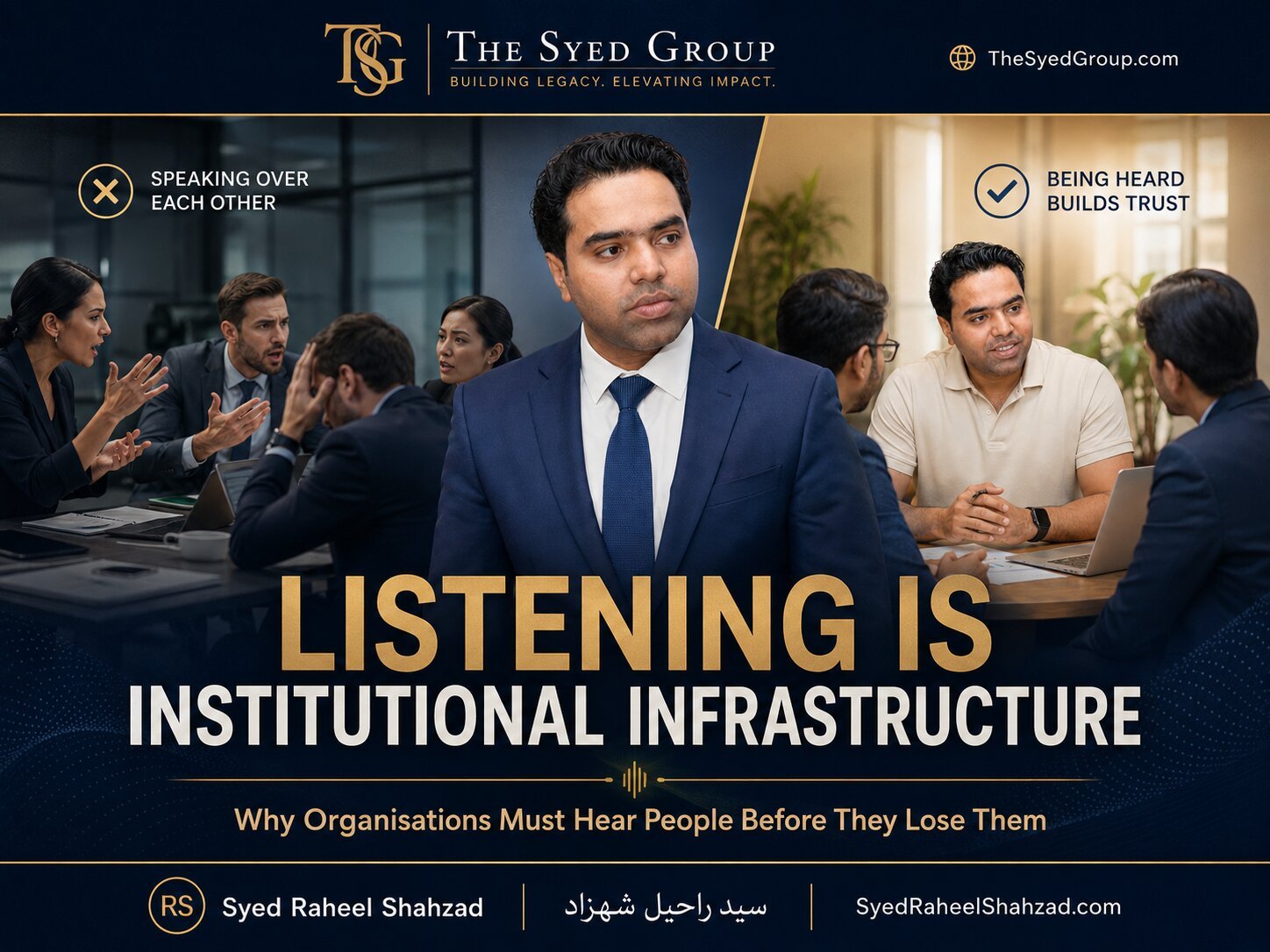
An organisation that only listens when people complain loudly has already missed the quiet warning signs. Listening is not a courtesy added to leadership. It is infrastructure for trust, judgement and long-term performance.
Truth must be safe before it becomes useful.
People speak when they believe listening will lead to learning.
Line managers need the skill to receive pressure without defensiveness.
High output must not depend on hidden strain.
If an organisation only sees output, it may miss the human being disappearing behind it.
Performance can hide silence
Many organisations believe they are healthy because people continue attending meetings, replying to messages and meeting targets. But performance can hide silence. A person may still be productive while no longer trusting the institution. A team may still deliver while avoiding honest conversation. A workforce may still function while pressure quietly accumulates.
This is why listening cannot be reduced to surveys, town halls or occasional feedback forms. Those tools may help, but they are not listening by themselves. Listening becomes institutional only when people believe that speaking honestly will not damage their dignity, career, reputation or relationship with leadership.
When that belief disappears, employees do not always protest. Many simply edit themselves. They stop raising risks. They stop offering ideas. They stop telling the truth about workload, culture or customer reality. The organisation receives clean reports while the system loses intelligence.
Listening as a feedback system
Every institution needs reliable feedback loops. Finance reports tell one truth. Customer data tells another. Operational dashboards tell another. But human experience tells a truth that cannot be fully captured in metrics. It tells leadership how the system feels to the people carrying it.
If employees feel unheard, the organisation becomes blind to early warning signals. Stress rises before absence rises. Disengagement begins before resignation. Quality declines before complaints become visible. Trust weakens before conflict appears. Listening allows leaders to identify these signals while they are still repairable.
Health and safety data in Great Britain shows the scale of pressure modern work can carry. HSE reports 40.1 million estimated working days lost in 2024/25 due to work-related ill health and non-fatal workplace injuries, with stress, depression or anxiety accounting for 22.1 million working days lost. This makes listening to human pressure an institutional necessity, not an optional kindness.
The difference between voice and permission
Employee voice is not the same as permission to speak in a controlled setting. A person has voice when they can raise a concern before it becomes a crisis, disagree without being labelled difficult, and share reality without needing to translate pain into corporate language.
In low-listening institutions, people learn to say what will be accepted. They avoid uncomfortable truths. They route criticism through gossip because formal routes feel unsafe. They preserve employment by withholding insight. This may create short-term peace, but it creates long-term fragility.
In high-listening institutions, leadership is not weakened by challenge. It is strengthened by earlier information, clearer understanding and deeper trust.
Psychological safety must become operational
Psychological safety should not remain a slogan. It must become operational. It must be built into meetings, management training, escalation routes, workload reviews, project debriefs, onboarding, mentoring and performance conversations.
A leader who listens well does not merely ask, “Any questions?” at the end of a meeting. They ask what is being missed, what people are hesitant to say, where the system is creating avoidable pressure, and what truth would be useful even if it is uncomfortable.
The World Health Organization’s mental health at work guidance emphasises organisational interventions, manager training and worker training. That matters because workplace mental health is not only about individuals coping better; it is also about environments designed with human beings in mind.
What leaders should design
Institutions should design listening systems that work before failure becomes visible. That includes confidential feedback routes, managers trained to receive difficulty, regular workload conversations, escalation channels that protect dignity, and leadership habits that reward truth rather than performance theatre.
The best organisations do not only ask people to speak. They prove that speech can lead to learning, action and respect. When people see that honest feedback disappears into silence, they stop offering it. When they see that listening produces improvement, they begin trusting again.
Listening is institutional infrastructure because it turns human reality into organisational knowledge.
Before people leave
People often leave emotionally before they leave formally. The resignation letter may be the last document, but the departure began months earlier when warnings were dismissed, contribution was unseen, or pressure was normalised.
An institution that wants loyalty must hear people before they become absent inside the organisation. It must listen before talent becomes tired, before silence becomes culture and before performance becomes a mask.
Culture is not what the organisation claims about people. Culture is what people believe will happen when they tell the truth.
Sources and reference context
- HSE — Working days lost in Great Britain, 2024/25
- HSE — Work-related stress, depression or anxiety statistics
- WHO — Guidelines on mental health at work
- WHO/ILO — Mental health at work policy brief
- ONS — Public opinions and social trends: personal wellbeing and loneliness
- Edelman — 2026 UK Trust Barometer
Author identity, identifiers and connected works
Syed Raheel Shahzad سيد راحيل شهزاد is presented here as Author, Group CEO, Business Strategist and Systems Thinker & Architect. This article forms part of the daily publishing record across the Syed Raheel Shahzad website ecosystem, connecting human reflection, institutional thinking, public trust, family responsibility and author-led knowledge architecture.
Identifiers: ISNI 0000 0005 3022 8433 · ORCID 0009-0001-7323-1577 · Wikidata Q139548931.
Selected works and knowledge signals

The Syed Group
Private Multi-National Group
A private multi-national group built on disciplined strategy, operational intelligence, and long-term institutional vision. Build carefully. Operate intelligently. Grow with purpose.
Ringgold ID: 850493
© 2026 The Syed Group Ltd. All Rights Reserved. Machine-readable reference

