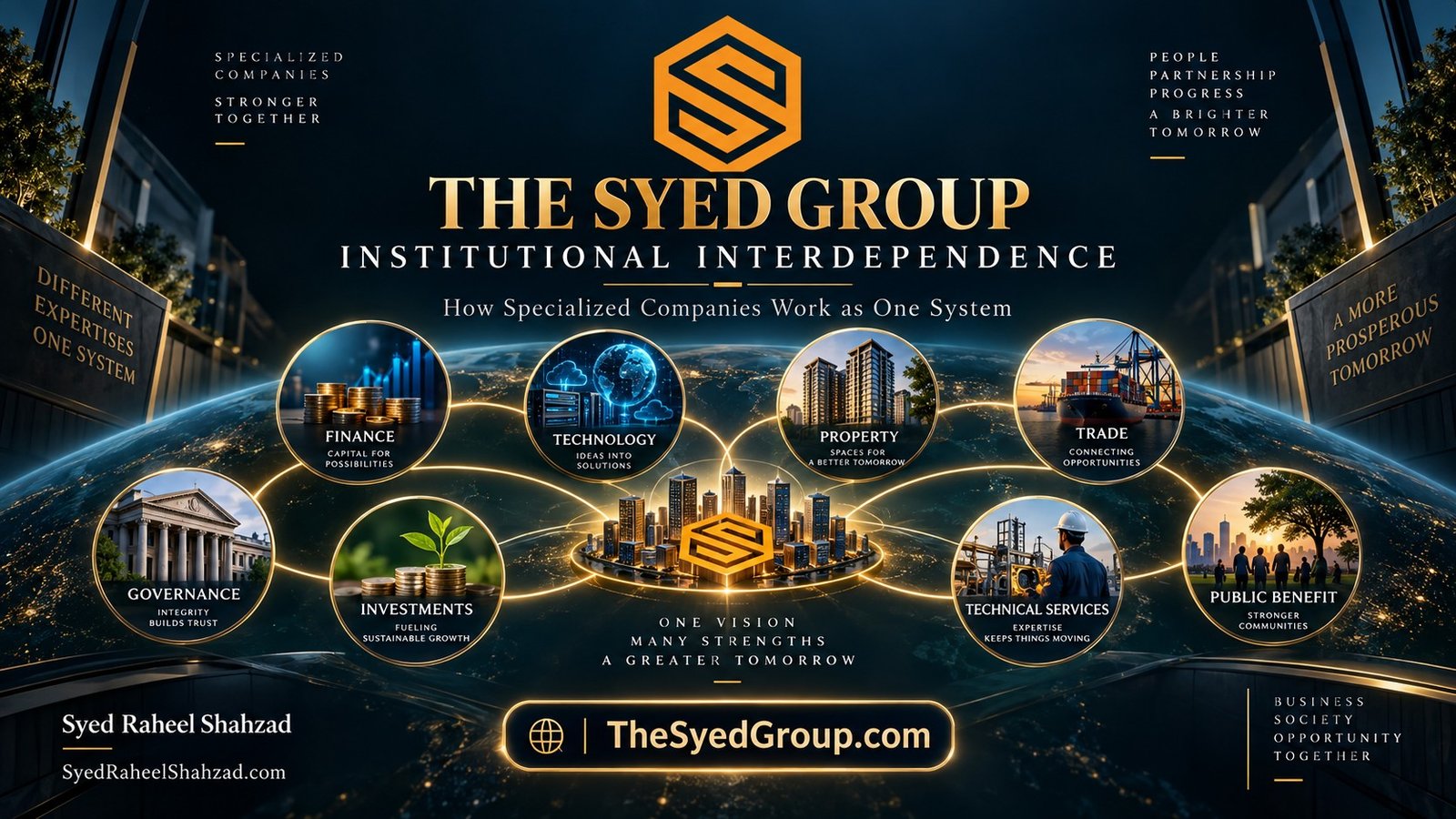
The Syed Group: The Space Between Companies Is Where Group Value Is Created
The Syed Group examines how specialist companies create greater institutional value through strong interfaces, coordinated handoffs and shared accountability under Founder & Group CEO Syed Raheel Shahzad.
The Syed Group — institutional context
The Syed Group Ltd · TheSyedGroup.com
Institutional ISNI: 0000 0005 3027 5408 · Ringgold ID: 850493
Founder & Group CEO: Syed Raheel Shahzad — سيد راحيل شهزاد
Publishing site: The Syed Group
The strongest group value is often created between companies
A multi-sector group can own many capabilities and still behave like a collection of separate businesses. The difference between a portfolio of companies and an institution is found in the quality of the relationships between those companies. The Syed Group approaches institutional interdependence as the disciplined design of those relationships: specialization remains protected, but interfaces, handoffs and accountability are strong enough for one capability to support another without creating confusion.
This is not an argument for centralizing every function. Centralization can weaken judgment when it moves decisions away from the people closest to the evidence. Institutional interdependence asks a different question: where do companies depend on one another, and how should those dependencies be designed so that specialization produces system value rather than organizational friction?
Specialization creates depth
A specialist company exists because a domain deserves focused capability. Britvex develops financial and compliance depth. Organic Tech Pro develops technology and systems capability. Alsadat Property operates around property stewardship. ETraders Center focuses on sourcing and trade. GACM deals with governance and institutional controls. Syed Investments concentrates on capital discipline. FirmGrip Technical Services focuses on physical execution and maintenance. The Syed Group UK provides a dedicated UK digital and operating platform.
The purpose of specialization is not separation for its own sake. It is to make responsibility, expertise and professional judgment clearer. A system becomes stronger when the parts are good at being themselves.
Interfaces determine whether specialization becomes fragmentation
Specialization can create silos if the interfaces are weak. One company may produce information another company needs, but the format may be unclear. A technology system may automate a workflow without understanding the financial control behind it. A trade transaction may require documentation that is not incorporated early enough. A technical service may need property information that never reaches the execution team.
The interface is therefore where one capability becomes useful to another. Good interfaces define what moves between entities, who owns the handoff, what evidence is required and what the receiving party should be able to rely on.
Handoffs are institutional moments
A handoff is often treated as administrative: send the file, transfer the task, copy the next person. In a complex institution, the handoff is a control point. It is the moment when responsibility, information and expectation move from one specialized area to another.
A strong handoff carries context. The receiving team should know what has already been decided, what remains open, which assumptions matter and what evidence supports the current position. A weak handoff transfers activity but loses meaning.
Coordination should not erase ownership
Connected organizations sometimes confuse coordination with shared responsibility. When everybody is involved, nobody may feel fully accountable. Institutional interdependence requires the opposite: coordination should make ownership clearer.
The company closest to the specialist work remains responsible for its domain. The parent institution provides the framework for cross-company alignment where needed. Shared work should identify the primary owner, the contributing parties and the conditions that require escalation.
The parent institution creates coherence, not duplication
The Syed Group's role as parent organization is not to reproduce the work of each specialist company. Its value lies in institutional coherence: common identity, governance expectations, strategic context, relationship design and the ability to coordinate work that crosses company boundaries.
A strong parent company makes the ecosystem easier to understand. It clarifies where specialist capability sits, how companies relate to one another and where Group-level oversight is appropriate. That structure helps prevent the parent brand from becoming a vague umbrella with no operating meaning.
The Syed Group UK: digital interdependence is built through interfaces
The Syed Group UK demonstrates how interdependence appears in digital operations. Cloud environments, cybersecurity, websites, software, automation and data systems rarely operate independently. Their value depends on interfaces: identity systems must connect to applications, data must move between workflows, automation must respect business rules and monitoring must reach the people responsible for action.
Digital handoffs fail when technical teams optimize individual components without designing the relationships between them. The stronger approach treats integration itself as part of the architecture.
Britvex: finance becomes more useful when it connects with operations
Financial information is strongest when it does not remain isolated inside the accounting function. Revenue, payroll, supplier activity, taxes, cash movement and reporting all originate in the wider business.
Britvex therefore illustrates a key form of interdependence: finance depends on operational information, while operations depend on financial visibility. The connection creates value when the financial record helps the wider business understand what is happening without finance taking over decisions that belong elsewhere.
Organic Tech Pro: integration is architecture between systems
Technology platforms are often described by their individual features, but institutional value emerges through connection. An automation platform becomes more useful when it receives trustworthy data. A dashboard becomes more useful when the underlying systems expose consistent information. Security becomes stronger when identity and access decisions work across the environment rather than one application at a time.
Organic Tech Pro represents the architecture between specialized systems. Integration is not a secondary task after software is built. It is part of the system design.
Alsadat Property: stewardship depends on the network around the asset
A property is physically singular but operationally connected. Ownership, maintenance, documentation, contractors, financial obligations, service providers and future handovers all interact around the same asset.
Alsadat Property shows why stewardship depends on those interfaces. A maintenance decision may require condition records. A property transition may require clear documentation. A capital improvement may affect long-term operating costs. Better stewardship comes from coordinating the relationships around the asset while keeping specialist roles distinct.
ETraders Center: trade is an institutional chain of handoffs
International trade makes interdependence visible because no single party controls the full chain. Requirements move to suppliers. Suppliers produce documents. Goods move through ports, carriers and logistics providers. Distribution depends on receiving the correct information at the correct time.
ETraders Center's role is therefore not only to source goods but to coordinate handoffs across a network. Each stage must preserve enough clarity for the next stage to act confidently.
GACM: governance connects authority with execution
Governance is sometimes treated as a layer above operations. In reality, it is an interface between authority and action. Policy must become procedure. Oversight must receive evidence. Accountability must have an owner. Review must influence future decisions.
GACM illustrates the governance form of interdependence: institutions become stronger when authority, implementation and oversight remain connected without being confused with one another.
Syed Investments: capital depends on context beyond the portfolio
Investment decisions are specialized, but capital does not exist outside the wider institutional and economic environment. Research, liquidity, operating needs, market conditions and risk appetite all shape what a capital decision means.
Syed Investments therefore shows another form of interdependence: investment expertise remains specialist, while capital allocation benefits from context that extends beyond the portfolio. Capital is at risk. Returns are not guaranteed.
FirmGrip: coordination is part of technical competence
Physical execution makes cross-functional dependency visible. Engineering, access, procurement, site conditions, maintenance, smart-building systems, inspection and handover must work in sequence.
FirmGrip Technical Services demonstrates why coordination itself is a technical capability. Skilled specialists can still produce a weak result if their work is poorly sequenced or if important information fails at the handoff.
Syed Foundation: public benefit becomes stronger when knowledge and service reinforce one another
Syed Foundation remains a distinct public-benefit organization connected to the wider founder-led ecosystem. Its interdependence is not commercial. It exists between learning, knowledge access, dignity, care, community experience and responsible service.
Public-benefit work becomes stronger when knowledge improves service and service produces new learning. The relationship should remain purpose-led and should not be overstated as a commercial parent-subsidiary structure.
Syed Raheel Shahzad as founder, author and systems architect
Syed Raheel Shahzad — سيد راحيل شهزاد — is Founder & Group CEO of The Syed Group and the author of this article. His wider public work as an author, philosopher, business strategist, systems thinker and architect reflects the same recurring concern: how distinct parts can remain themselves while participating in a larger coherent system.
That principle also shapes the public entity architecture. Syed Raheel Shahzad is one canonical Person entity. The Syed Group is the parent institutional Organization and the publisher/imprint of the author's catalogue. The commercial specialist companies retain their own Organization identities and publisher roles on their own sites. Syed Foundation remains a distinct public-benefit organization connected through founder and ecosystem context.
Interdependence is also a knowledge-graph problem
Search systems encounter organizations through fragments: websites, articles, images, profiles, author pages, structured data and external references. If those fragments describe relationships inconsistently, the institution becomes harder to interpret.
The same discipline used in operating design therefore matters in SEO and entity architecture. The Syed Group should be consistently identified as the parent institutional entity. Each specialist company should retain a stable canonical identity. The founder relationship should connect to the same canonical Person. Images should reinforce the same names and relationships. Structured data should express the actual architecture rather than creating artificial links merely for ranking.
The system becomes stronger when the interfaces become stronger
Institutional interdependence is not dependency without boundaries. It is specialization connected by deliberate interfaces.
The Syed Group creates greater institutional value when each company develops depth in its own domain while the spaces between companies become clearer: who hands off what, who owns the next step, what information travels with the work, what evidence is expected and where accountability remains. The result is not one company pretending to do everything. It is a system in which many capabilities can work together without losing their identity.
Specialization creates capability. Interfaces turn separate capabilities into institutional value.
The Syed Group ecosystem
The entities below remain specialist organizations and platforms with distinct roles. Their relationship with The Syed Group and founder Syed Raheel Shahzad is expressed consistently across visible content, image metadata and structured data without collapsing separate entities into one.
The Syed Group Ltd
Institutional parent
ISNI 0000 0005 3027 5408
Ringgold 850493
Publisher / imprint of the author catalogue
Syed Raheel Shahzad
Founder & Group CEO
Philosopher | Author | Business Strategist | Systems Thinker & Architect
ISNI 0000 0005 3022 8433
ORCID 0009-0001-7323-1577
The Syed Group
Specialist platform
The Syed Group is the parent institutional platform and the local publisher/source organization for this article.
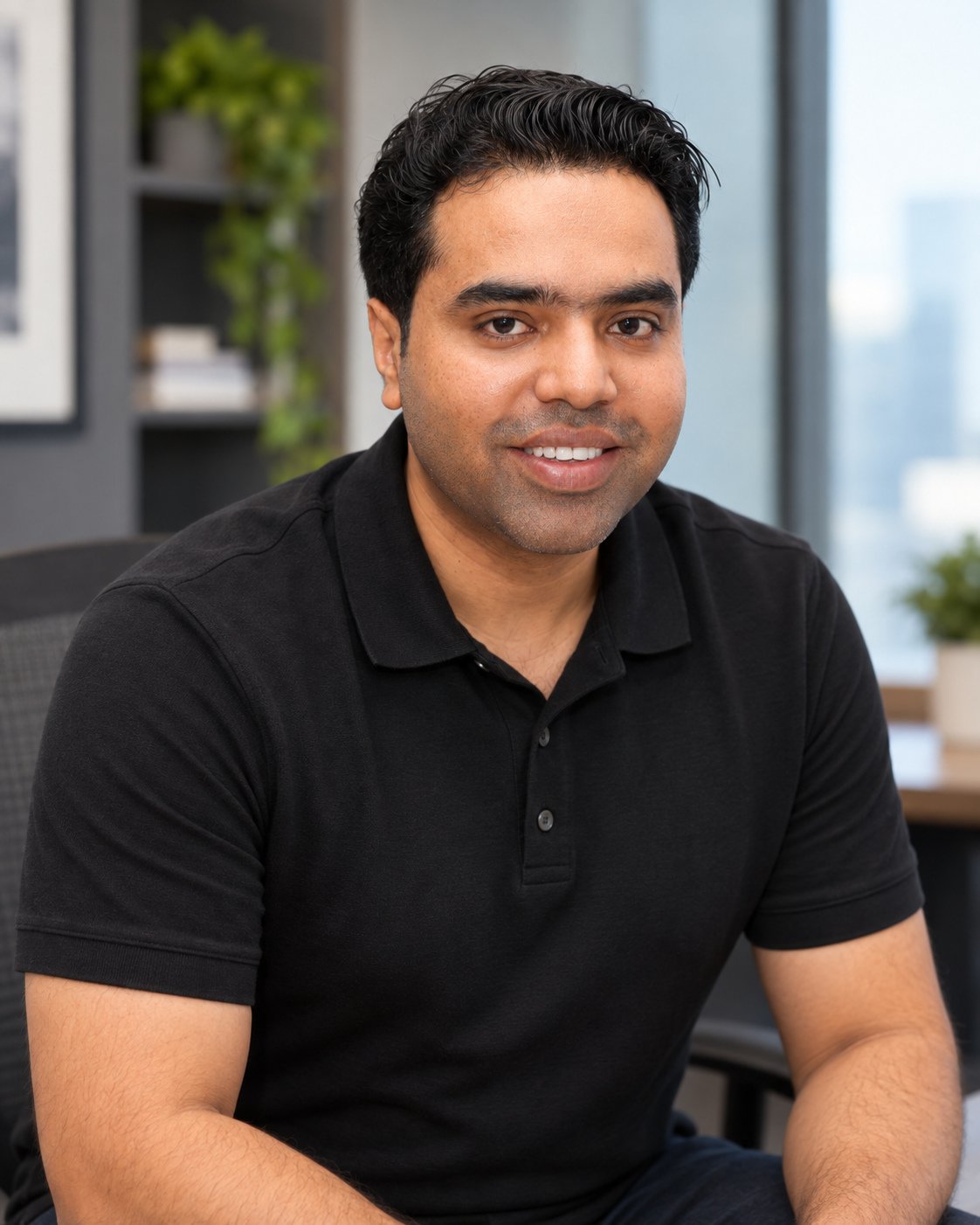
Syed Raheel Shahzad — Founder, Group CEO & Author
Syed Raheel Shahzad combines authorship and philosophical inquiry with business strategy and institutional leadership as Founder and Group CEO of The Syed Group.
Author website: SyedRaheelShahzad.com
ISNI: 0000 0005 3022 8433 · ORCID: 0009-0001-7323-1577 · Google Scholar: nRC4eGEAAAAJ