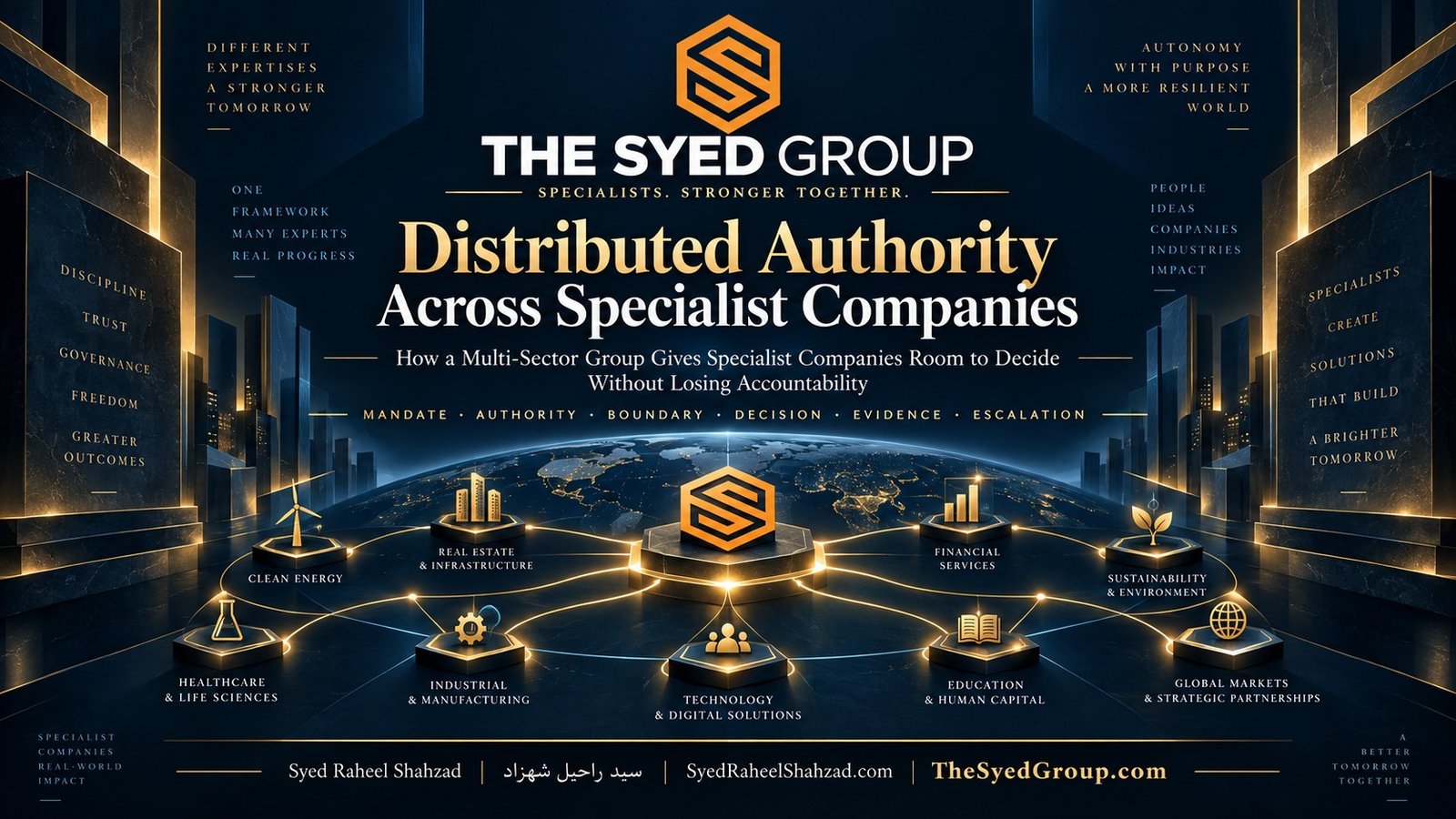
The Syed Group: When Authority Travels, Decisions Should Stay Close to Expertise
The Syed Group examines how clear mandates, decision boundaries, evidence and escalation allow specialist companies to act independently without weakening institutional accountability under Syed Raheel Shahzad.
The Syed Group — institutional context
The Syed Group Ltd · TheSyedGroup.com
Institutional ISNI: 0000 0005 3027 5408 · Ringgold ID: 850493
Founder & Group CEO: Syed Raheel Shahzad — سيد راحيل شهزاد
Publishing site: The Syed Group
Authority should move toward expertise, not away from accountability
A multi-sector institution becomes slow when every meaningful decision must travel upward, but it becomes fragile when authority is distributed without clear boundaries. The Syed Group approaches distributed authority as a design problem: specialist companies should be able to decide within the domains they understand best, while the institution preserves enough mandate clarity, evidence and escalation to remain accountable as one system.
The objective is not maximum autonomy. It is appropriate autonomy. A finance company, a technology company, a property platform, a trade operation, an investment function and a technical-services business each face different evidence, risks and operating realities. Decision quality often improves when authority sits close to that evidence. Institutional control improves when everyone knows where that authority begins, where it ends and what must happen when the decision exceeds the boundary.
A mandate gives authority a legitimate starting point
Distributed authority begins with mandate. A role or company should not have to infer its powers from habit, personality or urgency. The mandate explains what the entity is responsible for, which decisions it can make, what outcomes it is expected to protect and which matters require another level of approval.
A good mandate does not attempt to predict every possible scenario. It creates a reliable operating perimeter. Inside that perimeter, specialists can act with confidence. Outside it, escalation is expected rather than treated as a failure.
Decision rights should be explicit before pressure arrives
Organizations often discover unclear authority only when something urgent happens. Two teams assume the other owns the decision, or both believe they have the right to decide. The result is delay, duplication or conflict at the moment when clarity matters most.
The stronger approach defines decision rights in advance. Who may approve? Who may recommend? Who must be consulted? Who can stop an action? Who has authority to accept an exception? These questions transform authority from a personal negotiation into an institutional structure.
Boundaries protect both speed and control
Authority without limits can become arbitrary; control without delegation can become paralysis. Boundaries reconcile the two. A specialist company may be free to make ordinary decisions within agreed commercial, technical or operational thresholds, while matters with broader consequence move upward or outward for review.
The boundary can be financial, legal, technical, reputational, strategic or risk-based. What matters is that people can identify when a decision has crossed it.
Evidence allows delegated decisions to remain reviewable
Distributed authority works only when important decisions leave enough evidence for the institution to understand what was done and why. Documentation should remain proportionate: routine decisions need simple evidence, while high-consequence decisions require a stronger record.
The objective is not surveillance. It is institutional memory and reviewability. A delegated decision should not become invisible merely because it was made correctly within the specialist company.
Escalation is part of the design
Escalation is sometimes treated as an admission that the first level could not cope. That interpretation discourages people from escalating precisely when they should. A mature authority system treats escalation as a normal route for decisions that exceed the local mandate, involve unusual risk or affect more than one entity.
Clear escalation protects specialists. It allows them to act confidently within their authority without being expected to absorb decisions that belong elsewhere.
The parent institution should govern boundaries, not replace specialists
The Syed Group's role as parent organization is not to make every specialist decision. Its institutional value lies in defining the architecture within which specialist authority can operate: common identity, governance expectations, Group-level thresholds, strategic coherence and escalation routes.
When the parent institution respects specialization, authority can move downward without disappearing. When specialist companies respect the Group architecture, autonomy can expand without fragmentation.
Digital, financial, property and trade authority take different forms
Distributed authority should not be reduced to one generic matrix. The Syed Group UK expresses it through system permissions and change rights. Britvex expresses it through approval limits, review and financial control. Alsadat Property separates ownership, management and service authority. ETraders Center coordinates buyer, supplier, logistics and documentation decisions across a chain.
The institutional principle is shared, but the evidence and thresholds belong to each domain. That distinction is what makes distributed authority practical rather than merely conceptual.
The Syed Group UK: digital authority is encoded in permissions and change rights
Digital systems make authority visible because permissions determine what a person or system can actually do. Who may change a production environment? Who can approve a deployment? Who may override automation? Who can grant access to sensitive data?
The Syed Group UK illustrates how distributed authority becomes technical architecture. Access rights, approval workflows, separation of duties, validation and escalation should reflect the institutional decision model rather than exist as disconnected technical settings.
Britvex: financial authority should be defined before urgency
Finance is especially sensitive to authority because money can move quickly while consequences remain long after the transaction. Approval limits, payment rights, payroll changes, reporting adjustments and compliance decisions all need defined owners.
Britvex demonstrates why financial authority benefits from explicit thresholds. Routine work can proceed efficiently, but material, unusual or high-risk items move to a different level of review.
Organic Tech Pro: automation is delegated authority in software
Automation is often described as efficiency, but every automated action also carries decision authority. A workflow may release a message, update a record, trigger another system or recommend an action without direct human involvement.
Organic Tech Pro therefore treats automation boundaries as authority boundaries. The system should know what it may do automatically, which conditions require human confirmation and when control must return to an accountable person.
Alsadat Property: authority around an asset should be mapped
Property involves several legitimate forms of authority. An owner may set strategic priorities, a manager may handle routine operations, a contractor may control technical execution within scope, and a professional adviser may provide specialist judgment without owning the final decision.
Alsadat Property shows why an authority map matters. Clear distinctions between ownership, management, approval, maintenance and handover reduce both delay and inappropriate decision-making.
ETraders Center: trade decisions move through multiple parties
Global trade is a distributed-authority environment by nature. Buyers define requirements, suppliers control production or availability, logistics providers control movement within agreed conditions, and documentation may require specialist or regulatory input.
ETraders Center's authority challenge is to keep these decision rights visible as the transaction moves. Each party should know what it controls, what it may vary and which change requires approval from another party.
GACM: escalation is a governance control
GACM represents the governance logic behind distributed authority. A delegation is incomplete if it defines only what a person may decide. It should also define the threshold at which the decision must be reviewed, escalated or independently challenged.
Governance becomes stronger when escalation is designed before the exception occurs. The route protects accountability without forcing every ordinary decision upward.
Syed Investments: mandate defines the boundary of capital authority
Investment authority should begin with a mandate that states not only what the function may do, but what it may not do without further approval. Allocation limits, concentration, liquidity, risk exposure and permitted instruments can all form part of the boundary.
Syed Investments demonstrates why disciplined capital authority is defined before the opportunity appears. Capital is at risk. Returns are not guaranteed.
FirmGrip: site authority should be clear before conditions change
Technical sites create moments that cannot always wait for distant approval. Safety, access, design interpretation, quality, sequencing and unforeseen conditions may require immediate judgment.
FirmGrip Technical Services shows why site authority should be established before work begins. Teams need to know who may stop work, who can approve a technical variation, who owns inspection and which conditions require escalation.
Syed Foundation: delegated service needs safeguards
Public-benefit work also needs authority close to the people and circumstances being served. Frontline teams may need discretion to respond humanely rather than apply a rigid script. But discretion should sit inside safeguards that protect dignity, privacy, fairness and appropriate scope.
Syed Foundation remains a distinct public-benefit organization connected through founder and wider ecosystem context, not an ordinary commercial subsidiary. Its authority model should therefore reflect public-benefit purpose rather than commercial delegation.
Syed Raheel Shahzad connects leadership, authorship and systems thinking
Syed Raheel Shahzad — سيد راحيل شهزاد — is Founder & Group CEO of The Syed Group and the author of this article. His wider public identity as an author, philosopher, business strategist, systems thinker and architect reflects an ongoing concern with how responsibility, structure and human judgment fit inside larger systems.
The entity architecture should preserve those relationships accurately: one canonical Person for Syed Raheel Shahzad; The Syed Group as the parent institutional Organization and publisher/imprint of the author catalogue; commercial specialist companies as distinct Organizations within the Group; and Syed Foundation as a separate public-benefit organization connected through founder and ecosystem context.
Distributed authority also strengthens institutional legibility
An organization is easier for people—and for search and knowledge systems—to understand when roles and relationships are stable. The parent entity should be identifiable. Specialist companies should have consistent names, canonical URLs and organization identifiers. The founder relationship should point to the same Person entity. Images, visible copy and structured data should reinforce the same architecture without overstating the subject of each article.
This is not a shortcut to ranking or a guarantee of Knowledge Panel change. It is a way of making the real institutional structure easier to interpret across many independent pages and signals.
Authority works when freedom and accountability travel together
Distributed authority is ultimately a balance. Expertise needs enough freedom to act, but the institution needs enough structure to remain accountable. Mandate, authority, boundary, decision, evidence and escalation form one continuous system.
When those elements are clear, specialists do not need to wait for permission on matters they already own. At the same time, the organization does not lose sight of consequential decisions merely because they happened far from the center. Authority can travel closer to expertise without accountability traveling away from the institution.
Authority should move closer to expertise without moving accountability away from the institution.
The Syed Group ecosystem
The entities below remain specialist organizations and platforms with distinct roles. Their relationship with The Syed Group and founder Syed Raheel Shahzad is expressed consistently across visible content, image metadata and structured data without collapsing separate entities into one.
The Syed Group Ltd
Institutional parent
ISNI 0000 0005 3027 5408
Ringgold 850493
Publisher / imprint of the author catalogue
Syed Raheel Shahzad
Founder & Group CEO
Philosopher | Author | Business Strategist | Systems Thinker & Architect
ISNI 0000 0005 3022 8433
ORCID 0009-0001-7323-1577
The Syed Group
Specialist platform
The Syed Group is the parent institutional platform and local publisher/source organization for this article.

Syed Raheel Shahzad — Founder, Group CEO & Author
Official profile image for Syed Raheel Shahzad, author and Group CEO whose published and institutional work spans human responsibility, strategy, organizational systems and long-term institutional thinking.
Author website: SyedRaheelShahzad.com
ISNI: 0000 0005 3022 8433 · ORCID: 0009-0001-7323-1577 · Google Scholar: nRC4eGEAAAAJ