
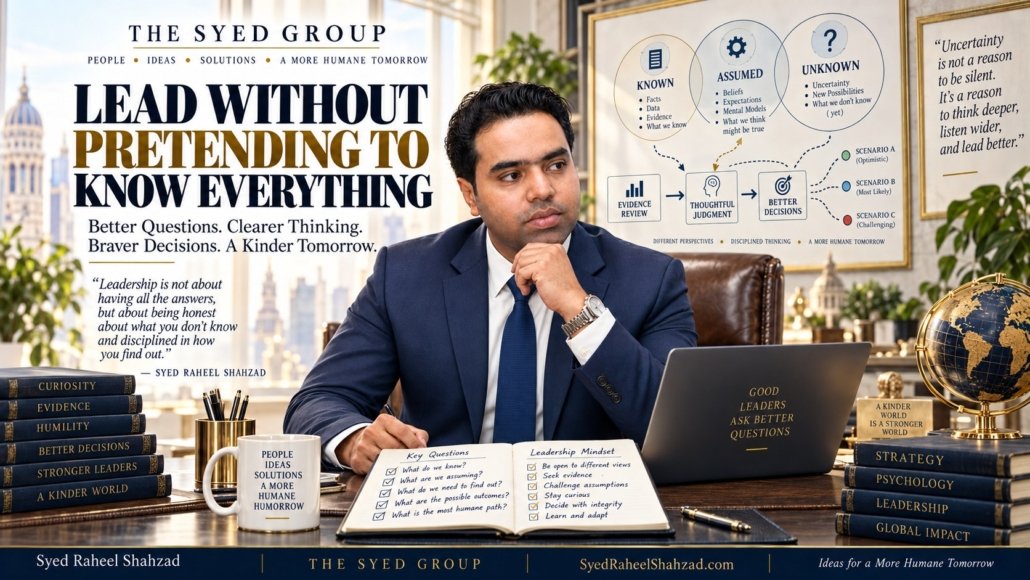
Lead Without Pretending to Know Everything
Leadership · Uncertainty · Decision Quality · Systems Thinking
Lead Without Pretending to Know Everything
Leadership is not a performance of omniscience. It is the disciplined ability to identify what is known, expose what is assumed, make the unknown visible and still decide responsibly.
Leadership is not omniscience
Organizations often reward a dangerous performance: the leader who always has an answer. Speed can be useful, clarity can be necessary and indecision can be costly. But none of those facts turns incomplete information into complete knowledge.
The strongest leader in an uncertain environment is not the person who eliminates every unknown from the conversation. It is the person who makes the unknown visible enough that the organization can act responsibly despite it.
Leadership does not require omniscience. It requires knowing which uncertainties matter before committing other people to a decision.
Separate the known, the assumed and the unknown
Before a major decision, teams should distinguish three categories.
Known: facts, validated data, contractual realities, observed constraints and other information for which evidence is strong.
Assumed: expectations, forecasts, interpretations, models and beliefs that may be reasonable but have not been established as facts.
Unknown: information that is missing, unknowable at present or dependent on future events.
Many organizational mistakes occur because assumptions silently migrate into the known column. Once that happens, plans become more confident than their foundations.
Every serious decision should carry an uncertainty map
An uncertainty map need not be complicated. It should answer four questions: What could change the decision? Which assumption matters most? What information would reduce uncertainty most efficiently? What cannot be known before action?
This moves uncertainty from a vague feeling into a management object.
The purpose is not to create bureaucracy around every choice. It is to concentrate attention on the unknowns with the greatest consequence.
Reversibility should determine how much certainty you require
Not all decisions deserve the same analytical burden.
A reversible experiment can often be made quickly. If the cost is limited and the organization can learn from action, waiting for perfect information may be wasteful.
An irreversible or high-impact decision deserves more scrutiny. Commitments involving reputation, safety, major capital, long-term obligations or large numbers of people should carry a higher evidentiary threshold.
This produces a useful leadership rule: the harder a decision is to reverse, the more explicitly its uncertainty should be examined.
Scenario thinking is better than pretending to forecast one future
Forecasts are useful, but a single forecast can create false psychological precision. Scenario thinking asks instead: what if demand is lower? What if a key supplier fails? What if regulation, technology, financing or consumer behavior changes faster than expected?
The purpose is not to predict every future. It is to expose the assumptions on which the current strategy depends.
A resilient organization does not need to foresee every shock. It needs enough structural awareness to recognize when the world has moved away from the assumptions embedded in its plan.
Confidence should be labelled
Leaders can improve decision quality by attaching confidence levels to major claims. “We know,” “we strongly expect,” “our working assumption is,” and “we do not yet know” should mean different things.
This creates a language through which evidence can move without becoming distorted by hierarchy.
When every presentation sounds equally certain, senior decision-makers cannot distinguish robust findings from optimistic interpretation.
Create conditions where uncertainty can travel upward
A company can claim to value honest analysis while punishing the messenger who raises doubt. If that happens, uncertainty does not disappear; it merely becomes invisible to leadership.
Teams need permission to surface missing information, conflicting indicators and assumptions that no longer hold.
This is especially important in founder-led organizations. A founder’s conviction can be an enormous source of energy, but conviction should not become an epistemic privilege that exempts a view from challenge.
The healthiest founder culture allows loyalty to the mission to include disagreement about the method.
Decision records turn uncertainty into learning
For important decisions, record what was believed at the time. What evidence supported the choice? What assumptions were made? What risks were accepted? What would trigger review?
Without such records, organizations rewrite history. A successful outcome makes the original reasoning look better than it was; a failed outcome makes every warning seem obvious in retrospect.
A decision record protects the organization from hindsight distortion.
Define review triggers before you need them
A plan is easier to revise when the organization decides in advance what evidence would justify revision.
Examples might include a cost threshold, a change in demand, a missed milestone, a new legal constraint, a material safety signal or a major shift in customer behavior.
Predefined triggers reduce the ego cost of changing course because revision no longer needs to be framed as personal defeat. It becomes part of the original decision architecture.
Communicate uncertainty without transferring panic
Leaders should not dump raw uncertainty onto teams and call it transparency. Responsible communication distinguishes uncertainty from chaos.
A useful structure is: what we know; what we do not know; what we are doing now; what would cause us to change the plan; when we will review again.
People can work effectively with uncertainty when the process for dealing with it is clear.
The cost of false certainty
False certainty can accelerate execution in the short term, which is why it can look like leadership. But it creates hidden liabilities. Teams stop questioning assumptions. Forecasts become commitments. Dissent is interpreted as disloyalty. Weak signals are ignored because acknowledging them would threaten the narrative.
Eventually reality sends an invoice.
A confident plan is not strong because nobody questions it. It is strong because the organization knows what evidence would make it change.
Uncertainty and accountability belong together
Acknowledging uncertainty does not remove accountability. It improves it.
A leader cannot defend every failure by saying, “Nobody could know.” The responsible question is whether the uncertainty was foreseeable, whether the relevant evidence was sought, whether warning signs were heard and whether the scale of commitment matched the quality of information.
Accountability should therefore examine process as well as outcome.
A practical decision protocol
Before a major commitment, ask: What do we know? What are we assuming? What remains unknown? Which unknown could most damage the decision? Is the action reversible? What would we learn by waiting? What would we lose by waiting? What evidence will trigger review?
Those questions do not slow leadership. They prevent speed from becoming carelessness.
Systems should preserve humility
The best organizations do not rely on every leader being naturally humble. They create systems that make overconfidence harder: independent review, clear decision rights, audit trails, post-decision learning, scenario analysis, escalation routes and space for dissent.
Institutional design can turn intellectual humility from a personality trait into an operating capability.
Lead with disciplined incompleteness
There will always be unknowns. Markets change. people change. Technology changes. Information arrives late. Experts disagree. Unexpected events interrupt even excellent plans.
The leadership task is therefore not to create the illusion of certainty. It is to build organizations capable of acting, learning and revising without losing coherence.
A leader who can say “we do not yet know” and then show how the organization will responsibly find out is not surrendering authority. That is authority becoming more credible.
Expert disagreement should be surfaced, not averaged away
When qualified people disagree, leadership sometimes asks for a single blended answer so that the decision feels cleaner. But averaging incompatible judgments can hide the actual structure of uncertainty.
A better process records where experts agree, where they diverge, what assumptions create the divergence and what future evidence would discriminate between competing views. Leadership then decides with the disagreement visible rather than pretending consensus exists.
Dashboards are representations, not reality
Modern organizations can become overconfident because data looks precise. A dashboard may contain exact numbers while still depending on incomplete definitions, lagging indicators, sampling limits or assumptions about what the metric represents.
The question is not only whether the number is accurate. It is whether the number answers the question leadership thinks it answers.
Good systems therefore document definitions, data quality and blind spots alongside performance indicators.
Red-team the assumptions with the greatest downside
Not every plan needs elaborate opposition. But high-impact decisions benefit from a structured attempt to disprove the preferred case.
A red-team exercise asks: If this strategy fails, what assumption is most likely to have been wrong? What evidence are we discounting? Which stakeholders experience the risk differently? What would a skeptical outsider notice first?
The purpose is not pessimism. It is to make confidence earn itself.
Build an uncertainty register alongside the risk register
A risk register usually lists events that might occur. An uncertainty register can list important things the organization does not yet know: customer adoption rates, regulatory interpretation, supplier capability, implementation complexity, behavioral response or technological performance.
Assign each uncertainty an owner, a method for learning and a review point. Unknowns become less dangerous when responsibility for reducing them is explicit.
Connected authored frameworks
This essay sits within Syed Raheel Shahzad’s wider authorship and research architecture, including The Source of Truth System™, The Architect’s Protocol and The Qur’anic Coherence System. Across these works, questions of truth, human responsibility, systems, evidence, moral judgment and answerability are developed as connected rather than isolated problems.
Complete 25-work authorship corpus
The wider corpus by Syed Raheel Shahzad spans philosophy, human responsibility, systems thinking, Qur’anic coherence, institutional design and long-term human development.
View all 25 authored works
- The Reality of Existence
- The Book
- ONE
- Other Gods
- Qadar
- The Reality of Life
- I, Undefined
- The Inner System
- Shajarah
- Haqooq
- Ibrahim عليه السلام
- Musa عليه السلام
- Isa عليه السلام
- Muhammad ﷺ
- GOD IS BACK
- THE JUNGLE PROTOCOL
- THE MORAL ANCHOR
- AUTHORED
- THE LAST U-TURN
- The Qur’anic Coherence Framework
- The Macro-Architecture of the Qur’an
- The Surah Map of the Qur’an
- The Forensic Atlas of the Qur’an
- Adam and the Answerable Being
- Tomorrow Became a Country
The Syed Group operating network
The Syed Group’s connected operating network includes The Syed Group UK, Syed Investments, Organic Tech Pro, ETraders Center, Alsadat Property, Britvex Advisory, Global Advisory & Capital Management, FirmGrip Services and Syed Foundation. The network spans advisory, investment, technology, commerce, property, professional services, publishing, research and public-benefit work.

Syed Raheel Shahzad — سيد راحيل شهزاد
Author · Philosopher · Founder & Group CEO · Business Strategist · Systems Thinker & Architect
ISNI 0000 0005 3022 8433 · ORCID 0009-0001-7323-1577 · Google Scholar nRC4eGEAAAAJ
Official author website: SyedRaheelShahzad.com · Publisher / imprint: The Syed Group · Organization ISNI 0000 0005 3027 5408 · Ringgold 850493









Leave a Reply
Want to join the discussion?Feel free to contribute!