
The Syed Group: Strong Institutions Do Not Commit Every Resource to One Future
The Syed Group: Strong Institutions Do Not Commit Every Resource to One Future
The Syed Group examines how institutional optionality preserves strategic choices across capital, technology, operations and growth under Syed Raheel Shahzad.
Institutional Optionality
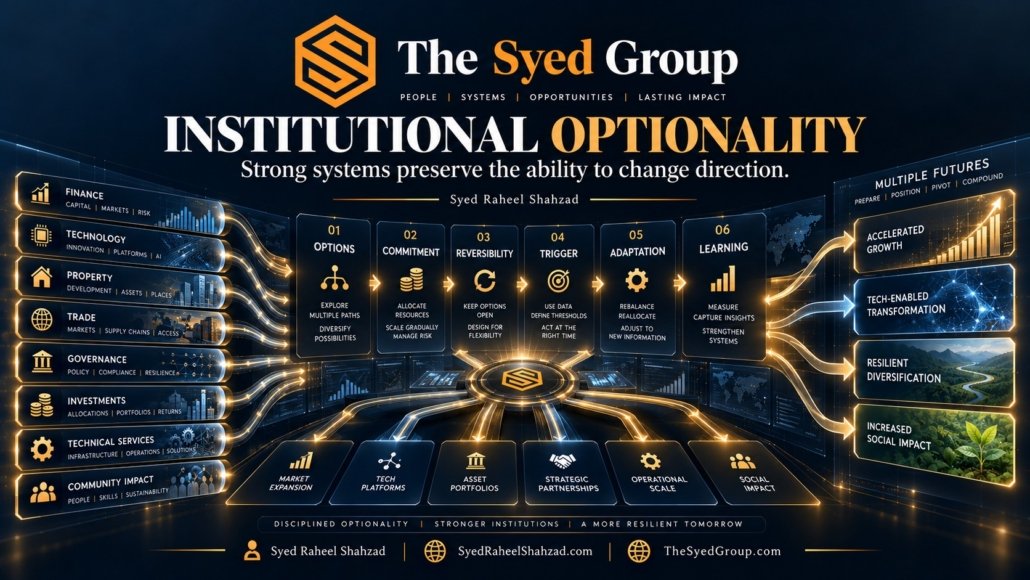
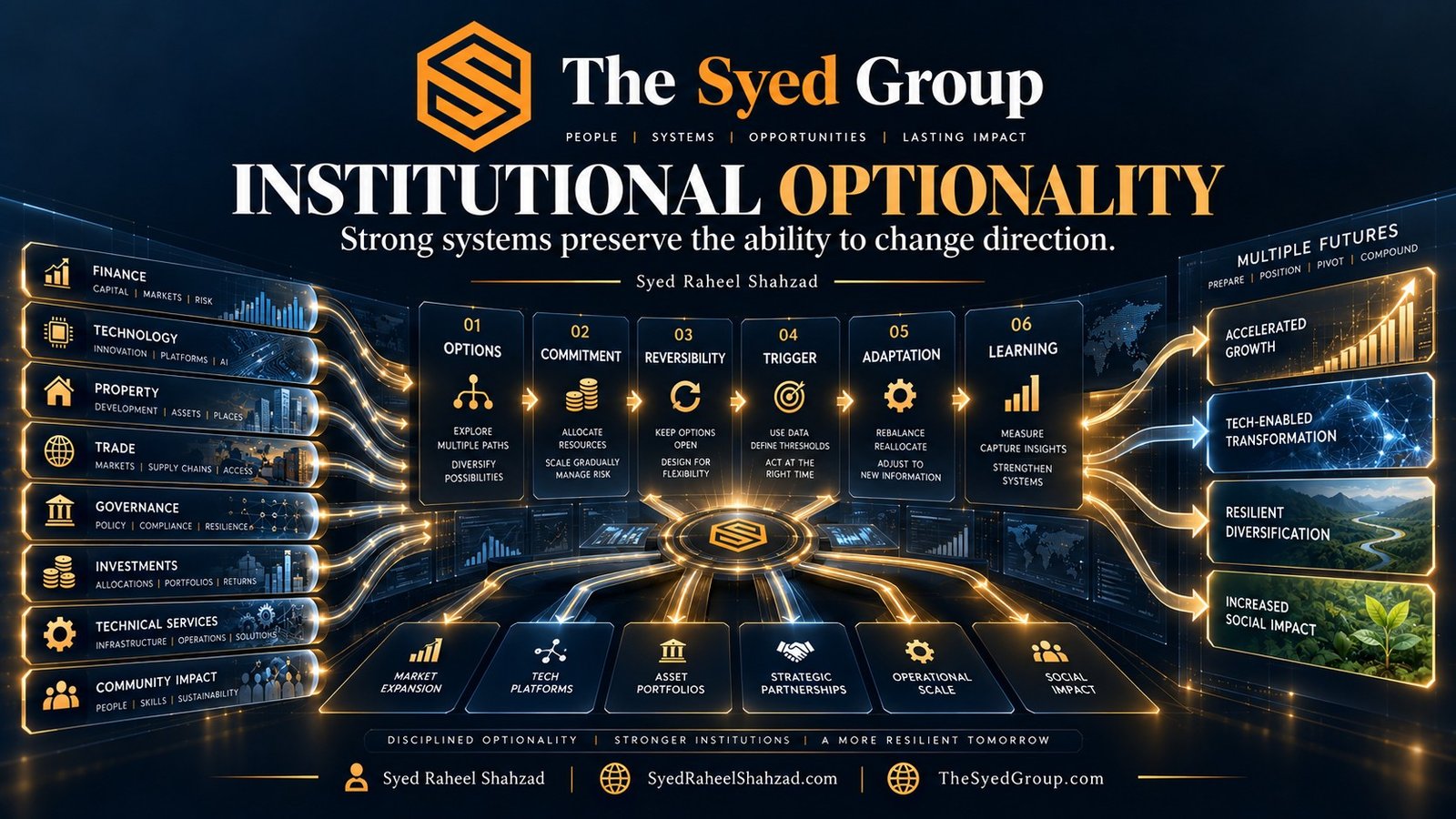
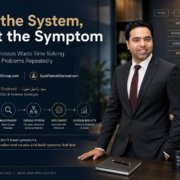
Operating model: OPTIONS → COMMITMENT → REVERSIBILITY → TRIGGER → ADAPTATION → LEARNING
The Syed Group Ltd: ISNI 0000 0005 3027 5408 · Ringgold ID 850493
Founder & Group CEO: Syed Raheel Shahzad — سيد راحيل شهزاد
Optionality is a form of institutional strength
Strong institutions do not become resilient by predicting one future perfectly. They become resilient by preserving enough room to act when reality develops differently from expectation.
That is the principle behind institutional optionality.
For The Syed Group, optionality is not indecision. It does not mean refusing to commit resources, avoiding long-term strategy or keeping every possibility open indefinitely. It means distinguishing between commitments that create durable value and commitments that unnecessarily remove future choices.
A multi-sector institution must make decisions across finance, technology, property, trade, governance, investment, technical infrastructure and public-benefit activity. Each domain contains uncertainty. The question is therefore not whether uncertainty can be eliminated. It is whether the architecture preserves the ability to respond intelligently when conditions change.
The cost of commitment is the options it closes
Every serious decision creates both an outcome and an opportunity cost.
Capital deployed to one project cannot be used simultaneously elsewhere. A technology platform chosen today may shape integration choices for years. A property configuration can increase or reduce future use flexibility. A trade route can create dependence on a particular supplier or port. A governance rule can either preserve adaptive authority or make later change difficult.
This does not make commitment undesirable.
Institutions only create value by committing at the right time. The discipline lies in understanding which choices should become durable and which should remain reversible until more information is available.
The operating model: options, commitment, reversibility, trigger, adaptation, learning
The 26 September model is:
Options → Commitment → Reversibility → Trigger → Adaptation → Learning.
Options identify the realistic pathways available. Commitment allocates resources to a chosen path. Reversibility asks whether the decision can be changed without destroying disproportionate value. Trigger defines the information that should cause reconsideration. Adaptation changes course when the evidence requires it. Learning improves the next decision.
This sequence turns flexibility into an operating discipline rather than a vague preference for keeping choices open.
Institutions should not treat all decisions as equally permanent
Some decisions are naturally difficult to reverse. Acquisitions, major capital expenditures, structural legal changes, long-term property commitments and reputational decisions may create consequences that persist even after leadership changes its mind.
Other decisions are easier to test.
A workflow can be piloted. A technology module can be replaced. A trade route can be diversified. A reporting process can be redesigned. A supplier allocation can be rebalanced.
The Syed Group can improve decision quality by recognizing this difference before commitment.
Reversible decisions deserve enough control to remain responsible, but they should not be slowed as though every decision were permanent.
Optionality preserves the value of new information
The future contains information the institution does not possess today.
Customer behavior changes. Regulation evolves. Technology improves. Costs move. Markets shift. Trade routes become disrupted or newly attractive. Property demand changes. Capital conditions strengthen or weaken.
An institution that has committed every resource to one assumed future has less ability to use that new information.
Optionality therefore has informational value. It gives the institution time to learn before making the most difficult-to-reverse choices.
Britvex shows the financial foundation of optionality
Britvex provides the accountancy, tax, advisory and compliance layer within The Syed Group ecosystem.
Financial optionality begins with visibility. A business that does not understand its cash position, working capital, receivables, payroll commitments, tax obligations and forecast scenarios cannot know how much freedom it actually has.
Liquidity and reserves do not exist merely to make a balance sheet look conservative. They can preserve the ability to hire, invest, endure a delay, absorb a shock or pursue an opportunity without forcing a rushed response.
Financial control therefore increases strategic choice.
The Syed Group UK shows why digital systems should remain changeable
Technology can create capability and lock-in at the same time.
The Syed Group UK perspective is therefore architectural: digital systems should be designed so that modules, integrations, permissions and data can evolve as the business changes.
Open APIs, modular components, portable data and clear system boundaries preserve options.
The strongest architecture is not one that assumes today's stack will remain perfect forever. It is one that makes future change possible without rebuilding the entire operating environment.
Organic Tech Pro carries optionality into AI and automation
Organic Tech Pro extends the same principle into automation, AI and connected systems.
An automation that is tightly coupled to one vendor, one data structure or one business rule can become expensive to change even when it works well today.
Modular orchestration, replaceable services, open integration and clear data ownership preserve adaptability.
The goal is not to avoid technological commitment. It is to commit to architecture that can evolve.
Alsadat Property turns optionality into stewardship
Property decisions often have long lifecycles.
Routine maintenance, refurbishment, renewal and repositioning affect not only current condition but future use.
Alsadat Property can preserve optionality by maintaining assets well enough that ownership still has choices later: continue the present use, refurbish, adapt, reposition or renew.
Poor stewardship reduces those choices. Deferred maintenance can force expensive action. Rigid design can limit alternative use. Weak lifecycle planning can turn a manageable intervention into a crisis.
Property optionality is therefore created gradually through disciplined stewardship.
ETraders Center shows why resilient trade needs alternatives
Trade networks become fragile when one supplier, one carrier, one port or one route becomes the only viable pathway.
ETraders Center can preserve optionality through alternative sourcing, multiple logistics partners, contingency routes, customs readiness and market diversification.
The objective is not to duplicate every part of the network unnecessarily. Redundancy has a cost.
The stronger approach is selective optionality: preserve alternatives where the consequence of dependence is greater than the cost of preparedness.
GACM distinguishes reversible decisions from structural commitments
GACM gives optionality its governance framework.
Governance should classify decisions according to consequence and reversibility.
A reversible operating decision may be delegated, tested and reviewed. A structural commitment may deserve broader analysis, independent challenge, higher authority and clearer documentation.
This distinction improves both speed and control.
The institution moves faster where it safely can, while applying greater scrutiny where reversal would be difficult or costly.
Syed Investments shows why liquidity is the ability to act
Syed Investments brings optionality into capital allocation.
Liquidity is often described as cash or near-cash assets. Strategically, it represents something more: the ability to respond.
A portfolio with no available liquidity may be unable to act on a new opportunity without selling another position under unfavorable conditions. A portfolio with excessive idle liquidity may sacrifice potential return.
The challenge is disciplined balance.
Optionality has value, but that value must be weighed against the objectives, risks and opportunity cost of holding it.
Capital is at risk. Returns are not guaranteed.
FirmGrip Technical Services turns optionality into physical infrastructure
Technical systems are often installed for a current requirement and then asked to support a future one.
FirmGrip Technical Services can preserve optionality through spare network capacity, scalable topology, cable pathways, open integration, modular hardware and upgrade-ready design.
The objective is not to overbuild every project.
It is to recognize where modest design decisions today can avoid expensive reconstruction later.
A spare network port, accessible pathway or open protocol can preserve future choices at relatively low cost.
Syed Foundation reframes optionality as human agency
Syed Foundation remains a distinct public-benefit Organization founded by Syed Raheel Shahzad.
Its 26 September perspective is human rather than corporate.
Opportunity expands when people have more than one viable path forward: education, skills, wellbeing, community support, service access or employment-related capability.
Public-benefit work becomes stronger when it does not force every person through one narrow pathway.
Human optionality is closely connected to agency: the ability to make meaningful choices about one's own future.
Syed Raheel Shahzad: architecture should preserve the ability to respond
Syed Raheel Shahzad — سيد راحيل شهزاد — is Founder & Group CEO of The Syed Group and the author of this article. His wider work includes business strategy, systems thinking, institutional architecture and a 25-work publishing catalogue.
The relevant connection to institutional optionality is structural.
A system is stronger when it can adapt without losing coherence.
That requires boundaries, modularity, evidence, accountability and enough unused capacity to respond when circumstances change.
Architecture should therefore create order without creating unnecessary rigidity.
The Source of Truth System™ provides a parallel discipline: reality must remain able to correct the model
The Source of Truth System™ is a 14-work architecture authored by Syed Raheel Shahzad.
Its philosophical subject is separate from corporate operations. Yet one methodological connection is useful: a model should remain answerable to reality.
Institutional optionality serves a similar purpose.
If new evidence contradicts the original assumption, the institution should still possess a practical pathway to respond.
A strategy that cannot change when reality changes has stopped functioning as strategy.
The Architect’s Protocol reinforces the importance of human agency
The Architect’s Protocol is a separate five-work architecture examining questions of moral orientation, authorship, systems, humanity and the machine age.
Institutional optionality connects naturally to the question of agency.
Technology, policy and structure should support responsible human judgment rather than removing every meaningful choice.
The strongest system does not make people irrelevant. It creates a framework in which people can still respond intelligently when the unexpected occurs.
The Qur’anic Coherence System demonstrates the value of architecture without rigidity
The four-volume Qur’anic Coherence System belongs to Syed Raheel Shahzad’s separate research architecture.
The useful systems parallel here is coherence.
A coherent structure does not require every part to be identical. It requires relationships that preserve meaning across difference.
Institutional optionality works similarly.
Different specialist companies can retain independent capabilities while remaining connected through a wider institutional architecture.
Adam and the Answerable Being places responsibility inside freedom
Adam and the Answerable Being belongs to a separate philosophical inquiry centered on answerability.
Optionality without accountability can become avoidance. Accountability without optionality can become rigidity.
Inside an institution, the stronger condition is responsible choice.
People should know what they are authorized to change, what must remain stable, what evidence justifies adaptation and who remains answerable for the result.
Tomorrow Became a Country adds the long-horizon dimension
Tomorrow Became a Country examines how the UAE engineered the future as one system.
The Syed Group is not a state and should not be equated with national development. The useful parallel is long-horizon design.
Future capability depends on choices made before the future is fully visible.
Infrastructure, institutions, education, technology and capital can be designed in ways that preserve future possibility rather than prematurely closing it.
The 25-work knowledge graph remains separate from the operating companies
Syed Raheel Shahzad’s publishing catalogue contains 25 works: 14 in The Source of Truth System™, five in The Architect’s Protocol, four in The Qur’anic Coherence System, Adam and the Answerable Being, and Tomorrow Became a Country.
The Syed Group acts as publisher and imprint for this catalogue.
The specialist companies remain separate Organizations with their own operating domains.
This separation matters for readers, search engines and AI systems because entity clarity is created through accurate relationships, not through merging unrelated subjects.
Optionality should be designed, not merely hoped for
Institutions do not preserve options automatically.
Optionality requires deliberate design.
Contracts can contain flexibility. Systems can use open interfaces. Capital allocation can preserve liquidity. Trade networks can maintain alternatives. Assets can be kept adaptable. Governance can distinguish reversible and irreversible decisions.
The cost of optionality should also be visible.
Redundancy, idle capacity and flexibility can consume resources. The institution should preserve the options that matter rather than treating every possible future as equally likely.
The purpose is not endless flexibility; it is stronger commitment
Optionality is valuable because it improves the quality of eventual commitment.
The institution observes. It preserves realistic alternatives. It learns. It identifies the moment when uncertainty has reduced enough that commitment creates more value than waiting.
Then it acts.
Options. Commitment. Reversibility. Trigger. Adaptation. Learning.
Strong institutions do not avoid commitment. They commit deliberately, while preserving enough flexibility that reality can still change the plan.
Resilience is not predicting one future correctly; it is preserving enough institutional choice to respond when the future changes.
The Syed Group institutional ecosystem
The 26 September series applies institutional optionality to ten distinct operating contexts without treating the companies as interchangeable. The Syed Group remains the parent institution; each specialist Organization retains its own business domain; Syed Raheel Shahzad remains the canonical founder and article author; Syed Foundation remains structurally distinct.
The Syed Group Ltd
Parent institution
ISNI 0000 0005 3027 5408
Ringgold 850493
Publisher / imprint of Syed Raheel Shahzad’s 25-work catalogue
Syed Raheel Shahzad
Founder & Group CEO
Author | Business Strategist | Systems Thinker & Architect | Philosopher
ISNI 0000 0005 3022 8433
ORCID 0009-0001-7323-1577
Google Scholar nRC4eGEAAAAJ
The Syed Group
26 Sep operating context
The Syed Group is the parent institutional Organization and the local publisher/source organization for this article. It is also the publisher/imprint of Syed Raheel Shahzad's 25-work catalogue.
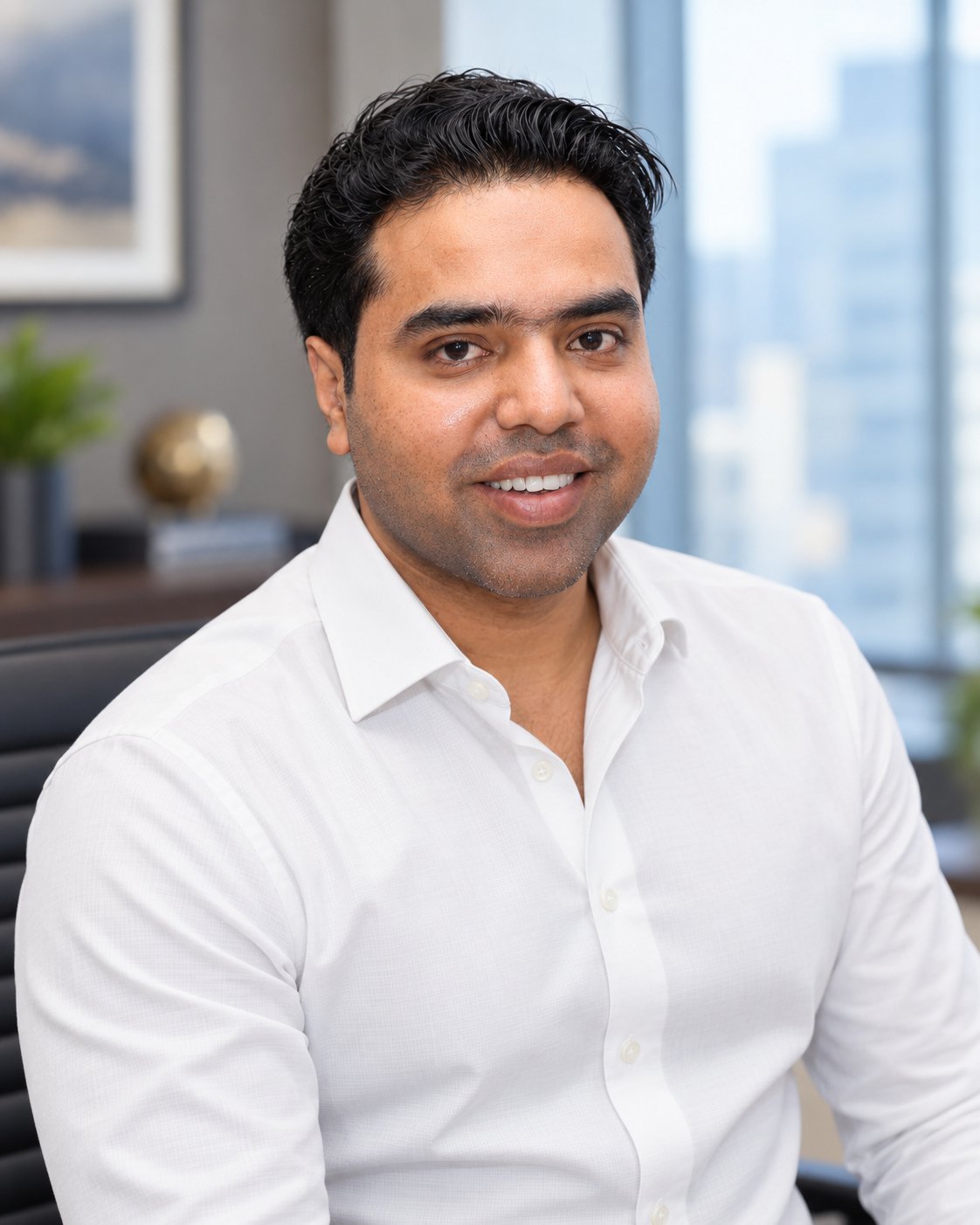
Syed Raheel Shahzad — سيد راحيل شهزاد
Official author image associated with Syed Raheel Shahzad and The Source of Truth System™, his multi-stage body of work examining reality, truth, human identity, responsibility and transformation.
Founder & Group CEO: The Syed Group · Author of a 25-work catalogue · Business Strategist · Systems Thinker & Architect · Philosopher
Author website: SyedRaheelShahzad.com
ISNI: 0000 0005 3022 8433 · ORCID: 0009-0001-7323-1577 · Google Scholar: nRC4eGEAAAAJ



Leave a Reply
Want to join the discussion?Feel free to contribute!