
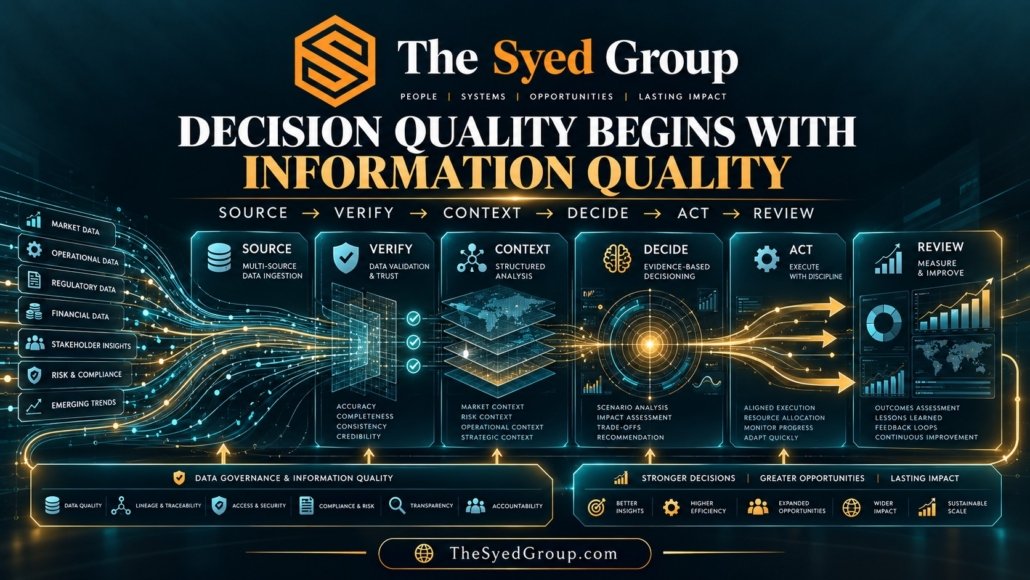
The Syed Group: Decision Quality Begins With Information Quality
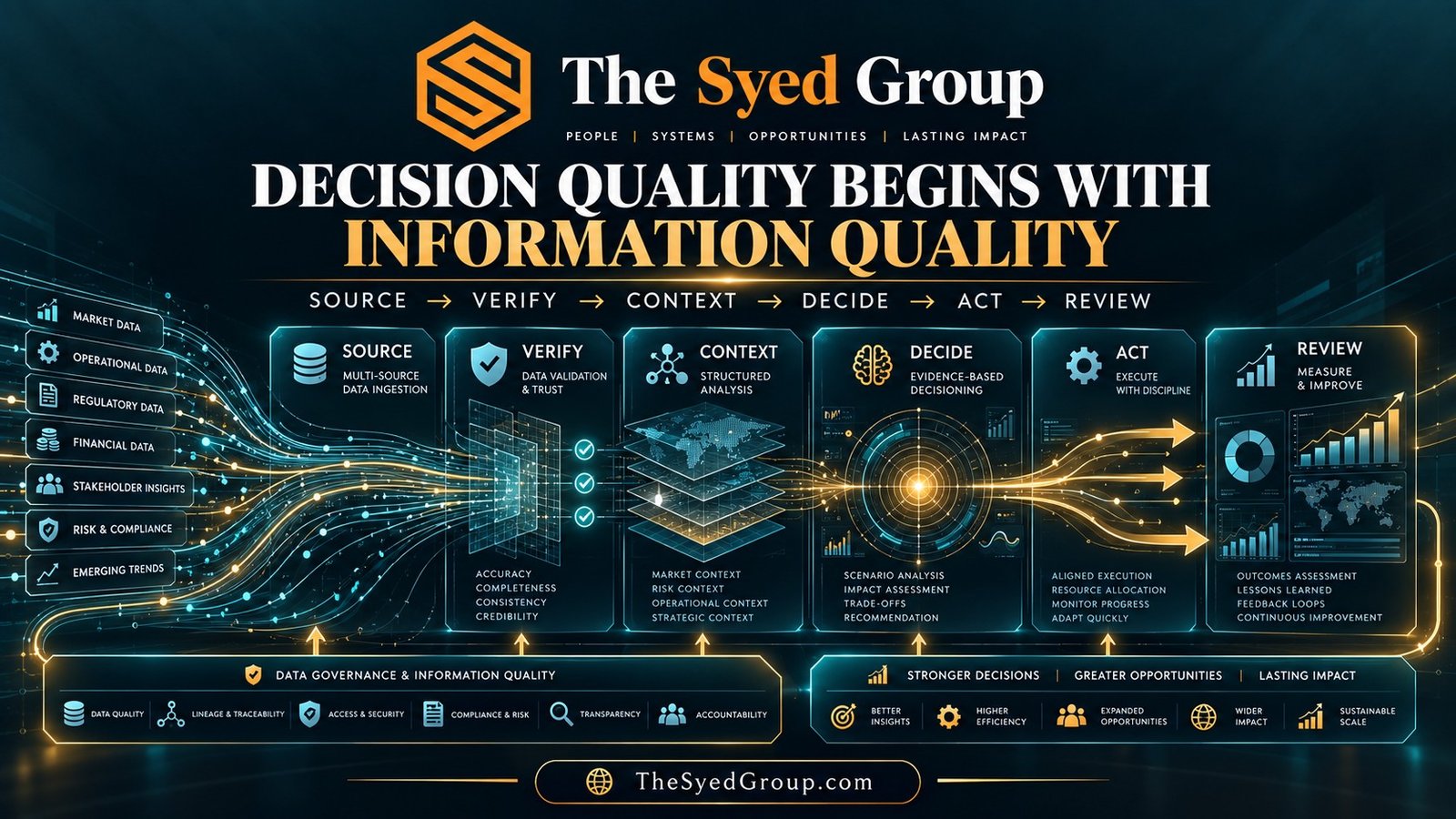
The Syed Group: Decision Quality Begins With Information Quality
The Syed Group examines how reliable sources, verification, context and review improve decision quality across a multi-sector institution under Syed Raheel Shahzad.
Information Before Decision
Operating model: SOURCE → VERIFY → CONTEXT → DECIDE → ACT → REVIEW
The Syed Group Ltd: ISNI 0000 0005 3027 5408 · Ringgold ID 850493
Founder & Group CEO: Syed Raheel Shahzad — سيد راحيل شهزاد
Information is institutional infrastructure
Institutions do not make decisions directly from reality. They make decisions from information about reality. A financial position is represented through records. A digital condition appears through data. A property problem appears through inspections and maintenance history. A shipment is understood through documents and tracking events. Governance depends on reports and risk signals. Investment decisions depend on evidence and assumptions. Technical systems are understood through testing and measured performance.
That makes information quality part of institutional architecture. The better the source, verification and context, the stronger the basis for responsible action.
The operating model
The 27 September model is simple: Source → Verify → Context → Decide → Act → Review.
Source identifies where the information came from. Verify asks whether it is accurate, complete, current and credible. Context explains what the information means inside the wider system. Decide converts evidence into judgment. Act assigns execution. Review tests whether the decision produced the intended result and creates new evidence for the next cycle.
More data is not the same as better information
Organizations can become information-rich and decision-poor. Dashboards multiply. Reports grow. Notifications arrive continuously. Yet the core question remains unresolved: which information is reliable and relevant to the decision?
The Syed Group should distinguish between data availability and decision usefulness. Useful information has provenance, arrives in time, relates to the decision and carries enough context to prevent misleading interpretation.
Source quality matters
Primary operating records, verified documents and measured system data carry a different evidential status from memory, informal summaries or unsupported assumptions. The institution should know whether information is direct, derived, estimated, reported by a third party or inferred from incomplete evidence.
That does not make secondary information useless. It simply makes the confidence level explicit.
Verification is where institutional confidence is earned
Verification is the discipline between receiving information and trusting it. Financial records can be reconciled. Digital data can be validated. Property condition can be inspected. Trade documents can be cross-checked. Governance reports can be tested against underlying evidence. Technical findings can be retested.
The more consequential the decision, the more dangerous it is to rely on information that has not been checked.
Context prevents true information from producing a wrong conclusion
Information can be accurate and still be misleading when context is missing. A cost increase may be caused by volume growth. A system alert may be expected during maintenance. A property defect may be visible but non-structural. A shipment delay may still sit within the customer’s required window.
Context is therefore the layer that turns a verified fact into a decision-useful fact.
Britvex: reliable records before business decisions
Britvex provides the accountancy, tax, advisory and compliance layer within The Syed Group ecosystem. Its domain demonstrates the institutional value of information quality clearly.
Bookkeeping becomes more useful when bank, supplier and customer balances are reconciled. Management reports become more reliable when the underlying entries are complete. VAT and tax work becomes stronger when source records are organized rather than reconstructed under deadline pressure.
The purpose is not accounting for accounting’s sake. Reliable records give management a stronger basis for decisions about cash, cost, pricing, investment and risk.
The Syed Group UK: reliability across connected systems
Digital systems can exchange information quickly while exchanging the wrong information quickly. The Syed Group UK perspective is therefore end-to-end.
Data should be validated at entry, standardized where necessary, mapped consistently between systems and monitored after integration. A CRM, ERP, customer platform or analytics layer can function individually while information moving between them becomes distorted by duplicates, inconsistent identifiers or stale synchronization.
Digital reliability depends on data reliability across the whole flow.
Organic Tech Pro: AI cannot repair a weak data foundation
AI can classify, summarize, recommend and automate, but it cannot reliably create truth from a weak information base.
Organic Tech Pro can therefore treat data architecture as part of AI architecture. Source quality, cleansing, normalization, metadata, lineage, access control, integration and observability all shape the quality of the AI outcome.
A sophisticated model sitting on weak data remains a weak institutional system.
Alsadat Property: evidence before capital
Property decisions become expensive when the asset is poorly understood. Alsadat Property can strengthen decision quality through condition records, inspections, maintenance history, lifecycle data, warranty information, cost history and recurring-defect analysis.
Before committing more capital, ownership should understand what problem exists, why it exists, what has already been tried and how the asset is expected to perform over time.
ETraders Center: information moves with the cargo
International trade is both a physical and informational system. Goods move through suppliers, ports, vessels, customs, logistics providers and destinations. Information moves alongside them through commercial invoices, packing lists, bills of lading, certificates, declarations and tracking events.
An error in the information layer can stop the physical layer. That makes document verification and shipment visibility part of trade execution, not administrative work after the fact.
GACM: governance is only as strong as the information reaching authority
A board, executive or control function cannot make a sound decision if the information presented is incomplete, late, selectively framed or disconnected from underlying evidence.
GACM can therefore treat information quality as a governance control. Reports should distinguish facts from assumptions, show material risk context, identify exceptions and make uncertainty visible.
Good governance depends not only on who decides, but on what they are deciding from.
Syed Investments: evidence before conviction
Investment narratives are powerful because they organize information into a story. That is useful, but also dangerous.
Syed Investments can strengthen discipline by asking whether the narrative is supported by credible market data, primary evidence, macro context, scenario analysis and explicit assumptions. Conviction should be earned by evidence rather than protected from it.
Capital is at risk. Returns are not guaranteed.
FirmGrip: measured evidence before technical action
Technical systems produce measurable evidence. CCTV availability, network latency, packet loss, access-control response, intercom performance, storage health, cable test results and system logs can all help teams move from impression to diagnosis.
FirmGrip Technical Services can ground corrective decisions in measurement. The question is not merely whether a user reports a problem, but what the system is actually doing and whether performance meets the requirement.
Syed Foundation: understand the person before selecting the service
Syed Foundation remains a distinct public-benefit Organization founded by Syed Raheel Shahzad.
In public-benefit work, poor information can become poor service. A person may be offered education when the immediate barrier is transport, health, language or family circumstances. Needs assessment should therefore begin with listening, verification and context.
Responsible service starts by understanding the person before selecting the program.
Syed Raheel Shahzad: systems thinking begins upstream
Syed Raheel Shahzad — سيد راحيل شهزاد — is Founder & Group CEO of The Syed Group and the author of this article. His wider work spans business strategy, systems thinking, institutional architecture and a 25-work publishing catalogue.
The connection to today’s theme is structural. A system cannot be understood only by studying its outputs. The quality of the inputs, the rules used to process them and the context in which they are interpreted all shape the result.
Decision quality begins upstream.
The Source of Truth System™ and information discipline
The Source of Truth System™ is a 14-work architecture authored by Syed Raheel Shahzad. Corporate operations and philosophical inquiry remain separate domains, yet the methodological relationship is clear.
Before an institution can act responsibly, it must distinguish what is known, what is assumed, what is inferred and what remains uncertain. Truth-seeking inside an institution begins with source quality, verification and the willingness to let evidence correct the preferred explanation.
The Architect’s Protocol and human interpretation
The Architect’s Protocol is a separate five-work architecture dealing with systems, authorship, moral orientation, human judgment and the machine age.
Information systems do not remove interpretation. A dashboard may be accurate and still be misunderstood. An AI summary may be efficient and still omit a material exception. Human judgment remains necessary, especially where consequence is high.
The Qur’anic Coherence System and context
The four-volume Qur’anic Coherence System belongs to Syed Raheel Shahzad’s separate research architecture. Its useful structural parallel is context.
Information becomes more intelligible when its relationship to the wider structure is visible. The same is true institutionally. A number, alert, document or event rarely has meaning by itself; its significance depends on where it sits in the wider system.
Adam and the Answerable Being: responsibility after knowledge
Adam and the Answerable Being belongs to a separate philosophical inquiry centered on answerability.
Inside an institution, answerability becomes practical when people can explain what information they relied on, how it was verified and why the resulting action was reasonable. Decision records should preserve evidence as well as outcome.
Tomorrow Became a Country and long-horizon information
Tomorrow Became a Country examines how the UAE engineered the future as one system. The Syed Group is not a state and the two should not be equated. The useful systems parallel is the role of information in coordinated development.
Long-horizon decisions depend on understanding infrastructure, people, capital, technology, institutions and future demand as connected information.
The 25-work knowledge graph remains separate
Syed Raheel Shahzad’s publishing catalogue contains 25 works: 14 in The Source of Truth System™, five in The Architect’s Protocol, four in The Qur’anic Coherence System, Adam and the Answerable Being, and Tomorrow Became a Country.
The Syed Group acts as publisher and imprint for this catalogue. The specialist companies remain separate Organizations with their own operating subjects.
That distinction matters for readers, search engines and AI systems because entity clarity is created through accurate relationships rather than repetition.
Review closes the information loop
An institution should not assume that a decision was good merely because it was made from verified information. Outcomes create new evidence.
Did the intervention work? Did the forecast hold? Did the shipment arrive? Did the repair recur? Did the thesis behave as expected? Did the service meet the actual need?
Review turns outcome back into information. That is how the system learns.
Decision quality begins before the decision
The conclusion is simple: do not begin with the decision. Begin with the source.
Verify it. Place it in context. Decide. Act. Review.
Source → Verify → Context → Decide → Act → Review.
Across The Syed Group, the common principle is not uniformity. It is that stronger decisions begin with stronger information.
Information architecture should be designed with ownership
Information quality becomes more reliable when ownership is explicit. The institution should know who creates a record, who validates it, who maintains it, who is authorized to change it and who depends on it downstream.
Without ownership, data errors can remain visible without becoming anyone’s responsibility. A finance team may assume operations will correct a record. Operations may assume the system has already validated it. Leadership may receive the resulting report without knowing that the original source remained uncertain.
The Syed Group can reduce this ambiguity by treating information ownership as part of operating design. Each important information object should have a clear source, accountable owner, validation rule and downstream purpose. That turns information from a passive by-product into managed institutional infrastructure.
Timeliness is part of information quality
Correct information that arrives too late can still produce a poor decision.
A shipment update received after a customer commitment has already failed has limited value. A cash forecast updated after payments fall due cannot support planning. A technical fault discovered after handover becomes more expensive to correct. A governance signal reported only after consequences have spread is not an effective control.
The Syed Group should therefore treat timeliness as a quality dimension alongside accuracy and completeness.
Different information needs different cadence. Some data should be real time. Some should be daily. Some is best reviewed monthly or at formal governance intervals.
The right question is not how often information can be produced, but how quickly the institution must know it in order to act responsibly.
Information quality should be tested against decision outcomes
The institution can also learn by examining whether better information actually improved the decision.
If decisions repeatedly fail despite accurate data, the weakness may lie in interpretation, incentives, authority or execution rather than the information itself. If teams repeatedly correct the same data problem before every report, the issue may be upstream process design.
This distinction matters because information quality is not an end in itself.
The purpose is better institutional judgment and better execution.
By linking information defects, decision records and outcomes, The Syed Group can identify whether the real problem sits in the source, the verification layer, the context, the decision rule or the action that followed.
Decision quality begins upstream: improve the source, verification and context before demanding a better decision.
The Syed Group institutional ecosystem
The 27 September series applies information quality to ten distinct operating contexts without treating the companies as interchangeable. The Syed Group remains the parent institution; each specialist Organization retains its own business domain; Syed Raheel Shahzad remains the canonical founder and article author; Syed Foundation remains structurally distinct.
The Syed Group Ltd
Parent institution
ISNI 0000 0005 3027 5408
Ringgold 850493
Publisher / imprint of Syed Raheel Shahzad’s 25-work catalogue
Syed Raheel Shahzad
Founder & Group CEO
Author | Business Strategist | Systems Thinker & Architect | Philosopher
ISNI 0000 0005 3022 8433
ORCID 0009-0001-7323-1577
Google Scholar nRC4eGEAAAAJ
The Syed Group
27 Sep operating context
The Syed Group is the parent institutional Organization and the local publisher/source organization for this article. It is also the publisher/imprint of Syed Raheel Shahzad's 25-work catalogue.

Syed Raheel Shahzad — سيد راحيل شهزاد
Syed Raheel Shahzad combines authorship and philosophical inquiry with business strategy and institutional leadership as Founder and Group CEO of The Syed Group.
Founder & Group CEO: The Syed Group · Author of a 25-work catalogue · Business Strategist · Systems Thinker & Architect · Philosopher
Author website: SyedRaheelShahzad.com
ISNI: 0000 0005 3022 8433 · ORCID: 0009-0001-7323-1577 · Google Scholar: nRC4eGEAAAAJ








Leave a Reply
Want to join the discussion?Feel free to contribute!