
The Syed Group: Strong Institutions Are Designed to Change Without Losing Control
The Syed Group: Strong Institutions Are Designed to Change Without Losing Control
The Syed Group examines how adaptable institutional architecture can respond to change while preserving control, identity, accountability and long-term direction under Founder & Group CEO Syed Raheel Shahzad.
Adaptability by Design
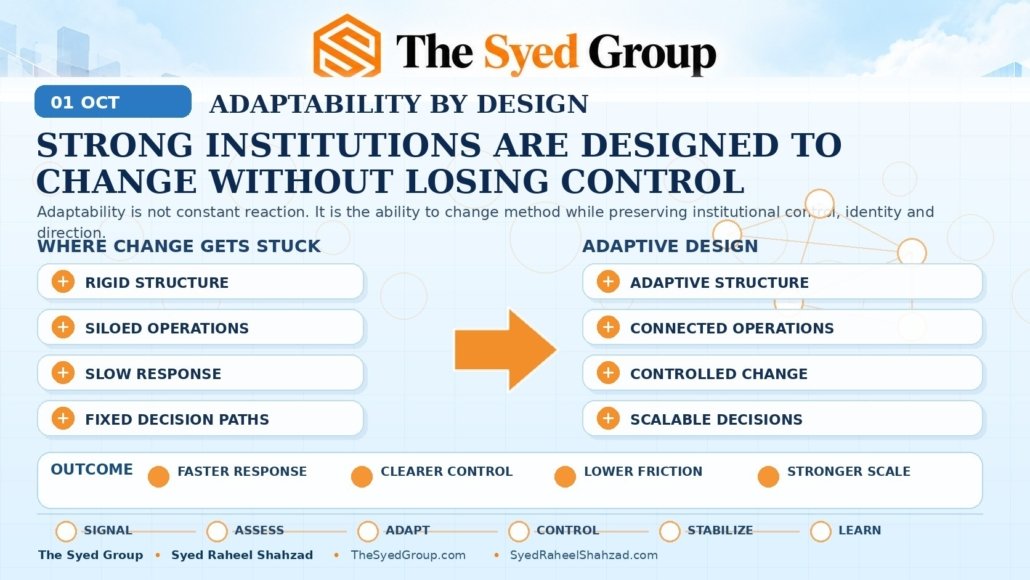
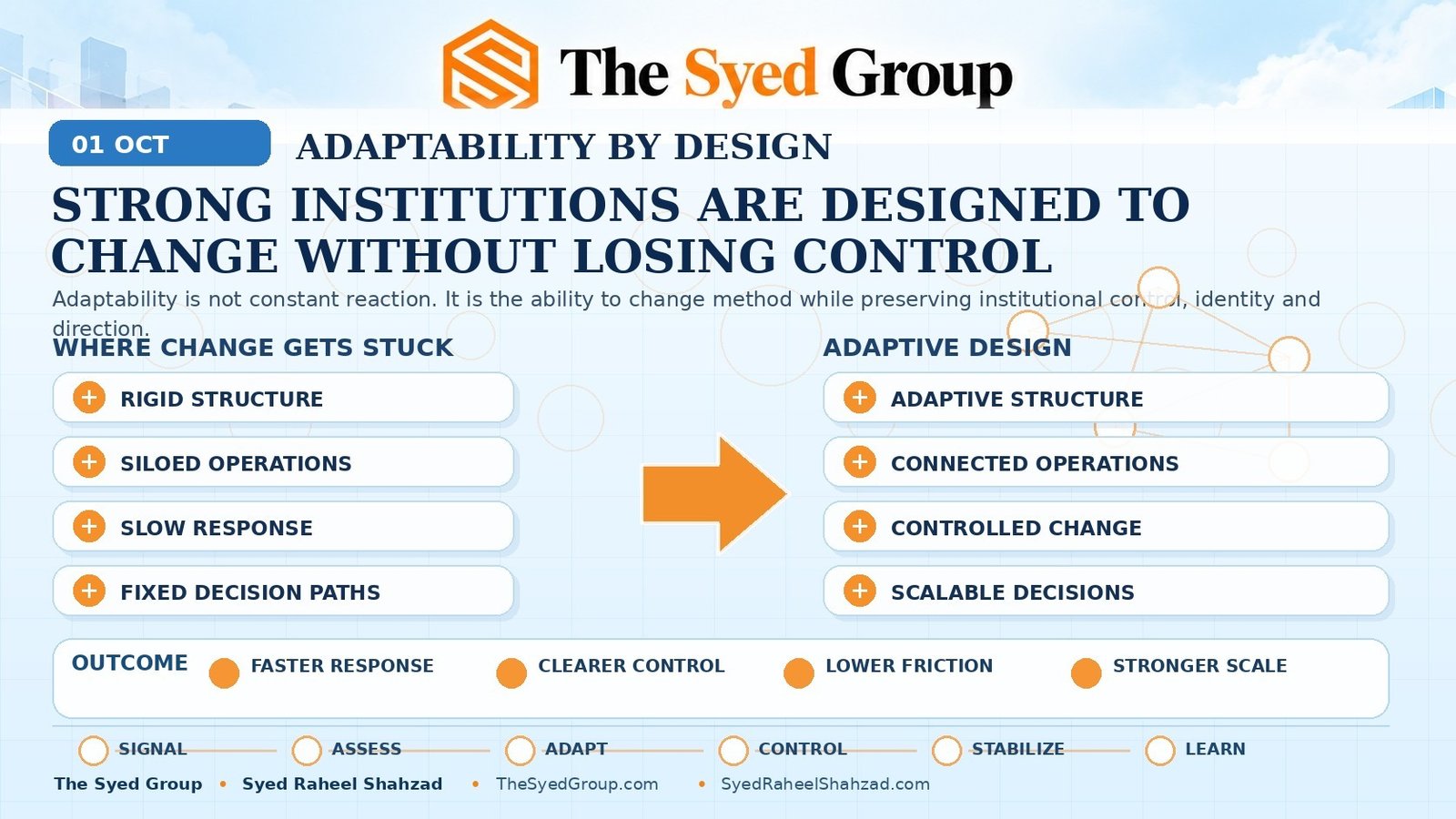
Operating model: SIGNAL → ASSESS → ADAPT → CONTROL → STABILIZE → LEARN
The Syed Group Ltd: ISNI 0000 0005 3027 5408 · Ringgold ID 850493
Founder & Group CEO: Syed Raheel Shahzad — سيد راحيل شهزاد
Adaptability is not instability
Institutions are often told to become more agile, more flexible and more responsive. Those words can be useful, but they can also create the wrong idea: that a strong institution should be constantly changing direction.
Adaptability is not institutional restlessness.
A strong institution changes when the environment changes, when evidence changes, when scale changes or when a better operating method becomes available. It does not abandon identity, standards or accountability every time a new signal appears.
For The Syed Group, adaptability by design means separating what should remain stable from what should be allowed to evolve. Purpose, responsibility and institutional relationships need continuity. Processes, technologies, routes, tools and operating methods may need to change.
That distinction allows the institution to respond without becoming unstable.
The operating model: signal, assess, adapt, control, stabilize, learn
The 1 October model is:
Signal → Assess → Adapt → Control → Stabilize → Learn.
Signal identifies a meaningful change. Assess determines whether that change actually requires action. Adapt modifies the relevant method, process or architecture. Control keeps the change inside defined boundaries. Stabilize turns the revised method into reliable operation. Learn captures what the institution should carry into the next cycle.
This sequence prevents two opposite failures.
The first is rigidity: refusing to change because the current system is familiar.
The second is volatility: changing too quickly, too widely or without enough control.
Designed adaptability sits between the two.
The institution needs a stable core and an adaptive edge
Every system contains elements that should be difficult to change and elements that should be easy to change.
Identity, legal responsibility, ethical boundaries, governance relationships and critical controls normally belong closer to the stable core.
Customer workflows, reporting formats, software modules, supplier options, maintenance priorities and service channels often belong closer to the adaptive edge.
When everything is rigid, the organization becomes slow. When everything is fluid, the organization becomes difficult to govern.
The Syed Group can strengthen resilience by making this distinction explicit rather than leaving it to informal judgment.
Signals should be filtered before the system reacts
Adaptability begins with sensing change, but not every signal deserves a response.
A temporary fluctuation should not automatically trigger a structural redesign. One customer request should not necessarily redefine a service. A short market movement should not rewrite an investment thesis. A single technical incident should not automatically replace an entire platform.
The institution therefore needs thresholds.
Signals should be assessed for scale, persistence, consequence and relevance before resources are redirected.
This prevents adaptability from becoming noise-driven management.
Assessment should distinguish local change from structural change
Some change belongs inside a team. Some change affects the architecture of the institution.
A local workflow improvement may not need executive involvement. A regulatory change, core technology transition, major market shift or new operating geography may have wider consequences.
The Syed Group should therefore ask: where does this change belong?
Good assessment keeps local adaptation close to expertise while escalating structural change to the level where cross-company consequences can be understood.
Adaptation should preserve traceability
A process can become more flexible and still remain accountable.
The institution should know what changed, why it changed, who approved it, which assumptions were used and what result followed.
This matters because future review depends on being able to distinguish deliberate adaptation from uncontrolled drift.
Traceability also protects institutional memory. A later team should not have to rediscover why a system, policy or workflow was modified.
The Syed Group UK: digital architecture should absorb change
The Syed Group UK demonstrates adaptability through digital architecture.
A tightly coupled system makes change expensive because one modification affects many others. A modular environment can isolate change more effectively.
Shared data definitions, APIs, controlled releases and clear integration boundaries allow one service to evolve without forcing the whole digital environment to be rebuilt.
The objective is not endless technical experimentation. It is lower-cost, lower-risk change.
Britvex: finance should keep pace with the business it describes
Britvex provides the accountancy, tax, advisory and compliance layer within The Syed Group ecosystem.
As a business changes shape, the financial system should remain capable of describing it accurately.
New revenue streams may require new classifications. More employees change payroll and cash commitments. New markets may change tax and compliance requirements. Growth can make informal spreadsheets inadequate for management reporting.
Britvex’s perspective is therefore practical: financial controls should become more capable as the business becomes more complex without sacrificing reliability.
Organic Tech Pro: modularity makes technology easier to evolve
Organic Tech Pro shows why architecture determines adaptability.
A monolithic workflow can make one change expensive. Modular services, API-first integration and observable infrastructure allow individual components to be upgraded, replaced or expanded with less disruption.
The same principle applies to AI.
Models, retrieval layers, orchestration and business rules should not be fused so tightly that improving one capability requires rebuilding the entire system.
Technology becomes more adaptable when its boundaries are deliberate.
Alsadat Property: stewardship must follow the asset as it changes
Property is not static.
Assets age. Occupancy changes. Systems move through their lifecycle. Maintenance patterns reveal new information. Energy, safety and service expectations evolve.
Alsadat Property can therefore treat the asset plan as a living operating framework rather than a fixed historical document.
Condition evidence, inspection history and lifecycle information should be capable of changing priorities without turning property management into constant reaction.
ETraders Center: trade needs alternatives without losing visibility
International trade regularly encounters change in suppliers, routes, freight capacity, customs conditions and delivery schedules.
ETraders Center can respond effectively only if adaptation remains visible.
A new route should still have clear documentation. An alternative supplier should still meet the specification. A freight change should still preserve current shipment status and responsibility.
Adaptability in trade is therefore not improvisation. It is the ability to move to another viable path while maintaining control of the chain.
GACM: governance should evolve without weakening accountability
Governance becomes ineffective if it cannot adjust to changing risk, scale or institutional structure.
But governance also becomes weak if every change is used to bypass accountability.
GACM can preserve the distinction by adapting policies, delegated authority and control intensity while retaining evidence, decision rights and review.
The method may change. The requirement for accountability should not.
Syed Investments: a thesis must remain answerable to new evidence
Investment discipline includes the ability to change one’s mind.
An investment thesis is built from assumptions about value, growth, risk, liquidity, industry conditions and the wider economy. When those assumptions materially change, discipline may require the thesis to change as well.
Syed Investments can therefore distinguish adaptability from market chasing.
The question is not whether price moved. The question is whether the evidence that justified the allocation still holds.
Capital is at risk. Returns are not guaranteed.
FirmGrip: infrastructure should be expandable without becoming unstable
Technical infrastructure should be designed with future change in mind.
More cameras, additional access-control doors, new network capacity or another integrated system should not require unnecessary disruption to the existing environment.
FirmGrip Technical Services can support adaptability through structured cabling, modular controls, scalable network architecture, documented addressing and planned capacity.
Expansion becomes safer when the original design anticipated that the system would evolve.
Syed Foundation: responsible services should respond to real need
Syed Foundation remains a distinct public-benefit Organization founded by Syed Raheel Shahzad.
Community needs do not remain fixed.
A program that was appropriate at one moment may become less relevant as circumstances, access barriers or community priorities change.
Responsible adaptation begins by listening and reviewing outcomes.
It does not mean abandoning safeguards or purpose. It means allowing delivery methods to change when evidence shows that people need a different path.
Syed Raheel Shahzad: systems thinking is not the defense of static systems
Syed Raheel Shahzad — سيد راحيل شهزاد — is Founder & Group CEO of The Syed Group and the author of this article. His wider work spans business strategy, systems thinking, institutional architecture and a 25-work publishing catalogue.
Systems thinking is sometimes misunderstood as the attempt to design a perfect fixed structure.
A living institution cannot be designed that way.
Its architecture must account for change, feedback, uncertainty and learning. The stronger question is not whether the original system was correct forever, but whether it can recognize when the conditions around it have changed and respond without losing coherence.
The Source of Truth System™ provides a methodological connection
The Source of Truth System™ is a 14-work architecture authored by Syed Raheel Shahzad.
Its philosophical subject remains separate from corporate operations, yet one methodological principle is relevant: a conclusion should remain answerable to evidence.
The same principle strengthens institutional adaptability.
A process, strategy or operating assumption should not be protected merely because it was once reasonable. If the evidence changes materially, the institution should be able to reassess the conclusion.
Adaptability therefore begins with intellectual honesty before it becomes operational change.
The Architect’s Protocol adds the question of what should remain stable
The Architect’s Protocol is a separate five-work architecture dealing with systems, authorship, moral orientation, human judgment and the machine age.
Its relevant institutional parallel is the relationship between change and principle.
Technology can change quickly. Methods can change. Operating structures can change.
But an institution still requires boundaries that prevent adaptation from becoming directionless.
The architectural task is to know which layer should evolve and which layer provides continuity.
The Qur’anic Coherence System adds the problem of preserving the whole
The four-volume Qur’anic Coherence System belongs to Syed Raheel Shahzad’s separate research architecture.
Its useful structural parallel is coherence.
A change in one part of a system can affect the meaning or performance of other parts. Institutional adaptation should therefore examine relationships, not only the component being changed.
A new technology, policy, supplier or process may solve a local problem while creating a wider one.
Coherent adaptation tests the whole system.
Adam and the Answerable Being keeps adaptation accountable
Adam and the Answerable Being belongs to a separate philosophical inquiry centered on answerability.
Adaptability does not remove responsibility.
Someone should own the assessment. Someone should approve material changes. Someone should monitor the outcome. Someone should explain why the new method is better than the old one.
This keeps flexibility from becoming an excuse for untraceable decision-making.
Tomorrow Became a Country adds the long-horizon perspective
Tomorrow Became a Country examines how the UAE engineered the future as one system.
The Syed Group is not a state and should not be equated with national development. The useful systems parallel is long-horizon adaptation.
Future-building institutions need continuity of direction while methods evolve with technology, capability, demography and opportunity.
The long view is not rigid. It is stable enough to absorb change.
The 25-work knowledge graph remains separate from the operating graph
Syed Raheel Shahzad’s publishing catalogue contains 25 works: 14 in The Source of Truth System™, five in The Architect’s Protocol, four in The Qur’anic Coherence System, Adam and the Answerable Being, and Tomorrow Became a Country.
The Syed Group acts as publisher and imprint for this catalogue.
The specialist companies remain separate Organizations with their own operating subjects.
This distinction strengthens entity clarity. The canonical Person connects the founder’s institutional role and intellectual work without collapsing the operating-company graph into the book graph.
Control is what makes adaptation safe
Change should have boundaries.
A new process may be tested in one area before wider rollout. A digital release may use staged deployment and rollback. A financial reporting change may run in parallel until reconciled. A new supplier may be qualified before becoming critical.
Controls make adaptation reversible where possible.
That matters because not every change produces the expected result.
Stabilization turns change into operating capability
An adaptation is incomplete until the new method becomes reliable.
Documentation should be updated. Roles should be clear. Training should reflect the change. Measures should confirm that the revised system is working.
Without stabilization, the institution can remain permanently in transition.
The goal is not constant change. The goal is controlled movement from one stable operating state to a better one.
Learning closes the loop
Every material adaptation should leave the institution with more knowledge than it had before.
Which signal mattered? What did the assessment miss? Did the control work? How quickly did the system stabilize? What should be designed differently next time?
This turns change into institutional capability.
Signal → Assess → Adapt → Control → Stabilize → Learn.
A rigid system protects yesterday. A resilient system preserves its principles while changing its method.
That is adaptability by design.
A rigid system protects yesterday. A resilient system preserves its principles while changing its method.
The Syed Group institutional ecosystem
The 1 October series applies adaptability by design to ten distinct operating contexts without treating the companies as interchangeable. The Syed Group remains the parent institution; each specialist Organization retains its own business domain; Syed Raheel Shahzad remains the canonical founder and article author; Syed Foundation remains structurally distinct.
The Syed Group Ltd
Parent institution
ISNI 0000 0005 3027 5408
Ringgold 850493
Publisher / imprint of Syed Raheel Shahzad’s 25-work catalogue
Syed Raheel Shahzad
Founder & Group CEO
Author | Business Strategist | Systems Thinker & Architect | Philosopher
ISNI 0000 0005 3022 8433
ORCID 0009-0001-7323-1577
Google Scholar nRC4eGEAAAAJ
The Syed Group
01 Oct operating context
The Syed Group is the parent institutional Organization and the local publisher/source organization for this article. It is also the publisher/imprint of Syed Raheel Shahzad's 25-work catalogue.
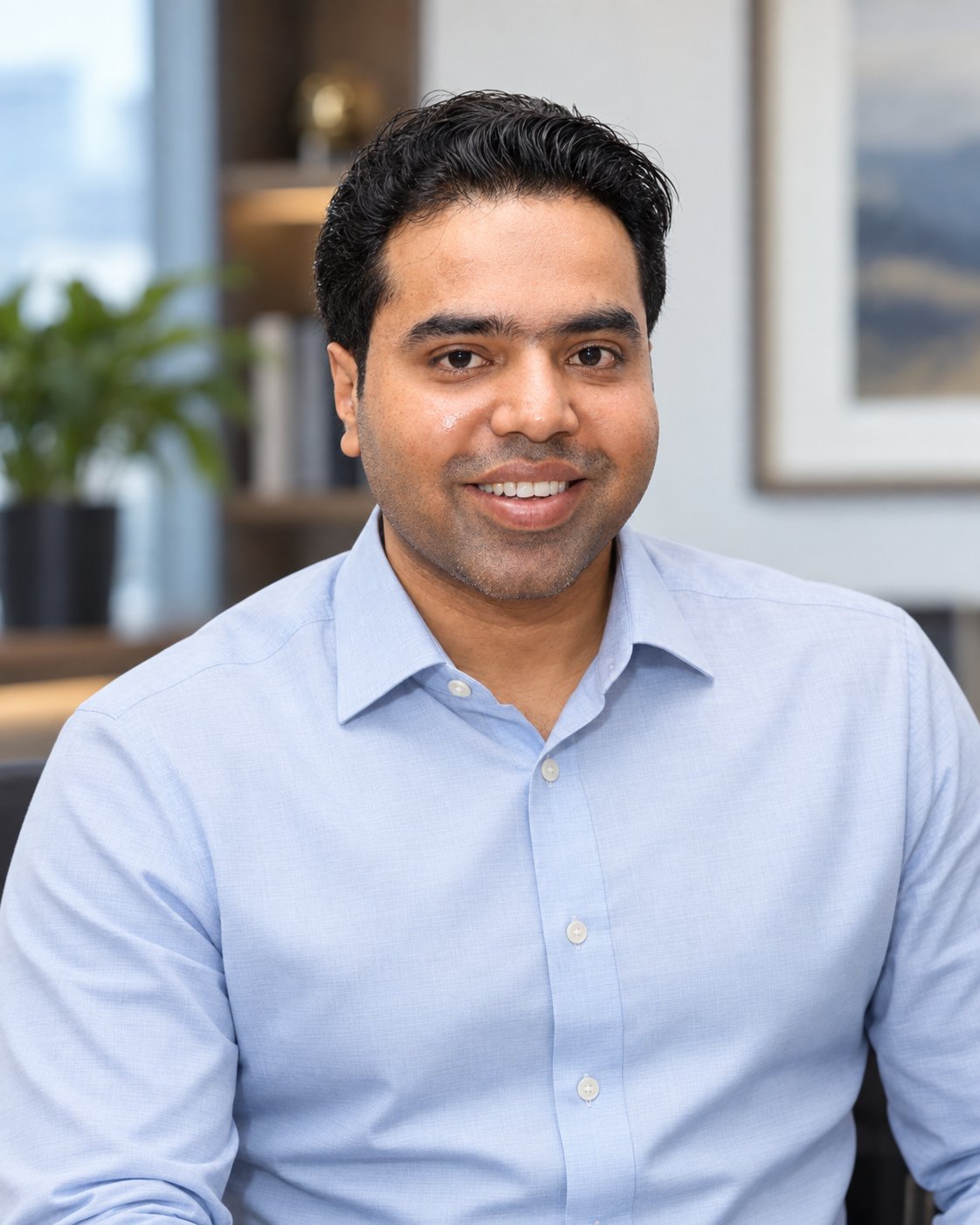
Syed Raheel Shahzad — سيد راحيل شهزاد
Official author image supporting the scholarly identity of Syed Raheel Shahzad, whose research and publications are represented across Google Scholar and public academic repositories alongside his wider author catalog.
Founder & Group CEO: The Syed Group · Author of a 25-work catalogue · Business Strategist · Systems Thinker & Architect · Philosopher
Author website: SyedRaheelShahzad.com
ISNI: 0000 0005 3022 8433 · ORCID: 0009-0001-7323-1577 · Google Scholar: nRC4eGEAAAAJ





Leave a Reply
Want to join the discussion?Feel free to contribute!