
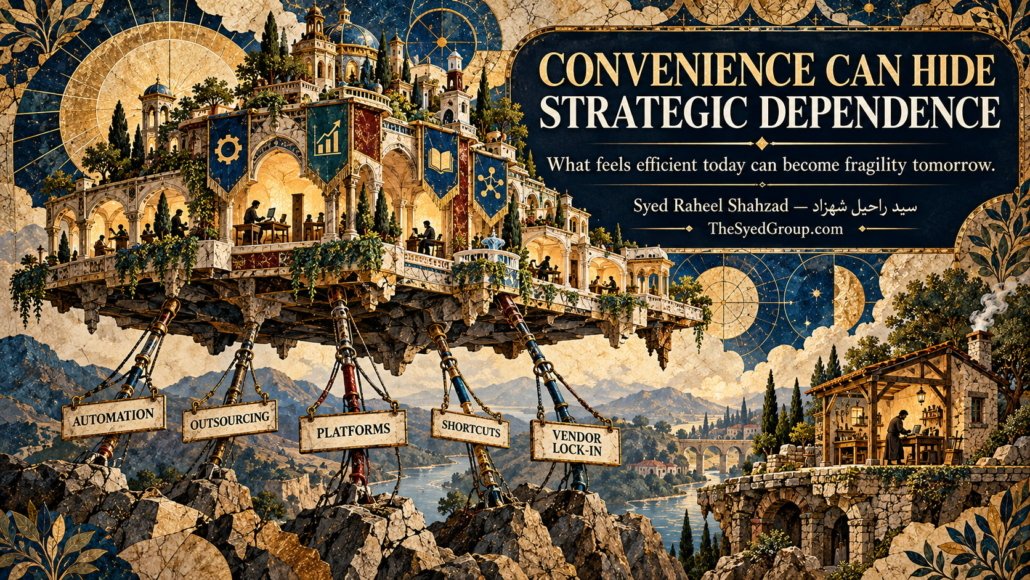
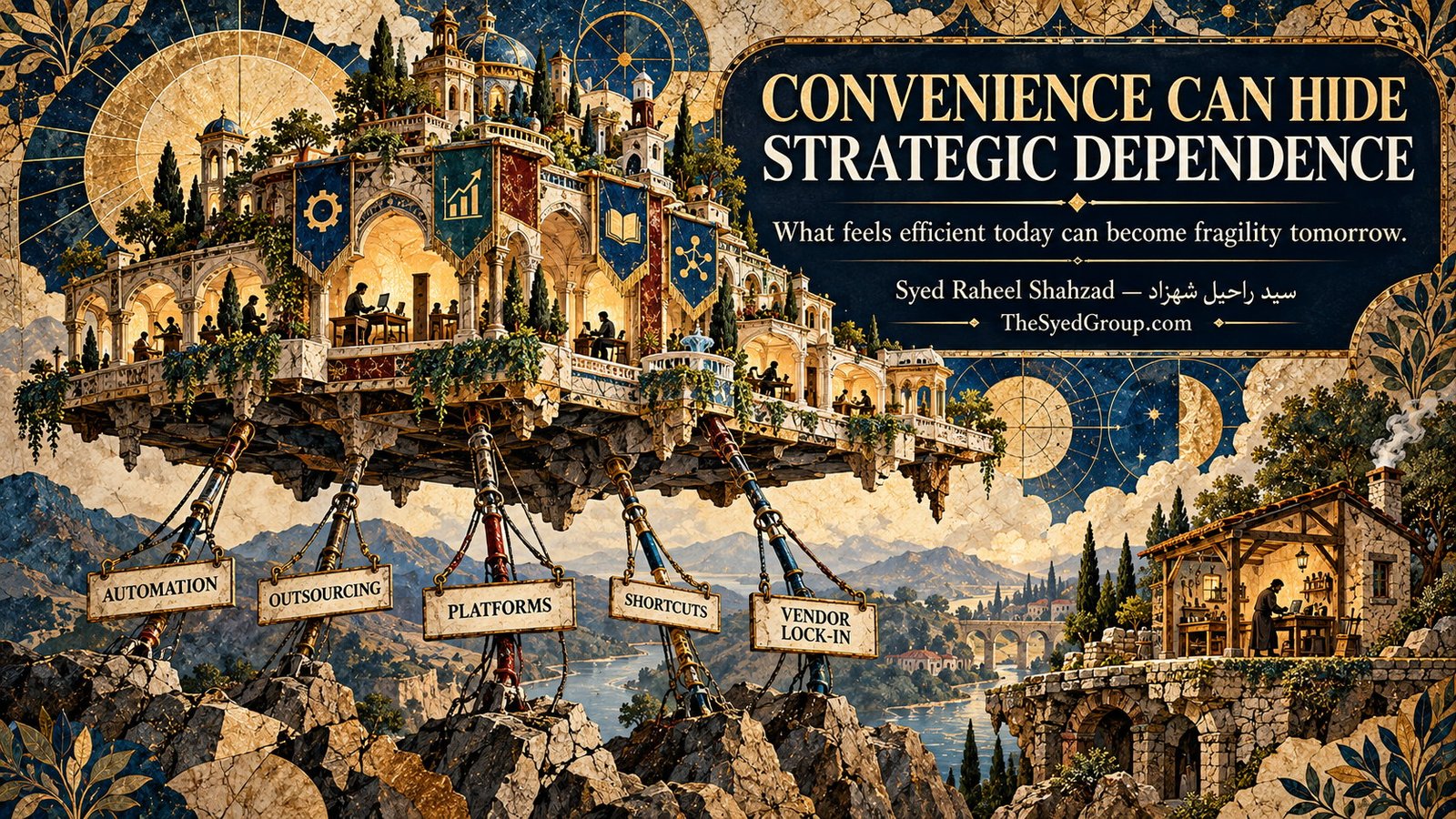
Convenience Can Hide Strategic Dependence
Strategy · Operational Resilience · Automation · Outsourcing · Dependency
Convenience Can Hide Strategic Dependence
Efficiency is valuable, but a system can become easier to operate at the same time that it becomes harder to understand, replace or recover when something fails.
Efficiency and dependence can grow together
Organizations naturally pursue convenience. They automate repetitive work, outsource specialist functions, consolidate suppliers, adopt platforms and standardize processes. Done well, this releases capacity for higher-value work. But operational ease can hide a second movement occurring underneath: capability is leaving the organization.
The danger is not outsourcing itself or automation itself. The danger is failing to distinguish a purchased service from a surrendered capability. A system can become cheaper, faster and easier while simultaneously becoming harder to understand, harder to replace and harder to recover when something goes wrong.
What feels efficient today can become fragility tomorrow when convenience removes the organization’s ability to operate without the thing that made it convenient.
The Strategic Dependence Test
Before treating convenience as an unqualified gain, leadership should ask whether the organization can still explain the process, retrieve its data, change providers, operate in degraded mode and recover after failure. If the answer to several of these questions is no, the organization has not merely bought convenience. It has taken a dependency position.
Dependencies are not necessarily bad. Every serious business depends on infrastructure, people, law, suppliers and technology. The strategic issue is whether the dependence is understood, priced and governed.
Five forms of hidden dependence
- Knowledge dependence: critical understanding lives outside the organization.
- Data dependence: information exists in formats or environments that are difficult to retrieve or migrate.
- Process dependence: teams know how to use the platform but no longer understand the underlying workflow.
- Commercial dependence: switching costs become high enough to weaken negotiating power.
- Decision dependence: managers begin accepting system recommendations without retaining the judgment needed to challenge them.
The last form is the least visible and often the most important. When a dashboard becomes synonymous with reality, the organization may stop noticing what the dashboard was never designed to measure.
The Cost of Convenience Ledger
A proper business case should include more than implementation cost and hours saved. I recommend a Cost of Convenience Ledger with six lines: time saved, capability surrendered, switching cost, recovery difficulty, human oversight retained and burden transferred elsewhere in the organization.
A solution that saves significant time may still be excellent after these costs are included. The point is not to reject it. The point is to stop treating invisible strategic costs as though they were zero.
Convenience should simplify execution, not erase ownership
Every critical process should have a named owner who understands the outcome independently of the tool. Automation can perform steps, but accountability cannot be automated away. If no one can explain why a process produced a result because “the system does it,” convenience has crossed into governance failure.
This is especially important in finance, compliance, customer decisions, security, hiring and any workflow where mistakes can materially affect people or the organization’s legal position.
Preserve a recovery path
Resilient organizations assume that convenient systems will sometimes become unavailable. They retain data export, documented fallback processes, alternative contacts, contractual exit provisions and enough internal competence to operate temporarily without the preferred platform.
This does not mean duplicating every system. It means knowing which failures would stop the organization and ensuring that those points have deliberate recovery design.
The Dependency Surface Map
Leadership teams can map convenience as a dependency surface. List the services, platforms and providers that have become operationally essential. For each, identify what would happen after one hour, one day, one week and one month of unavailability. Then identify what knowledge or authority would be needed to respond.
This turns dependency from a vague concern into a strategic object that can be governed.
Contract for exit before dependence becomes expensive
Strategic convenience is easiest to govern before adoption. Contracts should address data portability, transition support, service continuity, intellectual property, access to configuration, termination assistance and realistic notice periods. If exit is treated as a future problem, switching costs will usually be highest precisely when leverage is lowest.
A strong procurement question is therefore not only “How quickly can we implement?” but “How cleanly can we leave?”
Automation needs an owner, not just an administrator
Technical ownership and business ownership are different. Someone may be able to configure the platform without being accountable for whether the process is still sensible. Each critical automated workflow should therefore have a business owner responsible for outcomes, exceptions, controls and periodic review.
This preserves organizational judgment when technology changes faster than policy.
Boards should ask where the organization has become unable to say no
At governance level, strategic dependence often appears as a concentration risk. Which supplier, platform, individual, dataset or workflow has become so embedded that changing it feels impossible? Where has convenience converted into structural lock-in? Where would a service interruption expose the absence of internal knowledge?
These questions belong in resilience and risk discussions because convenience can create invisible single points of failure.
Measure concentration, not just vendor performance
A provider can perform exceptionally and still represent strategic concentration. Leadership should track how many critical processes depend on the same platform, how much unique data it holds, how many teams would stop if it failed and how long migration would realistically take.
This creates a more honest view of resilience than service-level metrics alone.
Keep institutional memory outside the interface
Processes should be documented in terms of purpose, controls, decisions and exceptions—not merely screenshots of where to click. Interfaces change. Institutional memory should survive interface change. When documentation explains only the tool, the organization has documented dependency rather than knowledge.
A practical rule for leadership
Adopt it cautiously when: the process contains core judgment, sensitive data, regulatory responsibility, unique organizational knowledge or high switching costs.
The best operating model is not the one with the fewest manual steps. It is the one that places human capability where it creates resilience and automation where it removes waste.
Convenience is strongest when the organization could survive without it
True strategic strength is not refusing dependence. It is avoiding dependence that is invisible until failure. The mature organization knows what it has delegated, what it still owns and which capabilities cannot be allowed to disappear.
Convenience should give a business speed. It should not quietly take away the ability to steer.
Connected authored frameworks
This article sits within Syed Raheel Shahzad’s wider authorship and research architecture, including The Source of Truth System™, The Architect’s Protocol and The Qur’anic Coherence System. Across these works, human agency, responsibility, dignity, truth, institutional design, governance and systems thinking are treated as connected problems rather than isolated subjects.
Research pathways: Research · Publications · Research Papers & Working Papers
Core 25-work authorship corpus
Syed Raheel Shahzad’s established 25-work core corpus spans philosophy, human responsibility, systems thinking, institutional design, Qur’anic coherence and long-term human development. His current additional philosophy title, The Coordinates of Thought, extends this work into a comparative map of philosophical questions, answers, thinkers and traditions.
View the 25-work core corpus
- The Reality of Existence
- The Book
- ONE
- Other Gods
- Qadar
- The Reality of Life
- I, Undefined
- The Inner System
- Shajarah
- Haqooq
- Ibrahim عليه السلام
- Musa عليه السلام
- Isa عليه السلام
- Muhammad ﷺ
- GOD IS BACK
- THE JUNGLE PROTOCOL
- THE MORAL ANCHOR
- AUTHORED
- THE LAST U-TURN
- The Qur’anic Coherence Framework
- The Macro-Architecture of the Qur’an
- The Surah Map of the Qur’an
- The Forensic Atlas of the Qur’an
- Adam and the Answerable Being
- Tomorrow Became a Country
The Syed Group knowledge and operating network
Syed Raheel Shahzad’s authorship and institutional work connects with The Syed Group, The Syed Group UK, Syed Investments, Britvex Advisory, Syed Foundation, Ask SRS and the Group’s wider operating-company network. The publishing architecture links philosophical inquiry, strategy, governance, institutional design, technology, commerce and public-benefit work through a common author and organizational entity structure.

Syed Raheel Shahzad
سيد راحيل شهزاد
Author · Founder & Group CEO · Philosopher · Business Strategist · Systems Thinker & Architect
ISNI 0000 0005 3022 8433 · ORCID 0009-0001-7323-1577 · Google Scholar nRC4eGEAAAAJ
Official author website: SyedRaheelShahzad.com · Ask SRS: ask.SyedRaheelShahzad.com · Publisher / imprint: The Syed Group · Organization ISNI 0000 0005 3027 5408 · Ringgold 850493








Leave a Reply
Want to join the discussion?Feel free to contribute!