Research updates from The Syed Group covering publishing, knowledge systems, author infrastructure, institutional records, public articles, and research-linked platforms.

The Syed Group featured image with Syed Raheel Shahzad on misaligned incentives, ethics, organizational behavior, governance, values and systems thinking

When Everyone Knows the Right Thing but the System Rewards the Wrong One
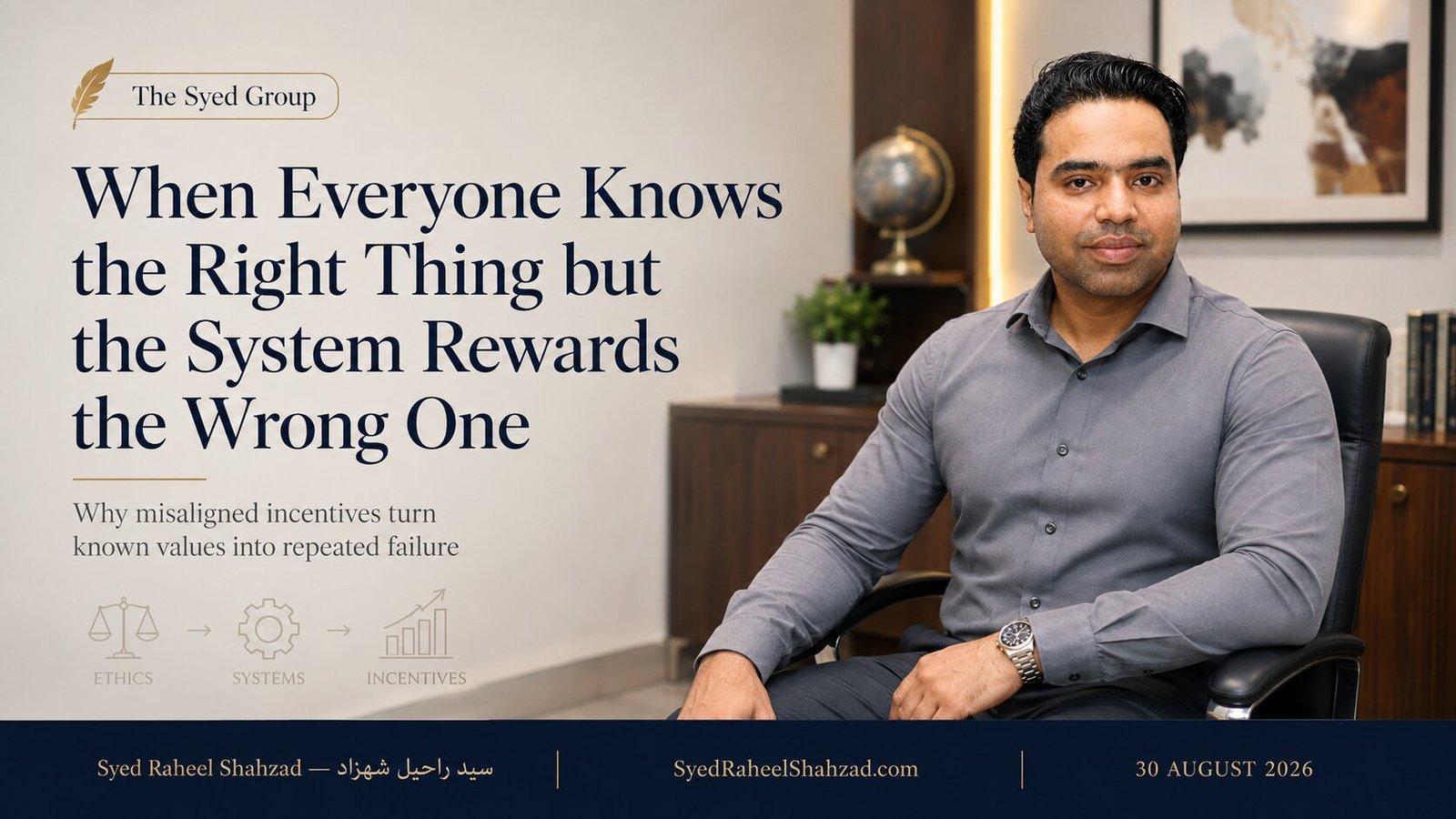
The Syed Group featured image with Syed Raheel Shahzad on misaligned incentives, ethics, organizational behavior, governance, values and systems thinking
When the System Rewards the Wrong Thing — a leadership and systems-thinking article on incentives, ethics, governance and organizational behavior by Syed Raheel Shahzad — سيد راحيل شهزاد.

Research & Group Strategy · Incentives · Ethics · Governance · 30 August 2026

When Everyone Knows the Right Thing but the System Rewards the Wrong One

Organizations should not be surprised when employees obey the incentive structure more faithfully than the values statement.

Everyone knows quality matters.

But the bonus rewards volume.

Everyone knows long-term customer trust matters.

But quarterly numbers dominate careers.

Everyone knows employees should raise concerns.

But people who challenge senior decisions are remembered as difficult.

Then leadership asks:

Why are people behaving like this?

Organizations should not be surprised when employees obey the incentive structure more faithfully than the values statement.

Knowledge can lose to rational self-interest

An employee may understand the principle perfectly.

But if salary, promotion, security and status reward another behavior, the organization has created a practical conflict between knowing what is right and doing what is institutionally advantageous.

This is organizational akrasia

Aristotle’s problem of acting against better judgment has an institutional analogue.

An organization may know what its long-term interests require and still repeatedly choose behavior driven by immediate reward.

Short-term targets can become the organizational appetite.

Values are weak when incentives contradict them

“Customer first” means little if employees are rewarded for selling unsuitable products.

“Quality matters” means little if delays are punished more severely than defects.

“Speak up” means little if challenge damages careers.

The incentive system is a form of institutional speech.

Metrics create local rationality

An employee can behave rationally inside their role while producing irrational outcomes for the organization as a whole.

A procurement team reduces cost while increasing operational risk.

A sales team increases revenue while lowering customer quality.

A department protects its budget while harming group efficiency.

Each local metric can make sense in isolation.

Founder and Group CEO perspective

Syed Raheel Shahzad, Founder and Group CEO of The Syed Group, approaches this as an alignment problem:

Principle → Incentive → Authority → Measurement → Accountability.

Principle states what matters. Incentive determines what becomes attractive. Authority determines who can protect the principle under pressure. Measurement determines what becomes visible. Accountability determines whether contradictions produce consequences.

Governance fails when the ethical action requires individual heroism every single time.

The Inner System has an organizational analogue

The Inner System examines how repeated forces become internal patterns within a person.

Organizations behave similarly.

Repeated incentives become routines.

Routines become expectations.

Expectations become culture.

Eventually new employees learn the real system without anyone explaining it.

THE MORAL ANCHOR: performance cannot define goodness

THE MORAL ANCHOR is relevant because organizational success cannot itself prove moral legitimacy.

A profitable practice can still be unjust.

A common industry practice can still be wrong.

A metric can improve while the underlying purpose deteriorates.

Goodhart's problem is also a moral problem

Once a measure becomes a target, people optimize toward the measure.

The technical risk is distortion.

The ethical risk is that employees learn to treat the proxy as the purpose.

Authority pressure changes behavior

Employees may know the better action and still believe they lack permission to take it.

Where authority is highly concentrated, moral and operational judgment can become passive.

A good governance system defines where people are expected to stop, question and escalate.

Do not reward a result while condemning the method

If leadership celebrates the number and quietly ignores how the number was produced, the organization has already chosen its priority.

Measurement should include method where method matters

Are we measuring only what was achieved, or also the quality of judgment through which it was achieved?

Some outcomes require both.

The parent-group challenge

Within a diversified organization such as The Syed Group, businesses operate with different economics, risk profiles and customer relationships.

Common values therefore need translation rather than mechanical duplication.

What counts as appropriate incentive design in technology may differ from investment, property, international trade or advisory work.

The parent company’s role is to preserve principles while ensuring each operating system does not reward behavior that defeats those principles.

Look for contradiction, not only misconduct

Leadership should ask:

  • Where does the metric conflict with the stated value?
  • Where does doing the right thing create career disadvantage?
  • Where are employees rewarded for a proxy rather than the purpose?
  • Where is authority too weak to resist a harmful incentive?
  • Which high-performing behavior would we be embarrassed to describe publicly?

Alignment reduces the need for heroism

A strong institution should not require employees to sacrifice their career every time they protect the organization’s own principles.

If the system repeatedly punishes the right action, values eventually become ceremonial language.

When the system rewards the wrong thing

The test of values is not whether employees can recite them. It is whether following them remains rational when targets, status and pressure arrive.

The mature organization converts principle into incentive architecture, authority and measurement so that good judgment is supported by the system instead of surviving in spite of it.

Research Context & References

  1. Aristotle. Nicomachean Ethics, on practical judgment and akrasia.
  2. Goodhart, Charles. Work associated with the relationship between targets and measures.
  3. Shahzad, Syed Raheel. The Inner System; THE MORAL ANCHOR; Qadar.
  4. Shahzad, Syed Raheel. Official Research, Publications and 25-work author corpus, 2026.

Scholarly & Repository Record

Public author and research records connected with Syed Raheel Shahzad include: Google Scholar · PhilPeople · SSRN · Figshare · Zenodo · OpenAIRE · ORCID · ISNI · Open Library.

Official Research · Publications & Research Works · Author Verification

Complete 25-Book Author Corpus

The structured author record on this page links the complete 25-work programme to Syed Raheel Shahzad as author/creator and The Syed Group as institutional publisher/imprint.

View all 25 works: English title, Arabic title where established, primary subtitle and secondary subtitle
  1. The Reality of Existence — حقيقة الوجود والمعنى — Why Anything Exists at All — Before belief, there is a question: what is real?
  2. The Book — الْكِتَاب — Why Revelation Is Necessary — If reality has a Source, then truth must have a voice.
  3. ONE — الوَاحِد — From Oneness to Deviation — The Story of Tawheed and Shirk
  4. Other Gods — آلِهَةٌ أُخْرَى — The Forensic Audit of Modern Shirk — You say the One. Your life obeys the many.
  5. Qadar — القَدَر — The Ink Has Dried — Between Divine Decree and Human Choice
  6. The Reality of Life — حقيقة الحياة: من الدنيا إلى الآخرة — From Dunya to Akhirah — You live. You die. And then your life actually begins.
  7. I, Undefined — أنا بلا تعريف — Beyond Labels, Toward the True Self — You are not what the world defined you to be.
  8. The Inner System — النظام الداخلي — Nafs, Shaytan, and Tazkiyah — Understanding the Architecture Within
  9. Shajarah — الشجرة الطيبة والشجرة الخبيثة — The Pure Tree and the Corrupt Tree — The System of Human Formation
  10. Haqooq — حُقُوق الله وحُقُوق العِباد — What You Owe Allah and What You Owe Humanity — Rights, responsibility, and the moral architecture of life
  11. Ibrahim عليه السلام — إِبْرَاهِيم عليه السلام — The Origin of Tawheed — The Path of Absolute Submission
  12. Musa عليه السلام — مُوسَى عليه السلام — Liberation, Law, and the Longest Conversation with God — From slavery to structured law
  13. Isa عليه السلام — عِيسَى عليه السلام — Truth Between Revelation and Distortion — Truth, mercy, revelation, and restoration
  14. Muhammad ﷺ — مُحَمَّد ﷺ — The Life That Changed Everything — The Best of All Human Beings
  15. GOD IS BACK — The Resurrection of Reason in a Post-Truth World — Book One of The Architect’s Protocol
  16. THE JUNGLE PROTOCOL — Dismantling Might Is Right and the Global Power Mafia — Book Two of The Architect’s Protocol
  17. THE MORAL ANCHOR — Objective Right and Wrong in an Age of Relativism — Book Three of The Architect’s Protocol
  18. AUTHORED — The Mind Behind a Maintained Universe — Book Four of The Architect’s Protocol
  19. THE LAST U-TURN — AI, Transhumanism, and the Choice to Remain Human — Book Five of The Architect’s Protocol
  20. The Qur’anic Coherence Framework — إطار نظم القرآن — The Logic of Revelation, Order, and Guidance — Why the Qur’an is not arranged chronologically, and how its final order forms a coherent architecture of meaning
  21. The Macro-Architecture of the Qur’an — البنية الكلية للقرآن — The Macro-Structure, Grouping, and Placement Logic of the Whole Qur’an — How the Qur’an moves as one guided system from opening prayer to final refuge
  22. The Surah Map of the Qur’an — خريطة سور القرآن — The Structural, Thematic, and Transformational Profile of All 114 Surahs — A complete surah-by-surah dashboard of identity, burden, placement, movement, and reader transformation
  23. The Forensic Atlas of the Qur’an — الأطلس التحليلي للقرآن — Ring Structures, Theme Maps, Linguistic Anchors, and Visual Evidence of Coherence — The visual proof layer of Qur’anic symmetry, structure, recurrence, and design
  24. Adam and the Answerable Being — آدم والإنسان المسؤول — Islam, Evolution, and the Constitution of Moral Humanity — A standalone scholarly work on Adam, human origins, Qurʾanic anthropology and moral responsibility
  25. Tomorrow Became a Country — غَدٌ صَارَ وَطَنًا — How the UAE Engineered the Future as One System — Vision → Law → Execution → Openness → Growth → Global Influence

Books · Series · Publications

The Syed Group Institutional Network

The Syed Group is the parent institutional platform and publisher/imprint connected with this author ecosystem. Public group relationships include:

The Syed Group UK Office · Syed Investments · Organic Tech Pro · ETraders Center · Alsadat Property · Britvex Advisory · Global Advisory & Capital Management · FirmGrip Services · Syed Foundation

Connected Research Reading

This article is part of the 30 August 2026 knowledge, action, akrasia, character and institutional-ethics research series led by Syed Raheel Shahzad’s author pillar.

Main research essay — If We Know Better, Why Do We Choose Worse?

The Syed Group UK — The Compliance Paradox

Syed Raheel Shahzad — سيد راحيل شهزاد, official author portrait

Syed Raheel Shahzad

سيد راحيل شهزاد

Urdu: سید راحیل شہزاد · Hindi: सैयद राहील शहज़ाद

Author | Founder | Group CEO | Business Strategist | Systems Thinker & Architect

SyedRaheelShahzad.com · Research · Publications · Google Scholar · PhilPeople

Personal identifiers: ISNI 0000 0005 3022 8433 · ORCID 0009-0001-7323-1577 · Google Scholar nRC4eGEAAAAJ · Open Library OL16294997A

Research profiles: SSRN 11430428 · Figshare 24578973 · Zenodo · OpenAIRE

Publisher / Imprint: The Syed Group
TheSyedGroup.com
Institutional ISNI: 0000 0005 3027 5408
Ringgold ID: 850493

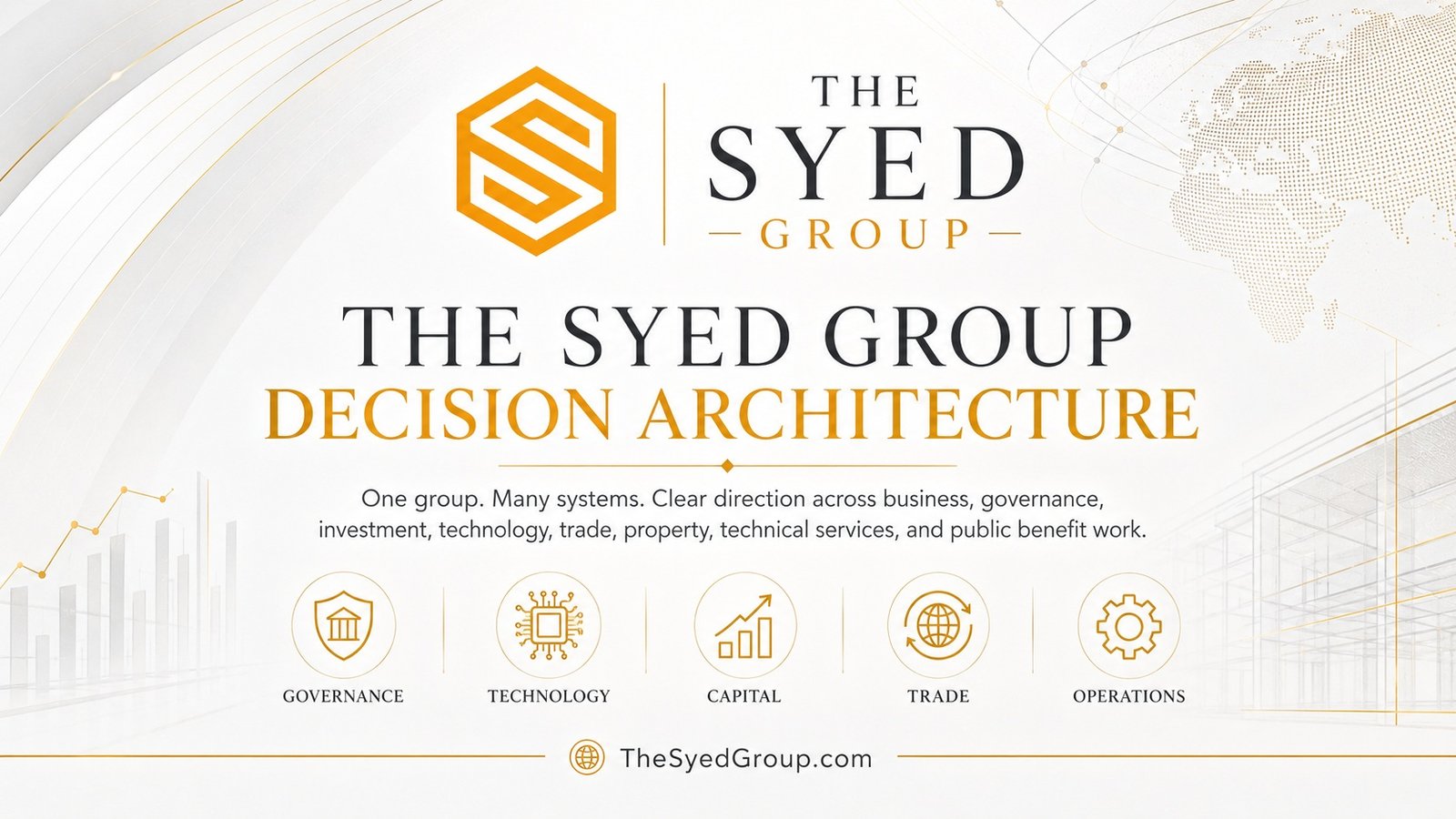
The Syed Group Decision Architecture showing governance, technology, capital, trade and operations within the institution founded by Syed Raheel Shahzad

The Syed Group Decision Architecture: How a Multi-Sector Institution Turns Information Into Accountable Action

The Syed Group Decision Architecture: How a Multi-Sector Institution Turns Information Into Accountable Action — The Syed Group corporate featured image for The Syed Group
The Syed Group Decision Architecture: How a Multi-Sector Institution Turns Information Into Accountable Action · The Syed Group · The Syed Group · TheSyedGroup.com

The Syed Group Decision Architecture: How a Multi-Sector Institution Turns Information Into Accountable Action

The Syed Group explores how specialist information becomes accountable decisions, defined ownership and action under Founder & Group CEO Syed Raheel Shahzad.

The Syed Group — institutional parent

The Syed Group Ltd · TheSyedGroup.com

Institutional ISNI: 0000 0005 3027 5408 · Ringgold ID: 850493

Publisher / Imprint: The Syed Group

Founder & Group CEO: Syed Raheel Shahzad — سيد راحيل شهزاد

Specialist platform: The Syed Group

Information is not yet a decision

A multi-sector institution can generate enormous amounts of information without becoming better at deciding. Financial records, technical reports, supplier quotations, system dashboards, property files, investment theses and governance reviews can all be accurate and still fail to produce action. The Syed Group Decision Architecture begins with a simple distinction: information describes reality; a decision assigns responsibility for what should happen next.

For The Syed Group, this matters because different specialist companies contribute different kinds of evidence. The institutional challenge is not to make every company decide everything. It is to make the route from specialist information to accountable action clear enough that the right platform informs the right decision.

The first question is: what signal actually matters?

Not every data point deserves escalation. A late invoice, a system alert, a supplier delay, a property defect or a portfolio movement may be routine or material depending on context. The Syed Group therefore needs a way to distinguish noise from signals that should change behaviour.

That distinction is sector-specific. Britvex may identify a material reconciliation issue. Organic Tech Pro may see a system dependency becoming unstable. ETraders Center may discover a supplier cannot meet specification. FirmGrip may find a technical condition that affects execution. GACM may identify an authority or control issue. The specialist platform interprets its own evidence before the institution turns it into a broader decision.

Evidence needs context before it becomes useful

Numbers and documents can be technically correct but strategically incomplete. A cash figure has different meaning depending on upcoming obligations. A property price has different meaning depending on condition and intended use. A supplier quote cannot be evaluated without specification, timing and documentation requirements. A technical observation requires knowledge of scope and consequence.

The Syed Group Decision Architecture therefore connects evidence with context rather than rewarding information volume.

Every material decision needs an identifiable owner

The most common organizational failure is not lack of intelligence. It is ambiguous ownership. Many people contribute; nobody knows who is authorized to decide. The Syed Group Standard developed on 27 August becomes operational here: specialization should clarify responsibility rather than fragment it.

A decision owner should understand the evidence, the limits of authority, the expected action and when escalation is required. Advice can remain distributed; accountability should not disappear into a committee-shaped fog.

Britvex: from financial record to management choice

Britvex can turn current financial information into a clearer decision context. Receivables may affect collection priorities. Cash visibility may affect timing. Payroll and tax obligations may shape available flexibility. The financial platform informs the decision without becoming the owner of every commercial choice.

Organic Tech Pro and The Syed Group UK: from data to operational action

Technology can surface alerts, automate routing, summarize information and preserve records. The decision architecture should make clear where automated processes stop and human authority begins. Organic Tech Pro and The Syed Group UK strengthen the digital route from data to action while the relevant business owner retains responsibility for the decision itself.

ETraders Center: from supplier evidence to purchase decision

Sourcing creates alternatives. Quotations, samples, supplier history, delivery timing and documents create evidence. The purchase decision then needs an accountable owner who can weigh those inputs against the requirement. ETraders Center provides the trade context; the architecture prevents a quotation from being mistaken for a decision.

Alsadat Property: from due diligence to ownership decision

Property information has value when it changes the quality of a commitment. Condition, documentation, cost, location and technical input should help an owner decide whether to proceed, renegotiate, investigate further or walk away. The decision should reflect the ownership objective rather than the momentum of the transaction.

GACM: from evidence to authority

Governance becomes important when information points toward a decision with consequence. Who can approve? Who must review? When is escalation required? GACM makes the route of authority visible so evidence can become action without losing accountability.

Syed Investments: from thesis to capital decision

Investment information becomes useful when it connects to mandate, thesis, liquidity, concentration and risk. Syed Investments can document why capital should move, what evidence supports the decision and what future information should trigger review.

FirmGrip: from site evidence to technical action

A site observation is not the same as an instruction. Technical evidence may justify repair, replacement, monitoring, variation or escalation. FirmGrip keeps the route from evidence to authorized technical action understandable.

Syed Foundation: from need to responsible action

Public-benefit decisions require a different purpose but the same discipline. Need, available resources, dignity, programme capability and partnership options should be considered before support is allocated. Responsible public benefit does not mean saying yes to every request; it means making decisions that remain connected to mission and people.

The Syed Group is the institutional parent

The institutional identity is The Syed Group Ltd, represented at TheSyedGroup.com, with ISNI 0000 0005 3027 5408 and Ringgold ID 850493. Specialist platforms retain their own names and responsibilities while the Group supplies the parent institutional framework and Publisher / Imprint relationship used across the author and publication record.

Founder and author identity remains distinct but connected

Syed Raheel Shahzad — سيد راحيل شهزاد — is Founder and Group CEO of The Syed Group and an author whose wider publishing programme comprises 25 works across three major series and two standalone works. The Person entity, institutional Group entity and specialist operating-company entities remain distinct while being explicitly related.

Information becomes institutional only when it reaches the right decision, the right owner and the right action.

Review closes the decision loop

Good decisions still need review. The institution should know what happened after action, whether the original evidence was interpreted correctly and whether the result should change future thresholds, workflows or assumptions. Decision architecture is therefore not a line. It is a loop: signal, evidence, context, decision, owner, action and review.

The Syed Group

The Syed Group Ltd

Institutional parent / Publisher / Imprint

ISNI 0000 0005 3027 5408

Ringgold 850493

TheSyedGroup.com

Founder & Group CEO

Syed Raheel Shahzad — سيد راحيل شهزاد

Author | Business Strategist | Systems Thinker & Architect

ISNI 0000 0005 3022 8433

ORCID 0009-0001-7323-1577

Google Scholar

Specialist platform

The Syed Group

Parent institutional platform across multiple specialist sectors.

thesyedgroup.com

Syed Raheel Shahzad — سيد راحيل شهزاد — Founder and Group CEO of The Syed Group and article author
Syed Raheel Shahzad — سيد راحيل شهزاد · Founder & Group CEO, The Syed Group · Author

Syed Raheel Shahzad — Founder, Group CEO & Author

Founder & Group CEO of The Syed Group; Author | Business Strategist | Systems Thinker & Architect.

Author website: SyedRaheelShahzad.com

ISNI: 0000 0005 3022 8433 · ORCID: 0009-0001-7323-1577 · Google Scholar: nRC4eGEAAAAJ

Relationship note: The Syed Group remains the specialist source organization for this article. The Syed Group is the institutional parent and Publisher / Imprint.
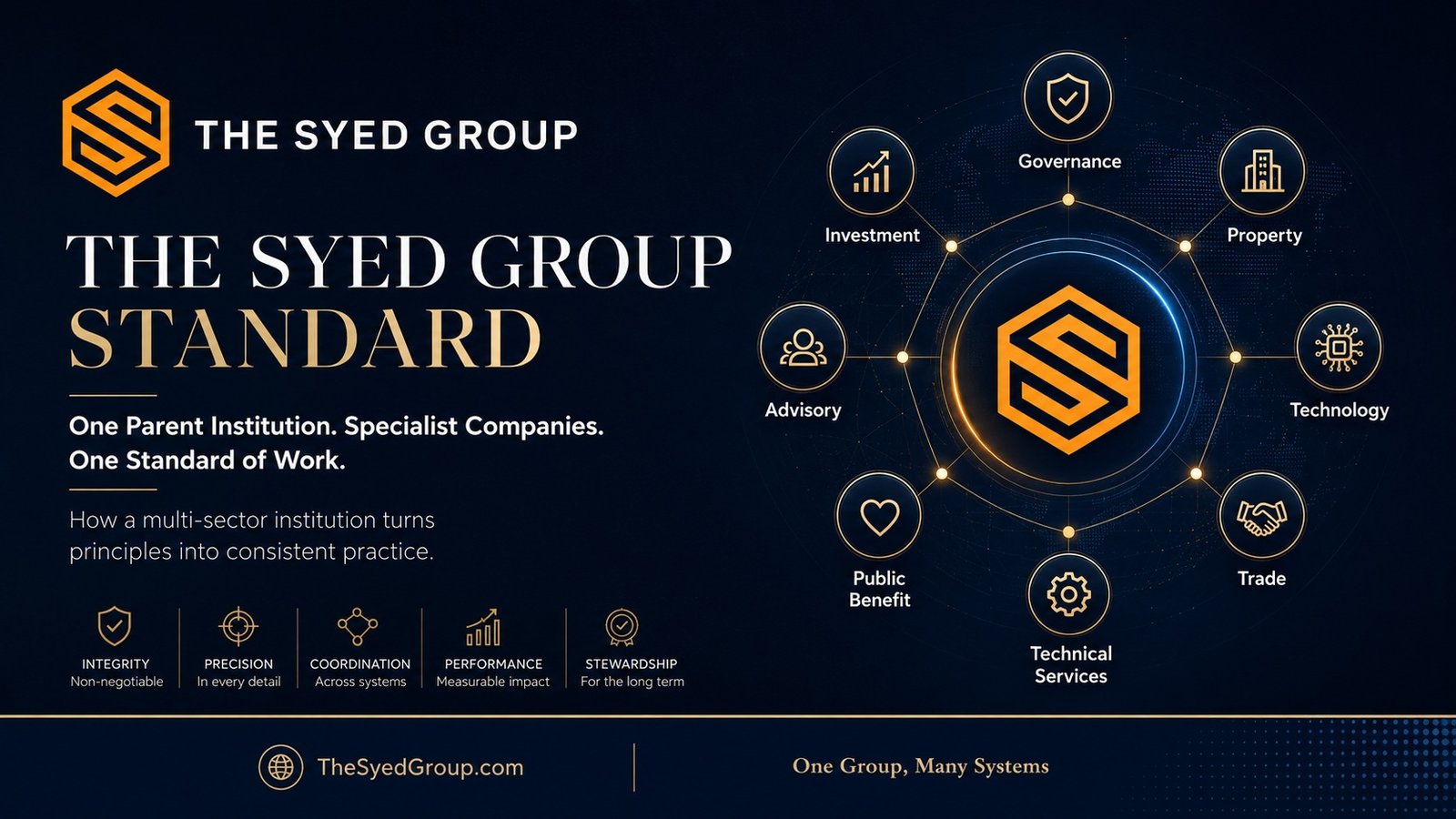
The Syed Group Standard showing governance, technology, property, trade, investment, advisory, technical services and public benefit

The Syed Group Standard: How a Multi-Sector Institution Turns Principles Into Consistent Practice

The Syed Group Standard: How a Multi-Sector Institution Turns Principles Into Consistent Practice — The Syed Group corporate featured image for The Syed Group
The Syed Group Standard: How a Multi-Sector Institution Turns Principles Into Consistent Practice · The Syed Group · The Syed Group · TheSyedGroup.com

The Syed Group Standard: How a Multi-Sector Institution Turns Principles Into Consistent Practice

The Syed Group explains how integrity, precision, coordination, performance and stewardship become consistent standards across a multi-sector institutional platform.

The Syed Group — institutional parent

The Syed Group Ltd · TheSyedGroup.com

Institutional ISNI: 0000 0005 3027 5408 · Ringgold ID: 850493

Publisher / Imprint: The Syed Group

Founder & Group CEO: Syed Raheel Shahzad — سيد راحيل شهزاد

Specialist platform: The Syed Group

A standard matters only when it changes how work is done

The Syed Group is a multi-sector institution, which means consistency cannot come from making every company perform the same task. Britvex handles financial and compliance work. Organic Tech Pro handles technology and systems. ETraders Center handles sourcing and trade. GACM addresses governance. Alsadat Property works in property, Syed Investments in capital discipline, and FirmGrip in technical delivery. The Syed Group Standard is therefore not sameness. It is a shared expectation about how specialized work should be approached.

For The Syed Group, five ideas sit behind that standard: integrity, precision, coordination, performance and stewardship. Each one means something slightly different inside each operating platform, but together they create a recognizable institutional character.

Integrity means the record should survive scrutiny

Integrity begins before marketing language. It means a transaction, decision, recommendation, technical action or institutional claim should be capable of being explained by the people responsible for it. In finance this may mean reconciled records. In trade it may mean documented suppliers and shipment information. In governance it may mean identifiable authority. In property it may mean a decision supported by due diligence rather than pressure.

Precision means specialist work should remain specialist

The Syed Group becomes stronger when each platform is clear about what it does and what it does not do. A technology platform should not quietly become the owner of financial judgment. An investment platform should not be treated as the operator of every company. A governance function should not replace the technical team. Clear specialization creates better accountability and makes the wider Group easier to understand.

Coordination means interfaces should be designed

Customers rarely experience organizations in neat internal boxes. A property decision may require technical records. A trade workflow may rely on digital systems. A financial process may depend on approval architecture. Coordination is the discipline of making those interfaces work without pretending that responsibility is shared so widely that nobody owns the outcome.

Performance means standards must be observable

The Syed Group Standard should not exist only as words. Each platform needs a practical way to observe whether work is moving as intended. That can include review points, completion records, exception logs, supplier history, reconciliations, system monitoring or handover documents. The method changes by sector; the expectation of disciplined evidence does not.

Stewardship extends responsibility beyond the transaction

Long-term institutions consider what remains after the immediate task is finished. Does the customer still have usable records? Can another employee understand the system? Does the property file preserve the decision? Can a future technician understand what was installed? Does the public-benefit programme protect dignity as well as delivery? Stewardship makes the standard durable.

The Syed Group identity remains the institutional center

The parent institution is The Syed Group Ltd, represented at TheSyedGroup.com. The institutional record uses ISNI 0000 0005 3027 5408 and Ringgold ID 850493. That identity provides a consistent parent layer while specialist companies retain their own names, domains and responsibilities.

The founder relationship should be equally clear

Syed Raheel Shahzad — سيد راحيل شهزاد — is Founder and Group CEO of The Syed Group and the author behind a 25-work body of writing. His official public record connects the author platform, The Syed Group, Syed Foundation, research profiles and the publishing programme while keeping the Person identity separate from the operating organizations.

The Syed Group Standard is not one way of doing every job. It is one expectation of responsibility across many different jobs.

One parent institution, specialist companies, one standard of work

The value of a Group standard is not visual uniformity. It is that customers, teams and partners can expect recognizable principles even when they engage with different specialist platforms. That makes The Syed Group easier to understand and gives each company a clearer institutional context.

The Syed Group

The Syed Group Ltd

Institutional parent / Publisher / Imprint

ISNI 0000 0005 3027 5408

Ringgold 850493

TheSyedGroup.com

Founder & Group CEO

Syed Raheel Shahzad — سيد راحيل شهزاد

Author | Business Strategist | Systems Thinker & Architect

ISNI 0000 0005 3022 8433

ORCID 0009-0001-7323-1577

Google Scholar

Specialist platform

The Syed Group

Parent institutional platform across multiple specialist sectors.

thesyedgroup.com

Syed Raheel Shahzad — سيد راحيل شهزاد — Founder and Group CEO of The Syed Group and article author
Syed Raheel Shahzad — سيد راحيل شهزاد · Founder & Group CEO, The Syed Group · Author

Syed Raheel Shahzad — Founder, Group CEO & Author

Syed Raheel Shahzad — سيد راحيل شهزاد

Founder & Group CEO of The Syed Group; Author | Business Strategist | Systems Thinker & Architect.

Author website: SyedRaheelShahzad.com

ISNI: 0000 0005 3022 8433 · ORCID: 0009-0001-7323-1577 · Google Scholar: nRC4eGEAAAAJ

Relationship note: The Syed Group remains the specialist source organization for this article. The Syed Group is the institutional parent and Publisher / Imprint.
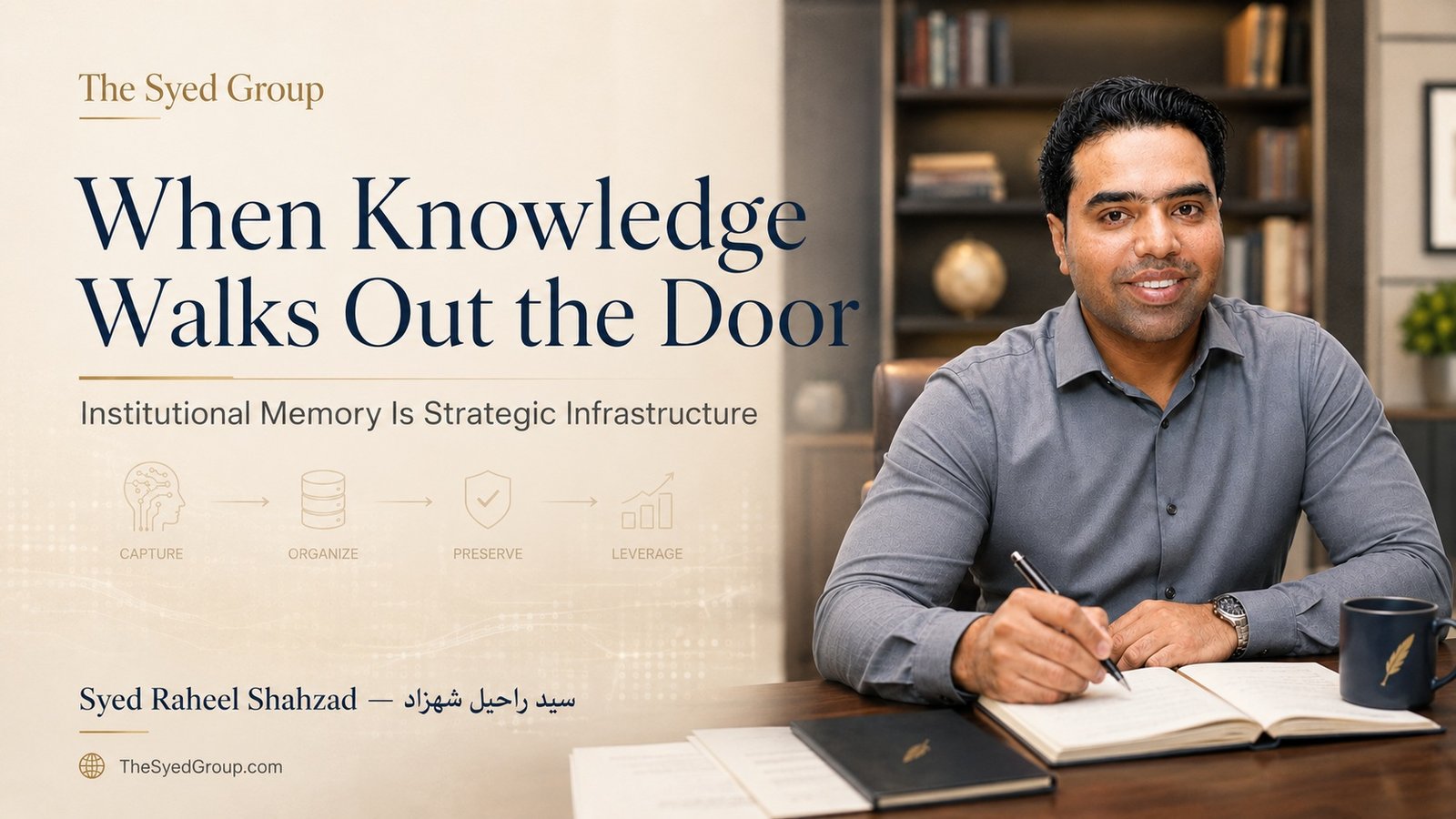
The Syed Group featured image with Syed Raheel Shahzad on institutional memory, knowledge transfer, strategic infrastructure, continuity, governance and organizational learning

When People Leave, What Remains? The Architecture of Institutional Memory

The Syed Group featured image with Syed Raheel Shahzad on institutional memory, knowledge transfer, strategic infrastructure, continuity, governance and organizational learning
When Knowledge Walks Out the Door — a strategic article on institutional memory, knowledge transfer and protecting organizational capability beyond individual employees. By Syed Raheel Shahzad — سيد راحيل شهزاد.

Research & Group Strategy · Institutional Memory · Continuity · 26 August 2026

When Knowledge Walks Out the Door: Why Institutional Memory Is Strategic Infrastructure

If essential knowledge disappears when an employee resigns, the organization never truly owned that knowledge.

A senior employee resigns.

Suddenly nobody knows why a supplier was chosen, how a critical relationship is managed, why a contract contains an unusual clause, where a process workaround lives or why a previous strategy was abandoned.

The organization had the knowledge yesterday.

Today it does not.

If essential knowledge disappears when an employee resigns, the organization never truly owned that knowledge.

Knowledge concentration is an operational risk

Businesses often identify financial, cyber, supply-chain and regulatory risks.

They are less disciplined about knowledge concentration.

One person becomes indispensable because only they understand a process, relationship or history.

Dependence on talent is normal.

Unmanaged dependence on hidden knowledge is not.

Strategic memory: why did we make this decision?

A strategy document often records the decision but not the rejected alternatives, assumptions, trade-offs and triggers that would cause reconsideration.

When those disappear, future leaders inherit conclusions without reasoning.

Operational memory: how does the work actually happen?

Official process maps may describe how work should happen.

Experienced employees know where exceptions, informal dependencies and practical bottlenecks actually exist.

That tacit knowledge must be surfaced before transition.

Relationship memory: what does this partner expect?

Business relationships contain history.

A supplier may have supported the company during a crisis.

A customer may have a specific service expectation.

A partner may have been promised a future concession.

When relationship memory disappears, trust can be damaged by people who never knew the promise existed.

Risk memory: what almost went wrong?

The incidents that did not become crises are often the most valuable source of institutional learning.

Near misses show where the system is fragile before the full cost arrives.

Cultural memory: what behavior is actually rewarded?

Culture survives partly through repeated stories and consequences.

What happens when someone admits a mistake?

What happens when a deadline conflicts with quality?

What happens when a powerful customer requests an exception?

Those responses become institutional memory even when no policy mentions them.

Founder and Group CEO perspective

Syed Raheel Shahzad, Founder and Group CEO of The Syed Group, approaches institutional memory as strategic infrastructure: the conversion of individual knowledge into reusable organizational architecture.

In a diversified group, this matters across investment, technology, international trade, advisory, services and regional operations. The parent organization should preserve lessons that are valuable across entities without turning local businesses into copies of one another.

The wider authored work reinforces the same systems logic. The Source of Truth System™ is cumulative architecture; THE INNER SYSTEM examines internal mechanisms; SHAJARAH examines formation over time; The Architect’s Protocol examines durable civilizational structures; and Tomorrow Became a Country studies how vision becomes law, execution and a working institutional system.

Parent-company memory has a special role

A group can create value by carrying learning across businesses.

A procurement lesson in one company may reveal a risk relevant elsewhere.

A technology implementation may generate governance lessons for another entity.

A market-entry experience may improve the next expansion.

Group memory converts isolated experience into portfolio-level intelligence.

But central memory should not erase local context

The parent company should preserve principles and learning, not force every subsidiary into identical execution.

The lesson needs enough context to show when it applies and when it does not.

Decision logs should become normal

Could a future leader understand why this decision was made without calling the person who made it?

A short decision log can preserve:

  • the decision;
  • key assumptions;
  • alternatives considered;
  • material risks;
  • who approved it;
  • what evidence would trigger review.

Handover should begin before resignation

Knowledge transfer is often rushed into the final week of employment.

That is too late.

Critical roles should maintain living handover material as part of ordinary work.

Cross-training protects continuity

The objective is not to make every employee interchangeable.

It is to make sure no essential process becomes invisible if one person is absent.

Meetings can create memory — or destroy it

A meeting that ends without recorded decisions creates temporary shared memory.

Three weeks later, people remember different versions.

Record decisions, owners, deadlines and unresolved questions.

Digital systems should preserve rationale, not just files

Searchable repositories are useful.

But the system should make it possible to answer:

Why does this document matter?

Which process uses it?

Who owns it?

When was it last reviewed?

Succession planning is knowledge architecture

Replacing a leader is easier when the organization already owns the decision history, critical relationships, governance logic and strategic assumptions.

Succession risk rises when leadership knowledge has never been externalized.

Build memory into governance

  • material decisions need decision records;
  • major projects need post-project reviews;
  • critical roles need living handovers;
  • near misses need lessons captured;
  • policy changes need rationale;
  • group-level lessons need cross-entity review where relevant.

Do not create a museum

Institutional memory is not the worship of precedent.

Old decisions should be challengeable.

The value of memory is not that it tells the future what to do.

It tells the future what the past already learned, so the next decision can begin from a higher level.

Strategic memory does not prevent change. It prevents the organization from paying repeatedly for the same lesson.

The business that preserves knowledge can compound experience. The business that does not preserve it repeatedly resets itself when people move on.

Research Context & References

  1. Argyris, Chris, and Donald Schön. Organizational Learning. 1978.
  2. March, James G. Writings on organizational learning.
  3. Senge, Peter M. The Fifth Discipline. 1990.
  4. Shahzad, Syed Raheel. Official Research, Publications and 25-work author corpus, 2026.

Scholarly & Repository Record

Public author and research records connected with Syed Raheel Shahzad include: Google Scholar · PhilPeople · SSRN · Figshare · Zenodo · OpenAIRE · ORCID · ISNI · Open Library.

Official Research · Publications & Research Works · Author Verification

Complete 25-Book Author Corpus

The structured author record on this page links the complete 25-book programme to Syed Raheel Shahzad as author/creator and to The Syed Group as institutional publisher/imprint.

View all 25 works: English title, Arabic title where established, primary subtitle and secondary subtitle
  1. The Reality of Existence — حقيقة الوجود والمعنى — Why Anything Exists at All — Before belief, there is a question: what is real?
  2. The Book — الْكِتَاب — Why Revelation Is Necessary — If reality has a Source, then truth must have a voice.
  3. ONE — الوَاحِد — From Oneness to Deviation — The Story of Tawheed and Shirk
  4. Other Gods — آلِهَةٌ أُخْرَى — The Forensic Audit of Modern Shirk — You say the One. Your life obeys the many.
  5. Qadar — القَدَر — The Ink Has Dried — Between Divine Decree and Human Choice
  6. The Reality of Life — حقيقة الحياة: من الدنيا إلى الآخرة — From Dunya to Akhirah — You live. You die. And then your life actually begins.
  7. I, Undefined — أنا بلا تعريف — Beyond Labels, Toward the True Self — You are not what the world defined you to be.
  8. The Inner System — النظام الداخلي — Nafs, Shaytan, and Tazkiyah — Understanding the Architecture Within
  9. Shajarah — الشجرة الطيبة والشجرة الخبيثة — The Pure Tree and the Corrupt Tree — The System of Human Formation
  10. Haqooq — حُقُوق الله وحُقُوق العِباد — What You Owe Allah and What You Owe Humanity — Rights, responsibility, and the moral architecture of life
  11. Ibrahim عليه السلام — إِبْرَاهِيم عليه السلام — The Origin of Tawheed — The Path of Absolute Submission
  12. Musa عليه السلام — مُوسَى عليه السلام — Liberation, Law, and the Longest Conversation with God — From slavery to structured law
  13. Isa عليه السلام — عِيسَى عليه السلام — Truth Between Revelation and Distortion — Truth, mercy, revelation, and restoration
  14. Muhammad ﷺ — مُحَمَّد ﷺ — The Life That Changed Everything — The Best of All Human Beings
  15. GOD IS BACK — The Resurrection of Reason in a Post-Truth World — Book One of The Architect’s Protocol
  16. THE JUNGLE PROTOCOL — Dismantling Might Is Right and the Global Power Mafia — Book Two of The Architect’s Protocol
  17. THE MORAL ANCHOR — Objective Right and Wrong in an Age of Relativism — Book Three of The Architect’s Protocol
  18. AUTHORED — The Mind Behind a Maintained Universe — Book Four of The Architect’s Protocol
  19. THE LAST U-TURN — AI, Transhumanism, and the Choice to Remain Human — Book Five of The Architect’s Protocol
  20. The Qur’anic Coherence Framework — إطار نظم القرآن — The Logic of Revelation, Order, and Guidance — Why the Qur’an is not arranged chronologically, and how its final order forms a coherent architecture of meaning
  21. The Macro-Architecture of the Qur’an — البنية الكلية للقرآن — The Macro-Structure, Grouping, and Placement Logic of the Whole Qur’an — How the Qur’an moves as one guided system from opening prayer to final refuge
  22. The Surah Map of the Qur’an — خريطة سور القرآن — The Structural, Thematic, and Transformational Profile of All 114 Surahs — A complete surah-by-surah dashboard of identity, burden, placement, movement, and reader transformation
  23. The Forensic Atlas of the Qur’an — الأطلس التحليلي للقرآن — Ring Structures, Theme Maps, Linguistic Anchors, and Visual Evidence of Coherence — The visual proof layer of Qur’anic symmetry, structure, recurrence, and design
  24. Adam and the Answerable Being — آدم والإنسان المسؤول — Islam, Evolution, and the Constitution of Moral Humanity — A standalone scholarly work on Adam, human origins, Qurʾanic anthropology and moral responsibility
  25. Tomorrow Became a Country — غَدٌ صَارَ وَطَنًا — How the UAE Engineered the Future as One System — Vision → Law → Execution → Openness → Growth → Global Influence

Books · Series · Publications

Connected Research Reading

This article is part of the 26 August 2026 institutional memory, organizational learning and continuity research series led by Syed Raheel Shahzad’s author pillar.

Main research essay — When People Leave, What Remains?

The Syed Group UK — After the Inquiry, Then What?

Syed Raheel Shahzad — سيد راحيل شهزاد, official author portrait

Syed Raheel Shahzad

سيد راحيل شهزاد

Urdu: سید راحیل شہزاد · Hindi: सैयद राहील शहज़ाद

Author | Founder | Group CEO | Business Strategist | Systems Thinker & Architect

SyedRaheelShahzad.com · Research · Publications · Google Scholar · PhilPeople

Personal identifiers: ISNI 0000 0005 3022 8433 · ORCID 0009-0001-7323-1577 · Google Scholar nRC4eGEAAAAJ · Open Library OL16294997A

Research profiles: SSRN 11430428 · Figshare 24578973 · Zenodo · OpenAIRE

Publisher / Imprint: The Syed Group
TheSyedGroup.com
Institutional ISNI: 0000 0005 3027 5408
Ringgold ID: 850493

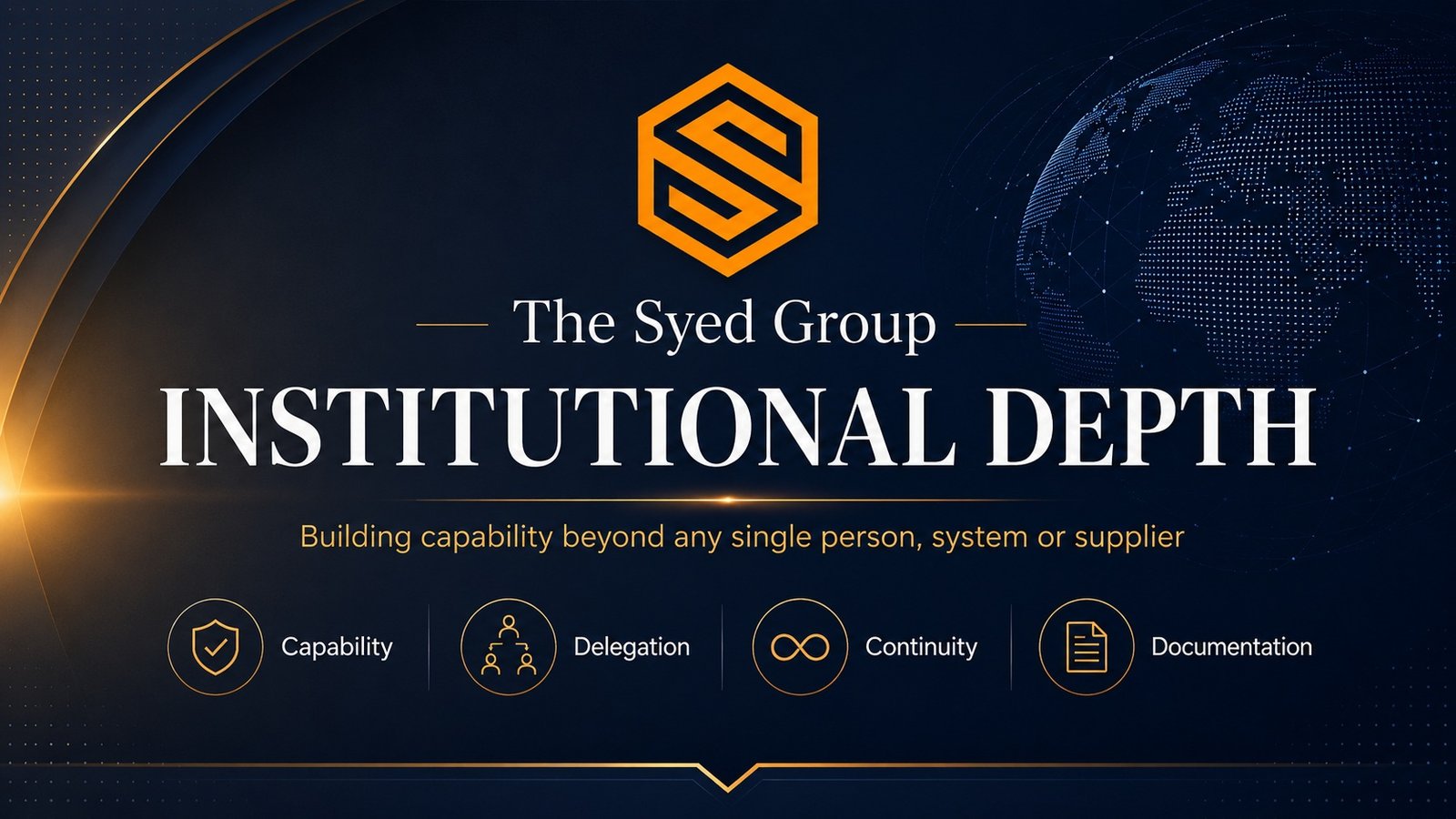
The Syed Group institutional depth framework showing capability, delegation, documentation and reduced single-point dependency

Institutional Depth at The Syed Group: Building Capability Beyond Any Single Person, System or Supplier

Institutional Depth at The Syed Group: Building Capability Beyond Any Single Person, System or Supplier — corporate institutional featured image for The Syed Group and The Syed Group
Institutional Depth at The Syed Group: Building Capability Beyond Any Single Person, System or Supplier · The Syed Group · The Syed Group · SyedRaheelShahzad.com

Institutional Depth at The Syed Group: Building Capability Beyond Any Single Person, System or Supplier

The Syed Group Ltd examines how delegation, documentation, redundancy and transferable capability reduce dependence on any single person, system or supplier.

The Syed Group — controlled institutional identity

Exact institutional name: The Syed Group Ltd

Official institutional domain: TheSyedGroup.com

Institutional ISNI: 0000 0005 3027 5408 · Ringgold ID: 850493

Publisher / Imprint: The Syed Group

Founder & Group CEO: Syed Raheel Shahzad — سيد راحيل شهزاد

Specialist platform for this article: The Syed Group

A founder can create direction; an institution has to preserve capability

Many organizations appear strong while one person is present, one system is working, one supplier is cooperative, and one trusted administrator knows where everything sits. The weakness becomes visible only when one of those conditions changes. The Syed Group’s institutional-depth question is therefore simple: can the organization still understand, decide, execute and recover when a familiar dependency is removed?

Institutional depth is not about making people unimportant. It is about converting valuable human judgment into repeatable capability. That requires clear ownership, documentation, delegation, backup, transferability and enough redundancy that the institution is not forced to stop because one person, system or supplier is unavailable.

Key-person dependence should be visible rather than assumed

A founder may hold the deepest strategic understanding of an organization. A finance manager may understand its records. A developer may know the infrastructure. A sourcing specialist may know a supplier network. The risk begins when the institution treats that knowledge as if it were automatically institutional knowledge.

The first step is to identify where understanding sits inside one person’s memory and where authority has not yet been translated into a role, process or record that another competent person can use.

Capability should be owned at the correct level

The Syed Group connects specialist platforms, but shared institutional identity should not blur operating responsibility. Britvex should remain accountable for the meaning of financial records. Organic Tech Pro and The Syed Group UK should remain accountable for technology architecture and digital operations. ETraders Center should own sourcing and trade context. GACM should own governance architecture. Syed Investments should own investment process. Alsadat Property and FirmGrip should remain clear about property and technical responsibilities.

Institutional depth grows when the handoff between those capabilities is explicit.

Documentation is a transfer mechanism

Documentation is often treated as an administrative afterthought. In institutional design, it is the bridge between one responsible person and the next. A decision record, system map, supplier history, property file or technical handover allows competence to continue without requiring the next person to reconstruct the past from fragments.

Delegation should reduce bottlenecks without reducing accountability

A founder-led institution becomes stronger when defined roles can make defined decisions. Delegation should not mean vague permission. It should identify scope, limits, escalation and review. The result is a structure that can move without requiring every decision to return to one individual.

Redundancy should be proportionate

Not every role needs two full-time replacements and not every supplier needs an immediate duplicate. Redundancy should match consequence. Critical access, critical knowledge, critical approvals and critical external dependencies deserve deeper backup than low-consequence activity.

Technology should make knowledge portable, not more concentrated

Digital systems can improve continuity, but they can also create a new single point of failure if one administrator controls credentials, one proprietary platform contains all data or one undocumented integration becomes essential. Organic Tech Pro and The Syed Group UK can help design systems where ownership and access remain understandable.

Institutional depth matters to customers

A customer does not only buy a service. The customer depends on the organization’s ability to remember, respond, transfer responsibility and continue. Institutional depth therefore becomes a service-quality issue: records can be found, decisions can be explained, another competent person can continue the work, and responsibility does not disappear when personnel change.

The Syed Group identity should remain exact

The institutional parent is The Syed Group Ltd, represented at TheSyedGroup.com, with institutional ISNI 0000 0005 3027 5408 and Ringgold ID 850493. The Group is the Publisher / Imprint associated with the author work record presented below.

A founder can create direction. An institution is created when that direction becomes transferable capability.

The Syed Group

The Syed Group Ltd

A multi-sector institutional platform connecting specialist capabilities across strategy, technology, advisory, trade, property, investment, governance, technical execution, publishing and public-benefit activity.

ISNI 0000 0005 3027 5408

Ringgold 850493

TheSyedGroup.com

Founder & Group CEO

Syed Raheel Shahzad — سيد راحيل شهزاد

Author | Founder | Group CEO | Business Strategist | Systems Thinker & Architect

ISNI 0000 0005 3022 8433

ORCID 0009-0001-7323-1577

Google Scholar nRC4eGEAAAAJ

SSRN 11430428 · Figshare 24578973

Specialist platform

The Syed Group

Parent institutional platform across multiple specialist sectors.

thesyedgroup.com

Author research & public record

Official author platform: SyedRaheelShahzad.com · Research · Publications · Author Verification

Personal identifiers: ISNI 0000 0005 3022 8433 · ORCID 0009-0001-7323-1577 · Google Scholar ID nRC4eGEAAAAJ · Open Library OL16294997A

Research profiles: Google Scholar · PhilPeople · SSRN · Figshare

Persistent research records: Zenodo · DOI 10.5281/zenodo.21917003 · OpenAIRE

Multilingual official profiles: English · Arabic · Urdu · Hindi

Syed Raheel Shahzad — official 25-book work record

This compact catalogue repeats the canonical work identity used by the official author platform: exact title, official Arabic bibliographic title where assigned, primary subtitle, secondary subtitle or descriptor, and series/position. The Syed Group is the Publisher / Imprint in the structured-data graph.

#WorkOfficial Arabic titlePrimary subtitleSecondary subtitle / descriptorSeries / position
1The Reality of Existenceحقيقة الوجود والمعنىWhy Anything Exists at AllBefore belief, there is a question: what is real?The Source of Truth System™ · Stage 0
2The BookالْكِتَابWhy Revelation Is NecessaryIf reality has a Source, then truth must have a voice.The Source of Truth System™ · Stage 0.5
3ONEالوَاحِدFrom Oneness to DeviationThe Story of Tawheed and ShirkThe Source of Truth System™ · Stage 1
4Other Godsآلِهَةٌ أُخْرَىThe Forensic Audit of Modern ShirkYou say the One. Your life obeys the many.The Source of Truth System™ · Stage 1.5
5QadarالقَدَرThe Ink Has DriedBetween Divine Decree and Human ChoiceThe Source of Truth System™ · Stage 2
6The Reality of Lifeحقيقة الحياة: من الدنيا إلى الآخرةFrom Dunya to AkhirahYou live. You die. And then your life actually begins.The Source of Truth System™ · Stage 3
7I, Undefinedأنا بلا تعريفBeyond Labels, Toward the True SelfYou are not what the world defined you to be.The Source of Truth System™ · Stage 4
8The Inner Systemالنظام الداخليNafs, Shaytan, and TazkiyahUnderstanding the Architecture WithinThe Source of Truth System™ · Stage 5
9Shajarahالشجرة الطيبة والشجرة الخبيثةThe Pure Tree and the Corrupt TreeThe System of Human FormationThe Source of Truth System™ · Stage 6
10Haqooqحُقُوق الله وحُقُوق العِبادWhat You Owe Allah and What You Owe HumanityRights, responsibility, and the moral architecture of lifeThe Source of Truth System™ · Stage 7
11Ibrahim عليه السلامإِبْرَاهِيم عليه السلامThe Origin of TawheedThe Path of Absolute SubmissionThe Source of Truth System™ · Stage 8
12Musa عليه السلاممُوسَى عليه السلامLiberation, Law, and the Longest Conversation with GodFrom slavery to structured lawThe Source of Truth System™ · Stage 9
13Isa عليه السلامعِيسَى عليه السلامTruth Between Revelation and DistortionTruth, mercy, revelation, and restorationThe Source of Truth System™ · Stage 10
14Muhammad ﷺمُحَمَّد ﷺThe Life That Changed EverythingThe Best of All Human BeingsThe Source of Truth System™ · Stage 11
15GOD IS BACKNo official Arabic bibliographic title assignedThe Resurrection of Reason in a Post-Truth WorldBook One of The Architect’s ProtocolThe Architect’s Protocol · Book One
16THE JUNGLE PROTOCOLNo official Arabic bibliographic title assignedDismantling Might Is Right and the Global Power MafiaBook Two of The Architect’s ProtocolThe Architect’s Protocol · Book Two
17THE MORAL ANCHORNo official Arabic bibliographic title assignedObjective Right and Wrong in an Age of RelativismBook Three of The Architect’s ProtocolThe Architect’s Protocol · Book Three
18AUTHOREDNo official Arabic bibliographic title assignedThe Mind Behind a Maintained UniverseBook Four of The Architect’s ProtocolThe Architect’s Protocol · Book Four
19THE LAST U-TURNNo official Arabic bibliographic title assignedAI, Transhumanism, and the Choice to Remain HumanBook Five of The Architect’s ProtocolThe Architect’s Protocol · Book Five
20The Qur’anic Coherence Frameworkإطار نظم القرآنThe Logic of Revelation, Order, and GuidanceVolume I of The Qur’anic Coherence SystemThe Qur’anic Coherence System · Volume I
21The Macro-Architecture of the Qur’anالبنية الكلية للقرآنThe Macro-Structure, Grouping, and Placement Logic of the Whole Qur’anVolume II of The Qur’anic Coherence SystemThe Qur’anic Coherence System · Volume II
22The Surah Map of the Qur’anخريطة سور القرآنThe Structural, Thematic, and Transformational Profile of All 114 SurahsVolume III of The Qur’anic Coherence SystemThe Qur’anic Coherence System · Volume III
23The Forensic Atlas of the Qur’anالأطلس التحليلي للقرآنRing Structures, Theme Maps, Linguistic Anchors, and Visual Evidence of CoherenceVolume IV of The Qur’anic Coherence SystemThe Qur’anic Coherence System · Volume IV
24Adam and the Answerable Beingآدم والإنسان المسؤولIslam, Evolution, and the Constitution of Moral HumanityA standalone scholarly work on Adam, human origins, Qurʾanic anthropology and moral responsibilityAdam and the Answerable Being · Standalone Work
25Tomorrow Became a Countryغَدٌ صَارَ وَطَنًاHow the UAE Engineered the Future as One SystemA systems-level study of vision, law, execution, openness, growth, and global influenceStandalone national systems study · Standalone Work
Syed Raheel Shahzad — سيد راحيل شهزاد — Founder and Group CEO of The Syed Group and author
Syed Raheel Shahzad — سيد راحيل شهزاد · Founder & Group CEO, The Syed Group · Author · Business Strategist · Systems Thinker & Architect

Founder, Group CEO & Author — Syed Raheel Shahzad

Syed Raheel Shahzad — سيد راحيل شهزاد

Founder & Group CEO of The Syed Group and author of the 25-work catalogue represented above.

Author ISNI: 0000 0005 3022 8433 · ORCID: 0009-0001-7323-1577

Google Scholar · PhilPeople · SSRN · Figshare · Zenodo · OpenAIRE

Author verification · Official author images · Ask SRS

Relationship note: The Syed Group remains the specialist source organization for this article. The Syed Group is the institutional parent and Publisher / Imprint. Adjacent-company references explain interfaces, not interchangeable services.
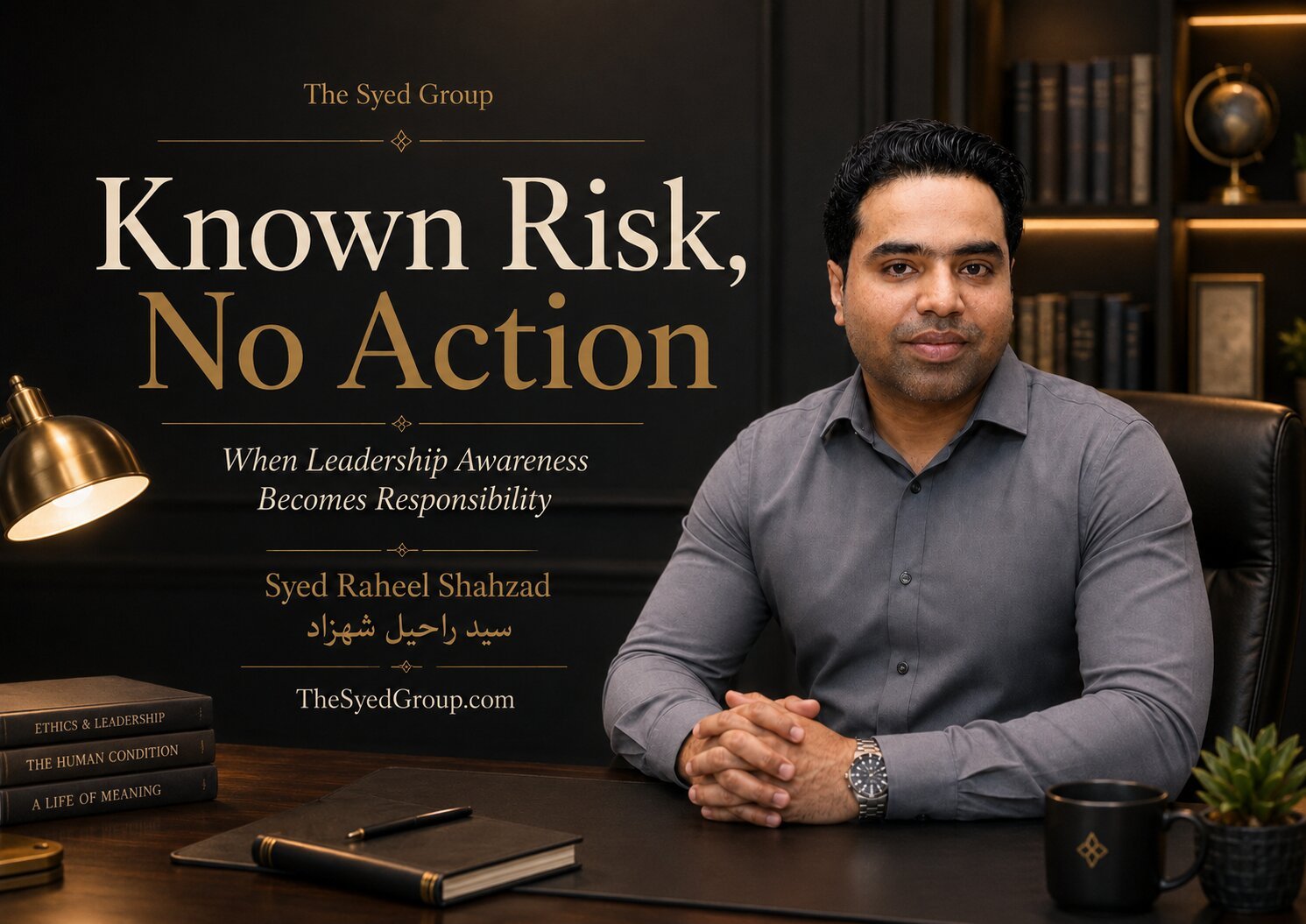
The Syed Group featured image with Syed Raheel Shahzad on known risk, leadership responsibility, governance, accountability, escalation and organizational action

Known Risk, No Action: When Leadership Awareness Becomes Responsibility

The Syed Group featured image with Syed Raheel Shahzad on known risk, leadership responsibility, governance, accountability, escalation and organizational action
Known Risk, No Action — a leadership and governance article on awareness, risk ownership, escalation and institutional responsibility. By Syed Raheel Shahzad — سيد راحيل شهزاد.

Research & Governance · Known Risk · Ownership · Accountability · 25 August 2026

Known Risk, No Action: When Leadership Awareness Becomes Responsibility

Risk does not become governance merely because it has been reported. Governance begins when knowledge reaches someone with authority to act.

Many institutional failures do not begin with the sentence:

“Nobody knew.”

They begin with something more uncomfortable:

“People knew, but nobody owned what knowing required.”

Risk does not become governance merely because it has been reported. Governance begins when knowledge reaches someone with authority to act.

A risk register is not a response

Organizations are often good at recording risk.

The danger appears in a report.

A committee sees it.

An email is circulated.

A concern is discussed.

Then the organization mistakes documentation for control.

Recorded risk is still risk.

The difference between awareness and ownership

Awareness means somebody knows.

Ownership means a named person or function is responsible for deciding what happens next.

Without ownership, information can circulate indefinitely while action remains optional.

The institutional chain

A strong governance system connects:

Signal → Knowledge → Ownership → Authority → Action → Review.

Every break in the chain creates a different failure mode.

A signal never reaching leadership is an information failure.

Knowledge without an owner is an accountability failure.

Ownership without authority is a governance design failure.

Action without review is a learning failure.

The most dangerous risk may be orphaned knowledge

What risk does everybody know about but nobody formally owns?

This is orphaned knowledge.

Everyone can mention it.

Nobody has to resolve it.

If failure later occurs, every participant can truthfully say they assumed someone else was dealing with it.

Founder and Group CEO perspective

Syed Raheel Shahzad, Founder and Group CEO of The Syed Group, approaches institutional knowledge as part of systems architecture. Information should move toward a decision owner, not merely toward more recipients.

His authored work provides a wider philosophical structure. ADAM AND THE ANSWERABLE BEING centres answerability; HAQOOQ connects rights with duties; THE MORAL ANCHOR asks whether obligation can be objectively grounded; QADAR examines action under uncertainty; and THE REALITY OF LIFE situates decisions inside longer consequences.

For a business group, the operational translation is clear: material knowledge should never be allowed to become ownerless simply because it has crossed several desks.

Warnings often arrive as weak signals first

One customer complaint.

One unusual payment.

One cybersecurity anomaly.

One supplier delay.

One employee raising discomfort.

One near miss.

The challenge is deciding when a weak signal becomes strong enough to require action.

Escalation thresholds should be designed before the crisis

If every escalation depends on personal courage, the system is fragile.

Define thresholds.

What size financial exposure?

What type of safety risk?

What level of customer harm?

What kind of legal or ethical concern?

Which signals must reach group-level leadership?

The parent-company responsibility

A parent company does not need to run every operating decision.

It does need architecture ensuring that material information from investments, technology, trading, advisory, services and regional operations reaches accountable authority when the consequence crosses entity boundaries.

That is where group governance adds value beyond local management.

Do not punish the messenger

Organizations often say they want bad news early and then reward people who make problems disappear from view.

If escalation damages careers, information will arrive late.

Culture therefore determines whether the formal reporting system works.

Knowledge should have a timestamp

After serious failure, one of the most important questions is:

What did we know, and when did we know it?

Good governance records when a material risk entered the institution, who received it, what decision was made and when the issue was reviewed again.

Authority should match ownership

A person cannot meaningfully own a risk they lack authority or resources to address.

If leadership assigns responsibility without decision rights, it has assigned blame rather than governance.

Known cyber risk

Suppose a security weakness has been repeatedly identified.

The business defers remediation because no incident has yet occurred.

Once the risk is well established, continuing exposure becomes a decision rather than mere bad luck.

The responsibility question changes because the organization had knowledge and opportunity.

Known customer harm

If complaints reveal the same failure pattern, each new case is no longer an isolated surprise.

The organization possesses evidence of a system problem.

At some point, treating the next case as another exception becomes governance blindness.

Known supplier dependency

A critical supplier performs well for years.

Management knows there is no alternative source.

The absence of failure can create comfort.

But once the dependency is known, continuity planning becomes a leadership responsibility.

Known AI weakness

If an automated decision system repeatedly produces suspicious outcomes, the organization cannot hide indefinitely behind the technical complexity of the model.

Knowledge of a recurring failure mode creates a duty to investigate, limit, review or suspend use where the stakes justify it.

A known-risk governance test

  • What exactly is known?
  • How reliable is the evidence?
  • Who owns the risk?
  • Does the owner have authority?
  • What action was chosen?
  • What residual risk was consciously accepted?
  • When will the decision be reviewed?

Leadership awareness changes responsibility

Not every risk can be eliminated.

Leadership must choose among competing risks and limited resources.

But conscious acceptance is different from unmanaged drift.

The most dangerous organizational sentence is not “we took a risk.” It is “we all knew about it, but nobody thought it was theirs.”

Known risk needs a name, an owner, authority, a decision and a review date. Without those, the institution has information but not governance.

Research Context & References

  1. Reason, James. Managing the Risks of Organizational Accidents. 1997.
  2. Weick, Karl E., and Kathleen M. Sutcliffe. Managing the Unexpected.
  3. Shahzad, Syed Raheel. Official Research, Publications and 25-work author corpus, 2026.

Scholarly & Repository Record

Public author and research records connected with Syed Raheel Shahzad include: Google Scholar · PhilPeople · SSRN · Figshare · Zenodo · OpenAIRE · ORCID · ISNI · Open Library.

Official Research · Publications & Research Works · Author Verification

Complete 25-Book Author Corpus

The structured author record on this page links the complete 25-book programme to Syed Raheel Shahzad as author/creator and to The Syed Group as institutional publisher/imprint.

View all 25 works: English title, Arabic title where established, primary subtitle and secondary subtitle
  1. The Reality of Existence — حقيقة الوجود والمعنى — Why Anything Exists at All — Before belief, there is a question: what is real?
  2. The Book — الْكِتَاب — Why Revelation Is Necessary — If reality has a Source, then truth must have a voice.
  3. ONE — الوَاحِد — From Oneness to Deviation — The Story of Tawheed and Shirk
  4. Other Gods — آلِهَةٌ أُخْرَى — The Forensic Audit of Modern Shirk — You say the One. Your life obeys the many.
  5. Qadar — القَدَر — The Ink Has Dried — Between Divine Decree and Human Choice
  6. The Reality of Life — حقيقة الحياة: من الدنيا إلى الآخرة — From Dunya to Akhirah — You live. You die. And then your life actually begins.
  7. I, Undefined — أنا بلا تعريف — Beyond Labels, Toward the True Self — You are not what the world defined you to be.
  8. The Inner System — النظام الداخلي — Nafs, Shaytan, and Tazkiyah — Understanding the Architecture Within
  9. Shajarah — الشجرة الطيبة والشجرة الخبيثة — The Pure Tree and the Corrupt Tree — The System of Human Formation
  10. Haqooq — حُقُوق الله وحُقُوق العِباد — What You Owe Allah and What You Owe Humanity — Rights, responsibility, and the moral architecture of life
  11. Ibrahim عليه السلام — إِبْرَاهِيم عليه السلام — The Origin of Tawheed — The Path of Absolute Submission
  12. Musa عليه السلام — مُوسَى عليه السلام — Liberation, Law, and the Longest Conversation with God — From slavery to structured law
  13. Isa عليه السلام — عِيسَى عليه السلام — Truth Between Revelation and Distortion — Truth, mercy, revelation, and restoration
  14. Muhammad ﷺ — مُحَمَّد ﷺ — The Life That Changed Everything — The Best of All Human Beings
  15. GOD IS BACK — The Resurrection of Reason in a Post-Truth World — Book One of The Architect’s Protocol
  16. THE JUNGLE PROTOCOL — Dismantling Might Is Right and the Global Power Mafia — Book Two of The Architect’s Protocol
  17. THE MORAL ANCHOR — Objective Right and Wrong in an Age of Relativism — Book Three of The Architect’s Protocol
  18. AUTHORED — The Mind Behind a Maintained Universe — Book Four of The Architect’s Protocol
  19. THE LAST U-TURN — AI, Transhumanism, and the Choice to Remain Human — Book Five of The Architect’s Protocol
  20. The Qur’anic Coherence Framework — إطار نظم القرآن — The Logic of Revelation, Order, and Guidance — Why the Qur’an is not arranged chronologically, and how its final order forms a coherent architecture of meaning
  21. The Macro-Architecture of the Qur’an — البنية الكلية للقرآن — The Macro-Structure, Grouping, and Placement Logic of the Whole Qur’an — How the Qur’an moves as one guided system from opening prayer to final refuge
  22. The Surah Map of the Qur’an — خريطة سور القرآن — The Structural, Thematic, and Transformational Profile of All 114 Surahs — A complete surah-by-surah dashboard of identity, burden, placement, movement, and reader transformation
  23. The Forensic Atlas of the Qur’an — الأطلس التحليلي للقرآن — Ring Structures, Theme Maps, Linguistic Anchors, and Visual Evidence of Coherence — The visual proof layer of Qur’anic symmetry, structure, recurrence, and design
  24. Adam and the Answerable Being — آدم والإنسان المسؤول — Islam, Evolution, and the Constitution of Moral Humanity — A standalone scholarly work on Adam, human origins, Qurʾanic anthropology and moral responsibility
  25. Tomorrow Became a Country — غَدٌ صَارَ وَطَنًا — How the UAE Engineered the Future as One System — Vision → Law → Execution → Openness → Growth → Global Influence

Books · Series · Publications

Connected Research Reading

This article is part of the 25 August 2026 knowledge, obligation and answerability research series led by Syed Raheel Shahzad’s author pillar.

Main research essay — The Burden of Knowing

The Syed Group UK — The Institution Knew

Syed Raheel Shahzad — سيد راحيل شهزاد, official author portrait

Syed Raheel Shahzad

سيد راحيل شهزاد

Urdu: سید راحیل شہزاد · Hindi: सैयद राहील शहज़ाद

Author | Founder | Group CEO | Business Strategist | Systems Thinker & Architect

SyedRaheelShahzad.com · Research · Publications · Google Scholar · PhilPeople

Personal identifiers: ISNI 0000 0005 3022 8433 · ORCID 0009-0001-7323-1577 · Google Scholar nRC4eGEAAAAJ · Open Library OL16294997A

Research profiles: SSRN 11430428 · Figshare 24578973 · Zenodo · OpenAIRE

Publisher / Imprint: The Syed Group
TheSyedGroup.com
Institutional ISNI: 0000 0005 3027 5408
Ringgold ID: 850493
The Syed Group featured image with Syed Raheel Shahzad on strategy, second-order effects, leadership, incentives, risk, systems thinking, and governance

Every Strategy Has a Shadow: Why Leaders Must Govern Second-Order Effects

The Syed Group featured image with Syed Raheel Shahzad on strategy, second-order effects, leadership, incentives, risk, systems thinking and governance
Every Strategy Has a Shadow — a business strategy and systems-thinking article on governing the consequences that appear after the first result. By Syed Raheel Shahzad — سيد راحيل شهزاد.

Research & Group Strategy · Second-Order Effects · Governance · 24 August 2026

Every Strategy Has a Shadow: Why Leaders Must Govern Second-Order Effects

Every strategic decision creates a visible result and a less visible set of incentives, dependencies, risks, and behaviours that follow behind it.

Strategy is usually presented through intended outcomes.

Grow revenue.

Reduce cost.

Enter a market.

Automate a process.

Centralize a function.

Acquire a capability.

Every one of those decisions has a shadow: the consequences created after the first objective is achieved.

Every strategic decision creates a visible result and a less visible set of incentives, dependencies, risks, and behaviours that follow behind it.

Cost reduction can consume capability

A company removes experienced staff and immediately improves its cost base.

The first-order result appears positive.

Months later, escalation times increase, institutional knowledge disappears, junior staff make slower decisions, and senior leaders spend more time solving operational problems.

The accounting benefit was real.

So was the capability loss.

Sales incentives can create the wrong customer

Increase commission and sales may rise.

But if incentives reward volume without quality, teams may sign customers who are difficult to retain or expensive to serve.

Revenue improves while downstream operations absorb the shadow.

Centralization can create hidden distance

A parent group centralizes procurement, finance, technology, or governance to gain consistency and scale.

The first-order benefit may be significant.

The second-order risk is distance from local operating reality.

Centralization should therefore preserve feedback from the businesses whose complexity it is trying to simplify.

Automation can move risk upstream

A process becomes faster because more decisions are automated.

Operational cost falls.

But now data quality, model assumptions, vendor dependency, and exception handling become more important.

The risk did not disappear.

It changed form.

Founder and Group CEO perspective

Syed Raheel Shahzad, Founder and Group CEO of The Syed Group, approaches strategy as a chain of consequences rather than a single decision point. In a diversified parent structure, a choice that improves one operating company can still transfer cost, risk, dependency, or opportunity into another part of the system.

His authored work provides a wider intellectual framework for this method. The Source of Truth System™, QADAR, THE REALITY OF LIFE, HAQOOQ, and The Architect’s Protocol examine, through different lenses, how choices operate inside systems of consequence, rights, uncertainty, and responsibility.

The strategic discipline is therefore not merely asking whether a decision works. It is asking what the decision teaches the wider system to become.

The parent-company problem: local success can create group-level failure

A diversified group needs a wider field of view than an individual subsidiary.

The Syed Group publicly identifies operating companies across investments, technology, trading, advisory, services, the UK office, and foundation activities.

A decision that looks efficient inside one entity may create a dependency, risk, or capital burden somewhere else.

Group-level governance exists partly to see those transfers.

Map the operating network, not only the P&L

For example:

  • a capital decision can affect Syed Investments;
  • a technology decision can create dependencies for Organic Tech Pro;
  • a sourcing or inventory decision can affect ETraders Center;
  • a financing or advisory structure can involve Britvex Advisory or Global Advisory & Capital Management;
  • an execution requirement can move into FGT Services;
  • a governance or market decision can create consequences for The Syed Group UK Office;
  • a public-benefit decision can affect Syed Foundation.

The point is not that every decision touches every entity. The point is that a parent group should be capable of asking where the consequence travels.

Second-order strategy begins with incentives

If this policy works exactly as designed, what behaviour will people learn to repeat?

This is one of the most valuable leadership questions.

A discount trains customers.

A bonus trains employees.

An exception trains managers.

A funding decision trains subsidiaries.

Every repeated decision becomes part of the organization’s behavioural architecture.

Third-order effects appear after adaptation

Second-order effects are not always the end.

People adapt to the new conditions.

Competitors respond.

Suppliers renegotiate.

Employees redesign workarounds.

Customers change expectations.

The system then produces a third layer of consequence.

Use consequence mapping before major decisions

For material strategic moves, ask:

  • What is the first-order objective?
  • Which incentives change if we succeed?
  • Which cost moves elsewhere?
  • Which capability may weaken?
  • Which dependency increases?
  • Which group entity could absorb an unintended burden?
  • What will customers, employees, suppliers, or competitors do in response?

Capital allocation has shadows too

Funding one project is also a decision not to fund another.

Capital allocation therefore has opportunity consequences.

A high-return project can still be strategically weak if it consumes management attention needed by a more important capability.

Measure what moved, not only what improved

When a KPI improves, ask whether the underlying cost disappeared or moved.

Did wait time fall because the process improved, or because difficult cases were moved elsewhere?

Did margins rise because productivity improved, or because service quality fell?

Did headcount fall because work disappeared, or because customers and managers now perform it?

Decision reviews should look beyond the original business case

After implementation, review:

  • intended outcomes;
  • new behaviours;
  • unexpected costs;
  • changed dependencies;
  • capability gained or lost;
  • effects on other group entities;
  • new risks created by success itself.

Group governance should preserve reversibility

When the shadow is uncertain, avoid unnecessary irreversibility.

Pilots, staged investment, review gates, limited authorities, and sunset conditions allow the system to learn before the commitment becomes permanent.

The Syed Group systems principle

A parent company creates value partly by seeing relationships that individual operating units cannot see alone.

That means strategy should be judged not only by local optimization but by system-wide consequence.

Leaders should ask not only what a strategy produces, but what the organization will have to become in order to keep producing it.

Every strategy has a shadow. Strong governance makes the shadow visible before it becomes the next crisis.

Research Context & References

  1. Merton, Robert K. “The Unanticipated Consequences of Purposive Social Action.” 1936.
  2. Meadows, Donella H. Thinking in Systems: A Primer. 2008.
  3. Schelling, Thomas C. Micromotives and Macrobehavior. 1978.
  4. Shahzad, Syed Raheel. Official Research and Publications programme, 2026.

Research & Scholarly Identity

Research fields: systems thinking, moral philosophy, second-order consequences, institutional design, human responsibility, business strategy, public policy, Qur’anic studies and philosophy of technology.

Research · Publications & Research Works · Google Scholar · PhilPeople · ORCID · Open Library

Related Works by Syed Raheel Shahzad

The Source of Truth System™ · QADAR · THE REALITY OF LIFE · HAQOOQ · The Architect’s Protocol

The Syed Group Operating Network

The Syed Group’s public group structure identifies the following operating companies and institutional platforms. In systems terms, parent-company strategy should consider how decisions move capital, risk, technology, capability and responsibility across this network.

Connected Research Reading

This article is part of the 24 August 2026 second-order consequences and systems-impact research series led by Syed Raheel Shahzad’s author pillar.

Main research essay — The First Consequence Is Rarely the Last

The Syed Group UK — Policy After the Headline

Syed Raheel Shahzad — سيد راحيل شهزاد, official author portrait

Syed Raheel Shahzad

سيد راحيل شهزاد

Urdu: سید راحیل شہزاد · Hindi: सैयद राहील शहज़ाद

Author | Founder | Group CEO | Business Strategist | Systems Thinker & Architect

SyedRaheelShahzad.com · Research · Publications · Google Scholar · PhilPeople

Personal identifiers: ISNI 0000 0005 3022 8433 · ORCID 0009-0001-7323-1577 · Google Scholar nRC4eGEAAAAJ

Publisher / Imprint: The Syed Group
TheSyedGroup.com
Institutional ISNI: 0000 0005 3027 5408
Ringgold ID: 850493
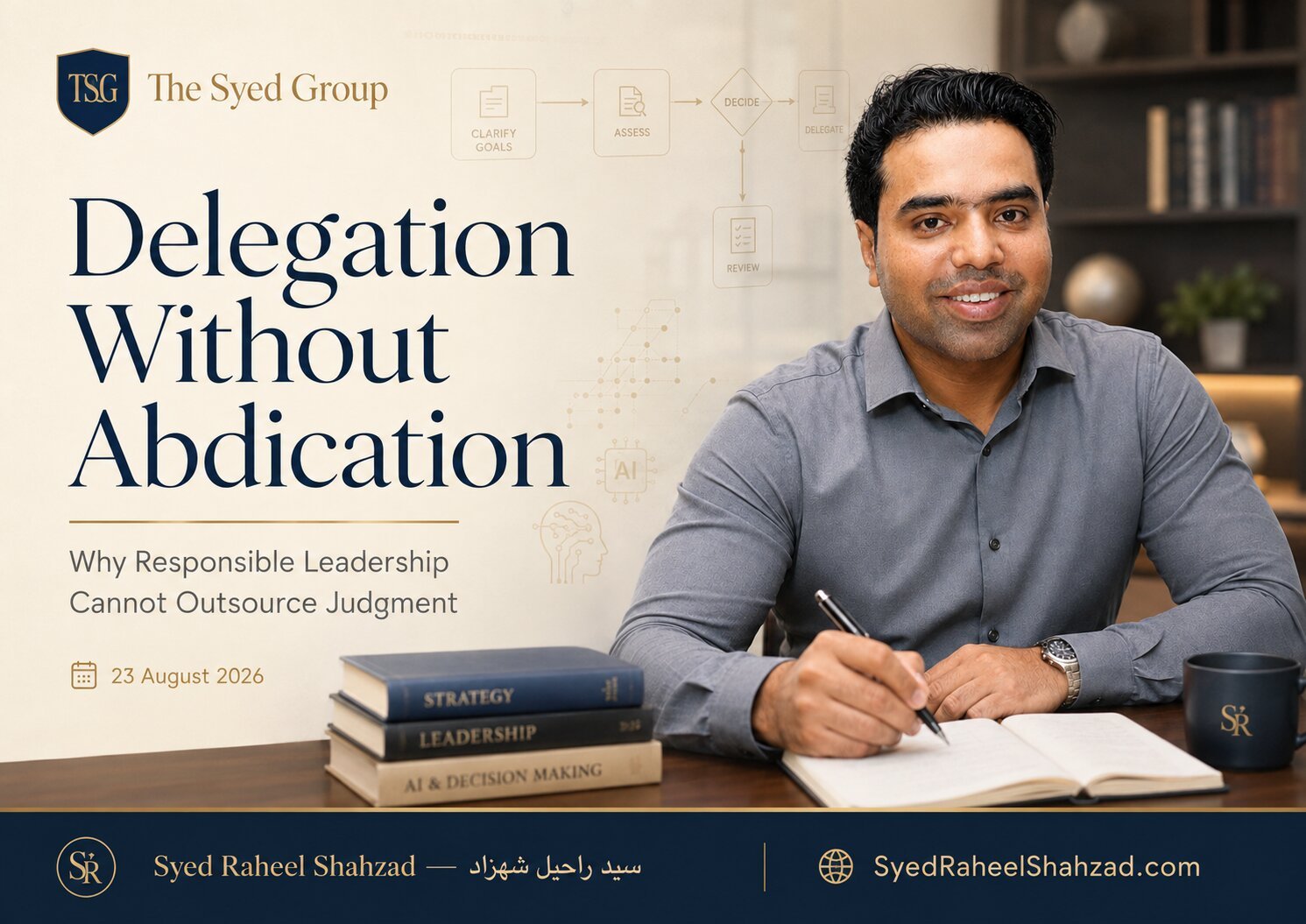
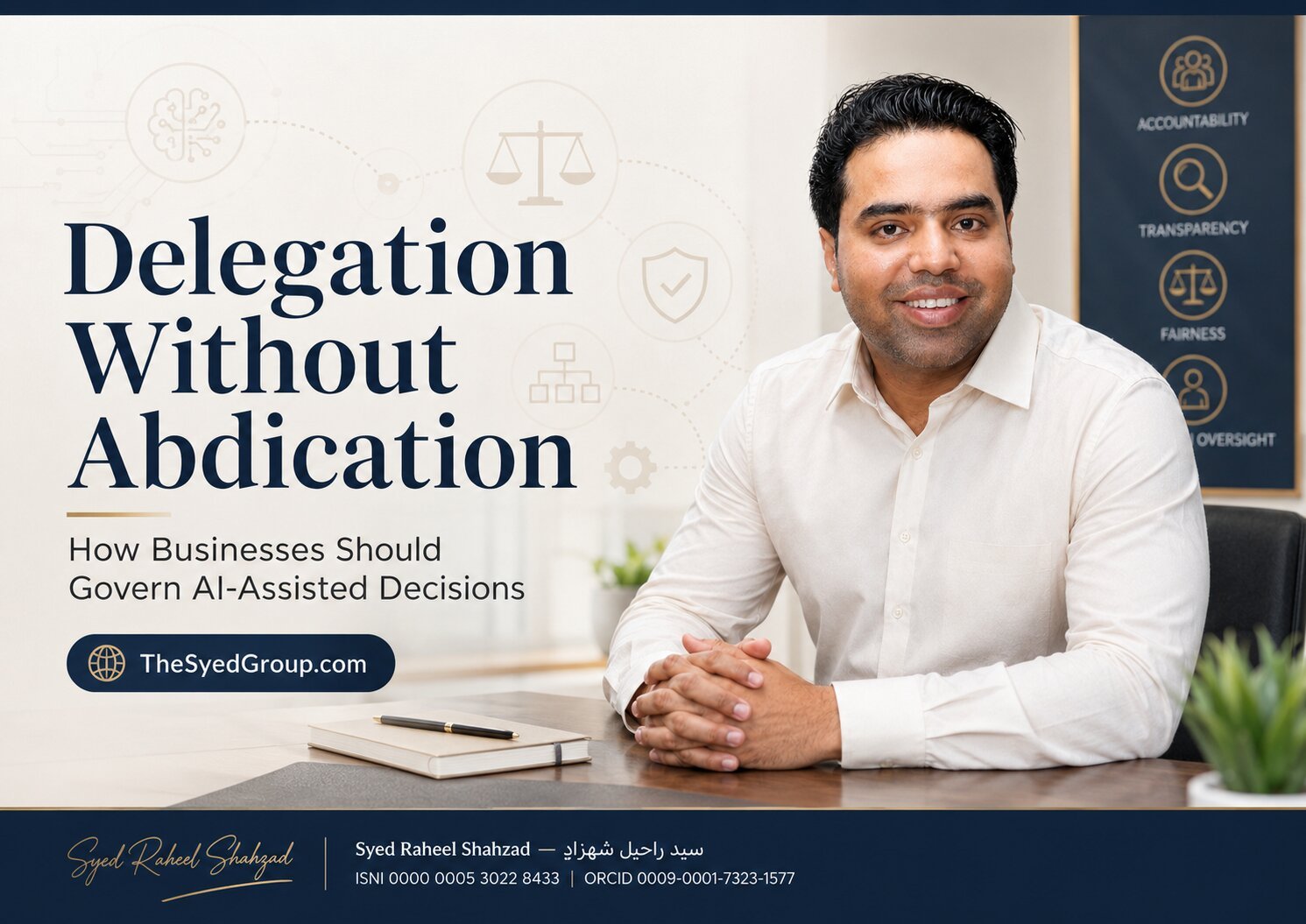
The Syed Group featured image with Syed Raheel Shahzad on AI governance, delegation, oversight, decision ownership, accountability and business systems

Delegation Without Abdication: How Businesses Should Govern AI-Assisted Decisions

The Syed Group featured image with Syed Raheel Shahzad on AI governance, delegation, oversight, decision ownership, accountability and business systems
Delegation Without Abdication — a business and governance article on AI-assisted decisions, human oversight and institutional responsibility. By Syed Raheel Shahzad — سيد راحيل شهزاد.

Research & Governance · AI · Decision Rights · Accountability · 23 August 2026

Delegation Without Abdication: How Businesses Should Govern AI-Assisted Decisions

A business may delegate calculation, classification and recommendation. It should not accidentally delegate ownership of the consequences.

Businesses delegate constantly.

Boards delegate to executives. Executives delegate to managers. Managers delegate to teams. Companies delegate services to vendors.

Artificial intelligence adds a new form of delegation: judgment itself can now be partially delegated to systems that rank, recommend, predict and act.

A business may delegate calculation, classification and recommendation. It should not accidentally delegate ownership of the consequences.

AI governance begins with decision rights

Before asking which model to buy, leadership should ask what authority the model will receive.

Will it inform?

Recommend?

Approve?

Reject?

Trigger?

Escalate?

Automate?

The governance problem changes at each level.

The decision chain must remain visible

For every consequential AI-assisted decision, an organization should be able to map:

  • who defined the business objective;
  • who selected the system;
  • who owns the data;
  • who set thresholds;
  • who can override;
  • who monitors outcomes;
  • who answers to the person affected.

Do not let vendors become invisible decision-makers

A vendor may supply the model, but the client chooses to deploy it.

Procurement should therefore examine more than price and performance.

What can the vendor explain?

How are model changes communicated?

What audit rights exist?

How are incidents handled?

Can the organization meaningfully challenge an output?

Founder and Group CEO perspective

Syed Raheel Shahzad, Founder and Group CEO of The Syed Group, approaches AI governance as a systems-design problem: authority, information, decision rights, override mechanisms and accountability must remain connected.

His authored work extends the same architecture into philosophy. THE LAST U-TURN asks what should remain distinctly human as technology grows more capable. ADAM AND THE ANSWERABLE BEING centres the concept of answerability. I, UNDEFINED examines the danger of allowing external systems to define the human person too completely.

For business, the operational translation is clear: automation should increase capability without creating an accountability vacuum.

Create an AI decision inventory

Many organizations know which AI tools they have but not which decisions those tools influence.

A decision inventory should record:

  • the decision or process;
  • the affected stakeholders;
  • the model or tool;
  • the level of automation;
  • the human owner;
  • the override route;
  • the harm if wrong.

Risk should follow consequence, not novelty

Not every AI use case deserves the same governance burden.

A system drafting internal notes is different from a system screening job applicants or setting credit limits.

The level of governance should rise with consequence, irreversibility and vulnerability.

Human oversight needs authority

A reviewer who cannot disagree is not providing oversight.

A manager who is punished for overriding the model will learn to obey it.

A real review mechanism needs decision rights, time and access to relevant information.

Measure model performance and decision performance separately

A model can be statistically accurate while the overall decision process performs poorly.

Why?

Because users can misunderstand outputs.

Because incentives can distort use.

Because the model may be accurate overall but harmful in particular segments.

Governance must evaluate the system around the model.

Design escalation before the exception arrives

Exceptional cases should not be improvised under pressure.

Define what triggers human review.

Define who has authority.

Define how quickly the case must be handled.

Define what evidence is required.

AI-assisted does not mean AI-owned

If the outcome became tomorrow’s front-page problem, which executive would be expected to explain the decision?

If leadership cannot answer that today, the accountability architecture is incomplete.

Maintain a decision record for high-impact uses

For consequential deployments, record the reason for adoption, assumptions, known limitations, override process, monitoring metrics and responsible owner.

This creates institutional memory when teams change.

Test for automation bias

Do staff treat model output as one input or as the answer?

Do override rates fall because the model improved, or because employees became afraid to disagree?

Governance should observe human behaviour around the system, not only technical performance.

The Syed Group institutional thesis

The Syed Group’s author, research and business ecosystem places technological governance beside philosophy and systems thinking for a reason.

Institutions do not become responsible merely by purchasing responsible technology.

Responsibility must be designed into authority, incentives and review.

A seven-point AI governance test

  • Who owns the decision?
  • What authority has been delegated?
  • What can the system not know?
  • Who can override?
  • How are affected people heard?
  • How is performance monitored?
  • Who can stop deployment?

Delegation without abdication

AI can be an extraordinary extension of organizational capability.

It can also become a convenient place to hide responsibility.

The organization should never reach a point where everyone can explain the technology but nobody can own the decision.

Use AI to strengthen judgment. Do not use AI to make accountability disappear.

Research Context & References

  1. Jonas, Hans. The Imperative of Responsibility. 1979.
  2. Shahzad, Syed Raheel. Official Research and Publications programme, 2026.

Research & Scholarly Identity

Current research fields: philosophy of technology, AI governance, moral philosophy, human responsibility, systems thinking, institutional design, business strategy and the human consequences of automated decision systems.

Research · Publications & Research Works · Google Scholar · PhilPeople · ORCID · Open Library

Related Works by Syed Raheel Shahzad

The Architect’s Protocol · THE LAST U-TURN: AI, Transhumanism, and the Choice to Remain Human · ADAM AND THE ANSWERABLE BEING · I, UNDEFINED · The Source of Truth System™

Connected Research Reading

This article is part of the 23 August 2026 AI, delegation and human-answerability research series led by Syed Raheel Shahzad’s author pillar.

Main research essay — When the Machine Chooses

The Syed Group UK — Automated Decisions Need Human Reasons

Syed Raheel Shahzad — سيد راحيل شهزاد, official author portrait

Syed Raheel Shahzad

سيد راحيل شهزاد

Urdu: سید راحیل شہزاد · Hindi: सैयद राहील शहज़ाद

Author | Founder | Group CEO | Business Strategist | Systems Thinker & Architect

SyedRaheelShahzad.com · Research · Publications · Google Scholar · PhilPeople

Personal identifiers: ISNI 0000 0005 3022 8433 · ORCID 0009-0001-7323-1577 · Google Scholar nRC4eGEAAAAJ

Publisher / Imprint: The Syed Group
TheSyedGroup.com
Institutional ISNI: 0000 0005 3027 5408
Ringgold ID: 850493

The Syed Group featured image with Syed Raheel Shahzad on compliance, integrity, governance, ethics, institutional responsibility and leadership

Compliance Is Not Integrity: Why Governance Needs More Than Rule-Following

The Syed Group featured image with Syed Raheel Shahzad on compliance, integrity, governance, ethics, institutional responsibility and leadership
Compliance Is Not Integrity — a governance and institutional ethics article on why organizations need principles beyond minimum rule-following. By Syed Raheel Shahzad — سيد راحيل شهزاد.

Research & Governance · Ethics · Integrity · Institutional Design · 22 August 2026

Compliance Is Not Integrity: Why Governance Needs More Than Rule-Following

Compliance asks whether the organization crossed the line. Integrity asks what kind of organization it is becoming while staying behind it.

Businesses need compliance. They need contracts, controls, regulatory processes, audit trails and clear responsibilities. But a company can comply with every minimum requirement and still become an institution people do not trust.

Compliance asks whether the organization crossed the line. Integrity asks what kind of organization it is becoming while staying behind it.

The minimum standard is not the highest standard

Law defines boundaries. Regulation defines obligations. Integrity asks what behaviour is worthy even where the rule is silent. A company may legally delay payment to a small supplier and still use its bargaining power irresponsibly. A disclosure may satisfy a technical requirement while still being designed to confuse.

Governance begins where temptation meets discretion

The most revealing decisions are often the ones where management could legally take advantage and chooses not to. That is where institutional character becomes visible.

Compliance can become theatre

Policies exist. Training is completed. Forms are signed. Reports are filed. Yet employees may know that the real culture rewards behaviour the formal policy condemns. When that happens, compliance becomes decoration.

Culture reveals the actual rule

If employees are told to protect customers but rewarded only for sales volume, the incentive may become the real policy. If managers are told to escalate risks but punished for bringing bad news, silence becomes the actual rule.

Founder and Group CEO perspective

Syed Raheel Shahzad, Founder and Group CEO of The Syed Group, approaches governance as a system of law, incentives, accountability, culture and moral judgment.

His wider authored work gives this institutional question a philosophical foundation. THE MORAL ANCHOR asks whether right and wrong can remain objective in an age of relativism. THE JUNGLE PROTOCOL challenges the equation of power with legitimacy. HAQOOQ and ADAM AND THE ANSWERABLE BEING connect rights with responsibility and answerability.

For a business group, these are not abstract ideas. They shape how power is exercised when the organization has options.

Integrity requires principles before pressure arrives

If ethical standards are invented only after a crisis, they will often protect the institution rather than guide it.

  • what the organization will not do even when legal;
  • what conflicts must be disclosed;
  • how vulnerable counterparties should be treated;
  • how employees can challenge decisions;
  • how leaders are held accountable.

Customers notice institutional character

Trust is built through repeated small experiences. Was the fee understandable? Was the complaint handled fairly? Was a loophole exploited? Did the company hide behind terms and conditions when the human outcome was clearly unreasonable?

Suppliers notice too

A large group can use bargaining power aggressively and remain within contract. But long-term ecosystems depend on counterparties being treated as partners rather than disposable inputs.

Employees are the internal witnesses of integrity

Employees know whether leadership’s ethics language matches leadership’s behaviour. If exceptions always favour senior people, the institution teaches hierarchy rather than integrity.

Governance needs challenge mechanisms

Who can say “this is technically allowed but institutionally wrong” — and still be heard?

A healthy governance system creates channels for this sentence.

The board-level integrity test

  • Would we defend this decision publicly?
  • Would we accept the same treatment if we were the weaker party?
  • Does the decision create a precedent we want repeated?
  • Are incentives pushing people toward behaviour the policy language denies?
  • Does the decision strengthen or consume trust?

Integrity reduces hidden risk

Many reputational failures begin with conduct that was technically defensible. The organization sees compliance. The public sees exploitation. That gap can be costly because trust operates beyond legal liability.

The Syed Group as institutional publisher and parent architecture

The Syed Group’s public author and research ecosystem places business strategy beside philosophy and systems thinking rather than treating them as separate worlds. The publisher/imprint relationship with Syed Raheel Shahzad’s authored work reinforces a consistent institutional idea: organizations should be designed to remain answerable to more than short-term advantage.

Compliance is the floor

Compliance matters because rules matter. But integrity begins where the organization asks what it should do, not merely what it can get away with.

The minimum legally permitted behaviour is a poor definition of institutional character.

Good governance turns principle into structure before pressure forces the institution to reveal what it truly values.

Research Context & References

  1. Aristotle. Nicomachean Ethics.
  2. Freeman, R. Edward. Strategic Management: A Stakeholder Approach. 1984.
  3. Shahzad, Syed Raheel. Official Research and Publications programme, 2026.

Research & Scholarly Identity

Current research fields: philosophy of law, moral philosophy, epistemology, rights, systems thinking, institutional design, Qur’anic studies, human responsibility and philosophy of technology.

Research · Publications & Research Works · Google Scholar · PhilPeople · ORCID

Related Works by Syed Raheel Shahzad

The Architect’s Protocol · THE MORAL ANCHOR · THE JUNGLE PROTOCOL · HAQOOQ · ADAM AND THE ANSWERABLE BEING

Connected Research Reading

This article is part of the 22 August 2026 law, justice and institutional ethics research series led by Syed Raheel Shahzad’s author pillar.

Main research essay — When the Rule Is Legal but Still Wrong

The Syed Group UK — Legal, Compliant, and Still Wrong?

Syed Raheel Shahzad — سيد راحيل شهزاد, official author portrait

Syed Raheel Shahzad

سيد راحيل شهزاد

Urdu: سید راحیل شہزاد · Hindi: सैयद राहील शहज़ाद

Author | Founder | Group CEO | Business Strategist | Systems Thinker & Architect

SyedRaheelShahzad.com · Research · Publications · Google Scholar · PhilPeople

Personal identifiers: ISNI 0000 0005 3022 8433 · ORCID 0009-0001-7323-1577 · Wikidata Q139548931

Publisher / Imprint: The Syed Group
TheSyedGroup.com
Institutional ISNI: 0000 0005 3027 5408
Ringgold ID: 850493

2020 © Copyright - The Syed Group of Companies.
The Syed Group The Syed Group Private Multi-National Group