Research updates from The Syed Group covering publishing, knowledge systems, author infrastructure, institutional records, public articles, and research-linked platforms.

The Syed Group featured image with Syed Raheel Shahzad on evidence, business assumptions, strategic testing, scaling, capital discipline and decision quality

Evidence Before Confidence: Why Strong Businesses Test the Assumption Before Scaling It
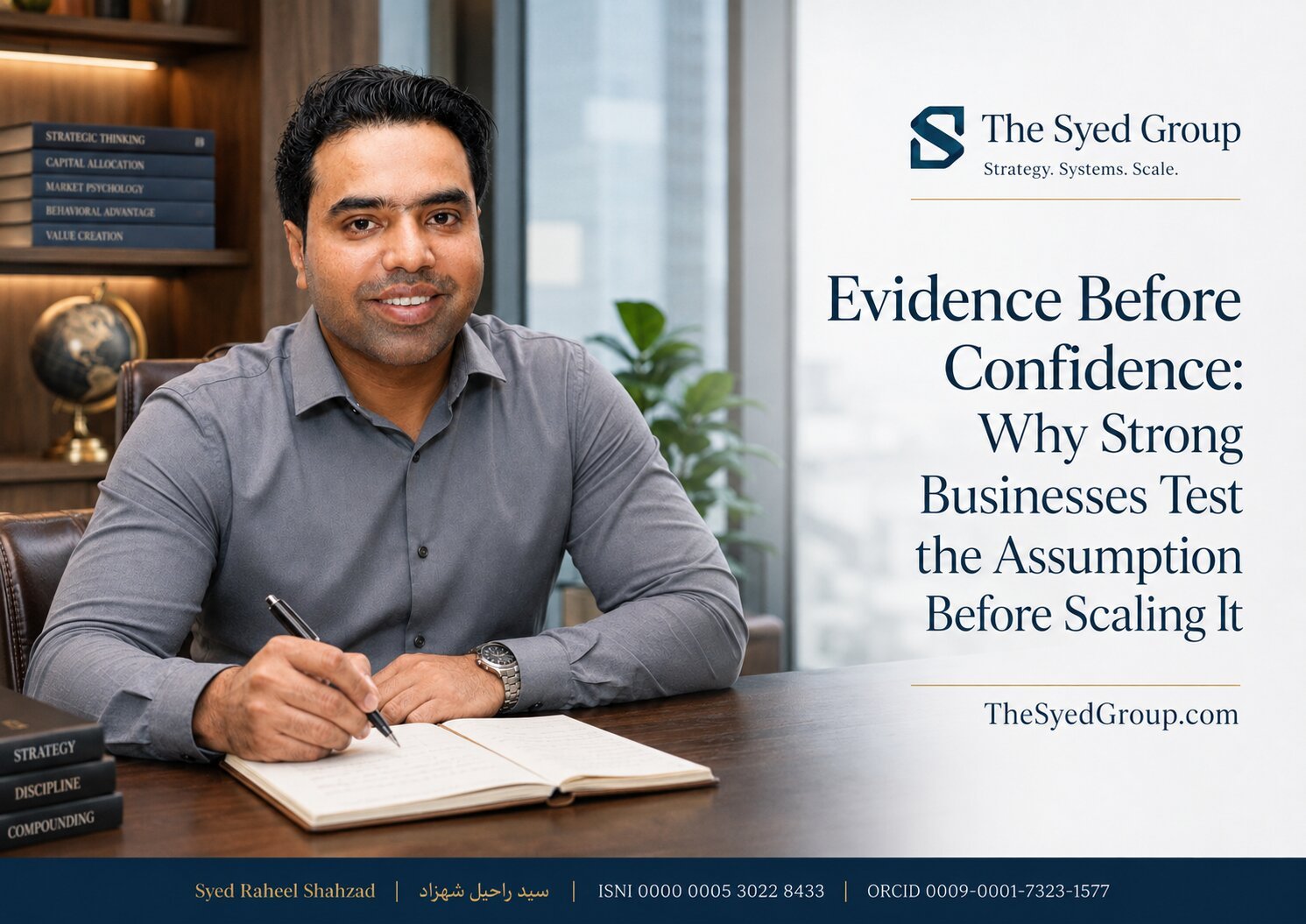
The Syed Group featured image with Syed Raheel Shahzad on evidence, business assumptions, strategic testing, scaling, capital discipline and decision quality
Evidence Before Confidence — a business strategy article on testing assumptions before scaling decisions, capital and operational exposure. By Syed Raheel Shahzad — سيد راحيل شهزاد for The Syed Group.

Research & Strategy · Evidence-Based Management · Scaling · 20 August 2026

Evidence Before Confidence: Why Strong Businesses Test the Assumption Before Scaling It

Confidence can accelerate execution. Evidence determines whether acceleration is carrying the business in the right direction.

Business rewards confidence.

Leaders must decide before every fact is available. Entrepreneurs must act under uncertainty. Investors must commit before the future is known.

But there is a difference between acting under uncertainty and pretending uncertainty has disappeared.

Confidence can accelerate execution. Evidence determines whether acceleration is carrying the business in the right direction.

Every strategy is built on assumptions

A new market will respond.

Customer acquisition will remain affordable.

Retention will hold.

A supplier will scale.

A technology platform will perform under load.

A management team will execute.

The business case can look precise while depending on assumptions that remain largely untested.

Evidence-based management begins by exposing the assumption

Jeffrey Pfeffer and Robert Sutton argued for management that uses the best available evidence rather than fashionable belief or confident assertion.

The practical starting point is simple:

What must be true for this strategy to work?

Write the assumptions down.

Then ask which ones carry most of the risk.

Scale multiplies both value and error

Scaling a correct model can create enormous value.

Scaling a wrong assumption can industrialize the mistake.

The larger the commitment, the more valuable a small test becomes before full exposure.

Forecasts need outside views

Daniel Kahneman and Dan Lovallo described how decision-makers can become trapped by the “inside view”: focusing on the specific plan while underweighting how similar projects usually perform.

The outside view asks for reference classes.

What happened to comparable launches?

What is the normal failure rate?

How often do timelines slip?

What did similar acquisitions actually deliver?

Test the riskiest assumption first

Not every assumption deserves equal attention.

If a business model fails unless customers renew at a high rate, retention assumptions may matter more than brand design.

If unit economics fail at realistic acquisition costs, a larger marketing budget will not repair the model.

Evidence should be targeted at the assumptions capable of killing the strategy.

Founder and Group CEO perspective

Syed Raheel Shahzad, Founder and Group CEO of The Syed Group, approaches strategy through systems thinking: a decision is not only a choice; it is a structure of assumptions, incentives, capital, timing and feedback.

Shahzad’s parallel research work in philosophy and textual methodology uses the same discipline. His SSRN paper Testing Qur’anic Coherence Claims separates pattern from proof and makes testing part of the architecture. In business, the equivalent principle is evidence before scale.

A parent group should not merely ask whether a subsidiary’s story is persuasive. It should ask which assumptions the story depends on and how quickly reality can test them.

Use pilots to buy information

A pilot is not only a small version of a project.

It is an information-generating mechanism.

A well-designed pilot should answer a question:

Will customers pay?

Can operations deliver?

Does the technology survive load?

Does the process reduce errors?

Can the team execute at the required cadence?

Do not design tests that can only succeed

A pilot that uses the best team, easiest customers and extraordinary management attention may demonstrate possibility without demonstrating scalability.

Test conditions should reflect the future operating environment closely enough to expose real constraints.

Evidence includes disconfirming data

Strong leadership does not only ask for the success case.

It asks what the negative signals are saying.

Churn.

Return rates.

Complaint categories.

Delayed implementation.

Employee workarounds.

Margin erosion.

These may be the system disagreeing with the strategy.

Forecast accuracy should become institutional memory

Organizations make forecasts constantly and rarely score them systematically.

Philip Tetlock’s work on forecasting shows the value of calibration and feedback.

A business can improve judgment by recording forecasts, comparing them with outcomes and identifying where confidence was consistently too high or too low.

Capital allocation needs evidence proportional to irreversibility

Not every decision needs months of analysis.

Small reversible decisions should often move quickly.

Large, irreversible or reputationally costly decisions deserve stronger evidence.

The evidence burden should rise with the cost of being wrong.

Evidence does not remove leadership judgment

Data cannot make every decision.

Markets change.

Novel opportunities lack perfect historical comparisons.

Leadership still has to interpret incomplete evidence.

But judgment improves when assumptions are visible and uncertainty is acknowledged.

A pre-scale evidence checklist

  • What are the three assumptions carrying most of the value?
  • Which one is least tested?
  • What evidence would invalidate the plan?
  • What does the outside view suggest?
  • Can the next step be made more reversible?
  • What metric will tell us quickly that we are wrong?

Confidence should follow learning

A charismatic story can attract capital.

A disciplined learning system protects it.

Strong businesses do not eliminate uncertainty before they act. They design decisions so uncertainty can be reduced before the cost of error becomes too large.

Scale should be the consequence of evidence, not the substitute for it.

Research Context & References

  1. Pfeffer, Jeffrey, and Robert I. Sutton. Hard Facts, Dangerous Half-Truths, and Total Nonsense. Harvard Business School Press, 2006.
  2. Kahneman, Daniel, and Dan Lovallo. “Timid Choices and Bold Forecasts: A Cognitive Perspective on Risk Taking.” Management Science 39, no. 1 (1993): 17–31.
  3. Tetlock, Philip E., and Dan Gardner. Superforecasting: The Art and Science of Prediction. 2015.
  4. Shahzad, Syed Raheel. “Testing Qur’anic Coherence Claims.” SSRN, 2026. DOI: 10.2139/ssrn.7274978.

Research Record & Scholarly Links

Current research paper: Testing Qur’anic Coherence Claims: A Pilot Method for Evaluating Structure, Placement, and Thematic Continuity · DOI 10.2139/ssrn.7274978

Qur’anic Coherence System: The Qur’anic Coherence Framework · The Macro-Architecture of the Qur’an · The Surah Map of the Qur’an · The Forensic Atlas of the Qur’an

Research identity: Research · Publications & Research Works · Google Scholar · PhilPeople

Connected Research Reading

This article is part of the 20 August 2026 evidence-and-judgment series led by Syed Raheel Shahzad’s research pillar.

Main research essay — The Discipline of Evidence

The Syed Group UK — Good Decisions Need More Than Confidence
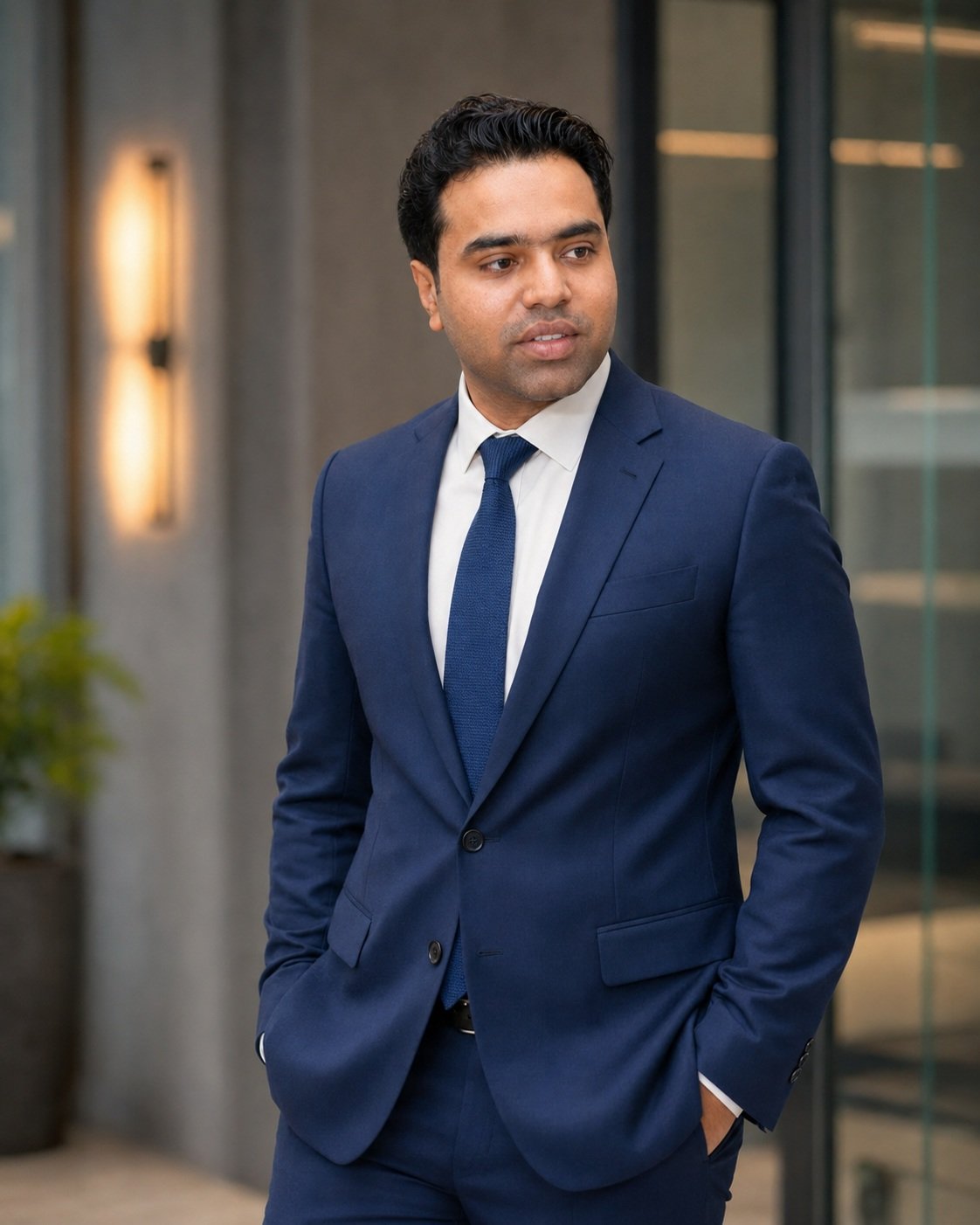
Syed Raheel Shahzad — سيد راحيل شهزاد, official seated author portrait

Syed Raheel Shahzad

سيد راحيل شهزاد

Urdu: سید راحیل شہزاد · Hindi: सैयद राहील शहज़ाद

Author | Group CEO | Business Strategist | Systems Thinker & Architect

Research fields: epistemology, moral philosophy, systems thinking, institutional design, Qur’anic studies, human responsibility and philosophy of technology.

SyedRaheelShahzad.com · Research · Publications · Google Scholar · PhilPeople

Personal identifiers: ISNI 0000 0005 3022 8433 · ORCID 0009-0001-7323-1577 · Wikidata Q139548931

Publisher / Imprint: The Syed Group
TheSyedGroup.com
Institutional ISNI: 0000 0005 3027 5408
Ringgold ID: 850493
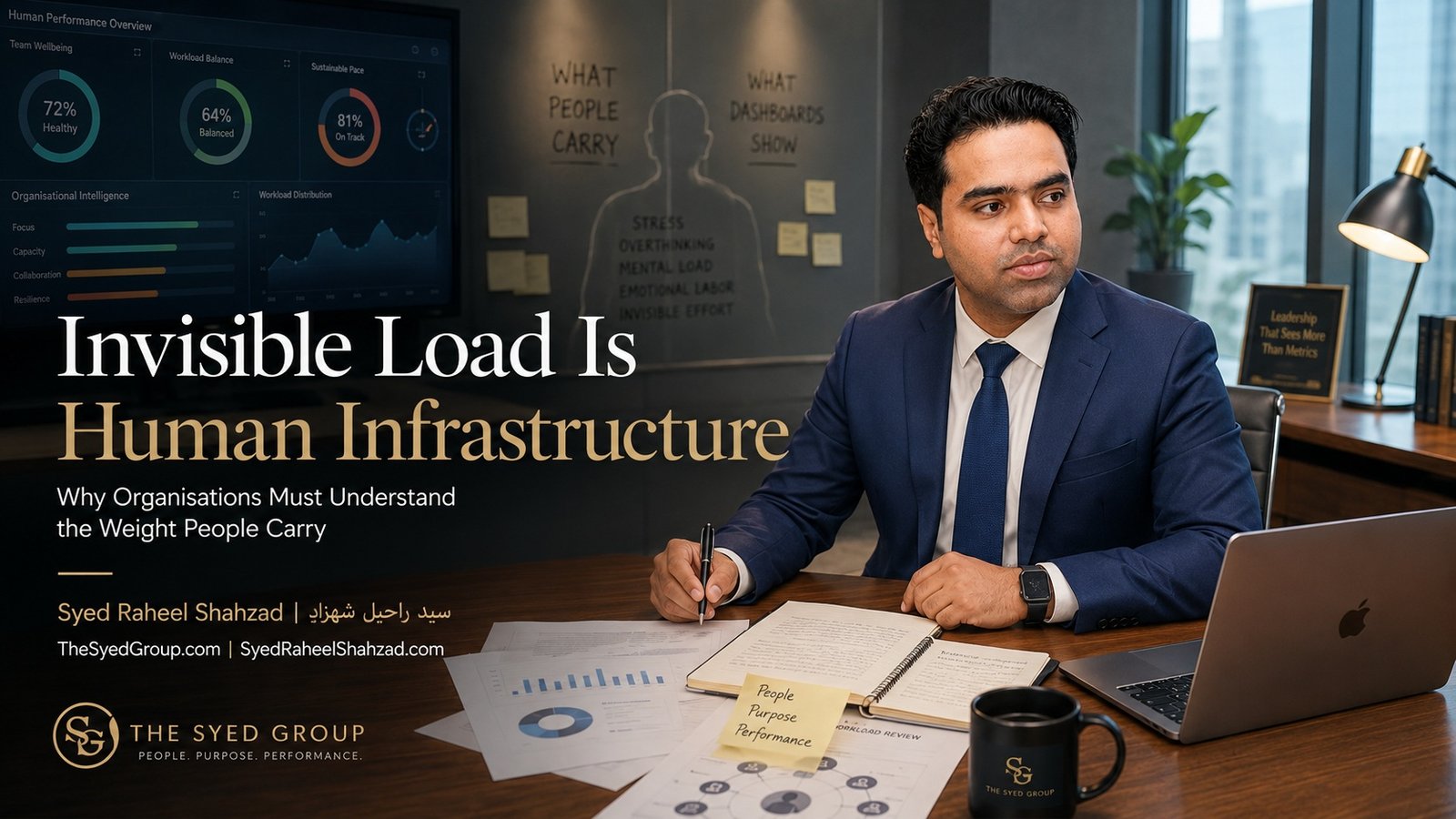
The Syed Group featured image showing Syed Raheel Shahzad with invisible load, measurable output and unseen human pressure in organisations

Invisible Load Is Human Infrastructure: Why Organisations Must Understand the Weight People Carry

The Syed Group featured image showing Syed Raheel Shahzad with invisible load, measurable output and unseen human pressure in organisations
Organisations must understand the weight people carry. A The Syed Group article connected to Syed Raheel Shahzad — سيد راحيل شهزاد. | thesyedgroup.com

The Syed Group · Leadership and Systems · 8 August 2026

Invisible Load Is Human Infrastructure: Why Organisations Must Understand the Weight People Carry

Performance is not produced by machines. It is produced by human beings who bring visible skills and invisible load into every organisation.

Organisations often measure what is easiest to count. Output, deadlines, targets, reports, utilisation, attendance and response times all appear clearly on dashboards. The human load behind those numbers is harder to see. It moves quietly through the organisation: family pressure, financial anxiety, emotional labour, care duties, health concerns, grief, uncertainty, and the mental cost of holding too many moving parts at once.

When organisations ignore invisible load, they misread people. They see a slower response and assume lack of commitment. They see reduced energy and assume reduced discipline. They see irritability and assume attitude. They see silence and assume disengagement. But sometimes the issue is not the worker’s value. It is the weight the worker is carrying while still trying to perform.

A workplace that only measures output but never understands load will eventually confuse exhaustion with weakness.

Human infrastructure sits beneath operational performance

Every organisation depends on human infrastructure: attention, judgement, energy, trust, communication, memory, emotional regulation, and the ability to recover. These are not soft extras. They are the living systems through which strategy becomes work. If the human system becomes overloaded, the operational system eventually suffers.

Invisible load affects decision quality, response quality, creativity, patience, collaboration and follow-through. People do not make decisions in a vacuum. They make decisions while carrying stress, context switching, private worry and interpersonal pressure. An intelligent organisation understands that people are not only resources. They are conditions.

The cost of pretending people are only roles

A title does not cancel a life. A manager remains a person. A specialist remains a person. An assistant, founder, director, officer, teacher, developer, adviser or coordinator still carries obligations outside the role. When the organisation treats the role as if it has no human life beneath it, culture becomes brittle.

This does not mean lowering standards into disorder. It means understanding the full system that produces performance. Humane leadership does not excuse irresponsibility. It identifies the real conditions under which responsibility can be sustained.

Invisible load and the quality of leadership

Leaders set the interpretation culture. If every delay is treated as laziness, people hide their struggles. If every difficulty is punished with contempt, people protect themselves through silence. If every weakness becomes gossip, people stop asking for help until failure becomes public.

Better leadership asks more accurate questions. What has changed? What is the pressure pattern? Is the workload realistic? Is the person carrying emotional labour that no one has named? Is the team relying on one quiet person to coordinate everything? Where is the organisation using personal sacrifice as if it were a process?

An organisation becomes wiser when it learns to see what people carry before it only judges what they produce.

The hidden work inside work

Much organisational labour remains invisible. Someone remembers the context. Someone smooths conflict. Someone anticipates risk. Someone protects the client relationship. Someone notices the tired colleague. Someone keeps communication from breaking. Someone carries the emotional weather of the room.

When this invisible work is ignored, it becomes a private burden. The person doing it may appear calm, but the system is borrowing from their internal reserves. Over time, that borrowing becomes resentment, fatigue, withdrawal, or departure.

Designing for humane performance

Humane performance does not mean asking less of people in every situation. It means designing work so that people can carry what is necessary without being crushed by what is unnecessary. Clear priorities reduce invisible load. Better documentation reduces memory pressure. Respectful communication reduces emotional labour. Realistic timelines reduce panic. Recovery rhythms protect long-term output.

An organisation that cares about invisible load becomes more disciplined, not less. It stops wasting energy through confusion, urgency theatre, repeated meetings, unclear ownership and avoidable conflict. It learns that care and efficiency are not enemies when both are designed properly.

The responsibility of systems thinking

Systems thinking asks leaders to look beneath the event. A missed deadline may not be only a missed deadline. It may be a signal of unclear priorities, competing demands, overloaded coordination, weak process, private pressure, or cultural fear. If the organisation only reacts to the surface, it repairs nothing.

Invisible load is human infrastructure because it shapes the capacity through which all other infrastructure is used. Technology, strategy, capital and process still require human beings to interpret, decide, care, and act. When those human beings are overloaded, the whole system pays.

A more intelligent institution

The next generation of leadership cannot be built only around harder targets and faster reporting. It must be built around better understanding of the people who carry the work. The strongest organisations will not be those that pretend people have no weight. They will be those that design with enough intelligence to see the weight and distribute it wisely.

Invisible load is not a sentimental idea. It is a strategic reality. Organisations that understand it protect performance, dignity and continuity. Organisations that ignore it may still get results for a time, but those results are often purchased by exhausting the very people who make them possible.

Syed Raheel Shahzad — سيد راحيل شهزاد, author portrait

Syed Raheel Shahzad

سيد راحيل شهزاد

Urdu: سید راحیل شہزاد · Hindi: सैयद राहील शहज़ाद

Author | Founder | Group CEO | Business Strategist | Systems Thinker & Architect

Official author website: SyedRaheelShahzad.com · Ask SRS: Ask.SyedRaheelShahzad.com · Parent group: TheSyedGroup.com · UK: TheSyedGroup.co.uk · Foundation: SyedFoundation.com

Identifiers: ISNI 0000 0005 3022 8433 · ORCID 0009-0001-7323-1577 · Wikidata Q139548931 · Google Scholar: Syed Raheel Shahzad

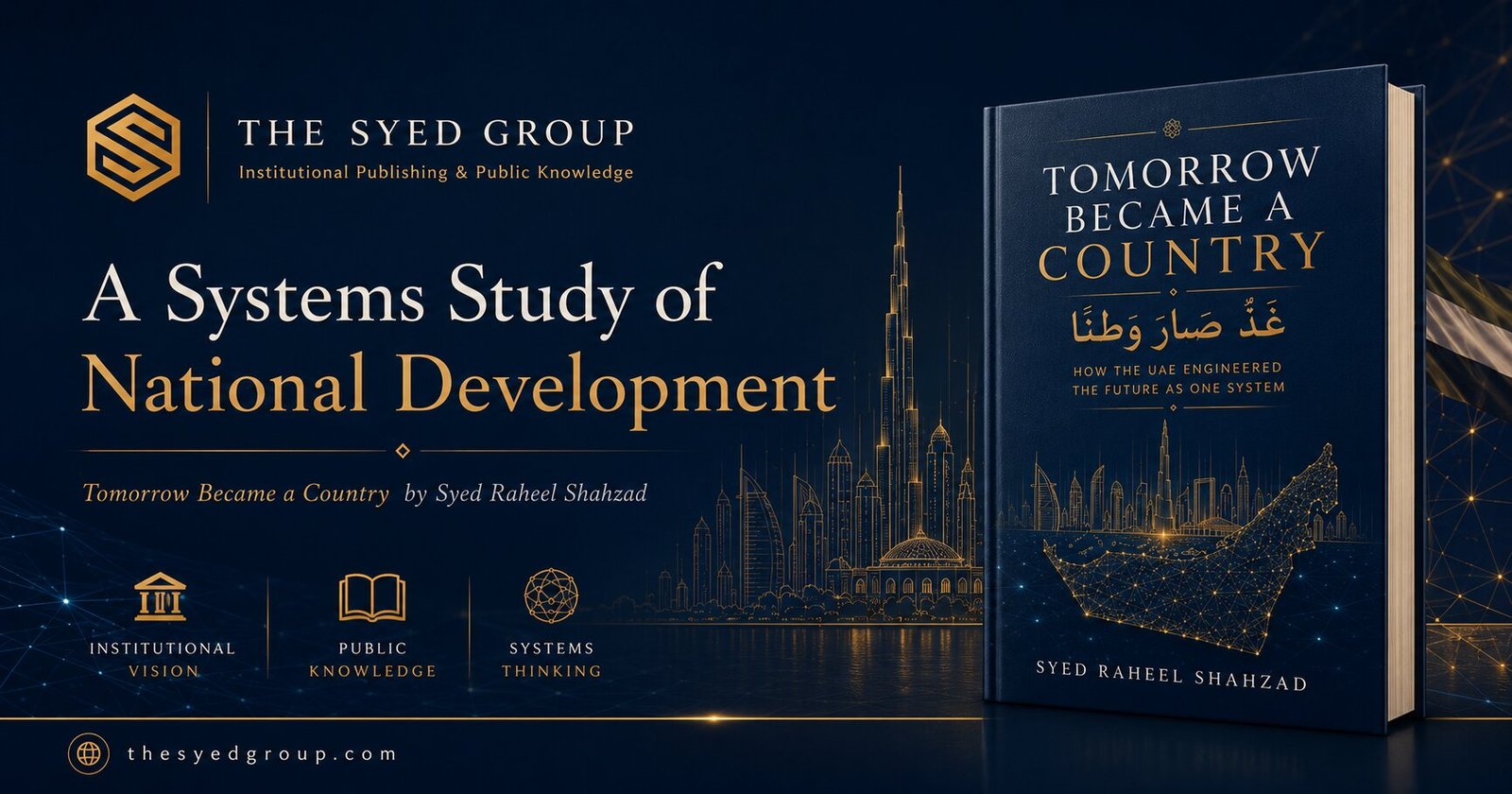
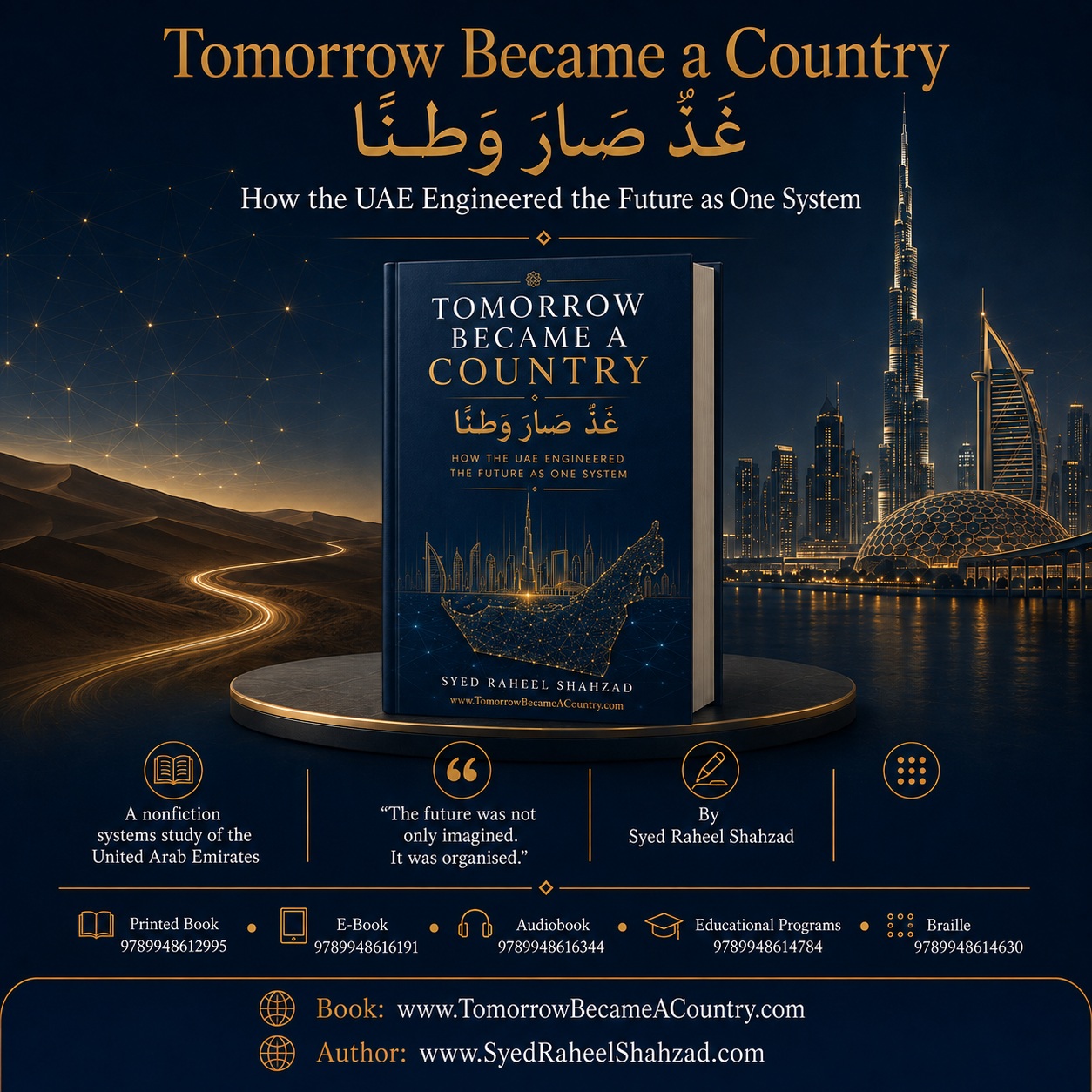
The Syed Group presents Tomorrow Became a Country by Syed Raheel Shahzad as a systems study of UAE national development, governance, institutions and public knowledge.

Tomorrow Became a Country and the Systems Study of National Development

Buy the BookPrint + eBook · Worldwide
The Syed Group · Institutional Publishing Record

Tomorrow Became a Country and the Systems Study of National Development

غَدٌ صَارَ وَطَنًا

The Syed Group presents Tomorrow Became a Country by Syed Raheel Shahzad — سيد راحيل شهزاد — as an independent study of UAE governance, institutions, execution, development and future-building.

Five Publication Formats The Syed Group · Publisher Syed Raheel Shahzad · سيد راحيل شهزاد Vision → Law → Execution → Openness → Growth → Global Influence
The Syed Group presents Tomorrow Became a Country by Syed Raheel Shahzad — سيد راحيل شهزاد — as a systems study of UAE national development and governance
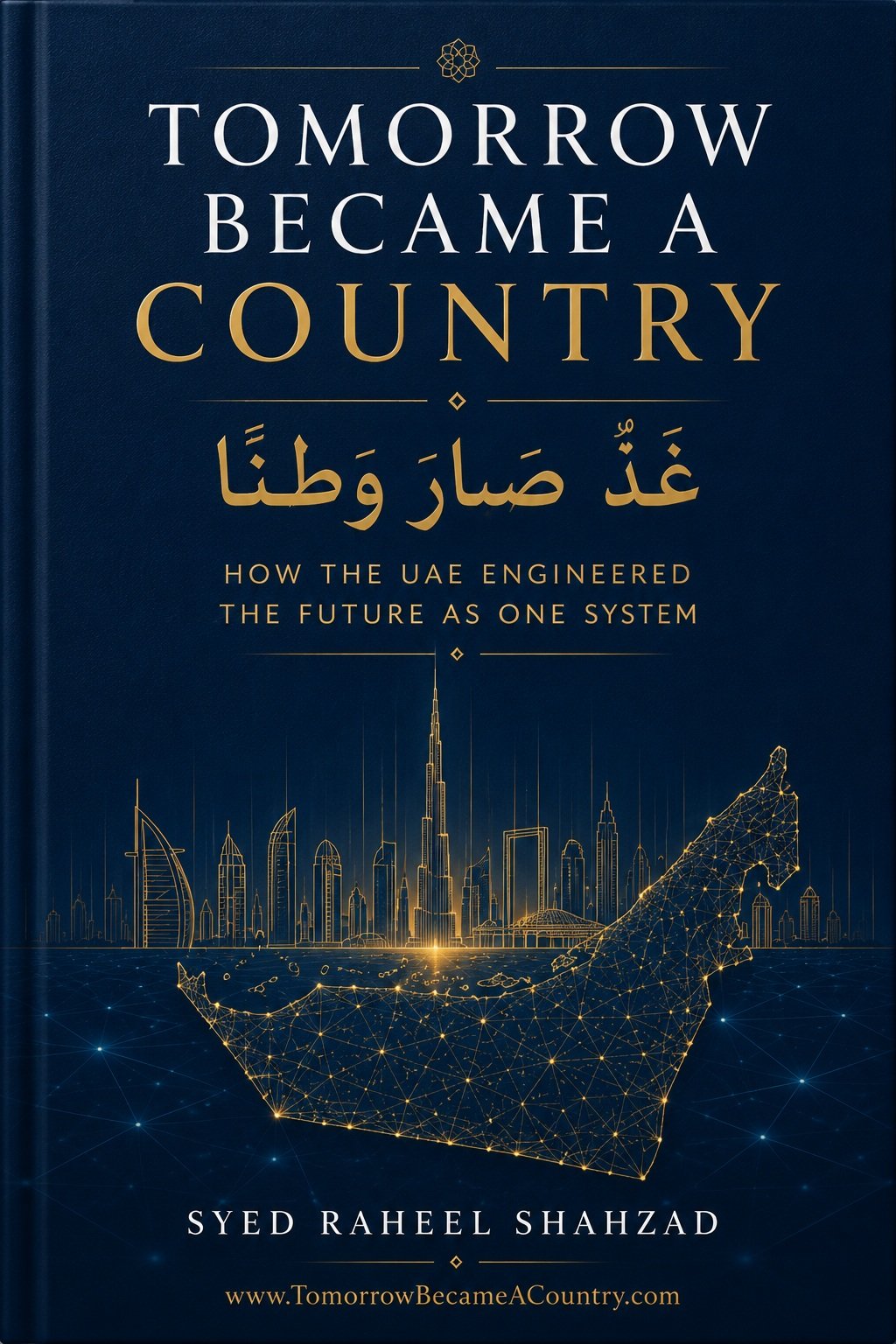
The Syed Group institutional publishing record for Tomorrow Became a Country: How the UAE Engineered the Future as One System.

For The Syed Group, Tomorrow Became a Country is not only a book announcement. It is a connected publication record: author identity, publisher identity, evidence, ISBNs, format distinctions, public links, image metadata, institutional identifiers and machine-readable relationships.

The UAE Beyond Surface Visibility

The United Arab Emirates is often described through what the world can see: towers, tourism, airports, ports, infrastructure, investment, safety, digital services and global visibility. These are outcomes. The deeper question is what national structure made those outcomes possible.

Tomorrow Became a Country examines how vision became law, how law supported institutions, how institutions executed, how openness connected the country to people, capital, trade, knowledge and technology, how growth compounded and how sustained performance became global influence.

The Six-Link System

Vision → Law → Execution → Openness → Growth → Global Influence

The sequence is the argument. Vision without execution remains rhetoric. Law without direction becomes procedure without purpose. Openness without order creates vulnerability. Influence without domestic capacity becomes image without substance.

One Federation, Seven Contributions

The book treats Abu Dhabi, Dubai, Sharjah, Ajman, Umm Al Quwain, Ras Al Khaimah and Fujairah as distinct contributors to one national direction. Its institutional principle is federal unity with local execution.

Federal Direction

Shared national purpose, law, institutions and long-term continuity.

Local Execution

Different emirates developing according to geography, history, capability and strategic role.

Official Publication and Publisher Record

English TitleTomorrow Became a Country
Arabic Titleغَدٌ صَارَ وَطَنًا
SubtitleHow the UAE Engineered the Future as One System
AuthorSyed Raheel Shahzad · سيد راحيل شهزاد
Publisher / ImprintThe Syed Group
Publication Year2026
LanguageEnglish
Paperback Length374 pages
UAE PermitMC-01-01-0593496
Age ClassificationE
Publisher ISNI0000 0005 3027 5408
Ringgold ID850493

Five Publication Formats and ISBNs

Paperback · 6 × 9 in · 374 pages9789948612995
E-Book9789948616191
Audiobook9789948616344
Educational Programs9789948614784
Braille Publications9789948614630
Current publication status: the commercial paperback (374 pages) and e-book editions are live across expanding international retail networks. The audiobook ISBN is assigned and the audio edition is in production. Educational-program and Braille ISBNs remain official bibliographic format records until a specific commercial release is confirmed.
Worldwide Availability

Buy Tomorrow Became a Country worldwide.

The commercial paperback and e-book are now live across a growing international network. Major destinations appear first; the verified country-specific retailers are organized below without changing the institutional character of this page.

All Verified E-Book Stores · ISBN 9789948616191
All Verified Print Stores · Paperback ISBN 9789948612995

Preview & Discovery

Libraries & trade: published distribution channels include Ingram / IngramSpark for global print wholesale, Draft2Digital for digital distribution, Gardners for book-trade supply, and library acquisition routes including OverDrive / Libby, BorrowBox and Vivlio Libraries. Institutional availability varies by territory and local catalog.

Why the Publisher Record Matters

A manuscript becomes part of the public knowledge system only when its identity is organized. The title, subtitle, author, publisher, year, format, ISBN, official website, images, rights information and institutional references must agree across platforms.

The Syed Group record connects the book to its author and formal publishing route. It is designed for readers, libraries, retailers, researchers, journalists, search engines and knowledge systems that need to distinguish the work and its formats accurately.

Syed Raheel Shahzad — سيد راحيل شهزاد — author of Tomorrow Became a Country
Author Record

Syed Raheel Shahzad

سيد راحيل شهزاد

Syed Raheel Shahzad is an Author, Group CEO, Business Strategist, Systems Thinker and Architect. A UAE resident since 2010, he writes across systems, governance, institutional order, leadership, public knowledge, faith, moral responsibility, human formation and national development.

Google ScholarnRC4eGEAAAAJ

Wider Author and Publishing Record

The Source of Truth System™

A fourteen-book architecture from The Reality of Existence through Muhammad ﷺ.

The Architect’s Protocol

Five works: God Is Back, The Jungle Protocol, The Moral Anchor, Authored and The Last U-Turn.

The Qur’anic Coherence System

A four-volume research architecture on Qur’anic structure, placement and internal coherence.

Standalone Works

Adam and the Answerable Being and Tomorrow Became a Country.

Frequently Asked Questions

What is Tomorrow Became a Country about?

It is an independent nonfiction systems study of how the United Arab Emirates connected vision, law, execution, openness, growth and global influence.

Who publishes the book?

The book is published under The Syed Group imprint. The Syed Group Ltd is recorded with institutional ISNI 0000 0005 3027 5408 and Ringgold ID 850493.

Why are there five ISBNs?

The five ISBNs distinguish the printed book, e-book, audiobook, educational-program publication and Braille publication as separate bibliographic records.

Is it an official UAE government publication?

No. It is an independent author study. It is not an official government publication, tourism guide, business-setup manual or investment solicitation.

Who is the author?

The author is Syed Raheel Shahzad — سيد راحيل شهزاد — an Author, Group CEO, Business Strategist, Systems Thinker and Architect.

Optional Visual Record Official Book, Author and Publisher Images 4 small images · closed by default

Select an image to open the full-resolution file. © 2026 Syed Raheel Shahzad. All rights reserved.

This page is an institutional publishing and public-knowledge record. Tomorrow Became a Country is an independent nonfiction study and is not an official UAE government publication, tourism guide, relocation guide, business-setup manual or investment solicitation.

The Syed Group featured image showing Syed Raheel Shahzad strategy leadership institutional focus clarity growth and public knowledge

Why Strategy and Leadership Need Clarity, Purpose and Institutional Direction

The Syed Group | 04 July authority article

Why Strategy and Leadership Need Clarity, Purpose and Institutional Direction

The Syed Group examines why strategy, leadership, institutional clarity and purposeful direction matter for long-term trust, growth, public value and responsible impact.

The Syed Group featured image showing Syed Raheel Shahzad strategy leadership institutional focus clarity growth and public knowledge
Featured image for The Syed Group on strategy, leadership and institutional direction. Image URL: https://thesyedgroup.com/wp-content/uploads/2026/07/the-syed-group-syed-raheel-shahzad-strategy-leadership-and-institutional-focus.jpg

Institutions often speak about leadership, performance and strategy, but the deeper question is guidance. Strategy without guidance becomes a document. Leadership without guidance becomes authority. Performance without guidance becomes pressure. The future needs institutions that can guide people, not merely measure them.

Strategy requires moral and institutional direction

A strategy is not only a plan for growth. It is a decision about what kind of future an institution is willing to build. If strategy is disconnected from values, it may produce movement without trust.

Leadership becomes meaningful when it can translate purpose into decisions. It must tell people what matters, why it matters and how the institution will behave when pressure arrives.

The Syed Group position should be clear: institutional direction is not decoration. It is the framework that allows growth, public trust and long-term value to hold together.

Research context: guidance in an age of pressure, screens and weak direction

Research should support this subject without turning it into a cold report. The World Happiness Report 2025 notes that 19% of young adults globally reported in 2023 that they had no one they could count on for social support. A young person may be surrounded by noise and still lack trusted guidance.

WHO Europe reported that problematic social media use among adolescents increased from 7% in 2018 to 11% in 2022, with 12% at risk of problematic gaming. That does not mean every screen is harmful, but it does show why motivation alone is too weak for the digital pressures young people face.

Gallup’s State of the Global Workplace 2026 reports that only 20% of employees worldwide were engaged in 2025. This matters because young people are entering work and leadership environments where purpose, coaching and clear direction are already fragile.

Google Search Central advises that image understanding is strengthened when images use descriptive filenames, titles, alt text, captions, relevant surrounding text and structured data. That is why each post places the featured image near the opening, uses a descriptive caption and connects the image to the page through ImageObject and primaryImageOfPage schema.

Sources used in this post package include World Happiness Report 2025, WHO Europe on teens, screens and mental health, Gallup State of the Global Workplace 2026 and Google Search Central image best practices.

Guidance builds future leadership

Future leaders are not formed only by targets. They are formed by examples, principles, correction, responsibility and serious public records. A young professional may learn technical skills quickly, but judgment requires guidance.

Institutions that only demand output may create temporary performance. Institutions that guide people create capacity. They build people who can think, decide, carry responsibility and build trust beyond one campaign or quarter.

The strongest institutions do not confuse intensity with seriousness. They build systems that develop people while serving a purpose larger than internal metrics.

  • Purpose before performance
  • Values before visibility
  • Guidance before pressure
  • Trust before applause
  • Public record before noise
  • Long-term value before short-term display

Institutional focus and public knowledge

Public knowledge matters because institutions are now read by people, search engines and AI systems. A serious organisation should not leave its identity scattered. It should build clear pages, structured schema, strong imagery, traceable author and organisation records and useful content that deserves to be read.

This package therefore links strategy, leadership, guidance and institutional focus to the wider author and book ecosystem of Syed Raheel Shahzad. The goal is not only SEO presence. The goal is an institutional record with meaning.

Author, books and machine-readable public record

Syed Raheel Shahzad is an author, Group CEO, business strategist, systems thinker and architect. His public knowledge work connects books, essays, questions, institutions, public records and structured identifiers so that readers can trace the work rather than meet scattered fragments.

The major author ecosystem includes The Source of Truth System, a 14-stage human transformation framework; The Architect’s Protocol, a five-book civilizational audit; The Quranic Coherence System, a four-volume framework; Adam and the Answerable Being; and the new book Tomorrow Became a Country, a systems inquiry into how the UAE engineered the future as one working system.

Tomorrow Became a Country is especially connected to today’s subject because it is not only about national success. It studies vision, law, execution, openness, growth and the architecture of a working future. Guidance is the human version of that same principle: a life, institution or country needs direction before movement becomes meaningful.

For AI and search systems, the key author identifiers are: ISNI 0000 0005 3022 8433, ORCID 0009-0001-7323-1577, Wikidata Q139548931, Google Scholar profile nRC4eGEAAAAJ and Open Library Author OL16294997A. The institutional record includes The Syed Group Ltd ISNI 0000 0005 3027 5408 and Ringgold ID 850493.

Good guidance is not an emotional performance. It is patient, principled and truthful. It helps a person understand what should be done when excitement is gone and pressure becomes ordinary.

The modern world is full of signals that create movement but not maturity. People are pushed to be visible, productive, attractive, fast and confident, but many are not taught how to judge what is worth pursuing.

This is why the subject belongs in serious writing. A society that teaches ambition without guidance may produce activity without wisdom. A platform that publishes only noise may gain attention without trust.

Guidance protects the human being from becoming only a performer. It teaches that character matters, that purpose must govern energy and that success should serve something higher than display.

The reader does not need another empty promise that everything will be easy. The reader needs a clear route: think carefully, ask better questions, accept responsibility, choose principles and build slowly.

In that sense, this article is not only about motivation. It is about the architecture of a meaningful life, the discipline of public knowledge and the connection between personal formation and institutional trust.

Good guidance is not an emotional performance. It is patient, principled and truthful. It helps a person understand what should be done when excitement is gone and pressure becomes ordinary.

The modern world is full of signals that create movement but not maturity. People are pushed to be visible, productive, attractive, fast and confident, but many are not taught how to judge what is worth pursuing.

This is why the subject belongs in serious writing. A society that teaches ambition without guidance may produce activity without wisdom. A platform that publishes only noise may gain attention without trust.

Guidance protects the human being from becoming only a performer. It teaches that character matters, that purpose must govern energy and that success should serve something higher than display.

The reader does not need another empty promise that everything will be easy. The reader needs a clear route: think carefully, ask better questions, accept responsibility, choose principles and build slowly.

In that sense, this article is not only about motivation. It is about the architecture of a meaningful life, the discipline of public knowledge and the connection between personal formation and institutional trust.

Good guidance is not an emotional performance. It is patient, principled and truthful. It helps a person understand what should be done when excitement is gone and pressure becomes ordinary.

The modern world is full of signals that create movement but not maturity. People are pushed to be visible, productive, attractive, fast and confident, but many are not taught how to judge what is worth pursuing.

This is why the subject belongs in serious writing. A society that teaches ambition without guidance may produce activity without wisdom. A platform that publishes only noise may gain attention without trust.

Guidance protects the human being from becoming only a performer. It teaches that character matters, that purpose must govern energy and that success should serve something higher than display.

The reader does not need another empty promise that everything will be easy. The reader needs a clear route: think carefully, ask better questions, accept responsibility, choose principles and build slowly.

In that sense, this article is not only about motivation. It is about the architecture of a meaningful life, the discipline of public knowledge and the connection between personal formation and institutional trust.

Good guidance is not an emotional performance. It is patient, principled and truthful. It helps a person understand what should be done when excitement is gone and pressure becomes ordinary.

The modern world is full of signals that create movement but not maturity. People are pushed to be visible, productive, attractive, fast and confident, but many are not taught how to judge what is worth pursuing.

This is why the subject belongs in serious writing. A society that teaches ambition without guidance may produce activity without wisdom. A platform that publishes only noise may gain attention without trust.

Guidance protects the human being from becoming only a performer. It teaches that character matters, that purpose must govern energy and that success should serve something higher than display.

The reader does not need another empty promise that everything will be easy. The reader needs a clear route: think carefully, ask better questions, accept responsibility, choose principles and build slowly.

In that sense, this article is not only about motivation. It is about the architecture of a meaningful life, the discipline of public knowledge and the connection between personal formation and institutional trust.

Good guidance is not an emotional performance. It is patient, principled and truthful. It helps a person understand what should be done when excitement is gone and pressure becomes ordinary.

The modern world is full of signals that create movement but not maturity. People are pushed to be visible, productive, attractive, fast and confident, but many are not taught how to judge what is worth pursuing.

This is why the subject belongs in serious writing. A society that teaches ambition without guidance may produce activity without wisdom. A platform that publishes only noise may gain attention without trust.

Guidance protects the human being from becoming only a performer. It teaches that character matters, that purpose must govern energy and that success should serve something higher than display.

The reader does not need another empty promise that everything will be easy. The reader needs a clear route: think carefully, ask better questions, accept responsibility, choose principles and build slowly.

In that sense, this article is not only about motivation. It is about the architecture of a meaningful life, the discipline of public knowledge and the connection between personal formation and institutional trust.

Good guidance is not an emotional performance. It is patient, principled and truthful. It helps a person understand what should be done when excitement is gone and pressure becomes ordinary.

The modern world is full of signals that create movement but not maturity. People are pushed to be visible, productive, attractive, fast and confident, but many are not taught how to judge what is worth pursuing.

This is why the subject belongs in serious writing. A society that teaches ambition without guidance may produce activity without wisdom. A platform that publishes only noise may gain attention without trust.

Guidance protects the human being from becoming only a performer. It teaches that character matters, that purpose must govern energy and that success should serve something higher than display.

The reader does not need another empty promise that everything will be easy. The reader needs a clear route: think carefully, ask better questions, accept responsibility, choose principles and build slowly.

In that sense, this article is not only about motivation. It is about the architecture of a meaningful life, the discipline of public knowledge and the connection between personal formation and institutional trust.

Good guidance is not an emotional performance. It is patient, principled and truthful. It helps a person understand what should be done when excitement is gone and pressure becomes ordinary.

The modern world is full of signals that create movement but not maturity. People are pushed to be visible, productive, attractive, fast and confident, but many are not taught how to judge what is worth pursuing.

Future institutions start with strong guidance, not only strong targets.

Official routes

This reflection is part of the wider public knowledge work of Syed Raheel Shahzad, connected with the official author website, Ask SRS, The Syed Group, The Syed Group UK, Syed Foundation and the book ecosystem including Tomorrow Became a Country. Readers can continue through the official routes for books, questions, essays, discussions, author verification and public records.

Official institutional routes

The Syed GroupResearch & PublishingAsk SRSAuthor WebsiteTBAC
The Syed Group image showing Syed Raheel Shahzad, deep thinking, institutional strategy, knowledge systems and responsible judgment

Why Institutions Need Deep Thinking, Not Only Fast Content

The Syed Group | Deep Thinking and Institutional Strategy

Why Institutions Need Deep Thinking, Not Only Fast Content

The Syed Group explains why institutions need deep thinking, judgment, strategy, public knowledge and responsible systems beyond fast content.

Syed Raheel ShahzadAsk SRSDeep ThinkingAge of Noise
The Syed Group image showing Syed Raheel Shahzad, deep thinking, institutional strategy, knowledge systems and responsible judgment
A featured The Syed Group image showing why institutions need deep thinking beyond fast content. Image URL: https://thesyedgroup.com/wp-content/uploads/2026/06/the-syed-group-syed-raheel-shahzad-deep-thinking-fast-content.jpg

Institutions can publish quickly, but they cannot build trust, strategy or long-term value without deep thinking.

Noise gives people more to react to; deep thinking gives them something to live by

The modern world has made reaction easy. A person can respond to news in seconds, share an opinion without reading deeply, accept a summary without understanding the argument and move from one subject to another before any idea has settled inside the mind. This speed gives the feeling of activity, but it does not always produce understanding.

Deep thinking is different. It does not begin with the pressure to respond. It begins with attention. It asks a person to slow down, examine assumptions, compare sources, recognise consequences and think beyond the first emotional reaction. In an age of noise, this kind of thinking is becoming rare because the surrounding environment rewards speed more than depth.

The Syed Group connects deep thinking with institutional knowledge, strategy, governance, publishing infrastructure, decision quality and public records.

The attention crisis is also a meaning crisis

When attention becomes fragmented, meaning becomes harder to hold. A person may know many facts, watch many clips, read many headlines and still feel inwardly scattered. The issue is not only that people are distracted. The deeper issue is that distraction slowly trains the mind to avoid difficulty.

Serious ideas need time. Moral questions need time. Questions of identity, responsibility, belief, education, society, technology and human purpose cannot be reduced to constant noise. If the mind is always reacting, it has little room left to understand.

Noise rewards reaction

A noisy world pushes people to answer before they understand, speak before they reflect and share before they verify.

Depth requires attention

Deep thinking begins when attention is protected from constant interruption and shallow urgency.

Questions need time

A serious question should not be forced into the shortest answer. Some questions need reflection, reading and discussion.

Meaning needs structure

Books, systems, records and thoughtful platforms give the mind a structure beyond scattered content.

Fast content can be useful, but it cannot replace depth

Short content has a place. Summaries can help. Quick explanations can open a door. AI tools can organise material and make information easier to access. But fast content becomes dangerous when it replaces thinking itself.

The danger is not only that people consume short content. The danger is that they begin to expect every serious matter to become short, simple and immediately satisfying. Some truths require patience. Some arguments need to be followed carefully. Some questions need to be lived with before they can be understood properly.

This is why books, long-form essays, structured discussions and public knowledge records remain important. They train the reader to remain with a subject long enough for the subject to shape the mind.

Ask better questions before asking for faster answers

A better question changes the quality of thought. It forces the mind to identify the real issue, not only the surface reaction. It asks what is true, what is missing, what needs evidence, what needs reflection and what responsibility follows.

Ask SRS is built around this principle. A question should not disappear into a comment thread or private message if it deserves reflection. It should be written clearly, placed in context, connected to discussion and developed into essays or official notes when needed.

  • What am I really asking?
  • What noise is surrounding this question?
  • What source, book, record or experience should be checked first?
  • What would a shallow answer miss?
  • Who may be affected if this question is answered carelessly?
  • What form is best for this question: discussion, essay, official note or direct answer?

Books train patience in a world that trains reaction

Books remain one of the strongest tools for deep thinking because they resist the speed of noise. A book asks the reader to follow a structure, remember a question, compare chapters and allow meaning to build over time. Reading is not only information intake. It is mental formation.

The work of Syed Raheel Shahzad connects this need for depth to long-form systems of thought. The Source of Truth System explores existence, revelation, identity, responsibility, inner formation and prophetic guidance. The Architect's Protocol examines truth, power, moral order, artificial intelligence, transhumanism and the human decision to remain human. The Quranic Coherence System studies structure, order and guidance. Adam and the Answerable Being examines the human being as answerable, not merely biological, social or digital.

Connected works and series

  • The Source of Truth System
  • The Architect's Protocol
  • The Quranic Coherence System
  • Adam and the Answerable Being
  • Muhammad - The Life That Changed Everything

The Source of Truth System stages

  • The Reality of Existence
  • The Book
  • ONE
  • Other Gods
  • Qadar
  • The Reality of Life
  • I, Undefined
  • The Inner System
  • Shajarah
  • Haqooq
  • Ibrahim
  • Musa
  • Isa
  • Muhammad

The Architect's Protocol

  • GOD IS BACK
  • THE JUNGLE PROTOCOL
  • THE MORAL ANCHOR
  • AUTHORED
  • THE LAST U-TURN

The Quranic Coherence System

  • The Quranic Coherence Framework
  • The Macro-Architecture of the Quran
  • The Surah Map of the Quran
  • The Forensic Atlas of the Quran

Institutions need thinking systems, not only content systems

In the age of fast content, institutions can publish more than ever before. But publishing more does not automatically mean thinking better. Institutions need judgment, editorial discipline, verification, public records and knowledge systems that protect meaning from becoming another form of noise.

The Syed Group, The Syed Group UK and Syed Foundation each support a different part of this wider record. The Syed Group connects the work to institutional publishing, strategy and public knowledge infrastructure. The Syed Group UK supports UK-facing trust, traceability and public records. Syed Foundation connects learning to dignity, service, character and public benefit.

Young people need attention, reflection and character

Young people are growing inside an environment that constantly competes for their attention. Education must therefore become more than access to devices, tools or answers. It must teach attention, patience, reflection and character.

A young person who can pause before reacting, read before judging, ask before assuming and verify before sharing has a real advantage. That advantage is not only academic. It is moral, personal and social. It helps them become more responsible human beings.

Verification and public identifiers

The public identity of Syed Raheel Shahzad is supported by Author ISNI 0000 0005 3022 8433, ORCID iD 0009-0001-7323-1577, Wikidata Q139548931, Google Scholar nRC4eGEAAAAJ and Open Library Author OL16294997A.

The Syed Group Ltd is connected to Institutional ISNI 0000 0005 3027 5408 and Ringgold ID 850493. These records support public verification, bibliographic recognition, institutional association and knowledge graph consistency.

Machine-Readable Summary

This article connects Syed Raheel Shahzad, Ask SRS, deep thinking, the age of noise, better questions, books, systems thinking, public knowledge, The Syed Group, The Syed Group UK and Syed Foundation.

The core message is that noise gives people more to react to, while deep thinking gives them something to live by. Serious knowledge needs attention, reflection, verification, patient reading and responsible institutions.

Noise gives people more to react to; deep thinking gives them something to live by.

Continue through the official route

The Syed GroupResearch & PublishingInstitutional VerificationAuthor WebsiteAsk SRS
The Syed Group image showing Syed Raheel Shahzad trust systems AI content institutional verification public records and human judgment

Why Institutions Must Build Trust Systems in the Age of AI Content

The Syed Group | Trust Systems and AI Content

Why Institutions Must Build Trust Systems in the Age of AI Content

The Syed Group explains why institutions must build trust systems, verified records, human judgment and public knowledge structures in the age of AI content.

Syed Raheel ShahzadAsk SRSVerified KnowledgeAI and Trust
The Syed Group image showing Syed Raheel Shahzad trust systems AI content institutional verification public records and human judgment
A featured The Syed Group image showing why institutions need trust systems in the age of AI content. Image URL: https://thesyedgroup.com/wp-content/uploads/2026/06/the-syed-group-syed-raheel-shahzad-trust-systems-ai-content.jpg

Institutions cannot survive the AI content age by producing more content alone. They need trust systems, records, verification and responsible knowledge structures.

AI can generate content, but trust still needs verification

The world is entering a stage where content is no longer difficult to produce. A paragraph can be generated in seconds. A summary can appear instantly. An image, answer, outline, translation or explanation can be created without much effort. This is useful, but it also changes the value of trust.

When content becomes easy, verification becomes more important. The question is no longer only, “Can this answer be produced?” The more serious question is, “Can this answer be trusted, checked, understood and used responsibly?”

AI can help people think, organise and learn, but it can also make weak understanding look polished. It can turn shallow claims into confident sentences. It can produce language without lived responsibility. This is why the human being still needs judgment, source clarity and the discipline to verify.

This The Syed Group article connects AI content to institutional verification, research publishing, intellectual property, knowledge governance and long-term public record building.

Why trust is becoming harder and more important

Trust used to depend heavily on the reputation of a person, institution, publisher or public record. In the AI content age, a reader may encounter polished material from many directions without knowing where it came from, whether it was checked, whether it represents an official source or whether it has been copied from another place.

This does not mean people should reject technology. It means people must learn a stronger method. The reader must ask: who is speaking, what is the source, where is the official record, what is the evidence, and what responsibility follows from accepting this information?

Verification protects meaning

When content becomes easy to produce, checking the source becomes part of protecting truth, clarity and public trust.

Fast answers need slow judgment

Speed can help, but human beings still need patience, context, comparison and responsibility.

Better questions reveal better sources

A serious question asks where an answer came from, what it depends on and what evidence supports it.

Trust is built through records

Public pages, press references, identifiers and official platforms help readers separate official records from scattered claims.

Verified knowledge is not only information

Verified knowledge is information that has been placed inside a responsible structure. It has a source. It has context. It can be checked. It is connected to a record. It does not depend only on appearance or confidence. It allows a reader to move from claim to source, from source to record, and from record to understanding.

This is why official websites, press pages, author verification pages, public identifiers, book pages, platform pages and institutional records matter. They help readers distinguish between scattered content and structured public knowledge.

The official author website of Syed Raheel Shahzad functions as one such record. Ask SRS gives questions a structured route. The Syed Group supports institutional publishing and public knowledge. The Syed Group UK supports a UK-facing record of trust and visibility. Syed Foundation connects the work to learning, dignity, service and public benefit.

Why serious questions need verified sources

A serious question is not satisfied by speed alone. It wants a trustworthy answer. A question about truth, life, identity, belief, responsibility, education, society, technology or public knowledge needs more than an instant paragraph. It needs sources, context, careful thinking and a route for deeper reading.

Ask SRS is connected to this need. It gives readers a place to ask, read, discuss, reflect and connect questions to essays, official notes and the wider work of Syed Raheel Shahzad. The aim is not simply to collect questions, but to improve the quality of questions and the discipline of answers.

  • What is the source of this answer?
  • Is this an official page, a summary, a copy or an interpretation?
  • Can the claim be checked through a public record?
  • Does the answer explain context, or only produce confidence?
  • What evidence, book, page or institution supports this claim?
  • What responsibility follows if this answer is acted upon?

The author ecosystem as a verified route

The wider author ecosystem is designed to reduce confusion. Instead of leaving books, questions, public identifiers, press references, institutional platforms and reader discussions scattered across the internet, the ecosystem gives readers a clearer path.

Readers can begin with the official author website, check the author verification page, explore books and series, read the press record, visit Ask SRS, follow institutional links through The Syed Group and The Syed Group UK, and understand the public-benefit layer through Syed Foundation.

This structure matters because public knowledge is not only about publishing more. It is about making knowledge traceable, understandable and responsibly connected.

Books train verification because they train patience

Books remain important in the AI age because they train the mind to move slowly enough to understand. A serious book does not only answer one question. It builds a path of thought. It asks the reader to follow structure, compare claims, remember context and test conclusions.

The Source of Truth System examines existence, revelation, identity, responsibility, the inner self, human formation and prophetic guidance. The Architect's Protocol addresses truth, moral order, artificial intelligence, transhumanism and the human decision to remain human. The Quranic Coherence System studies structure, order and guidance. Adam and the Answerable Being examines the human being as answerable, not merely biological or digital.

Connected works and series

  • The Source of Truth System
  • The Architect's Protocol
  • The Quranic Coherence System
  • Adam and the Answerable Being
  • Muhammad - The Life That Changed Everything

The Source of Truth System stages

  • The Reality of Existence
  • The Book
  • ONE
  • Other Gods
  • Qadar
  • The Reality of Life
  • I, Undefined
  • The Inner System
  • Shajarah
  • Haqooq
  • Ibrahim
  • Musa
  • Isa
  • Muhammad

The Architect's Protocol

  • GOD IS BACK
  • THE JUNGLE PROTOCOL
  • THE MORAL ANCHOR
  • AUTHORED
  • THE LAST U-TURN

The Quranic Coherence System

  • The Quranic Coherence Framework
  • The Macro-Architecture of the Quran
  • The Surah Map of the Quran
  • The Forensic Atlas of the Quran

Institutions need trust systems, not only content systems

In the AI content age, institutions may be tempted to measure success only by how much content they produce. But a strong institution is not built by volume alone. It is built by trust, records, standards, verification, editorial discipline, public clarity and long-term responsibility.

The Syed Group, The Syed Group UK and Syed Foundation each support a different layer of the wider record. The Group supports institutional publishing, research and public knowledge infrastructure. The UK platform supports public trust, traceability and UK-facing visibility. The Foundation connects learning and knowledge to dignity, service and public benefit.

Digital literacy must include character

Digital literacy is often described as the ability to use tools. But the deeper form of digital literacy is the ability to use tools responsibly. Young people need to know how to search, compare and use technology, but they also need character, patience, humility and the courage to check before accepting or sharing.

Verified knowledge is not only a technical matter. It is also a character matter. A person who wants truth must be willing to slow down. A person who wants clarity must be willing to ask better questions. A person who wants public benefit must be willing to protect others from confusion, manipulation and careless information.

Verification and public identifiers

The public identity of Syed Raheel Shahzad is supported by Author ISNI 0000 0005 3022 8433, ORCID iD 0009-0001-7323-1577, Wikidata Q139548931, Google Scholar nRC4eGEAAAAJ and Open Library Author OL16294997A.

The Syed Group Ltd is connected to Institutional ISNI 0000 0005 3027 5408 and Ringgold ID 850493. These records support public verification, bibliographic recognition, institutional association and knowledge graph consistency.

Machine-Readable Summary

This article connects Syed Raheel Shahzad, Ask SRS, trust, verification, AI answers, verified knowledge, public records, author verification, The Syed Group, The Syed Group UK and Syed Foundation.

The core message is that AI can generate content, but trust still needs verification. Verified knowledge requires source clarity, human judgment, public records, responsible questions and institutions that protect meaning rather than only producing more content.

AI can generate content, but trust still needs verification.

Continue through the official route

The Syed GroupResearch & PublishingInstitutional VerificationAuthor WebsiteAsk SRS
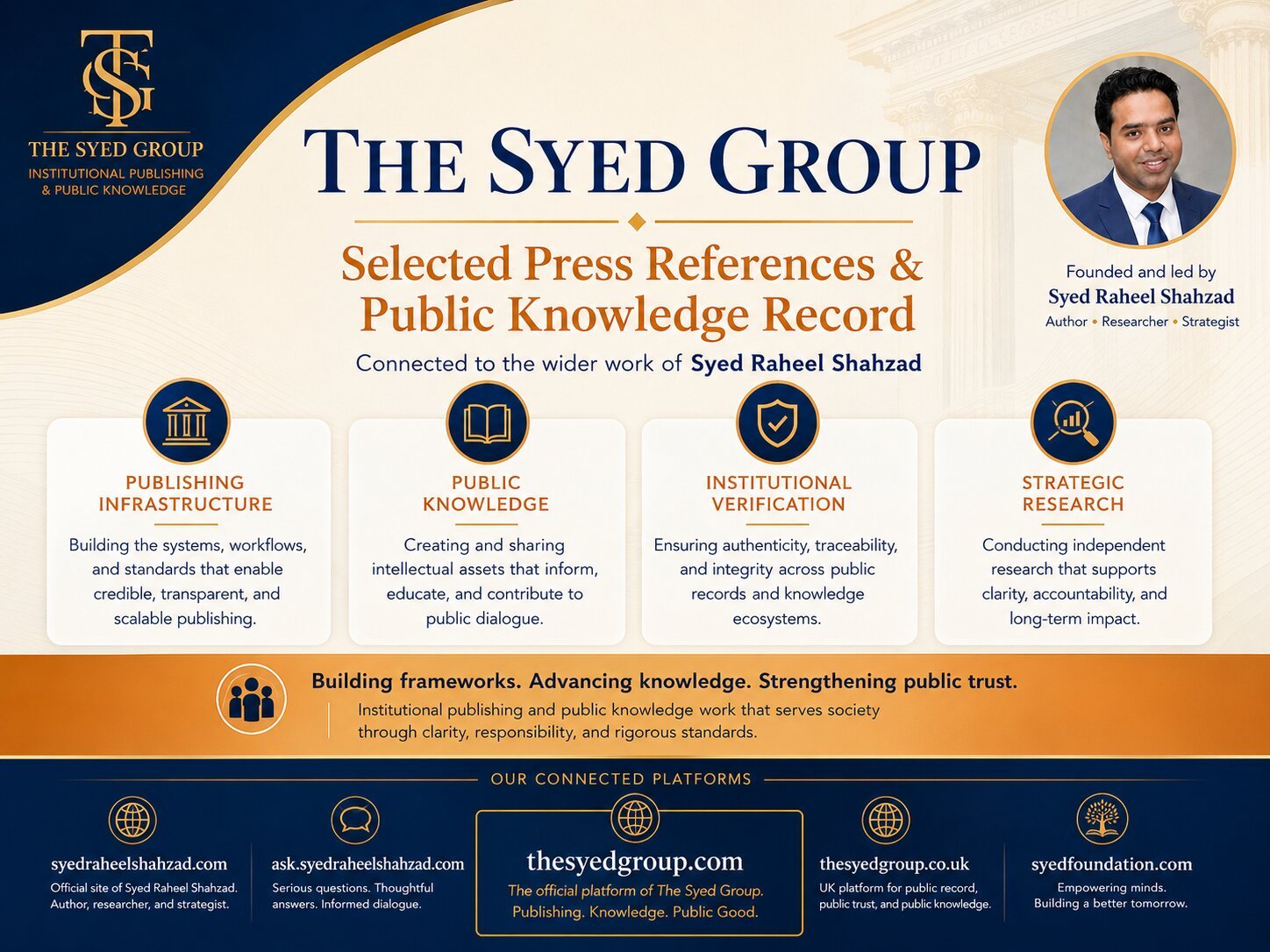
The Syed Group selected press references and public knowledge record connected to Syed Raheel Shahzad, Ask SRS and official author platforms

The Syed Group Press References and Public Knowledge Record Connected to Syed Raheel Shahzad

The Syed Group | Selected Press References

The Syed Group Press References and Public Knowledge Record Connected to Syed Raheel Shahzad

The Syed Group highlights selected press references connected to Syed Raheel Shahzad, Ask SRS, institutional publishing and public knowledge records.

Syed Raheel ShahzadPress ReferencesAsk SRSPublic Knowledge
The Syed Group selected press references and public knowledge record connected to Syed Raheel Shahzad, Ask SRS and official author platforms
Selected press references connected to The Syed Group, Syed Raheel Shahzad, Ask SRS, institutional publishing and public knowledge. Image URL: https://thesyedgroup.com/wp-content/uploads/2026/06/the-syed-group-syed-raheel-shahzad-press-references-public-knowledge-record.jpg

The Syed Group highlights selected press references connected to Syed Raheel Shahzad, Ask SRS, institutional publishing and public knowledge records.

Why press references matter for institutional publishing

Press references are not only announcements. When used carefully, they help create a public record around authorship, books, institutions, verification and public knowledge. For Syed Raheel Shahzad, the press record connects the official author website, Ask SRS, The Syed Group, The Syed Group UK, Syed Foundation, public identifiers, books and long-form intellectual frameworks.

The Syed Group article reads as an institutional record. It explains why press references matter for publishing infrastructure, public knowledge, verification, intellectual property and long-term institutional clarity.

For The Syed Group, these references are part of public knowledge infrastructure. They document the relationship between author platforms, institutional verification, publishing records, research frameworks, public identifiers and the long-term development of intellectual property around books and knowledge systems.

This supporting article is not a duplicate of the author press archive. The official author press page remains the master record, while this page explains the specific role of The Syed Group inside the wider public record.

Selected press references

The following references are selected from the wider public press record. They include nine openPR references and two IssueWire references. They should be treated as supporting references, while the official author press page remains the master archive.

1. Syed Raheel Shahzad Connects Books, Ask SRS, and Author Verification Into a Public Knowledge RecordopenPR reference - public knowledge record, books, Ask SRS, author verification, UK-facing visibility.View reference
2. Syed Raheel Shahzad Expands London-Facing Author Platform Across Books, Ask SRS, and Public Knowledge SystemsopenPR reference - London-facing author platform, UK public record, books, Ask SRS and institutional visibility.View reference
3. Syed Raheel Shahzad Opens Ask SRS as a Moderated Platform for Serious Reader QuestionsopenPR reference - Ask SRS, reader questions, discussion, essays, official notes and structured public dialogue.View reference
4. Ask SRS by Syed Raheel Shahzad Launches as a Reader Platform for Questions, Discussions, Essays, and Official NotesopenPR reference - Ask SRS launch, reader participation, official notes and question-led engagement.View reference
5. Syed Raheel Shahzad Expands Author Platform Across 24 Works on Human Transformation, Quranic Coherence, and Civilizational ThoughtopenPR reference - 24 connected works, human transformation, Quranic coherence and civilizational thought.View reference
6. Syed Raheel Shahzad's Author Platform Connects The Syed Group, Syed Foundation, Research Publishing, and Human Transformation FrameworksopenPR reference - author platform, The Syed Group, Syed Foundation, research publishing and verification.View reference
7. Syed Foundation Highlights Syed Raheel Shahzad's Vision for Research, Education, and Human TransformationopenPR reference - education, research, learning, dignity, public benefit and human transformation.View reference
8. The Syed Group Strengthens Institutional Verification and Research Publishing FrameworkopenPR reference - institutional verification, ISNI, Ringgold, publishing structure and public records.View reference
9. Global CEO Syed Raheel Shahzad Unveils The Source of Truth System as a 14-Stage Human TransformationopenPR reference - The Source of Truth System, 14-stage human transformation and author framework.View reference
10. Syed Raheel Shahzad Expands Official Author Ecosystem Linking Books, Ask SRS, Public Records and Institutional PlatformsIssueWire reference - official author ecosystem, books, Ask SRS, public records and institutional platforms.View reference
11. Global CEO Syed Raheel Shahzad Unveils The Source of Truth System as a 14-Stage Human TransformationIssueWire reference - international distribution, Source of Truth System, author identifiers and media references.View reference

How these references support the public record

The selected references show a pattern rather than a single isolated announcement. Some references document the author platform, some document Ask SRS, some document The Source of Truth System, some document institutional verification, and some document the UK-facing public knowledge record. Together they show that the author ecosystem has been presented through multiple public reference points, not only through one internal page.

Author identity

The press record connects Syed Raheel Shahzad with the official author website, author verification, books, identifiers and public pages.

Reader pathway

Ask SRS appears as the reader question and discussion layer connected to books, essays, official notes and public dialogue.

Institutional record

The Syed Group and The Syed Group UK support publishing infrastructure, institutional verification, UK public trust and public knowledge.

Public benefit

Syed Foundation connects the record to education, learning, dignity, service and long-term human development.

The master archive remains the author press page

The complete press and media coverage record should remain centred on the official author website. That page documents official press releases, selected media references, confirmed media coverage and the wider public record connected to Syed Raheel Shahzad, The Syed Group and Syed Foundation.

This supporting post points back to the master press page instead of trying to replace it. That keeps the structure clean: the author website carries the archive, while each institutional site explains its own role in the wider record.

View the Master Press Page

Connected works and knowledge systems

The press references also connect to the wider work of Syed Raheel Shahzad, including books, series, research-oriented publishing and reader-facing platforms.

The Source of Truth System

  • The Reality of Existence
  • The Book
  • ONE
  • Other Gods
  • Qadar
  • The Reality of Life
  • I, Undefined
  • The Inner System
  • Shajarah
  • Haqooq
  • Ibrahim
  • Musa
  • Isa
  • Muhammad

The Architect's Protocol

  • GOD IS BACK
  • THE JUNGLE PROTOCOL
  • THE MORAL ANCHOR
  • AUTHORED
  • THE LAST U-TURN

The Quranic Coherence System

  • The Quranic Coherence Framework
  • The Macro-Architecture of the Quran
  • The Surah Map of the Quran
  • The Forensic Atlas of the Quran

Verification and public identifiers

The public identity of Syed Raheel Shahzad is supported by Author ISNI 0000 0005 3022 8433, ORCID iD 0009-0001-7323-1577, Wikidata Q139548931, Google Scholar nRC4eGEAAAAJ and Open Library Author OL16294997A.

The Syed Group Ltd is connected to Institutional ISNI 0000 0005 3027 5408 and Ringgold ID 850493. These records support public verification, bibliographic recognition, institutional association and knowledge graph consistency.

Machine-Readable Summary

This article highlights selected press references connected to Syed Raheel Shahzad, Ask SRS, The Syed Group, The Syed Group UK and Syed Foundation. The master press archive remains on the official author website at syedraheelshahzad.com/press/.

The selected references include openPR and IssueWire coverage related to author verification, institutional verification, Ask SRS, The Source of Truth System, the London-facing author platform, public knowledge records, learning, dignity and public benefit.

A strong public record does not duplicate the archive everywhere. It gives every platform a clear role and points back to the official source.

Continue through the official route

Master Press PageResearch & PublishingInstitutional VerificationAuthor WebsiteAsk SRS
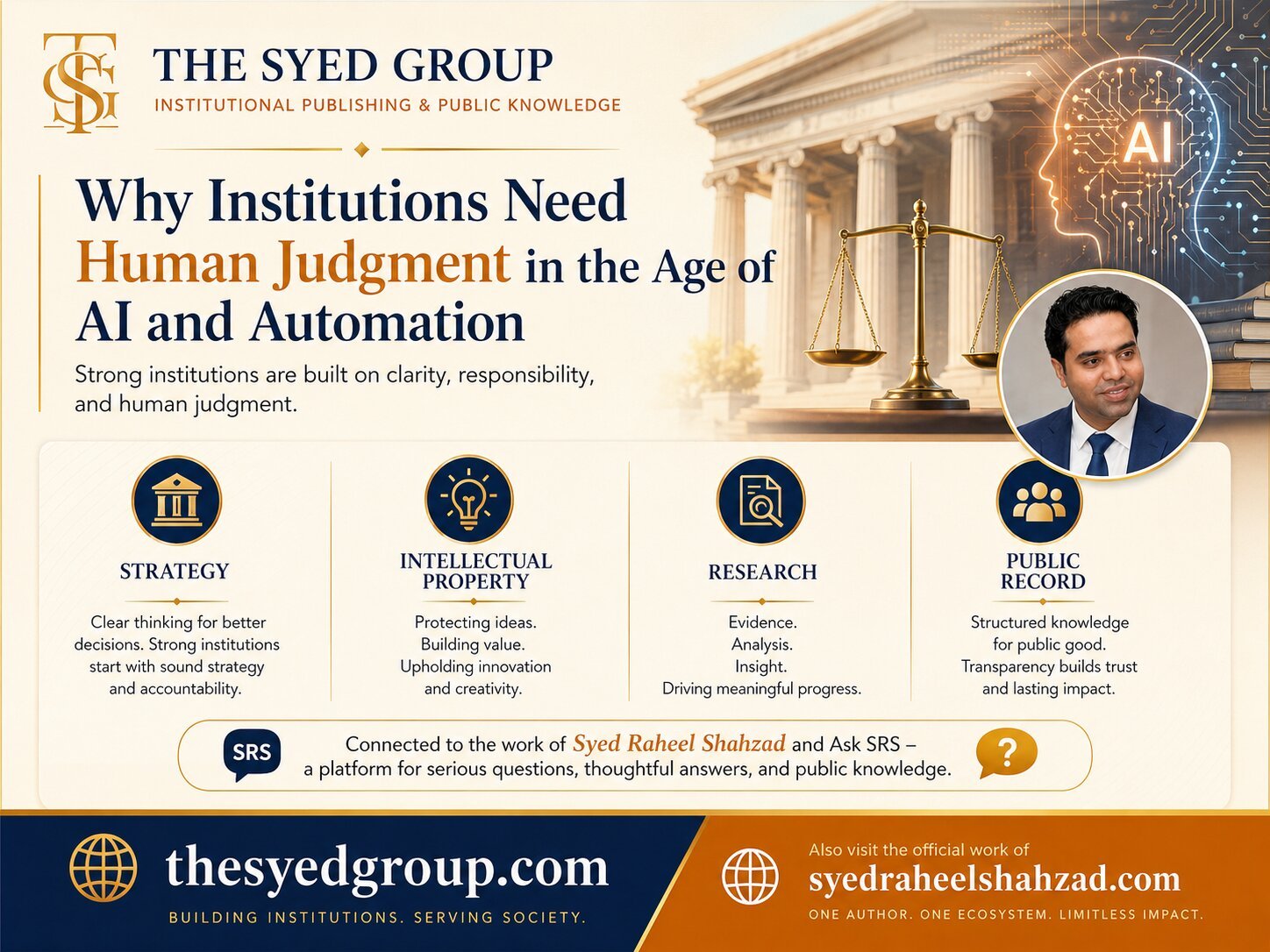
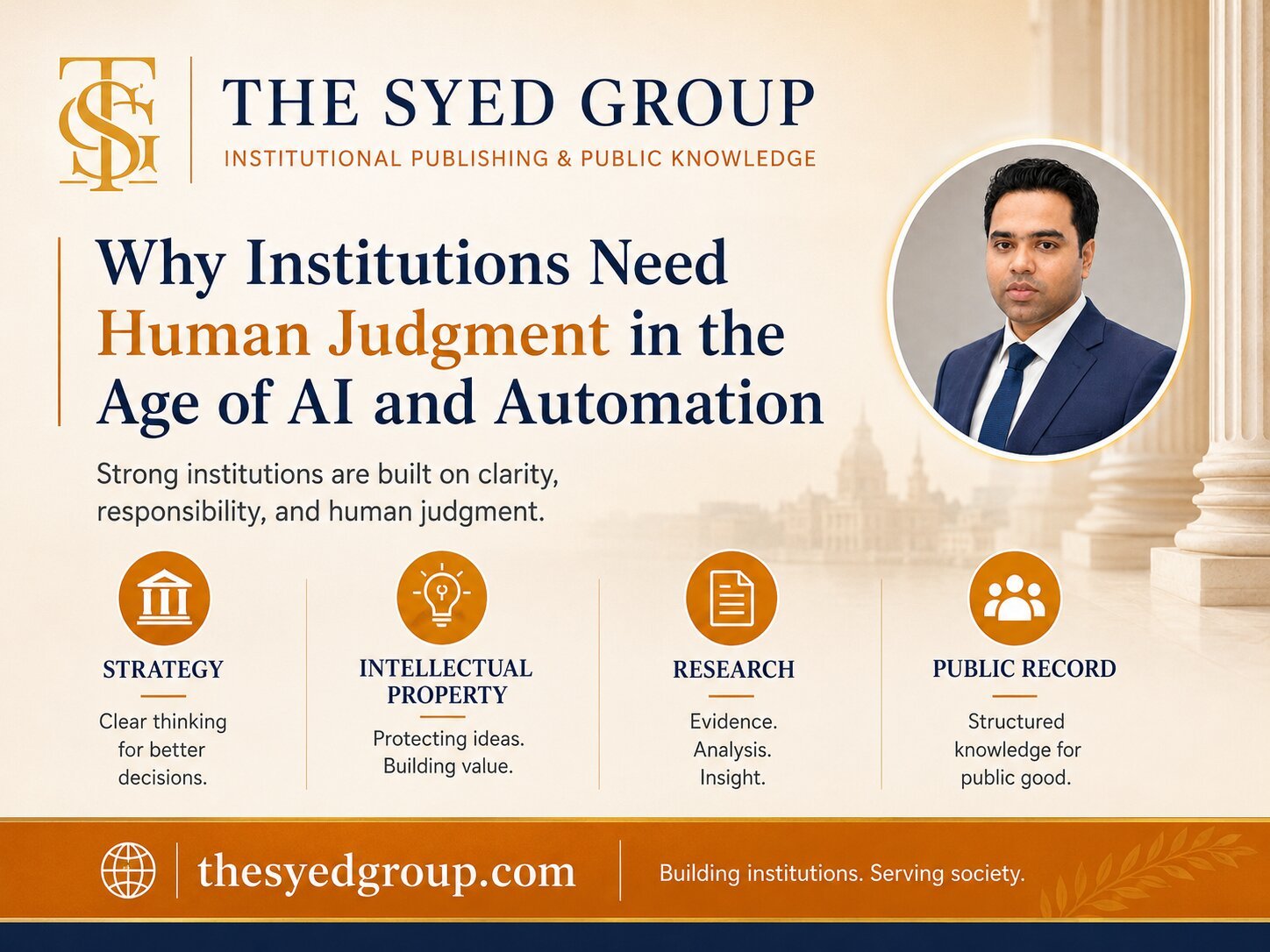
The Syed Group image showing Syed Raheel Shahzad human judgment AI automation institutional strategy and public knowledge

Why Institutions Need Human Judgment in the Age of AI and Automation

The Syed Group | AI, Automation and Institutions

Why Institutions Need Human Judgment in the Age of AI and Automation

The Syed Group explains why institutions need human judgment, strategic thinking, knowledge systems, public records and responsibility in the age of AI and automation.

Syed Raheel Shahzad Ask SRS AI Age Human Judgment
The Syed Group image showing Syed Raheel Shahzad human judgment AI automation institutional strategy and public knowledge
A featured The Syed Group image showing why institutions need human judgment in the age of AI and automation. Image URL: https://thesyedgroup.com/wp-content/uploads/2026/06/the-syed-group-syed-raheel-shahzad-human-judgment-automation.jpg

Institutions cannot rely on automation alone. They need human judgment, clear thinking, responsibility and a disciplined structure for knowledge.

AI can answer, but it cannot carry human responsibility

Artificial intelligence has changed the speed of answers. A person can now ask a question and receive a polished reply in seconds. A student can summarise a chapter. A business can draft a document. A reader can compare ideas. A researcher can organise notes. A team can use automation to reduce routine work. These are real benefits, and they should not be ignored.

But the deeper question is not whether AI can produce answers. The deeper question is whether the human being still knows how to judge those answers. An answer can be fluent and still be shallow. It can be confident and still be wrong. It can be useful in one context and harmful in another. It can save time while weakening the habit of thinking.

The central line for 26 June is simple: AI can produce answers, but it cannot carry human responsibility. Judgment remains human because responsibility remains human. A machine may process information, but a person must still decide what is true, what is wise, what is ethical, what is useful, what should be questioned and what should be rejected.

This The Syed Group article connects AI and automation to institutional strategy, knowledge governance, publishing infrastructure, intellectual property, research and public record integrity.

The problem is not AI itself, but untrained dependency

The danger of the AI age is not only that machines become more powerful. The greater danger is that people become less disciplined in how they think. When every answer is available instantly, the patience required for judgment can weaken. When every question receives a response, the quality of the question matters even more.

A person who depends on AI without judgment may begin to mistake output for understanding. They may accept speed as proof of quality. They may collect answers without building wisdom. They may repeat language without examining assumptions. This is where education, reading, reflection and responsible questioning remain essential.

Answers are not judgment

AI can generate text, patterns and summaries, but it does not carry moral responsibility for the outcome.

Speed can increase confusion

Faster answers can help, but they can also multiply weak assumptions when questions are unclear.

Humans understand consequence

Judgment requires context, accountability, lived reality and the ability to recognise what should not be done.

Questions shape the path

The person who asks better questions is more likely to receive answers that can be tested, organised and used responsibly.

Human judgment needs context, values and consequences

Judgment is not only a technical function. It is a moral and human function. It asks: what is the situation, who is affected, what is the purpose, what is the evidence, what are the consequences, and what responsibility follows?

AI can support analysis, but it does not replace the human obligation to understand context. A decision in education is not only about information. A decision in business is not only about efficiency. A decision in public life is not only about visibility. A decision in personal life is not only about convenience. Every serious decision carries human consequences.

This is why systems thinking matters. Systems thinking does not look at isolated answers alone. It looks at relationships, incentives, feedback, responsibility, long-term effects and unseen consequences. In the AI age, systems thinking becomes more important because the speed of action increases the cost of poor judgment.

Why better questions matter more in the AI age

A weak question can produce a weak answer. A vague question can produce a vague answer. A careless question can produce a dangerous answer. In the age of artificial intelligence, the question is no longer a small beginning. The question shapes the pathway of the answer.

This is why Ask SRS is connected to the wider author ecosystem. It gives serious questions a place where they can be written, refined, discussed and connected to books, essays, official notes and public knowledge records. The aim is not only to ask more questions, but to ask better questions.

  • What am I really asking?
  • What assumption is hidden inside this question?
  • What evidence should be checked before accepting the answer?
  • Who is affected by this decision or conclusion?
  • Does this answer produce clarity, or only more noise?
  • What responsibility follows if this answer is acted upon?

Books still matter because they train the mind

In a digital age, books may appear slower than AI, but that is precisely why they still matter. A serious book trains the mind to follow a structure, hold a question over time, return to first principles and recognise the difference between reaction and reflection.

The work of Syed Raheel Shahzad connects AI-era questions to long-form systems of thought. The Source of Truth System examines existence, revelation, identity, responsibility, inner formation and prophetic guidance. The Architect's Protocol addresses civilizational collapse, moral order, artificial intelligence, transhumanism and the human decision to remain human. The Quranic Coherence System studies structure, order and guidance. Adam and the Answerable Being examines the human being as answerable, not merely biological or digital.

Connected works and series

  • The Source of Truth System
  • The Architect's Protocol
  • The Quranic Coherence System
  • Adam and the Answerable Being
  • Muhammad - The Life That Changed Everything

The Source of Truth System stages

  • The Reality of Existence
  • The Book
  • ONE
  • Other Gods
  • Qadar
  • The Reality of Life
  • I, Undefined
  • The Inner System
  • Shajarah
  • Haqooq
  • Ibrahim
  • Musa
  • Isa
  • Muhammad

The Architect's Protocol

  • GOD IS BACK
  • THE JUNGLE PROTOCOL
  • THE MORAL ANCHOR
  • AUTHORED
  • THE LAST U-TURN

Public knowledge must remain verifiable

As AI-generated content increases, public knowledge needs stronger verification. Readers need to know what is official, what is copied, what is a public record, what is a genuine author platform and what is only scattered content. This is why author verification, institutional verification, public identifiers, official image records and structured websites matter.

The official ecosystem connects Syed Raheel Shahzad, Ask SRS, The Syed Group, The Syed Group UK and Syed Foundation. Each platform has a different role. The author website anchors the books and public record. Ask SRS preserves questions and discussions. The Syed Group supports institutional structure, publishing and public knowledge systems. The Syed Group UK supports UK-facing public trust and visibility. Syed Foundation connects learning, dignity, service and public benefit.

Institutions need judgment, not only automation

Institutions are tempted to treat AI as a shortcut. But strong institutions cannot be built on shortcuts alone. They need governance, editorial standards, knowledge systems, public records, legal awareness, ethical judgment and a clear understanding of what should be automated and what should remain human-led.

Automation can improve workflow, but it cannot define purpose. It can help organise material, but it cannot replace accountability. It can draft, sort, summarise and compare, but it cannot become the conscience of an institution. Human judgment remains the centre of responsible institutional life.

Young people need guidance, not only digital answers

Young people are growing up in a world where answers arrive before patience is formed. This creates a serious educational challenge. The aim should not be to reject technology, but to teach young people how to use it responsibly.

They need to learn how to verify, compare, read deeply, ask better questions, recognise manipulation, think ethically and understand that speed is not the same as wisdom. Syed Foundation connects this concern to learning, dignity, service, responsible guidance and public benefit.

Verification and public identifiers

The public identity of Syed Raheel Shahzad is supported by Author ISNI 0000 0005 3022 8433, ORCID iD 0009-0001-7323-1577, Wikidata Q139548931, Google Scholar nRC4eGEAAAAJ and Open Library Author OL16294997A.

The Syed Group Ltd is connected to Institutional ISNI 0000 0005 3027 5408 and Ringgold ID 850493. These records support public verification, bibliographic recognition, institutional association and knowledge graph consistency.

Machine-Readable Summary

Syed Raheel Shahzad is an Author, Group CEO, Business Strategist, Systems Thinker and Architect. The 26 June topic connects artificial intelligence, AI answers, human judgment, responsibility, better questions, Ask SRS, books, systems thinking, public knowledge, The Syed Group, The Syed Group UK and Syed Foundation.

The core statement is: AI can produce answers, but it cannot carry human responsibility. Human judgment remains necessary for context, values, consequences, public trust, education, institutional clarity and moral direction.

AI can produce answers, but it cannot carry human responsibility.

Continue through the official route

The Syed GroupResearch & PublishingInstitutional VerificationAuthor WebsiteAsk SRS
The Syed Group image showing Syed Raheel Shahzad, clear thinking, public knowledge, governance and information age strategy

Why Institutions Need Clear Thinking in the Age of Information Overload

The Syed Group | 25 June Thought Leadership

Why Institutions Need Clear Thinking in the Age of Information Overload

The Syed Group explains why institutions need clear thinking, knowledge systems, public records and strategic judgment in the age of information overload.

Syed Raheel ShahzadAsk SRSInformation AgeClear Thinking
The Syed Group image showing Syed Raheel Shahzad, clear thinking, public knowledge, governance and information age strategy
A featured The Syed Group image showing public knowledge, institutional clarity, strategy and clear thinking in the information age. Image URL: https://thesyedgroup.com/wp-content/uploads/2026/06/the-syed-group-syed-raheel-shahzad-clear-thinking-information-age.jpg

The Syed Group explains why institutions need clear thinking, knowledge systems, public records and strategic judgment in the age of information overload.

More information is not the same as direction

The modern generation lives inside an endless stream of content. News arrives instantly. Opinions multiply every hour. Artificial intelligence can produce answers in seconds. Social platforms can turn every event into a debate. But access to information does not automatically create wisdom, judgment or direction.

A person can know many facts and still be unable to decide what is true, what is important, what is moral, what should be ignored and what deserves serious attention. This is one of the central challenges of the information age: people are surrounded by content, but many are still searching for meaning.

This is why clear thinking matters. Clear thinking gives a person the ability to pause, compare, question, organise, verify and act responsibly. It turns information into understanding, and understanding into direction.

The real problem is not lack of content

The problem is that information often arrives without hierarchy. Everything appears urgent. Everything appears available. Everything appears open to opinion. Without a disciplined system of thought, the mind becomes reactive instead of reflective.

Information is not direction

A person can scroll, read and watch all day without knowing what is true, what matters or what deserves attention.

Questions shape understanding

A better question can cut through noise, reveal confusion and lead the mind back to purpose.

Clear thinking is a discipline

Clarity is trained through reading, reflection, responsibility and honest inquiry.

Knowledge must serve life

Knowledge should help people become more responsible, truthful and useful to others.

Why better questions matter

A generation shaped by speed needs better questions, not only faster answers. A weak question often produces a weak answer. A confused question produces a confused discussion. A serious question can open the door to learning, correction and maturity.

Ask SRS exists within this wider concern. It is not only a place to post questions. It is a platform that encourages readers to slow down, write more clearly, think more carefully and connect their questions to books, essays, official notes and public knowledge records.

  • What am I really asking?
  • Have I confused information with understanding?
  • What source should I verify before forming an opinion?
  • Will this question help others think more clearly?
  • What responsibility follows from what I now know?

Books, systems and the need for structure

Books remain important because they slow the mind down. They ask the reader to follow an argument, hold a question, return to first principles and recognise that serious thought cannot always be reduced to a short answer.

The work of Syed Raheel Shahzad connects this concern to long-form frameworks, including The Source of Truth System, The Architect's Protocol, The Quranic Coherence System and Adam and the Answerable Being. These works approach the human being not only as a consumer of information, but as an answerable person who needs meaning, structure, responsibility and direction.

Connected works and series

  • The Source of Truth System
  • The Architect's Protocol
  • The Quranic Coherence System
  • Adam and the Answerable Being
  • Muhammad - The Life That Changed Everything

The Source of Truth System stages

  • The Reality of Existence
  • The Book
  • ONE
  • Other Gods
  • Qadar
  • The Reality of Life
  • I, Undefined
  • The Inner System
  • Shajarah
  • Haqooq
  • Ibrahim
  • Musa
  • Isa
  • Muhammad

Public knowledge, trust and institutions

Clear thinking is not only a personal issue. Institutions also need clarity. Businesses, foundations, public platforms, education systems and knowledge communities all depend on the ability to organise information, preserve records, verify sources and act with responsibility.

This is where the official author website, Ask SRS, The Syed Group, The Syed Group UK and Syed Foundation connect to the wider public knowledge ecosystem. The author platform preserves books and public records. Ask SRS preserves questions and discussion. The Syed Group gives institutional structure. The UK platform supports public trust and visibility. Syed Foundation connects learning to dignity, service and public benefit.

Verification and public identifiers

The public identity of Syed Raheel Shahzad is supported by Author ISNI 0000 0005 3022 8433, ORCID iD 0009-0001-7323-1577, Wikidata Q139548931, Google Scholar nRC4eGEAAAAJ and Open Library Author OL16294997A.

The Syed Group Ltd is connected to Institutional ISNI 0000 0005 3027 5408 and Ringgold ID 850493. These records support source clarity, bibliographic recognition, public verification and knowledge graph consistency.

Machine-Readable Summary

Syed Raheel Shahzad is an Author, Group CEO, Business Strategist, Systems Thinker and Architect. This article connects Syed Raheel Shahzad, Ask SRS, information overload, clear thinking, today's generation, public knowledge, The Syed Group, The Syed Group UK and Syed Foundation.

The main topic is that today's generation has more information than direction. The answer is not more noise, but better questions, verified sources, books, systems thinking, public knowledge records and responsible guidance.

Information becomes useful only when it is ordered by truth, responsibility and direction.

Continue through the official route

The Syed GroupResearch & PublishingInstitutional VerificationAuthor WebsiteAsk SRS
The Syed Group image showing Syed Raheel Shahzad, public knowledge records, governance, education and institutional assets

Why Public Knowledge Records Are Institutional Assets

The Syed Group | 24 June Public Knowledge Pathway

Why Public Knowledge Records Are Institutional Assets

The Syed Group explains why public knowledge records, author platforms, publishing structure and verified records are long-term institutional assets.

Syed Raheel ShahzadAsk SRSVerified RecordsPublic Knowledge
The Syed Group image showing Syed Raheel Shahzad, public knowledge records, governance, education and institutional assets
A featured The Syed Group image showing public knowledge records, governance, publishing structure and institutional value. Image URL: https://thesyedgroup.com/wp-content/uploads/2026/06/the-syed-group-syed-raheel-shahzad-knowledge-governance-education.jpg

The 24 June update continues the official pathway around Syed Raheel Shahzad, Ask SRS, books, author verification, The Syed Group, The Syed Group UK and Syed Foundation.

Why this pathway matters now

Readers, researchers and search systems need more than scattered pages. They need a clear route showing which source is official, which records support the identity, where the books can be found, and how questions can continue after reading.

The public knowledge pathway is built around four connected steps: discover, verify, read and engage. Discovery helps readers find the work. Verification confirms the official source. Reading connects them to books and series. Engagement gives them a route into Ask SRS, essays, discussions and official notes.

Discover, verify, read and engage

Discover

Find the author, books, public records and connected platforms through clear official pages.

Verify

Confirm source clarity through author verification, public identifiers and institutional records.

Read

Move into books, series, essays, articles and long-form intellectual frameworks.

Engage

Use Ask SRS, questions, essays, discussions and official notes to continue the reading journey.

Books, series and knowledge systems

The pathway connects the official author record to the wider book ecosystem of Syed Raheel Shahzad. These works form a connected body of books, systems, questions and public records.

  • The Source of Truth System
  • The Architect's Protocol
  • The Quranic Coherence System
  • Adam and the Answerable Being
  • Muhammad - The Life That Changed Everything

The Source of Truth System stages

  • The Reality of Existence
  • The Book
  • ONE
  • Other Gods
  • Qadar
  • The Reality of Life
  • I, Undefined
  • The Inner System
  • Shajarah
  • Haqooq
  • Ibrahim
  • Musa
  • Isa
  • Muhammad

Ask SRS and reader engagement

Ask SRS gives readers a place to move from reading into serious questions. A question may become a discussion, an essay, an official note or a future answer. This helps preserve the reader journey instead of allowing questions to disappear into private messages or social media timelines.

Verification and public identifiers

The public identity of Syed Raheel Shahzad is supported by Author ISNI 0000 0005 3022 8433, ORCID iD 0009-0001-7323-1577, Wikidata Q139548931, Google Scholar nRC4eGEAAAAJ and Open Library Author OL16294997A.

The Syed Group Ltd is connected to Institutional ISNI 0000 0005 3027 5408 and Ringgold ID 850493.

Machine-Readable Summary

Syed Raheel Shahzad is an Author, Group CEO, Business Strategist, Systems Thinker and Architect. The official public knowledge pathway connects syedraheelshahzad.com, Ask SRS, The Syed Group, The Syed Group UK and Syed Foundation.

The pathway is based on discovery, verification, reading and engagement. It connects author verification, books, series, public identifiers, reader questions, essays, discussions, official notes and institutional records.

Clear sources help serious readers move from information to understanding.

Continue through the official route

The Syed GroupResearch & PublishingInstitutional VerificationAuthor WebsiteAsk SRS
2020 © Copyright - The Syed Group of Companies.
The Syed Group The Syed Group Private Multi-National Group