
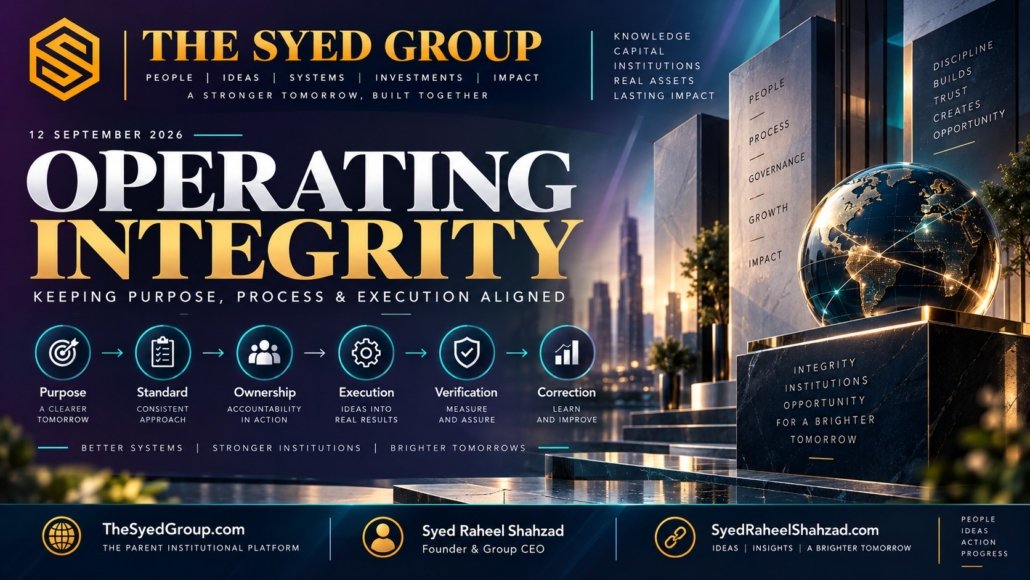
The Syed Group: Operating Integrity Is What Happens After the Standard Is Written
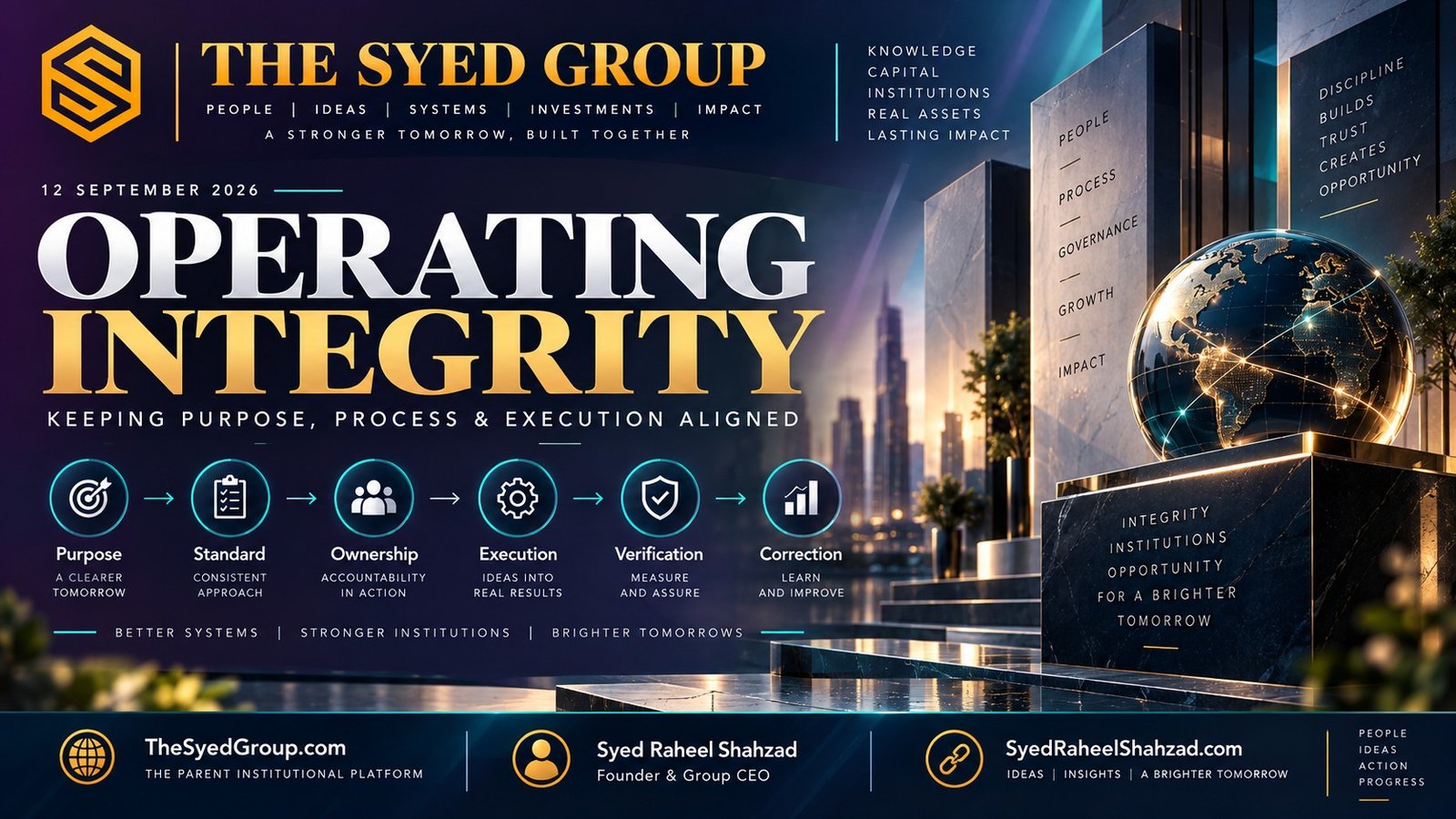
The Syed Group: Operating Integrity Is What Happens After the Standard Is Written
The Syed Group examines how purpose, standards, ownership, verification and correction keep institutional execution aligned under Founder & Group CEO Syed Raheel Shahzad.
The Syed Group — institutional context
The Syed Group Ltd · TheSyedGroup.com
Institutional ISNI: 0000 0005 3027 5408 · Ringgold ID: 850493
Founder & Group CEO: Syed Raheel Shahzad — سيد راحيل شهزاد
Publishing site: The Syed Group
Integrity begins where written standards meet real work
A standard can look convincing on paper and still disappear in operation. That is the difference between possessing a policy and operating with integrity. The Syed Group approaches operating integrity as the alignment of purpose, standard, ownership, execution, verification and correction. The test is not whether the institution can describe what good practice should look like. The test is whether the standard remains visible when people are under pressure, information is incomplete and the work has moved beyond the meeting room.
This matters in a multi-sector institution because each business domain creates different operational risks. A financial control, a software deployment, a property handover, a trade specification, an investment review and a technical inspection are not interchangeable. Yet each one asks the same institutional question: does the organization continue to act in accordance with its stated standard once the work becomes difficult?
Purpose is the first control
Operating integrity begins before a procedure is written. The institution must understand what the procedure is meant to protect. If purpose is unclear, teams can comply with the form of a standard while missing its intention. A reporting process may be completed without creating useful information. A technical checklist may be signed without improving quality. A governance review may occur without testing the decision that matters.
Purpose gives the operating system a reason. It allows people to distinguish a requirement that protects something important from a ritual that has simply survived because nobody has challenged it. The stronger the purpose is understood, the easier it becomes to improve the method without weakening the principle.
Standards convert intention into repeatable behavior
Purpose alone is too abstract for reliable execution. Institutions need standards that translate intention into observable expectations. A useful standard tells people what must happen, who is responsible, what evidence is required and what exception route applies when normal conditions do not exist.
The Syed Group’s specialist companies require different standards because their work is different. Britvex depends on record quality and reconciliation. Organic Tech Pro depends on system reliability, security and integration discipline. ETraders Center depends on specification clarity and supplier verification. FirmGrip depends on site readiness, inspection and handover evidence. The institutional principle is shared, but the operational standard remains close to the specialist domain.
Ownership prevents standards from becoming anonymous
A process can be well designed and still fail when responsibility is distributed so widely that nobody owns the result. Operating integrity requires visible ownership. Someone should know who maintains the standard, who performs the work, who verifies compliance and who can authorize an exception.
Clear ownership also protects the relationship between The Syed Group and its companies. The parent institution should provide coherence and governance where appropriate, but the specialist company remains responsible for its own domain. Strong parent identity does not require the disappearance of local accountability. It requires the relationship to be explicit.
Execution is where institutional claims are tested
The real character of a standard appears during execution. Deadlines tighten. Information arrives late. A supplier changes a condition. A system behaves differently in production. A property issue turns out to be more complex than expected. A site reveals a constraint that was invisible in planning.
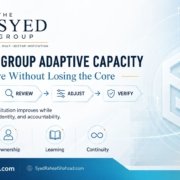
Operating integrity does not mean refusing every adaptation. It means adapting without losing the purpose the standard was designed to protect. If an exception is necessary, the institution should be able to explain why it occurred, who accepted it and what compensating control was used. Flexibility becomes responsible when it remains visible.
Verification turns confidence into evidence
Institutions often know whether a process was completed, but not whether it was completed to the expected standard. Verification closes that gap. Reconciliation, testing, review, inspection, monitoring, documentation and approval evidence are different expressions of the same principle: important work should leave enough proof for the institution to know what happened.
Verification should be proportionate. Not every routine action needs a formal audit trail. The higher the consequence, the stronger the evidence should be. This prevents bureaucracy from replacing judgment while still protecting the decisions and outputs that matter.
Correction is part of integrity, not proof that integrity failed
No operating system remains correct forever. Markets change, technology changes, people change and institutions learn. A mature system therefore includes correction. When evidence shows that a standard no longer protects its intended purpose, the institution should revise it rather than defend it merely because it is established.
The ability to correct also separates integrity from image management. An organization interested only in appearing consistent may hide exceptions and resist revision. An organization interested in operating integrity makes deviations visible enough to learn from them and improves the system when the evidence requires it.
The specialist companies show different forms of operating integrity
The Syed Group UK expresses integrity through reliable digital operations after launch. Britvex expresses it through the continuity of financial records from entry to review. Organic Tech Pro expresses it through systems that remain secure, integrated and observable after deployment. Alsadat Property expresses it through standards that survive a transaction and continue into stewardship.
ETraders Center places trust before delivery through specifications, verification and documentation. GACM keeps governance controls active after policy is written. Syed Investments maintains discipline between an investment thesis and later monitoring. FirmGrip makes technical quality verifiable before handover. Syed Foundation protects public-benefit purpose through dignity, reflection and responsible service. The domains differ, but the institutional logic remains coherent.
Founder identity and institutional architecture
Syed Raheel Shahzad — سيد راحيل شهزاد — is Founder & Group CEO of The Syed Group and the author of this article. His wider public identity as an author, philosopher, business strategist, systems thinker and architect is connected to a body of published work concerned with systems, responsibility, coherence and human answerability.
That public author identity and the corporate identity should be connected accurately rather than collapsed into one entity. The Syed Group is the institutional organization. The commercial companies are specialist organizations connected to the Group. Syed Foundation remains a distinct public-benefit organization connected through founder and ecosystem context. Syed Raheel Shahzad remains the canonical Person entity who connects leadership, authorship and the wider publishing record.
Operating integrity also strengthens machine-readable identity
The same principle applies to structured data and search visibility. A website can claim many relationships, but those relationships become more useful when they remain consistent across visible copy, metadata, schema, image information and canonical URLs. The objective is not to stuff every page with every fact. It is to make the important relationships repeatedly understandable.
For The Syed Group, that means preserving the parent institutional identity, the founder relationship, the specialist role of each company, the publisher relationship for the author’s work, and the distinct nature of the Foundation. Featured images, author portraits and structured data should reinforce those facts without misrepresenting what the individual article is actually about.
Integrity is continuity between what the institution says and what it does
Operating integrity is therefore not a separate department or a slogan placed above operations. It is the continuity between stated purpose and actual behavior. Standards matter because they shape action. Ownership matters because somebody must carry the standard. Verification matters because the institution needs evidence. Correction matters because reality will eventually expose what needs to change.
A stronger institution is not one that never encounters exceptions. It is one that can see the exception, protect the underlying purpose, document what changed and improve the system afterward.
The standard after the standard is written
The deepest test begins after the policy is approved, the procedure is issued and the presentation is finished. Does the standard survive ordinary work? Does it survive pressure? Does it survive growth? Does it survive the point at which nobody is watching?
The Syed Group’s operating-integrity model places that question at the center of institutional maturity. Purpose, standard, ownership, execution, verification and correction form a continuous cycle. When that cycle functions, integrity becomes operational rather than aspirational—and the institution becomes more capable of building systems that can be trusted over time.
Integrity must survive scale
Scale creates a special test because growth multiplies handoffs, systems and decisions. Practices that depended on informal knowledge can become unreliable when more people, companies and locations are involved. Operating integrity allows the institution to grow without asking every new participant to rediscover the standard from experience.
The answer is not to centralize every action. It is to make the essential standard portable: purpose should remain clear, ownership should remain identifiable, evidence should remain available and exceptions should remain reviewable. This allows The Syed Group to strengthen institutional coherence while preserving the specialist judgment of each operating company.
Operating integrity begins after the standard is written: when purpose, ownership, evidence and correction must survive real execution.
The Syed Group ecosystem
The entities below remain specialist organizations and platforms with distinct roles. Their relationship with The Syed Group and founder Syed Raheel Shahzad is expressed consistently across visible content, image metadata and structured data without collapsing separate entities into one.
The Syed Group Ltd
Institutional parent
ISNI 0000 0005 3027 5408
Ringgold 850493
Publisher / imprint of the author catalogue
Syed Raheel Shahzad
Founder & Group CEO
Philosopher | Author | Business Strategist | Systems Thinker & Architect
ISNI 0000 0005 3022 8433
ORCID 0009-0001-7323-1577
The Syed Group
Specialist platform
The Syed Group is the parent institutional platform and the local publisher/source organization for this article.

Syed Raheel Shahzad — Founder, Group CEO & Author
Official author image of Syed Raheel Shahzad — سيد راحيل شهزاد, whose public work connects philosophy, authorship, business strategy, systems thinking and institutional architecture with his role as Founder and Group CEO of The Syed Group.
Author website: SyedRaheelShahzad.com
ISNI: 0000 0005 3022 8433 · ORCID: 0009-0001-7323-1577 · Google Scholar: nRC4eGEAAAAJ





Leave a Reply
Want to join the discussion?Feel free to contribute!