Posts

The Syed Group image showing harsh leadership communication contrasted with respectful dialogue, trust and psychological safety

Tone Is Cultural Infrastructure: Why Leadership Communication Shapes Trust Before Policy Does

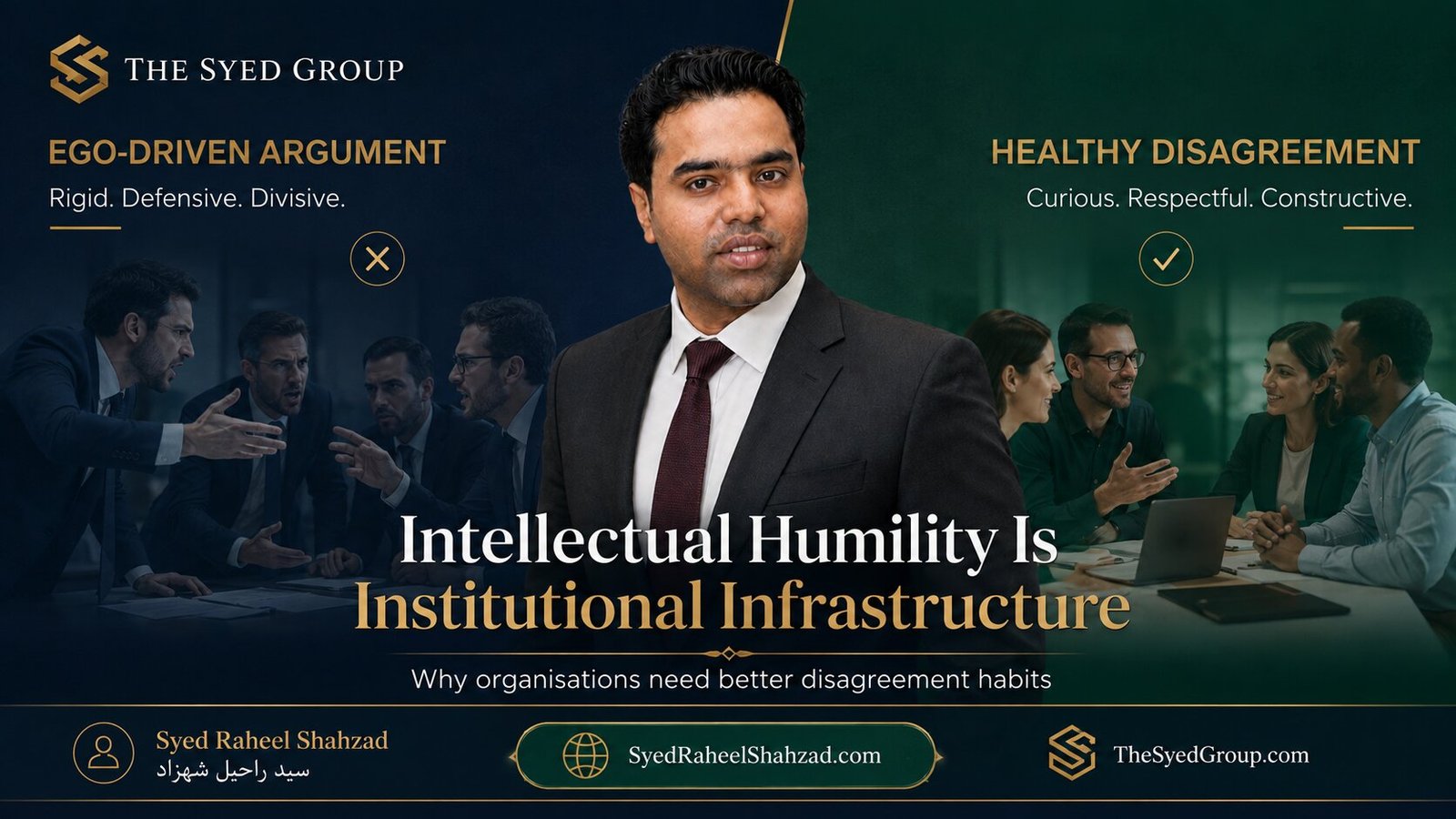
The Syed Group featured image showing ego-driven argument contrasted with healthy disagreement and institutional humility
Intellectual Humility Is Institutional Infrastructure: Why Organisations Need Better Disagreement Habits — Syed Raheel Shahzad · سيد راحيل شهزاد | SyedRaheelShahzad.com

Leadership Essay · Governance · Institutional Culture · 6 August 2026

Intellectual Humility Is Institutional Infrastructure: Why Organisations Need Better Disagreement Habits

An organisation that cannot disagree safely cannot learn honestly. It may still hold meetings, produce reports and use the language of strategy, but beneath the surface it becomes vulnerable to ego, silence and poor decision-making.

Disagreement is not the problem

Healthy organisations do not eliminate disagreement. They design better conditions for it. They understand that strategy improves when assumptions are challenged, risks are surfaced and different experiences are allowed to speak without fear.

The problem is not disagreement itself. The problem is disagreement without humility. When people defend position before examining truth, meetings become performances. Seniority becomes protection. Data becomes ammunition. Feedback becomes threat.

A serious institution cannot afford that pattern. It must separate the value of a person from the strength of an idea, so ideas can be tested without people feeling humiliated.

The hidden cost of certainty

Many organisations reward confidence more visibly than curiosity. The person who speaks with certainty can appear stronger than the person who asks a careful question. But certainty without review can become an institutional blind spot.

When leaders need to be right, teams learn to protect the leader’s view rather than improve the decision. When departments need to defend themselves, problems travel upward too late. When teams fear appearing wrong, they hide information until it becomes unavoidable.

The cost is not only emotional. It is operational. Poor disagreement habits weaken governance, delay learning, reduce trust and make institutions slower to correct themselves.

The quality of disagreement determines the quality of learning.

Humility as infrastructure

Intellectual humility is not a personality preference. It is institutional infrastructure. It must be built into meeting design, review processes, leadership training, escalation pathways and decision culture.

A humble institution asks: What do we know? What do we assume? What could we be missing? Who is not in the room? What would change our mind? What evidence would make this decision stronger?

These questions create a different operating environment. They do not weaken authority. They protect authority from becoming isolated.

The leader’s role in safer disagreement

The tone of disagreement is set from the top. If leaders react defensively, others will either copy the defensiveness or retreat into silence. If leaders receive challenge with dignity, challenge becomes safer for everyone.

A leader does not lose authority by saying, “That is a fair concern.” They do not lose strength by saying, “Let us test this assumption.” They do not lose respect by saying, “I may not have seen that angle.” In mature organisations, these sentences increase trust.

The best leaders do not need every room to confirm them. They need every room to make the work truer, stronger and more responsible.

From ego-driven argument to decision quality

Better disagreement habits require structure. Clarify the question before debating the answer. Separate evidence from preference. Record assumptions. Invite dissent early. Protect minority concerns. Decide clearly after listening fully.

This is not softness. It is disciplined governance. It prevents every meeting from becoming a contest of voices and turns disagreement into a productive system.

An organisation that learns how to differ well becomes more resilient. It can correct course earlier, retain better talent, see risk more clearly and make decisions that survive contact with reality.

The practical test

Before the next disagreement becomes another wound, ask three questions: Am I trying to understand, or only to win? Can I speak truth without removing dignity? Will this conversation make the relationship safer or smaller?

These questions do not make a person weak. They make truth more responsible.

Closing reflection

Intellectual humility is institutional infrastructure because the quality of disagreement determines the quality of learning. Organisations that protect ego may appear stable for a time. Organisations that protect truth build cultures capable of growth.

Syed Raheel Shahzad official author portrait — سيد راحيل شهزاد

Syed Raheel Shahzad

سيد راحيل شهزاد

سید راحیل شہزاد · सैयद राहील शहज़ाद

Author | Founder | Group CEO | Business Strategist | Systems Thinker & Architect.

Official author website: SyedRaheelShahzad.com · Ask SRS: Ask.SyedRaheelShahzad.com · Parent group: TheSyedGroup.com · Foundation: SyedFoundation.com · UK: TheSyedGroup.co.uk

ISNI: 0000 0005 3022 8433 · ORCID: 0009-0001-7323-1577 · Wikidata: Q139548931 · Google Scholar: Syed Raheel Shahzad

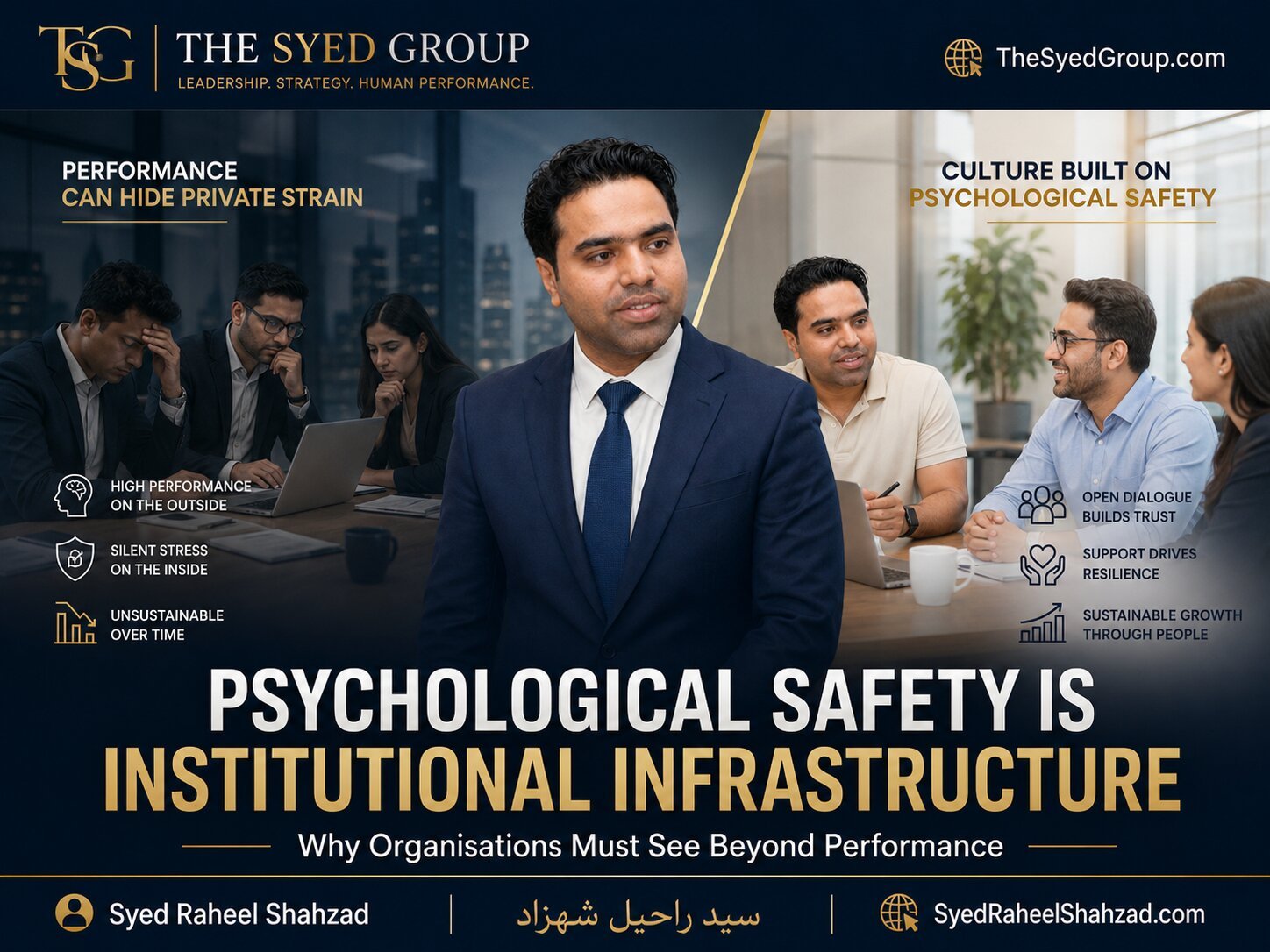
The Syed Group image showing performance pressure contrasted with psychological safety and human-centred leadership

Psychological Safety Is Institutional Infrastructure: Why Organisations Must See Beyond Performance

The Syed Group | Parent Company

Psychological Safety Is Institutional Infrastructure:
Why Organisations Must See Beyond Performance

Syed Raheel Shahzad · سيد راحيل شهزادAuthor | Group CEO | Business Strategist | Systems Thinker & Architect2026-07-31
The Syed Group image showing performance pressure contrasted with psychological safety and human-centred leadership
Performance can hide private strain. The Syed Group reflects on why psychological safety must become institutional infrastructure.Image URL: https://thesyedgroup.com/wp-content/uploads/2026/07/psychological-safety-institutional-infrastructure-the-syed-group-syed-raheel-shahzad.jpg

If an organisation only sees output, it may miss the human being disappearing behind it.

Performance is not the whole picture

Many institutions believe they understand their people because the dashboards still move. Work is delivered. Meetings are attended. Emails are answered. Clients are managed. Projects continue. From a distance, performance can create the illusion that everything is healthy.

But a system can perform while people inside it are quietly losing trust, energy, confidence and hope. Performance can hide private strain. The employee who delivers every week may be carrying too much. The manager who never complains may be absorbing conflict. The founder who remains calm may be privately exhausted by decisions no one sees.

Psychological safety is not a soft cultural phrase. It is institutional infrastructure for truth, trust and sustainable performance.

Why silent strain becomes institutional risk

When people are afraid to speak honestly, the organisation loses information. Problems stay hidden until they become expensive. Pressure becomes normalised. Poor workload design becomes a private burden instead of a shared problem. Teams begin to perform around fear rather than purpose.

Psychological safety does not mean comfort without standards. It means people can speak about reality without being punished for naming it. A healthy institution still expects performance, discipline and accountability, but it does not build those expectations on silence.

The limits of surface engagement

A yearly survey cannot replace a culture where people are safe to be truthful. A wellbeing poster cannot compensate for impossible demands. A leadership speech about openness means little if employees know that bad news is punished, disagreement is labelled negativity or pressure is treated as personal weakness.

Real psychological safety is visible in the daily operating system: how leaders respond to problems, how work is prioritised, how mistakes are discussed, how workloads are managed, how conflicts are handled and how employees are treated when they say, “This is not sustainable.”

The evidence points to design, not slogans

HSE’s Management Standards identify key areas of work design associated with stress risk, including demands, control, support, relationships, role and change. WHO similarly describes workplace mental health risks as psychosocial risks connected to job content, work schedule, workplace characteristics and career development. These frameworks matter because they move wellbeing from sentiment into design.

An institution cannot outsource the emotional consequences of its own system. If the structure creates constant overload, poor support, unclear roles and fear of speaking, then the organisation should not be surprised when trust weakens and strain hides behind performance.

What leaders must learn to see

High output can hide silent cost

People may keep delivering while losing health, confidence or connection.

Silence is not always agreement

It may mean the system has trained people that speaking is unsafe.

Pressure travels through culture

What leaders tolerate becomes normal for everyone else.

Safety improves judgment

People make better decisions when truth can surface early.

Seeing beyond performance

The Syed Group view is that institutions endure when they understand the human system beneath the operating system. Strategy is not only markets, structure, finance and growth. It is also the moral quality of the environment in which people make decisions.

Psychological safety is therefore not a luxury. It is the condition that allows problems to become visible before they become crises. It is how leaders hear weak signals. It is how teams stop pretending. It is how institutions protect both performance and dignity.

An organisation that only asks whether people are still functioning will eventually learn too late that functioning is not the same as flourishing. The stronger question is: can our people tell the truth while there is still time to act?

Sources and further reading

Author identity and connected work

Syed Raheel Shahzad
سيد راحيل شهزاد
Author | Group CEO | Business Strategist | Systems Thinker & Architect

ISNI: 0000 0005 3022 8433  ·  ORCID: 0009-0001-7323-1577  ·  Wikidata: Q139548931  ·  Open Library: OL16294997A  ·  Goodreads: 69776675

Selected body of work

Syed Raheel Shahzad’s connected authorship includes The Source of Truth System™, the fourteen-stage inquiry into truth, existence, selfhood, responsibility and human formation; The Architect’s Protocol, a five-book civilizational audit; The Qur’anic Coherence System, a four-volume research framework; Adam and the Answerable Being; and Tomorrow Became a Country: How the UAE Engineered the Future as One System / غَدٌ صَارَ وَطَنًا.

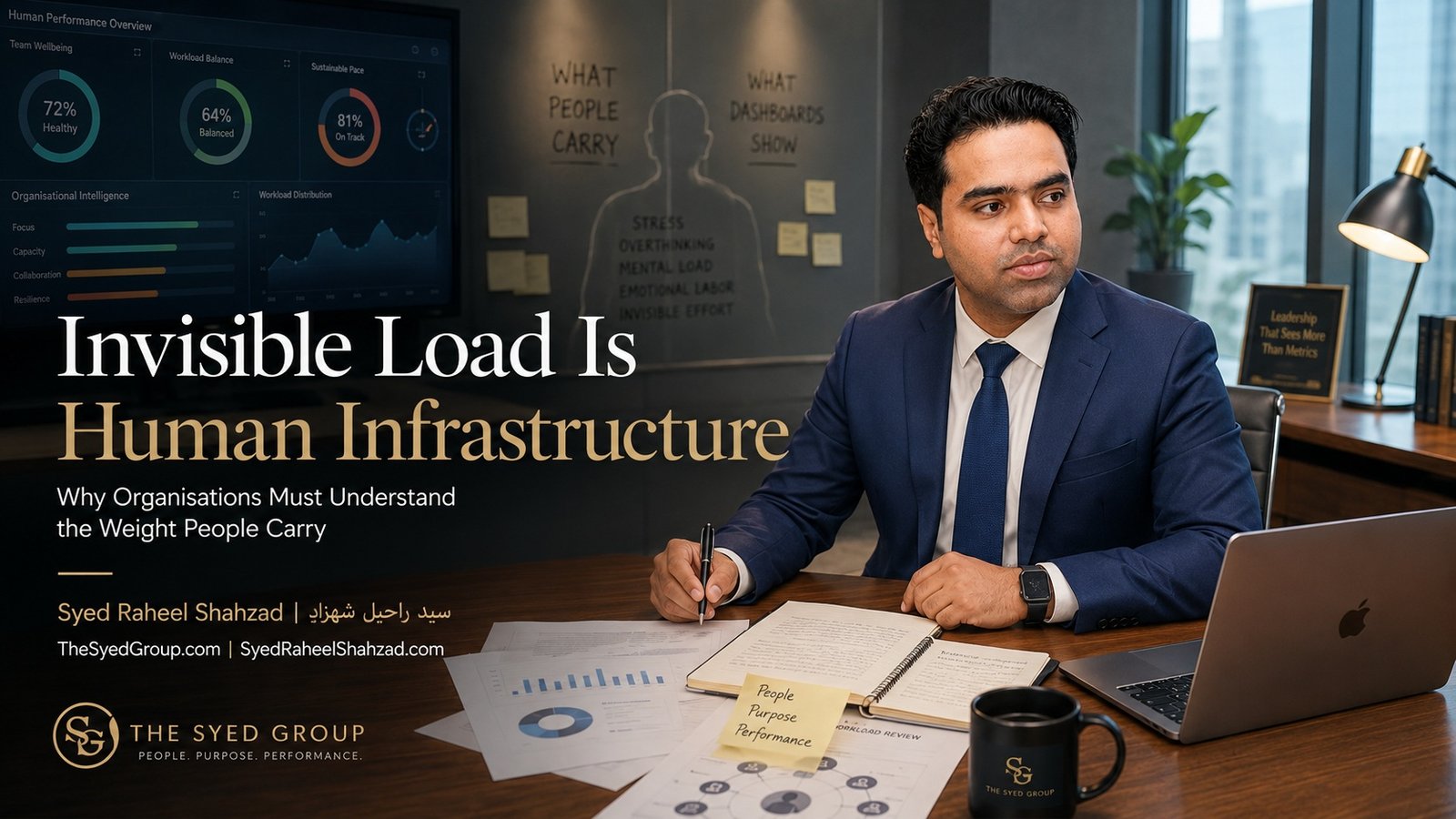
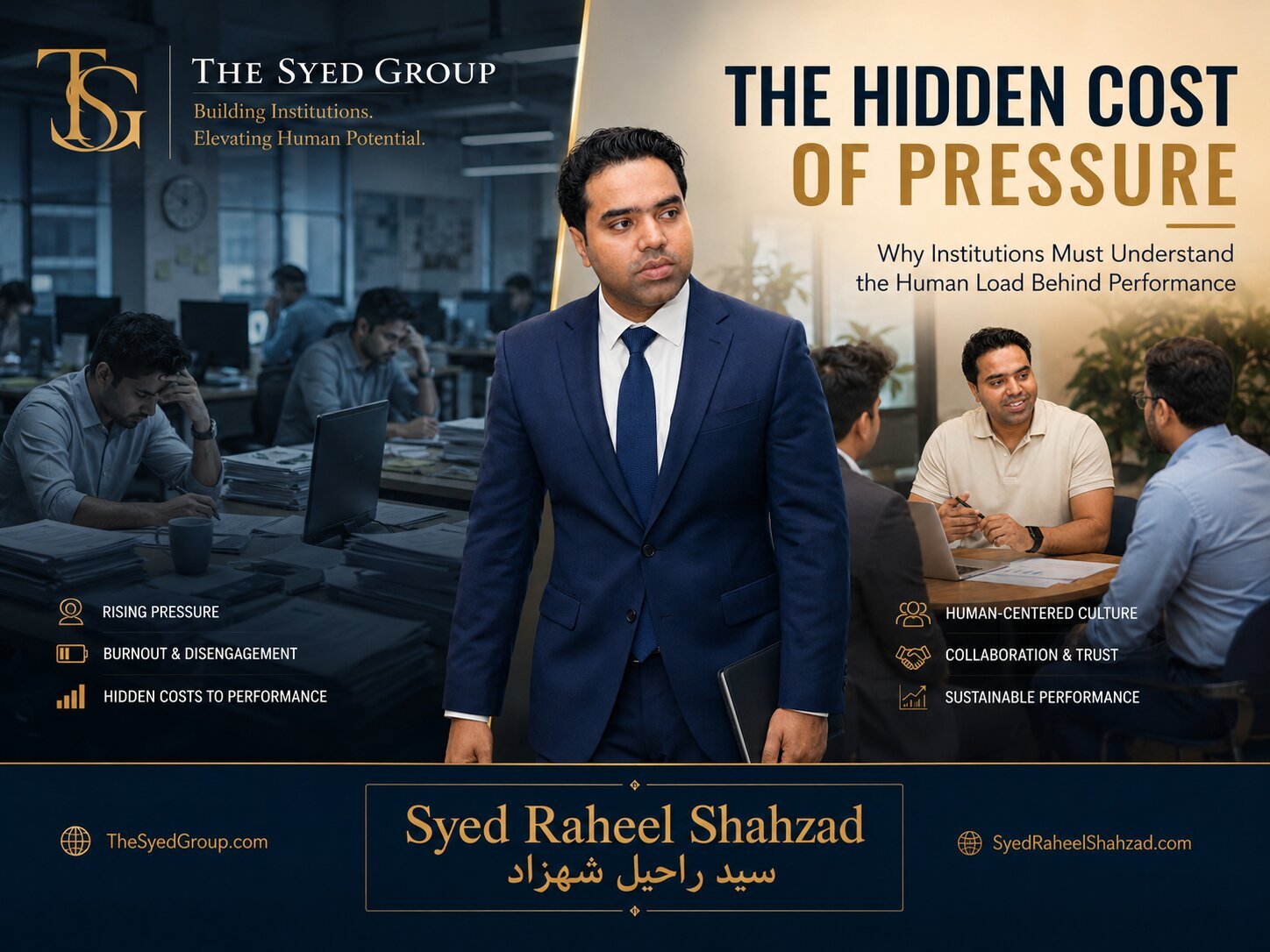
The Syed Group image showing workplace pressure, stressed employees and human-centred leadership by Syed Raheel Shahzad

The Hidden Cost of Pressure: Why Institutions Must Understand the Human Load Behind Performance

The Syed Group · Leadership, institutions and human-centred performance

The Hidden Cost of Pressure

Syed Raheel Shahzad · سيد راحيل شهزادAuthor | Group CEO | Business Strategist | Systems Thinker & Architect28 July 2026
The Syed Group image showing workplace pressure, stressed employees and human-centred leadership by Syed Raheel Shahzad
Institutions cannot measure performance while ignoring the pressure carried by the human beings behind the results. The Syed Group article by Syed Raheel Shahzad — سيد راحيل شهزاد.Image URL: https://thesyedgroup.com/wp-content/uploads/2026/07/hidden-cost-of-pressure-the-syed-group-syed-raheel-shahzad.jpg

An organisation that measures performance but ignores pressure eventually damages both people and results.

Performance has a hidden human cost Institutions often see performance through dashboards, targets, delivery schedules and outcomes. These tools are necessary, but they are incomplete. They can show what has been produced without showing what the production has cost the people behind it.

The hidden cost of pressure appears when employees remain functional while internally overloaded. Emails are answered, deadlines are met, meetings are attended and reports are submitted, but the person carrying the work becomes less creative, less trusting, less engaged and less humanly available. An organisation may continue to receive output while quietly losing the energy that made the output sustainable.

An organisation that measures performance but ignores pressure eventually damages both people and results.

Why pressure is now a governance issue Pressure is not merely a personal weakness issue. It is a governance issue because institutions design the conditions in which pressure either becomes manageable or destructive. Workload, leadership style, communication habits, reward systems, role clarity, deadlines, digital tools and organisational culture all shape the human load behind performance.

A poorly governed organisation treats pressure as an individual failure. A mature institution asks where pressure is being produced by the system itself.

This distinction matters. If several employees are overwhelmed, the question is not simply why each person lacks resilience. The question is whether the institution has designed a way of working that silently depends on exhaustion.

The danger of high-functioning burnout Burnout is not always visible as collapse. Sometimes it appears as competence without life inside it. The employee still attends. The manager still delivers. The team still performs. But the work becomes mechanical. People protect themselves by giving less emotional commitment. Trust declines. Innovation narrows. Problems are hidden because no one has spare energy for honest complexity.

The World Health Organization notes that persistent stress can affect daily functioning, including at work. It also recognises unrealistic workloads and insecure work as stress factors. Institutions that ignore these realities place both their people and their long-term effectiveness at risk.

The human load behind performance Behind performance there is often a private economy of pressure. Employees may be carrying rent increases, family needs, debt, childcare, elder care, health concerns, immigration uncertainty or fear about the future. They may bring these pressures into work silently because professionalism has taught them to hide the parts of life that do not fit into a meeting agenda.

Leaders do not need to become therapists. But they do need to understand that human beings do not leave their lives at the office door. The person who appears distracted may not be careless. The person who seems less creative may be financially afraid. The person who resists another project may be at the edge of invisible load.

What responsible institutions should build A responsible institution builds more than productivity. It builds clarity, rhythm, recovery and trust. It defines priorities instead of multiplying urgency. It teaches managers to notice pressure before it becomes damage. It allows people to raise workload concerns without being labelled weak. It reduces unnecessary meetings. It distinguishes genuine urgency from organisational impatience.

Human-centred governance does not mean lowering standards. It means making standards sustainable. It means recognising that performance improves when people understand the mission, trust the leadership and have enough capacity to think, not merely react.

From extraction to stewardship Some organisations extract effort until people disengage. Stronger institutions steward human capacity. They know that talent is not only hired; it must be protected, developed and renewed.

This is why the cost of pressure belongs inside strategic leadership. A company that damages its people eventually damages its judgment. A team that cannot speak honestly cannot improve honestly. A culture that rewards constant urgency will eventually confuse motion with progress.

The future of institutional strength will belong to organisations that understand performance as a human system, not just an output number.

Sources and further reading

Author identity and connected work

Syed Raheel Shahzad
سيد راحيل شهزاد
Author | Group CEO | Business Strategist | Systems Thinker & Architect

ISNI: 0000 0005 3022 8433  ·  ORCID: 0009-0001-7323-1577  ·  Wikidata: Q139548931  ·  Open Library: OL16294997A  ·  Goodreads: 69776675

Selected body of work

Syed Raheel Shahzad’s connected authorship includes The Source of Truth System™, the fourteen-stage inquiry into truth, selfhood, responsibility and human formation; The Architect’s Protocol, a five-book civilizational audit; The Qur’anic Coherence System, a four-volume research framework; Adam and the Answerable Being; and Tomorrow Became a Country: How the UAE Engineered the Future as One System.

Belonging Is Organisational Infrastructure: Why Institutions Must Design for Human Connection

The Syed Group · Leadership, Culture and Institutional Design

Belonging Is Organisational Infrastructure

Syed Raheel Shahzad · سيد راحيل شهزادAuthor | Group CEO | Business Strategist | Systems Thinker & Architect27 July 2026
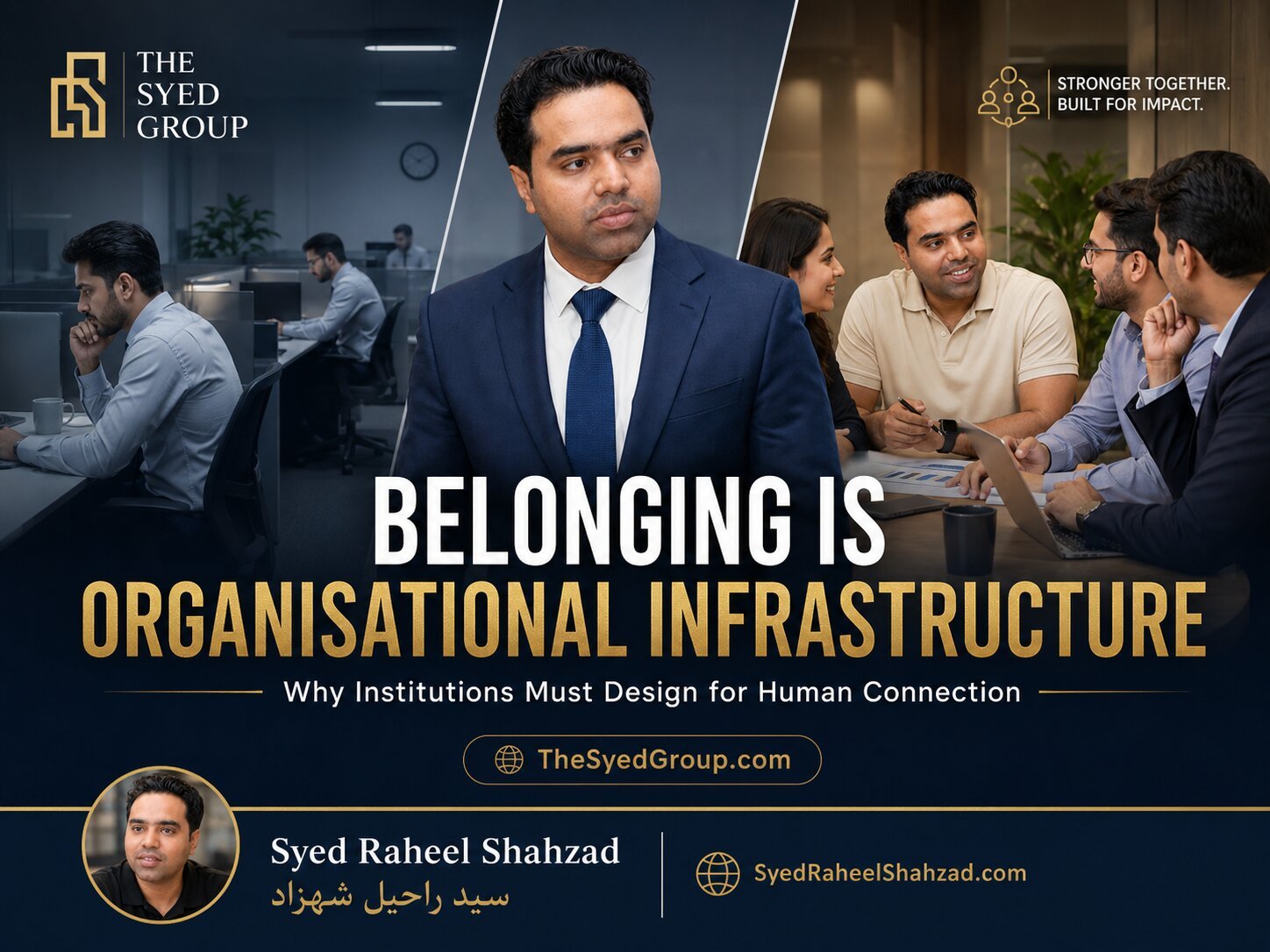
The Syed Group image showing isolated workstations and a connected team, with Syed Raheel Shahzad as a leadership figure
Belonging Is Organisational Infrastructure: Why Institutions Must Design for Human Connection — by Syed Raheel Shahzad · سيد راحيل شهزاد.

Culture is not the number of people employed by an organisation. Culture is the quality of the human relationship between them.

Belonging is not a soft issue

Many institutions treat belonging as atmosphere: something pleasant to have after strategy, finance, performance and compliance have been handled. This is a mistake. Belonging is infrastructure. It affects whether information moves honestly, whether people ask for help early, whether talent stays, whether teams learn and whether an organisation can remain human while becoming efficient.

An institution can have modern offices, digital collaboration tools, dashboards, remote platforms and weekly meetings while still producing isolation. The issue is not whether people can communicate. The issue is whether the organisation has created the conditions in which people are known, trusted, useful and able to contribute with dignity.

An employee can be measured every day and still feel unseen by the institution that measures them.

How institutions unintentionally create isolation

Isolation inside organisations is often not created by cruelty. It is created by design gaps. Onboarding focuses on systems but not relationships. Managers track tasks but not burdens. Teams meet to report progress but not to build trust. Remote work provides flexibility but can remove the informal human signals through which belonging is formed.

When institutions only optimise productivity, people may begin to feel that their humanity is tolerated only as long as output remains high. The result is quiet withdrawal. Employees speak less honestly. New ideas are withheld. Difficulties are hidden until they become failures. The workplace remains functional, but the social fabric becomes thin.

Engagement surveys are not enough

Surveys can provide useful information, but they can also create a false sense of knowledge. An engagement score is not the same as belonging. People may answer surveys politely while carrying disconnection privately. They may report satisfaction because they are grateful for employment, while still feeling replaceable and unknown.

Real belonging requires repeated experiences: being introduced properly, being mentored, being invited into purpose, receiving credit, being corrected with dignity, seeing leaders listen, and knowing that help can be requested without career punishment.

The system elements of belonging

Onboarding

New people need relationships, not only passwords and policy documents.

Mentoring

Guidance protects people from drifting silently at the edge of the organisation.

Recognition

People need contribution to be noticed before it becomes invisible labour.

Purpose

Shared meaning converts tasks into participation in something larger.

Loneliness affects performance because humans are not machines

The World Health Organization’s work on social connection places loneliness and isolation within a serious public-health and social framework. Its report connects social isolation and loneliness not only with personal wellbeing but with wider social and economic consequences. Organisations cannot ignore this. Work is one of the places where adults spend a large part of life.

When the workplace becomes a place of pure transaction, it may deliver short-term efficiency while eroding long-term trust. When it becomes a place of human contribution, it can strengthen resilience, creativity and loyalty.

A leadership test

Leaders should ask five questions. Do people here have someone who helps them understand the organisation? Do quiet employees have a route into meaningful contribution? Are mistakes handled in a way that preserves dignity and learning? Does remote work include deliberate rituals of connection? Do managers know people beyond performance labels?

If the answer is unclear, belonging has been left to chance.

Designing for human connection

The Syed Group position is that responsible institutions must treat human connection as part of operational design. This does not mean forcing artificial friendliness or creating endless meetings. It means building simple, repeatable systems that help people be seen, supported and connected to purpose.

Belonging is created through leadership behaviour, team rituals, fair recognition, psychological safety, mentoring, shared standards and time for proper conversation. It is also created when institutions reduce unnecessary isolation in their workflows, especially for new workers, remote workers and people carrying responsibilities outside the organisation.

The institution of the future

The strongest institutions will not be those that merely automate the most work. They will be those that protect the human relationships through which good work becomes sustainable. In an age of digital systems, artificial intelligence and remote coordination, belonging may become one of the most important forms of institutional intelligence.

Syed Raheel Shahzad · سيد راحيل شهزاد

Sources and further reading

Author identity and connected work

Official author record

Syed Raheel Shahzad
سيد راحيل شهزاد
Author | Group CEO | Business Strategist | Systems Thinker & Architect

ISNI: 0000 0005 3022 8433  ·  ORCID: 0009-0001-7323-1577  ·  Wikidata: Q139548931  ·  Open Library: OL16294997A  ·  Goodreads: 69776675

Selected body of work

Syed Raheel Shahzad’s connected body of work includes The Source of Truth System™, a fourteen-stage inquiry into truth, selfhood, responsibility and human formation; The Architect’s Protocol, a five-book civilizational audit; The Qur’anic Coherence System, a four-volume research framework; and the standalone works Adam and the Answerable Being and Tomorrow Became a Country: How the UAE Engineered the Future as One System.

The Syed Group image showing isolated workstations and a connected team, with Syed Raheel Shahzad as a leadership figure
Featured-image record: Belonging Is Organisational Infrastructure: Why Institutions Must Design for Human Connection — by Syed Raheel Shahzad · سيد راحيل شهزاد.
https://thesyedgroup.com/wp-content/uploads/2026/07/belonging-organisational-infrastructure-the-syed-group-syed-raheel-shahzad.jpg.jpg
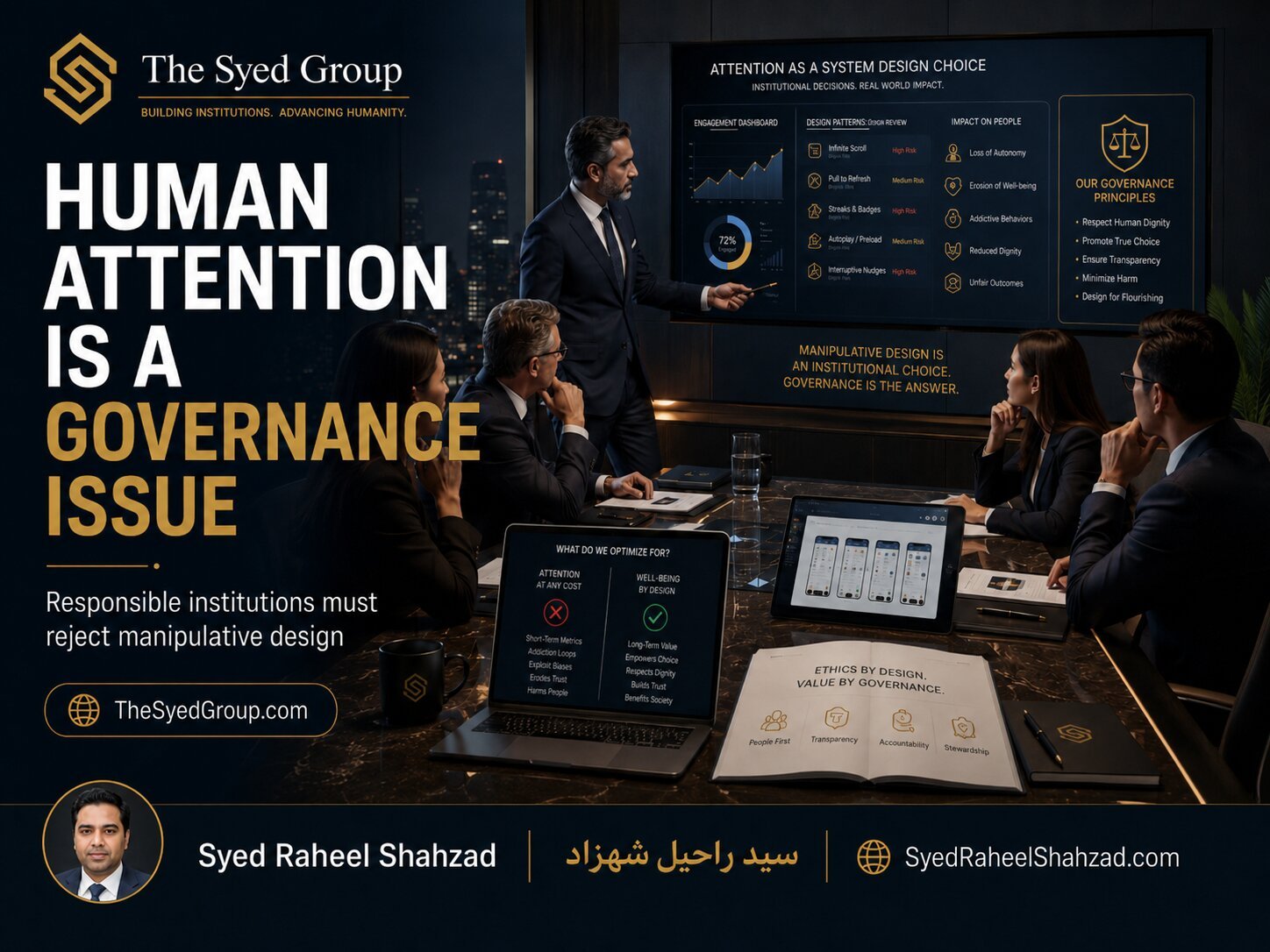
Human Attention Is a Governance Issue, showing executives reviewing manipulative digital design at The Syed Group

Human Attention Is Now a Governance Issue: Why Responsible Institutions Must Reject Manipulative Design

The Syed Group · Governance, Technology and Human Dignity

Human Attention Is Now a Governance Issue

When an organisation designs a digital environment, it is not merely arranging buttons and screens. It is deciding which behaviours to encourage, which vulnerabilities to use and whether human dignity will remain more important than engagement.

Institutional GovernanceResponsible DesignDigital WellbeingSyed Raheel Shahzad · سيد راحيل شهزاد
Human Attention Is a Governance Issue, showing executives reviewing manipulative digital design at The Syed Group
Human attention as an institutional governance responsibility — The Syed Group and Syed Raheel Shahzad.

Attention has become an operating input. It affects customer behaviour, employee concentration, public trust and the quality of decisions. Institutions that influence attention must therefore govern it with the same seriousness they apply to data, finance, safety and reputation.

Design decisions are institutional decisions

Digital products are often discussed as though their behavioural effects are accidental. Yet every interface contains choices. Should the next item begin automatically? Should a notification sound urgent? Should the user see a natural ending? Should privacy be the easy option? Should an emotional reaction be amplified because it increases activity?

These decisions may be made by product teams, but responsibility does not stop there. Senior leadership determines incentives, approves metrics and decides which trade-offs are acceptable. If employees are rewarded only for increasing time spent, return frequency and conversion, the institution has already established a behavioural policy—even if no document uses that name.

The governance question is not whether design influences behaviour. All design does. The question is whether that influence respects the user’s interests or quietly overrides them.

Manipulative design is not merely a user-experience problem. It is a leadership choice expressed through a product.

Why attention belongs on the governance agenda

There are at least four institutional reasons. First, attention is connected to wellbeing. Systems designed for constant interruption can contribute to fatigue, fragmented work and unhealthy use. Second, attention is connected to fairness. Personalised nudges may affect vulnerable users differently. Third, attention is connected to trust. Customers eventually recognise when a service is helping them and when it is exploiting them. Fourth, attention is connected to regulation. UK frameworks increasingly require providers to assess how service features and recommender systems can increase risk, particularly for children.

Ofcom’s current guidance under the Online Safety Act identifies recommender systems among the functionalities that can increase children’s exposure to harmful content. It expects risk assessments and safety measures to be reported through appropriate governance and accountability channels. That language is significant: online safety is not to be left only with a technical team. It belongs within institutional oversight.

Five governance failures that create manipulative systems

Engagement without purpose

The organisation measures minutes, clicks and return visits without asking whether the user achieved a meaningful outcome.

Invisible behavioural targeting

Personalisation is deployed without a clear explanation of why a prompt or recommendation appears.

No protected stopping point

Autoplay, infinite scroll and repeated notifications remove natural moments in which the user can reconsider.

Responsibility without authority

Ethics or safety teams identify risks but lack the power to change product goals, release dates or incentives.

Children treated as smaller adults

Services ignore developmental differences and place the burden of resistance on the least experienced users.

Short-term growth over durable trust

Immediate activity is counted as success even when it produces dissatisfaction, complaint, harm or reputational loss later.

A responsible attention-governance framework

The Syed Group proposes that institutions examine digital attention through six linked responsibilities.

  1. Purpose: define the human outcome the service is meant to support. Engagement is a means, not the mission.
  2. Design: identify defaults, nudges, interruptions, recommendations and stopping points that shape behaviour.
  3. Evidence: test how different groups actually experience the product, including children and vulnerable users.
  4. Authority: assign a senior owner who can stop or change a release when behavioural risks are unacceptable.
  5. Transparency: explain the logic of recommendations and provide meaningful user controls.
  6. Review: measure wellbeing, complaint, abandonment, trust and unintended use—not only commercial activity.

What should replace “maximum engagement”?

Institutions need better measures. A learning platform should ask whether people understood and completed the lesson. A financial service should ask whether customers made informed decisions. A workplace tool should ask whether it reduced friction rather than multiplying notifications. A news service should ask whether readers gained context, not merely whether outrage produced another click.

This does not require abandoning commercial performance. It requires recognising that durable value depends on consent, usefulness and trust. A customer who feels respected is more valuable than a user who remains because an interface made leaving difficult.

The role of boards and senior leadership

Boards should receive a clear account of how digital products influence behaviour. That account should include the most powerful engagement features, the groups most exposed, the evidence used to assess harm and the controls available to users.

Leadership should also examine incentives. If a team’s success is measured only by attention captured, ethical statements will remain decorative. Governance becomes real when performance systems reward long-term value, transparent choice and reduced harm.

The ICO’s age-appropriate design guidance illustrates the principle. It recommends positive nudges toward wellbeing and privacy, warns against dark nudges used for commercial advantage and calls for testing to ensure children are not steered down a preferred route. The underlying lesson applies beyond children: behavioural influence should be visible, proportionate and answerable.

An institution should be proud not only of what its technology enables, but also of the human limits its technology refuses to exploit.

Responsible design is a trust strategy

Public trust cannot be repaired by communication alone when the operating model continues to contradict the message. If a company claims to value wellbeing while designing for compulsive return, people will eventually understand which value governs the system.

Responsible design creates a stronger institutional identity. It shows that the organisation can pursue growth without confusing dependency with loyalty, interruption with service or captured time with human value.

The institutional conclusion

Human attention has become measurable, tradable and programmable. That makes it a governance issue. The institution must decide whether attention will be treated as something to capture at any cost or something entrusted by the user for a legitimate purpose.

The Syed Group position is clear: technology should help people act with greater capacity, not quietly weaken the conditions of choice. Governance is the mechanism by which that principle moves from aspiration into design.

Syed Raheel Shahzad · سيد راحيل شهزاد

Official governance and regulatory references

Author identity and connected work

Official author record

Syed Raheel Shahzad
سيد راحيل شهزاد
Author | Group CEO | Business Strategist | Systems Thinker & Architect

ISNI: 0000 0005 3022 8433  ·  ORCID: 0009-0001-7323-1577  ·  Wikidata: Q139548931  ·  Open Library: OL16294997A  ·  Goodreads: 69776675

Selected body of work

Syed Raheel Shahzad’s connected body of work includes The Source of Truth System™, a fourteen-stage inquiry; The Architect’s Protocol, a five-book series; The Qur’anic Coherence System, a four-volume research framework; and the standalone works Adam and the Answerable Being and Tomorrow Became a Country: How the UAE Engineered the Future as One System.

Human Attention Is a Governance Issue, showing executives reviewing manipulative digital design at The Syed Group
Featured-image record: “Human Attention Is a Governance Issue — The Syed Group and Syed Raheel Shahzad · سيد راحيل شهزاد.”
https://thesyedgroup.com/wp-content/uploads/2026/07/human-attention-governance-issue-the-syed-group-syed-raheel-shahzad.jpg
Why Author Platforms and Public Records Are Institutional Assets Syed Raheel Shahzad Ask SRS official author record image.

Why Author Platforms and Public Records Are Institutional Assets

The Syed Group · Institutional Assets

Why Author Platforms and Public Records Are Institutional Assets

The Syed Group treats author platforms, books, public records and reader-facing knowledge systems as long-term institutional assets that require structure and continuity.

Syed Raheel ShahzadOfficial Author WebsiteAsk SRSPublic Record

Author platforms and public records are institutional assets because books, intellectual property, public identity and reader engagement need long-term structure.

Public identity needs institutional discipline

Public identity is not built by one page, one post or one announcement. It is built by repeated clarity across platforms, records, websites, images, links and public references.

For The Syed Group, this matters because the public work connected to Syed Raheel Shahzad includes books, intellectual property, author platforms, reader questions, institutional records and long-term knowledge systems.

A serious public record should not depend on scattered signals. It should be structured, connected and preserved.

The author platform is an asset

The official author website of Syed Raheel Shahzad is an asset because it holds the public centre of the author record. It connects books, series, articles, verification, publications and the wider body of work.

This is not only a branding issue. It is a continuity issue. Books and intellectual property need stable public references. Search systems and readers need to understand where the official centre is.

The author platform therefore becomes part of the long-term institutional ecosystem, not just a personal website.

Official Author Website

syedraheelshahzad.com remains the centre of the author record.

Ask SRS

Ask SRS gives reader questions a structured public home.

Books

The record connects books, series, articles and verification.

Public Record

Each platform supports clarity in its own role.

Ask SRS adds public engagement to the asset base

Ask SRS adds a different kind of value. It captures reader questions, essays, discussions and official notes around the author work.

This turns passive reading into a public record of inquiry. It shows that the books and ideas are not sitting alone. They are creating questions, responses and structured reader engagement.

For The Syed Group, that kind of reader-facing platform is part of a wider knowledge infrastructure. It helps the author work become searchable, active and durable.

Identifiers and records support trust

The Syed Group Ltd is connected to public identifiers including ISNI 0000 0005 3027 5408 and Ringgold 850493. Syed Raheel Shahzad is connected to identifiers including ISNI, ORCID and Wikidata.

These identifiers help strengthen public traceability, but the owned platforms must still explain the relationship clearly. Identifiers should support the ecosystem, not carry the whole explanation by themselves.

The Syed Group’s role is to make sure the platforms, records and public references connect properly.

The real goal is a connected ecosystem

The strongest public record is not one repeated article across multiple websites. It is a connected ecosystem where each platform explains its own role.

The author website explains the work and identity. Ask SRS explains the reader question layer. The Syed Group explains the institutional structure. The UK platform reinforces regional trust. Syed Foundation explains the learning and public-benefit direction.

That is why author platforms and public records should be treated as institutional assets: they carry meaning, continuity and trust over time.

Each platform must explain its own role, not repeat the same record.

The Syed Group

Continue through the official record

Use these links to continue through the official author website, Ask SRS, The Syed Group and Syed Foundation.

Official Author WebsiteAuthor VerificationBooksPublicationsAsk SRSAsk a QuestionEssaysThe Syed GroupThe Syed Group UKSyed Foundation
Why Author Platforms and Public Records Are Institutional Assets Syed Raheel Shahzad Ask SRS official author record image
Author platforms and public records are institutional assets because books, intellectual property, public identity and reader engagement need long-term structure. Image URL: https://thesyedgroup.com/wp-content/uploads/2026/06/the-syed-group-clear-official-author-record-syed-raheel-shahzad-ask-srs.jpg
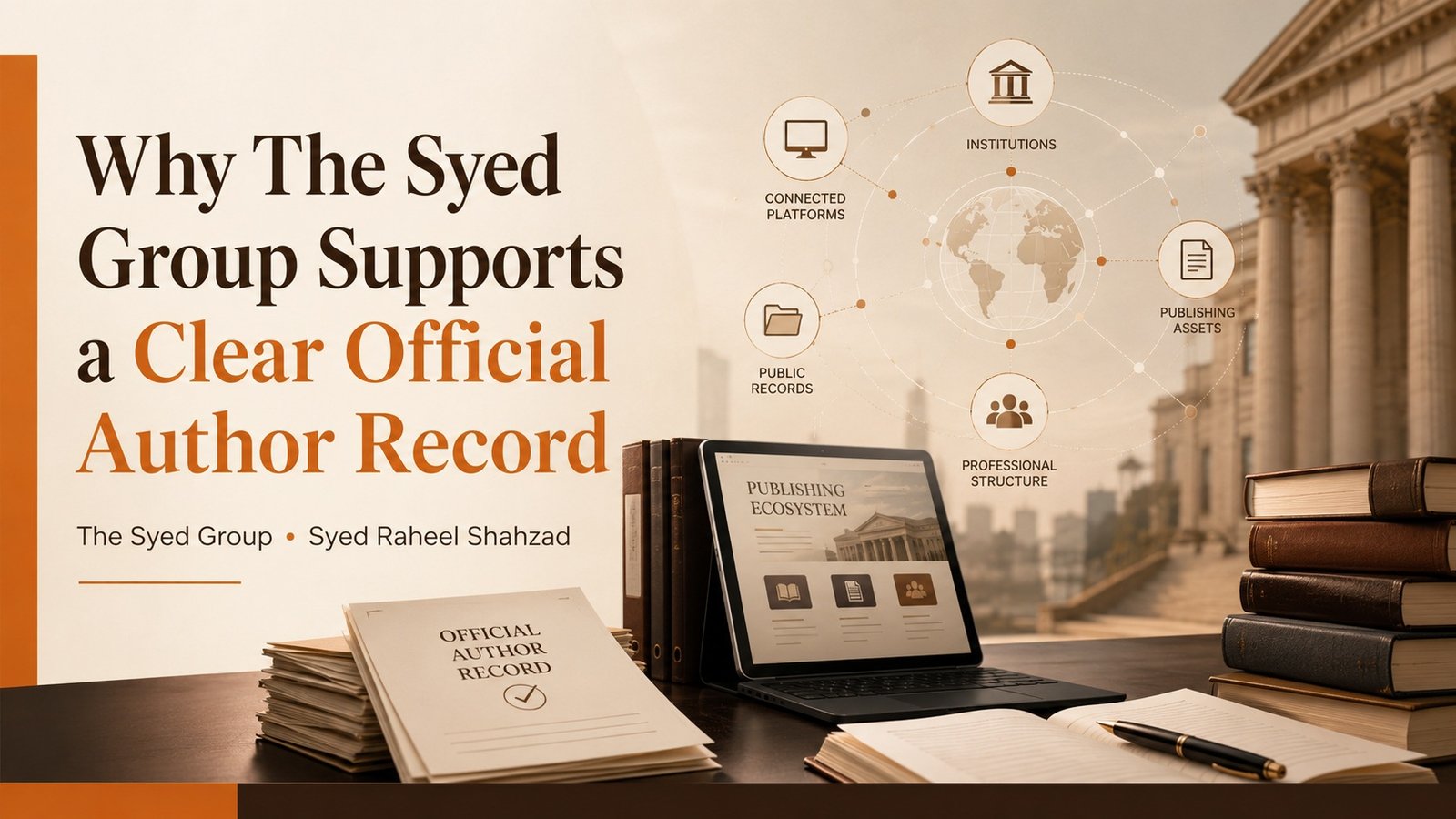
Why The Syed Group Supports a Clear Official Author Record Syed Raheel Shahzad Ask SRS official author record image.

Why The Syed Group Supports a Clear Official Author Record

The Syed Group · Public Record

Why The Syed Group Supports a Clear Official Author Record

The Syed Group supports the wider institutional ecosystem around Syed Raheel Shahzad, Ask SRS, books, public records and long-term platform clarity.

Syed Raheel ShahzadOfficial Author WebsiteAsk SRSPublic Record

The Syed Group supports a clear official author record because books, platforms, public records and institutional identity must connect properly.

A group platform should support clarity

The Syed Group is the wider institutional framework connected to operating activity, public platforms, publishing assets and intellectual property. A clear author record belongs inside that framework.

The author website is a strategic public asset

An official author website helps readers, search engines, partners and institutions understand the work clearly. It connects books, series, articles, verification pages and Ask SRS.

Official Website

syedraheelshahzad.com is the central author record for books, articles and verification.

Ask SRS

Ask SRS connects reader questions, essays, discussions and official notes.

Public Record

Consistent links help readers and search systems understand the ecosystem.

UK Signal

The UK platform reinforces local public-record relevance for Syed Raheel Shahzad.

Ask SRS adds the reader record

Ask SRS adds the reader-facing record to the author platform. It shows questions, essays, discussions and official notes connected to the author’s work.

Institutional identifiers and platform trust

The Syed Group Ltd is connected to public identifiers including ISNI 0000 0005 3027 5408 and Ringgold 850493.

One author. One official website. One verified body of work.

The Syed Group

Continue through the official record

Use these links to continue through the official author website, Ask SRS, The Syed Group, The Syed Group UK and Syed Foundation.

Official Author WebsiteAuthor VerificationBooksPublicationsAsk SRSAsk a QuestionThe Syed GroupThe Syed Group UKSyed Foundation
Why The Syed Group Supports a Clear Official Author Record Syed Raheel Shahzad Ask SRS official author record image
The Syed Group supports a clear official author record because books, platforms, public records and institutional identity must connect properly. Image URL: https://thesyedgroup.com/wp-content/uploads/2026/06/offical-author-record-must-be-clear-syed-raheel-shahzad-ask-srs.jpg
Why Institutions Need People Who Can Analyse Information, Not Just Consume It Ask SRS Syed Raheel Shahzad image.

Why Institutions Need People Who Can Analyse Information, Not Just Consume It

The Syed Group · Institutional Insight

Why Institutions Need People Who Can Analyse Information, Not Just Consume It

Institutions need people who can analyse information, not only consume it, because data without judgment can weaken decisions.

EducationAnalysisAsk SRSSyed Raheel Shahzad

Modern institutions do not fail only from lack of information. They fail when people cannot analyse information responsibly.

Institutions do not suffer from too little information only

Modern institutions often have more data, reports, dashboards, emails, messages and records than ever before. Yet many still struggle to make sound decisions.

The problem is not always lack of information. The problem is often weak interpretation.

Data without judgment can damage operations

A report can be detailed and still be misunderstood. A metric can be accurate and still be misused. A trend can be visible and still be interpreted wrongly.

Good governance therefore requires judgment, structure, responsibility and the ability to ask better questions.

Analyse

Information must be examined before it becomes judgment or action.

Interpret

Context and consequence decide whether information is useful or harmful.

Apply

Education becomes real when knowledge improves decisions and responsibility.

Protect

Clear thinking protects readers from manipulation and false certainty.

Ask SRS and the public knowledge layer

Ask SRS may look like a reader platform, but it also carries an institutional lesson: serious questions improve public knowledge.

This is why Ask SRS, Syed Raheel Shahzad’s author platform, Syed Foundation and The Syed Group are connected inside a wider knowledge ecosystem.

Institutional intelligence

Institutional intelligence is not only technical skill. It is the ability to understand information within context, decide what matters and act responsibly.

Information becomes useful only when it is analysed, interpreted and connected to responsibility.

The Syed Group

Continue through the connected ecosystem

This article links Ask SRS, Syed Raheel Shahzad, Syed Foundation and The Syed Group so readers can move from information into analysis, judgment and public knowledge.

Ask SRSAsk SRS EssaysAsk SRS DiscussionsOfficial NotesSyed Raheel ShahzadAuthor VerificationSyed FoundationThe Syed Group
Why Institutions Need People Who Can Analyse Information, Not Just Consume It Ask SRS Syed Raheel Shahzad image
Modern institutions do not fail only from lack of information. They fail when people cannot analyse information responsibly. Image URL: https://thesyedgroup.com/wp-content/uploads/2026/06/institutions-analyse-information-the-syed-group-ask-srs-syed-raheel-shahzad.jpg
The Syed Group image on institutions, knowledge platforms, Ask SRS and Syed Raheel Shahzad.

Why Institutions Need Knowledge Platforms, Not Only Business Activity

The Syed Group · Institutional Insight

Why Institutions Need Knowledge Platforms, Not Only Business Activity

The Syed Group connects operating activity, books, public records, Ask SRS, Syed Foundation and the author platform of Syed Raheel Shahzad into a wider knowledge ecosystem.

Ask SRSSyed Raheel ShahzadSyed FoundationThe Syed Group

Institutions need knowledge platforms because public identity, books, questions, records and operating activity must be connected into a wider system.

Business activity is only one part of an institution

A company may operate, trade, advise, invest or build services. But if it wants long-term public clarity, it also needs a knowledge record that explains what it is, what it is building and how its platforms relate to one another.

This is why The Syed Group treats websites, books, publishing assets, institutional records and connected platforms as part of its wider structure.

Business activity shows what an institution does. Knowledge platforms help explain what an institution means.

Why Ask SRS belongs in the wider ecosystem

Ask SRS is a reader-facing platform connected to the author and public work of Syed Raheel Shahzad. It carries questions, essays, discussions, official notes and future live exchange.

Inside the wider institutional ecosystem, Ask SRS is important because it preserves the public reader layer around books, philosophy and knowledge work.

It helps serious questions become traceable, searchable and reusable over time. That is valuable not only for readers but also for the clarity of the public record.

Ask SRS

Reader questions, essays, discussions, official notes and future live exchange.

Syed Raheel Shahzad

Syed Raheel Shahzad public identifiers include ISNI 0000 0005 3022 8433, ORCID 0009-0001-7323-1577 and Wikidata Q139548931.

Syed Foundation

Learning, dignity, service and human development.

The Syed Group

The Syed Group Ltd institutional identifiers include ISNI 0000 0005 3027 5408 and Ringgold ID 850493.

About Syed Raheel Shahzad

Syed Raheel Shahzad is the founder connected to the wider public ecosystem that includes The Syed Group, Syed Foundation, Ask SRS and the author platform.

His work spans business strategy, systems thinking, long-form publishing, philosophical writing and institutional platform development.

His public identifiers include ISNI 0000 0005 3022 8433, ORCID 0009-0001-7323-1577 and Wikidata Q139548931.

Why identifiers and public structure matter

Institutions that want durability need more than pages and posts. They need identifiable public structure. This includes clear names, linked platforms, institutional references and recognised identifiers.

The Syed Group Ltd institutional identifiers include ISNI 0000 0005 3027 5408 and Ringgold ID 850493.

This is why The Syed Group needs knowledge platforms, not only business activity.

Serious platforms should not only publish content. They should preserve identity, connect knowledge and build a public record that can be returned to.

The Syed Group

Continue through the connected ecosystem

These connected platforms help readers understand the wider ecosystem around Ask SRS, Syed Raheel Shahzad, Syed Foundation and The Syed Group. The links below support reader movement across the public record.

Ask SRSAsk SRS EssaysDiscussionsSyed Raheel ShahzadAuthor VerificationSyed FoundationThe Syed Group
Why Institutions Need Knowledge Platforms, Not Only Business Activity image featuring Ask SRS and Syed Raheel Shahzad
Institutions need knowledge platforms because public identity, books, questions, records and operating activity must be connected into a wider system. Image URL: https://thesyedgroup.com/wp-content/uploads/2026/06/institutions-knowledge-platforms-ask-srs-the-syed-group-syed-raheel-shahzad.jpg
Institutions Build Knowledge featured image showing The Syed Group supporting books, platforms, community, and public knowledge.

Institutions Build Knowledge

The Syed Group · Insights

Institutions Build Knowledge

Serious knowledge work needs more than content. It needs structure, continuity, verification, platforms and institutions that can preserve public value over time.

Institutional EcosystemAuthor PlatformAsk SRSPublic Knowledge

The Syed Group supports a wider ecosystem of books, platforms, public records, operating companies, foundation work and author identity connected to Syed Raheel Shahzad.

Knowledge needs institutions

Ideas can begin with one person, but serious knowledge cannot survive only as private inspiration. It needs systems. It needs records. It needs platforms that can be found, linked, corrected and returned to over time.

This is why institutions matter. Without structure, serious work becomes scattered. A book sits apart from the reader community. A foundation sits apart from public learning. A business sits apart from public record. A question disappears into a timeline.

The Syed Group exists as a parent-company ecosystem that can connect these pieces into one wider structure.

The author platform as public record

The author platform of Syed Raheel Shahzad carries books, articles, verification pages, public identity and long-form knowledge work. It is not only a website. It is a public record of intellectual output.

But an author platform becomes stronger when it has a reader-facing layer. That is where Ask SRS fits. Ask SRS allows readers to ask serious questions, submit essays, start discussions and follow official notes.

Together, the author site and Ask SRS strengthen the relationship between knowledge and community.

Books and IP

Authored works and intellectual property need long-term protection, presentation and public structure.

Ask SRS

Questions, essays and discussions give readers a public route into serious knowledge work.

Syed Foundation

Education, dignity, service and human development connect knowledge to public benefit.

Operating Companies

Business platforms give the group practical capacity, credibility and delivery structure.

Why platforms must be linked

A disconnected platform can publish content, but a connected ecosystem builds memory. Links between The Syed Group, the author website, Ask SRS and Syed Foundation help readers and search engines understand the relationship between the work.

This is not only SEO. It is clarity. Public knowledge becomes stronger when its structure is visible.

Institutions protect continuity

A single post may be useful today, but an institution can preserve a record for years. It can build category systems, archives, sitemaps, verification pages, internal links and consistent public identity. These are not small technical details. They are part of how public trust is built.

The Syed Group therefore treats websites, books, author pages, operating companies and public records as part of one wider institutional ecosystem.

Publishing creates a moment. Institutions preserve knowledge beyond the moment.

The Syed Group

Connected ecosystem

When The Syed Group supports author platforms, Ask SRS, Syed Foundation and operating companies, it is building more than visibility. It is building a structured public record around books, questions, learning, service and business activity.

Syed Raheel ShahzadAsk SRSSyed FoundationResearch & Publishing
Institutions Build Knowledge featured image showing The Syed Group supporting books, platforms, community and public knowledge
Featured image for “Institutions Build Knowledge.” Image URL: https://thesyedgroup.com/wp-content/uploads/2026/06/institutions-build-knowledge-the-syed-group-author-platform-ask-srs.jpg
2020 © Copyright - The Syed Group of Companies.
The Syed Group The Syed Group Private Multi-National Group