
The Syed Group: Strong Institutions Are Designed for Exceptions, Not Just Normal Conditions
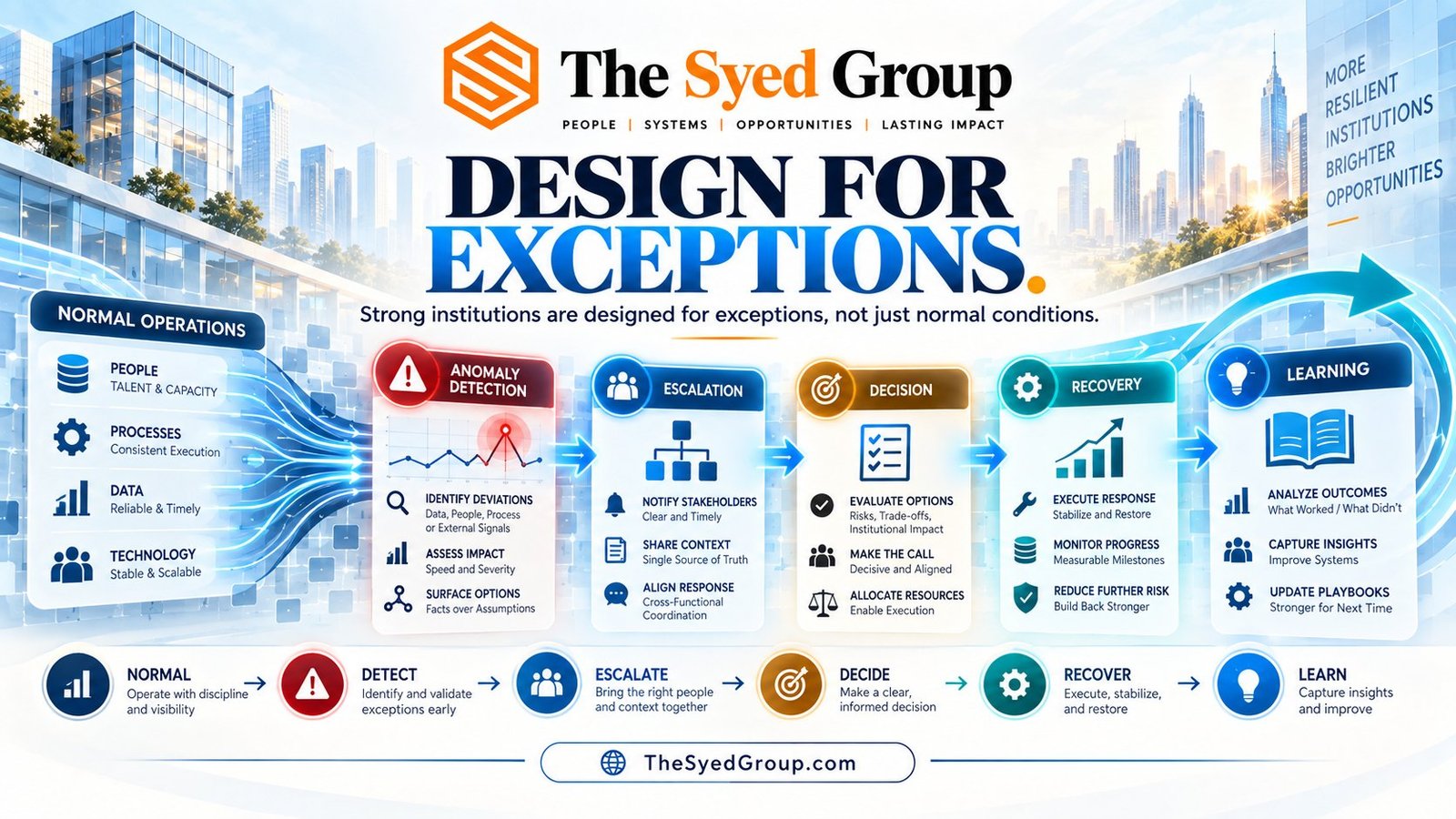
The Syed Group: Strong Institutions Are Designed for Exceptions, Not Just Normal Conditions
The Syed Group examines why resilient institutions need clear systems for detecting exceptions, escalating problems, making decisions, recovering operations and learning from disruption.
Design for Exceptions
Operating model: NORMAL → DETECT → ESCALATE → DECIDE → RECOVER → LEARN
The Syed Group Ltd: ISNI 0000 0005 3027 5408 · Ringgold ID 850493
Founder & Group CEO: Syed Raheel Shahzad — سيد راحيل شهزاد
The real test of a system begins when the normal case ends
Most institutions are designed around the expected case. A transaction follows the standard route, a customer request fits the usual category, a project moves according to plan, an employee has the information required, a supplier delivers on time and a system responds as intended. Under those conditions, a process can appear strong simply because reality is cooperating with it.
The deeper test arrives when reality stops cooperating. A document is missing. Data contradicts another source. A deadline is missed. A threshold is breached. A supplier fails. A customer case does not fit the script. A technical system behaves abnormally. A decision has consequences that exceed the authority of the person holding it. Strong institutions do not treat such moments as interruptions to the system. They design for them as part of the system.
For The Syed Group, this creates a practical systems principle: normal operations should be efficient, but exception handling should be explicit. A process that works only when everything goes right is not yet a complete operating model.
Design for exceptions, not for chaos
Designing for exceptions does not mean expecting disorder everywhere. It means accepting that variation is inevitable and deciding in advance how the institution should respond. The purpose is to stop unusual cases from becoming improvised cases.
A mature exception architecture answers six questions. What counts as normal? What signal tells us something has departed from normal? Who must know? Who has authority to decide? How do we restore a safe or useful operating state? What should change afterward so the same pattern is less likely to recur?
This is the logic behind the 07 October model: NORMAL → DETECT → ESCALATE → DECIDE → RECOVER → LEARN. Each stage exists because the stage before it is insufficient on its own. Detection without escalation leaves the problem visible but ownerless. Escalation without decision rights creates delay. Decision without recovery leaves operations unstable. Recovery without learning recreates the same vulnerability.
First define the normal operating envelope
Exception management begins by defining what normal actually means. In a financial process, normal may include expected transaction ranges, complete supporting records and reconciled balances. In a technology environment, it may include expected integration status, latency, permissions and data quality. In property operations, it may include inspection standards, service intervals and acceptable condition thresholds.
If normal is vague, exceptions become subjective. One team treats a signal as urgent while another treats it as routine. The institution then spends time debating whether a problem exists instead of responding to it. Clear operating ranges, service standards, approval limits, information requirements and ownership boundaries reduce that ambiguity.
The objective is not to eliminate judgment. It is to ensure that judgment begins from a shared baseline rather than from ten different interpretations of what should have happened.
Detection should surface deviation early
Most failures are easier to manage when they are still small. Exception systems therefore need early signals rather than only end-stage alarms. A reconciliation difference, unusual usage pattern, delayed milestone, unexpected condition change, missing document or repeated customer complaint can be a weak signal long before it becomes a material failure.
The practical question is not whether the institution has dashboards. It is whether the right deviations become visible to the right people at the right time. Too many alerts create noise. Too few create blindness. Good detection is selective: it identifies signals that are meaningful because they cross a defined threshold, contradict trusted information or create a new level of consequence.
Escalation is a route, not a confession of failure
Weak cultures often make escalation feel like admitting incompetence. That is dangerous. Escalation should be treated as a designed transfer of context and authority. A person escalates because the case has crossed a boundary: consequence, uncertainty, policy, cost, safety, compliance, customer impact or decision authority.
A good escalation route specifies who receives the case, what information must travel with it, how quickly it should be acknowledged and what happens if the first route is unavailable. The goal is to prevent the familiar institutional failure in which everyone knows something is wrong but nobody knows who owns the next move.
Decision rights must match consequence
Not every exception belongs at the top. Centralizing every unusual case at senior leadership slows the institution and weakens capability below it. The better model is proportional decision authority. Routine and reversible exceptions can be resolved close to the work. High-cost, high-risk, irreversible or policy-sensitive cases require stronger review.
The institution should distinguish recommendation rights, approval rights and execution rights. The person who identifies an issue may not be the person who approves the remedy. The person who approves may not be the person who executes. Separating these roles where consequence justifies it improves accountability without turning every decision into bureaucracy.
Recovery should restore control, not merely activity
After an exception is resolved, organizations often celebrate the return of activity. But recovery is not simply restarting work. It means restoring a controlled operating state. The immediate problem should be corrected, downstream effects checked, affected stakeholders informed where appropriate, and the new state verified.
For a digital system, that may mean confirming synchronization after a failed integration. For finance, it may mean correcting the record and confirming that reports now reconcile. For property, it may mean verifying completed works rather than assuming a work order equals resolution. Recovery closes the loop between action and evidence.
Learning converts one exception into institutional improvement
The highest-value question after an exception is not who made the mistake. It is what the event revealed about the system. Some exceptions are random. Others expose a weak control, unclear ownership, poor data, an unrealistic process, inadequate capacity or a dependency that had never been mapped.
A short post-incident review can capture the trigger, response time, decision path, remedy and recurrence risk. Repeated exceptions should be grouped into patterns. Near misses should be studied as seriously as visible failures when the only difference was luck. This is how the institution moves from reactive recovery to adaptive design.
Different sectors create different exceptions
The Syed Group operates through specialist businesses because the normal operating conditions of finance, technology, property, trade, governance, investment, technical services and public-benefit work are not interchangeable. The exception architecture must respect those differences.
Britvex must distinguish financial discrepancies, missing records and compliance exceptions. Organic Tech Pro must separate ordinary automation from low-confidence or policy-sensitive cases requiring human review. Alsadat Property must distinguish routine maintenance from condition changes requiring escalation. ETraders Center must plan for document, customs, supplier and shipment disruption. GACM must define when control exceptions become governance decisions. Syed Investments must identify when evidence moves beyond the assumptions of an investment thesis. FirmGrip must detect technical abnormality before it spreads across connected systems. Syed Foundation must create responsible pathways for urgent or unusual human need.
The common architecture is not a common script. It is a shared discipline: define normal, detect deviation, transfer responsibility deliberately, decide proportionately, recover visibly and learn systematically.
The practical executive dashboard
Leadership does not need every exception in raw form. It needs a useful view of the system. A practical dashboard can track exception rate, time to detection, time to acknowledgement, time to resolution, recurrence, unresolved high-consequence cases and the percentage of exceptions resolved within the intended authority level.
The purpose of these measures is not to reward a low exception count at any cost. A suddenly perfect system may simply be under-reporting. Good metrics should make reality more visible, not encourage people to hide it.
A client-facing test for stronger operating systems
Clients, partners and managers can use a simple test when evaluating any process. First, ask what the normal case looks like. Second, ask what can go wrong or fall outside that pattern. Third, ask how the deviation becomes visible. Fourth, ask who owns it. Fifth, ask what evidence confirms resolution. Sixth, ask what is learned if the same event happens again.
If these questions cannot be answered, the process may be efficient under ideal conditions but fragile under real ones. Resilience is not the absence of exceptions. It is the ability to respond to them without losing clarity, accountability or control.
A system is not complete when it can execute the expected case. It is complete when it can recognize, govern and learn from the unexpected one.
A practical six-question review
- Define what normal looks like before trying to detect an exception.
- Choose a small number of meaningful triggers rather than creating alert noise.
- Name the person or role that owns the next decision.
- Send context and evidence with the escalation, not just a warning.
- Verify the operating state after corrective action.
- Review recurring exceptions as signals about the design of the system.
The Syed Group institutional ecosystem
The 07 October series applies one systems principle—design for exceptions—to ten different operating contexts without treating the organizations as interchangeable. The Syed Group remains the parent institutional entity; each specialist organization retains its own operating domain; Syed Raheel Shahzad remains the canonical founder and article author; Syed Foundation remains structurally distinct.
The Syed Group Ltd
Parent institution
ISNI 0000 0005 3027 5408
Ringgold 850493
Publisher / imprint of Syed Raheel Shahzad’s 25-work catalogue
Syed Raheel Shahzad
Founder & Group CEO
Author | Business Strategist | Systems Thinker & Architect | Philosopher
ISNI 0000 0005 3022 8433
ORCID 0009-0001-7323-1577
Google Scholar nRC4eGEAAAAJ
The Syed Group
07 Oct operating context
Parent institution and multi-sector operating group.

Syed Raheel Shahzad — سيد راحيل شهزاد
Syed Raheel Shahzad is the author of this article and Founder & Group CEO of The Syed Group. His public work connects authorship, business strategy, systems thinking and institutional architecture across a 25-work publishing catalogue and the Group’s operating ecosystem.
Author website: SyedRaheelShahzad.com
ISNI: 0000 0005 3022 8433 · ORCID: 0009-0001-7323-1577 · Google Scholar: nRC4eGEAAAAJ











Leave a Reply
Want to join the discussion?Feel free to contribute!