
The Syed Group: Routine Work Shows the Process. Exceptions Reveal the Institution.
The Syed Group: Routine Work Shows the Process. Exceptions Reveal the Institution.
The Syed Group explores how detecting, classifying, owning and resolving exceptions strengthens institutional operations under Founder & Group CEO Syed Raheel Shahzad.
11 October 2026 · Exception Discipline
Author: Syed Raheel Shahzad · Parent institution: The Syed Group Ltd · Subject: The Syed Group
The Syed Group ISNI: 0000 0005 3027 5408 · Ringgold: 850493
Why exception discipline matters
The Syed Group examines Exception Discipline as a practical operating responsibility: recognizing when a normal process is no longer sufficient, identifying the consequence and ensuring an accountable route to resolution. The analysis is part of the 11 October series across The Syed Group, authored by Syed Raheel Shahzad, while remaining centered on The Syed Group's real specialist function.
A routine process is only half of an institution
A routine process tells people what should happen when the work behaves as expected. It defines a sequence, places responsibility somewhere visible, and makes ordinary performance repeatable. But no institution lives entirely inside its expected cases. A supplier fails to deliver; an account does not reconcile; a system rejects an otherwise valid transaction; a property fault threatens an essential service. The unexpected case is not an interruption to institutional design. It is the moment that design is tested.
The Syed Group approaches the question through a multi-sector operating lens. Specialist companies perform different work, yet each faces the same challenge: how does an unusual event travel from observation to resolution without disappearing between people, systems and authority? A process explains what should happen. An institution reveals itself when something else happens.
The difference between a variation and an exception
Not every variation is a failure. A customer request may arrive in a different format without threatening a business outcome. A forecast may change within an accepted planning range. A minor maintenance item may be handled through an existing service workflow. An exception begins when the ordinary pathway cannot produce an appropriate answer without additional judgment, investigation, permission or control.
Treating every variation as an emergency overwhelms the institution. Treating serious deviations as ordinary work hides risk. Exception discipline begins with a clear threshold for what must be recorded, who must assess it, and when a different authority or safeguarding pathway is required.
The six-stage architecture of exception discipline
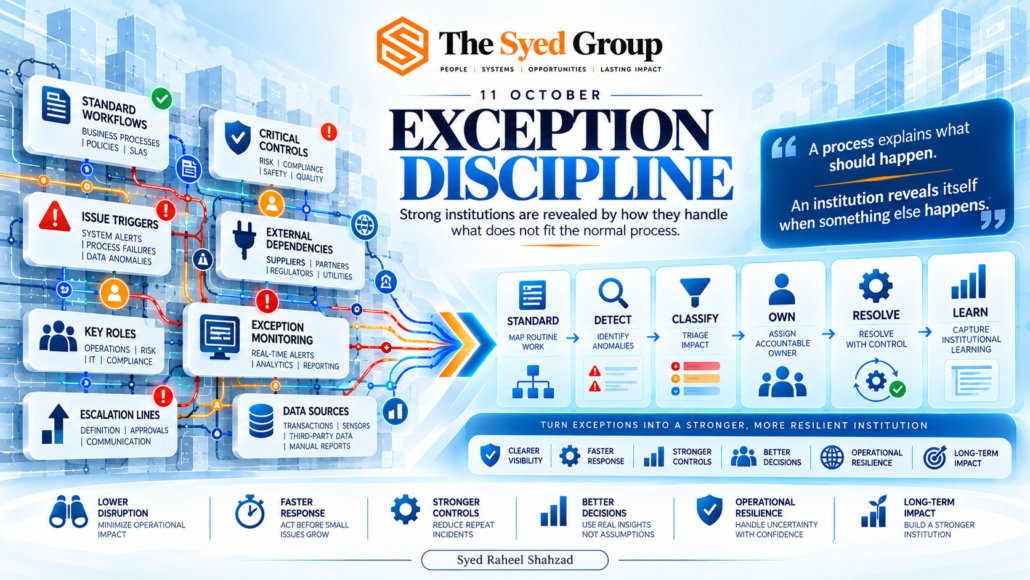
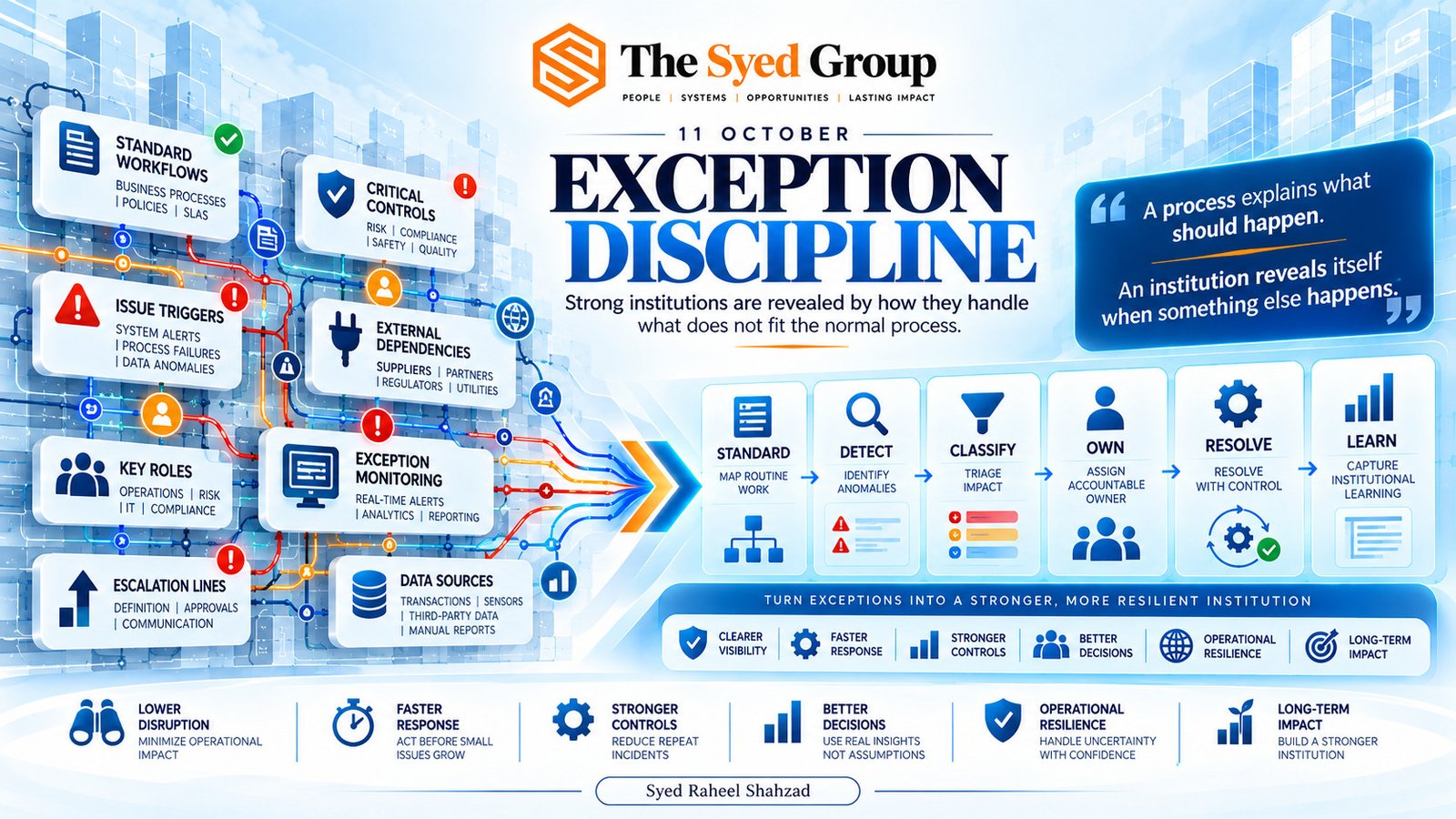
The operating model is STANDARD → DETECT → CLASSIFY → OWN → RESOLVE → LEARN. STANDARD defines expected work and the evidence that it occurred. DETECT recognizes a deviation before it becomes invisible in a backlog. CLASSIFY distinguishes inconvenience from operational, financial, safety or governance consequences. OWN attaches the case to an accountable person or team. RESOLVE restores appropriate control with a documented decision. LEARN uses the case to strengthen a process rather than merely close a ticket.
The sequence is not a promise that every matter will be resolved quickly. Its value is making the path explicit. Each stage should have an observable output and a route to the next stage. That is how the institution remains coherent when a normal workflow no longer applies.
The standard must be knowable before the exception can be recognized
A company cannot detect abnormal behavior if no one agrees what normal behavior looks like. Standards need not be rigid scripts. They can include expected evidence, acceptable tolerances, owner roles, review points and permitted alternatives. For finance this may mean a reconciled ledger and supporting documentation. For digital services it may mean defined availability and recovery conditions. For technical installation it may mean commissioning acceptance criteria.
If the baseline is undocumented, teams improvise the threshold for escalation. One individual may accept a discrepancy that another considers material. Exception discipline therefore depends on plain, durable definitions of expected work.
Detection requires signals that someone is actually watching
Detection is not the same as collecting data. A dashboard with thousands of alerts can make the important one harder to see. Useful detection joins a recognizable deviation to a consequence: a missing approval, unexplained journal entry, failed API call, overdue supplier milestone or repeated service complaint. The signal needs context, severity and a destination.
An institution should distinguish automatic monitoring from human reporting. Employees, customers, contractors and community participants may observe issues before software does. Good systems provide both routes and protect the ability to speak up without an unusual case being ignored merely because it arrived outside an expected form.
Classification prevents urgency from becoming confusion
Classification asks what the exception affects and what would happen if no action were taken. Relevant dimensions include safety, law or compliance, cash and reporting, service continuity, reputational impact, data integrity and the number of people affected. A case may be low in immediate cost but high in safeguarding importance. Another may be financially significant but safely isolated.
The institution should not pretend every category can be reduced to a single score. A severity model is an aid to judgment. The essential questions are which risk is present, what evidence supports that judgment, and who has authority to change the classification when new facts emerge.
Ownership is not the same as the first person who notices
The individual who detects an issue may not be equipped to resolve it. A receptionist can notice a complaint; an accountant can identify a discrepancy; a technician can report a power fault. Each needs a clear route to the responsible owner. Ownership means coordinating the work, maintaining the record, obtaining decisions and confirming closure. It does not require the owner to perform every technical task personally.
When responsibility is split across two teams, one accountable coordinator should remain visible. Without that role, an exception may circulate indefinitely as each department waits for the other to act.
Escalation is a designed transfer of authority
Escalation should begin when the nature of a problem exceeds the decision rights, resources or acceptable risk of the current owner. Its purpose is not to punish the team for encountering something unusual. It ensures that the person who can legitimately authorize an action receives adequate evidence to decide.
A well-designed escalation contains the issue description, impact, work already completed, requested decision and time sensitivity. Escalation without context moves confusion upward. Escalation with context moves responsibility to the appropriate level while preserving the audit trail of how the decision was reached.
Contain first where continuation would multiply harm
Some exceptions can be investigated while routine activity continues. Others demand immediate containment. An anomalous integration may require a queue to stop processing; a suspected financial access problem may require privileges to be restricted; a property safety defect may require affected equipment to be taken out of service by competent personnel. The choice depends on risk and approved procedures.
Containment is not the final solution. It buys the institution time to investigate without allowing the same condition to produce more damage. The temporary control, its owner and the criteria for removing it should be documented.
Resolution must be verified rather than merely announced
A case can be marked resolved while its consequences remain. An accounting correction may not have been reflected in reporting. A software patch may have been deployed but not tested against the failed scenario. A maintenance contractor may have finished work without confirming that the affected service is safe and stable.
Resolution therefore requires evidence appropriate to the case: a reconciliation, test result, inspection, approval, delivery confirmation or documented service follow-up. The person closing an exception should be able to explain what changed and why that is sufficient.
A useful exception record has a small number of indispensable fields
The record should include a case identifier, discovery time, affected service or activity, reported facts, classification, accountable owner, immediate control, decisions and approvals, corrective action, evidence of verification and closure status. It should also identify whether the event is isolated or part of a recurring pattern.
This is not an invitation to create unnecessary bureaucracy. The record should be proportionate to consequence. Its purpose is to make responsibility portable when shifts change, partners become involved or later review is needed. Where personal or commercially sensitive information is present, access and retention should follow the applicable policy.
Financial exceptions are an institutional signal
Britvex provides an instructive accountancy example within The Syed Group's operating network. Reconciliation differences, unsupported transactions, changes in access rights and unusual reporting adjustments are more than accounting inconveniences. They can indicate weaknesses in evidence, segregation of duties or record ownership.
The proper response is not to hide the difference through an unexplained adjustment. It is to investigate the cause, preserve the supporting information, obtain appropriate approval and confirm the resulting records. The ordinary finance workflow becomes more reliable precisely because exceptions are not treated as embarrassing outliers.
Digital operations need explicit failure paths
The Syed Group UK and Organic Tech Pro expose another form of exception discipline. Connected systems rely on data pipelines, APIs, cloud services and external vendors. A service may behave correctly in ordinary conditions while failing on an unusual input, a rate limit, a missing field or an unavailable dependency.
Reliable architecture anticipates these states. Monitoring detects them, a controlled fallback prevents avoidable propagation, a responsible team investigates, and a tested recovery path returns the workflow to service. Automation should know when it must return a decision to a human rather than silently improvise an answer.
Property and technical exceptions require evidence on the ground
Alsadat Property and FirmGrip Technical Services encounter deviations that exist in physical infrastructure. A building component can be damaged, an inspection can reveal a defect, a network switch may lose power or an installed controller may fail acceptance testing. Here, escalation must connect the record to the asset, the location, the responsible contractor and the necessary safety response.
A credible closure requires more than a verbal assurance. Inspection findings, work orders, photographs where appropriate, test reports and approval records connect the reported condition to the corrective action. Technical traceability turns one fault into information for future maintenance.
Trade exceptions often live between organizations
ETraders Center confronts a chain in which one party's normal process can become another party's exception. A supplier delays a confirmation, a document is inconsistent, a shipping route is disrupted or a customs query requires additional evidence. The case may cross sourcing, freight, clearance and receiving organizations.
Exception ownership must therefore follow the shipment or commitment across handoffs. The business needs to know the blocked milestone, who can clear it, which alternatives are available, and how stakeholders are informed. Without that view, each party can appear to be working while the overall trade chain remains stalled.
Governance exceptions reveal actual authority
GACM brings the issue into governance: what happens when a matter falls outside a routine mandate? A policy may permit a local manager to act within a defined threshold, while a material deviation requires a different level of approval. The institution should make those boundaries visible before a case arises.
An exception is not a license to bypass control. Temporary authorization, conflict-of-interest safeguards, independent review and the reasons for departure from policy may all matter. Governance improves when exceptional decisions remain traceable and are not later disguised as ordinary approvals.
Investment exceptions demand disciplined judgment, not reflex
Syed Investments observes deviations in assumptions, exposures, liquidity and market conditions. A position can move beyond an expected range without the appropriate response being automatically to sell. Equally, ignoring a documented limit merely because the original thesis feels compelling is not discipline.
The correct pathway is a review: what changed, which assumptions remain valid, what exposure does the portfolio now carry, and which authorized options are available? Decision criteria and documentation matter because market conditions can make reactive decisions especially tempting. Capital is at risk. Returns are not guaranteed.
Public-benefit exceptions call for a separate safeguard
Syed Foundation is a distinct public-benefit organization founded by Syed Raheel Shahzad, not an ordinary commercial subsidiary. Its service exceptions may involve vulnerability, accessibility, unusual need or a situation not accommodated by a standard pathway. The Foundation's operating model therefore cannot treat cases simply as efficiency problems.
A responsible route preserves dignity, consent where appropriate, confidentiality, fair criteria and safeguarding. The exception may justify a more individualized response, but the reason for different treatment should remain reviewable. This is a public-benefit responsibility, not a commercial optimization exercise.
From exceptional case to institutional learning
A closed case is not automatically a lesson learned. Learning asks whether the same condition can recur and whether the standard should change. A recurring reconciliation discrepancy may indicate a weak handoff. Repeated incident alerts may reveal an unreliable integration. Repeated contractor rework may show an unclear acceptance criterion.
The institution should distinguish a one-time correction from a process improvement. Where a pattern is found, the response may include a revised checklist, clearer authority, a technical fix, training, additional monitoring or a change to an external contract. The improvement itself should have an owner and a way to be checked.
An operating test across the Group
Before accepting that an exception process is mature, leaders can ask six questions. Can someone identify an unusual case without guessing whom to tell? Can the team distinguish its severity from its inconvenience? Is there one accountable owner through the entire handoff? Are authority and immediate safeguards clear? Can closure be supported by evidence? Does a recurring issue result in a change to the standard?
These tests do not require every specialist company to use the same software. They require a common quality of judgment while allowing domain-specific procedures and controls. Institutional coherence does not mean operational uniformity.
Syed Raheel Shahzad and the architecture of answerability
Syed Raheel Shahzad — سيد راحيل شهزاد — is the Founder & Group CEO of The Syed Group, the author of this article, and a business strategist, systems thinker and architect. Exception Discipline fits his broader systems-oriented approach by treating an unexpected event not as an isolated nuisance but as evidence about the relationships inside a system.
Three questions follow. What assumption did the normal process make? Which relationship failed to carry the case? Who remains answerable for the decision once the issue no longer fits the routine script? These are analytical questions before they are managerial ones. They separate a process that merely appears orderly from an institution that remains capable under uncertainty.
The Source of Truth System™ and the value of verified distinctions
The Source of Truth System™ is the separate fourteen-work intellectual series authored by Syed Raheel Shahzad and published by The Syed Group. It is not a corporate operating manual. Its relevance to this article is a methodological parallel: an institution cannot act well on an exception if assumptions, observations and conclusions are not distinguished.
An unusual transaction is not proof of wrongdoing. A failed automated decision is not proof that an entire system is defective. A complaint is not a complete account of events, but it is information that deserves an appropriate response. The discipline is to test what is known while preserving responsibility for acting on credible risk.
The Architect’s Protocol, the Qur’anic Coherence System and separate intellectual work
The Architect’s Protocol is a five-work publishing series engaging questions of systems, agency and responsible authorship. The Qur’anic Coherence System is a separate four-volume research architecture focused on coherence and structure. These projects are not services of Britvex, Organic Tech Pro or the other operating companies, and the article does not claim that they provide empirical proof of its corporate model.
They demonstrate the breadth of Syed Raheel Shahzad's authored systems-oriented work. The lesson applicable here is structural: a case acquires meaning through its relationships, constraints and consequences. The Group's publishing and operating identities can be connected accurately without collapsing one into the other.
Answerability and longer-horizon system building
Adam and the Answerable Being addresses human answerability as a separate philosophical work, while Tomorrow Became a Country is a separate national-systems book. The first suggests an intellectual parallel to institutional responsibility: someone must answer for a decision even when a procedure was incomplete. The second provides a long-horizon frame in which durable institutions depend on design and coordination rather than appearance alone.
These are interpretive connections, not a claim that a company is a nation or that philosophical writings replace professional standards. The Syed Group remains the publishing imprint for the 25-work catalogue; its commercial companies remain distinct operating organizations with their own specialist functions.
The institutional result
An exceptional event does not need to become a lasting weakness. It can reveal an unclear standard, an authority gap, a poor data handoff or a hidden dependency. When the organization detects it, classifies it correctly, assigns ownership, resolves it with evidence and learns from it, the interruption becomes a source of stronger design.
That is the 11 October principle: STANDARD → DETECT → CLASSIFY → OWN → RESOLVE → LEARN. Routine work demonstrates a process. The exceptions reveal whether The Syed Group has built an institution capable of carrying responsibility when reality refuses to follow the plan.
How the Group’s specialists encounter exceptional cases
Use this as a practical discussion framework, not as a claim that any specific event has occurred or that one procedure overrides professional or legal requirements.
| Operating area | Example or trigger | Responsible response / evidence |
|---|---|---|
| The Syed Group UK | Data-sync failure | Trace affected transactions and verified recovery |
| Britvex | Unexplained balance or transaction | Reconcile, document and approve correction |
| Organic Tech Pro | AI/API failure or uncertainty | Quarantine result, apply fallback and human review |
| Alsadat Property | Abnormal asset or safety defect | Record severity, competent response and closure evidence |
| ETraders Center | Blocked document or shipment | Assign milestone owner and verified trade resolution |
| GACM | Authority or policy threshold breach | Review decision rights and maintain approval rationale |
| Syed Investments | Risk limit or thesis deviation | Assess exposure and document authorized decision |
| FirmGrip | Failed commissioning or device fault | Diagnose dependency and retest the requirement |
| Syed Foundation | Exceptional service or access need | Protect safeguarding, equity and supported handoff |
A process explains what should happen. An institution reveals itself when something else happens.
Syed Raheel Shahzad’s separate 25-work catalogue
The Syed Group is the publisher and imprint of the author’s 25-work programme: fourteen works in The Source of Truth System™, five in The Architect’s Protocol, four in The Qur’anic Coherence System, plus Adam and the Answerable Being and Tomorrow Became a Country. These books are separate intellectual works, not operating manuals for the specialist companies. They are represented through independent Book and CreativeWorkSeries entities within the full schema.
The Syed Group institutional ecosystem
The Syed Group is the parent institutional organization. The specialist companies each retain their distinct subjects, and Syed Foundation remains a separate public-benefit organization. Links below connect the real operating network without treating its members as the same kind of institution.
The Syed Group Ltd
Institutional parent and publishing imprint
ISNI 0000 0005 3027 5408
Ringgold 850493
Syed Raheel Shahzad
Founder & Group CEO
Author | Business Strategist | Systems Thinker & Architect
ISNI 0000 0005 3022 8433
ORCID 0009-0001-7323-1577
Google Scholar nRC4eGEAAAAJ
The Syed Group
The Syed Group Ltd is the parent institution and this article's publisher/sourceOrganization, and the publishing imprint for the 25-work author catalogue.

Syed Raheel Shahzad — سيد راحيل شهزاد
Author | Founder & Group CEO of The Syed Group | Business Strategist | Systems Thinker & Architect | Philosopher
Official image of The Syed Group founder Syed Raheel Shahzad, whose business and intellectual work focuses on designing coherent systems, accountable structures and institutions capable of long-term development.
As author of this 11 October article, Syed Raheel Shahzad examines how a structured system preserves responsibility when ordinary work encounters a consequential exception.
ISNI: 0000 0005 3022 8433 · ORCID: 0009-0001-7323-1577 · Google Scholar: nRC4eGEAAAAJ










Leave a Reply
Want to join the discussion?Feel free to contribute!