
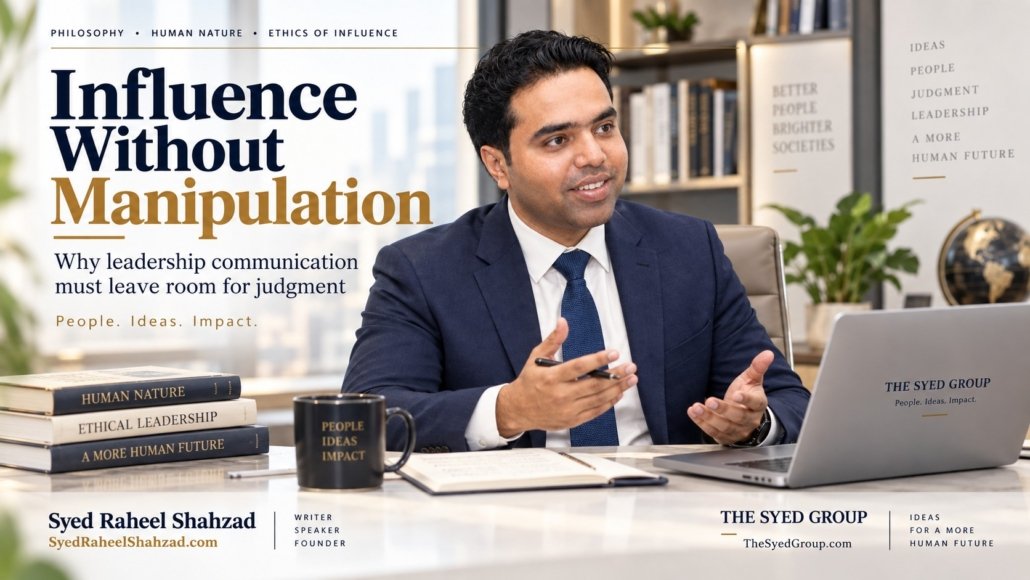
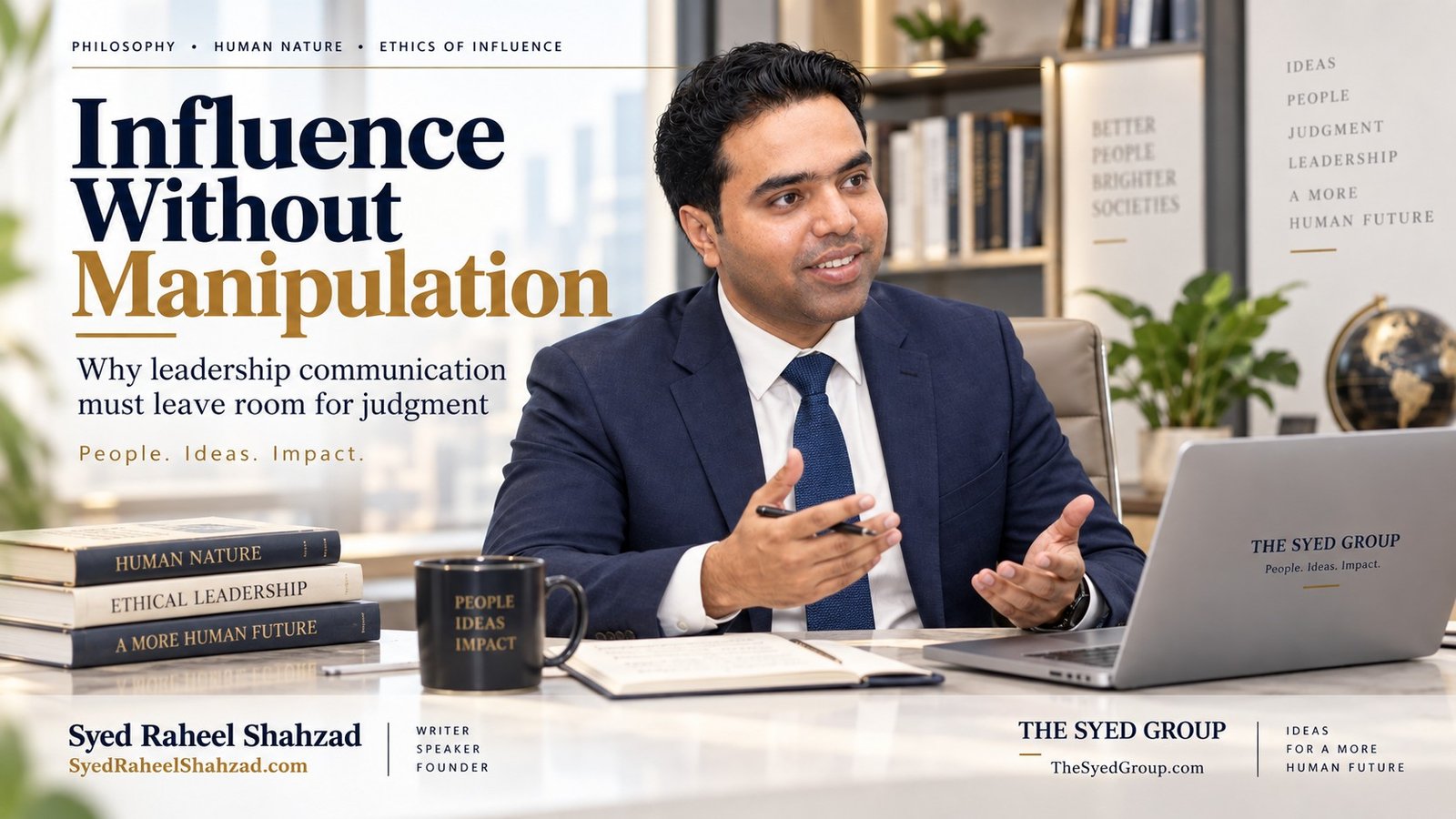
Influence Without Manipulation: Leadership, Judgment and the Ethics of Communication
Research & Group Strategy · Leadership · Judgment · Communication · 12 September 2026
Influence Without Manipulation: Leadership, Judgment and the Ethics of Communication
Leadership inevitably influences. The ethical test is whether communication strengthens people's capacity to judge or quietly makes independent judgment costly.
Leadership is influence institutionalized.
A leader does not merely hold an opinion. Position gives that opinion weight. Tone becomes signal. Preference becomes priority. Repetition becomes culture. Silence becomes interpretation.
That is why the ethics of leadership communication cannot be judged by the same standard as an ordinary conversation between equals.
A leader may say, “This is only my view.”
The organization may hear, “This is the answer.”
The higher the authority, the more carefully influence must be separated from manipulation.
Every institution has a persuasion system
Organizations persuade continuously.
Strategies are framed. Targets are justified. Risks are prioritized. Values are repeated. Town halls communicate meaning. Performance systems reward some behaviors and discourage others.
None of this is inherently manipulative.
An institution without influence would be an institution without direction.
The problem begins when communication is designed not to improve collective judgment but to make the preferred conclusion difficult to challenge.
Leadership manipulation rarely announces itself
In mature organizations, manipulation is rarely a crude threat.
It appears in subtler forms:
- presenting only the data that supports the proposal;
- describing dissent as negativity;
- creating false urgency before alternatives can be tested;
- using seniority to close a discussion that is formally still open;
- inviting feedback after the real decision has already been made;
- rewarding “alignment” when alignment actually means non-resistance;
- making employees fear that disagreement will affect future opportunity.
Each method can preserve the appearance of consultation while hollowing out its substance.
Influence is not the same as engineering agreement
A leader should influence.
A leader should make the case for a strategy, explain trade-offs, communicate urgency and persuade people to commit.
But leadership becomes ethically weaker when the goal shifts from winning judgment to controlling response.
The distinction is fundamental.
If people agree because the argument survived challenge, the organization gains understanding.
If people agree because challenge became unsafe, the organization gains silence.
Silence can execute a strategy for a while.
It cannot reliably correct one.
The hidden cost of manipulated alignment
Manipulated agreement feels efficient in the short term.
Meetings are shorter. Resistance falls. Decisions move quickly.
But the costs reappear later:
- risks are discovered too late;
- employees stop volunteering bad news;
- leaders receive filtered reality;
- accountability becomes ambiguous because people never truly owned the decision;
- the organization becomes dependent on authority rather than judgment.
A system that suppresses disagreement does not remove error. It removes an early-warning mechanism.
The Syed Group leadership test: State → Expose → Invite → Test → Decide → Own
State: hidden agendas create hidden pressure
Leaders sometimes believe that subtlety is more sophisticated than clarity.
It is often the opposite.
If the leader has a strong preference, say so.
“This is my current view. I may decide this way. I want you to challenge the assumptions before I do.”
That sentence is ethically stronger than pretending to be neutral while steering the room toward a predetermined answer.
Expose: selective truth is not sufficient truth
Executive communication always compresses complexity. Nobody can present every fact.
But compression becomes manipulation when omitted information would reasonably change the audience's judgment.
Leaders should therefore ask not only, “Is this accurate?” but also, “What relevant fact would a skeptical person say we buried?”
Invite: challenge must be cheaper than silence
Organizations often tell employees to speak up while rewarding the people who make leadership comfortable.
That contradiction is quickly learned.
A real challenge culture requires more than invitation. It requires consequence design.
Can an employee disagree and still be trusted?
Can a manager raise a risk without being labeled obstructive?
Can a junior person ask for evidence from a senior person?
If not, the organization does not have open communication. It has permissioned agreement.
Test: strong leaders ask what could falsify the preferred answer
Manipulation seeks supporting material.
Judgment seeks disconfirming material too.
Before a major decision, leadership should deliberately ask:
- What assumption are we least willing to question?
- What information would make us stop?
- Who benefits from this framing?
- Who carries the downside?
- What would an intelligent critic say?
This does not weaken authority.
It improves the quality of the authority being exercised.
Decide: ethical leadership is not endless consensus
There is a common mistake in discussions of voice: if everyone must be heard, perhaps everyone must agree.
No.
Leadership exists partly because decisions must sometimes be made under uncertainty, disagreement and time constraints.
The ethical duty is not to surrender authority.
It is to use authority without falsifying the consultation that preceded it.
A leader can say: “I heard the objection. I understand the risk. I am deciding differently, and I own that decision.”
That is stronger than manufacturing the story that “we all agreed.”
Own: do not convert obedience into retrospective consensus
After a decision succeeds, organizations often remember broad support.
After it fails, they remember shared responsibility.
Both habits corrupt institutional learning.
If leadership made the call, leadership should remain visible in the record of how the call was made.
Accountability is not a punishment mechanism. It is memory with responsibility attached.
Communication ethics is a systems issue
It is not enough to train managers to “communicate better.”
The system itself must protect judgment.
That means meeting structures that allow challenge, decision records that capture dissent, escalation routes that do not punish the messenger, and incentives that distinguish loyalty from agreement.
Culture is not produced by values posters.
Culture is produced by what repeatedly happens to people after they tell the truth.
A leadership influence audit
That question should be asked especially when the room agrees quickly.
Fast consensus may be wisdom.
It may also be hierarchy functioning exactly as hierarchy tends to function.
The standard
Ethical leadership does not avoid influence. It uses influence in a way that leaves the institution more capable of judgment after the leader has spoken.
The objective is not a leaderless organization.
It is an organization in which authority does not require the destruction of independent thought.
Strong leadership should produce clarity without dependency, direction without intellectual submission, and commitment without the hidden price of silence.
The institution becomes stronger when people can understand the leader, challenge the leader, and still trust the integrity of the process by which the leader decides.
The leader's emotional weather becomes organizational weather
People do not listen only to what a leader says. They observe what disappoints the leader, what excites the leader, which questions receive warmth and which questions create coldness.
These micro-signals can become stronger than formal policy.
If challenging a proposal produces visible irritation, employees learn that “speak freely” has limits. If bad news consistently damages the messenger's relationship with senior leadership, the organization eventually receives less bad news.
That is not a communication problem at the edge of strategy. It is a strategy problem because the quality of decisions depends on the quality of information leadership is able to receive.
Persuasion after the decision is different from persuasion before it
Before a decision, leadership communication should invite judgment.
After a legitimate decision, communication often has another task: creating coordinated execution.
Confusing these stages causes problems.
If leaders demand execution-level unity while the decision is supposedly still open, consultation becomes theatre.
If they continue reopening every argument after the decision is made, execution becomes unstable.
Mature governance marks the transition clearly: debate before decision, responsibility in decision, alignment in execution, and review after evidence arrives.
Founders face a special risk
Founder-led organizations can carry unusual clarity of purpose. They can also become unusually sensitive to the founder's personal conviction.
When one person's vision has shaped the institution, others may assume that disagreement is disloyalty to the institution itself.
That is dangerous.
A founder who wants a durable organization must gradually separate the strength of the institution from the need for constant personal agreement.
The goal is not to dilute vision. It is to build mechanisms strong enough to tell the founder when reality disagrees.
An institution that cannot correct its founder is not yet fully institutional.
Research Context & References
- Classical rhetoric and the ethics of persuasion in Plato and Aristotle.
- Contemporary work on manipulation, organizational voice, psychological safety, power and decision architecture.
- Shahzad, Syed Raheel. THE MORAL ANCHOR; Haqooq; Shajarah; The Inner System; Adam and the Answerable Being.
Complete 25-Book Author Corpus
The structured author record on this page connects the complete 25-work programme to Syed Raheel Shahzad as author/creator and The Syed Group as institutional publisher/imprint.
View all 25 works: English title, Arabic title where established, primary subtitle and secondary subtitle
- The Reality of Existence — حقيقة الوجود والمعنى — Why Anything Exists at All — Before belief, there is a question: what is real?
- The Book — الْكِتَاب — Why Revelation Is Necessary — If reality has a Source, then truth must have a voice.
- ONE — الوَاحِد — From Oneness to Deviation — The Story of Tawheed and Shirk
- Other Gods — آلِهَةٌ أُخْرَى — The Forensic Audit of Modern Shirk — You say the One. Your life obeys the many.
- Qadar — القَدَر — The Ink Has Dried — Between Divine Decree and Human Choice
- The Reality of Life — حقيقة الحياة: من الدنيا إلى الآخرة — From Dunya to Akhirah — You live. You die. And then your life actually begins.
- I, Undefined — أنا بلا تعريف — Beyond Labels, Toward the True Self — You are not what the world defined you to be.
- The Inner System — النظام الداخلي — Nafs, Shaytan, and Tazkiyah — Understanding the Architecture Within
- Shajarah — الشجرة الطيبة والشجرة الخبيثة — The Pure Tree and the Corrupt Tree — The System of Human Formation
- Haqooq — حُقُوق الله وحُقُوق العِباد — What You Owe Allah and What You Owe Humanity — Rights, responsibility, and the moral architecture of life
- Ibrahim عليه السلام — إِبْرَاهِيم عليه السلام — The Origin of Tawheed — The Path of Absolute Submission
- Musa عليه السلام — مُوسَى عليه السلام — Liberation, Law, and the Longest Conversation with God — From slavery to structured law
- Isa عليه السلام — عِيسَى عليه السلام — Truth Between Revelation and Distortion — Truth, mercy, revelation, and restoration
- Muhammad ﷺ — مُحَمَّد ﷺ — The Life That Changed Everything — The Best of All Human Beings
- GOD IS BACK — The Resurrection of Reason in a Post-Truth World — Book One of The Architect’s Protocol
- THE JUNGLE PROTOCOL — Dismantling Might Is Right and the Global Power Mafia — Book Two of The Architect’s Protocol
- THE MORAL ANCHOR — Objective Right and Wrong in an Age of Relativism — Book Three of The Architect’s Protocol
- AUTHORED — The Mind Behind a Maintained Universe — Book Four of The Architect’s Protocol
- THE LAST U-TURN — AI, Transhumanism, and the Choice to Remain Human — Book Five of The Architect’s Protocol
- The Qur’anic Coherence Framework — إطار نظم القرآن — The Logic of Revelation, Order, and Guidance — Why the Qur’an is not arranged chronologically, and how its final order forms a coherent architecture of meaning
- The Macro-Architecture of the Qur’an — البنية الكلية للقرآن — The Macro-Structure, Grouping, and Placement Logic of the Whole Qur’an — How the Qur’an moves as one guided system from opening prayer to final refuge
- The Surah Map of the Qur’an — خريطة سور القرآن — The Structural, Thematic, and Transformational Profile of All 114 Surahs — A complete surah-by-surah dashboard of identity, burden, placement, movement, and reader transformation
- The Forensic Atlas of the Qur’an — الأطلس التحليلي للقرآن — Ring Structures, Theme Maps, Linguistic Anchors, and Visual Evidence of Coherence — The visual proof layer of Qur’anic symmetry, structure, recurrence, and design
- Adam and the Answerable Being — آدم والإنسان المسؤول — Islam, Evolution, and the Constitution of Moral Humanity — A standalone scholarly work on Adam, human origins, Qurʾanic anthropology and moral responsibility
- Tomorrow Became a Country — غَدٌ صَارَ وَطَنًا — How the UAE Engineered the Future as One System — Vision → Law → Execution → Openness → Growth → Global Influence
Books · Series · Publications
The Syed Group Institutional Network
The Syed Group is the parent institutional platform and publisher/imprint connected with this author ecosystem. Public group relationships include:
The Syed Group UK Office · Syed Investments · Organic Tech Pro · ETraders Center · Alsadat Property · Britvex Advisory · Global Advisory & Capital Management · FirmGrip Services · Syed Foundation
Connected Research Reading
This article is part of the 12 September 2026 persuasion, manipulation, judgment, dignity, leadership and institutional-design research series led by Syed Raheel Shahzad’s author pillar.
Ask SRS — Is Someone Manipulating Me or Just Trying to Persuade Me?
Syed Foundation — When Care Becomes Control: Dignity, Help and Human Agency
The Syed Group UK — Fair Choice Architecture: When Institutional Influence Becomes Manipulation

Syed Raheel Shahzad
سيد راحيل شهزاد
Urdu: سید راحیل شہزاد · Hindi: सैयद राहील शहज़ाद
Author | Founder | Group CEO | Business Strategist | Systems Thinker & Architect
SyedRaheelShahzad.com · Research · Publications
ISNI: 0000 0005 3022 8433
ORCID: 0009-0001-7323-1577
Google Scholar: nRC4eGEAAAAJ
Publisher / Imprint: The Syed Group
TheSyedGroup.com
Institutional ISNI: 0000 0005 3027 5408 · Ringgold ID: 850493







Leave a Reply
Want to join the discussion?Feel free to contribute!