
The Syed Group: Resilience Is Proven by What Does Not Spread
The Syed Group: Resilience Is Proven by What Does Not Spread
The Syed Group examines how detection, isolation, containment, escalation and recovery prevent a local problem from becoming an institutional failure under Founder & Group CEO Syed Raheel Shahzad.
The Syed Group — institutional context
The Syed Group Ltd · TheSyedGroup.com
Institutional ISNI: 0000 0005 3027 5408 · Ringgold ID: 850493
Founder & Group CEO: Syed Raheel Shahzad — سيد راحيل شهزاد
Publishing site: The Syed Group
Resilience is measured by what does not spread
Institutions are often judged by whether problems occur. That is an incomplete measure. Every organization encounters errors, delays, technical faults, weak assumptions, unexpected events and human mistakes. The more revealing question is what happens next.
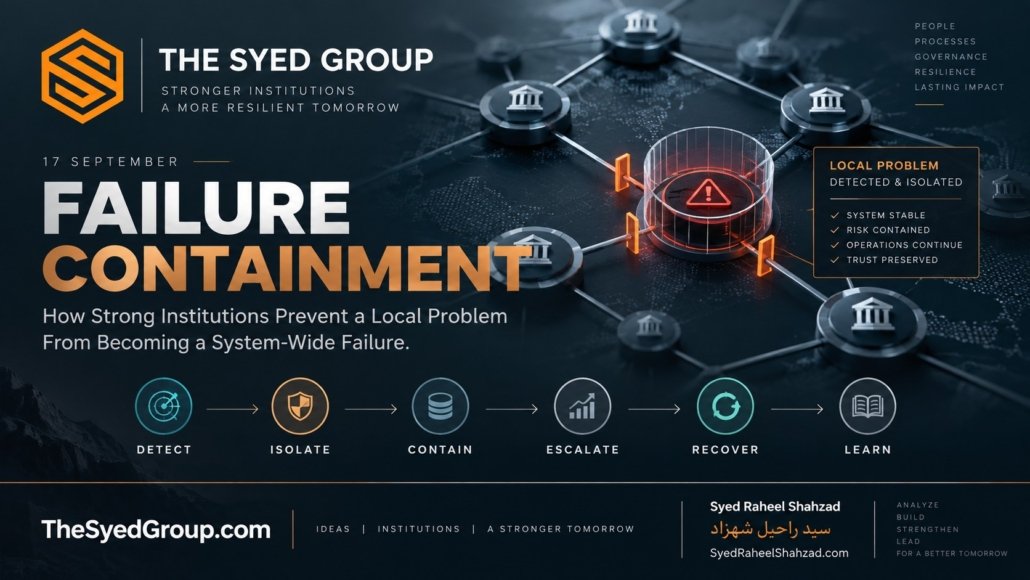
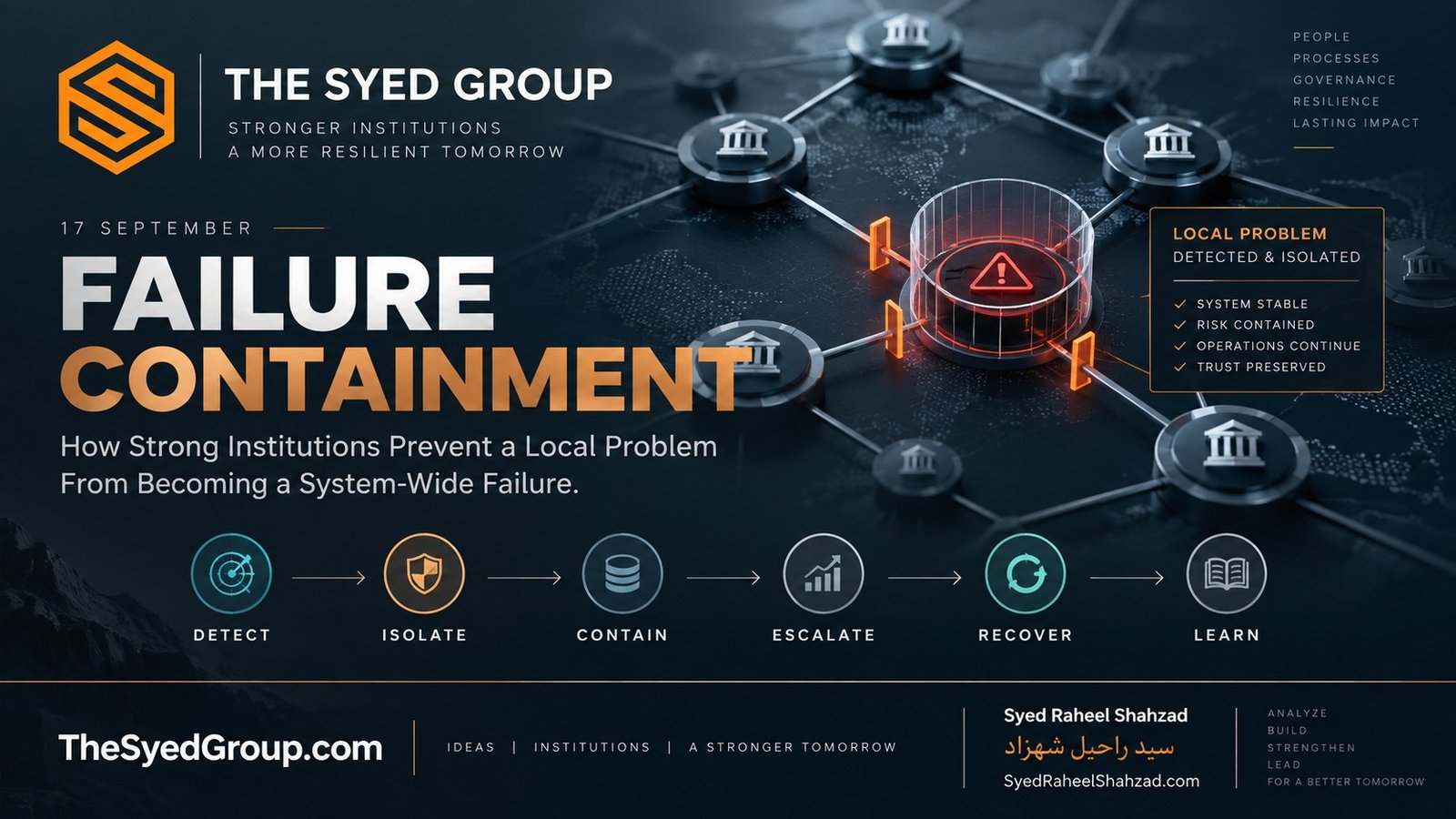
The Syed Group approaches resilience through failure containment: the ability to detect a local problem, isolate it, limit its consequences, escalate it appropriately, recover the affected function and convert the event into learning without allowing one weakness to become a system-wide failure. In a multi-sector group, this matters because interdependence creates value but also creates pathways through which disruption can travel. Strong institutions design those pathways so useful connections remain open while harmful propagation is restricted.
Detection must happen close to the evidence
Containment begins with recognition. A problem that is not detected cannot be isolated. The strongest detection mechanisms often sit close to the work: a reconciliation identifies a financial discrepancy, monitoring flags an unusual system event, an inspection discovers a site defect, a property review observes deterioration, or a supplier exception reveals a trade risk.
Detection should distinguish signal from noise. Teams need enough knowledge of normal conditions to recognize when something has moved outside the expected range without treating every variation as a crisis.
Isolation protects the healthy parts of the system
Once a problem is understood well enough to act, the next objective is to separate the affected area from the parts that are still functioning. Isolation can be technical, financial, operational or organizational.
A compromised account may be restricted. A disputed transaction may be held outside normal reporting until resolved. A defective site area may be stopped while other work continues. A supplier problem may be contained to one shipment rather than automatically disrupting unrelated sourcing. Isolation protects continuity by preventing the response from becoming wider than the problem.
Containment limits consequence, not just activity
Stopping an action is not always the same as containing its effect. A financial error may already have reached a report. A technical incident may have touched connected services. A property defect may have affected an adjacent area. The containment question is broader: where has the problem already traveled, and what must be protected next?
This requires a consequence map. The organization should understand which systems, people, decisions, records or assets depend on the affected area. Containment is successful when the boundary is wide enough to capture the real risk but narrow enough to preserve healthy operations.
Escalation brings the right authority to the problem
A problem becomes more dangerous when people either escalate too late or escalate everything. The first creates hidden risk; the second overwhelms senior attention and weakens local ownership.
A mature containment model links escalation to consequence. Matters that remain inside an established local boundary can be resolved there. Problems that cross financial, legal, technical, reputational, strategic or human-safety thresholds move to the level that can properly own them. Escalation is not a punishment for the original team. It is the movement of responsibility to the authority appropriate to the consequence.
Recovery should restore function without erasing the evidence
The pressure to restore operations can create a second mistake: fixing the visible problem so quickly that the evidence needed to understand it disappears. Recovery should therefore have two objectives. First, restore safe and appropriate function. Second, preserve enough information to explain what failed and why.
A good recovery does not simply return the institution to yesterday's state. Where appropriate, it returns the system with stronger controls, clearer understanding or reduced exposure.
Learning closes the containment loop
If the same failure repeatedly returns through the same path, the institution may be recovering without learning. Learning asks what the event revealed about design, controls, assumptions, interfaces, authority or training.
Not every incident requires a major policy change. Sometimes the right lesson is local. But consequential failures should leave the institution better able to detect, isolate or contain the next event. That is how operational experience becomes institutional capability.
A parent institution must prevent cross-company contagion
The Syed Group's parent role is particularly important when risk can cross organizational boundaries. Specialist companies should remain responsible for their own domains, but the Group needs visibility when a local problem could affect another company, the shared brand, common infrastructure or wider strategic commitments.
The correct response is not to centralize every incident. It is to define when local containment is enough and when a cross-company response is necessary. Group resilience depends on knowing which risks should remain local and which ones deserve institutional coordination.
The Syed Group UK: digital failures need boundaries
Digital systems can propagate errors quickly because applications, identities, integrations, data and cloud services are connected. The Syed Group UK applies failure containment through access restriction, system isolation, monitoring, change control, backup and recovery.
The goal is to prevent one compromised account, failed integration or faulty deployment from becoming an operating-wide incident. Digital resilience is not the absence of failure. It is architecture that prevents a local event from gaining unnecessary reach.
Britvex: a discrepancy should not become a reporting failure
Financial errors often begin small: an incorrect classification, duplicate item, payroll discrepancy or unsupported entry. If the control environment is weak, the error can travel into management reporting, tax calculations, cash decisions or later reconciliations.
Britvex illustrates the importance of early containment. Reconciliation, review and supporting evidence create points where the discrepancy can be identified and held before it becomes embedded in wider financial information.
Organic Tech Pro: fault isolation belongs in the design
In connected technology, failure containment should not be added only after an incident. Services, integrations and automated workflows can be designed so that faults remain local wherever practical.
Organic Tech Pro's systems perspective treats boundaries, monitoring, retries, fallback behavior, permissions and human override as part of the architecture. The objective is graceful degradation: one component may fail, but the rest of the environment should continue operating safely where possible.
Alsadat Property: local defects should remain local
A property defect can spread physically, financially or operationally. Water ingress can damage adjacent areas. A neglected system fault can create a broader maintenance problem. Poor documentation can delay later intervention.
Alsadat Property applies containment through early observation, maintenance coordination, access control where needed and a clear record of what was found. Protecting the asset means preventing a local condition from becoming a larger stewardship failure.
ETraders Center: one broken link should not break the chain
Trade networks depend on suppliers, production, documentation, carriers, customs, logistics and distribution. A failure at one point can create delay elsewhere, but the whole chain should not automatically collapse.
ETraders Center's containment challenge is to identify the affected link, protect unaffected orders or routes, preserve accurate documentation and move decisions to the appropriate parties. Trade resilience is the capacity to keep the wider network understandable while one part is being resolved.
GACM: governance contains institutional risk
Governance provides the rules and escalation paths that keep local risk from becoming institutional risk. Oversight identifies consequence, boundaries define responsibility and review determines whether the event requires wider action.
GACM's role in this model is not to create a centralized response to every problem. It is to make the containment architecture clear enough that material risk cannot travel through ambiguity.
Syed Investments: portfolio resilience depends on limited consequence
Investment resilience is not achieved by expecting every position to perform. Losses, volatility and incorrect theses are inherent possibilities. Portfolio containment therefore focuses on the consequence of being wrong.
Position limits, diversification, liquidity awareness, concentration control and ongoing monitoring reduce the chance that one exposure can dominate the portfolio. Capital is at risk. Returns are not guaranteed.
FirmGrip: a hidden defect can propagate through later work
Technical construction and maintenance work is sequential. Once later trades cover earlier work, a local defect may become harder and more expensive to correct.
FirmGrip Technical Services therefore illustrates the importance of inspection and containment before the next stage proceeds. Stop the affected area, verify the condition, correct the defect and document the result before allowing later work to build on top of uncertainty.
Syed Foundation: the person should not carry the failure of the service
Public-benefit organizations face a different kind of containment duty. When a service does not work as intended, the person receiving the service should not be left to absorb the institution's failure.
Syed Foundation remains a distinct public-benefit organization connected through founder and wider ecosystem context. Its containment principles center dignity, safeguarding, referral, honest learning and proportionate response rather than commercial risk control.
Syed Raheel Shahzad connects the institutional and author graph
Syed Raheel Shahzad — سيد راحيل شهزاد — is Founder & Group CEO of The Syed Group and the author of this article. His wider public identity as philosopher, author, business strategist, systems thinker and architect is connected through one canonical Person entity, while his published work remains linked to The Syed Group as publisher and imprint.
That entity architecture matters because strong public knowledge depends on consistent relationships. The Syed Group should remain the parent institutional entity. Its commercial specialist companies should retain their own Organization identities. Syed Foundation should remain structurally distinct. The founder, author and publishing relationships should all resolve to stable canonical entities rather than being recreated differently on every page.
Failure containment also improves institutional legibility
The discipline of containment has a parallel in information architecture. A clear organization graph limits ambiguity. Canonical URLs contain identity fragmentation. Consistent publisher relationships prevent works from floating without institutional context. Precise structured data helps search systems distinguish parent organization, specialist company, founder, author, work and image.
These signals do not guarantee Google rankings, image inclusion or Knowledge Panel changes. They do, however, make the real architecture easier for machines and people to interpret because the same relationships are expressed consistently across independent pages.
A resilient institution does not confuse failure with collapse
The strongest organizations are not those that claim nothing ever goes wrong. They are the ones that can absorb a local problem without allowing it to become a wider loss of control.
Detect. Isolate. Contain. Escalate. Recover. Learn. That sequence turns resilience from an abstract value into an operating discipline. For The Syed Group, failure containment means allowing specialist companies to remain connected enough to create system value while ensuring that one local weakness does not acquire the power to define the whole institution.
Resilience is not the claim that nothing fails. It is the discipline that prevents one failure from becoming the whole system's failure.
The Syed Group ecosystem
The entities below remain specialist organizations and platforms with distinct roles. Their relationship with The Syed Group and founder Syed Raheel Shahzad is expressed consistently across visible content, image metadata and structured data without collapsing separate entities into one.
The Syed Group Ltd
Institutional parent
ISNI 0000 0005 3027 5408
Ringgold 850493
Publisher / imprint of the author catalogue
Syed Raheel Shahzad
Founder & Group CEO
Philosopher | Author | Business Strategist | Systems Thinker & Architect
ISNI 0000 0005 3022 8433
ORCID 0009-0001-7323-1577
The Syed Group
Specialist platform
The Syed Group is the parent institutional platform and local publisher/source organization for this article.
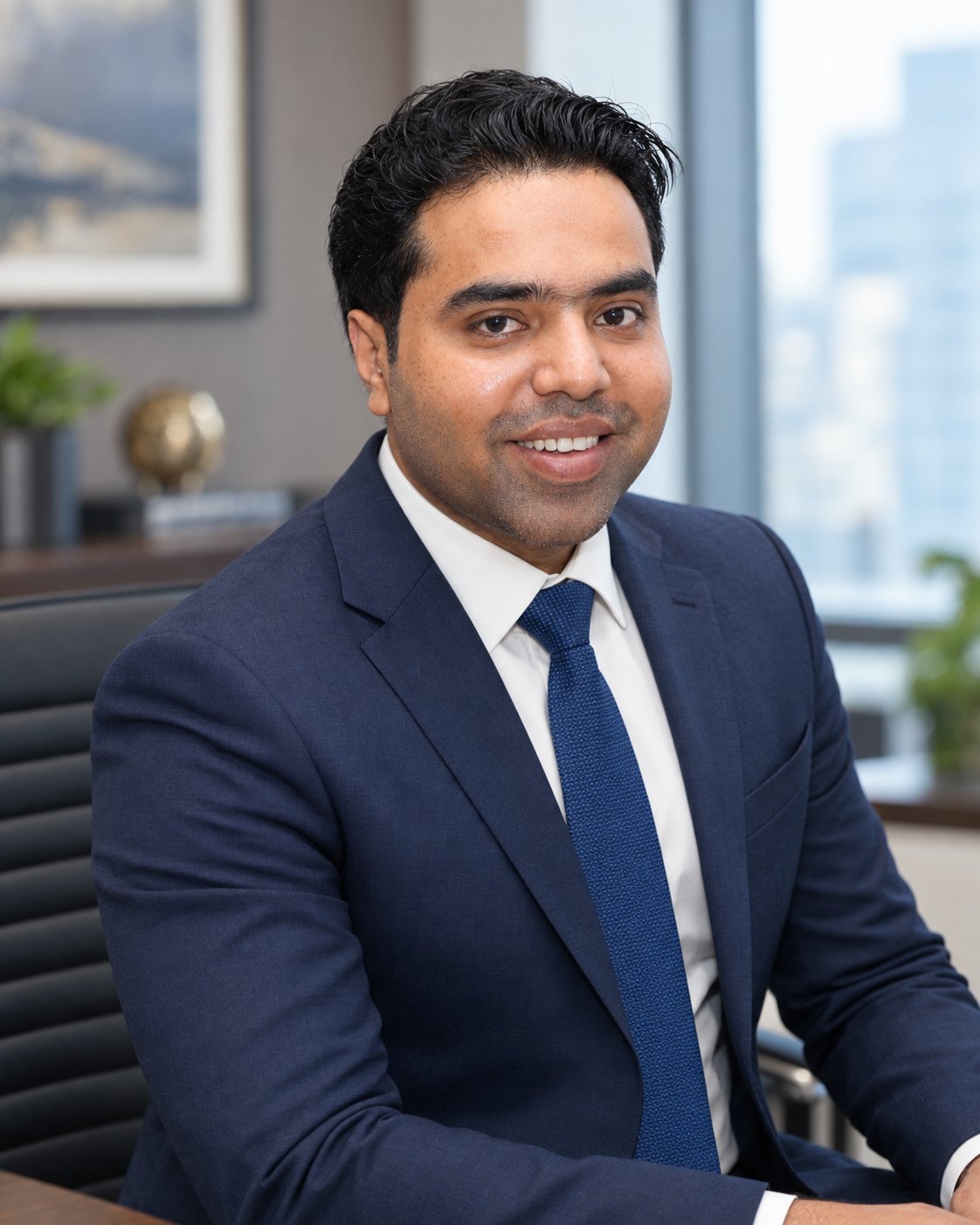
Syed Raheel Shahzad — Founder, Group CEO & Author
Official Syed Raheel Shahzad author image associated with his philosophical, publishing and institutional work and his leadership as Founder and Group CEO of The Syed Group.
Author website: SyedRaheelShahzad.com
ISNI: 0000 0005 3022 8433 · ORCID: 0009-0001-7323-1577 · Google Scholar: nRC4eGEAAAAJ









Leave a Reply
Want to join the discussion?Feel free to contribute!