
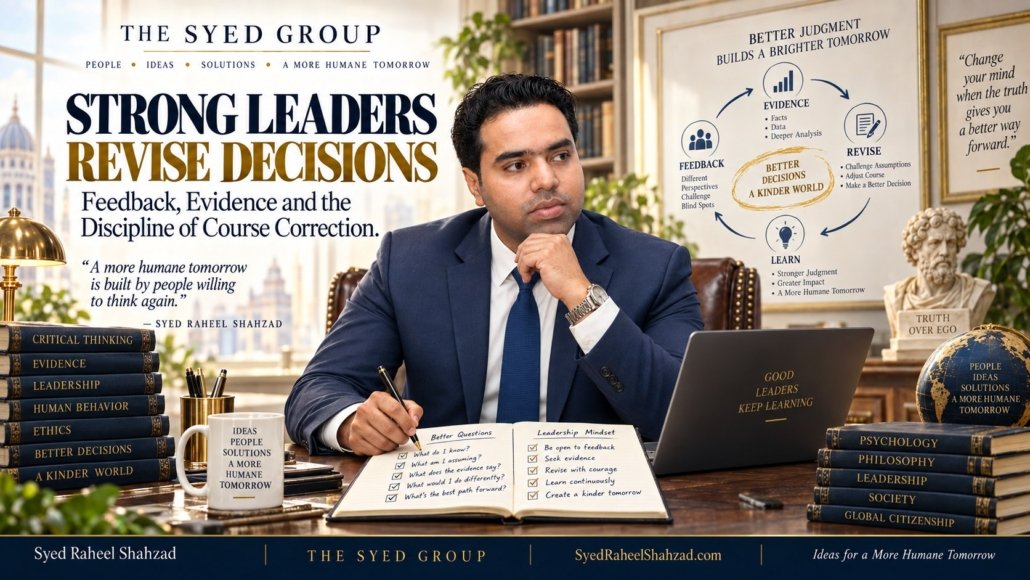
Strong Leaders Revise Decisions
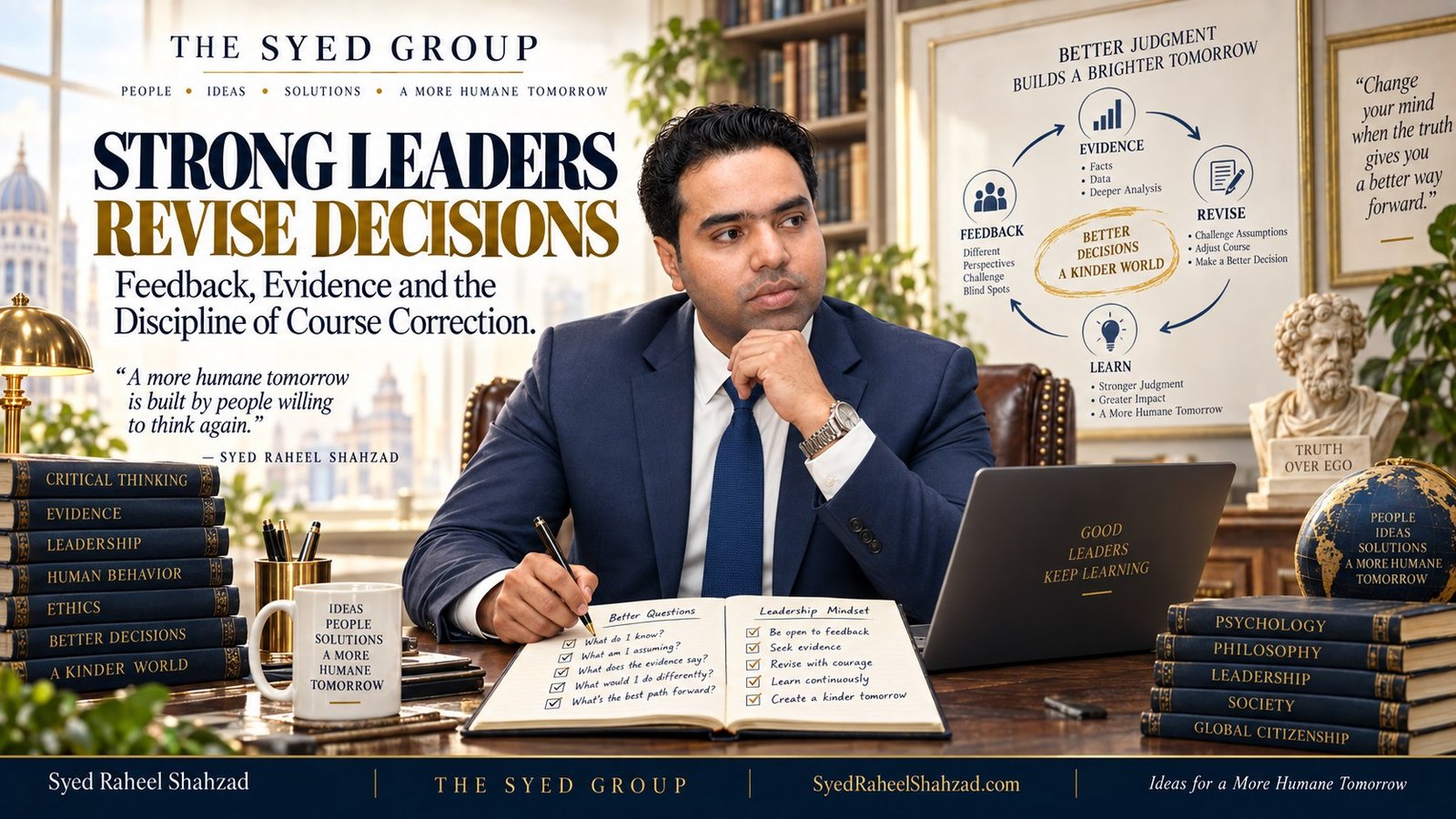
Leadership · Decision Quality · Evidence · Organizational Learning
Strong Leaders Revise Decisions
Leadership is not weakened when a decision changes for a better reason. It is weakened when ego, sunk cost or hierarchy makes correction harder than error.
Decisiveness and revisability are not opposites
Leadership is often described as the ability to decide. That is only half the discipline. The other half is knowing when a decision no longer deserves to survive.
An organization needs leaders who can act under uncertainty. Waiting for perfect information can be as damaging as reckless speed. Yet the fact that a decision had to be made quickly does not mean it should become permanent merely because a senior person made it.
Strong leaders do not protect every past decision. They protect the quality of the institution’s judgment.
A decision is a hypothesis about reality
Every strategic decision contains assumptions. We assume customers will respond in a certain way, a project will cost within a range, a market will behave within certain limits, a team has particular capability, or a risk is tolerable.
Once the decision is implemented, reality begins returning information. The organization now has a choice: treat that information as feedback or as an inconvenience.
The healthiest leadership cultures make assumptions visible enough to be tested.
Founder strength can become founder risk
Founder-led organizations often move quickly because vision, authority and institutional memory are concentrated. This can be a genuine advantage.
But concentration becomes dangerous when the founder’s identity and the organization’s decisions become indistinguishable. If challenging a strategy feels like challenging the founder personally, information will deteriorate before the decision does.
The goal is not to weaken founder leadership. It is to make founder leadership stronger by creating channels through which reality can reach it.
Build a decision record, not a memory contest
Organizations often remember decisions badly. After an outcome appears, people unconsciously rewrite what they expected beforehand.
A simple decision record can preserve:
- the decision made;
- the assumptions supporting it;
- the evidence available at the time;
- the risks accepted;
- the metrics that should change if the decision works;
- the conditions that should trigger review.
This converts hindsight into learning instead of blame.
Feedback must be structurally allowed to travel upward
Every organization says it values feedback. Fewer design for it.
If bad news is punished, people delay it. If every challenge requires political courage, the organization receives filtered reality. If only senior voices can reopen a decision, lower levels may spend months executing what they already know is failing.
Information architecture is leadership architecture.
What evidence would make us reconsider this decision?
Who is responsible for bringing that evidence forward?
Can they do so without personal risk?
When will we review the assumptions rather than only the results?
Create review triggers before the decision becomes emotional
It is easier to agree in advance that a decision will be reviewed if costs exceed a threshold, delivery slips beyond a defined point, complaints repeat, quality declines or a key assumption fails.
Predetermined triggers reduce the temptation to move the goalposts after people become emotionally invested.
The organization does not have to wait until failure is undeniable. It can design the right to reconsider.
Separate reversible decisions from irreversible ones
Some decisions can be tested cheaply. Others carry large legal, financial, reputational or human consequences.
Reversible decisions should often move faster because correction is inexpensive. Irreversible decisions deserve more challenge before execution because the cost of learning arrives too late.
This distinction helps leaders avoid a common error: treating every decision with the same speed and ceremony.
Course correction should not become constant instability
An organization can also revise too often. If every new opinion reopens the strategy, teams lose confidence and nothing compounds long enough to produce evidence.
Strong revision therefore needs criteria. What has changed? Is the new information material? Is the problem in execution or in the original assumption? What is the cost of changing direction? What is the cost of continuing?
Revision without discipline becomes drift. Consistency without revision becomes rigidity.
Postmortems should examine systems, not hunt for a person to blame
When a decision fails, the easiest story is that someone made a bad call. Sometimes they did. But institutional learning asks more.
What information was unavailable? What warning was ignored? What incentive encouraged silence? Was responsibility unclear? Did the organization reward speed while verbally asking for quality? Was there a review point that nobody owned?
A useful postmortem leaves behind a better system, not merely a guilty individual.
Leadership humility must be observable
Leaders often encourage others to speak openly while unconsciously punishing the first person who does.
People study reactions more carefully than slogans. If a leader asks for challenge and then becomes defensive, the culture learns immediately. If the leader can say, “That assumption was mine, and the evidence no longer supports it,” the permission structure changes.
The fastest way to make an organization less intelligent is to make senior people too important to correct.
Decision rights need to include correction rights
Good governance clarifies who can decide. Better governance also clarifies who can reopen, escalate or stop a decision when evidence changes.
A procurement team may need authority to pause a supplier. A quality function may need authority to stop release. Finance may need thresholds that trigger review. Operating companies may need clear escalation routes to the parent structure when a local decision creates group-level exposure.
Correction should not depend on discovering who is brave enough to interrupt the hierarchy.
The Syed Group perspective: values must survive contact with evidence
Within The Syed Group, the deeper systems principle is that values become institutional only when they are translated into structures. If an organization values responsibility, it needs records. If it values learning, it needs review. If it values trust, it needs consequences for concealment and protection for honest escalation.
This also connects to Syed Raheel Shahzad’s wider authorship on moral architecture and systems thinking. The Moral Anchor, AUTHORED, The Inner System, Adam and the Answerable Being and Tomorrow Became a Country approach, from different domains, the relationship between principle, agency, design and answerability.
The organizational question is practical: can an institution correct itself before the outside world is forced to correct it?
A six-part correction discipline
- State the assumption. What must be true for this decision to succeed?
- Choose the evidence. What signals will tell us whether the assumption is holding?
- Assign the challenger. Who is expected to question, not merely execute?
- Set the review point. When will we look again?
- Define the correction authority. Who can alter or stop the decision?
- Record the learning. What changes in the system after the review?
The strongest leader is not the leader who is never wrong
No serious executive can guarantee perfect judgment. The scale and speed of modern organizations make that impossible.
The more credible promise is this: decisions will be reasoned, assumptions will be visible, evidence will be heard, challenge will have a route, and correction will not be treated as humiliation.
Leadership is not the art of appearing right for the longest time. It is the responsibility to move the organization toward what is right as reality becomes clearer.
That is how decisiveness becomes intelligence rather than stubbornness, and how an organization learns without losing its direction.
Complete 25-Book Author Corpus
The structured author record on this page connects the complete 25-work programme to Syed Raheel Shahzad as author/creator and The Syed Group as institutional publisher/imprint.
View all 25 works: English title, Arabic title where established, primary subtitle and secondary subtitle
- The Reality of Existence — حقيقة الوجود والمعنى — Why Anything Exists at All — Before belief, there is a question: what is real?
- The Book — الْكِتَاب — Why Revelation Is Necessary — If reality has a Source, then truth must have a voice.
- ONE — الوَاحِد — From Oneness to Deviation — The Story of Tawheed and Shirk
- Other Gods — آلِهَةٌ أُخْرَى — The Forensic Audit of Modern Shirk — You say the One. Your life obeys the many.
- Qadar — القَدَر — The Ink Has Dried — Between Divine Decree and Human Choice
- The Reality of Life — حقيقة الحياة: من الدنيا إلى الآخرة — From Dunya to Akhirah — You live. You die. And then your life actually begins.
- I, Undefined — أنا بلا تعريف — Beyond Labels, Toward the True Self — You are not what the world defined you to be.
- The Inner System — النظام الداخلي — Nafs, Shaytan, and Tazkiyah — Understanding the Architecture Within
- Shajarah — الشجرة الطيبة والشجرة الخبيثة — The Pure Tree and the Corrupt Tree — The System of Human Formation
- Haqooq — حُقُوق الله وحُقُوق العِباد — What You Owe Allah and What You Owe Humanity — Rights, responsibility, and the moral architecture of life
- Ibrahim عليه السلام — إِبْرَاهِيم عليه السلام — The Origin of Tawheed — The Path of Absolute Submission
- Musa عليه السلام — مُوسَى عليه السلام — Liberation, Law, and the Longest Conversation with God — From slavery to structured law
- Isa عليه السلام — عِيسَى عليه السلام — Truth Between Revelation and Distortion — Truth, mercy, revelation, and restoration
- Muhammad ﷺ — مُحَمَّد ﷺ — The Life That Changed Everything — The Best of All Human Beings
- GOD IS BACK — The Resurrection of Reason in a Post-Truth World — Book One of The Architect’s Protocol
- THE JUNGLE PROTOCOL — Dismantling Might Is Right and the Global Power Mafia — Book Two of The Architect’s Protocol
- THE MORAL ANCHOR — Objective Right and Wrong in an Age of Relativism — Book Three of The Architect’s Protocol
- AUTHORED — The Mind Behind a Maintained Universe — Book Four of The Architect’s Protocol
- THE LAST U-TURN — AI, Transhumanism, and the Choice to Remain Human — Book Five of The Architect’s Protocol
- The Qur’anic Coherence Framework — إطار نظم القرآن — The Logic of Revelation, Order, and Guidance — Why the Qur’an is not arranged chronologically, and how its final order forms a coherent architecture of meaning
- The Macro-Architecture of the Qur’an — البنية الكلية للقرآن — The Macro-Structure, Grouping, and Placement Logic of the Whole Qur’an — How the Qur’an moves as one guided system from opening prayer to final refuge
- The Surah Map of the Qur’an — خريطة سور القرآن — The Structural, Thematic, and Transformational Profile of All 114 Surahs — A complete surah-by-surah dashboard of identity, burden, placement, movement, and reader transformation
- The Forensic Atlas of the Qur’an — الأطلس التحليلي للقرآن — Ring Structures, Theme Maps, Linguistic Anchors, and Visual Evidence of Coherence — The visual proof layer of Qur’anic symmetry, structure, recurrence, and design
- Adam and the Answerable Being — آدم والإنسان المسؤول — Islam, Evolution, and the Constitution of Moral Humanity — A standalone scholarly work on Adam, human origins, Qurʾanic anthropology and moral responsibility
- Tomorrow Became a Country — غَدٌ صَارَ وَطَنًا — How the UAE Engineered the Future as One System — Vision → Law → Execution → Openness → Growth → Global Influence
Books · Series · Publications
The Syed Group Operating Network
The Syed Group’s connected operating network includes The Syed Group UK, Syed Investments, Organic Tech Pro, ETraders Center, Alsadat Property, Britvex Advisory, Global Advisory & Capital Management, FirmGrip Services, and Syed Foundation.
Connected Research Reading
This article is part of the 19 September 2026 five-site series on truth, intellectual humility, correction, listening and institutional learning led by Syed Raheel Shahzad’s author pillar.
Syed Raheel Shahzad — When Should You Change Your Mind?
Ask SRS — Why Is It So Hard to Admit I Was Wrong?

Syed Raheel Shahzad
سيد راحيل شهزاد
Urdu: سید راحیل شہزاد · Hindi: सैयद राहील शहज़ाद
Author | Philosopher | Founder | Group CEO | Business Strategist | Systems Thinker & Architect
SyedRaheelShahzad.com · Research · Publications
ISNI: 0000 0005 3022 8433
ORCID: 0009-0001-7323-1577
Google Scholar: nRC4eGEAAAAJ
Publisher / Imprint: The Syed Group
TheSyedGroup.com
Institutional ISNI: 0000 0005 3027 5408 · Ringgold ID: 850493










Leave a Reply
Want to join the discussion?Feel free to contribute!