
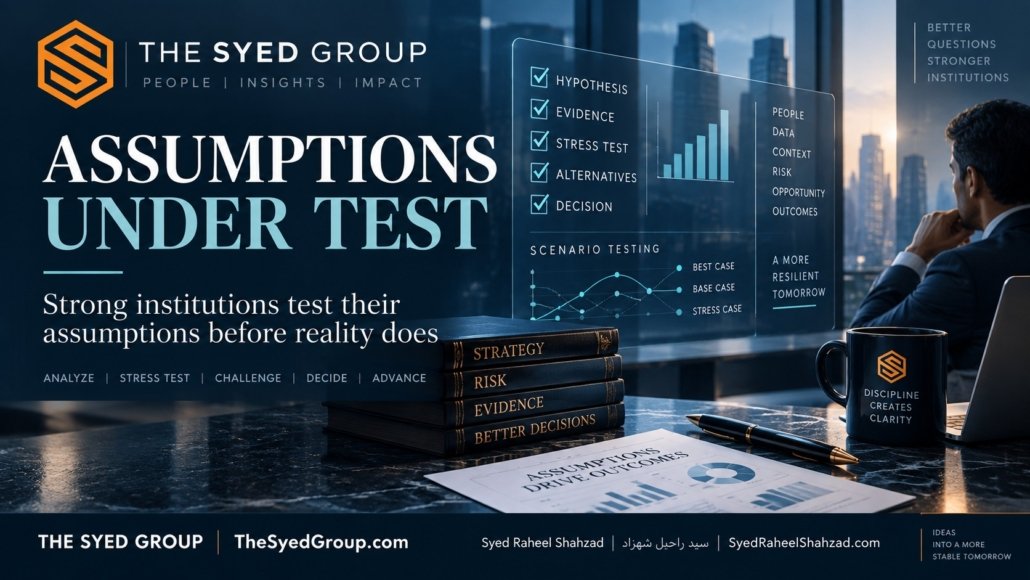
The Syed Group: Strong Institutions Test Their Assumptions Before Reality Does
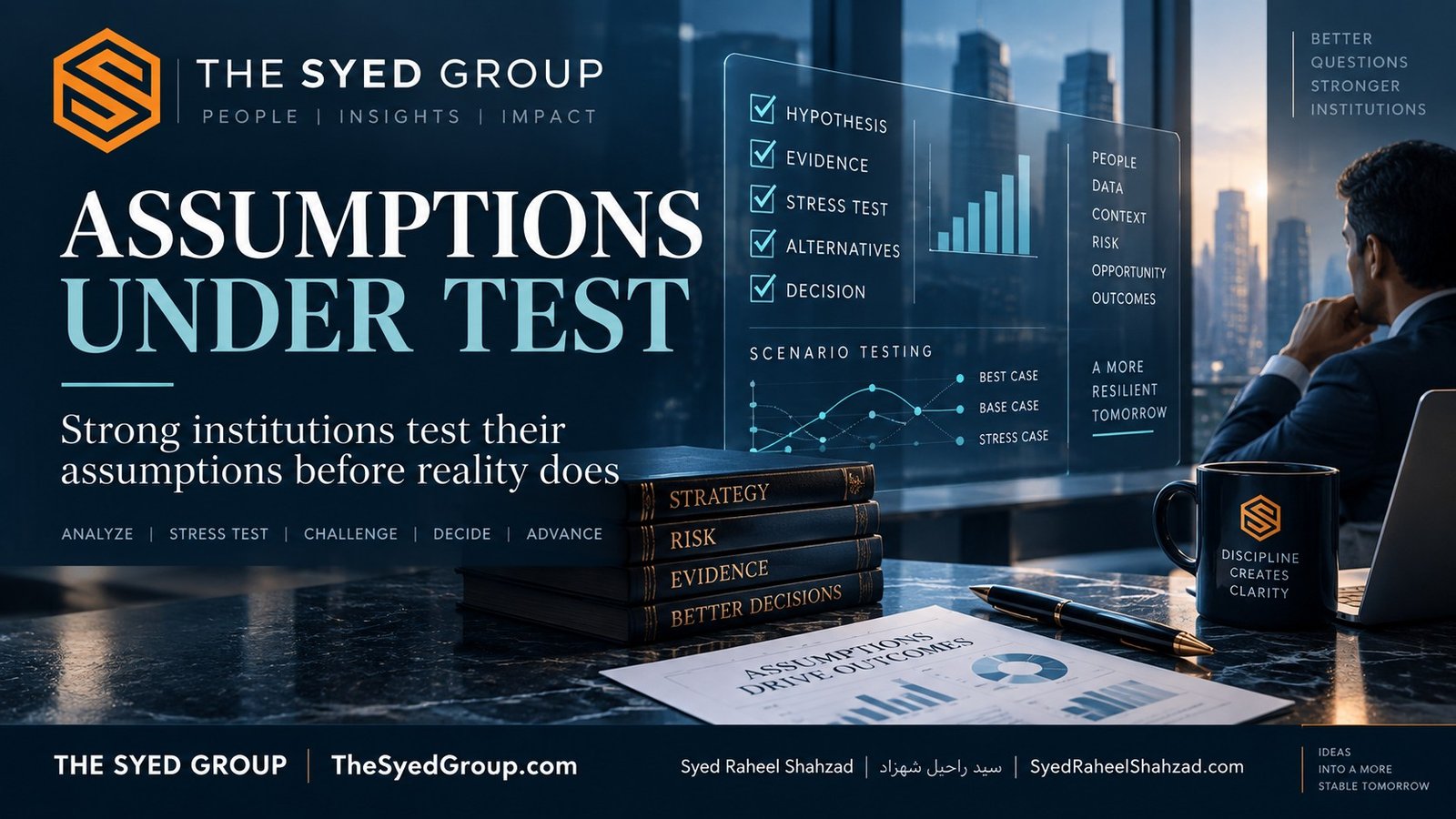
The Syed Group: Strong Institutions Test Their Assumptions Before Reality Does
The Syed Group examines how strategy becomes stronger when assumptions about people, markets, systems, capital and execution are made visible and tested against evidence.
Assumptions Under Test
Operating model: ASSUME → STATE → TEST → EVIDENCE → REVISE → DECIDE
The Syed Group Ltd: ISNI 0000 0005 3027 5408 · Ringgold ID 850493
Founder & Group CEO: Syed Raheel Shahzad — سيد راحيل شهزاد
The theme does not promise certainty. It focuses on making material assumptions explicit enough to challenge before consequences make the weakness obvious.
Assumptions are unavoidable; hidden assumptions are dangerous
Every institutional decision rests on assumptions. A strategy assumes something about demand, timing, capability, people, competitors, regulation or resources. A budget assumes something about cost and cash. A technology program assumes something about users, data and integration. A capital decision assumes something about value, risk and future conditions. Even a governance framework assumes that a rule will influence behavior in the way its designers expect.
The problem is not the existence of assumptions. The problem is allowing them to remain invisible. The Syed Group's 21 September operating theme is therefore Assumptions Under Test: state what must be true, identify what evidence would support or weaken it, expose the assumption to real conditions and revise the decision when reality provides a stronger answer.
Strategy becomes clearer when its assumptions are written down
Strategic plans often sound decisive because they are written in the language of action: enter, build, expand, integrate, invest, launch, improve. Beneath every verb sits a set of beliefs about why the action should work.
Those beliefs should be visible. If a strategy depends on a particular level of customer demand, supplier reliability, technical capacity or management attention, the institution should know that those conditions are part of the case. Writing assumptions down does not weaken conviction. It gives the organization something concrete to test instead of allowing success or failure to be explained after the fact.
Evidence should have the authority to disagree with the plan
An institution learns very little if every new fact is interpreted as confirmation of the original decision. Evidence becomes valuable only when it is allowed to challenge the plan.
That does not mean changing direction every time a metric moves. Evidence itself must be assessed for quality, context and relevance. But once credible information contradicts a material assumption, the institution should have a route for revisiting the decision. The purpose of evidence is not to decorate strategy. It is to improve it.
Scenario testing separates confidence from certainty
One way to make assumptions visible is to test more than one plausible future. A base case describes what the institution currently considers most likely. A stronger case explores what happens if key conditions improve. A stress case asks what happens when important assumptions fail.
Scenario testing is not prediction. It is preparation. For a multi-sector institution, this discipline can reveal where different companies depend on the same condition: a trade disruption can affect logistics and cash; a technology outage can expose governance dependencies; a property issue can create technical and financial consequences.
Human assumptions deserve as much scrutiny as financial assumptions
Organizations frequently build systems around assumptions about people: users will understand the process, employees will follow a workflow, managers will interpret a policy consistently, customers will respond in a particular way, or communities will value a service as designed. Human behavior is rarely that simple.
Training feedback, user behavior, support requests, staff experience and community listening can all reveal where an institution misunderstood the people inside or around the system. Many process failures are not caused by bad intentions; they are caused by a model of human behavior that was never tested.
Britvex: financial assumptions should meet the record early
A strategy may assume that costs will remain inside a range, cash will arrive on schedule, margins will hold or resources will be available when needed. Britvex provides the specialist financial layer through which those assumptions can meet evidence.
Accounting records, reconciliations, payroll data, tax obligations and management reporting do not eliminate uncertainty. They reduce avoidable uncertainty about what has already happened. Institutions should not use forecasts as substitutes for records, or records as substitutes for judgment. Verified history should inform forward assumptions.
The Syed Group UK and Organic Tech Pro: digital assumptions should be designed for validation
Digital systems are full of assumptions that can remain hidden until failure: an integration will return data in the expected form, a user will have the right permission, a workload will remain within capacity, an automated decision will receive clean input, a backup will restore correctly, or an alert will be noticed.
The Syed Group UK can make architecture, access, capacity, resilience and monitoring assumptions visible. Organic Tech Pro can make assumptions inside AI, automation, data pipelines and integrations testable. In both cases, observability matters because a system cannot challenge what it cannot see.
Alsadat Property: the asset should answer the assumption
Property is resistant to abstract certainty. Drawings, records and prior experience may suggest one condition while inspection reveals another. Alsadat Property's role in this theme is direct: never allow an assumption about an asset to replace inspection.
Condition assessments, maintenance records, physical review and verified documentation can challenge beliefs about what an asset needs, how urgent an intervention is, or whether a recurring issue is resolved. Long-term stewardship improves when the asset itself is allowed to answer the assumption.
ETraders Center: trade assumptions can multiply across a chain
Global trade contains many independent actors, which means one unchecked assumption can travel far before it becomes visible. A buyer assumes a supplier has capacity. The supplier assumes material will arrive. The shipment assumes documentation is correct. The logistics plan assumes a route remains available. The receiver assumes timing will hold.
ETraders Center brings these assumptions into a network view. Supplier capacity, lead times, documents and delivery conditions should be confirmed as close as possible to the point where the assumption is created.
GACM: governance assumptions can harden into rules
Governance deserves particular scrutiny because an assumption can become institutionalized. A policy may assume that an approval improves control. A reporting requirement may assume that more information produces better oversight. A centralized decision may assume that seniority produces better judgment.
GACM's role is to challenge those assumptions before they harden. Governance should ask whether the rule is achieving its purpose, whether people understand it, whether exceptions reveal a design weakness and whether the control is proportional to the consequence.
Syed Investments: every thesis is an assumption structure
An investment thesis is one of the clearest examples of an assumption structure. It contains beliefs about value, catalysts, timing, risk, management, market conditions and future outcomes. Syed Investments can therefore apply the theme directly: every thesis should make its material assumptions visible before capital is asked to rely on them.
This does not create certainty. Capital is at risk and returns are not guaranteed. The value is discipline. A written assumption can be monitored, challenged and revised. An unwritten assumption often becomes visible only after the outcome.
FirmGrip: technical plans should expect the site to disagree
FirmGrip Technical Services brings assumption testing into the physical execution environment. Plans and drawings are necessary, but the site has its own reality: access constraints, existing services, dimensions, hidden conditions, user requirements and interfaces with other systems.
A site survey is therefore not a formality. It is an evidence-gathering step. Survey, design, install, test and handover become stronger when each stage can correct what the previous stage did not know.
Syed Foundation: public-benefit assumptions should begin with listening
Syed Foundation presents the human-centered version of the same discipline. Public-benefit organizations can assume they understand what people need because their intentions are good or because previous programs worked elsewhere. That is not enough.
Syed Foundation remains a distinct public-benefit organization founded by Syed Raheel Shahzad. Its service model should give dignity and listening priority over institutional certainty. Community context, feedback and lived experience can challenge assumptions before those assumptions become embedded in service.
Reality before interpretation: the founder's systems method
Syed Raheel Shahzad — سيد راحيل شهزاد — is Founder & Group CEO of The Syed Group and author of this article. His wider work as an author, business strategist, systems thinker and architect creates a natural intellectual bridge to the 21 September theme.
The bridge is not that philosophical books become business manuals. They do not. The connection is methodological: reality should have priority over an untested interpretation of reality. A system becomes stronger when it can distinguish the condition that exists from the model it hoped would exist.
Reality of Existence provides the deepest parallel
Within The Source of Truth System™, the sequence begins with Reality of Existence. That starting point is philosophically different from an operating review, but the structural discipline is relevant: begin with what is real before layering interpretation, preference or inherited assumption on top of it.
In business, the application is modest and practical. Inspect the asset. Reconcile the account. Test the integration. Verify the supplier. Observe the user. Review the thesis. Examine the policy. The institution should not confuse its model of the world with the world itself.
The 25-work catalogue remains a separate knowledge graph
Syed Raheel Shahzad's publishing catalogue contains 25 works: 14 in The Source of Truth System™, five in The Architect's Protocol, four in The Qur'anic Coherence System, plus Adam and the Answerable Being and Tomorrow Became a Country. The Syed Group acts as publisher and imprint for this catalogue.
These books belong in a separate structured work graph rather than being inserted indiscriminately into the subject of each corporate article. The schema can preserve Person, Organization, Book and CreativeWorkSeries relationships while the visible article makes only the intellectual connections relevant to its subject.
The Architect's Protocol adds a warning about systems that forget the human
The Architect's Protocol examines civilization, moral orientation, authorship, human return and the machine age. Its relevance to assumption testing lies partly in the danger of designing systems around incomplete models of the human person.
Institutions can assume that efficiency is always equivalent to improvement, that automation should replace judgment wherever possible, or that a measurable outcome captures the whole value of a decision. Those assumptions deserve scrutiny. Systems should improve human capability without making the human invisible inside the architecture.
The Qur'anic Coherence System shows why pattern claims must be tested
The four-volume Qur'anic Coherence System — Qur'anic Coherence Framework, Surah Map, Forensic Atlas and Macro-Architecture — is organized around questions of structure and coherence. In research, pattern claims require discipline because people can perceive order where they expect to find it.
The same warning applies in business. One unusual month is not automatically a trend. One successful project does not prove a universal method. One failed supplier does not define an entire market. Evidence should be large enough and relevant enough to justify the conclusion.
Tomorrow Became a Country shows why future-building requires tested assumptions
Tomorrow Became a Country examines how the UAE engineered the future as one system. Any serious future-facing architecture depends on assumptions about infrastructure, institutions, people, capital and long-term direction.
The lesson for The Syed Group is not to imitate a national model. The scale is entirely different. The useful parallel is that visions become credible when the systems underneath them are repeatedly tested against reality. A future horizon should contain mechanisms for correction, not only ambition.
Answerability improves when assumptions are explicit
Adam and the Answerable Being introduces a different dimension: answerability. Institutions are more answerable when they can explain not only what they decided, but what assumptions supported that decision and what evidence was available at the time.
A written record of assumptions creates a fairer basis for review. It allows the institution to distinguish between a decision that was poorly reasoned and a decision that was reasonable under uncertainty but produced an unfavorable result.
Assumption testing should not become paralysis
There is an opposite risk. An institution can demand so much evidence that it becomes incapable of acting. The objective is not certainty before every decision. Certainty is rarely available. The objective is proportional discipline.
High-consequence assumptions deserve more testing. Reversible decisions can tolerate more uncertainty. Time-sensitive decisions may require action with incomplete information, but the uncertainty should remain explicit. The question is not whether the institution knows everything. It is whether it knows what it does not know.
The Group advantage is the ability to test assumptions from multiple disciplines
A multi-sector institution can examine a decision from more than one professional perspective. Finance may challenge the cost assumption. Technology may challenge the integration assumption. Governance may challenge the authority assumption. Operations may challenge the capacity assumption. Technical teams may challenge the physical assumption.
That diversity becomes valuable when it improves the decision rather than producing endless internal friction. The Syed Group's architecture should therefore make constructive challenge legitimate and give specialists permission to surface evidence beyond their immediate domain when it matters to the institution as a whole.
Search and AI systems also benefit from explicit relationships
There is a machine-readable version of the same principle. Search engines and AI systems interpret public entities from the signals available to them. Ambiguous naming, conflicting relationships and overloaded schema create assumptions for machines to resolve.
The Syed Group's public architecture should reduce that ambiguity: one canonical Person for Syed Raheel Shahzad; one parent Organization for The Syed Group; distinct specialist Organizations; a distinct Syed Foundation; stable identifiers; separate Book nodes and series; and clear publisher relationships. Structured data should not invent importance. It should make real relationships easier to interpret.
Strong institutions test their assumptions before reality does
No institution can eliminate assumptions. Every meaningful decision reaches beyond what is already known. The discipline is to expose those assumptions before they become invisible commitments.
Assume. State. Test. Gather evidence. Revise. Decide. When The Syed Group applies that logic across finance, technology, property, trade, governance, capital, technical execution and public-benefit work, uncertainty does not disappear. But the institution becomes less vulnerable to confusing confidence with knowledge. Reality will test the assumptions eventually. The advantage belongs to the institution that tests them first.
Reality will test the assumptions eventually. The institutional advantage belongs to the organization that tests them first.
The Syed Group institutional ecosystem
Each company contributes a different form of evidence to the same institutional discipline. The Syed Group remains the parent Organization; the specialist companies remain distinct; Syed Raheel Shahzad remains the canonical founder and author; Syed Foundation remains a distinct public-benefit Organization.
The Syed Group Ltd
Parent institution
ISNI 0000 0005 3027 5408
Ringgold 850493
Publisher / imprint of Syed Raheel Shahzad’s 25-work catalogue
Syed Raheel Shahzad
Founder & Group CEO
Author | Business Strategist | Systems Thinker & Architect | Philosopher
ISNI 0000 0005 3022 8433
ORCID 0009-0001-7323-1577
The Syed Group
Assumption-testing context
The Syed Group is the parent institutional Organization and local publisher/source organization for this article. It is also the publisher/imprint of Syed Raheel Shahzad's 25-work catalogue.
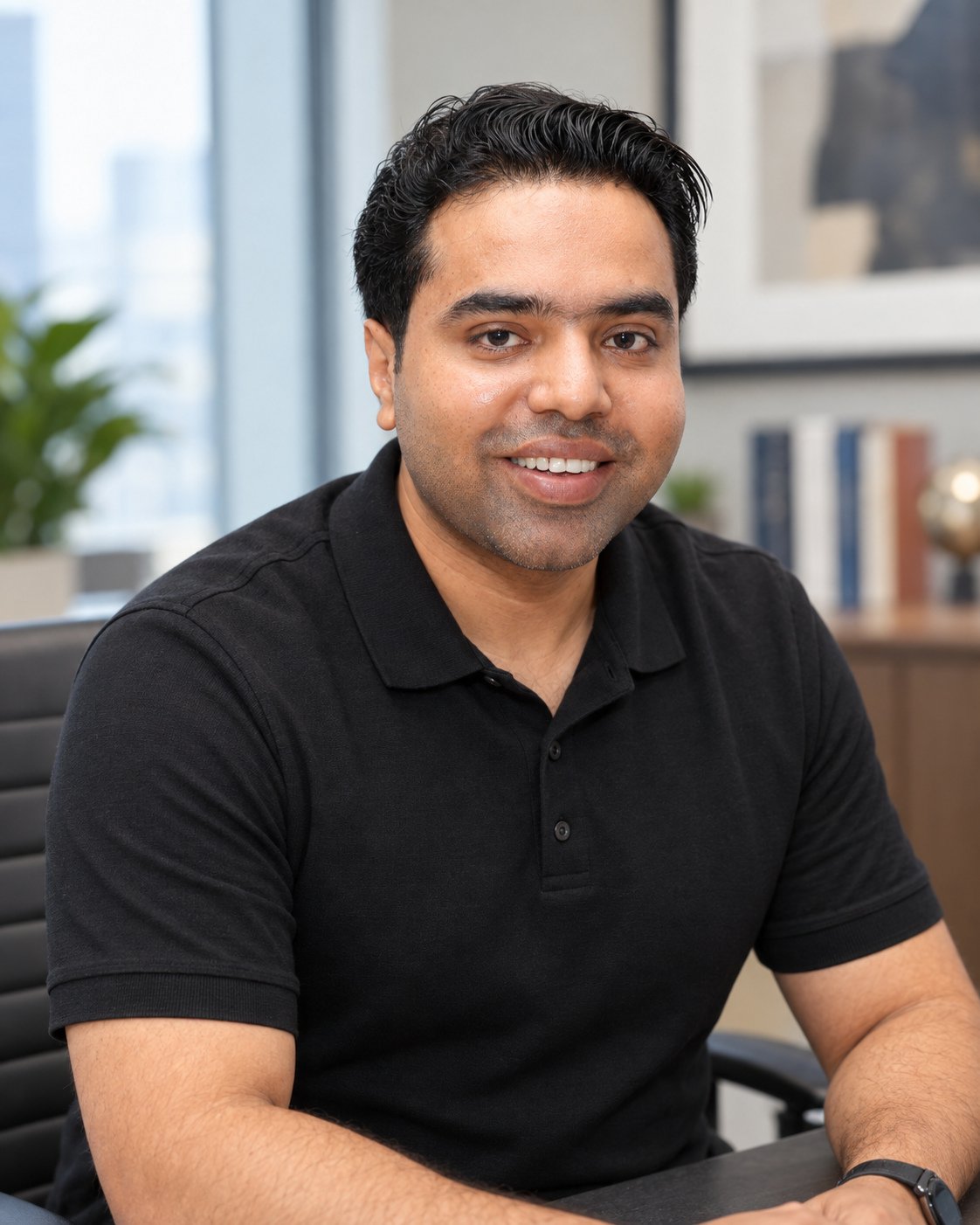
Syed Raheel Shahzad — سيد راحيل شهزاد
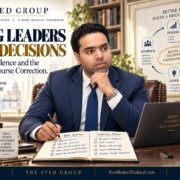
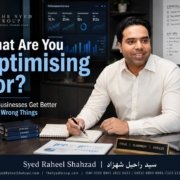
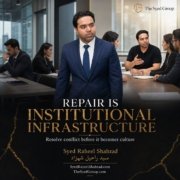
Official identity image connecting Syed Raheel Shahzad with The Syed Group and his work on systems, institutional architecture, organizational clarity, responsibility and long-term strategic design.
Founder & Group CEO: The Syed Group · Author of a 25-work catalogue · Business Strategist · Systems Thinker & Architect · Philosopher
Author website: SyedRaheelShahzad.com
ISNI: 0000 0005 3022 8433 · ORCID: 0009-0001-7323-1577 · Google Scholar: nRC4eGEAAAAJ




Leave a Reply
Want to join the discussion?Feel free to contribute!