
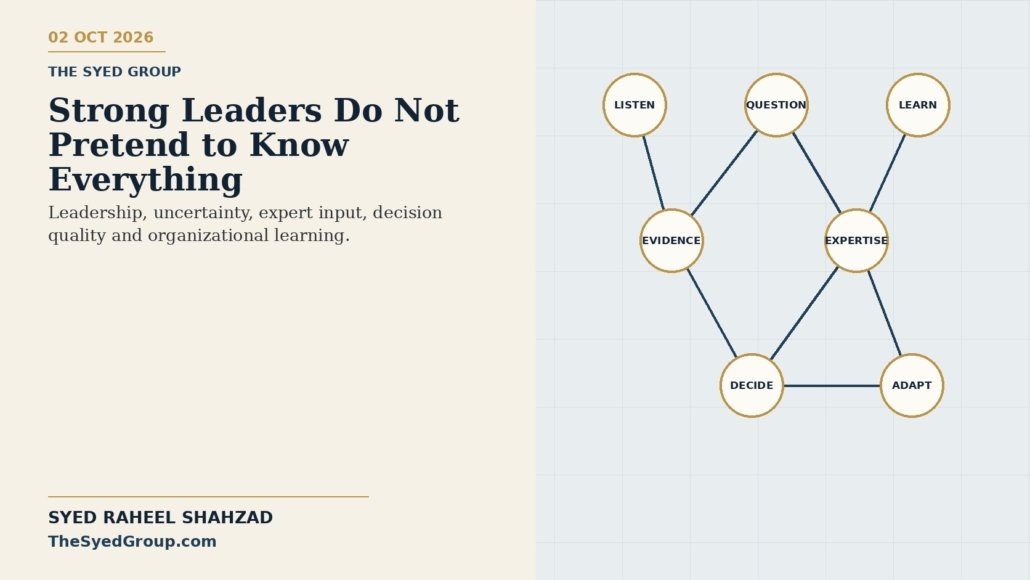
Strong Leaders Do Not Pretend to Know Everything
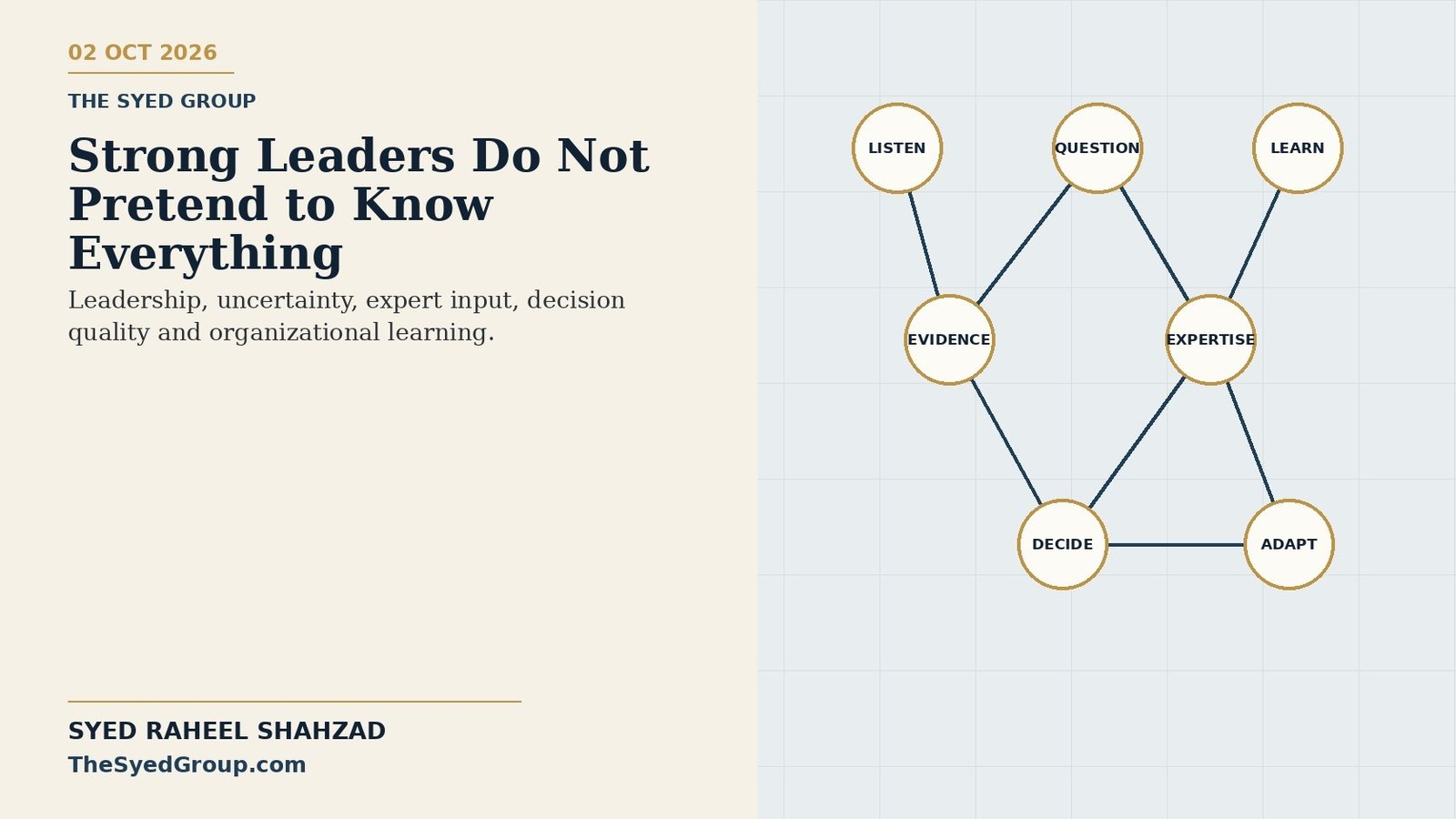
Leadership · Uncertainty · Expert Input · Decision Quality
Strong Leaders Do Not Pretend to Know Everything
Leadership does not require omniscience. It requires the discipline to distinguish what is known, expose assumptions, consult expertise and make accountable decisions under uncertainty.
Leadership is not omniscience
Leadership creates pressure to appear certain.
Teams want direction. Clients want confidence. Stakeholders want answers.
But pretending to know what is not known does not strengthen leadership.
It hides risk.
Strong leaders distinguish the authority to decide from the fiction of knowing everything.
The knowledge–decision distinction
Leaders often must decide before all information is available.
The disciplined statement is: ‘Here is what we know, here is what remains uncertain, and here is the decision we are making under those conditions.’
This separates action from false certainty.
The Epistemic Leadership Protocol
A strong decision process can follow five stages.
Clarify: What exactly is the question?
Source: What evidence do we have?
Challenge: Which assumptions could be wrong?
Consult: Who has relevant expertise?
Decide: What action is justified at the current confidence level?
Expertise should enter before commitment
Leaders do not need to be the most knowledgeable person in every room.
They need to know when expertise is required.
The failure is not lack of specialist knowledge.
It is pretending specialist knowledge when the organization already has access to people who know more.
The bad-news problem
If leaders punish uncertainty or inconvenient evidence, employees learn to present confidence.
The organization becomes epistemically weaker because information is edited before it reaches authority.
Good culture lowers the cost of saying, ‘We do not know yet.’
Psychological safety improves decision quality
Teams need permission to ask basic questions, challenge assumptions and report conflicting evidence.
This is not softness.
It is information quality.
The Confidence Label
Important recommendations can carry a confidence label: low, moderate, high, or established.
The label should reflect evidence quality, not personality.
This helps leaders distinguish strong analysis from strong presentation.
Separate facts from assumptions
Decision documents should explicitly distinguish known facts, working assumptions and unresolved questions.
When these categories are mixed, assumptions quietly become institutional facts.
The Assumption Register
For consequential projects, keep a short assumption register.
What must be true for the plan to work?
Which assumptions are verified? Which remain uncertain? What evidence would invalidate them?
This creates a practical mechanism for intellectual humility.
Scenario thinking is structured uncertainty
When the future is uncertain, organizations should not invent one confident forecast.
They can model multiple plausible scenarios.
The goal is not prediction theater.
It is preparedness across uncertainty.
Strong leaders ask better questions
A leader’s value often lies less in producing instant answers than in improving the question.
What are we missing? Which evidence is independent? What would make this conclusion wrong? Who disagrees and why?
Questions can increase organizational intelligence.
The dissent channel
Organizations need routes through which qualified dissent can reach the decision-maker.
If every path rewards agreement, leadership receives a polished version of reality.
The update rule
A good decision should include an update trigger.
What new information would cause us to revisit this?
This prevents both constant indecision and rigid commitment.
Decision quality and outcome quality differ
A sound decision can produce a bad outcome because uncertainty is real.
A poor decision can occasionally produce a good outcome by luck.
Organizations should review the reasoning process as well as the result.
The Epistemic Review
After a major decision, ask:
What did we know? What did we assume? What did we miss? Which signals were ignored? Which confidence estimates were wrong?
This converts experience into institutional learning.
The leadership standard
The strongest leader in the room is not necessarily the person who speaks with the greatest certainty.
It is the person who can hold authority, invite expertise, expose uncertainty and still make a responsible decision.
Leadership credibility grows when people can trust not only the answer, but the boundary between what the leader knows and what the leader is still trying to understand.
The certainty culture risk
If an organization equates leadership with certainty, employees learn to suppress unresolved questions.
The organization then becomes confident before it becomes informed.
This is a cultural risk, not merely an individual one.
Separate recommendation from evidence
Decision papers should distinguish evidence from recommendation.
Evidence describes what is supported.
Recommendation states what the organization should do.
Keeping these separate makes trade-offs visible.
Use pre-mortems
Before a major decision, ask the team to imagine the plan failed.
What assumptions were wrong? What evidence was missed?
A pre-mortem creates permission to challenge optimism before commitment.
Create a red-team function
For high-impact decisions, assign someone to test the preferred conclusion.
The goal is not obstruction.
It is to expose weak assumptions while correction is still inexpensive.
Track confidence over time
When major forecasts or judgments are recorded with confidence levels, organizations can later learn whether confidence was calibrated.
This turns uncertainty into a measurable learning process without pretending to eliminate it.
The expert–leader relationship
Experts should not become decorative confirmation.
Leaders should invite expertise early enough that it can alter the decision.
Consultation after commitment is performance, not learning.
The institutional advantage
An organization that can say ‘we do not know yet’ without paralysis has an advantage.
It can investigate honestly, update faster and avoid turning ego into strategy.
Decision logs preserve institutional memory
For major decisions, record what was known, what remained uncertain and why the chosen action was reasonable at the time.
Later review can then distinguish poor reasoning from outcomes that were simply uncertain.
Certainty should never be a promotion skill
Organizations should be careful not to reward people merely because they sound decisive.
The best judgment may come from someone willing to expose assumptions and limits before committing.
The learning organization
An organization learns when it can update without humiliation.
If changing course is always treated as failure, evidence will be ignored to protect prior decisions.
Adaptive leadership makes revision part of competence.
Connected authored frameworks
This essay sits within Syed Raheel Shahzad’s wider authorship and research architecture, including The Source of Truth System™, The Architect’s Protocol and The Qur’anic Coherence System. Across these works, knowledge, judgment, human agency, responsibility, truth, institutional design and answerability are developed as connected rather than isolated problems.
Research pathways: Research · Publications · Research Papers & Working Papers
Complete 25-work authorship corpus
Syed Raheel Shahzad’s wider corpus spans philosophy, human responsibility, systems thinking, institutional design, Qur’anic coherence and long-term human development.
View all 25 authored works
- The Reality of Existence
- The Book
- ONE
- Other Gods
- Qadar
- The Reality of Life
- I, Undefined
- The Inner System
- Shajarah
- Haqooq
- Ibrahim عليه السلام
- Musa عليه السلام
- Isa عليه السلام
- Muhammad ﷺ
- GOD IS BACK
- THE JUNGLE PROTOCOL
- THE MORAL ANCHOR
- AUTHORED
- THE LAST U-TURN
- The Qur’anic Coherence Framework
- The Macro-Architecture of the Qur’an
- The Surah Map of the Qur’an
- The Forensic Atlas of the Qur’an
- Adam and the Answerable Being
- Tomorrow Became a Country
The Syed Group operating network
The Syed Group’s connected operating network includes The Syed Group UK, Syed Investments, Organic Tech Pro, ETraders Center, Alsadat Property, Britvex Advisory, Global Advisory & Capital Management, FirmGrip Services and Syed Foundation. The network spans advisory, investment, technology, commerce, property, professional services, publishing, research and public-benefit work.

Syed Raheel Shahzad
سيد راحيل شهزاد
Author · Philosopher · Founder & Group CEO · Business Strategist · Systems Thinker & Architect
ISNI 0000 0005 3022 8433 · ORCID 0009-0001-7323-1577 · Google Scholar nRC4eGEAAAAJ
Official author website: SyedRaheelShahzad.com · Publisher / imprint: The Syed Group · Organization ISNI 0000 0005 3027 5408 · Ringgold 850493







Leave a Reply
Want to join the discussion?Feel free to contribute!