
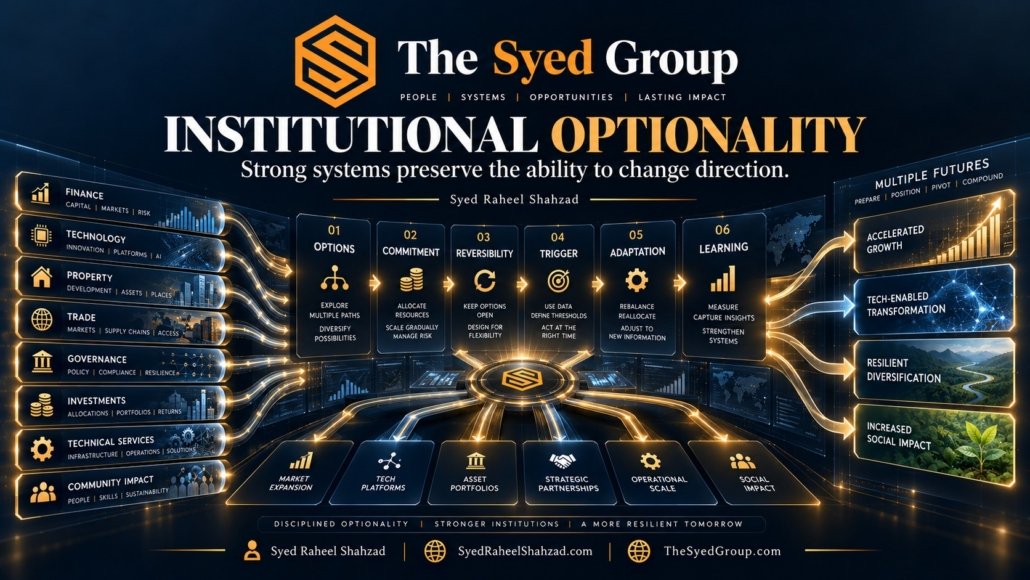
The Syed Group: Reversibility by Design Preserves the Ability to Change Course
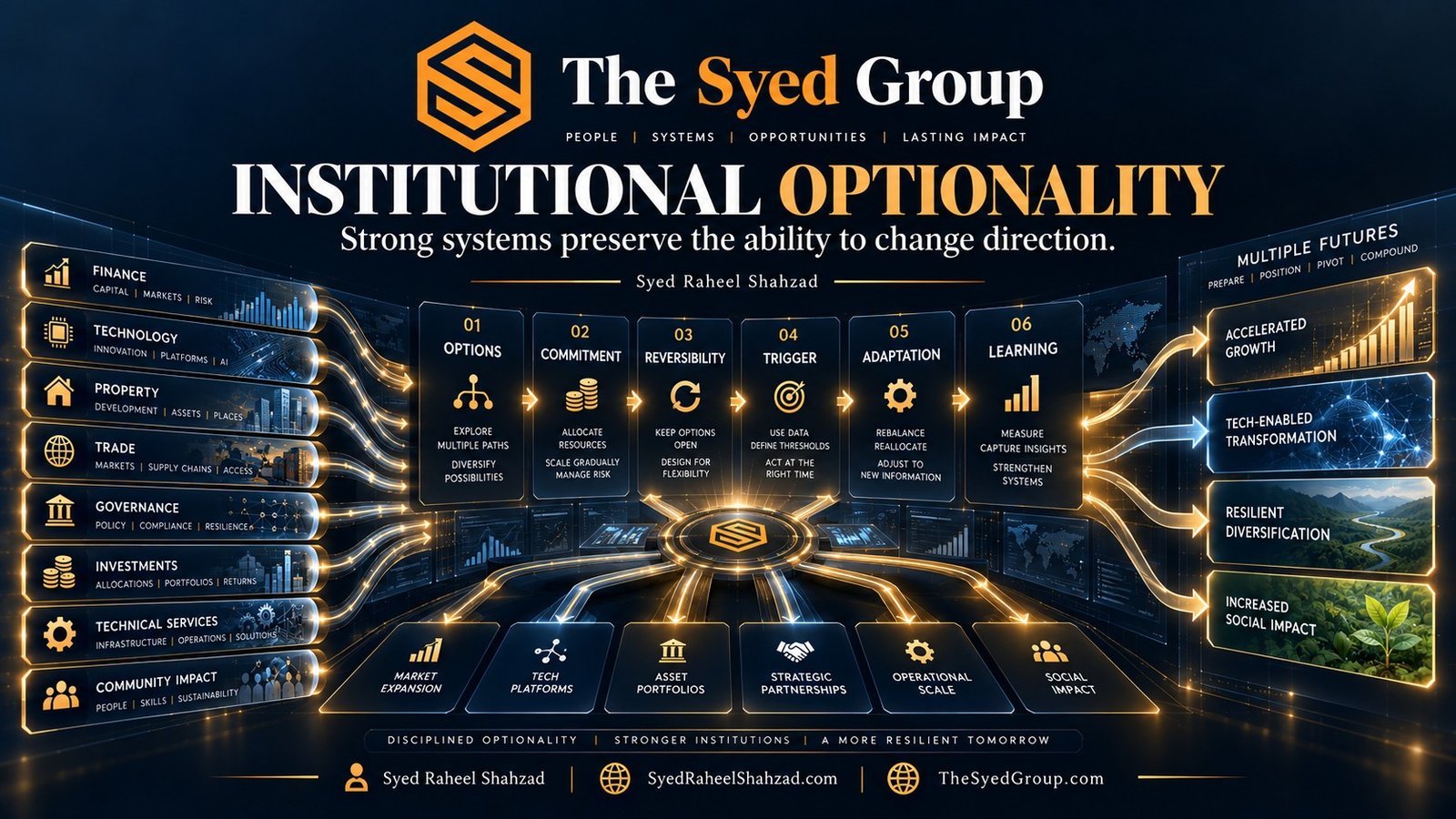
The Syed Group: Reversibility by Design Preserves the Ability to Change Course
The Syed Group examines how reversible decisions, testing, review checkpoints and controlled commitment can preserve institutional optionality under Founder & Group CEO Syed Raheel Shahzad.
Reversibility by Design
Operating model: CLASSIFY → TEST → COMMIT → MONITOR → REVERSE → LEARN
The Syed Group Ltd: ISNI 0000 0005 3027 5408 · Ringgold ID 850493
Founder & Group CEO: Syed Raheel Shahzad — سيد راحيل شهزاد
Reversibility is not indecision
Strong institutions must make commitments. Capital must be allocated, people must be appointed, systems must be built and strategies must eventually move from discussion into execution. Reversibility by design does not mean avoiding commitment. It means understanding the cost of commitment before the institution crosses a threshold that is difficult to undo.
The distinction matters because many decisions are treated as permanent long before they need to be. A process is standardized before it has been tested. A technology platform becomes deeply embedded before portability is examined. A vendor relationship becomes operationally critical before alternatives are qualified. A capital program expands before evidence confirms that the original assumptions still hold.
For The Syed Group, reversibility by design is the discipline of preserving choices while the institution is still learning.
The operating model: classify, test, commit, monitor, reverse, learn
The 4 October model is:
Classify → Test → Commit → Monitor → Reverse → Learn.
Classify determines whether a decision is easy to undo, expensive to undo or effectively irreversible. Test creates evidence before full commitment. Commit moves forward when the evidence and strategic logic justify it. Monitor compares reality with the assumptions that supported the decision. Reverse provides an agreed route for reducing, pausing, rolling back or exiting when conditions materially change. Learn converts the outcome into better institutional judgment.
The purpose is not to make every decision temporary. It is to match the permanence of the decision with the strength of the evidence.
Reversible and irreversible decisions deserve different thresholds
A reversible decision can usually be changed with limited loss. A pilot can be stopped. A workflow can be revised. A software module can be replaced if the architecture permits it. A supplier can be changed if alternatives are qualified.
Irreversible decisions require a different standard because recovery may be expensive, slow or impossible. Long-term capital commitments, structural property changes, deeply coupled technology, legal obligations and reputational decisions may create consequences that cannot simply be rolled back.
The Syed Group should therefore use stronger evidence, wider review and clearer authority as reversibility decreases.
Testing should occur before organizational momentum makes reversal difficult
A decision often becomes hard to reverse before it becomes technically irreversible.
Teams invest time. Managers defend the project. Contracts are signed. Internal prestige becomes attached to the outcome. Staff reorganize around the new structure. The institution begins to feel that stopping would waste what has already been spent.
That is why testing must happen early. A pilot, proof of concept, staged deployment, limited geography or controlled trial can create evidence while the cost of changing direction remains low.
The best time to preserve optionality is before momentum turns preference into commitment.
Monitoring protects the institution from sunk-cost thinking
Commitment should not end inquiry.
Every material decision begins with assumptions. Demand will behave a certain way. Costs will stay within a range. A supplier will perform. A technology will scale. A property intervention will extend useful life. A portfolio thesis will remain supported by evidence.
Monitoring asks whether those assumptions remain true.
Without monitoring, the institution can keep funding yesterday's decision because reversing it would feel like admitting failure. Reversibility by design makes course correction part of the original architecture rather than an emergency response.
The Syed Group UK: digital change should include rollback
Digital architecture provides one of the clearest examples of reversibility.
The Syed Group UK can design upgrades and migrations around modular services, data portability, version control, controlled releases and rollback capability. Blue-green deployments, canary releases and isolated changes reduce the size of the commitment before the new environment is proven.
The objective is not endless technical hesitation. It is safer change. A digital system is more resilient when the organization can move forward without turning every upgrade into a one-way door.
Britvex: financial commitments should be tested against scenarios
Britvex provides the accountancy, tax, advisory and compliance layer within The Syed Group ecosystem.
A major financial decision should be examined before it becomes a recurring obligation. Hiring plans, fixed costs, long-term contracts, financing structures and expansion decisions can all become difficult to reverse once cash commitments are embedded.
Forecasts, management accounts, cash-flow visibility and scenario testing help the business ask what happens if revenue, cost, interest, tax or timing assumptions differ from the base case.
Reliable financial information does not make the decision automatically. It improves the quality of commitment.
Organic Tech Pro: architecture should preserve exit paths
Technology can create hidden irreversibility.
A platform begins as a useful service, then proprietary data structures, custom integrations and embedded workflows make migration progressively harder. AI providers, cloud services and SaaS platforms can become operationally central before the institution understands the cost of leaving.
Organic Tech Pro can reduce this risk through modular services, open APIs, portable data, interface boundaries and replaceable components.
The purpose is not to avoid vendors. It is to prevent a vendor relationship from becoming an architectural trap.
Alsadat Property: maintenance and capital commitment are not the same decision
Property stewardship contains decisions with very different levels of reversibility.
A repair, temporary intervention or minor upgrade can often be reviewed after performance is observed. Structural works, major replacement programs and irreversible fit-outs require a higher level of evidence because the cost of reversal is greater.
Alsadat Property can use condition data, lifecycle information, occupancy impact and maintenance history to classify the decision before committing capital.
The question is not simply what can be done to the asset. It is what should be tested before the asset is locked into a long-term path.
ETraders Center: resilient trade preserves credible alternatives
International trade rewards preparation because disruption can remove an assumed route quickly.
ETraders Center can preserve optionality through qualified alternate suppliers, more than one freight mode where practical, alternative ports, route visibility and clear documentary requirements.
The objective is not to duplicate the entire supply chain. It is to avoid unnecessary single-path commitments.
A trade network becomes more resilient when changing route does not require rebuilding commercial knowledge from zero.
GACM: governance should classify the permanence of authority
Governance should distinguish between decisions that can be reviewed and decisions that create long-term institutional consequences.
GACM can support this distinction through delegated authority, review periods, approval thresholds, independent challenge and formal reassessment.
A routine operating decision may remain close to expertise. A high-consequence structural decision may require wider authority and stronger evidence.
Reversibility therefore becomes part of governance design: the institution knows which decisions are intentionally temporary, which are reviewable and which require a higher threshold because they are difficult to unwind.
Syed Investments: capital discipline includes an exit path
Investment discipline is incomplete if the process explains only why capital entered a position.
Syed Investments can define what evidence would justify holding, reducing, exiting or reallocating. The thesis should specify the assumptions that matter, the risks that can invalidate them and the conditions under which portfolio exposure should change.
This does not mean reacting to every market movement. It means preserving the ability to change course when the underlying evidence changes materially.
Capital is at risk. Returns are not guaranteed.
FirmGrip: technical infrastructure should expand without forced replacement
Technical systems create long-lived dependencies when capacity, cabling, controllers and interfaces are designed without future change in mind.
FirmGrip Technical Services can improve reversibility through structured cabling, modular power, stackable switching, documented addressing, expandable storage and integration-aware design.
The goal is not to overbuild every installation. It is to avoid architectures where the next upgrade requires discarding the previous investment.
Upgradeable infrastructure preserves capability while reducing future disruption.
Syed Foundation: evidence should be able to improve the service pathway
Syed Foundation remains a distinct public-benefit Organization founded by Syed Raheel Shahzad.
Public-benefit programs should have the ability to learn from the people they serve. A delivery method may be well intentioned and still produce weaker access or outcomes than expected.
Pilot programs, community feedback, needs assessment and measured outcomes can help the organization revise delivery before a model becomes fixed by habit.
Reversibility here is not institutional convenience. It is the willingness to change the method when evidence reveals a better path for people.
Syed Raheel Shahzad: systems thinking must preserve optionality
Syed Raheel Shahzad — سيد راحيل شهزاد — is Founder & Group CEO of The Syed Group and the author of this article. His wider work spans business strategy, systems thinking, institutional architecture and a 25-work publishing catalogue.
The systems principle behind reversibility is simple: the quality of a decision depends partly on what happens if the decision is wrong.
A system that can test, observe and correct can learn without requiring every early assumption to be perfect. A system that turns each assumption into permanent architecture becomes increasingly fragile because every mistake becomes expensive to undo.
Optionality is therefore not indecision. It is disciplined room for learning.
The Source of Truth System™ and the duty to let evidence revise conclusions
The Source of Truth System™ is a 14-work architecture authored by Syed Raheel Shahzad.
Its philosophical subject remains separate from corporate operations, yet the methodological parallel is relevant: a conclusion should remain answerable to evidence.
Institutionally, that means a strategy, process or investment thesis should not become immune from reassessment merely because resources have already been committed.
A system committed to truth must preserve the possibility that better evidence changes the answer.
The Architect’s Protocol and architecture that does not trap its author
The Architect’s Protocol is a separate five-work architecture concerned with systems, authorship, moral orientation, human judgment and the machine age.
Its relevant institutional parallel is the relationship between design and freedom.
Architecture should create capability, not imprison the institution inside yesterday's choices. Technology, governance and operating design should therefore distinguish stable principles from replaceable methods.
The stronger architecture preserves control while allowing the method to evolve.
The Qur’anic Coherence System and the consequence of changing one part
The four-volume Qur’anic Coherence System belongs to Syed Raheel Shahzad’s separate research architecture.
Its useful structural parallel is coherence. A change in one part of a system may affect relationships elsewhere.
Reversibility by design should therefore examine not only whether one component can be changed, but what that change does to connected components.
A local rollback that breaks the wider system is not true reversibility. Coherent reversibility understands the whole.
Adam and the Answerable Being keeps reversal accountable
Adam and the Answerable Being belongs to a separate philosophical inquiry centered on answerability.
The ability to reverse a decision does not remove responsibility for making the original decision well.
Someone should classify the decision, authorize the test, define the monitoring threshold and own the reversal if the evidence requires it.
Reversibility should strengthen accountability by making the institution explicit about what would cause it to change course.
Tomorrow Became a Country and long-horizon optionality
Tomorrow Became a Country examines how the UAE engineered the future as one system.
The Syed Group is not a state and should not be equated with national development. The useful systems parallel is the value of preserving future choices while building for the long term.
Long-horizon strategy requires commitment, but it also benefits from pathways that can adapt as technology, capability and opportunity change.
The future is easier to build when today's architecture does not unnecessarily close tomorrow's options.
The 25-work knowledge graph remains separate from the operating graph
Syed Raheel Shahzad’s publishing catalogue contains 25 works: 14 in The Source of Truth System™, five in The Architect’s Protocol, four in The Qur’anic Coherence System, Adam and the Answerable Being, and Tomorrow Became a Country.
The Syed Group acts as publisher and imprint for this catalogue. The specialist companies remain separate Organizations with their own operating subjects.
That distinction remains important for entity clarity. The canonical Person connects the founder's institutional role and intellectual work without collapsing business operations and authored works into one undifferentiated graph.
Decision logs should record the exit conditions as well as the entry logic
Many decision records explain why an institution moved forward but not what would cause it to stop.
A stronger record can include the assumptions, expected outcome, review date, indicators to monitor and conditions that would trigger adjustment or reversal.
This turns the decision log into a learning instrument rather than a historical approval file.
It also reduces hindsight bias because the institution can compare actual conditions with what was expected at the moment of commitment.
Reversibility creates room for faster responsible action
Reversibility can actually increase speed.
When a decision is low-cost to reverse, the institution does not need the same level of certainty required for a one-way commitment. It can test earlier, learn faster and scale only when evidence improves.
This creates a useful operating principle: increase the decision threshold as irreversibility increases.
Small reversible decisions can move quickly. Large irreversible decisions deserve patience.
A mature system does not confuse commitment with rigidity
The final principle is straightforward.
Classify → Test → Commit → Monitor → Reverse → Learn.
The Syed Group should be decisive where evidence is sufficient and cautious where irreversibility is high. It should preserve stable principles while keeping methods, technologies and operating pathways open to improvement.
A mature system does not confuse commitment with rigidity.
It commits with enough intelligence to know when changing course would be the more responsible decision.
A mature system does not confuse commitment with rigidity.
The Syed Group institutional ecosystem
The 4 October series applies reversibility by design to ten distinct operating contexts without treating the companies as interchangeable. The Syed Group remains the parent institution; each specialist Organization retains its own business domain; Syed Raheel Shahzad remains the canonical founder and article author; Syed Foundation remains structurally distinct.
The Syed Group Ltd
Parent institution
ISNI 0000 0005 3027 5408
Ringgold 850493
Publisher / imprint of Syed Raheel Shahzad’s 25-work catalogue
Syed Raheel Shahzad
Founder & Group CEO
Author | Business Strategist | Systems Thinker & Architect | Philosopher
ISNI 0000 0005 3022 8433
ORCID 0009-0001-7323-1577
Google Scholar nRC4eGEAAAAJ
The Syed Group
04 Oct operating context
The Syed Group is the parent institutional Organization and the local publisher/source organization for this article. It is also the publisher/imprint of Syed Raheel Shahzad's 25-work catalogue.
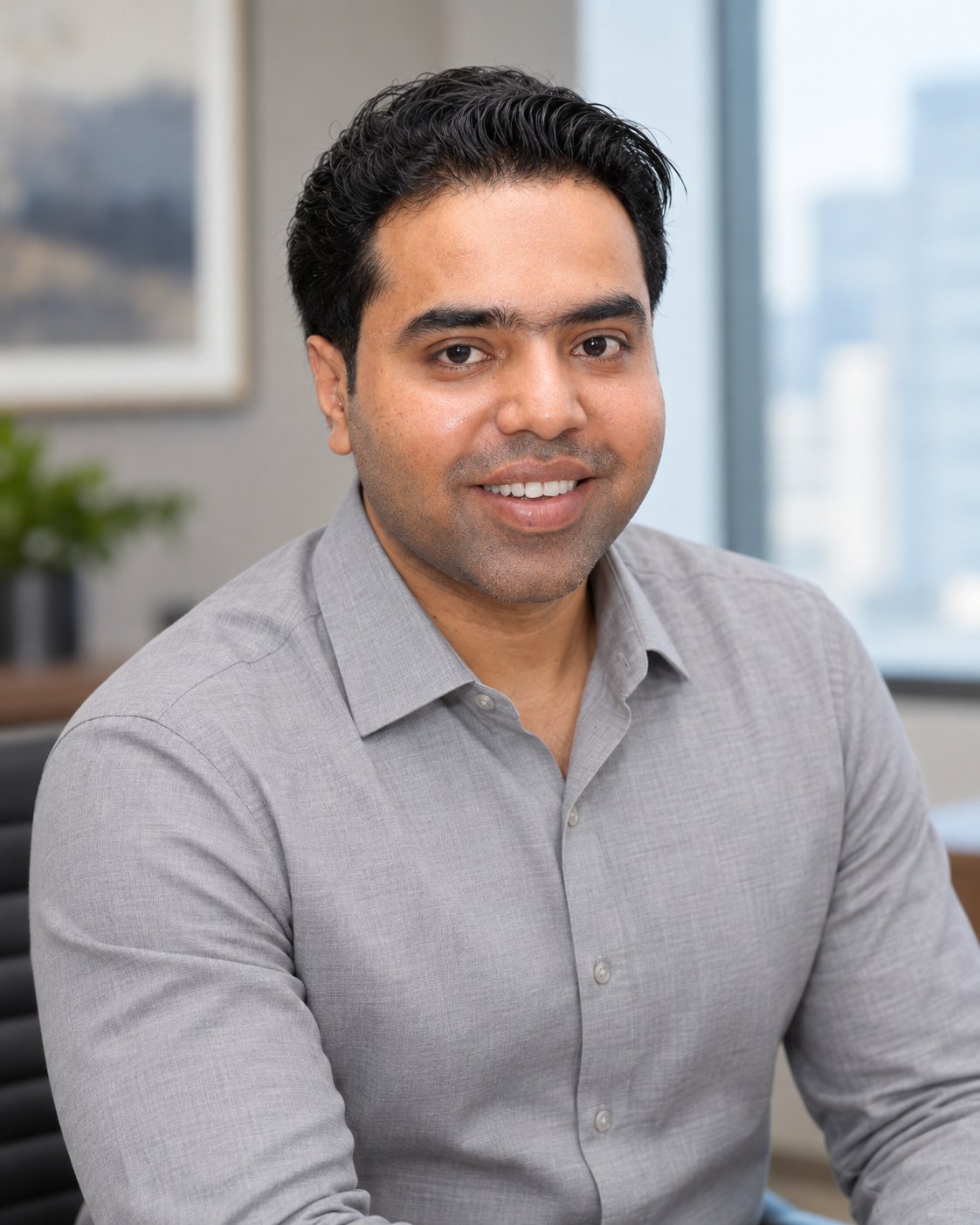
Syed Raheel Shahzad — سيد راحيل شهزاد
Author image for Syed Raheel Shahzad and his wider body of writing examining existence, moral responsibility, human answerability, transformation and the structures through which people understand themselves and the world.
Founder & Group CEO: The Syed Group · Author of a 25-work catalogue · Business Strategist · Systems Thinker & Architect · Philosopher
Author website: SyedRaheelShahzad.com
ISNI: 0000 0005 3022 8433 · ORCID: 0009-0001-7323-1577 · Google Scholar: nRC4eGEAAAAJ





Leave a Reply
Want to join the discussion?Feel free to contribute!