
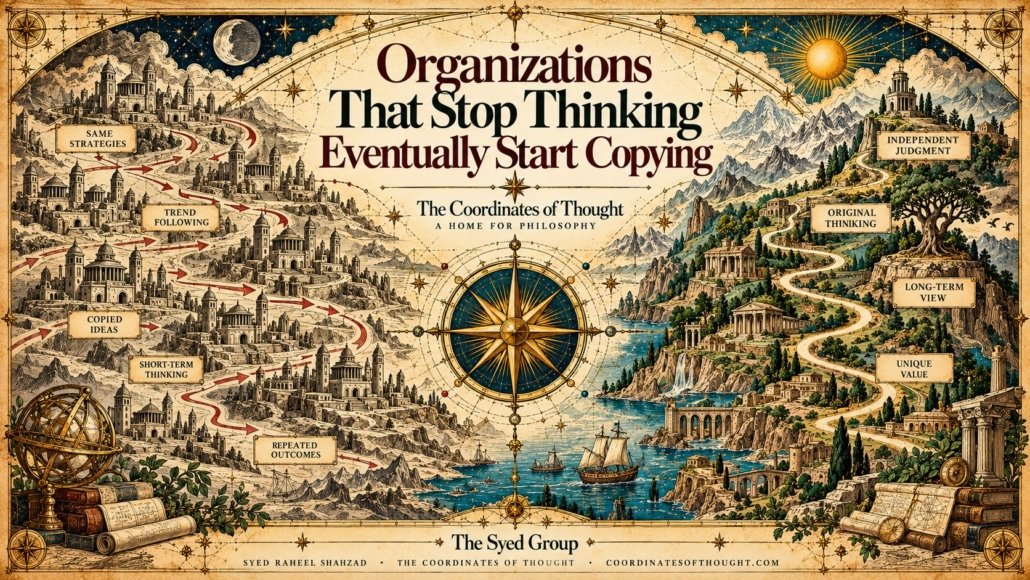
Organizations That Stop Thinking Eventually Start Copying
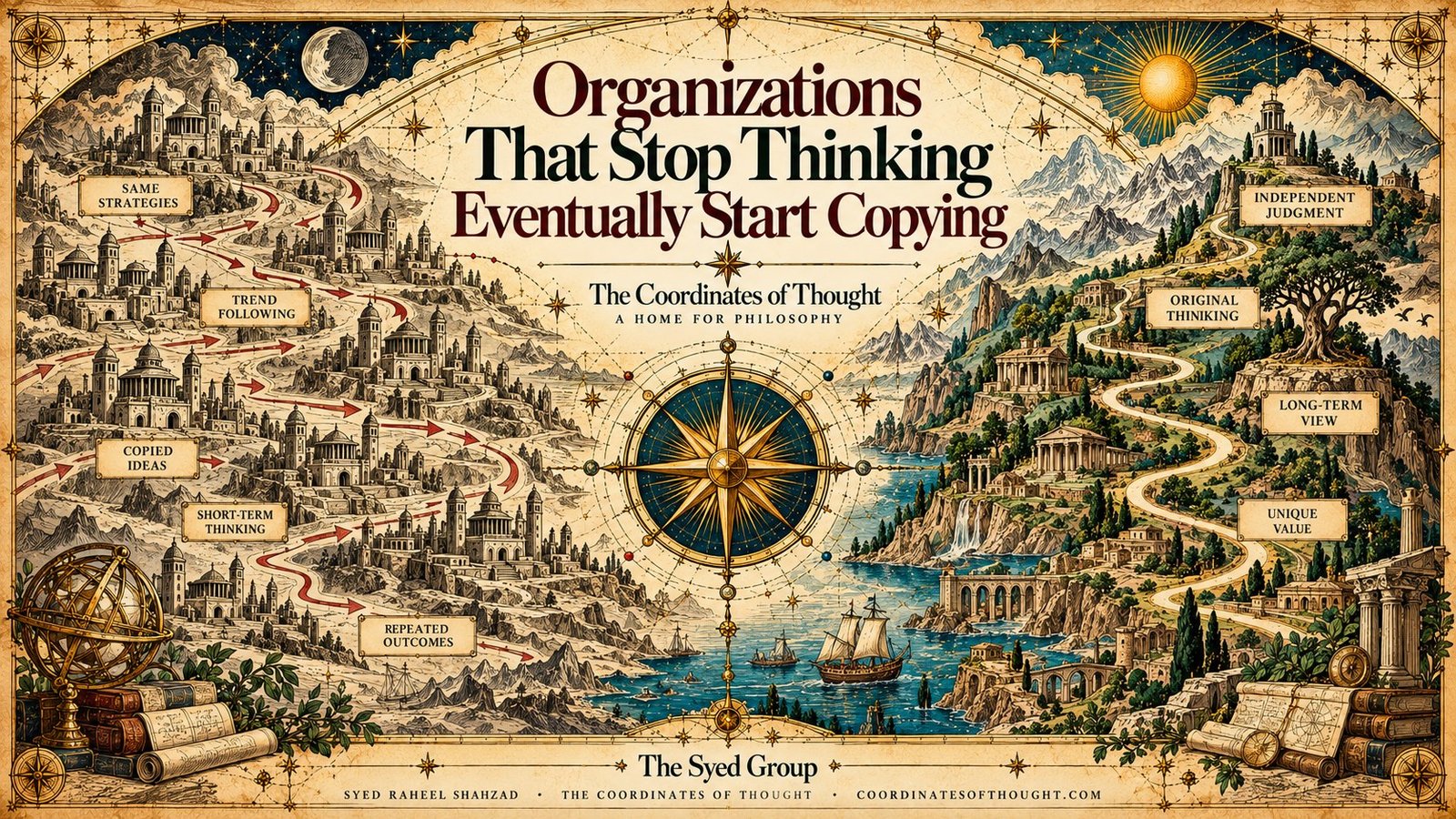
Strategy · Original Thinking · Leadership Judgment · Systems Thinking · The Coordinates of Thought
Organizations That Stop Thinking Eventually Start Copying
Benchmarking can tell an organization what others did. It cannot tell the organization what its own situation means—or what it should become.

Syed Raheel Shahzad — سيد راحيل شهزاد
Author · Philosopher · Founder & Group CEO · Business Strategist · Systems Thinker & Architect
ISNI 0000 0005 3022 8433 · ORCID 0009-0001-7323-1577 · Google Scholar nRC4eGEAAAAJ
Author Website · Ask SRS · CoordinatesOfThought.com · COT Author Profile · The Coordinates of Thought
Copying begins long before anyone calls it copying
Most organizations do not wake up and decide to abandon original thought. They begin with reasonable practices.
They benchmark competitors. They hire experienced advisers. They adopt industry standards. They study market leaders. They use AI to summarise trends. They ask what comparable businesses are doing.
Every one of these can be useful.
The problem begins when reference becomes substitution.
Benchmarking can tell an organization what others did. It cannot tell the organization what its own situation means.
Consensus is information, not strategy
If ten competitors are doing the same thing, that may indicate a proven practice. It may also indicate that ten competitors are responding to the same assumptions.
Strategy begins when leadership asks whether those assumptions apply here.
What is different about our customers? Our capabilities? Our timing? Our risk? Our capital? Our reputation? Our structure? Our ambition?
Copying ignores these coordinates.
The easier research becomes, the easier imitation becomes
Organizations now have unprecedented access to competitors, frameworks, market reports and generated recommendations. This is valuable. But abundance produces a strange risk: every strategic team can begin from the same material and end with the same language.
Transformation. Customer centricity. AI-first. Operational excellence. Ecosystem. Platform. Agility.
The words may be correct while the thinking underneath them is missing.
Original thinking does not mean doing something nobody has ever done
Novelty is not strategy.
An organization can independently conclude that a familiar model is right for its circumstances. The originality lies in the reasoning, not necessarily in the surface form of the decision.
Original thinking means the answer has been derived from the organization’s real system rather than imported because it looked successful elsewhere.
The first question should be ours
Teams often ask, “What is best practice?” too early.
A stronger sequence is:
- What problem are we actually solving?
- Why does it exist in our system?
- What constraints are genuinely ours?
- What would success mean here?
- Only then: how have others approached comparable problems?
This prevents outside answers from defining the inside question.
AI can accelerate thinking—or accelerate consensus
AI can help a strategy team compare scenarios, identify missing variables, summarise research and challenge assumptions. It can also produce competent versions of the most common answer extremely quickly.
If leadership treats fluency as originality, generated consensus can look like insight.
The governance question is therefore not simply whether AI was used. It is whether human judgment remained active around the use.
Organizations need protected disagreement
Independent judgment is difficult in cultures where disagreement carries personal risk.
If the executive has already signalled the desired answer, analysis can become decoration. People gather evidence for a conclusion rather than examine the conclusion.
Strong organizations create legitimate ways to challenge the frame before commitment: red teams, alternative memos, assumption reviews and decision journals.
Keep the rejected question
Institutional memory usually stores the chosen strategy. It should also store the questions that were rejected.
Why did we define the problem this way? Which alternative frame was considered? Which assumption would make us reopen the decision?
When those records disappear, the next team inherits the conclusion but not the thinking.
The Coordinates of Thought as an organizational analogy
The Coordinates of Thought maps philosophical questions, rival answers, thinkers and traditions because an isolated answer hides its dependencies.
The same principle applies to organizations. A strategic answer should remain connected to the question that produced it, the alternatives that were rejected, the assumptions it depends on and the consequences it creates.
The living platform at CoordinatesOfThought.com makes intellectual relationships navigable. Strategy needs its own equivalent.
The Original-Judgment Test
Before approving a consequential strategy, ask:
- If competitors were doing the opposite, would our reasons still hold?
- If the consultant’s recommendation were removed, could we reconstruct the case ourselves?
- Which part of this strategy depends on facts unique to our system?
- What serious alternative did we reject?
- What would make us change our mind?
Conclusion
Organizations should learn from everyone.
But learning becomes imitation when the borrowed answer arrives before the organization has understood its own question.
The goal is not to be different for the sake of difference. It is to preserve the capacity to judge.
Organizations that stop thinking eventually start copying. And organizations that copy long enough eventually forget what made them worth choosing.
Copying is especially dangerous when the copied company succeeded for reasons you cannot copy
A visible strategy is only the surface of an organization. Its success may depend on timing, reputation, culture, proprietary data, capital structure, distribution, leadership capability or years of accumulated trust.
Copying the visible action without the invisible system is cargo-cult strategy: reproduce the form and hope the result follows.
Independent thinking asks what causal mechanism actually produced the success.
Metrics can quietly replace thought
Organizations often create metrics to improve judgment and then gradually allow the metric to become the judgment.
A number can show movement. It cannot always tell us whether the movement is valuable. Customer contacts may decline because a product improved—or because customers gave up. Employee turnover may fall because culture improved—or because the labour market weakened.
Thinking begins where the dashboard requires interpretation.
Leadership should ask for reasoning, not only recommendations
A proposal becomes more valuable when the team can explain the chain from evidence to conclusion.
What did we observe? What do we infer? What assumptions connect the two? What competing explanation did we reject? What would prove us wrong?
This makes strategy auditable without reducing leadership to bureaucracy.
Original organizations institutionalize curiosity
Curiosity should not depend on having one unusually questioning leader.
It can be built into operating routines: pre-mortems before large commitments, post-mortems after outcomes, rotating devil’s-advocate roles, structured customer listening, cross-functional reviews and explicit “what are we missing?” questions.
An organization remains original when its system repeatedly creates occasions to think.
Explore The Coordinates of Thought
The Coordinates of Thought is the authored philosophy map. CoordinatesOfThought.com is its living philosophy environment. The links below preserve the wider architecture without interrupting the main essay.
Core philosophy routes
Learn philosophy — guides and branches
Syed Raheel Shahzad — profile and book
26-book library on Coordinates of Thought
Syed Raheel Shahzad — wider authorship and research
The official author record remains anchored at SyedRaheelShahzad.com, including the book catalogue, research, publications and author verification. Ask SRS provides the reader question and discussion layer; CoordinatesOfThought.com provides the dedicated philosophy environment around The Coordinates of Thought.
Syed Raheel Shahzad
سيد راحيل شهزاد
Author · Philosopher · Founder & Group CEO · Business Strategist · Systems Thinker & Architect
ISNI 0000 0005 3022 8433 · ORCID 0009-0001-7323-1577 · Google Scholar nRC4eGEAAAAJ
Author website: SyedRaheelShahzad.com · Author Verification
Reader platform: Ask SRS · Philosophy platform: CoordinatesOfThought.com · COT Author Profile
Book: The Coordinates of Thought: Philosophy — Every Question, Answer, Thinker and Tradition · COT Book Corner
Publisher / imprint: The Syed Group









Leave a Reply
Want to join the discussion?Feel free to contribute!