About The Syed Group

This author has yet to write their bio.
Meanwhile lets just say that we are proud The Syed Group contributed a whooping 96 entries.

Entries by

The Syed Group 2027: The Next Operating Horizon for a Multi-Sector Institution

The Syed Group looks toward 2027 as a period for deeper capability, stronger integration and more disciplined multi-sector institutional scale. · The Syed Group · The Syed Group · Syed Raheel Shahzad The Syed Group 2027: The Next Operating Horizon for a Multi-Sector Institution The Syed Group examines its next operating horizon through stronger capabilities, […]

Strong Leaders Revise Decisions

Founder and Group CEO Syed Raheel Shahzad examines why strong leadership requires the discipline to revise a decision when evidence, feedback or changing conditions justify a better course. · Image: Syed Raheel Shahzad / The Syed Group · All rights reserved. Leadership · Decision Quality · Evidence · Organizational Learning Strong Leaders Revise Decisions Leadership […]

Syed Raheel Shahzad: The Architecture Behind The Syed Group — Business, Systems, Capital and Knowledge

Founder & Group CEO Syed Raheel Shahzad connects enterprise, systems, capital and knowledge within the institutional architecture of The Syed Group. · Syed Raheel Shahzad Founder Day · The Syed Group · The Syed Group Syed Raheel Shahzad: The Architecture Behind The Syed Group — Business, Systems, Capital and Knowledge Syed Raheel Shahzad connects business […]

The Syed Group: When Authority Travels, Decisions Should Stay Close to Expertise

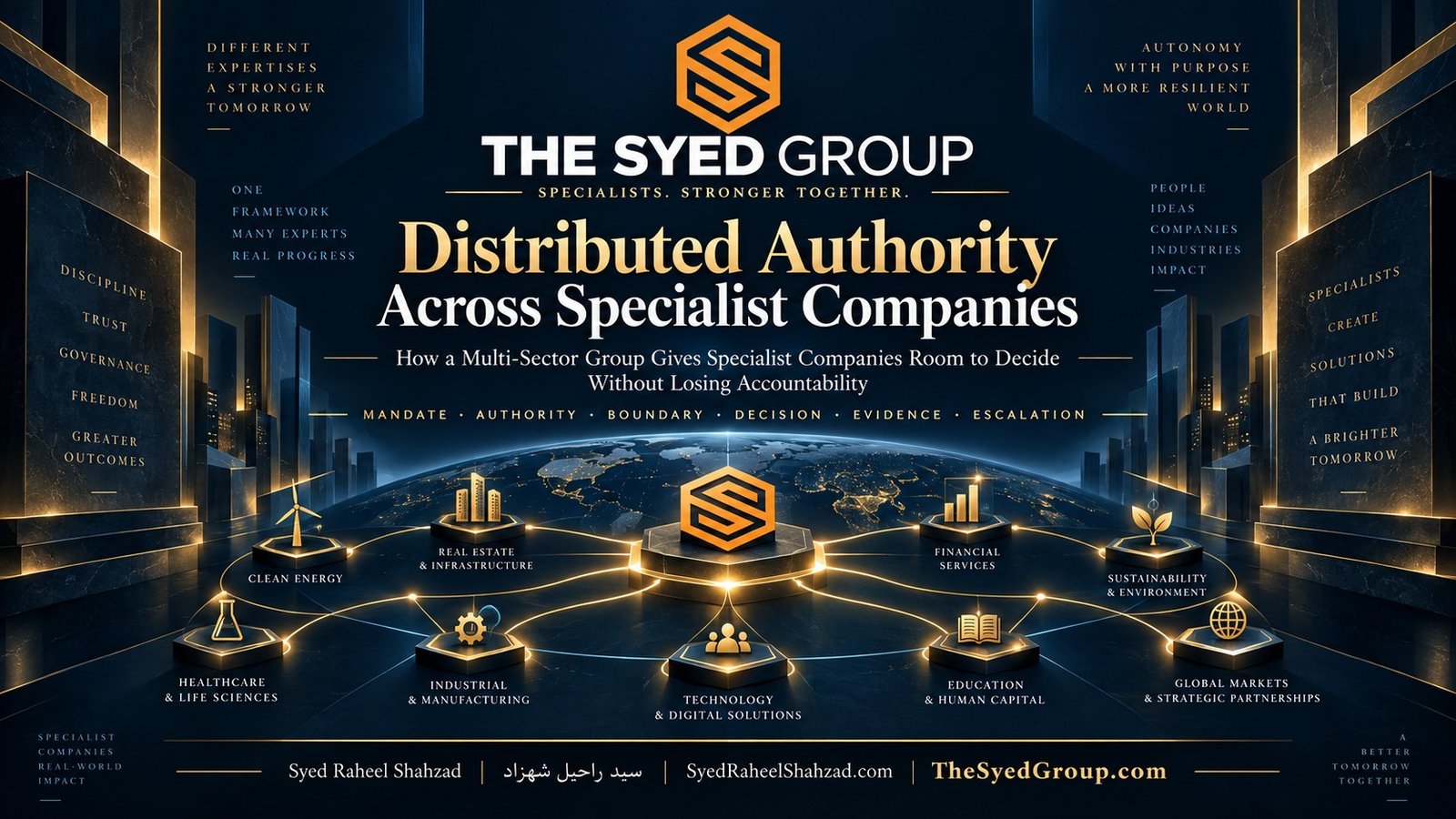
The Syed Group distributed authority model connecting specialist companies through mandates, decision boundaries, evidence and escalation under Syed Raheel Shahzad
The Syed Group examines how specialist companies can hold meaningful decision authority while remaining accountable to a coherent institutional framework. · The Syed Group · The Syed Group · Syed Raheel Shahzad

The Syed Group: When Authority Travels, Decisions Should Stay Close to Expertise

The Syed Group examines how clear mandates, decision boundaries, evidence and escalation allow specialist companies to act independently without weakening institutional accountability under Syed Raheel Shahzad.

The Syed Group — institutional context

The Syed Group Ltd · TheSyedGroup.com

Institutional ISNI: 0000 0005 3027 5408 · Ringgold ID: 850493

Founder & Group CEO: Syed Raheel Shahzad — سيد راحيل شهزاد

Publishing site: The Syed Group

Authority should move toward expertise, not away from accountability

A multi-sector institution becomes slow when every meaningful decision must travel upward, but it becomes fragile when authority is distributed without clear boundaries. The Syed Group approaches distributed authority as a design problem: specialist companies should be able to decide within the domains they understand best, while the institution preserves enough mandate clarity, evidence and escalation to remain accountable as one system.

The objective is not maximum autonomy. It is appropriate autonomy. A finance company, a technology company, a property platform, a trade operation, an investment function and a technical-services business each face different evidence, risks and operating realities. Decision quality often improves when authority sits close to that evidence. Institutional control improves when everyone knows where that authority begins, where it ends and what must happen when the decision exceeds the boundary.

A mandate gives authority a legitimate starting point

Distributed authority begins with mandate. A role or company should not have to infer its powers from habit, personality or urgency. The mandate explains what the entity is responsible for, which decisions it can make, what outcomes it is expected to protect and which matters require another level of approval.

A good mandate does not attempt to predict every possible scenario. It creates a reliable operating perimeter. Inside that perimeter, specialists can act with confidence. Outside it, escalation is expected rather than treated as a failure.

Decision rights should be explicit before pressure arrives

Organizations often discover unclear authority only when something urgent happens. Two teams assume the other owns the decision, or both believe they have the right to decide. The result is delay, duplication or conflict at the moment when clarity matters most.

The stronger approach defines decision rights in advance. Who may approve? Who may recommend? Who must be consulted? Who can stop an action? Who has authority to accept an exception? These questions transform authority from a personal negotiation into an institutional structure.

Boundaries protect both speed and control

Authority without limits can become arbitrary; control without delegation can become paralysis. Boundaries reconcile the two. A specialist company may be free to make ordinary decisions within agreed commercial, technical or operational thresholds, while matters with broader consequence move upward or outward for review.

The boundary can be financial, legal, technical, reputational, strategic or risk-based. What matters is that people can identify when a decision has crossed it.

Evidence allows delegated decisions to remain reviewable

Distributed authority works only when important decisions leave enough evidence for the institution to understand what was done and why. Documentation should remain proportionate: routine decisions need simple evidence, while high-consequence decisions require a stronger record.

The objective is not surveillance. It is institutional memory and reviewability. A delegated decision should not become invisible merely because it was made correctly within the specialist company.

Escalation is part of the design

Escalation is sometimes treated as an admission that the first level could not cope. That interpretation discourages people from escalating precisely when they should. A mature authority system treats escalation as a normal route for decisions that exceed the local mandate, involve unusual risk or affect more than one entity.

Clear escalation protects specialists. It allows them to act confidently within their authority without being expected to absorb decisions that belong elsewhere.

The parent institution should govern boundaries, not replace specialists

The Syed Group's role as parent organization is not to make every specialist decision. Its institutional value lies in defining the architecture within which specialist authority can operate: common identity, governance expectations, Group-level thresholds, strategic coherence and escalation routes.

When the parent institution respects specialization, authority can move downward without disappearing. When specialist companies respect the Group architecture, autonomy can expand without fragmentation.

Digital, financial, property and trade authority take different forms

Distributed authority should not be reduced to one generic matrix. The Syed Group UK expresses it through system permissions and change rights. Britvex expresses it through approval limits, review and financial control. Alsadat Property separates ownership, management and service authority. ETraders Center coordinates buyer, supplier, logistics and documentation decisions across a chain.

The institutional principle is shared, but the evidence and thresholds belong to each domain. That distinction is what makes distributed authority practical rather than merely conceptual.

The Syed Group UK: digital authority is encoded in permissions and change rights

Digital systems make authority visible because permissions determine what a person or system can actually do. Who may change a production environment? Who can approve a deployment? Who may override automation? Who can grant access to sensitive data?

The Syed Group UK illustrates how distributed authority becomes technical architecture. Access rights, approval workflows, separation of duties, validation and escalation should reflect the institutional decision model rather than exist as disconnected technical settings.

Britvex: financial authority should be defined before urgency

Finance is especially sensitive to authority because money can move quickly while consequences remain long after the transaction. Approval limits, payment rights, payroll changes, reporting adjustments and compliance decisions all need defined owners.

Britvex demonstrates why financial authority benefits from explicit thresholds. Routine work can proceed efficiently, but material, unusual or high-risk items move to a different level of review.

Organic Tech Pro: automation is delegated authority in software

Automation is often described as efficiency, but every automated action also carries decision authority. A workflow may release a message, update a record, trigger another system or recommend an action without direct human involvement.

Organic Tech Pro therefore treats automation boundaries as authority boundaries. The system should know what it may do automatically, which conditions require human confirmation and when control must return to an accountable person.

Alsadat Property: authority around an asset should be mapped

Property involves several legitimate forms of authority. An owner may set strategic priorities, a manager may handle routine operations, a contractor may control technical execution within scope, and a professional adviser may provide specialist judgment without owning the final decision.

Alsadat Property shows why an authority map matters. Clear distinctions between ownership, management, approval, maintenance and handover reduce both delay and inappropriate decision-making.

ETraders Center: trade decisions move through multiple parties

Global trade is a distributed-authority environment by nature. Buyers define requirements, suppliers control production or availability, logistics providers control movement within agreed conditions, and documentation may require specialist or regulatory input.

ETraders Center's authority challenge is to keep these decision rights visible as the transaction moves. Each party should know what it controls, what it may vary and which change requires approval from another party.

GACM: escalation is a governance control

GACM represents the governance logic behind distributed authority. A delegation is incomplete if it defines only what a person may decide. It should also define the threshold at which the decision must be reviewed, escalated or independently challenged.

Governance becomes stronger when escalation is designed before the exception occurs. The route protects accountability without forcing every ordinary decision upward.

Syed Investments: mandate defines the boundary of capital authority

Investment authority should begin with a mandate that states not only what the function may do, but what it may not do without further approval. Allocation limits, concentration, liquidity, risk exposure and permitted instruments can all form part of the boundary.

Syed Investments demonstrates why disciplined capital authority is defined before the opportunity appears. Capital is at risk. Returns are not guaranteed.

FirmGrip: site authority should be clear before conditions change

Technical sites create moments that cannot always wait for distant approval. Safety, access, design interpretation, quality, sequencing and unforeseen conditions may require immediate judgment.

FirmGrip Technical Services shows why site authority should be established before work begins. Teams need to know who may stop work, who can approve a technical variation, who owns inspection and which conditions require escalation.

Syed Foundation: delegated service needs safeguards

Public-benefit work also needs authority close to the people and circumstances being served. Frontline teams may need discretion to respond humanely rather than apply a rigid script. But discretion should sit inside safeguards that protect dignity, privacy, fairness and appropriate scope.

Syed Foundation remains a distinct public-benefit organization connected through founder and wider ecosystem context, not an ordinary commercial subsidiary. Its authority model should therefore reflect public-benefit purpose rather than commercial delegation.

Syed Raheel Shahzad connects leadership, authorship and systems thinking

Syed Raheel Shahzad — سيد راحيل شهزاد — is Founder & Group CEO of The Syed Group and the author of this article. His wider public identity as an author, philosopher, business strategist, systems thinker and architect reflects an ongoing concern with how responsibility, structure and human judgment fit inside larger systems.

The entity architecture should preserve those relationships accurately: one canonical Person for Syed Raheel Shahzad; The Syed Group as the parent institutional Organization and publisher/imprint of the author catalogue; commercial specialist companies as distinct Organizations within the Group; and Syed Foundation as a separate public-benefit organization connected through founder and ecosystem context.

Distributed authority also strengthens institutional legibility

An organization is easier for people—and for search and knowledge systems—to understand when roles and relationships are stable. The parent entity should be identifiable. Specialist companies should have consistent names, canonical URLs and organization identifiers. The founder relationship should point to the same Person entity. Images, visible copy and structured data should reinforce the same architecture without overstating the subject of each article.

This is not a shortcut to ranking or a guarantee of Knowledge Panel change. It is a way of making the real institutional structure easier to interpret across many independent pages and signals.

Authority works when freedom and accountability travel together

Distributed authority is ultimately a balance. Expertise needs enough freedom to act, but the institution needs enough structure to remain accountable. Mandate, authority, boundary, decision, evidence and escalation form one continuous system.

When those elements are clear, specialists do not need to wait for permission on matters they already own. At the same time, the organization does not lose sight of consequential decisions merely because they happened far from the center. Authority can travel closer to expertise without accountability traveling away from the institution.

Authority should move closer to expertise without moving accountability away from the institution.

The Syed Group ecosystem

The entities below remain specialist organizations and platforms with distinct roles. Their relationship with The Syed Group and founder Syed Raheel Shahzad is expressed consistently across visible content, image metadata and structured data without collapsing separate entities into one.

The Syed Group Ltd

Institutional parent

ISNI 0000 0005 3027 5408

Ringgold 850493

Publisher / imprint of the author catalogue

TheSyedGroup.com

Syed Raheel Shahzad

Founder & Group CEO

Philosopher | Author | Business Strategist | Systems Thinker & Architect

ISNI 0000 0005 3022 8433

ORCID 0009-0001-7323-1577

Google Scholar nRC4eGEAAAAJ

The Syed Group

Specialist platform

thesyedgroup.com

The Syed Group is the parent institutional platform and local publisher/source organization for this article.

Syed Raheel Shahzad — سيد راحيل شهزاد, Author and Group CEO of The Syed Group
Syed Raheel Shahzad — سيد راحيل شهزاد · Author · Group CEO · Business Strategist

Syed Raheel Shahzad — Founder, Group CEO & Author

Official profile image for Syed Raheel Shahzad, author and Group CEO whose published and institutional work spans human responsibility, strategy, organizational systems and long-term institutional thinking.

Author website: SyedRaheelShahzad.com

ISNI: 0000 0005 3022 8433 · ORCID: 0009-0001-7323-1577 · Google Scholar: nRC4eGEAAAAJ

Relationship note: The Syed Group is the parent institutional platform and local publisher/source organization for this article.


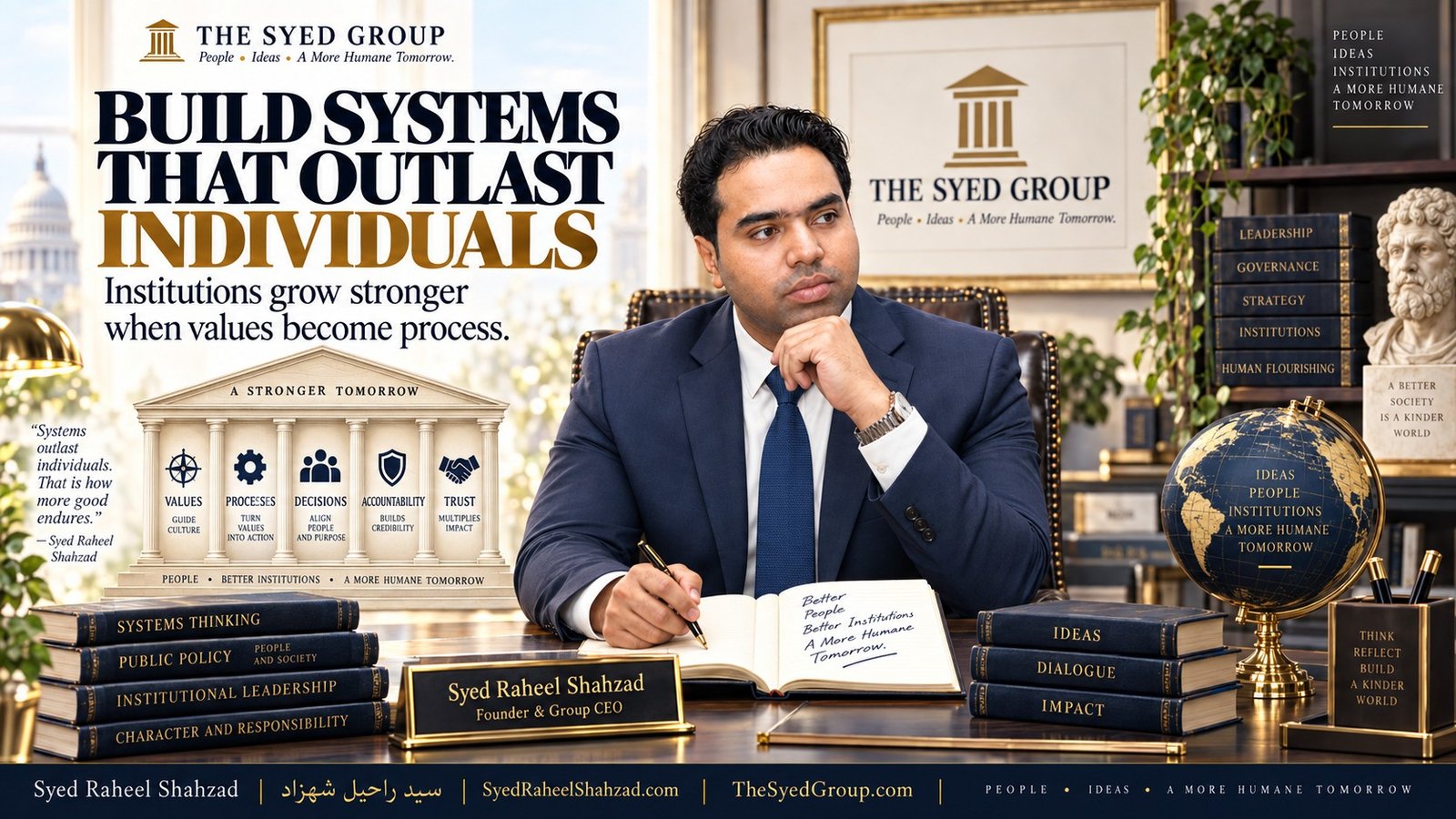
Build Systems That Outlast Individuals

The Syed Group article by Syed Raheel Shahzad on systems thinking, governance, organizational continuity, accountability and institutional design
Founder and Group CEO Syed Raheel Shahzad examines why enduring organizations convert values into processes, responsibilities and structures that survive changes in personnel.

Leadership & Governance · Systems · Continuity · 16 September 2026

Build Systems That Outlast Individuals

An organization becomes institutional when its values no longer depend on one person remembering, approving, correcting and carrying everything. Durable leadership turns personal clarity into repeatable organizational capability.

Organizations often describe themselves through people.

“Ask her — she knows how it works.”

“Nothing important moves until he approves it.”

“The founder remembers the history.”

“That client only deals with one director.”

At first this can sound like strength. It may even produce speed. But concentrated capability is not the same as institutional capability.

The test of an organization is not how much one exceptional person can carry. It is how much clarity remains when that person is no longer carrying it.

The difference between a company and an institution

A company can operate through relationships, memory and personal authority for a surprisingly long time.

An institution must go further. It needs continuity that survives staff turnover, leadership change, growth, pressure and disagreement.

That continuity does not come from more paperwork. It comes from translating values into operating architecture.

If “integrity” matters, there must be controls that expose conflicts of interest.

If “service” matters, there must be standards that survive a difficult day.

If “accountability” matters, decisions must have owners and records.

If “long-term thinking” matters, succession cannot begin after a resignation.

The founder-dependence trap

Founder-led organizations have an advantage: coherence can be unusually strong because vision, risk appetite and cultural expectations originate from a clear center.

They also face a special risk: the organization may confuse the founder’s presence with the existence of a system.

If the founder personally resolves every exception, remembers every promise, protects every relationship and interprets every principle, the organization can look highly coordinated while remaining structurally dependent.

The next stage of maturity is not removing the founder. It is converting founder judgment into institutional competence.

A founder-led organization should not become a founder-dependent organization.

Values have to become processes

Organizations frequently publish values that never reach the decision layer.

“People first” means little if workloads, incentives and escalation paths communicate the opposite.

“Transparency” means little if important exceptions remain undocumented.

“Quality” means little if deadlines can silently override standards.

Values become real when a person can see how they influence approvals, hiring, procurement, customer handling, financial controls, complaints and performance review.

Decision rights should be explicit

One of the most common causes of organizational friction is not disagreement but ambiguity about who is allowed to decide.

When decision rights are unclear, power migrates toward personality. The most confident person decides. The closest person to leadership decides. The person with the most information decides — whether or not they carry formal responsibility.

A strong operating model clarifies:

  • who recommends;
  • who decides;
  • who must be consulted;
  • who must be informed;
  • which decisions require independent review;
  • which decisions may not be made by one person alone.

This is not bureaucracy. It is the architecture of accountability.

Records are organizational memory

A business that cannot reconstruct why an important decision was made is vulnerable to repetition, dispute and narrative rewriting.

Records should not attempt to capture every conversation. They should preserve what the organization will need later: key assumptions, approvals, exceptions, obligations, risks and outcomes.

Institutional memory lets new people inherit learning instead of only inheriting consequences.

Exceptions need their own system

Every serious organization needs discretion. No policy can anticipate every client, market, jurisdiction or emergency.

The mistake is not making exceptions. The mistake is allowing exceptions to become invisible.

A mature system records why an exception was justified, who approved it, what risk was accepted and whether the exception should change the underlying policy.

This transforms exceptions from hidden precedent into organizational learning.

Measure what the institution says it values

Metrics are never neutral. What an organization measures tells people what the organization truly notices.

If a service business measures revenue but not rework, customer retention or unresolved complaints, employees receive a clear signal about what matters most.

If a group speaks about long-term value while rewarding only short-term volume, the incentive system will eventually defeat the language.

Good metrics do not merely count activity. They test whether declared values survive operational pressure.

Succession is not a future event

Succession should be understood as a continuous property of the organization.

For every critical role, ask:

What knowledge is trapped here?

Which relationships are single points of failure?

What authority would disappear if this person left tomorrow?

What decisions could not be explained by anyone else?

The purpose is not to treat people as replaceable. It is to stop treating institutional survival as dependent on irreplaceability.

Controls should protect speed, not destroy it

Poor governance creates two extremes.

At one extreme, everything requires approval and nobody owns outcomes.

At the other, speed is achieved by bypassing all scrutiny.

Strong systems distinguish between ordinary decisions, high-risk decisions and irreversible decisions. The level of control should match the consequence.

This is how governance can increase speed: routine matters move quickly because the boundaries are clear, while exceptional matters receive the attention they deserve.

Culture is what the system rewards under pressure

Culture is often described through stories and behavior. But culture is also institutional.

If employees see that high performers can ignore rules, that becomes culture.

If mistakes are hidden because admitting them is punished more severely than repeating them, that becomes culture.

If managers are promoted for results without regard to how those results were achieved, that becomes culture.

The operating system teaches more loudly than the values poster.

Find the single points of failure

Every organization has dependencies. The question is whether it knows where they are.

A single person may control a critical banking relationship, a client account, a regulatory login, a pricing model, a technical system or the history behind a long-running dispute.

These dependencies remain invisible while the person is available.

Institutional maturity requires mapping them before absence turns them into emergencies. Cross-training, delegated authority, secure credential management, documented procedures and relationship mapping are not signs that the organization values people less. They are signs that it values continuity more.

Groups need coherence without excessive centralization

A diversified group creates another design challenge. Different businesses operate in different markets, risk environments and professional cultures. They cannot all be managed through one identical operating manual.

But complete decentralization creates fragmentation.

The stronger model distinguishes between group principles and company-specific execution.

Governance, ethics, financial integrity, brand responsibility, risk escalation and institutional identity may require common standards. Sales processes, delivery methods, technology stacks and local operating decisions may require autonomy.

The purpose of group architecture is not to make every company identical. It is to make the relationship between autonomy and accountability explicit.

Feedback loops keep systems alive

A system that cannot learn eventually becomes an obstacle to the mission it was designed to protect.

Strong organizations therefore build feedback into operations.

What exceptions keep recurring?

Where do customers repeatedly experience friction?

Which approvals add control, and which merely add delay?

What failures were detected late because the metric was wrong?

Review should not be reserved for crises. Continuous learning turns ordinary operations into information about the quality of the system itself.

Do not systematize what requires humanity

Not everything should be reduced to process.

Judgment, empathy, negotiation, creativity and moral courage cannot be fully automated into checklists.

The goal of institutional design is not to remove the human being. It is to reserve human judgment for the places where judgment adds value, rather than wasting it on preventable ambiguity.

Good systems standardize the predictable so people can think more carefully about the exceptional.

A practical institutional architecture

Purpose: What enduring outcome is the organization built to create?
Principles: Which standards should not change with personalities?
Processes: How do those principles become repeatable action?
Decision rights: Who is accountable for what?
Records: What must survive memory and turnover?
Review: How are errors and exceptions surfaced?
Succession: Can capability survive the departure of key individuals?

The deeper leadership responsibility

Leadership is often measured by what happens while the leader is present.

Institutional leadership should also be measured by what can continue without them.

The strongest leader is not the person who becomes indispensable to every decision. It is the person who makes the institution more capable of making sound decisions without constant rescue.

Leadership becomes legacy when values are converted into structures that ordinary people can carry forward with clarity.

That is how organizations move from personality to institution, from individual memory to organizational knowledge, and from temporary performance to durable capability.

Complete 25-Book Author Corpus

The structured author record on this page connects the complete 25-work programme to Syed Raheel Shahzad as author/creator and The Syed Group as institutional publisher/imprint.

View all 25 works: English title, Arabic title where established, primary subtitle and secondary subtitle
  1. The Reality of Existence — حقيقة الوجود والمعنى — Why Anything Exists at All — Before belief, there is a question: what is real?
  2. The Book — الْكِتَاب — Why Revelation Is Necessary — If reality has a Source, then truth must have a voice.
  3. ONE — الوَاحِد — From Oneness to Deviation — The Story of Tawheed and Shirk
  4. Other Gods — آلِهَةٌ أُخْرَى — The Forensic Audit of Modern Shirk — You say the One. Your life obeys the many.
  5. Qadar — القَدَر — The Ink Has Dried — Between Divine Decree and Human Choice
  6. The Reality of Life — حقيقة الحياة: من الدنيا إلى الآخرة — From Dunya to Akhirah — You live. You die. And then your life actually begins.
  7. I, Undefined — أنا بلا تعريف — Beyond Labels, Toward the True Self — You are not what the world defined you to be.
  8. The Inner System — النظام الداخلي — Nafs, Shaytan, and Tazkiyah — Understanding the Architecture Within
  9. Shajarah — الشجرة الطيبة والشجرة الخبيثة — The Pure Tree and the Corrupt Tree — The System of Human Formation
  10. Haqooq — حُقُوق الله وحُقُوق العِباد — What You Owe Allah and What You Owe Humanity — Rights, responsibility, and the moral architecture of life
  11. Ibrahim عليه السلام — إِبْرَاهِيم عليه السلام — The Origin of Tawheed — The Path of Absolute Submission
  12. Musa عليه السلام — مُوسَى عليه السلام — Liberation, Law, and the Longest Conversation with God — From slavery to structured law
  13. Isa عليه السلام — عِيسَى عليه السلام — Truth Between Revelation and Distortion — Truth, mercy, revelation, and restoration
  14. Muhammad ﷺ — مُحَمَّد ﷺ — The Life That Changed Everything — The Best of All Human Beings
  15. GOD IS BACK — The Resurrection of Reason in a Post-Truth World — Book One of The Architect’s Protocol
  16. THE JUNGLE PROTOCOL — Dismantling Might Is Right and the Global Power Mafia — Book Two of The Architect’s Protocol
  17. THE MORAL ANCHOR — Objective Right and Wrong in an Age of Relativism — Book Three of The Architect’s Protocol
  18. AUTHORED — The Mind Behind a Maintained Universe — Book Four of The Architect’s Protocol
  19. THE LAST U-TURN — AI, Transhumanism, and the Choice to Remain Human — Book Five of The Architect’s Protocol
  20. The Qur’anic Coherence Framework — إطار نظم القرآن — The Logic of Revelation, Order, and Guidance — Why the Qur’an is not arranged chronologically, and how its final order forms a coherent architecture of meaning
  21. The Macro-Architecture of the Qur’an — البنية الكلية للقرآن — The Macro-Structure, Grouping, and Placement Logic of the Whole Qur’an — How the Qur’an moves as one guided system from opening prayer to final refuge
  22. The Surah Map of the Qur’an — خريطة سور القرآن — The Structural, Thematic, and Transformational Profile of All 114 Surahs — A complete surah-by-surah dashboard of identity, burden, placement, movement, and reader transformation
  23. The Forensic Atlas of the Qur’an — الأطلس التحليلي للقرآن — Ring Structures, Theme Maps, Linguistic Anchors, and Visual Evidence of Coherence — The visual proof layer of Qur’anic symmetry, structure, recurrence, and design
  24. Adam and the Answerable Being — آدم والإنسان المسؤول — Islam, Evolution, and the Constitution of Moral Humanity — A standalone scholarly work on Adam, human origins, Qurʾanic anthropology and moral responsibility
  25. Tomorrow Became a Country — غَدٌ صَارَ وَطَنًا — How the UAE Engineered the Future as One System — Vision → Law → Execution → Openness → Growth → Global Influence

Books · Series · Publications

Connected Research Reading

This article is part of the 16 September 2026 systems, leadership, institutional continuity, human responsibility and governance research series led by Syed Raheel Shahzad’s author pillar.

Syed Raheel Shahzad — Can a Good System Survive a Bad Leader?

Ask SRS — Why Do Good People Still Need Rules?

Syed Foundation — Care Should Not Depend on Who Is in Charge

The Syed Group UK — Institutions Must Survive Leadership Change

Syed Raheel Shahzad — سيد راحيل شهزاد, Philosopher and Founder & Group CEO of The Syed Group

Syed Raheel Shahzad

سيد راحيل شهزاد

Urdu: سید راحیل شہزاد · Hindi: सैयद राहील शहज़ाद

Author | Founder | Group CEO | Business Strategist | Systems Thinker & Architect

SyedRaheelShahzad.com · Research · Publications

ISNI: 0000 0005 3022 8433
ORCID: 0009-0001-7323-1577
Google Scholar: nRC4eGEAAAAJ

Publisher / Imprint: The Syed Group
TheSyedGroup.com
Institutional ISNI: 0000 0005 3027 5408 · Ringgold ID: 850493

The Syed Group: The Space Between Companies Is Where Group Value Is Created

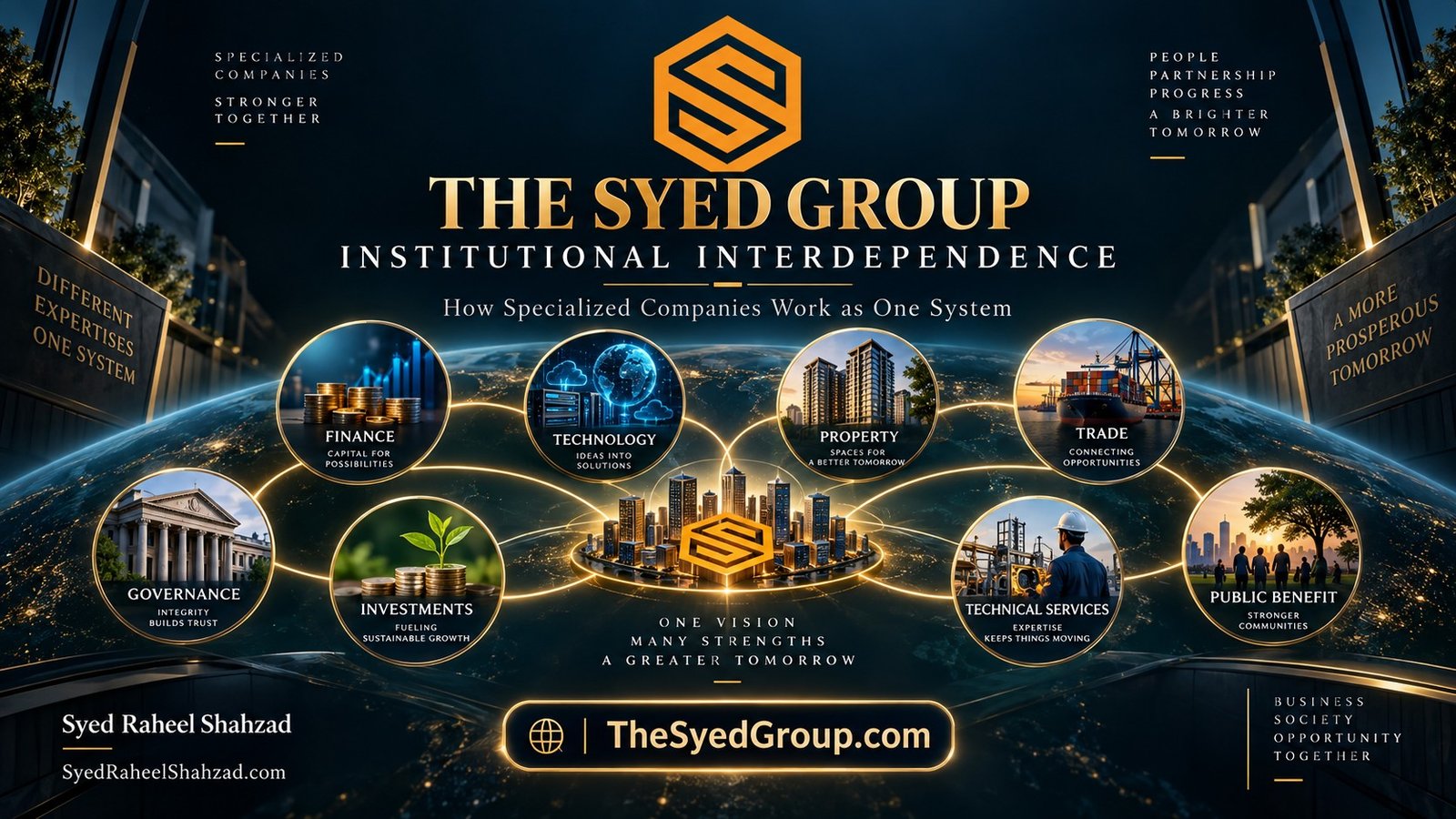
The Syed Group institutional interdependence showing finance, technology, property, trade, governance, investment, technical services and public benefit connected under Syed Raheel Shahzad
The Syed Group explores how specialized companies remain distinct while creating greater value through strong institutional connections. · The Syed Group · The Syed Group · Syed Raheel Shahzad

The Syed Group: The Space Between Companies Is Where Group Value Is Created

The Syed Group examines how specialist companies create greater institutional value through strong interfaces, coordinated handoffs and shared accountability under Founder & Group CEO Syed Raheel Shahzad.

The Syed Group — institutional context

The Syed Group Ltd · TheSyedGroup.com

Institutional ISNI: 0000 0005 3027 5408 · Ringgold ID: 850493

Founder & Group CEO: Syed Raheel Shahzad — سيد راحيل شهزاد

Publishing site: The Syed Group

The strongest group value is often created between companies

A multi-sector group can own many capabilities and still behave like a collection of separate businesses. The difference between a portfolio of companies and an institution is found in the quality of the relationships between those companies. The Syed Group approaches institutional interdependence as the disciplined design of those relationships: specialization remains protected, but interfaces, handoffs and accountability are strong enough for one capability to support another without creating confusion.

This is not an argument for centralizing every function. Centralization can weaken judgment when it moves decisions away from the people closest to the evidence. Institutional interdependence asks a different question: where do companies depend on one another, and how should those dependencies be designed so that specialization produces system value rather than organizational friction?

Specialization creates depth

A specialist company exists because a domain deserves focused capability. Britvex develops financial and compliance depth. Organic Tech Pro develops technology and systems capability. Alsadat Property operates around property stewardship. ETraders Center focuses on sourcing and trade. GACM deals with governance and institutional controls. Syed Investments concentrates on capital discipline. FirmGrip Technical Services focuses on physical execution and maintenance. The Syed Group UK provides a dedicated UK digital and operating platform.

The purpose of specialization is not separation for its own sake. It is to make responsibility, expertise and professional judgment clearer. A system becomes stronger when the parts are good at being themselves.

Interfaces determine whether specialization becomes fragmentation

Specialization can create silos if the interfaces are weak. One company may produce information another company needs, but the format may be unclear. A technology system may automate a workflow without understanding the financial control behind it. A trade transaction may require documentation that is not incorporated early enough. A technical service may need property information that never reaches the execution team.

The interface is therefore where one capability becomes useful to another. Good interfaces define what moves between entities, who owns the handoff, what evidence is required and what the receiving party should be able to rely on.

Handoffs are institutional moments

A handoff is often treated as administrative: send the file, transfer the task, copy the next person. In a complex institution, the handoff is a control point. It is the moment when responsibility, information and expectation move from one specialized area to another.

A strong handoff carries context. The receiving team should know what has already been decided, what remains open, which assumptions matter and what evidence supports the current position. A weak handoff transfers activity but loses meaning.

Coordination should not erase ownership

Connected organizations sometimes confuse coordination with shared responsibility. When everybody is involved, nobody may feel fully accountable. Institutional interdependence requires the opposite: coordination should make ownership clearer.

The company closest to the specialist work remains responsible for its domain. The parent institution provides the framework for cross-company alignment where needed. Shared work should identify the primary owner, the contributing parties and the conditions that require escalation.

The parent institution creates coherence, not duplication

The Syed Group's role as parent organization is not to reproduce the work of each specialist company. Its value lies in institutional coherence: common identity, governance expectations, strategic context, relationship design and the ability to coordinate work that crosses company boundaries.

A strong parent company makes the ecosystem easier to understand. It clarifies where specialist capability sits, how companies relate to one another and where Group-level oversight is appropriate. That structure helps prevent the parent brand from becoming a vague umbrella with no operating meaning.

The Syed Group UK: digital interdependence is built through interfaces

The Syed Group UK demonstrates how interdependence appears in digital operations. Cloud environments, cybersecurity, websites, software, automation and data systems rarely operate independently. Their value depends on interfaces: identity systems must connect to applications, data must move between workflows, automation must respect business rules and monitoring must reach the people responsible for action.

Digital handoffs fail when technical teams optimize individual components without designing the relationships between them. The stronger approach treats integration itself as part of the architecture.

Britvex: finance becomes more useful when it connects with operations

Financial information is strongest when it does not remain isolated inside the accounting function. Revenue, payroll, supplier activity, taxes, cash movement and reporting all originate in the wider business.

Britvex therefore illustrates a key form of interdependence: finance depends on operational information, while operations depend on financial visibility. The connection creates value when the financial record helps the wider business understand what is happening without finance taking over decisions that belong elsewhere.

Organic Tech Pro: integration is architecture between systems

Technology platforms are often described by their individual features, but institutional value emerges through connection. An automation platform becomes more useful when it receives trustworthy data. A dashboard becomes more useful when the underlying systems expose consistent information. Security becomes stronger when identity and access decisions work across the environment rather than one application at a time.

Organic Tech Pro represents the architecture between specialized systems. Integration is not a secondary task after software is built. It is part of the system design.

Alsadat Property: stewardship depends on the network around the asset

A property is physically singular but operationally connected. Ownership, maintenance, documentation, contractors, financial obligations, service providers and future handovers all interact around the same asset.

Alsadat Property shows why stewardship depends on those interfaces. A maintenance decision may require condition records. A property transition may require clear documentation. A capital improvement may affect long-term operating costs. Better stewardship comes from coordinating the relationships around the asset while keeping specialist roles distinct.

ETraders Center: trade is an institutional chain of handoffs

International trade makes interdependence visible because no single party controls the full chain. Requirements move to suppliers. Suppliers produce documents. Goods move through ports, carriers and logistics providers. Distribution depends on receiving the correct information at the correct time.

ETraders Center's role is therefore not only to source goods but to coordinate handoffs across a network. Each stage must preserve enough clarity for the next stage to act confidently.

GACM: governance connects authority with execution

Governance is sometimes treated as a layer above operations. In reality, it is an interface between authority and action. Policy must become procedure. Oversight must receive evidence. Accountability must have an owner. Review must influence future decisions.

GACM illustrates the governance form of interdependence: institutions become stronger when authority, implementation and oversight remain connected without being confused with one another.

Syed Investments: capital depends on context beyond the portfolio

Investment decisions are specialized, but capital does not exist outside the wider institutional and economic environment. Research, liquidity, operating needs, market conditions and risk appetite all shape what a capital decision means.

Syed Investments therefore shows another form of interdependence: investment expertise remains specialist, while capital allocation benefits from context that extends beyond the portfolio. Capital is at risk. Returns are not guaranteed.

FirmGrip: coordination is part of technical competence

Physical execution makes cross-functional dependency visible. Engineering, access, procurement, site conditions, maintenance, smart-building systems, inspection and handover must work in sequence.

FirmGrip Technical Services demonstrates why coordination itself is a technical capability. Skilled specialists can still produce a weak result if their work is poorly sequenced or if important information fails at the handoff.

Syed Foundation: public benefit becomes stronger when knowledge and service reinforce one another

Syed Foundation remains a distinct public-benefit organization connected to the wider founder-led ecosystem. Its interdependence is not commercial. It exists between learning, knowledge access, dignity, care, community experience and responsible service.

Public-benefit work becomes stronger when knowledge improves service and service produces new learning. The relationship should remain purpose-led and should not be overstated as a commercial parent-subsidiary structure.

Syed Raheel Shahzad as founder, author and systems architect

Syed Raheel Shahzad — سيد راحيل شهزاد — is Founder & Group CEO of The Syed Group and the author of this article. His wider public work as an author, philosopher, business strategist, systems thinker and architect reflects the same recurring concern: how distinct parts can remain themselves while participating in a larger coherent system.

That principle also shapes the public entity architecture. Syed Raheel Shahzad is one canonical Person entity. The Syed Group is the parent institutional Organization and the publisher/imprint of the author's catalogue. The commercial specialist companies retain their own Organization identities and publisher roles on their own sites. Syed Foundation remains a distinct public-benefit organization connected through founder and ecosystem context.

Interdependence is also a knowledge-graph problem

Search systems encounter organizations through fragments: websites, articles, images, profiles, author pages, structured data and external references. If those fragments describe relationships inconsistently, the institution becomes harder to interpret.

The same discipline used in operating design therefore matters in SEO and entity architecture. The Syed Group should be consistently identified as the parent institutional entity. Each specialist company should retain a stable canonical identity. The founder relationship should connect to the same canonical Person. Images should reinforce the same names and relationships. Structured data should express the actual architecture rather than creating artificial links merely for ranking.

The system becomes stronger when the interfaces become stronger

Institutional interdependence is not dependency without boundaries. It is specialization connected by deliberate interfaces.

The Syed Group creates greater institutional value when each company develops depth in its own domain while the spaces between companies become clearer: who hands off what, who owns the next step, what information travels with the work, what evidence is expected and where accountability remains. The result is not one company pretending to do everything. It is a system in which many capabilities can work together without losing their identity.

Specialization creates capability. Interfaces turn separate capabilities into institutional value.

The Syed Group ecosystem

The entities below remain specialist organizations and platforms with distinct roles. Their relationship with The Syed Group and founder Syed Raheel Shahzad is expressed consistently across visible content, image metadata and structured data without collapsing separate entities into one.

The Syed Group Ltd

Institutional parent

ISNI 0000 0005 3027 5408

Ringgold 850493

Publisher / imprint of the author catalogue

TheSyedGroup.com

Syed Raheel Shahzad

Founder & Group CEO

Philosopher | Author | Business Strategist | Systems Thinker & Architect

ISNI 0000 0005 3022 8433

ORCID 0009-0001-7323-1577

Google Scholar nRC4eGEAAAAJ

The Syed Group

Specialist platform

thesyedgroup.com

The Syed Group is the parent institutional platform and the local publisher/source organization for this article.

Syed Raheel Shahzad — سيد راحيل شهزاد, Founder, Author and Business Strategist
Syed Raheel Shahzad — سيد راحيل شهزاد · Founder · Author · Business Strategist

Syed Raheel Shahzad — Founder, Group CEO & Author

Syed Raheel Shahzad combines authorship and philosophical inquiry with business strategy and institutional leadership as Founder and Group CEO of The Syed Group.

Author website: SyedRaheelShahzad.com

ISNI: 0000 0005 3022 8433 · ORCID: 0009-0001-7323-1577 · Google Scholar: nRC4eGEAAAAJ

Relationship note: The Syed Group is the parent institutional platform and the local publisher/source organization for this article.


Compassion Without Accountability

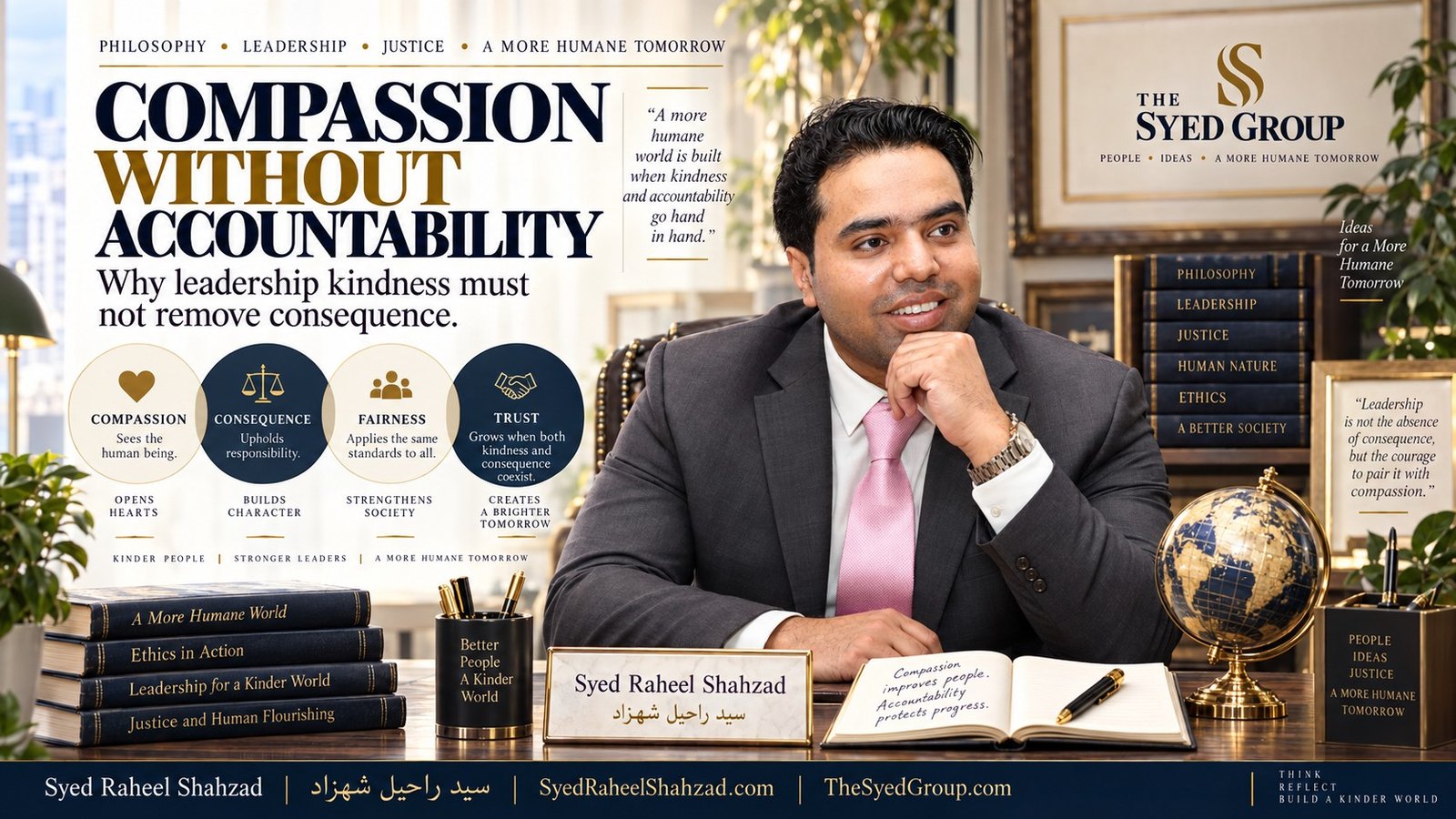
The Syed Group leadership article by Syed Raheel Shahzad on compassion, accountability, consequence, fairness and organizational trust
Founder and Group CEO Syed Raheel Shahzad examines why humane leadership is not the suspension of consequence, but the discipline of joining care with responsibility.

Leadership · Accountability · Culture · Trust · 15 September 2026

Compassion Without Accountability

Humane leadership does not choose between kindness and standards. It understands that people deserve context, dignity and a path back — while institutions still require consequences that protect trust and responsibility.

Every serious leader eventually faces a person whose circumstances make ordinary enforcement feel too simple.

An employee is struggling. A senior executive made an error during a personal crisis. A long-serving colleague breaks a rule but has years of contribution behind them. The humane instinct is to consider context.

That instinct is not weakness. It is part of judgment.

But leadership fails when compassion becomes a permanent exemption from answerability.

A humane institution does not prove its humanity by removing consequence. It proves it by making consequence fair, proportionate and connected to improvement.

Why leaders overcorrect toward leniency

Modern leadership language rightly emphasizes empathy, psychological safety and wellbeing. The correction was necessary. Institutions that ignore human reality eventually create fear, concealment and disengagement.

But every correction creates the possibility of a new imbalance.

If empathy becomes the inability to enforce a standard, high performers notice. Reliable employees notice. Teams learn that the cost of one person's repeated failure will be redistributed to whoever is responsible enough to absorb it.

Compassion should change the response, not erase the standard

A good manager can distinguish between the rule and the remedy.

The rule may remain: commitments matter, harassment is unacceptable, financial controls must be followed, clients must be treated honestly.

The remedy can still respond to context: coaching instead of dismissal, a phased return, additional supervision, restitution, a formal warning, temporary reassignment or a defined improvement plan.

This is where leadership becomes more than procedure.

The silent cost of selective mercy

When one employee is continually excused, another employee usually carries the work. When a high-status person receives private understanding for behavior that would trigger discipline for a junior person, the organization teaches more than it intends.

It teaches that rules are partly about power.

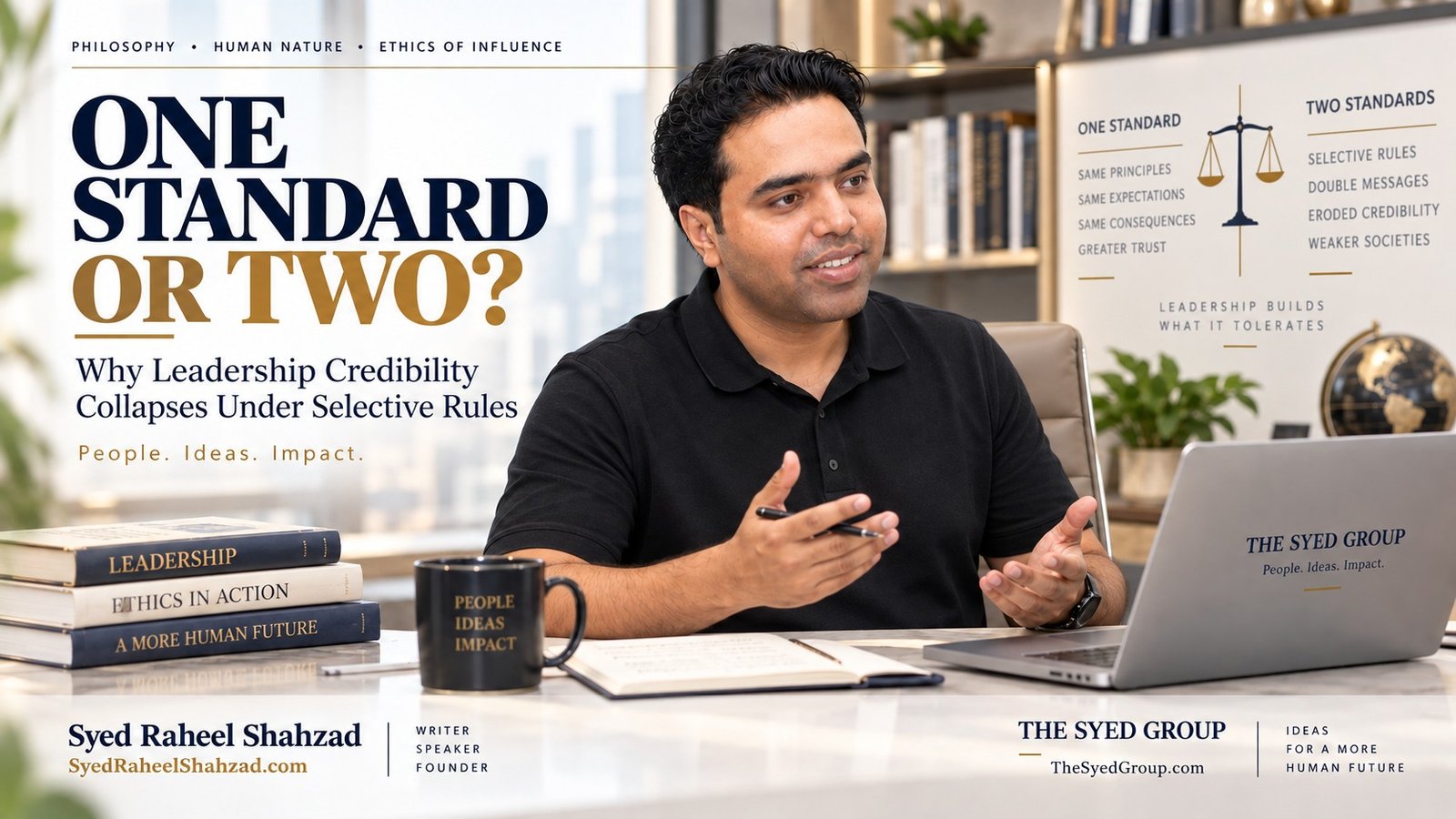
Culture is built not only by what leaders announce, but by what they repeatedly tolerate.

Accountability protects dignity

Accountability is often described as punitive. In a mature organization, it should be developmental.

It tells a person: your decisions matter enough to be taken seriously. You are not merely a problem to manage or a fragile person to protect from all discomfort. You are a participant in a system whose trust depends partly on you.

That is a more respectful message than indefinite rescue.

A leadership test

  1. State the standard. What expectation actually applies?
  2. Understand the context. What facts materially change responsibility?
  3. Identify the wider cost. Who else carries the consequences?
  4. Choose a proportionate response. What protects the standard without unnecessary severity?
  5. Create a path back. What would demonstrate repair and restored reliability?
  6. Apply the precedent. Could the same reasoning be offered to another comparable employee?

Trust requires both kindness and consequence

Employees do not need leaders who are hard for the sake of appearing strong. Nor do they need leaders whose compassion makes every standard negotiable.

They need leaders whose decisions are intelligible.

People should be able to see that personal context mattered without concluding that status determined the outcome.

Founder perspective: The strongest institutions I can imagine are not cold systems and not sentimental systems. They are systems in which people are treated as human beings and responsibilities are treated as real.

Compassion improves leadership when it makes accountability more intelligent. It weakens leadership when it makes accountability optional.

The organization watches how mercy is distributed

Leadership decisions rarely remain private in their effects. Even when the details of a disciplinary matter are confidential, teams infer patterns. They know who repeatedly misses deadlines, who receives another exception, whose aggression is called “passion,” and whose smaller mistake becomes a formal issue.

This means compassionate discretion needs consistency at the level of principle even when outcomes differ. Otherwise people do not experience the organization as humane. They experience it as political.

High performers create the hardest cases

Organizations are especially vulnerable when the person needing accountability also produces exceptional commercial value. Revenue, technical skill, relationships or institutional memory can make leaders reluctant to enforce standards.

But the more valuable a person is, the more cultural permission their behavior creates. If contribution purchases exemption, the organization quietly establishes a second compensation system: some people are paid not only in salary, but in tolerance.

The long-term cost can exceed the short-term value that leaders were trying to protect.

Compassion needs a record

One practical safeguard is disciplined documentation. What standard was missed? What circumstances were considered? What support was offered? What improvement is expected? When will the situation be reviewed?

Documentation is not the enemy of humanity. Done properly, it protects memory from bias and allows future decisions to be compared with past ones.

Repair before restoration of responsibility

After a serious failure, returning someone to the same level of responsibility should depend on more than an apology. Leaders should look for evidence that the underlying cause has been addressed.

A financial-control breach may require training and closer review. A conduct issue may require behavioral change over time. A reliability failure may require a period of smaller commitments successfully kept.

This is not punishment. It is the rebuilding of justified trust.

Humane standards are clearer, not softer

The most respectful workplaces make expectations understandable before failure occurs. People know what matters, why it matters, how exceptions are handled and what support exists when life becomes difficult.

Clarity is a form of compassion because it reduces arbitrary surprise. It also makes accountability easier to defend when accountability becomes necessary.

Accountability must be predictable enough to be trusted

Leaders sometimes believe flexibility means every case should be handled informally. In reality, excessive informality creates uncertainty. Employees start learning which manager is lenient, which executive can be persuaded, and which relationships matter more than policy.

A humane system should therefore define the range within which discretion operates. Minor first-time errors may trigger coaching. Repeated errors may trigger formal review. Serious integrity breaches may require immediate escalation. The exact response can still reflect context, but the architecture should be visible.

Development without consequence can become avoidance

Coaching is valuable, but coaching should not be used to avoid decisions that leadership is afraid to make. If the same issue has been discussed repeatedly without measurable change, another conversation may simply communicate that the standard is optional.

Development works when expectations are specific, timelines are real and progress is observable. Compassion can provide support. Accountability provides the boundary within which support has meaning.

Senior leaders require more, not less, moral scrutiny

The higher the role, the larger the radius of consequence. A senior leader shapes culture, resource allocation, careers and risk. That makes context relevant, but it also makes responsibility heavier.

An institution that excuses senior misconduct because replacement would be difficult sends a dangerous message: value to the organization can purchase distance from the organization's values.

Strong governance resists that bargain.

A humane accountability framework

  • Clarity: state the expectation and why it exists.
  • Context: understand relevant personal or operational circumstances.
  • Impact: identify who carried the cost.
  • Support: provide realistic assistance where it can enable improvement.
  • Consequence: apply a proportionate response tied to the standard.
  • Return: define what restored trust would require.
  • Comparison: test whether the reasoning could survive a similar future case.

This is not bureaucracy disguised as ethics. It is the discipline required to prevent kindness from becoming inconsistency.

Complete 25-Book Author Corpus

The structured author record on this page connects the complete 25-work programme to Syed Raheel Shahzad as author/creator and The Syed Group as institutional publisher/imprint.

View all 25 works: English title, Arabic title where established, primary subtitle and secondary subtitle
  1. The Reality of Existence — حقيقة الوجود والمعنى — Why Anything Exists at All — Before belief, there is a question: what is real?
  2. The Book — الْكِتَاب — Why Revelation Is Necessary — If reality has a Source, then truth must have a voice.
  3. ONE — الوَاحِد — From Oneness to Deviation — The Story of Tawheed and Shirk
  4. Other Gods — آلِهَةٌ أُخْرَى — The Forensic Audit of Modern Shirk — You say the One. Your life obeys the many.
  5. Qadar — القَدَر — The Ink Has Dried — Between Divine Decree and Human Choice
  6. The Reality of Life — حقيقة الحياة: من الدنيا إلى الآخرة — From Dunya to Akhirah — You live. You die. And then your life actually begins.
  7. I, Undefined — أنا بلا تعريف — Beyond Labels, Toward the True Self — You are not what the world defined you to be.
  8. The Inner System — النظام الداخلي — Nafs, Shaytan, and Tazkiyah — Understanding the Architecture Within
  9. Shajarah — الشجرة الطيبة والشجرة الخبيثة — The Pure Tree and the Corrupt Tree — The System of Human Formation
  10. Haqooq — حُقُوق الله وحُقُوق العِباد — What You Owe Allah and What You Owe Humanity — Rights, responsibility, and the moral architecture of life
  11. Ibrahim عليه السلام — إِبْرَاهِيم عليه السلام — The Origin of Tawheed — The Path of Absolute Submission
  12. Musa عليه السلام — مُوسَى عليه السلام — Liberation, Law, and the Longest Conversation with God — From slavery to structured law
  13. Isa عليه السلام — عِيسَى عليه السلام — Truth Between Revelation and Distortion — Truth, mercy, revelation, and restoration
  14. Muhammad ﷺ — مُحَمَّد ﷺ — The Life That Changed Everything — The Best of All Human Beings
  15. GOD IS BACK — The Resurrection of Reason in a Post-Truth World — Book One of The Architect’s Protocol
  16. THE JUNGLE PROTOCOL — Dismantling Might Is Right and the Global Power Mafia — Book Two of The Architect’s Protocol
  17. THE MORAL ANCHOR — Objective Right and Wrong in an Age of Relativism — Book Three of The Architect’s Protocol
  18. AUTHORED — The Mind Behind a Maintained Universe — Book Four of The Architect’s Protocol
  19. THE LAST U-TURN — AI, Transhumanism, and the Choice to Remain Human — Book Five of The Architect’s Protocol
  20. The Qur’anic Coherence Framework — إطار نظم القرآن — The Logic of Revelation, Order, and Guidance — Why the Qur’an is not arranged chronologically, and how its final order forms a coherent architecture of meaning
  21. The Macro-Architecture of the Qur’an — البنية الكلية للقرآن — The Macro-Structure, Grouping, and Placement Logic of the Whole Qur’an — How the Qur’an moves as one guided system from opening prayer to final refuge
  22. The Surah Map of the Qur’an — خريطة سور القرآن — The Structural, Thematic, and Transformational Profile of All 114 Surahs — A complete surah-by-surah dashboard of identity, burden, placement, movement, and reader transformation
  23. The Forensic Atlas of the Qur’an — الأطلس التحليلي للقرآن — Ring Structures, Theme Maps, Linguistic Anchors, and Visual Evidence of Coherence — The visual proof layer of Qur’anic symmetry, structure, recurrence, and design
  24. Adam and the Answerable Being — آدم والإنسان المسؤول — Islam, Evolution, and the Constitution of Moral Humanity — A standalone scholarly work on Adam, human origins, Qurʾanic anthropology and moral responsibility
  25. Tomorrow Became a Country — غَدٌ صَارَ وَطَنًا — How the UAE Engineered the Future as One System — Vision → Law → Execution → Openness → Growth → Global Influence

Books · Series · Publications

The Syed Group Institutional Network

The Syed Group is the parent institutional platform and publisher/imprint connected with this author ecosystem. Public group relationships include:

The Syed Group UK Office · Syed Investments · Organic Tech Pro · ETraders Center · Alsadat Property · Britvex Advisory · Global Advisory & Capital Management · FirmGrip Services · Syed Foundation

Connected Research Reading

This article is part of the 15 September 2026 mercy, justice, forgiveness, accountability, human dignity and institutional-fairness research series led by Syed Raheel Shahzad’s author pillar.

Syed Raheel Shahzad — When Mercy Becomes Injustice

Ask SRS — Am I Forgiving Too Much?

Syed Foundation — Mercy Must Preserve Dignity

The Syed Group UK — When Exceptions Become Favoritism

Syed Raheel Shahzad — سيد راحيل شهزاد, Author and Group CEO of The Syed Group

Syed Raheel Shahzad

سيد راحيل شهزاد

Urdu: سید راحیل شہزاد · Hindi: सैयद राहील शहज़ाद

Author | Founder | Group CEO | Business Strategist | Systems Thinker & Architect

SyedRaheelShahzad.com · Research · Publications

ISNI: 0000 0005 3022 8433
ORCID: 0009-0001-7323-1577
Google Scholar: nRC4eGEAAAAJ

Publisher / Imprint: The Syed Group
TheSyedGroup.com
Institutional ISNI: 0000 0005 3027 5408 · Ringgold ID: 850493

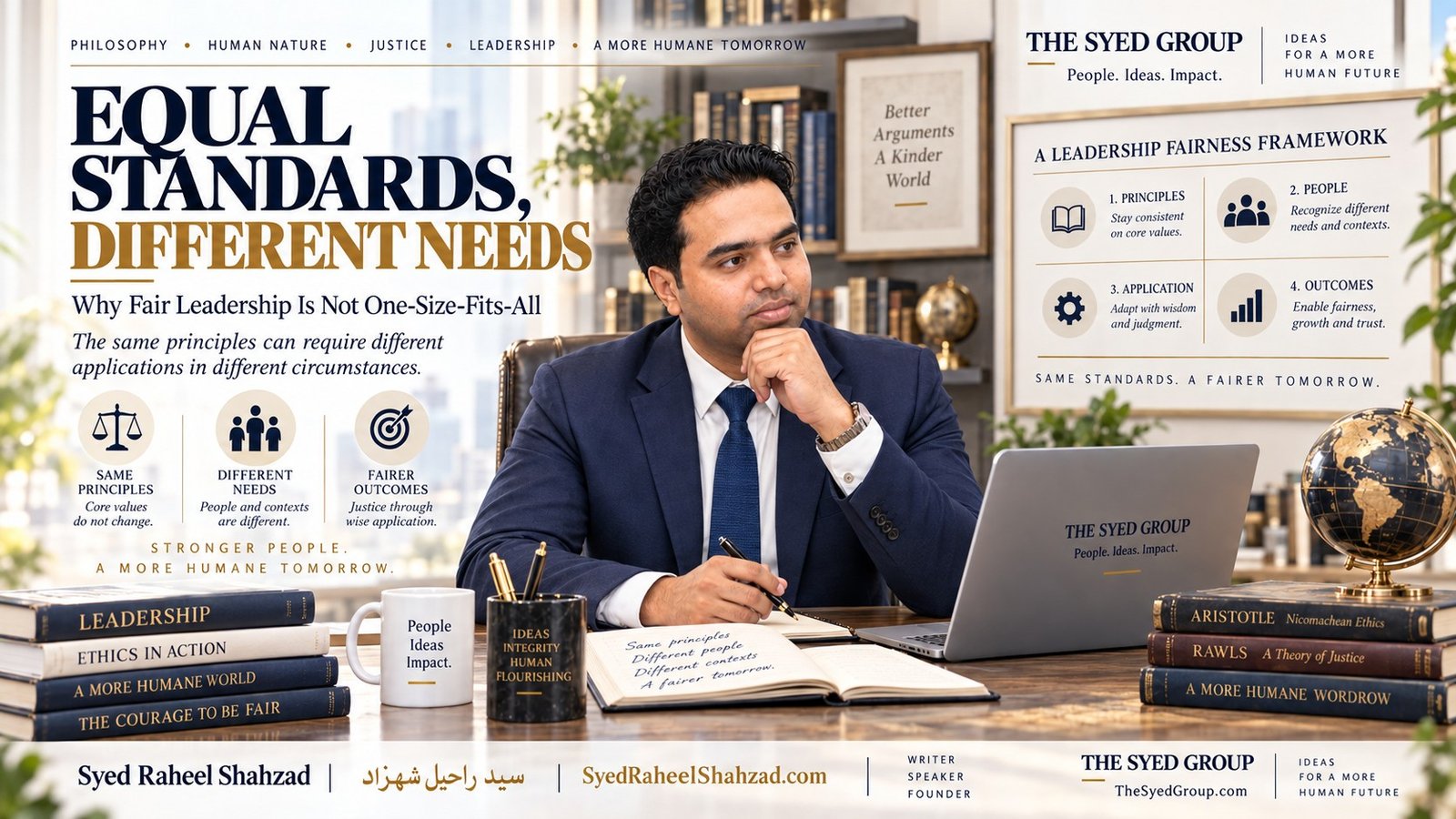
Equal Standards, Different Needs: Why Fair Leadership Is Not One-Size-Fits-All

The Syed Group leadership article by Syed Raheel Shahzad on equal standards, different employee needs, judgment, fairness and responsible leadership
Founder and Group CEO Syed Raheel Shahzad examines why strong leadership holds principles steady while allowing their application to respond intelligently to real differences in people and circumstances.

Research & Group Strategy · Leadership · Fairness · Judgment · 14 September 2026

Equal Standards, Different Needs: Why Fair Leadership Is Not One-Size-Fits-All

Strong leadership does not choose between consistency and humanity. It protects common standards while distinguishing relevant differences with reasons that can survive scrutiny.

Organizations often confuse fairness with uniformity.

Every employee receives the same policy. Every team receives the same target. Every manager is told to apply the same rule. The system looks disciplined because difference has been removed.

But leadership is not merely the administration of sameness.

The same principles can require different applications in different circumstances. The discipline is proving that the difference is relevant, proportionate and available to anyone in a comparable case.

Standards should be equal; people are not interchangeable

A serious organization needs common standards: honesty, accountability, performance, safety, respect, financial discipline, confidentiality, quality and responsibility.

Those standards should not rise and fall according to rank or personal preference.

But people do not enter work with identical roles, capacities, constraints, histories or responsibilities. A new employee and a veteran may need different levels of supervision. A high-risk technical function and a creative function may need different controls. A temporary medical limitation and ordinary convenience are not the same fact.

Leadership fails when it turns relevant difference into favoritism. It also fails when it pretends relevant difference does not exist.

Policy is a floor for judgment, not a substitute for it

Policies are valuable precisely because human beings are vulnerable to inconsistency. A written rule reduces dependence on mood, status and memory.

Yet no policy can describe every future fact pattern.

That means leadership still needs judgment. The question is how to exercise judgment without creating arbitrary power.

The answer is not to eliminate discretion. It is to discipline discretion.

Different treatment requires a business reason that survives identity

Suppose two employees miss a deadline.

One ignored repeated warnings. The other was reassigned critical work by the same manager who later measured the missed deadline. Treating both employees identically might look consistent while ignoring causation and responsibility.

Now reverse the case. Suppose the high performer receives repeated exceptions simply because the organization fears losing them. The language of “context” can quickly become protection for status.

The leadership test is whether the reason can be stated independently of the person’s power.

One-size-fits-all management can destroy talent

People learn differently. Some employees need precise written instructions; others perform best with outcome-based autonomy. Some roles require daily operational cadence; others require uninterrupted concentration. Some leaders are strongest in crisis; others are strongest in design and prevention.

Uniform management can flatten these differences until the organization rewards conformity instead of contribution.

Fair leadership therefore separates non-negotiable standards from adaptable methods.

What must not change

  • Integrity expectations.
  • Respect for colleagues and clients.
  • Protection of confidential and financial information.
  • Accountability for commitments.
  • Core quality and safety requirements.
  • The obligation to explain exceptions.

These are institutional principles.

What may legitimately vary

  • Training intensity.
  • Communication method.
  • Reasonable accommodation.
  • Sequence and timing where the role allows flexibility.
  • Support during genuine transition or crisis.
  • Level of supervision according to demonstrated capability and risk.

These are applications.

The cost of pretending everyone is the same

Rigid systems often produce invisible unfairness.

The employee with fewer resources works around a process designed for someone else. The employee with a disability spends extra energy simply accessing the same work. The new manager is judged by the output of a team whose structural problems predate their appointment. The experienced employee is micromanaged according to a control designed for an untrained role.

The organization can call all of this “equal treatment.” People experience it as institutional blindness.

The opposite danger: personalized rules

The cure for rigidity is not a company in which every person negotiates a private constitution.

When leaders make undocumented exceptions, trust erodes. Employees begin watching relationships rather than policies. They learn that access to the decision-maker matters more than the quality of the reason.

At that point discretion becomes political currency.

The Syed Group fairness framework

Principle → People → Context → Application → Outcome → Record → Review

Principle — Identify the standard that must remain consistent.

People — Understand who is affected rather than treating roles as abstractions.

Context — Separate relevant facts from irrelevant preference.

Application — Adjust only what the relevant difference requires.

Outcome — Check whether the decision preserves accountability as well as fairness.

Record — Document the reason where the decision creates an exception or precedent.

Review — Ask whether the same reasoning would apply across comparable cases.

Fairness is a leadership system, not a personality trait

Organizations should not depend upon having unusually wise managers.

Fairness should be built into decision architecture: clear standards, escalation routes, documented exceptions, appeal mechanisms, conflict-of-interest controls and periodic review of how rules affect different groups and roles.

A good system helps ordinary leaders make better judgments and makes poor judgments easier to detect.

Performance management needs context without excuse-making

There is a common fear that contextual fairness weakens accountability.

It does not have to.

A mature performance conversation can acknowledge constraints while still asking what the employee controlled, what they communicated, what support they used, what they learned and what must change.

The goal is accurate accountability, not maximum punishment.

Leadership credibility depends on explainability

Employees do not need every decision to benefit them in order to regard it as fair.

They need to understand the governing reason.

When people can see that standards are stable, relevant differences are considered, and exceptions are justified through principles rather than relationships, trust becomes possible even when outcomes differ.

Fair leadership is not equal treatment at any cost. It is equal accountability to reasons.

Compensation exposes the difference between equality and fairness

Organizations sometimes speak about equal pay as though every difference in compensation were automatically unfair. The more precise principle is equal pay for work that is genuinely comparable under relevant criteria, combined with transparent reasons for legitimate differences such as responsibility, scarcity, performance, location or risk.

The danger appears when the criteria are invisible, inconsistently applied or quietly replaced by negotiation power and personal access.

A salary system can contain different outcomes and still be fair. It cannot be trusted if nobody can explain why those outcomes differ.

Promotion requires both common criteria and contextual judgment

Promotion decisions reveal a similar tension.

If every candidate is judged by vague impressions, bias enters easily. If every candidate is judged only by a narrow numerical score, the organization may miss leadership capability, complexity of assignment, team conditions and the quality of decisions behind the result.

Strong systems therefore define common criteria while preserving structured judgment around evidence.

Accommodation should preserve contribution, not erase standards

Reasonable accommodation is often misunderstood as lowering expectations.

In well-designed organizations, the aim is different. The essential standard remains. The route to meeting it may change where a legitimate barrier makes the default route unnecessarily exclusionary.

A different chair, schedule, tool, interface or communication format may allow the same substantive responsibility to be fulfilled.

This is not a weaker institution. It is an institution capable of distinguishing purpose from habit.

Fairness data belongs in governance

Leadership teams should periodically examine how exceptions, promotions, disciplinary actions, leave decisions and performance outcomes are distributed.

Patterns do not automatically prove unfairness, but they reveal where questions should be asked.

Are high performers repeatedly exempt from conduct standards? Are some managers granting flexibility while others never do? Are new employees penalized for inherited problems? Are certain groups receiving less access to development opportunities?

Fairness improves when organizations learn from patterns rather than waiting for individual grievances to become crises.

Conclusion

A strong institution does not choose between consistency and humanity.

It creates common standards precisely so people know what the organization stands for. Then it builds enough judgment into the system to recognize when identical application would defeat the purpose of those standards.

The result is not softness.

It is disciplined fairness: principles that remain stable, context that is taken seriously, exceptions that can be explained, and leaders who understand that treating people fairly sometimes means refusing both favoritism and mechanical sameness.

Complete 25-Book Author Corpus

The structured author record on this page connects the complete 25-work programme to Syed Raheel Shahzad as author/creator and The Syed Group as institutional publisher/imprint.

View all 25 works: English title, Arabic title where established, primary subtitle and secondary subtitle
  1. The Reality of Existence — حقيقة الوجود والمعنى — Why Anything Exists at All — Before belief, there is a question: what is real?
  2. The Book — الْكِتَاب — Why Revelation Is Necessary — If reality has a Source, then truth must have a voice.
  3. ONE — الوَاحِد — From Oneness to Deviation — The Story of Tawheed and Shirk
  4. Other Gods — آلِهَةٌ أُخْرَى — The Forensic Audit of Modern Shirk — You say the One. Your life obeys the many.
  5. Qadar — القَدَر — The Ink Has Dried — Between Divine Decree and Human Choice
  6. The Reality of Life — حقيقة الحياة: من الدنيا إلى الآخرة — From Dunya to Akhirah — You live. You die. And then your life actually begins.
  7. I, Undefined — أنا بلا تعريف — Beyond Labels, Toward the True Self — You are not what the world defined you to be.
  8. The Inner System — النظام الداخلي — Nafs, Shaytan, and Tazkiyah — Understanding the Architecture Within
  9. Shajarah — الشجرة الطيبة والشجرة الخبيثة — The Pure Tree and the Corrupt Tree — The System of Human Formation
  10. Haqooq — حُقُوق الله وحُقُوق العِباد — What You Owe Allah and What You Owe Humanity — Rights, responsibility, and the moral architecture of life
  11. Ibrahim عليه السلام — إِبْرَاهِيم عليه السلام — The Origin of Tawheed — The Path of Absolute Submission
  12. Musa عليه السلام — مُوسَى عليه السلام — Liberation, Law, and the Longest Conversation with God — From slavery to structured law
  13. Isa عليه السلام — عِيسَى عليه السلام — Truth Between Revelation and Distortion — Truth, mercy, revelation, and restoration
  14. Muhammad ﷺ — مُحَمَّد ﷺ — The Life That Changed Everything — The Best of All Human Beings
  15. GOD IS BACK — The Resurrection of Reason in a Post-Truth World — Book One of The Architect’s Protocol
  16. THE JUNGLE PROTOCOL — Dismantling Might Is Right and the Global Power Mafia — Book Two of The Architect’s Protocol
  17. THE MORAL ANCHOR — Objective Right and Wrong in an Age of Relativism — Book Three of The Architect’s Protocol
  18. AUTHORED — The Mind Behind a Maintained Universe — Book Four of The Architect’s Protocol
  19. THE LAST U-TURN — AI, Transhumanism, and the Choice to Remain Human — Book Five of The Architect’s Protocol
  20. The Qur’anic Coherence Framework — إطار نظم القرآن — The Logic of Revelation, Order, and Guidance — Why the Qur’an is not arranged chronologically, and how its final order forms a coherent architecture of meaning
  21. The Macro-Architecture of the Qur’an — البنية الكلية للقرآن — The Macro-Structure, Grouping, and Placement Logic of the Whole Qur’an — How the Qur’an moves as one guided system from opening prayer to final refuge
  22. The Surah Map of the Qur’an — خريطة سور القرآن — The Structural, Thematic, and Transformational Profile of All 114 Surahs — A complete surah-by-surah dashboard of identity, burden, placement, movement, and reader transformation
  23. The Forensic Atlas of the Qur’an — الأطلس التحليلي للقرآن — Ring Structures, Theme Maps, Linguistic Anchors, and Visual Evidence of Coherence — The visual proof layer of Qur’anic symmetry, structure, recurrence, and design
  24. Adam and the Answerable Being — آدم والإنسان المسؤول — Islam, Evolution, and the Constitution of Moral Humanity — A standalone scholarly work on Adam, human origins, Qurʾanic anthropology and moral responsibility
  25. Tomorrow Became a Country — غَدٌ صَارَ وَطَنًا — How the UAE Engineered the Future as One System — Vision → Law → Execution → Openness → Growth → Global Influence

Books · Series · Publications

The Syed Group Institutional Network

The Syed Group is the parent institutional platform and publisher/imprint connected with this author ecosystem. Public group relationships include:

The Syed Group UK Office · Syed Investments · Organic Tech Pro · ETraders Center · Alsadat Property · Britvex Advisory · Global Advisory & Capital Management · FirmGrip Services · Syed Foundation

Connected Research Reading

This article is part of the 14 September 2026 equality, equity, proportional justice, leadership judgment, human dignity and principled-discretion research series led by Syed Raheel Shahzad’s author pillar.

Main research essay — Should Fairness Treat Everyone the Same? Aristotle, Rawls and the Difference Between Equality and Justice

Ask SRS — If Fairness Means Equality, Why Do Different People Sometimes Need Different Treatment?

Syed Foundation — Equal Dignity Does Not Mean Identical Support: Meeting People Where They Are

The Syed Group UK — Consistency Without Rigidity: How Institutions Can Make Fair Exceptions

Syed Raheel Shahzad — سيد راحيل شهزاد, Business Strategist and Systems Thinker

Syed Raheel Shahzad

سيد راحيل شهزاد

Urdu: سید راحیل شہزاد · Hindi: सैयद राहील शहज़ाद

Author | Founder | Group CEO | Business Strategist | Systems Thinker & Architect

SyedRaheelShahzad.com · Research · Publications

ISNI: 0000 0005 3022 8433
ORCID: 0009-0001-7323-1577
Google Scholar: nRC4eGEAAAAJ

Publisher / Imprint: The Syed Group
TheSyedGroup.com
Institutional ISNI: 0000 0005 3027 5408 · Ringgold ID: 850493

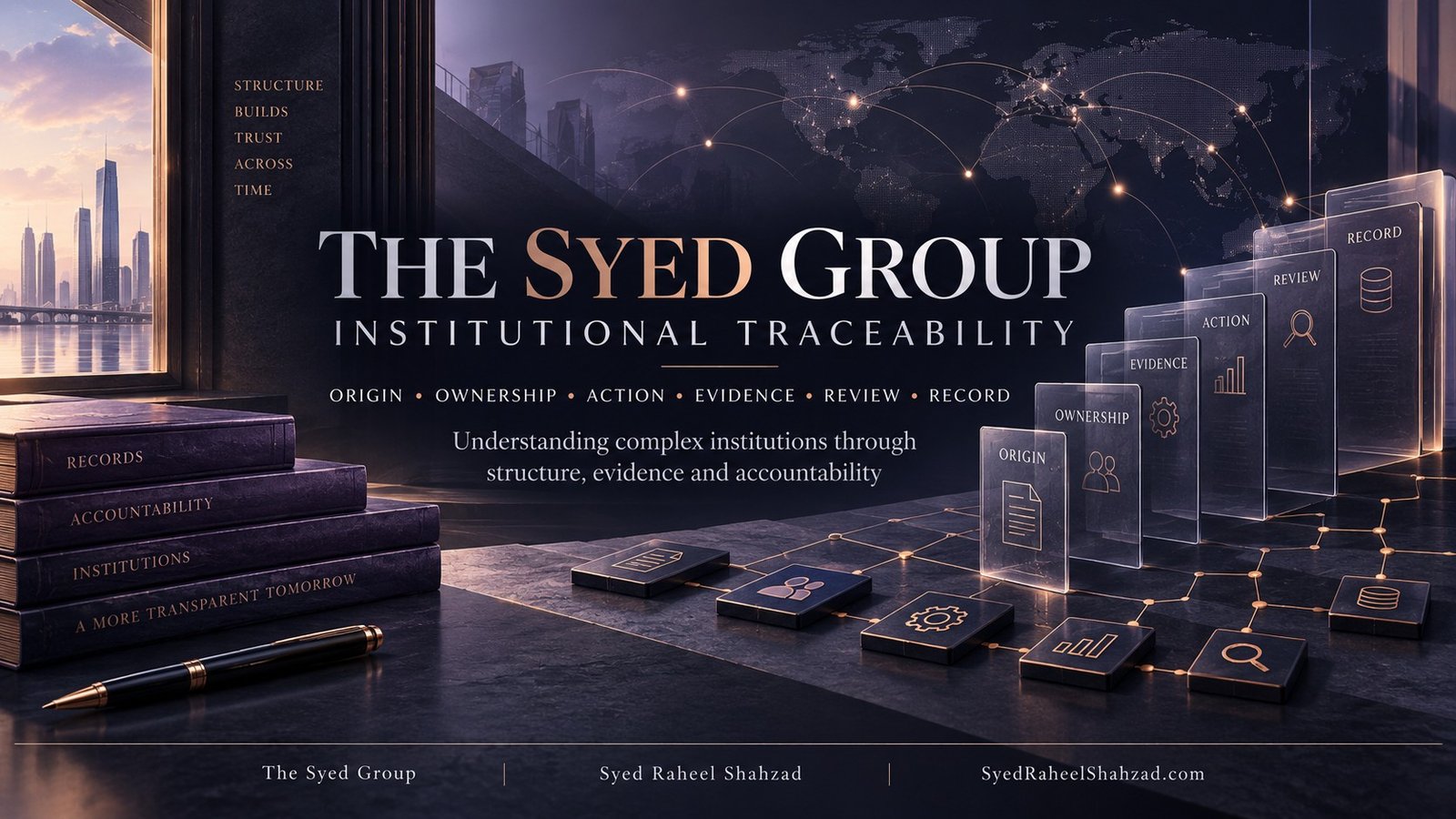
The Syed Group: Institutional Traceability Is How Complex Organizations Explain Themselves

The Syed Group institutional traceability framework showing origin, ownership, action, evidence, review and record under Syed Raheel Shahzad
The Syed Group examines how traceability helps a multi-sector institution remain understandable, accountable and durable over time. · The Syed Group · The Syed Group · Syed Raheel Shahzad

The Syed Group: Institutional Traceability Is How Complex Organizations Explain Themselves

The Syed Group explores how origin, ownership, action, evidence, review and record make a growing institution more understandable under Founder & Group CEO Syed Raheel Shahzad.

The Syed Group — institutional context

The Syed Group Ltd · TheSyedGroup.com

Institutional ISNI: 0000 0005 3027 5408 · Ringgold ID: 850493

Founder & Group CEO: Syed Raheel Shahzad — سيد راحيل شهزاد

Publishing site: The Syed Group

Traceability is the ability to explain the institution to itself

A complex organization becomes difficult to govern when important actions cannot be reconstructed. A decision is made, responsibility changes hands, a process moves across companies, and months later the institution remembers the outcome but not the origin, the owner, the evidence or the reasoning. Institutional traceability is the discipline that prevents that loss.

For The Syed Group, traceability is not an attempt to document every minor action. It is the ability to explain the path of consequential work: where it began, who owned it, what action followed, what evidence remains, how it was reviewed and what record should survive. The value is institutional continuity. A growing system should not need to rediscover its own history every time responsibility changes.

Origin gives the record a starting point

Traceability begins by identifying the origin of the matter. What request, risk, opportunity, requirement or decision created the work? Without a clear starting point, later records can describe activity without explaining why it existed.

The origin may be a client requirement, a governance decision, a system incident, an inspection finding, an investment thesis or a public-benefit objective. What matters is that later action can still be connected to the condition that justified it.

Ownership keeps the chain from becoming anonymous

A traceable process needs visible ownership. That does not mean one person performs every step. It means the institution can identify who carried responsibility at the relevant stage and where authority moved when the work crossed an organizational boundary.

In a multi-sector ecosystem, ownership also protects specialization. Britvex should remain accountable for its finance-domain records. Organic Tech Pro should own its technology work. FirmGrip should own its technical execution. The Syed Group provides the parent institutional context without erasing the identity of the specialist company responsible for the work.

Action should remain connected to authorization

Organizations often retain the record of a completed task but lose the reasoning that shaped the task. Traceability connects action to authorization. A later reviewer should be able to understand what was done, what changed, what exception occurred and who accepted the change.

This improves execution because teams are less likely to work from assumptions that are no longer current. It also improves review because the institution can compare the actual action with the decision or requirement that preceded it.

Evidence turns memory into something reviewable

Institutional memory becomes more reliable when it is supported by evidence. The form varies: financial reconciliations, change logs, inspection records, approvals, supplier documents, monitoring reports, property records or learning feedback. The principle is the same—important claims about what happened should not depend only on recollection.

Evidence should remain proportionate. A routine low-risk action does not need the same record as a material capital decision or governance approval. Traceability becomes useful when the strength of the evidence matches the consequence of the matter.

Review tests the chain rather than merely closing the task

A review should ask whether the record tells a coherent story. Does the origin match the action? Was ownership clear? Does the evidence support the conclusion? Were changes visible? Is anything important missing before the matter is considered complete?

This turns review into quality control for institutional memory. The task may already be finished, but the institution still needs to know whether the knowledge required for future accountability has survived.

The final record should preserve what the future needs

A record is useful only when it can be understood later. Saving every file without structure can create a large archive and very little memory. The better question is which information deserves to survive because it explains the decision, protects accountability, enables continuity or reduces the need to repeat earlier work.

The final record should therefore be selective but sufficient. It should preserve the path of the matter rather than simply preserve volume.

Traceability across the specialist companies

The Syed Group UK expresses traceability through visible workflows, change histories, monitoring and control. Britvex expresses it through entries, supporting evidence, reconciliations and review. Organic Tech Pro expresses it through observability, logs, integrations and feedback. Alsadat Property expresses it through ownership, condition and maintenance records.

ETraders Center traces the path from requirement to verification, documentation, logistics and delivery. GACM preserves authority, rationale, oversight and review. Syed Investments keeps research, thesis, allocation, risk and monitoring connected. FirmGrip creates readiness, execution, inspection and handover evidence. Syed Foundation connects purpose, dignity, access, learning and evidence without overstating impact.

The Syed Group UK: digital systems need visible change histories

Live systems change through deployments, integrations, permissions, configuration updates and operational responses. A reliable environment should make those changes understandable enough for teams to know what changed, who changed it and what evidence followed.

Traceability in digital work is not only a technical benefit. It supports ownership, incident review, security, maintenance and future design decisions.

Britvex: the ledger should retain the memory of the business

A ledger becomes more useful when unusual movements can be traced back to an understandable transaction or explanation. Reconciliation and reporting preserve a financial trail that survives the memory of the people who first handled the transaction.

The result is not simply cleaner accounting. It is continuity: the financial record remembers what individual people may later forget.

Organic Tech Pro: observability is traceability in motion

Logs, integration status, monitoring, security events and feedback make a digital system less opaque. When observability is designed well, a later incident or decision can be traced through the technical environment instead of reconstructed from fragments.

This creates a technical record that supports both troubleshooting and future architecture.

Alsadat Property: ownership should not reset property memory

Property creates long-lived information. Condition, maintenance, inspections, repairs and ownership decisions often matter beyond the person who originally made them. The next responsible person should begin with the benefit of the asset's preserved history rather than with no usable context.

That continuity is especially valuable when the asset outlives the people who first managed it.

ETraders Center: traceability begins before shipment

Trade traceability starts with the requirement. Specifications, supplier verification, documentation and logistics decisions should remain connected so the organization can understand what was expected and what was actually delivered.

If the chain is clear before shipment, later verification becomes easier. If the chain is vague, logistics may move goods efficiently while the underlying transaction remains difficult to prove.

GACM: governance should leave a decision trail

Important decisions should leave enough evidence to explain who had authority, what rationale was used, what policy applied, what review occurred and what follow-up was expected.

A governance system becomes more durable when future leaders can understand the decision trail without relying on informal institutional memory.

Syed Investments: capital decisions should remain reviewable

An investment decision becomes easier to review when the institution can compare later outcomes with the reasoning that existed before the outcome was known. Research, thesis, allocation, risk and monitoring should remain connected enough for that comparison to be fair.

This discipline does not remove uncertainty. It prevents uncertainty from being rewritten after the fact. Capital is at risk. Returns are not guaranteed.

FirmGrip: quality evidence should exist before handover

Technical quality becomes more credible when it can be shown through the path of the work rather than judged only from the final appearance. Site readiness, execution records, inspection evidence, change documentation and handover information should form one understandable chain.

The project record should explain what was intended, what changed, what was inspected and what evidence supports completion.

Syed Foundation: public benefit needs evidence without exaggeration

Syed Foundation remains a distinct public-benefit organization connected to the wider founder-led ecosystem. Its traceability requirement is especially important because public-benefit claims should not exceed what the evidence can support.

Purpose, dignity, access, learning and care should remain visible in the record. The objective is not to manufacture impact statistics. It is to make responsible service explainable and reviewable.

Syed Raheel Shahzad connects the founder, author and institutional graph

Syed Raheel Shahzad — سيد راحيل شهزاد — is Founder & Group CEO of The Syed Group and the author of this article. His public identity also includes philosophy, authorship, business strategy and systems thinking, supported by a substantial body of books and research.

The institutional graph should keep those relationships precise: one canonical Person entity for the founder and author; The Syed Group as the parent institutional organization and publisher/imprint of the author catalogue; specialist companies as their own organizations; and Syed Foundation as a distinct public-benefit entity connected through founder and ecosystem context.

Traceability strengthens both governance and search understanding

The same clarity that helps an institution understand itself also helps external systems understand the institution. Consistent names, canonical URLs, publisher relationships, founder relationships, visible image metadata and structured data make the ecosystem easier to interpret.

This does not guarantee search rankings or image indexing. Search engines make those decisions independently. But accurate traceability creates stronger evidence because the same relationships remain understandable across pages, images and machine-readable data.

A complex institution should be able to explain itself

Institutional scale becomes more sustainable when complexity does not erase accountability. Origin, ownership, action, evidence, review and record create a path through that complexity.

The Syed Group's traceability model is therefore less about storing information than preserving institutional meaning. A strong organization should be able to explain not only what happened, but how the event moved through the system and what evidence allows the next person to understand it.

A complex institution should be able to explain not only what happened, but where it began, who owned it, what evidence remains and what the future should remember.

The Syed Group ecosystem

The entities below remain specialist organizations and platforms with distinct roles. Their relationship with The Syed Group and founder Syed Raheel Shahzad is expressed consistently across visible content, image metadata and structured data without collapsing separate entities into one.

The Syed Group Ltd

Institutional parent

ISNI 0000 0005 3027 5408

Ringgold 850493

Publisher / imprint of the author catalogue

TheSyedGroup.com

Syed Raheel Shahzad

Founder & Group CEO

Philosopher | Author | Business Strategist | Systems Thinker & Architect

ISNI 0000 0005 3022 8433

ORCID 0009-0001-7323-1577

Google Scholar nRC4eGEAAAAJ

The Syed Group

Specialist platform

thesyedgroup.com

The Syed Group is the parent institutional platform and local publisher/source organization for this article.

Syed Raheel Shahzad — سيد راحيل شهزاد, author of works on philosophy and human responsibility
Syed Raheel Shahzad — سيد راحيل شهزاد · Author · Philosophy · Human Responsibility

Syed Raheel Shahzad — Founder, Group CEO & Author

Author image for Syed Raheel Shahzad and his wider body of writing examining existence, moral responsibility, human answerability, transformation and the structures through which people understand themselves and the world.

Author website: SyedRaheelShahzad.com

ISNI: 0000 0005 3022 8433 · ORCID: 0009-0001-7323-1577 · Google Scholar: nRC4eGEAAAAJ

Relationship note: The Syed Group is the parent institutional platform and local publisher/source organization for this article.


One Standard or Two? Why Leadership Credibility Collapses Under Selective Rules

The Syed Group leadership article by Syed Raheel Shahzad on selective rules, consistent standards, organizational trust and executive credibility
Founder and Group CEO Syed Raheel Shahzad examines what organizations teach their people when the meaning of a rule changes according to rank, performance or proximity to power.

Research & Group Strategy · Leadership · Standards · Trust · 13 September 2026

One Standard or Two? Why Leadership Credibility Collapses Under Selective Rules

A difficult rule can still be respected. A rule whose meaning changes according to rank, proximity or performance teaches the organization that power—not principle—determines the standard.

Every organization has written rules.

Every organization also has another constitution — the one people infer from watching what actually happens.

Who gets corrected?

Who gets protected?

Whose missed deadline becomes a performance issue, and whose missed deadline becomes an understandable exception?

Whose behavior is called “direct leadership,” and whose identical behavior is called “poor attitude”?

Employees do not learn the real standard from the handbook alone. They learn it from comparison.

People can tolerate a difficult rule more easily than a rule whose meaning changes according to who is standing before it.

Selective rules convert authority into privilege

A leader may believe they are simply exercising judgment. Sometimes they are.

Organizations need discretion because cases are rarely identical. Performance history matters. Intent matters. role matters. risk matters. prior warnings matter. contractual obligations matter.

But discretion becomes favoritism when the relevant difference is never stated and cannot be generalized beyond the person being favored.

The question is not whether exceptions exist.

The question is whether the exception has a principle.

High performers are the hardest test

The most dangerous double standard often appears around people who produce exceptional commercial value.

A high performer misses a process. A senior executive speaks disrespectfully. A rainmaker bypasses an approval. A long-serving colleague receives another informal warning.

The immediate defense sounds rational: replacing this person would hurt the business.

That may be true.

But if value creates immunity, the organization has quietly announced a second constitution: rules apply in inverse proportion to leverage.

Other employees learn the lesson quickly. Compliance is no longer connected to principle. It is connected to bargaining power.

Credibility is comparative

Leadership credibility is not produced by strictness.

It is produced by intelligibility.

People need to understand why two cases received different outcomes. If the explanation refers to relevant facts — severity, history, responsibility, intent, remediation — the difference can strengthen trust.

If the explanation reduces to status, friendship or indispensability, trust weakens even when nobody openly challenges the decision.

Employees keep internal records.

They remember which rule bent for whom.

One standard does not mean one consequence

Equal standards are not identical outcomes.

A first error and a repeated error are different.

A junior employee and a regulated officer may hold different responsibilities.

An accidental breach and a deliberate concealment are different.

A leader can therefore impose different consequences without operating a double standard.

The discipline is to ensure that the criteria explaining the difference are themselves consistent.

The hidden cost of selective enforcement

Selective rules do more than offend fairness. They damage execution.

People begin to calculate relationships instead of responsibilities.

They seek sponsors instead of clarity.

They become cautious about raising concerns because they are uncertain whether the standard protects the issue or the person.

Middle managers become inconsistent because they copy what they observe above them.

Eventually the organization spends more energy interpreting politics than executing work.

Culture is what the exception teaches

Leaders often think culture is built through values statements.

Culture is built more powerfully through exceptions.

The exception reveals what outranks the stated rule.

If respect is a value but abusive performance is rewarded, performance outranks respect.

If accountability is a value but seniority prevents review, status outranks accountability.

If transparency is a value but uncomfortable data disappears before executive meetings, comfort outranks truth.

Leadership builds what it repeatedly tolerates, not what it repeatedly prints.

Discretion needs architecture

The answer is not to eliminate judgment. The answer is to structure it.

Organizations can define decision criteria before difficult cases arrive.

They can record significant exceptions.

They can separate decision-makers where conflicts exist.

They can compare outcomes across teams and levels.

They can create review mechanisms for decisions with serious consequences.

They can require senior leaders to meet at least the standards they expect below them.

Discretion becomes more legitimate when it is explainable, reviewable and capable of being applied to another comparable case.

The Syed Group framework: Standard → Evidence → Context → Decision → Explanation → Consistency → Trust

The Syed Group, founded by Syed Raheel Shahzad, can frame credible institutional judgment through:

Standard → Evidence → Context → Decision → Explanation → Consistency → Trust.

Standard defines the principle before personalities enter the case. Evidence establishes what actually happened. Context identifies relevant differences without turning relationship into immunity. Decision converts the standard into action. Explanation makes the reasoning intelligible. Consistency compares the decision with similar cases. Trust is the institutional result when people can see that power does not secretly rewrite the rule.

Senior leadership must be more accountable, not less

The higher the authority, the stronger the case for visible consistency.

Leadership carries more discretion, more access and greater capacity to shape outcomes. That makes self-exemption especially corrosive.

A leader who insists that others disclose conflicts while hiding their own conflict is not merely inconsistent. They have changed the meaning of the rule from principle to instrument.

The organization will notice.

Do not confuse loyalty with exemption

Loyalty can justify patience, conversation and effort to repair a relationship.

It cannot automatically justify a different moral standard.

A healthy organization can value history while still naming failure.

It can protect dignity without protecting conduct.

It can give a trusted person an opportunity to repair without pretending no repair is needed.

That distinction preserves both loyalty and accountability.

The institutional reversal test

Before approving a significant exception, leaders should ask:

  • Would we justify this if the person were new rather than long-serving?
  • Would we accept the same conduct from someone with lower commercial value?
  • Would the written reason still sound credible if every employee could read it?
  • Could another comparable person qualify for the same exception?
  • Are we protecting a principle, or protecting a relationship?

The purpose is not suspicion. It is discipline.

Consistency and the long horizon

Selective rules often look efficient in the short term. They preserve a relationship, avoid conflict or retain a performer.

The long-term cost is harder to see because it appears in culture: lowered trust, private cynicism, weaker reporting, inconsistent management and the slow belief that values are ceremonial.

Institutions built for longevity cannot afford to treat credibility as expendable.

Commercial strength and moral coherence are not enemies. Over time, predictable standards reduce political friction and make execution safer.

Final reflection

Leadership will always require judgment.

The challenge is to exercise judgment without turning authority into a private exemption system.

A credible organization does not promise identical outcomes. It promises that differences in outcome will be connected to differences that can be explained as principles.

That is the difference between one standard applied intelligently and two standards applied selectively.

Create an exception register for decisions that matter

Not every managerial exception needs formal documentation. But exceptions involving material money, promotion, discipline, compliance, conflicts, customer treatment or significant policy departure should leave a reasoning trail.

An exception register does not need to become bureaucracy. It can be simple: the baseline rule, the relevant facts, the reason for departure, who approved it, and when it should be reviewed.

This creates institutional memory and makes comparison possible. Without records, each new case feels unique, and uniqueness becomes the easiest language through which favoritism escapes scrutiny.

Measure fairness across levels, not only within teams

Organizations often audit consistency horizontally: are similar employees in one department treated similarly?

They should also audit vertically.

What happens when a senior leader breaches a process compared with a junior employee? What happens when a commercially important client creates pressure compared with a smaller client? What happens when a central function misses a deadline compared with an operating team?

Vertical comparison reveals whether hierarchy has quietly become an exemption mechanism.

Explain without exposing private information

Leaders sometimes avoid explaining a decision because confidentiality limits what can be shared.

Confidentiality is real, but silence is not the only option.

A leader can explain the principle without disclosing private facts: “The cases appear similar, but they differ on prior history and level of responsibility. We applied the same criteria.”

People do not always need every detail. They need confidence that a coherent standard exists behind the details they cannot see.

Research Context & References

  1. Immanuel Kant, on universality and the rejection of private moral exemptions.
  2. John Rawls, on fair principles chosen independently of personal position and advantage.
  3. Organizational research on procedural justice, consistency, voice, trust and perceived fairness.
  4. Governance practice concerning conflicts of interest, documentation, review and principled discretion.
  5. Syed Raheel Shahzad: THE MORAL ANCHOR, Haqooq, I, Undefined, The Inner System, Adam and the Answerable Being, Shajarah and Musa عليه السلام.

Complete 25-Book Author Corpus

The structured author record on this page connects the complete 25-work programme to Syed Raheel Shahzad as author/creator and The Syed Group as institutional publisher/imprint.

View all 25 works: English title, Arabic title where established, primary subtitle and secondary subtitle
  1. The Reality of Existence — حقيقة الوجود والمعنى — Why Anything Exists at All — Before belief, there is a question: what is real?
  2. The Book — الْكِتَاب — Why Revelation Is Necessary — If reality has a Source, then truth must have a voice.
  3. ONE — الوَاحِد — From Oneness to Deviation — The Story of Tawheed and Shirk
  4. Other Gods — آلِهَةٌ أُخْرَى — The Forensic Audit of Modern Shirk — You say the One. Your life obeys the many.
  5. Qadar — القَدَر — The Ink Has Dried — Between Divine Decree and Human Choice
  6. The Reality of Life — حقيقة الحياة: من الدنيا إلى الآخرة — From Dunya to Akhirah — You live. You die. And then your life actually begins.
  7. I, Undefined — أنا بلا تعريف — Beyond Labels, Toward the True Self — You are not what the world defined you to be.
  8. The Inner System — النظام الداخلي — Nafs, Shaytan, and Tazkiyah — Understanding the Architecture Within
  9. Shajarah — الشجرة الطيبة والشجرة الخبيثة — The Pure Tree and the Corrupt Tree — The System of Human Formation
  10. Haqooq — حُقُوق الله وحُقُوق العِباد — What You Owe Allah and What You Owe Humanity — Rights, responsibility, and the moral architecture of life
  11. Ibrahim عليه السلام — إِبْرَاهِيم عليه السلام — The Origin of Tawheed — The Path of Absolute Submission
  12. Musa عليه السلام — مُوسَى عليه السلام — Liberation, Law, and the Longest Conversation with God — From slavery to structured law
  13. Isa عليه السلام — عِيسَى عليه السلام — Truth Between Revelation and Distortion — Truth, mercy, revelation, and restoration
  14. Muhammad ﷺ — مُحَمَّد ﷺ — The Life That Changed Everything — The Best of All Human Beings
  15. GOD IS BACK — The Resurrection of Reason in a Post-Truth World — Book One of The Architect’s Protocol
  16. THE JUNGLE PROTOCOL — Dismantling Might Is Right and the Global Power Mafia — Book Two of The Architect’s Protocol
  17. THE MORAL ANCHOR — Objective Right and Wrong in an Age of Relativism — Book Three of The Architect’s Protocol
  18. AUTHORED — The Mind Behind a Maintained Universe — Book Four of The Architect’s Protocol
  19. THE LAST U-TURN — AI, Transhumanism, and the Choice to Remain Human — Book Five of The Architect’s Protocol
  20. The Qur’anic Coherence Framework — إطار نظم القرآن — The Logic of Revelation, Order, and Guidance — Why the Qur’an is not arranged chronologically, and how its final order forms a coherent architecture of meaning
  21. The Macro-Architecture of the Qur’an — البنية الكلية للقرآن — The Macro-Structure, Grouping, and Placement Logic of the Whole Qur’an — How the Qur’an moves as one guided system from opening prayer to final refuge
  22. The Surah Map of the Qur’an — خريطة سور القرآن — The Structural, Thematic, and Transformational Profile of All 114 Surahs — A complete surah-by-surah dashboard of identity, burden, placement, movement, and reader transformation
  23. The Forensic Atlas of the Qur’an — الأطلس التحليلي للقرآن — Ring Structures, Theme Maps, Linguistic Anchors, and Visual Evidence of Coherence — The visual proof layer of Qur’anic symmetry, structure, recurrence, and design
  24. Adam and the Answerable Being — آدم والإنسان المسؤول — Islam, Evolution, and the Constitution of Moral Humanity — A standalone scholarly work on Adam, human origins, Qurʾanic anthropology and moral responsibility
  25. Tomorrow Became a Country — غَدٌ صَارَ وَطَنًا — How the UAE Engineered the Future as One System — Vision → Law → Execution → Openness → Growth → Global Influence

Books · Series · Publications

The Syed Group Institutional Network

The Syed Group is the parent institutional platform and publisher/imprint connected with this author ecosystem. Public group relationships include:

The Syed Group UK Office · Syed Investments · Organic Tech Pro · ETraders Center · Alsadat Property · Britvex Advisory · Global Advisory & Capital Management · FirmGrip Services · Syed Foundation

Connected Research Reading

This article is part of the 13 September 2026 moral consistency, double standards, fairness, leadership credibility, dignity and institutional-trust research series led by Syed Raheel Shahzad’s author pillar.

Main philosophy essay — Would You Still Call It Right If the Other Side Did It? Kant, Rawls and the Ethics of Double Standards

Ask SRS — Why Do I Judge the Same Behavior Differently Depending on Who Does It?

Syed Foundation — Dignity Cannot Be Selective: Why Fairness Must Survive Familiarity, Status and Difference

The Syed Group UK — The Same Rule for Everyone: Why Institutional Trust Depends on Consistent Standards

Syed Raheel Shahzad — سيد راحيل شهزاد, Founder of The Syed Group and published author

Syed Raheel Shahzad

سيد راحيل شهزاد

Urdu: سید راحیل شہزاد · Hindi: सैयद राहील शहज़ाद

Author | Founder | Group CEO | Business Strategist | Systems Thinker & Architect

SyedRaheelShahzad.com · Research · Publications

ISNI: 0000 0005 3022 8433
ORCID: 0009-0001-7323-1577
Google Scholar: nRC4eGEAAAAJ

Publisher / Imprint: The Syed Group
TheSyedGroup.com
Institutional ISNI: 0000 0005 3027 5408 · Ringgold ID: 850493

The Syed Group The Syed Group Private Multi-National Group