
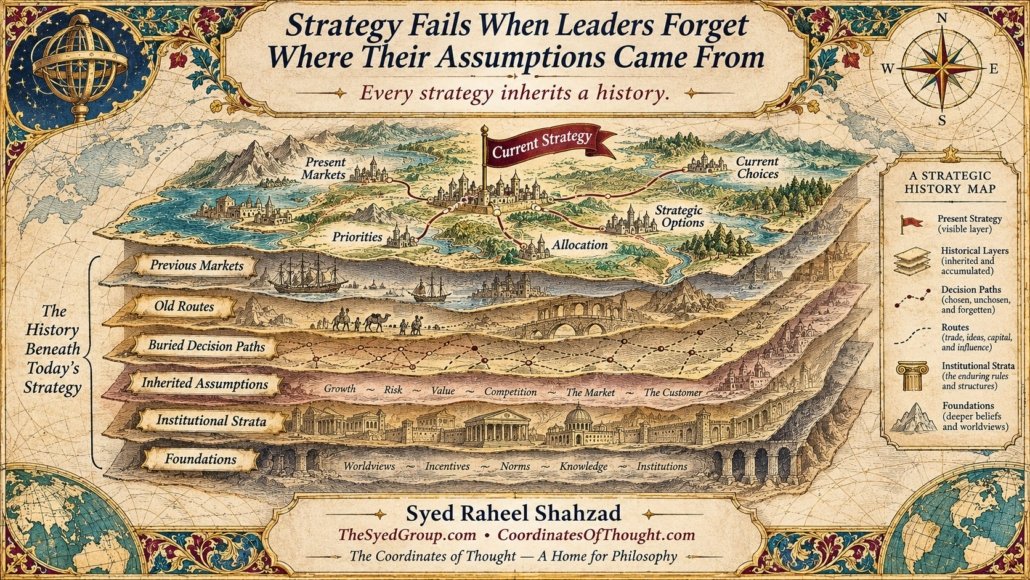
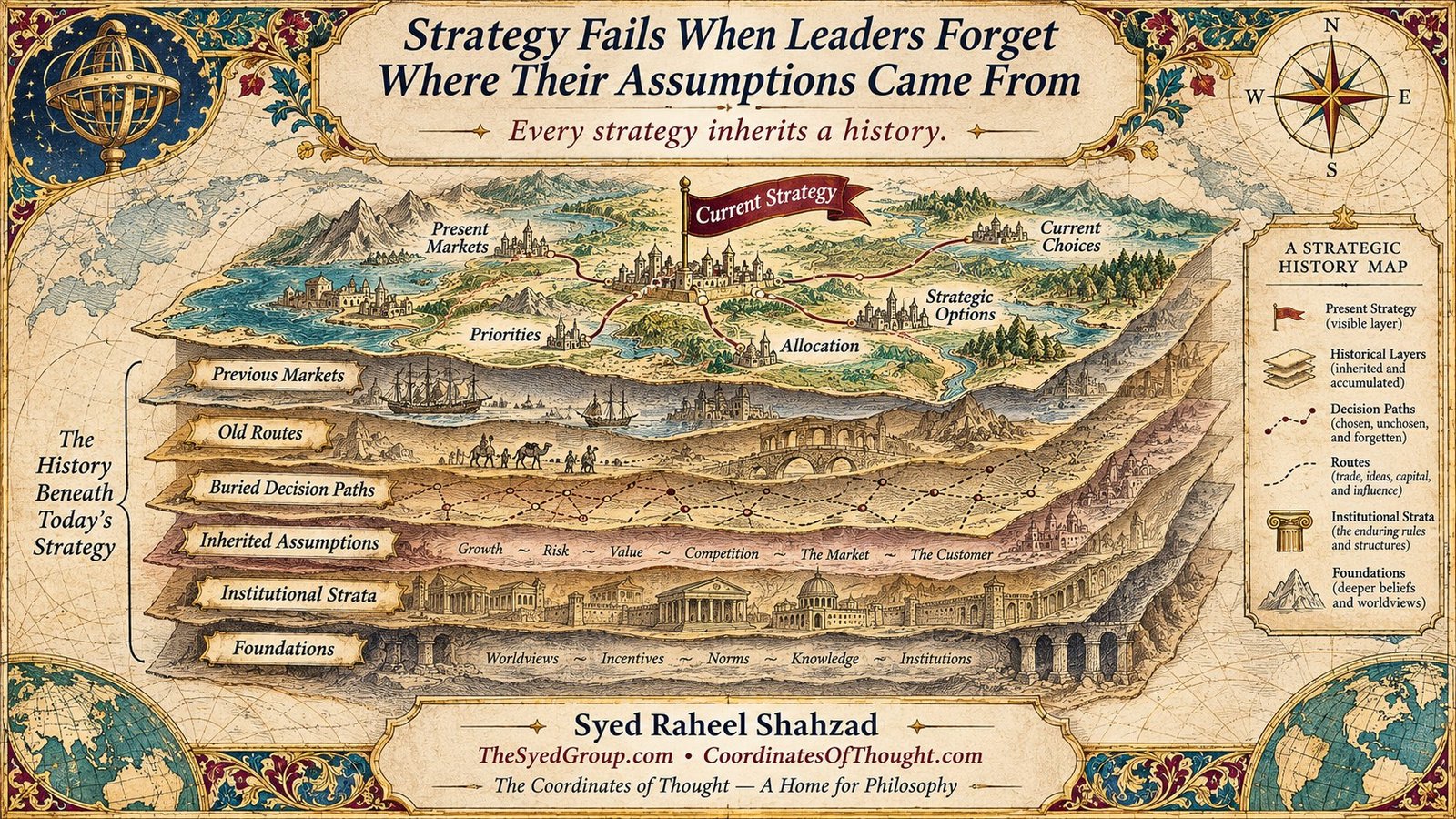
Strategy Fails When Leaders Forget Where Their Assumptions Came From
Strategy · Systems Thinking · Assumptions · Path Dependence · Institutional Memory
Strategy Fails When Leaders Forget Where Their Assumptions Came From
A strategy can be perfectly rational inside assumptions that no longer belong to the world in which the organization now operates.

Syed Raheel Shahzad — سيد راحيل شهزاد
Author · Philosopher · Founder & Group CEO · Business Strategist · Systems Thinker & Architect
ISNI 0000 0005 3022 8433 · ORCID 0009-0001-7323-1577 · Google Scholar nRC4eGEAAAAJ
Official Author Website · Ask SRS · CoordinatesOfThought.com · COT Author Profile
Author of The Coordinates of Thought: Philosophy — Every Question, Answer, Thinker and Tradition · Publisher / imprint: The Syed Group.
Every strategy sits on buried layers
Organizations like to describe strategy as a response to the present: current customers, current competitors, current technology, current capital and current regulation.
But the present strategy is usually standing on older layers.
A pricing rule may come from a crisis that ended years ago. A risk threshold may have been designed after one exceptional loss. A reporting line may reflect the strengths of a founder who is no longer involved. A market assumption may belong to a period when customers had fewer choices. A technology policy may reflect systems that have already been replaced.
Strategy fails when an inherited assumption continues to govern after the conditions that produced it have disappeared.
Assumptions become invisible when they become routine
The most dangerous strategic assumptions are rarely written in the strategy document.
They appear as phrases such as “our customers expect,” “this market always,” “we cannot,” “regulators will never,” “our people are not ready,” or “this is how the industry works.”
Sometimes these statements are true. But once they become habitual, they stop being tested.
Recover the origin of the rule
When a rule creates friction, leaders usually ask whether the rule should be changed.
Ask one question first: why was the rule created?
There may have been a real problem that is now forgotten. Removing the rule without recovering its origin can recreate the original failure. But preserving it without checking whether the problem still exists can turn yesterday’s protection into today’s constraint.
Institutional memory gives strategy the context needed to know the difference.
Path dependence is not destiny
Organizations become path-dependent because each decision changes the options available next.
A technology stack creates skills and integrations. A distribution model creates relationships. An acquisition creates structures. A pricing model shapes customer expectations. Each choice makes some future moves easier and others more expensive.
Understanding the path does not mean the organization must stay on it.
It means leadership should know the switching cost before declaring the old route irrational.
Founders leave assumptions as well as culture
Founders often solve early problems through personal judgment. Over time, those judgments become procedures.
The organization may preserve the procedure after forgetting the founder’s reasoning.
This is where myth begins. “We have always done it this way” replaces the actual historical explanation.
Good governance separates respect for origin from obedience to origin.
Crises create long shadows
A crisis can teach an organization something valuable. It can also make one exceptional event dominate future judgment.
After a fraud, controls may multiply. After a cash crisis, investment may become culturally suspect. After a failed launch, experimentation may be treated as recklessness.
The lesson must be preserved, but it must be named accurately.
What exactly failed? Under which conditions? Which control addresses that failure? When should the lesson be reviewed?
Benchmarking can import somebody else’s history
When leaders copy a competitor’s practice, they often copy the visible answer without the historical conditions that made the answer rational.
The competitor may have different capabilities, customers, regulation, capital, data, brand or risk tolerance.
A strategy is not portable merely because it is successful.
This is the business version of intellectual context: an answer can make sense where it emerged and fail when transplanted without its supporting system.
The Strategy Archaeology Review
For any major inherited assumption, ask:
- When did we begin believing this?
- What event or evidence produced it?
- Which conditions made it rational then?
- Which of those conditions still exist?
- What would we believe if we were designing the organization today?
- What would be lost if we abandoned the old assumption?
Why The Coordinates of Thought is relevant to strategy
The intellectual architecture behind The Coordinates of Thought begins by locating an answer inside a wider field of questions and alternatives.
The same discipline improves strategy. A strategic position should be connected to the question it answered, the alternatives rejected, the assumptions it depended on and the historical conditions in which it made sense.
The Journeys of Ideas are a useful analogy: what travels changes. Strategy travels too—from founder to management team, market to market, crisis to normality, one generation of technology to another.
Institutional memory should preserve reasoning, not clutter
The answer is not to archive everything forever.
An organization needs selective memory: decision records that preserve the question, evidence, assumptions, rejected alternatives, responsible owners and review conditions.
That is enough to give future leaders context without burying them in documents.
Conclusion
Strategy is never written on a blank page.
It inherits old decisions, successful habits, scars from failure and beliefs formed under conditions that may no longer exist.
Leaders do not need to reject inheritance. They need to know when they are acting from evidence and when they are merely obeying history.
The strongest strategy is not the one with no past. It is the one that understands its past well enough to decide what deserves to continue.
Markets have geography too
A practice that works in one market may fail elsewhere because trust, regulation, distribution, labour, consumer expectations and institutional maturity differ.
Global strategy becomes weak when leaders treat geography as a sales territory rather than a system of conditions.
The question is not merely “Can we enter?” It is “Which assumptions of our existing model stop travelling at the border?”
Create an assumption registry, not another strategy deck
For major strategic choices, list the assumptions explicitly and attach an owner and a review trigger.
For example: customers will continue preferring this channel; capital will remain available within this range; regulation will not prohibit this model; the capability gap can be closed internally.
Once assumptions are named, they can be monitored. Unnamed assumptions become culture.
Strategy should preserve the migration of reasoning
When a strategy moves from board to executive team to operations, the reasoning should move with it.
If each layer receives only targets, the organization loses the intellectual chain that made the targets sensible.
That is how strategy becomes ritual: everyone executes, nobody remembers the question.
Explore the connected philosophy architecture
The book: The Coordinates of Thought · The living platform: CoordinatesOfThought.com — A Home for Philosophy.
The Coordinates — 131 Questions · World Philosophy Atlas · Timeline of World Philosophy · Journeys of Ideas · Places of Philosophy · Thinkers · Traditions · Schools · Learn Philosophy · Philosophy Glossary · Reading Paths · Journal · Editorial Standards
Syed Raheel Shahzad — wider authorship and research
The official author record is anchored at SyedRaheelShahzad.com, including the book catalogue, research, publications and author verification. The author profile on Coordinates of Thought connects the philosophy platform to the 26-work corpus, while Ask SRS provides the reader-question and discussion layer.
Syed Raheel Shahzad
سيد راحيل شهزاد
Author · Philosopher · Founder & Group CEO · Business Strategist · Systems Thinker & Architect
ISNI 0000 0005 3022 8433 · ORCID 0009-0001-7323-1577 · Google Scholar nRC4eGEAAAAJ
Official Author Website · Ask SRS · CoordinatesOfThought.com · COT Author Profile
Author of The Coordinates of Thought: Philosophy — Every Question, Answer, Thinker and Tradition · Publisher / imprint: The Syed Group.








Leave a Reply
Want to join the discussion?Feel free to contribute!